December 13, 2013

Australian submarine selection, GMH closing, defence spending


Part of the Australian Submarine Corporation's complex, Adelaide, South Australia (Image from http://www.hassellstudio.com/cms_images/389_26-07-2011_5562.png )
------------------
Most public interest generally focusses on a submarine's military technology, attributes and functions. Submarine technology, tactics and their missiles are cool. But below the surface are other pivotal matters including domestic industrial policy, jobs, international relations and government budgeting.

The December 10-11, 2013 announcement that General Motors Holden (GMH) will close its Adelaide factory in 2017 (Adelaide's Mitsubishi car factory closed in 2008) will impact on Australia's submarine selection. Adelaide is the capital of the ship-submarine building state of South Australia. South Australia relies on manufacturing more than other Australian states because South Australia has smaller mining, energy and agricultural resources than most states. Australia's federal government may well find it necessary to direct more funding, in the shape of defence spending, to South Australia, for jobs, economic growth and ultimately votes.

The Adelaide based Australian Submarine Corporation (ASC) is Australia's largest domestic defence company (as distinct from foreign owned Boeing and Lockheed Martin). From the 1980s to the 2000s ASC (working with Kockums and other foreign corporations) built the six Collins Class submarines. ASC is now involved in the expensive and extensive maintenance of the six Collins - see http://www.asc.com.au/en/Programs/Submarines/ .

ASC's main current defence construction activity is building the three Hobart Class Air Warfare Destroyers (AWDs) - also see http://www.asc.com.au/en/Programs/Ships/ .  

Timing

The closure of GMH in Adelaide in 2017 may impact not only on the Federal and South Australian states determination to that the future submarines be constructed domestically but also impact on the timing of future submarine project - SEA 1000
http://www.defence.gov.au/dmo/id/dcp/html_dec10/sea/Sea1000.html . As things stand it appears that many of the decisions for SEA 1000 might not be made until 2020, if not later. South Australian workers, businessmen and voters may well object to this timing. An earlier decision that might involve the ASC concurrently performing substantial work on a future submarine, as well as completing the AWDs, may be necessary.

Pete  

December 6, 2013

The HDW 218SG - 2,000-4,000 tonne submarine [proved to be 2,000-2,200 tonnes]

Diagram of HDW 216 arrangement. A 2,000 to 4,000 tonne HDW 218SG submarine (same as or smaller than a HDW 216) would have long range for Asia-Pacific conditions. The design would include greater diesel and battery capacity, AIP and possibly a vertical multi-purpose lock (VMPL) permitting vertical launch capabilities. A horizontal lock, in place of 2 torpedo tubes, might provide be an alternative to a VMPL.
-------------------------

Note - the predictions in this 2013 article proved to be wrong (it happens!). When Singapore's Type 218SG was launched on February 18, 2019 its weight proved to be 2,000 tonnes (surfaced) and 2,200 tonnes (submerged) with no reported unusual innovations (like a VMPL).

This article follows on from earlier article http://gentleseas.blogspot.com.au/2013/12/singapore-buying-two-hdw-218sg.html announcing Singapore's December 2, 2013, decision to buy two HDW 218SG subs. The HDW 218SG might be a 3000 to 4,000 tonne submarine - for the following reasons:

  • HDW is increasingly reliant on its Asia-Pacific customer base. Asia-Pacific customers need longer range submarines and other features such as land attack missile capability. In terms of size this signifies a evolution from below 2,000 tonne HDW 212/214 subs built mainly for European (Baltic, Arctic Ocean, North Atlantic) conditions to a 2,000+ tonne design (see below) for Asia-Pacific (Indian and Pacific Oceans) conditions.

  • TKMS-Kockums already has experience in helping to design considerably larger than the European size. That experience is in building the 3,000 tonne Collins Class. TKMS bought Kockums not only to remove Kockums as a competitor to HDW but to utilise Kockums' experience, workforce, technology and design information - including the process of building a  larger submarine.
  • HDW is developing the 2,000+ to 4,000 tonne, 218 (Asia-Pacific) design not only for Singaporean but for the Australian, Canadian and Indian markets. 
  • The 218SG build schedule (for launch around 2019 - 2021) coincides with South Korea's building schedule (from 2018) for its planned 3,000 tonne submarine the KSS-III (D-3000). South Korean subs to date have heavily relied on HDW 209  (KSS-I) and HDW 214 (KSS-II) designs. This pattern suggests that the 3,000 KSS-III will also be supported by HDW design work despite South Korea's claims of a wholly "indigenous" KSS-III design.
  • A 2,000 to 4,000 tonne submarine could incorporate heavier battery, increased diesel oil and large  AIP capacity for increased Asia-Pacific range requirements.  Advice here is "the 218SG will have 240-320kw PEM fuel cell AIP (offering 22-30 days at 5 kts)".  Heavier batteries can also allow longer range submerged operation with higher discretion (non-snorkel use) rates against (mainly) Chinese sensor platforms. 
  • A 2,000 to 4,000 tonne submarine would also have the range to permit Singaporean use of refuelling-replenishment bases belonging to its US and Australian allies. Such bases include Diego Garcia, Guam, Pearl Harbor and Rockingham (Australia).

Conclusions

The HDW 218SG is most probably designed for long-range Asia-Pacific conditions, all requiring a 2,000 - 4,000 tonne displacement. SG signifies a subset of HDW 218 customized for Singaporean conditions - including air-conditioning for tropical weather, hull-anechoic coating optimized for warmer sea use and a Singaporean-specialized combat system. The HDW 218SG probably represents HDW's latest export submarine design for launch around 2018 and first delivery around 2020.

The designation 218 (neither 214 nor 216) provides uncertainty over the 218's features and weight. This uncertainty provides advantages for Singapore's national security and commercial-competitive secrecy for HDW. HDW would also wish to avoid any mid-build headlines like those experienced by Navantia over the S-80 - see the S-80's weight problems at http://gentleseas.blogspot.com.au/2012/06/australias-future-submarine-selection-s.html .

By not specifying the 218's weight this also permits flexibility in balancing desirable features, within Singapore's expected tonnage parametres, without politicized assumptions. Development of a 218SG somewhere in the 2,000 - 4,000 weight range also may have implications for HDW's likely tendering for Australia's future submarine SEA 1000 project.

Pete

December 3, 2013

Singapore buying two HDW 218SG submarines - Sweden's loss


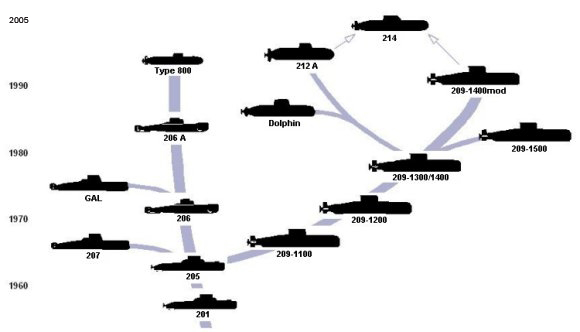
The Israeli AIP Dolphin 2 at just over 2,000 tonnes evolved from the HDW 209 and HDW 212. The HDW 218SG is very similar to the Dolphin 2 in length and beam. See model of the 218SG later revealed.
---


Where will the Type 218SG fit on this HDW submarine tree?
-------------------------

For the latest on Sweden vs Germany see June 11, 2014’s Australia's Future Submarine - Swedish vs German Claims http://gentleseas.blogspot.com.au/2014/06/australias-future-submarine-swedish-vs.html .

After two decades of buying renovated submarines from Kockums Singapore will  buy two new-build submarines designated HDW 218SG. Significantly the 218SGs are from Thyssenkrupp Marine System (TKMS) German submarine division HDW rather than from Kockumss which TKMS also owns. The 218SGs will be built at HDW's shipyard in the northern German port of Kiel.

Singapore's Defence Ministry (Mindef) signed the purchase deal with TKMS on November 29, 2013 to buy two the 218SGs.  The contract was likely to be worth more than 1 billion euros (US$1.36 billion).

In hindsight this website's November 13, 2013 article http://gentleseas.blogspot.com.au/2013/11/germans-sinking-kockums-swedish-sub.html was an indicator that HDW winning the Singapore order was suspected by the Swedish and German media. Singapore's 218SG decision is clearly a blow to Kockums and to Sweden's Navy (which would rely on foreign sales of Kockums subs to lower unit costs of Kockums subs). Unless the Swedish Government or a Swedish firm buys back Kockums Sweden might be forced to buy its future submarines from HDW or at least TKMS owned Kockums. Also link with Saab Being Subsidized to Buy Back Kockums? of March 4, 2014  http://gentleseas.blogspot.com.au/2014/03/saab-being-subsidized-to-buy-back.html .

For Singapore there is some continuity buying customised submarines - from customised Kockums Archer and Challenger Class to customised HDW 218SG class.

I suspect HDW 218SG will be an enlarged evolution of the HDW 209, 212 or 214, perhaps like Israel's HDW built Dolphin 2s. The HDW 218SG may be larger - between 2,000 and 3,000 tons (surfaced) see http://gentleseas.blogspot.com.au/2013/12/the-hdw-218sg-probably-3000-tonne.html . Given the expected 218SG delivery date of 2020 it is unlikely that the 218SG would be radically enlarged to 4,000 tonnes (HDW 216 Class). A 4,000 tonne design would probably take longer than the seven years to develop (2013-2020). Also the 218's purchase price of around US$650 million each implies an existing design rather than a radically new 4,000 ton (surfaced) 216 which would be far more expensive.

The two 218SGs, together with two existing Kockums Archer Class submarines, will replace the four ageing Challenger Class submarines, built in the 1960s and acquired by Singapore in the 1990s, which will be progressively retired from service. This follows Singaporean Defence Minister Ng Hen's comments in March 2013 about Mindef's plan to replace the Challenger submarines.

The 218SG contract includes a logistics package and the training of Singaporean crew in Germany. The 218SGs will have significantly improved capabilities including new build fuel cell Air Independent Propulsion (AIP) which significantly increases a  submarine’s  underwater range and hence reduces the risk of detection.

TKMS indicated Singapore Technologies Electronics, a unit of defence conglomerate Singapore Technologies Engineering Ltd , would co-develop the submarines' tailor-made combat system with Atlas Elektronik GmbH, a joint venture of ThyssenKrupp and European aerospace group EADS. Atlas already builds combat systems for other HDW subs including the Israeli Dolphin Class.
  
Singapore's projected defence budget for 2013 is Sg$12.34 billion (US$9.84 billion) up from 2012's Sg$11.83 billion in 2012. Under Singaporean law all able-bodied men must serve for two years in the military upon turning 18, providing additional manpower on top of the estimated 20,000 regulars. Singapore, surrounded by far larger neighbours has pursued a robust  defence strategy since its complicated split from Malaysia in 1965. In part due to this large neighbour situation Singapore has cemented close relations with the US, Australian and Israeli military for decades.

For some Comments made in September 2009 which envisaged market distortion between HDW and Kockums see this website's earlier article on Singapore's Archer and Challenger Class submarines at http://gentleseas.blogspot.com.au/2009/09/singapore-submarine-development.html .
--------------------------------

 http://www.straitstimes.com/breaking-news/singapore/story/mindef-buys-2-new-submarines-which-will-be-delivered-2020-20131202

http://www.nst.com.my/latest/singapore-to-acquire-two-submarines-from-german-firm-1.419154:

http://in.reuters.com/article/2013/12/02/thyssenkrupp-submarines-idINL5N0JH37T20131202

-
Pete

December 1, 2013

SEA 1000 Continued - Maybe no VLS and no LockMart


So many choices for Vertical Launch Systems (VLS) or broader term Vertical Multi-Purpose Locks (VMPL). Nice to have - adding strategic and tactical flexibility - but very heavy and expensive for a diesel-electric submarine limited to 4,500 tonnes (submerged).
--------------------------

The following is MHalblaub's comment of "Australian SEA 1000 future submaine - an S-80 development or HDW 216?" of November 30, 2013 at http://gentleseas.blogspot.com.au/2013/11/australian-sea-1000-future-submaine-s.html

"Dear Pete,

our view coincide that SEA 1000 is a very ambitious project. Just like the F-35. Ambitious defence projects tend to be delayed and more expensive than expected. In my opinion both projects are far too ambitious.

That any submarine has to use a Lockheed Martin SUBIC combat system will not enhance the development time. The decision to use this combat system is not based on requirements. In my opinion it is only based on cronyism because nobody tried to ask if Australia could get better insight in another system.

A vertical launch system (VLS) is nice to have in case of a real big submarine like the Vertical Multi-Purpose Lock (VMPL) on planed Type 216. You said many missiles could be fired at once from one submarine. My argument is that for one big SEA 1000 submarine at a cost of A$3 billion each Australia could buy 4 small submarines instead with capability to fire even more missiles at once.

For a "piggyback" submarine a VMPL is also unnecessary. A26 or 210mod are planned with a big “torpedo” tube for special purpose. http://www.thyssenkrupp-marinesystems.com/en/hdw-class-210mod.html A smaller submarine can get closer to the shore and the "piggyback" sub doesn’t have to be big.

You have the fear an "interim" sub could become a permanent fix. My fear is that without an interim solution Australia will have no operational submarine in the future. A big submarine even with support by DCNS or HDW and interference by ASC will not be ready before 2030. Navantia is troubled to get the S-80 working. A sole Australian submarine solution might be ready in 2040 (IOC). A small “Off The Shelf” (OTS) solution could be built fast in case no big changes were made to sonar system, command and control system, torpedoes …

I also doubt the claim it would be uneconomic to operate two types of submarines at once. At the moment RAN operates one very uneconomic type of submarine. Does RAN also operate just one type of surface ships because this is more economic? Do you think the F-35 will be the only fighter aircraft for RAAF?

Even with SEA 1000 RAN will operate two types at once for a while. I expect it will be a very unreliable Collins-class with incredible maintenance costs and a troubled SEA 1000 program with many delays.

What about politics? Do you think Australia could use an US built nuclear submarine for any mission without restrictions from Washington? Maybe the best solution would be two or three Virginia-class submarines and a fleet of “cheap” small submarines.

Missile systems:
The seeker system of a Popeye missile was build to hit land targets while the Harpoon was initially built against ships. Therefore I think Israel did use Popeye missiles with a 50 % bigger and better suited warhead.

Regards,
MHalblaub

---------------------

Pete's Response 

Hi MHalblaub

Not only is SEA 1000's plans to develop an Australia only SSK ambitious, expensive and highly risky but Australia's planned future purchase of 100 Lockheed Martin F-35s from around 2016 would frustrate and delay any major expenditure on the SEA 1000 project.

The purchase of a Lockheed Martin submarine combat system may indeed add risk to the SEA 1000 project given Lockheed Martin has established a convincing reputation for over-time and over-budget. The extent of Lockheed Martin's political, hence market, power in the US conquers mere considerations of cost and efficiency.

A Vertical Multi-Purpose Lock (VMPL) (of course with VLS capabilities) may indeed be a heavy luxury that may not bring sufficient benefits. Tomahawks fired from 6 standard horizontal tubes could be achieved quickly.

On mini piggy back subs and diver exit I noticed "The Collins class boats are also capable of supporting special forces teams. In 2005, Collins was fitted with various modifications to support special forces, including exterior shelters for inflatable boats. [HMAS] Dechaineux was modified in 2006, and the other submarines will receive the hatches during their full cycle docking." http://en.wikipedia.org/wiki/Collins-class_submarine#Armament

To avoid what I still see overly problematic options of an interim sub or two SSK designs operating simultaneously the only solution might be to buy a large existing design Off The Shelf. This could be from the most experienced exporters-indigenous build supporters which are DCNS and HDW. In comparison Navantia with its currently troubled S-80 design has comparatively little submarine building experience and no independent sub export or indigenous sub build support experience.

Unfortunately Navantia's problems in themselves might form a sufficient recipe for Navantia's selection by Australia. Our acquisition trend is frequently weighted in favour of choosing under-developed, hence problematic designs like the F-111, then the Collins and now Australia believes itself committed to 100 troubled F-35s.

A DCNS (SSK or SSK transition to SSN) will be considered in following articles as will the Japanese Soryu Class .

Mission restrictions may well be a problem from choosing a US (SSN) or Japanese (SSK) design. But then again the political and strategic advantages of choosing a design from an Asia-Pacific ally like the US and Japan must be factored in.

Regarding Israel's recent use of possible a Harpoon land attack or Popeye missile the issue becomes even more clouded with:

"The Harpoon Block II adds GPS guidance, improved processing that helps it distinguish targets amidst near-shore “clutter,” and land attack features. Harpoon competes with Israel’s own ship-borne Gabriel 3 anti-ship missile external link; Israel’s Navy operates both types," http://www.defenseindustrydaily.com/israel-requests-642m-in-missiles-fuel-03682/

Regards

Pete

November 30, 2013

Australian SEA 1000 future submaine - an S-80 development or HDW 216?


 A rough sketch of the Navantia S-80 submarine. This sub is still being built-developed and might be launched in 2015.
--------------------

Concerning my article of November 22, 2013, "Ongoing debate on Australia's SEA 1000 future submarine requirements." http://gentleseas.blogspot.com.au/2013/11/ongoing-debate-on-australias-sea-1000.html MHalblaub commented:

"Hi Pete,

do you think the US are unreliable allies? That was my thought reading RAN has to shadow a fast going nuclear powered submarine (SNN) for a week. I doubt that there will be within the next 10 years any technique for a conventional submarine to maintain submerged about 20 knots for more than 24 hours. Therefore the only solution would be a SNN, to wait or to trust the US.

I am well aware that the small HDW 210mod falls short of the SEA 1000 requirements. In my eyes these requirements are the wet dreams of some Admirals.

A greater range would be useful. A bigger weapons load is nice to have. The 8+ VLS are also a nice to have but they could also be tube launched. Btw Popeyes in action: http://voiceofrussia.com/news/2013_07_14/Israel-hits-Syria-to-destroy-Russian-made-Yakhont-anti-ship-missiles-3943/

The British Astute-class submarines can also fire Tomahawks without an US combat system.

The problem for Royal Australian Navy will be the gap between Collins-class retirement and entry into service of SEA 1000 submarines. Australia can throw a lot of money after the Collins-class to keep them running until 2030. Today the price for one HDW Type 210 is about the costs Australia needs to maintain Collins-class for one year. The maintenance costs for Collins-class will awfully rise in the future.

My advice would be to order as soon as possible 6 Type 210mod/A 26 to fill this gap. 5 submarines should be built in Australia. That will give Australia time and knowledge to design a proper submarine. This interim solution would also save a lot of money and add capabilities.

Australia should not try to reinvent wheels that already exist in far better quality. E.g. engines, AIP, combat system, … That will lead to a troubled and outdated son of Collins – just like the father.

Regards,
MHalblaub
(I tried two times to log me in …)

AIP: Direct Methanol Fuel Cell: http://www.sfc-defense.com/products

November 22, 2013"

-------------------------
Pete's Comments
My response is that I think the US are reliable allies that provide Australia with security benefits in peacetime and would be an essential ally if Australia faced an enemy too big for Australia to handle alone.

You are right that no non-nuclear propulsion would allow an Australian submarine to shadow a fast moving SSN for a week. And yes the only options are for an Australian SSN or reliance on US SSNs to do fast moving shadowing.

It is true the SEA 1000 requirements are very ambitious. They would require a unique, new, very large diesel-electric submarine (SSK) or an SSN.

The value of a VLS is its flexibility eg. for: a divers wet-dry chamber; a hatch for a mini "piggyback" sub; and to fire cruise or small ballistic missiles. For missile firing the main value of a VLS is the low indiscretion factor - meaning the sub can fire all (say) 8 missiles very quickly - reducing that chance that the sub will be detected while firing. Using horizontal tubes probably involves "slow time" reloads of missiles or of follow-up torpedos.

Regarding http://voiceofrussia.com/news/2013_07_14/Israel-hits-Syria-to-destroy-Russian-made-Yakhont-anti-ship-missiles-3943/ its quite possible Popeyes were not used. The target was in range of Israel's Harpoon SLCMs. It would therefore have been unnecessary for Israel to use its (perhaps) 1,500 km range Popeye SLCMs and there would have been a risk a malfunctioning Popeye would crash and then its technical secrets might be revealed. If the Popeye SLCMs have a 1,500 km range (see http://www.nti.org/analysis/articles/israel-submarine-capabilities/) its more likely they would be used for targets deep inland like Tehran or even Riyadh.

Yes its true the British Astute class SSN is a possibility. However any purchase of a French or UK SSN has the disadvantage that their maintenance-repair bases are around 20,000 km away in Northern Europe or effectively further if the Suez Canal is blocked in wartime. Meanwhile the US provides some SSN maintenance facilities much closer in Diego Garcia, Guam and certainly Pearl Harbour.

The Royal Australian Navy would be very aware that an "interim" sub choice might become permanent. The fixed costs of any sub choice are high - therefore making interim highly uneconomic as would running two different sub types simultaneously.

In any case the HDW 210 is basically the smallest of the HDW range (with the even smaller HDW 206 being phased out). This makes the HDW 210 the least likely HDW Australia might buy. The bigger the better in terms of range and endurance - making a very large version of the HDW 212-214 basically a HDW 800 Dolphin+ the most likely buy from HDW.

An HDW Dolphin+ is on the way to an even larger (but technically and financially high risk)  HDW 216 in response to SEA 1000 requirements. It needs to be remembered though that the US (Lockheed Martin) may well not make its highly developed combat system available to HDW. Against this HDW is probably the world's most experienced and productive builder of conventional diesel-electric subs.

In contrast I understand Lockheed Martin is placing its combat system into the Spanish Navantia S-80. It is significant that Australia might have confidence in dealing with Navantia in submarine development because I believe Australia has a positive relationship with Navantia in the current Canberra LHD and Hobart AWD projects. Against this Navantia has never independently built and then launched an operational submarine. Navantia has also had no independent experience building subs for export or assisting a customer to build a sub

Possibly I'm overrating the importance of the Lockheed Martin SUBICs combat system in the SEA 1000 submarine selection - see http://www.asiapacificdefencereporter.com/articles/193/SEA-1000-COMBAT-SYSTEMS-SELECTION-FOR-SEA-1000 .

While Kockums submarine division's future is in doubt Australia developing an A26 or any other Kockums design is unlikely.

Definitely "Australia should not try to reinvent wheels" and should avoid a repeat of the Collins experience.

I also have had problems logging-in or commenting on some blogger-blogspot sites - probably some technical problem involving blogger-blogspot or even of its Google owner.

Regards

Pete

November 29, 2013

Asia's Gradual Submarine Race


The first of six Russian built Kilo 636 subs for the Vietnamese Navy delivered to Vietnam in November 2013, 2,350 tons surfaced-4,000 tons submerged but no AIP.
-------------------------


 for the US Navy Institute has written a fairly comprehensive article:
 http://news.usni.org/2013/11/13/asias-submarine-race of November 13, 2013 concerning Asia's steadily developing submarine race.

"Asia’s Submarine Race"   
               

"Last week’s delivery of the improved Kilo-class submarine Ha Noi to the government of Vietnam was just the latest undersea-vessel acquisition of Asian navies. Asia is in the midst of a submarine buying spree, with most of the major powers planning substantial fleet increases over the next two decades. Two countries, Malaysia and Vietnam, have recently acquired their first submarines while a third, Thailand, is pushing to purchase its first submarines in the near future.

The trend to submarines reflects the desire of Asian countries to protect their recently acquired wealth and enduring economic interests. Much of Asia is dependent on open sea lanes to keep export-driven economies humming, and a recognition of the importance of sea power is driving a general naval expansion throughout the region.
Another, more ominous driver is the recent uptick in territorial disputes in Asian littorals, particularly those driven by China. China’s claim of the so-called “Cow’s Tongue” in the South China Sea brings it into conflict with the territorial claims of Taiwan, the Philippines, Vietnam, Malaysia, and Brunei. Meanwhile the Senkaku/Diaoyu islands in the East China Sea are claimed by China, Japan and Taiwan.
China
Fueled by a strong economy, the Chinese navy is making strides in development of a multifaceted
submarine force. One goal of Chinese submarines is to create an anti-access/area denial zone up to what it refers to as the First Island Chain, consisting of the Kuril Islands, Japan, Taiwan, and the South China Sea. The chain represents the absolute minimum to defend the Chinese mainland.
The second goal would be to enforce China’s claims on the East and South China Seas. Patrols and presence missions in the waters surrounding those areas would help press these claims.
The Chinese navy is replacing the single Xia-class (092) ballistic missile submarine with up to six modern Jin-class (094) ballistic missile submarines. Each Jin-class displaces 9,000 tons submerged and is equipped with a dozen JL-2 submarine-launched ballistic missiles. The JL-2 is estimated to have a range of 7,200 kilometers (4,475 miles) and capable of carrying up to eight nuclear warheads.
The three submarines of the Shang class (093) represent the second generation of Chinese nuclear attack submarines, the previous Han class having been a technical disappointment. Displacing 6,000 tons submerged, the Shang class features six bow-mounted 533mm torpedo tubes. Built with Russian assistance, only three ships were produced, suggesting the class was less than successful. Yet another class (095) is believed to be under development.
China also operates a range of diesel electric submarines. Nine submarines of the Yuan class (041) and the 14 of the smaller Song class (039) represent the indigenously produced fleet. Yuan-class ships displace up to 2,400 tons submerged, while the slightly smaller Song boats rate 2,200 tons submerged. Both are equipped with six bow-mounted 533mm torpedo tubes.
China also operates ten improved Kilo submarines purchased from Russia, and earlier this year placed an order for another four Lada-class subs. That latest order, despite production of the Yuan class, suggests dissatisfaction with the performance of the latter.
Russia
The Russian Pacific Fleet reflects the decline of the former Soviet navy’s submarine forces, even more so than the rest of the Russian navy. All of the submarines of the Pacific Fleet were built in the 20th century, with a good number constructed in the 1980s.
Four Borey-class ballistic missile submarines will be assigned to the Pacific Fleet in the future, replacing the fleet’s single Delta III submarine. Submarines of the Borey class displace 19,400 tons submerged and are equipped with six 533mm bow-mounted torpedo tubes and 16 SS-N-32 Bulava submarine-launched ballistic missiles. Development of the Bulava has been problematic, with nearly half of test launches ending in failure.
Four Oscar-class guided-missile submarines serve with the Pacific Fleet. Each displaces 14,500 tons submerged and carries 24 SS-N-19 anti-ship missiles. Torpedo armament is in the form of four 533mm and four 650mm bow-mounted torpedo tubes capable of firing SS-N-16 Stallion and SS-N-15 Starfish anti-submarine missiles, guided torpedoes, and Shkval supercavitating torpedoes.
The bulk of the Pacific Fleet’s submarine force lies in its attack submarines—four nuclear powered Akula-I, each displacing more than 8,000 tons submerged. Armament consists of four 533mm and four 650mm bow-mounted torpedo tubes, capable of launching SS-N-21 Sampson land-attack missiles, SS-N-15 anti-submarine missiles, torpedoes, and mines.
Finally, there are seven Kilo-class diesel-electric submarines, including three improved Kilo submarines. The Kilo-class displaces 3,100 tons submerged, and features six 533mm torpedo tubes capable of launching either SS-N-15s or torpedoes. The ship can alternately carry up to 24 mines, or a mixture thereof.
India

India’s submarine fleet, which faces both Pakistan and China, is in an increasingly precarious position. Indian submarines are growing older as plans to replace them become tangled in bureaucratic red tape, and both of India’s potential enemies’ submarine fleets grow larger and increasingly sophisticated.
India has launched its first ballistic missile submarines, the Arihant. [Possibly] Based on the Russian Akula nuclear attack submarine design, the Arihant-class features a 10-meter plug to accommodate four vertical launch silos equipped with K-15 Sagarika ballistic missiles. The 6,500-ton submerged submarine also features six 533mm torpedo tubes capable of launching torpedoes or Klub anti-ship missiles. At least three Arihant-class submarines are projected.
India also retains one Akula-1 submarine, INS Chakra, in conventional attack submarine configuration. Displacing 9,100 tons submerged, torpedo armament is identical to the Arihant class. Originally built for the Russian navy as the Nerpa, it suffered from quality control problems and a 15-year construction period. The ship is currently on a ten-year lease to India.
In addition to nuclear submarines, India operates a fleet of ten Kilo-class Russian submarines, the oldest of which is 30 years old. One submarine, Sindhurakshak, exploded in port earlier this year and was a total loss. A plan to build six submarines of the Scorpene class—1,700 ton ships equipped with torpedoes and Exocet missiles—has been repeatedly delayed because of bureaucratic and technical problems.
Pakistan
Pakistan’s sole adversary at sea is India. Pakistan maintains five submarines of the French Agosta class: two are of the original Agosta class built in the 1970s, while the other three are of the modernized Agosta 90B class. The three Agosta 90B submarines displace between 1,760 and 2,010 tons submerged, are equipped with four 533mm bow-mounted torpedo tubes capable of firing torpedoes and Exocet missiles. By 2014 all three will feature an air-independent propulsion system, making them among the most sophisticated submarines in Asia.
Japan
Japan recently declared an intent to boost its submarine fleet from 16 to 22 ships. Production of the Soryu-class diesel electric submarines continues with last week’s launch of Kokuryu (“Black Dragon”). Eight Soryu-class submarines will be built, the last of which was laid down this year. At 4,200 tons submerged, the Soryu class is one of the few regional submarines to feature air independent propulsion, technology acquired from Sweden. Armament is in the form of six 533mm torpedo tubes capable of launching Type 89 homing torpedoes and Sub Harpoon missiles.
Rounding out Japan’s submarine fleet are the 11 submarines of the Oyashio class. At 3,600 tons submerged, armament is identical to that of the Soryu class. It is not clear how Japan intends to grow its submarine fleet, but for the near future that fleet will likely include the Soryu class, the Oyashio class, and the three remaining ships of the Harushio class, 2,750 ton ships with armament identical to the other classes. The oldest Harushio submarine is only 19 years old, the average age at which Japanese subs are retired, but a time when diesel electric submarines in other navies are usually still in service.
Japan’s submarine fleet will increase its ability to create an anti-access / area denial force of its own. The Chinese Navy has regularly sortied through the Miyako Strait, the shortest route between the Eastern Fleet’s headquarters and the Western Pacific. Japanese submarines, backed up by surface and air assets, would make Chinese transit of the straits a difficult proposition.
Australia
Australia’s submarine force lies in the six ships of the Collins class. At 3,300 tons submerged, the ships are theoretically some of the most advanced diesel-electric submarines in existence, with advanced sensors and excellent performance submerged. Six bow-mounted torpedo tubes are capable of firing U.S. Mk-48 ADCAP torpedoes and Sub Harpoon anti-ship missiles.
The Collins class has been beset with problems since the lead ship entered service. Software problems, hydrodynamic flow problems, cracked propellers, engine and gearbox seal problems, and periscope vibration have all contributed to a low operational readiness rate for the submarines. At one point in 2009 only one submarine, HMAS Farncomb, was rated capable of sea duty. That is expected to improve to four submarines capable of sea duty by early 2014.
In 2009 the Australian government called for replacing the six ships of the Collins class with a dozen submarines of an advanced design. The new design likely will be either an evolution of the Collins design or something new, and will be built in Australian shipyards. In the meantime the Collins class will continue to serve, with upgrades, until at least 2030.
Singapore
Sitting astride the southern approach to the Strait of Malacca, Singapore is in close proximity to one of the most important shipping lanes in the world. Singapore has two submarines of the Archer class, submarines originally built for the Swedish navy. Although up to 25 years old, the Archer class was extensively refitted, including the addition of air-independent auxiliary engines. Each Archer class submarine displaces 1,600 tons submerged and has six bow-mounted 533mm torpedo tubes and three bow-mounted 400mm torpedo tubes. The ships also are capable of carrying up to 22 mines in external portable containers.
Singapore additionally has four submarines of the Centurion class. Also Swedish in origin, the Centurion boats were built in the late 1960s but remain in excellent condition when retired. At 1,400 tons submerged, each packs four 533mm and two 400mm bow-mounted torpedo tubes.
North Korea
The North Korean economy did not adjust well to the fall of the Soviet Union, and its navy, the service with the lowest priority in terms of resources, has particularly undergone hard times. Since then North Korea has begun constructing submarines of less than 500 tons, one of which sank the Republic of Korea Navy corvette Cheonan in 2010.
Originally the mainstay of the North Korean submarine force, the 20 Soviet-designed, Chinese-built Romeo-class diesel electric submarines are slowly being phased out in favor of the Sang-O class of coastal submarines. Up to 40 Sang-O-class ships have been produced. The Sang-O class displaces 325 tons submerged, is equipped with four 533mm torpedo tubes, and can carry up to 16 mines. At least some ships of the class are unarmed infiltration submarines designed to ferry North Korean special forces. A lengthened version, the K-300, was identified in 2011.
North Korea also operates up to 10 midget submarines of the Yono class. At 130 tons submerged, featuring two 533mm torpedo tubes, it is believed to be the type of submarine responsible for the sinking of South Korean Cheonan.
South Korea
Like the rest of the Republic of Korea Navy, the submarine force is in a period of expansion and is expected to double over the next 20 years. The current force consists of nine Type 209 submarines, built in both Germany and South Korea. The Type 209s displace 1,300 tons submerged and are equipped with four bow-mounted 533mm torpedo tubes capable of firing torpedoes and laying mines. Some ships in the class are capable of firing Sub Harpoon.
In addition to the Type 209s, a force of nine Type 214 submarines is also under construction, with three completed. At 1,800 tons submerged the 214s are heavier than their predecessors and carry twice as many torpedo tubes, all of which will be capable of firing Sub Harpoon.
A future submarine program, KSX-III, envisions nine submarines of 3,000 tons entering service around 2020.
Taiwan
Taiwan has four aging diesel-electric submarines — the oldest of which are of World War II vintage. Taiwan for some time has expressed a desire to find a replacement, but has been unable to find submarine producing countries that are willing to defy Chinese political pressure. The only potential provider of submarines, the United States, does not build diesel-electric submarines.
Vietnam
In April 2009 Vietnam signed a deal with Russia for six new so-called “Improved Kilo” (Project 636) submarines for $1.8 billion. The six diesel electric submarines will be the first Vietnamese submarines in service. Displacing 4,000 tons submerged, the Ha Noi class mounts six 533mm torpedo tubes capable of launching torpedoes or SS-N-27 (“Klub”) anti-ship missiles. The first of the six submarines, Ha Noi, was delivered to Vietnam on 7 November. The last of the boats is scheduled for delivery by 2016. Up to 50 mines may be carried as an alternative to torpedoes and missiles, an important area-denial capability.
Indonesia
The Indonesian navy’s submarine inventory currently consists of two aging submarines of the German Type 209 class, Cakra and Naggala. The submarines displace 1,400 tons submerged, have eight bow mounted torpedo tubes, and the option to lay mines. Both are over 30 years old and despite repeated refits are currently out of service awaiting upgrades. Daewoo of South Korea was contracted to modernize Cakra, which was supposed to be completed by 2013.
Indonesia’s Defense Strategic Plan 2024 calls for a fivefold increase in the number of submarines over the next 11 years. Toward that end Indonesia has ordered three modified Type 209 submarines, to be built in both South Korea and Indonesia. The 1,600 ton vessels will feature eight 533mm torpedo tubes, capable of launching a mixture of torpedoes and mines. The submarines will begin entering service in 2015, with all three completed by 2018.
Malaysia
Malaysia recently completed purchase of its first two submarines, the Scorpene-class vessels Tunku Abdul Rahman, and Tun Razak. At 1,740 tons submerged, the submarines have six 533mm torpedo tubes, capable of firing Black Shark homing torpedoes and Exocet anti-ship missiles. The submarines are not fitted with an air-independent propulsion system, but the boat’s design makes an option for future installation.
The submarines were built by the French defense contractor DCNS and Spain’s Navantia. Tunku Abdul Rahman had problems early on with her cooling system and was unable to dive, but those issues are thought to have been solved. The two submarines were purchased, along with training, for $1.1 billion. Crews for the submarines were trained locally, on board the retired French navy submarine Quessant.
Thailand
Thailand does not own any submarines, but it is laying the groundwork for a future fleet. A submarine fleet headquarters at Sattahip Naval Base will be completed in 2014. Thailand has sent officers to attend submarine training in Germany and South Korea, and will also soon complete construction of a Submarine Command Team Trainer. The Thai Ministry of Defense proposed purchasing six used Type 209 submarines from Germany in 2011, but the sale was canceled."