Showing posts with label VMPL. Show all posts

April 16, 2015

South Korean Submarines, 3,000+ ton KSS-III, Nuclear Potential

See detail on possible South Korean nuclear submarine technology in redded KSS-N sub-heading below.

One of South Korea's (international convention of just "Korea" now used) nine Chang Bogo class (KSS-Is). Korea is completing a sale of three to Indonesia.
---

One of Korea's four Son Won-Il class (KSS-IIs) in commision - five to go. Larger than the KSS-I and AIP equipped. Looks like a pre-launch ceremony. 
---

With the KSS-III being described as a "3,000 tonne submarine" for a decade the above dimensions (very similar to the single hull Collins) may be accurate. The "3,000 t" would be surfaced displacement.
---

A larger KSS-III? If its length is really 83.5 m and breadth/beam 7.7 m, then compared with the Collins (77.4 m, 7.8 m) the KSS-III's displacement appears to be around 3,400 tonnes (surfaced) and 3,800 tonnes (submerged). There are many other variables in estimating displacement of course! Other possibilities are that the above is a "4,000 t" nuclear KSS-N? or 83.5 is propaganda to equal the Soryu's 84 m length.
---

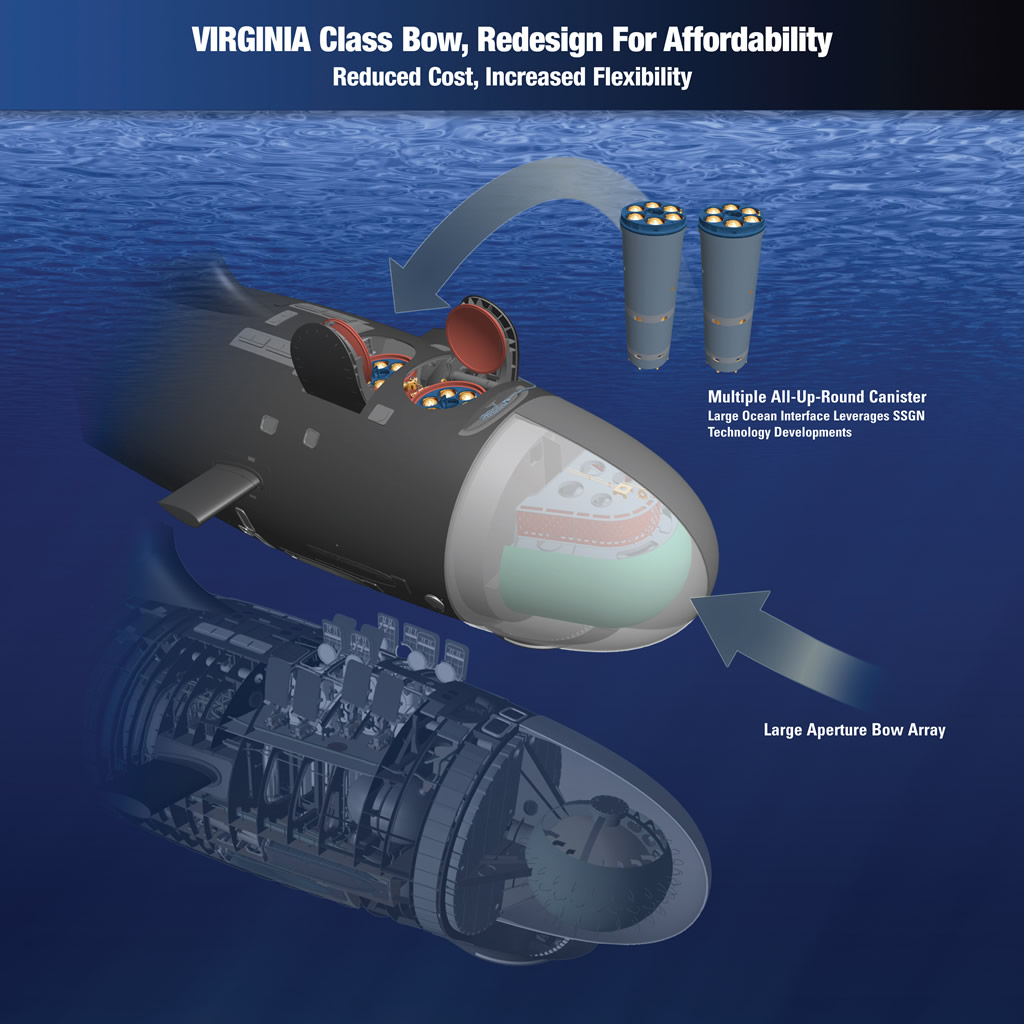
Another model of what the KSS-III may turn out like. It appears to have 6 VLS hatches but a 6 missile Vertical Multi Purpose Lock (VMPL) is more likely.
---

South Korea (international convention of just "Korea" now used) has a long and competitive ship-building tradition. Korea has the world's largest ship-building industry - with 41% of world market share (in first quarter 2015). This has put Korea in a good position to build German TKMS-HDW designed submarines (from kits?) since 1990. Korea has also has submarine export success and is perhaps well prepared to develop a 3,000-4,000 tonne conventional submarine. It faces threats even greater than Japan does - having a land border with North Korea and in much closer proximity to China. The Korean Navy has publicised its creation of a Submarine Command for reasons difficult to discern but perhaps to suggest an eventual capability of a pre-emptive or second strike nuclear deterrent.

South Korea's KSS-I, KSS-II and KSS-III building program suggest a goal of having a rolling average of at least 18 submarines operational and perhaps 22 to match Japan's medium term goal. The so-called "indigenous" submarine (KSS-III) project may still draw heavily on TKMS-HDW technology but "indigenous" also provides ambiguity if Korea needs to develop KSS-III into a nuclear propelled submarine "KSS-N" possibly nuclear armed. 

South Korea's strategy includes the creation of a pre-emptive strike "kill chain" (of threat detection, decision making-authorisation and (mainly missile) pre-emptive strike) against North Korea. Submarines would be a (or the) principal pre-emptive strike and counter-strike platform. Subsonic cruise missiles are generally too slow for these roles - making supersonic+ cruise and ballistic missiles the logical solution.


Used South Korean has two Dolgorae class mini submarines (above) launched 1990 and 1991, 175 tons, with two small 410mm torpedo tubes. They have crews of 14 and may be used for surveillance and perhaps special forces. They were acquired by South Korea to obtain initial experience with the basics of operating a submarine force and to train surface ASW ships in the detection of subs.

In 2011 South Korea indicated it would be building new mini-subs, known as KSS-500As, weighing 510 tons. They may operate only on Lithium-ion Batteries and diesel engines. 

KSS-Is and KSS-IIs

Korea's navy operates:

- 9 Chang Bogo class (KSS-I), a variant of the TKMS-HDW type 209/1200. In 2011 Daewoo Shipbuilding & Marine Engineering (DSME) won a contract to supply Indonesia with two pre-assembled Chang Bogos (to be delivered probably in 2016-2017) with a third Chang Bogo to be assembled in Indonesia (perhaps the beginning of an indigenous Indonesian production line!). The 9 KSS-Is have been regularly upgraded which may extend their service life past the usual 30 years. A major future upgrade may be Lithium-ion batteries fully or partly replacing lead-acid batteries - although such a retrofit may be very difficult. See NTI document for names of specific, commissioned KSS-Is and KSS-IIs up to 2011.

-  4 Son Won-Il class (KSS-II) as at April 2015. Five more are due to be commissioned by 2020. These are variants of the TKMS-HDW Type 214 submarines. Hyundai Heavy Industries (HHI) built the first three (commissioned 2007-2009). DSME, HHI and STX Offshore & Shipbuilding are alternately building the second batch of six with one of the six commissioned in December 2014 and the final one due to be commissioned in 2018. Like the KSS-Is the KSS-IIs carry some US built Harpoon missiles for anti-ship and possibly land attack. Like the KSS-Is the KSS-IIs are orientated to a surveillance, anti-shipping, anti-submarine and (a short range) land attack capability. 

KSS-III, 3,000-4,000 tonne Design - Conventional and Potentially Nuclear  

There will be eventually 9 (KSS-III) 3,000-4,000 tonne submarines See the 3rd and 4th pictues above that contain varying dimentions attributed to the KSS-III (also called "DSX-3000") which indicate its surfaced displacement may be anywhere between 3,000 and 3,400 tonnesDSME will be the main designer. The lead KSS-III boat began development in November 2014 at DSME's submarine yard at Okpo. It my be a major step forward in utilising Lithium-ion Batteries (LIBs). The second batch of KSS-IIIs (especially if they use new technology LIBs) may take 8 years to build and launch (2024) and then 3 years to commission (about 2027). 

The larger size of the KSS-III will permit it to include some of the latest submarine technologies, including:

- large diameter unmanned underwater vehicles (LDUUVs)
- Seal/diver delivery vehicles (SDVs)
- dry-wet cells for special forces in dinghies/divers/Seals
- VLS or more probably the major advance of Vertical Multi Purpose Lock (VMPL) capable of launching 1,500+ km cruise and Harpoon missiles,, VMPLs are also capable of launching LDUUVs and SDVs. 

As well as retaining fuel cell (or less likely Stirling) AIP, KSS-IIIs could also incorporate features from the TKMS-HDW Dolphin 2 including the large rudder system and reinforced hull bottom which allow such a large SSK to operate in shallow, littoral waters. Also Germany's TKMS-HDW could provide assistance using features from the so-far drawing board only HDW 216 (intended to be a 3,000+ tonne design). 

One additional reason Korea is going the indigenously developed submarine route is that international political pressure on Germany would probably prevent Germany from openly assisting South Korea to develop the KSS-III in the medium-long term into a nuclear propelled KSS-N submarine, possibly armed with nuclear weapons.

The capability to use Tomahawk or indigenous Hyunmoo-3 series cruise missiles of 1,500+ km (far longer than the 140 km range KSS-I/KSS-IIs UGM-84 Harpoons) potentially makes the KSS-III much more effective against such additional threats as China and Russia. The future KSS-IIIs may also be capable of firing ballastic missiles.

The US may have been politically unwilling to supply the Tomahawk to Korea. Instead Korea appears to have incorporated many of Tomahawk's features into the Hyunmoo-3 series. By building an indigenous missile, warhead ambiguity is introduced. Korea is one of those countries (like Japan) that could develop a nuclear weapon in less than a year. Miniaturisation may be a major hurdle but a Hyunmoo-3 (or other cruise missiles) could trade range to achieve a heavier warhead than 500 kg.

KSS-III could best be described as multi-purpose. For a medium sized navy like Korea's KSS-IIIs (or KSS-Ns) could combine some of the capabilities that larger navies cover more comprehensively with distinctly different types, such as SSKs, SSNs, SSGNs and SSBNs. 

KSS-N, a Nuclear Development of the KSS-III? 

Korea appears to have long maintained an option of a KSS-N (also called KSSX-N and SSX) 4,000+ ton nuclear propelled development of the KSS-III. On past plans see Globalsecurity.com reportHowever to date any plan has not occurred due to pressure from all of Korea's neighbours, US opposition and the necessity of building an indigenous submarine rather than a submarine that heavily relies on a foreign country (Germany). Also a nuclear propelled Korean submarine would diminish any chance that North Korea would remove/destroy its nuclear weapons and ballistic missiles. Korea might develop the KSS-N submarine if threats against it sufficiently increase and/or US military support diminishes.

Korea has long and extensive experience building nuclear power reactors - mostly large but still useful in any future development of submarine reactors. Interestingly DSME (as at April 2015) appears to be designing a "nuclear propulsion [surface] ship". This would have the legitimate purpose of meeting market demand for nuclear propelled, very large, ice-breaking, oil and LNG tankers. This activity also provides dual-use potential for submerged nuclear propulsion. 

In terms of an actual reactor technology path the Korea Atomic Energy Research Institute (KAERI) is also operating and further developing a small 100 MW ("SMART") pressurised water reactor with a output (at least) that may suite a 4,000 ton KSS-N. The SMART reactor's main current weakness is that it uses 5% enriched Uranium (U) 235 providing a poor power to size/weight ratio. 5% means SMART presently needs three year (overly frequent) refueling. Korea probably could legitimately develop the SMART at a higher (ice breaker surface ship) U enrichment percentage to make it much more useful as a submarine reactor. Korea has been seeking IAEA-US permission to develop a greater U enrichment capability but has been blocked. Although at a small amount-laboratory level Korea has a proven Uranium enrichment ability.

So Korea's indigenous submarine (KSS-III) program is well worth watching for its potential.

I'll do an article on North Korea's submarine situation in the future.

More Sources


Pete

August 11, 2014

Toward Stealth and Sea Denial: Submarine Modernization in East Asia

What technology might Singapore's 218SGs incorporate: fuel cell or Stirling AIP, Vertical Multi-Purpose Lock (VMPL) or Lithium-ion batteries? (Diagram courtesy of Globalsecurity)

The following is another excellent article* by Michael Raska, Research Fellow, Institute of Defence and Strategic Studies, S. Rajaratnam School of International Studies (RSIS), Nanyang Technological University, Singapore. The article details competition involving ever larger, more numerous and more capable submarines in Northeast and Southeast Asia. 

I maintain that Australia will need to respond to this strategic submarine competition be acquiring a new class of larger SSKs or more prudently SSNs. This is in recognition that only SSNs can perform all the roles required of a modern submarine force. 

Michael Raska's article was published by RSIS on July 7, 2014 in html at http://www.rsis.edu.sg/rsis-publication/idss/toward-stealth-and-sea-denial-submarine-modernization-in-east-asia/#.U-gpBPmSySo and also in pdf at


Toward Stealth and Sea Denial: Submarine Modernization in East Asia


IDSS / RSIS / Commentaries / East Asia and Asia Pacific / International Politics and Security / Maritime Security
07 JULY, 2014
DOWNLOAD


RSIS Commentary No. 130/2014

"Synopsis

An important aspect of the regional “arms competition” in East Asia is the gradual introduction of new classes of conventionally-powered diesel-electric submarines (SSKs), which are increasingly becoming “platforms of choice” – as force-multipliers in diverse missions as well as against superior forces.

Commentary

Notwithstanding East Asia’s economic growth rates and deepening integration into the global economy, the region’s strategic realities reflect contending trajectories. As China expands its national interests in the broader context of “new historic missions”, it seeks to regain a great power status and reassert its geopolitical role in the region. As a result of China’s accelerating military modernization, regional powers are responding by revamping their force modernization priorities, alliances, and overall strategic choices.

The economic, political, and military rise of China, embedded in three decades of relentless Chinese economic growth, has propelled progressive modernization of the Chinese military with major improvements in virtually every capability domain.

China’s Naval Modernization and Submarine Expansion


Notwithstanding weaknesses and limitations in capabilities integration, China’s PLA Navy (PLAN) is gradually transforming toward a regional [blue water] defensive and offensive type navy with extended so-called anti-access/area-denial (A2/AD) capabilities, limited expeditionary capabilities, and corresponding defensive and offensive air power. China calls its comprehensive A2/AD strategy a “counter-intervention”, which is interpreted as denying the U.S. and its allies the freedom of action in China’s ‘near seas’ by restricting their deployments into theatre (anti access) and denying them freedom of movement there (area denial).

An important aspect of China’s multilayered strategy is the gradual introduction of new classes of submarines – both nuclear and conventional. China is currently operating as many as 45 submarines structured in six different classes: two classes of indigenously designed diesel submarines, including the Song class (Type 039) and the Yuan-class (Type 041), and four nuclear classes that include the Shang-class (Type 093), Jin-class (Type 094) nuclear powered ballistic missile submarines (SSBN) and the follow-on Type 095 nuclear-powered attack submarine (SSN) and Tang-class (Type 096) SSBN.
Since 2004, China is believed to have launched 12 Type 041 Yuan-class conventional submarines, which have been progressively modified to carry more advanced high-frequency sonar, upgraded weapons systems, noise reduction and air independent propulsion (AIP) technologies. The PLA Navy may procure up to 20 additional Yuan-class submarines based on technologies imported from Russian boats. Since the mid-1990s, China has procured as many as 12 Kilo-class submarines from Russia, and is reportedly negotiating the purchase of at least four fourth-generation Amur (Lada)-class or possibly a fifth-generation Kalina-class, both featuring advanced AIP systems.

Regional Responses


In Northeast Asia, Japan and South Korea are prioritizing the procurement of new types of submarines. In September 2013, South Korea launched a fourth 1,800 ton Son Won-ill class (German Type 214) submarine, featuring AIP and combat management systems. South Korea now operates 13 submarines: nine Type 209 Chang Bogo and four Son Won-ill class submarines. Meanwhile, in October 2013, the Japan Marine Self Defense Force (MSDF) launched its newest submarine the Kokuryu – the sixth of planned ten Soryu class boats first commissioned in 2009. With its range, endurance, sensors, weapons load and other systems, including the Stirling AIP propulsion system and Harpoon anti-ship missiles, the Soryu class is regarded as the most advanced in Japan’s conventional submarine fleet of 16 submarines.

In Southeast Asia, the relatively high acquisition costs and maintenance requirements have traditionally precluded a quantitative diffusion of submarines. However, the recent introduction of more capable coastal diesel-powered submarines provides unprecedented capabilities. Most recently, Vietnam received two of six Kilo-class (Project 636) diesel-electric submarines from Russia in 2013- 2014, designed for diverse reconnaissance and patrol, anti-submarine and anti-ship missions.

Indonesia, Malaysia, and Singapore are also planning to expand or upgrade their submarine fleets. From 2007-09, Malaysia took formal delivery of two French-built Scorpene-class submarines, equipped with underwater-launched Exocet anti-ship missiles. Both submarines are based at the Kota Kinabalu Naval Base in Sabah, East Malaysia, indicating their primary mission to protect Malaysia’s sovereignty in part of South China Sea. Meanwhile, Indonesia has ambitious plans to expand its submarine fleet to at least six, and ideally to 12 by 2024, a key element in the “Minimum Essential Force” (MEF) and declared goal of developing a ‘green-water’ navy. In 2012, the Indonesian Navy (TNI-AL) announced a US$1.1 billion contract for three Type-209/1400 diesel-electric submarines, constructed by South Korea’s Daewoo Shipbuilding and Marine Engineering.

In November 2013, Singapore announced a contract with German shipbuilder ThyssenKrupp to acquire two advanced Type-218SG submarines that will augment existing Archer-class boats and replace ageing ex-Swedish Challenger-class by 2020. Type-218SG, designed for littoral, shallow sea operations, is a customized design that will integrate features from Type 214 and possibly Type-216 ‘concept submarine’ fitted with fuel-cell AIP system. [Pete's Comment - the atypical 218 designation might also suggest that the 218s might be fitted with Stirling engine AIP in line with the Stirlings already incorporated into Singapore's two Archer class subs.]

Strategic Ramifications


Over the past decade, the operational utility of submarines in East Asia has widened: from anti-submarine warfare to force protection such as close submarine escort missions, intelligence surveillance, and reconnaissance (ISR), support of Special Forces, and other complementary deterrence and defensive tasks supporting territorial defense. At the same time, the introduction of submarine-launched anti-ship and land-attack cruise missiles, anti-submarine sensors and weapons, as well as air independent propulsion systems have increased their stealth capacity to remain undetected shortened their target-identification-and-attack cycle, and ultimately, improved their flexibility, mobility, endurance, reach, and lethality.

For smaller, defensively-oriented navies in East and Southeast Asia, these attributes enable “sea-denial” capabilities aimed at preventing an opponent from using the sea, rather than providing a degree of sea control to use the sea for own power projection. Submarines will therefore become an increasingly valuable strategic asset in the region, particularly with installed AIP systems. The key difference, however, will be in the experience, training, and skill set of its operators."

Michael Raska's earlier submarine article appeared on this blog on July 31, 2014 as Air Independent Propulsion - A Game Changer .

July 11, 2014

Australia may select Japanese Submarine

The Maritime Executive (MAREX) reported, July 9, 2014 that http://www.maritime-executive.com/article/Australia-Inches-Closer-to-Japanese-Submarine-Deal-2014-07-09 : 


July 09, 2014

Australia Inches Closer to Japanese Submarine Deal

Australian Defence Minister David Johnston hailed the signing on Wednesday of an agreement with Japan as “an important milestone”. The agreement will deepen bilateral defense science and technology cooperation.


Australia’s Prime Minister Tony Abbott and Japan’s Prime Minister Shinzo Abe signed the agreement in Canberra during Abe’s visit to Australia. “This is an important milestone in the Australia-Japan defense relationship, and an integral part of the broader efforts to strengthen our strategic partnership,” said Johnston.


The agreement will facilitate deeper bilateral defense technology cooperation, and the first project will be the Marine Hydrodynamics Project, an important topic in relation to designing a submarine’s hull to ensure its low noise, stealth capabilities and to improve propulsive efficiency. 


The sharing may not be all one-sided. Scientists from Australia have invented sound-absorbing hull and mast tiles that absorb the radio-wave pings sent out by searching sonar sets. Japan is also said to be interested in radar technology developed in Australia that has proved to be effective at shooting down incoming supersonic missiles.


Currently the Japanese constitution prevents that country from taking military defensive action on behalf of allies, but Abe is looking to change that to allow for the concept of “collective self-defense”. Consequently, allies might be more inclined to assist Japan if needed. Australia and Japan have already agreed to work together on submarine design, and this change in policy is viewed as contributing to a growing alliance between the countries. 


Australia may ask Japan for help in designing a new class of submarine or may consider buying complete submarines from Japan. Australia’s previous government had promised to build 12 submarines in Adelaide for a total cost of around $40 billion, the country’s most expensive defense project. However, the Abbott government, elected in September last year, may downsize that and is said to be considering other options.


Of-the-shelf European submarines have been rejected in the past for being too small and lacking in range for Australian conditions, so Japan’s Soryu class are now an attractive prospect given the willingness of Japan to engage with Australia on the project.


“The language being used is unprecedented in terms of speaking of the special relationship, the depth and breadth of the friendship and their preparedness to share sensitive information with us,” Australia’s minister for foreign affairs, Julie Bishop told The Australian.


However, Australia still claims to be in discussions with other countries including Germany, France, the US and Britain. “This is not the only option available to us at this stage. It’s one of a number,” Johnston says.


The ability of any Japanese submarines bought by Australia to operate with the US fleet of nuclear submarines will be a significant factor. Any new Australian submarines are likely to include the same combat system and [US Mark 48] torpedoes as the US Virginia-class nuclear-powered attack submarines and near-silent propellers developed in the US.


If Australia bought foreign off-the-shelf submarines it would be a serious setback for the local shipbuilding industry. However, after delays and cost overruns in the Air Warfare Destroyer project, the government has already chosen to build a new series of naval supply ships in either Spain or South Korea." ENDS

PETE's COMMENT

Note that Japan in the next few years plans to develop a new generation submarine to start replacing the current Soryu's by the 2030s. What the Soryu's probably don't have (vertical multi-purpose locks (VMPLs)? Lithium-ion batteries?) - which Australia probably wants - might be incorporated into Japan's next generation submarine. 

Pete

December 6, 2013

The HDW 218SG - 2,000-4,000 tonne submarine [proved to be 2,000-2,200 tonnes]

Diagram of HDW 216 arrangement. A 2,000 to 4,000 tonne HDW 218SG submarine (same as or smaller than a HDW 216) would have long range for Asia-Pacific conditions. The design would include greater diesel and battery capacity, AIP and possibly a vertical multi-purpose lock (VMPL) permitting vertical launch capabilities. A horizontal lock, in place of 2 torpedo tubes, might provide be an alternative to a VMPL.
-------------------------

Note - the predictions in this 2013 article proved to be wrong (it happens!). When Singapore's Type 218SG was launched on February 18, 2019 its weight proved to be 2,000 tonnes (surfaced) and 2,200 tonnes (submerged) with no reported unusual innovations (like a VMPL).

This article follows on from earlier article http://gentleseas.blogspot.com.au/2013/12/singapore-buying-two-hdw-218sg.html announcing Singapore's December 2, 2013, decision to buy two HDW 218SG subs. The HDW 218SG might be a 3000 to 4,000 tonne submarine - for the following reasons:

  • HDW is increasingly reliant on its Asia-Pacific customer base. Asia-Pacific customers need longer range submarines and other features such as land attack missile capability. In terms of size this signifies a evolution from below 2,000 tonne HDW 212/214 subs built mainly for European (Baltic, Arctic Ocean, North Atlantic) conditions to a 2,000+ tonne design (see below) for Asia-Pacific (Indian and Pacific Oceans) conditions.

  • TKMS-Kockums already has experience in helping to design considerably larger than the European size. That experience is in building the 3,000 tonne Collins Class. TKMS bought Kockums not only to remove Kockums as a competitor to HDW but to utilise Kockums' experience, workforce, technology and design information - including the process of building a  larger submarine.
  • HDW is developing the 2,000+ to 4,000 tonne, 218 (Asia-Pacific) design not only for Singaporean but for the Australian, Canadian and Indian markets. 
  • The 218SG build schedule (for launch around 2019 - 2021) coincides with South Korea's building schedule (from 2018) for its planned 3,000 tonne submarine the KSS-III (D-3000). South Korean subs to date have heavily relied on HDW 209  (KSS-I) and HDW 214 (KSS-II) designs. This pattern suggests that the 3,000 KSS-III will also be supported by HDW design work despite South Korea's claims of a wholly "indigenous" KSS-III design.
  • A 2,000 to 4,000 tonne submarine could incorporate heavier battery, increased diesel oil and large  AIP capacity for increased Asia-Pacific range requirements.  Advice here is "the 218SG will have 240-320kw PEM fuel cell AIP (offering 22-30 days at 5 kts)".  Heavier batteries can also allow longer range submerged operation with higher discretion (non-snorkel use) rates against (mainly) Chinese sensor platforms. 
  • A 2,000 to 4,000 tonne submarine would also have the range to permit Singaporean use of refuelling-replenishment bases belonging to its US and Australian allies. Such bases include Diego Garcia, Guam, Pearl Harbor and Rockingham (Australia).

Conclusions

The HDW 218SG is most probably designed for long-range Asia-Pacific conditions, all requiring a 2,000 - 4,000 tonne displacement. SG signifies a subset of HDW 218 customized for Singaporean conditions - including air-conditioning for tropical weather, hull-anechoic coating optimized for warmer sea use and a Singaporean-specialized combat system. The HDW 218SG probably represents HDW's latest export submarine design for launch around 2018 and first delivery around 2020.

The designation 218 (neither 214 nor 216) provides uncertainty over the 218's features and weight. This uncertainty provides advantages for Singapore's national security and commercial-competitive secrecy for HDW. HDW would also wish to avoid any mid-build headlines like those experienced by Navantia over the S-80 - see the S-80's weight problems at http://gentleseas.blogspot.com.au/2012/06/australias-future-submarine-selection-s.html .

By not specifying the 218's weight this also permits flexibility in balancing desirable features, within Singapore's expected tonnage parametres, without politicized assumptions. Development of a 218SG somewhere in the 2,000 - 4,000 weight range also may have implications for HDW's likely tendering for Australia's future submarine SEA 1000 project.

Pete

December 1, 2013

SEA 1000 Continued - Maybe no VLS and no LockMart


So many choices for Vertical Launch Systems (VLS) or broader term Vertical Multi-Purpose Locks (VMPL). Nice to have - adding strategic and tactical flexibility - but very heavy and expensive for a diesel-electric submarine limited to 4,500 tonnes (submerged).
--------------------------

The following is MHalblaub's comment of "Australian SEA 1000 future submaine - an S-80 development or HDW 216?" of November 30, 2013 at http://gentleseas.blogspot.com.au/2013/11/australian-sea-1000-future-submaine-s.html

"Dear Pete,

our view coincide that SEA 1000 is a very ambitious project. Just like the F-35. Ambitious defence projects tend to be delayed and more expensive than expected. In my opinion both projects are far too ambitious.

That any submarine has to use a Lockheed Martin SUBIC combat system will not enhance the development time. The decision to use this combat system is not based on requirements. In my opinion it is only based on cronyism because nobody tried to ask if Australia could get better insight in another system.

A vertical launch system (VLS) is nice to have in case of a real big submarine like the Vertical Multi-Purpose Lock (VMPL) on planed Type 216. You said many missiles could be fired at once from one submarine. My argument is that for one big SEA 1000 submarine at a cost of A$3 billion each Australia could buy 4 small submarines instead with capability to fire even more missiles at once.

For a "piggyback" submarine a VMPL is also unnecessary. A26 or 210mod are planned with a big “torpedo” tube for special purpose. http://www.thyssenkrupp-marinesystems.com/en/hdw-class-210mod.html A smaller submarine can get closer to the shore and the "piggyback" sub doesn’t have to be big.

You have the fear an "interim" sub could become a permanent fix. My fear is that without an interim solution Australia will have no operational submarine in the future. A big submarine even with support by DCNS or HDW and interference by ASC will not be ready before 2030. Navantia is troubled to get the S-80 working. A sole Australian submarine solution might be ready in 2040 (IOC). A small “Off The Shelf” (OTS) solution could be built fast in case no big changes were made to sonar system, command and control system, torpedoes …

I also doubt the claim it would be uneconomic to operate two types of submarines at once. At the moment RAN operates one very uneconomic type of submarine. Does RAN also operate just one type of surface ships because this is more economic? Do you think the F-35 will be the only fighter aircraft for RAAF?

Even with SEA 1000 RAN will operate two types at once for a while. I expect it will be a very unreliable Collins-class with incredible maintenance costs and a troubled SEA 1000 program with many delays.

What about politics? Do you think Australia could use an US built nuclear submarine for any mission without restrictions from Washington? Maybe the best solution would be two or three Virginia-class submarines and a fleet of “cheap” small submarines.

Missile systems:
The seeker system of a Popeye missile was build to hit land targets while the Harpoon was initially built against ships. Therefore I think Israel did use Popeye missiles with a 50 % bigger and better suited warhead.

Regards,
MHalblaub

---------------------

Pete's Response 

Hi MHalblaub

Not only is SEA 1000's plans to develop an Australia only SSK ambitious, expensive and highly risky but Australia's planned future purchase of 100 Lockheed Martin F-35s from around 2016 would frustrate and delay any major expenditure on the SEA 1000 project.

The purchase of a Lockheed Martin submarine combat system may indeed add risk to the SEA 1000 project given Lockheed Martin has established a convincing reputation for over-time and over-budget. The extent of Lockheed Martin's political, hence market, power in the US conquers mere considerations of cost and efficiency.

A Vertical Multi-Purpose Lock (VMPL) (of course with VLS capabilities) may indeed be a heavy luxury that may not bring sufficient benefits. Tomahawks fired from 6 standard horizontal tubes could be achieved quickly.

On mini piggy back subs and diver exit I noticed "The Collins class boats are also capable of supporting special forces teams. In 2005, Collins was fitted with various modifications to support special forces, including exterior shelters for inflatable boats. [HMAS] Dechaineux was modified in 2006, and the other submarines will receive the hatches during their full cycle docking." http://en.wikipedia.org/wiki/Collins-class_submarine#Armament

To avoid what I still see overly problematic options of an interim sub or two SSK designs operating simultaneously the only solution might be to buy a large existing design Off The Shelf. This could be from the most experienced exporters-indigenous build supporters which are DCNS and HDW. In comparison Navantia with its currently troubled S-80 design has comparatively little submarine building experience and no independent sub export or indigenous sub build support experience.

Unfortunately Navantia's problems in themselves might form a sufficient recipe for Navantia's selection by Australia. Our acquisition trend is frequently weighted in favour of choosing under-developed, hence problematic designs like the F-111, then the Collins and now Australia believes itself committed to 100 troubled F-35s.

A DCNS (SSK or SSK transition to SSN) will be considered in following articles as will the Japanese Soryu Class .

Mission restrictions may well be a problem from choosing a US (SSN) or Japanese (SSK) design. But then again the political and strategic advantages of choosing a design from an Asia-Pacific ally like the US and Japan must be factored in.

Regarding Israel's recent use of possible a Harpoon land attack or Popeye missile the issue becomes even more clouded with:

"The Harpoon Block II adds GPS guidance, improved processing that helps it distinguish targets amidst near-shore “clutter,” and land attack features. Harpoon competes with Israel’s own ship-borne Gabriel 3 anti-ship missile external link; Israel’s Navy operates both types," http://www.defenseindustrydaily.com/israel-requests-642m-in-missiles-fuel-03682/

Regards

Pete