Showing posts with label HDW 218SG. Show all posts

April 27, 2015

Singapore's Submarine Service - from Sweden to Germany

A Dolphin 2 under construction in Kiel, Germany. Note complex rudder for tight turns in tight spots. Note the hard looking underbody for taking scrapes and sitting on the bottom (of the Malacca Strait)?
---

Inside view of a Dolphin 2. Might Singapore's 218SGs look like this? 
---

Singapore has worked closely with Sweden over two decades to build up a relaunched, but efficient, submarine service to meet Singapore's (presumably) short distance needs. Due to a uncharacteristically shortsighted Swedish decision in 1999 to sell its submarine builder to its German competitor this Swedish-Singaporean relationship appears to be gradually drawing to a close.

Singapore is maintaining a fleet of four operational submarines with the retirement of two of its older Challenger class submarines, RSS Challenger and RSS Centurion on March 11, 2015.

Singapore's submarine service now consists of:

RSS Conqueror (Challenger class) launched 1967, relaunched 1999 - in semi-service to 2021? 
- RSS Chieftain (Challenger class) launched 1968, relaunched 2001 - in semi-service to 2022?

- RSS Archer (Archer class
- RSS Swordsman (Archer class)

All four submarines were built by Sweden's Kockums, were formerly in the Swedish Navy and will be replaced by (eventually four) German built TKMS-HDW 218SGs. This Swedish to German change directly followed Sweden's error in selling Kockums to HDW. Kockums was returned too late
 to Swedish (Saab) control in 2014 to avert the loss of new Singaporean business to Germany (TKMS-HDW). 

It remains unclear what the two TKMS-HDW 218SGs, when handed over to Singapore in 2020-2022, will most resemble - 212s, 214s, 216s or Dolphin 2s? The 218s will probably feature fuel-cell AIP and perhaps Lithium-ion batteries permitting an endurance of eleven weeks of which four weeks might be continuously submerged. They may also have a land attack capability and eventually Seal Delivery Vehicles and Large Diameter UUVs for surveillance in the shallows.

To pack all these features in a 218 would suggest a heavier sub than the Archer class (1,400 tonnes  surfaced) perhaps as heavy as the 2,000 tonne (surfaced) Dolphin 2. As the combined price of the 218s is less than US$2 Billion perhaps they are not as radically new as my 2014 prediction of a 3,000 tonne submarine?

Pete

May 23, 2014

Australia's Future Submarines - Some Considerations

A MOTS solution for Australia's future submarine?

For the latest on Sweden vs Germany see June 11, 2014’s Australia's Future Submarine - Swedish vs German Claims http://gentleseas.blogspot.com.au/2014/06/australias-future-submarine-swedish-vs.html . It is unclear whether Germany or Sweden hold the strongest intellectual property rights to the Stirling AIP.

Australia's future submarine decision making process is at the very basic stage of what do we want, when and why? Concerning when? - the usual complex decision making cycle will mean the first of the new submarines will probably be launched on or after 2030 the last in about 2040. The six or more submarines will have the usual thirty year operating life meaning they will be with us until 2070.

It was assumed that such basic issues had been ironed out under the previous Labor government. However Australia new (since September 2013) Coalition Government claims nothing has been resolved other than  the future submarine will be: conventional diesel-electric; probably larger than the Collins; not necessarily 12 submarines; and the submarines will probably be assembled in Adelaide, South Australia.

The major challenge for the future submarine will be improvements in anti-submarine sensor technology in the operating areas of Australian submarines. Australian submarines would be most vulnerable to detection if they were on the surface. Surface movement might have been possible in World War Two, but today surface movement would be too detectable even at night. This is due to the increasing presence of efficient sensors on satellites, ships, UAVs, fixed undersea arrays and manned aircraft. Diesel electric submarines must "snort" for short periods - that is suck in air while the submarine is close to the surface. The air is used principally to drive the diesel engines to recharge the batteries. The period of the snorting process (known as the "indiscretion rate") renders the submarine vulnerable to detection by many types of sensors because the snorkel must be run on the surface, the submarine is running shallow and the diesel engines are relatively noisy when running. 

Longer periods and longer travel distances of quiet operation is thus desirable and likely to be present in Australia's future submarines. The Australian solution might be AIP achieved by Stirling, Fuel Cell or MESMA and/or increased battery capacity (possibly Lithium ion). All these solutions add to the weight and size to the submarine. 

Australia also has to consider the 3,000 km each way transit distances to travel from the major bases at Fleet Base West, Rockingham, Western Australia and Sydney 6,000 km to northern Australian waters. For a conventional submarine to transit those distances quietly takes much longer than SSNs travelling at 30+ knots. Due to secure transit requirements 2,000 ton European theatre submarine designs are inadequate. Hence European MOTS won't meet Australian needs. Japanese MOTS in the shape of the 4,000 tonne Soryu might meet Australian needs. The HDW 216 if it is a sufficiently developed design (perhaps present in Singapore's HDW 218SG) might possibly meet Australia's range-discretion-endurance needs. 

If Australia could select ANY submarine design it would probably be a current US, UK or French SSN MOTS. The most efficient energy source in terms of power to weight and discrete operation is nuclear. This would address Australia's transit speed, range, endurance, and other operational needs (not only in littoral waters) while more compatible with US alliance requirements. However, for Australian domestic political reasons, the nuclear option is banned.

In terms of comparative cost the higher capabilities of nuclear propulsion, along with shorter maintenance rotations, would mean that fewer SSNs would be required - perhaps down to 4 blue-gold crewed SSNs instead of 6-8 single crew SSKs. This may make an SSN force equivalent in cost to a more numerous SSK force. The rising nuclear propulsion capabilities of regional powers, China and India, must also be considered and, to an extent, countered. Japan could also develop nuclear propulsion rapidly.

It has long been envisaged that Australia's future submarines might field Tomahawk cruise missiles for land attack. It is conceivable that during these submarines' operating lives (through to 2070) that the warheads might not all be conventional. It would be risky to entrust Australia's possible future missile arsenal to the limitations of SSK operation.

Pete

January 13, 2014

Southeast Asian States Buying Submarines - Palu Naval Base

The site of Indonesia's developing Palu Naval Base in Central Sulawesi (Celebes). Significantly Palu Naval Base is close to the oil rich Ambalat sea blockclaimed by Indonesia and Malaysia, just east of East Kalimantan.  
------------

In April 2013 Indonesian Navy Chief of Staff Admiral Marsetio (second right), at the developing Palu Naval Base, Palu, Central Sulawesi. Indonesia's three new Chang Bogo class HDW 209 submarines and other vessels will be based at Palu.
-----------  

Australian Emeritus Professor Carl Thayer  has written an interesting article on the buildup of conventional  subs in Southeast Asia. The article, dated January 3, 2014, is at http://thediplomat.com/2014/01/southeast-asian-states-deploy-conventional-submarines/

"Southeast Asian States Deploy Conventional Submarines

On December 31, Vietnamese media reported the delivery of the first Russian Project 636 Varshavyanka-class (enhanced Kilo) conventional submarine to Cam Ranh Bay. The sub was transported from the port of St. Petersburg on the heavy lift vessel Rolldock Sea.
The submarine was accompanied by experts from Admiralty Shipyards in St. Petersburg who will undertake final work before the formal handover ceremonies. The submarine will be named HQ 182 Hanoi. The last of the remaining five Project 636 Varshavyanka-class submarines is expected to be delivered by 2016.
In late November, during the visit of Vietnam’s party Secretary General Nguyen Phu Trong to India, it was announced that India would provide training for up to 500 submarines as part of its defense cooperation program with Vietnam. Training will be conducted at the Indian Navy’s modern submarine training center INS Satavahana in Visakhapatnam. The Indian Navy has operated Russian Kilo-class submarines since the mid-1980s.
The arrival of HQ 182 Hanoi provides a timely reminder that regional navies are embarking on naval modernization programs that increasingly include the acquisition of conventional submarines.
As long ago as 1967 Indonesia became one of the first Southeast Asian countries to acquire an undersea capability when it took delivery of a batch of Soviet Whiskey-class submarines. These were later replaced in 1978 by two West German diesel submarines.
In 2012 Indonesia’s Defense Ministry announced it was planning to expand its submarine fleet to twelve by 2020. Twelve is the minimum number of submarines required to cover strategic choke points or maritime entry passages into the  archipelago.
At present Indonesia has an order for three ["Chang Bogo" class] HDW 209 submarines that are being built in South Korea by Daewoo Shipbuilding and Marine Engineering in cooperation with PT PAL Indonesia. The U-209s are expected to be delivered between 2015 and 2016.
In addition, Indonesia is mulling two options. The first option is to buy and modify used Russian Kilo-class submarines. An Indonesian technical team headed by Navy Chief of Staff Admiral Marsetio will visit Russia this month to inspect the submarines and associated weaponry. It will report on the cost and feasibility of this option.
Indonesian sources report that the Kilo-option is attractive because the submarine can be armed with either the supersonic Yakhont or Klub-S cruise missiles. The latter can be fired underwater and strike surface targets up to 400 kilometers away.
Indonesia’s second option is to purchase new submarines from South Korea. This option is attractive because the new submarines are compatible with existing port infrastructure.
Press reports indicate that Indonesia’s new submarines will be berthed at the recently built Palu Naval Base in Central Sulawesi. These submarines would be able to operate in the deep waters around Indonesia’s eastern islands.
In late November Singapore announced that it had signed a contract for the purchase of two new Type 218SG conventional submarines from ThyssenKrupp Marine Systems in Germany. The sales contract included provisions for servicing and crew training in Germany.
Singapore’s submarines will be outfitted with the Air Independent Propulsion system and are expected to be delivered by 2020. The new submarines will replace four older Challenger-class submarines and will join the two refurbished Archer-class (formerly Swedish Västergötland-class) submarines to form Singapore’s undersea fleet.
Malaysia acquired two two Scorpène-class submarines from France following a contract signed in 2002. The two [Scorpene submarines], RMN Tunku Abdul Rahman and RMN Tun Abdul Razak  entered service in 2007 and 2009, respectively. They are based at Sepanggar, Sabah. In May 2012 Malaysia indicated that any further submarine acquisitions would depend on the availability of funding. That year Malaysia signed a contract for the purchase of a Submarine Escape and Rescue Service vessel to be built in Singapore.
In June 2013, Myanmar Army Chief Senior General Min Aung Hlaing entered into discussions with Russian officials for the purchase of two-Kilo class submarines. That same month it was reported that twenty officers and ratings began basic submarine familiarization and training in Pakistan at its Submarine Training Center PNS Bahadur. These two developments underscore reports that Myanmar intends to crease a submarine force by 2015.
In April 2011 Thailand entered the market for the purchase of two to six decommissioned German Type 206A diesel submarines for $220 million. Weighing in at 500 tonnes submerged displacement, they are among the world’s smallest attack submarines. A change of government in July 2011 and internal differences between the new Defense Minister and the Navy resulted in the expiration of Thailand’s options and the shelving of this project.
In October 2013 it was reported that the Royal Thai Navy will include the purchase of three submarines as part of its next ten-year procurement process. Meanwhile, Thailand has commenced construction of facilities for a submarine training center and base at the Sattahip Naval Base in Chon Buri. This base is expected to be completed in March this year and will be equipped with a Submarine Command Team Trainer.
Last year the Royal Thai Navy sent eighteen officers for a thirty-two week submarine training course in Germany and another ten officers for an eight-week training course in South Korea.
In the early years of the Aquino Administration in the Philippines, submarines were reportedly included on a Department of National Defense “wish list” for procurement under an armed forces modernization program. The acquisition of submarines appears has been quietly dropped.
Within the next five years to a decade, Southeast Asian waters, and the South China Sea in particular, will witness a marked rise in the deployment of conventional submarines by regional states. This will make the South China Sea even more congested.
The acquisition of submarine forces will add a fourth dimension to regional war-fighting capabilities – air, land, sea and sub-surface. Submarines will be able to engage in reconnaissance and intelligence gathering, mine laying, anti-ship warfare and long-range strikes.
There appears to have been very little discussion by naval chiefs among the members of the Association of Southeast Asian Nations (ASEAN) about the implications of this development. At the most basic level, few of the ASEAN countries are equipped to assist one of their submarines in distress. Singapore and Malaysia, however, are the exceptions. In late 2008 Singapore launched the MV Swift Rescue, a submarine support vessel equipped with two Deep Search and Rescue vessels.
Singapore has been at the forefront in promoting cooperation in submarine rescue among regional navies in the event of a misadventure. Agreements have been signed with Australia, Indonesia and Vietnam."
BACKGROUND

Concerning Palu Naval Base sited close to the oil rich Ambalat sea block, off East Kalimantan, claimed by Indonesia and by Malaysia, see the 2009 article Indonesia Gets Apology From Malaysian Navy Over Latest Ambalat Flare Up at http://gentleseas.blogspot.com.au/2009/06/indonesia-gets-apology-from-malaysian.html.
-
Pete

December 6, 2013

The HDW 218SG - 2,000-4,000 tonne submarine [proved to be 2,000-2,200 tonnes]

Diagram of HDW 216 arrangement. A 2,000 to 4,000 tonne HDW 218SG submarine (same as or smaller than a HDW 216) would have long range for Asia-Pacific conditions. The design would include greater diesel and battery capacity, AIP and possibly a vertical multi-purpose lock (VMPL) permitting vertical launch capabilities. A horizontal lock, in place of 2 torpedo tubes, might provide be an alternative to a VMPL.
-------------------------

Note - the predictions in this 2013 article proved to be wrong (it happens!). When Singapore's Type 218SG was launched on February 18, 2019 its weight proved to be 2,000 tonnes (surfaced) and 2,200 tonnes (submerged) with no reported unusual innovations (like a VMPL).

This article follows on from earlier article http://gentleseas.blogspot.com.au/2013/12/singapore-buying-two-hdw-218sg.html announcing Singapore's December 2, 2013, decision to buy two HDW 218SG subs. The HDW 218SG might be a 3000 to 4,000 tonne submarine - for the following reasons:

  • HDW is increasingly reliant on its Asia-Pacific customer base. Asia-Pacific customers need longer range submarines and other features such as land attack missile capability. In terms of size this signifies a evolution from below 2,000 tonne HDW 212/214 subs built mainly for European (Baltic, Arctic Ocean, North Atlantic) conditions to a 2,000+ tonne design (see below) for Asia-Pacific (Indian and Pacific Oceans) conditions.

  • TKMS-Kockums already has experience in helping to design considerably larger than the European size. That experience is in building the 3,000 tonne Collins Class. TKMS bought Kockums not only to remove Kockums as a competitor to HDW but to utilise Kockums' experience, workforce, technology and design information - including the process of building a  larger submarine.
  • HDW is developing the 2,000+ to 4,000 tonne, 218 (Asia-Pacific) design not only for Singaporean but for the Australian, Canadian and Indian markets. 
  • The 218SG build schedule (for launch around 2019 - 2021) coincides with South Korea's building schedule (from 2018) for its planned 3,000 tonne submarine the KSS-III (D-3000). South Korean subs to date have heavily relied on HDW 209  (KSS-I) and HDW 214 (KSS-II) designs. This pattern suggests that the 3,000 KSS-III will also be supported by HDW design work despite South Korea's claims of a wholly "indigenous" KSS-III design.
  • A 2,000 to 4,000 tonne submarine could incorporate heavier battery, increased diesel oil and large  AIP capacity for increased Asia-Pacific range requirements.  Advice here is "the 218SG will have 240-320kw PEM fuel cell AIP (offering 22-30 days at 5 kts)".  Heavier batteries can also allow longer range submerged operation with higher discretion (non-snorkel use) rates against (mainly) Chinese sensor platforms. 
  • A 2,000 to 4,000 tonne submarine would also have the range to permit Singaporean use of refuelling-replenishment bases belonging to its US and Australian allies. Such bases include Diego Garcia, Guam, Pearl Harbor and Rockingham (Australia).

Conclusions

The HDW 218SG is most probably designed for long-range Asia-Pacific conditions, all requiring a 2,000 - 4,000 tonne displacement. SG signifies a subset of HDW 218 customized for Singaporean conditions - including air-conditioning for tropical weather, hull-anechoic coating optimized for warmer sea use and a Singaporean-specialized combat system. The HDW 218SG probably represents HDW's latest export submarine design for launch around 2018 and first delivery around 2020.

The designation 218 (neither 214 nor 216) provides uncertainty over the 218's features and weight. This uncertainty provides advantages for Singapore's national security and commercial-competitive secrecy for HDW. HDW would also wish to avoid any mid-build headlines like those experienced by Navantia over the S-80 - see the S-80's weight problems at http://gentleseas.blogspot.com.au/2012/06/australias-future-submarine-selection-s.html .

By not specifying the 218's weight this also permits flexibility in balancing desirable features, within Singapore's expected tonnage parametres, without politicized assumptions. Development of a 218SG somewhere in the 2,000 - 4,000 weight range also may have implications for HDW's likely tendering for Australia's future submarine SEA 1000 project.

Pete

December 3, 2013

Singapore buying two HDW 218SG submarines - Sweden's loss


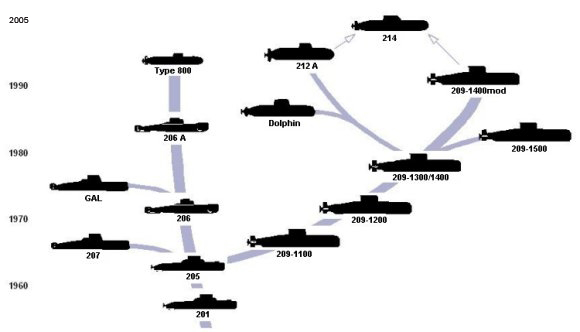
The Israeli AIP Dolphin 2 at just over 2,000 tonnes evolved from the HDW 209 and HDW 212. The HDW 218SG is very similar to the Dolphin 2 in length and beam. See model of the 218SG later revealed.
---


Where will the Type 218SG fit on this HDW submarine tree?
-------------------------

For the latest on Sweden vs Germany see June 11, 2014’s Australia's Future Submarine - Swedish vs German Claims http://gentleseas.blogspot.com.au/2014/06/australias-future-submarine-swedish-vs.html .

After two decades of buying renovated submarines from Kockums Singapore will  buy two new-build submarines designated HDW 218SG. Significantly the 218SGs are from Thyssenkrupp Marine System (TKMS) German submarine division HDW rather than from Kockumss which TKMS also owns. The 218SGs will be built at HDW's shipyard in the northern German port of Kiel.

Singapore's Defence Ministry (Mindef) signed the purchase deal with TKMS on November 29, 2013 to buy two the 218SGs.  The contract was likely to be worth more than 1 billion euros (US$1.36 billion).

In hindsight this website's November 13, 2013 article http://gentleseas.blogspot.com.au/2013/11/germans-sinking-kockums-swedish-sub.html was an indicator that HDW winning the Singapore order was suspected by the Swedish and German media. Singapore's 218SG decision is clearly a blow to Kockums and to Sweden's Navy (which would rely on foreign sales of Kockums subs to lower unit costs of Kockums subs). Unless the Swedish Government or a Swedish firm buys back Kockums Sweden might be forced to buy its future submarines from HDW or at least TKMS owned Kockums. Also link with Saab Being Subsidized to Buy Back Kockums? of March 4, 2014  http://gentleseas.blogspot.com.au/2014/03/saab-being-subsidized-to-buy-back.html .

For Singapore there is some continuity buying customised submarines - from customised Kockums Archer and Challenger Class to customised HDW 218SG class.

I suspect HDW 218SG will be an enlarged evolution of the HDW 209, 212 or 214, perhaps like Israel's HDW built Dolphin 2s. The HDW 218SG may be larger - between 2,000 and 3,000 tons (surfaced) see http://gentleseas.blogspot.com.au/2013/12/the-hdw-218sg-probably-3000-tonne.html . Given the expected 218SG delivery date of 2020 it is unlikely that the 218SG would be radically enlarged to 4,000 tonnes (HDW 216 Class). A 4,000 tonne design would probably take longer than the seven years to develop (2013-2020). Also the 218's purchase price of around US$650 million each implies an existing design rather than a radically new 4,000 ton (surfaced) 216 which would be far more expensive.

The two 218SGs, together with two existing Kockums Archer Class submarines, will replace the four ageing Challenger Class submarines, built in the 1960s and acquired by Singapore in the 1990s, which will be progressively retired from service. This follows Singaporean Defence Minister Ng Hen's comments in March 2013 about Mindef's plan to replace the Challenger submarines.

The 218SG contract includes a logistics package and the training of Singaporean crew in Germany. The 218SGs will have significantly improved capabilities including new build fuel cell Air Independent Propulsion (AIP) which significantly increases a  submarine’s  underwater range and hence reduces the risk of detection.

TKMS indicated Singapore Technologies Electronics, a unit of defence conglomerate Singapore Technologies Engineering Ltd , would co-develop the submarines' tailor-made combat system with Atlas Elektronik GmbH, a joint venture of ThyssenKrupp and European aerospace group EADS. Atlas already builds combat systems for other HDW subs including the Israeli Dolphin Class.
  
Singapore's projected defence budget for 2013 is Sg$12.34 billion (US$9.84 billion) up from 2012's Sg$11.83 billion in 2012. Under Singaporean law all able-bodied men must serve for two years in the military upon turning 18, providing additional manpower on top of the estimated 20,000 regulars. Singapore, surrounded by far larger neighbours has pursued a robust  defence strategy since its complicated split from Malaysia in 1965. In part due to this large neighbour situation Singapore has cemented close relations with the US, Australian and Israeli military for decades.

For some Comments made in September 2009 which envisaged market distortion between HDW and Kockums see this website's earlier article on Singapore's Archer and Challenger Class submarines at http://gentleseas.blogspot.com.au/2009/09/singapore-submarine-development.html .
--------------------------------

 http://www.straitstimes.com/breaking-news/singapore/story/mindef-buys-2-new-submarines-which-will-be-delivered-2020-20131202

http://www.nst.com.my/latest/singapore-to-acquire-two-submarines-from-german-firm-1.419154:

http://in.reuters.com/article/2013/12/02/thyssenkrupp-submarines-idINL5N0JH37T20131202

-
Pete