Showing posts with label Archer Class. Show all posts

April 27, 2015

Singapore's Submarine Service - from Sweden to Germany

A Dolphin 2 under construction in Kiel, Germany. Note complex rudder for tight turns in tight spots. Note the hard looking underbody for taking scrapes and sitting on the bottom (of the Malacca Strait)?
---

Inside view of a Dolphin 2. Might Singapore's 218SGs look like this? 
---

Singapore has worked closely with Sweden over two decades to build up a relaunched, but efficient, submarine service to meet Singapore's (presumably) short distance needs. Due to a uncharacteristically shortsighted Swedish decision in 1999 to sell its submarine builder to its German competitor this Swedish-Singaporean relationship appears to be gradually drawing to a close.

Singapore is maintaining a fleet of four operational submarines with the retirement of two of its older Challenger class submarines, RSS Challenger and RSS Centurion on March 11, 2015.

Singapore's submarine service now consists of:

RSS Conqueror (Challenger class) launched 1967, relaunched 1999 - in semi-service to 2021? 
- RSS Chieftain (Challenger class) launched 1968, relaunched 2001 - in semi-service to 2022?

- RSS Archer (Archer class
- RSS Swordsman (Archer class)

All four submarines were built by Sweden's Kockums, were formerly in the Swedish Navy and will be replaced by (eventually four) German built TKMS-HDW 218SGs. This Swedish to German change directly followed Sweden's error in selling Kockums to HDW. Kockums was returned too late
 to Swedish (Saab) control in 2014 to avert the loss of new Singaporean business to Germany (TKMS-HDW). 

It remains unclear what the two TKMS-HDW 218SGs, when handed over to Singapore in 2020-2022, will most resemble - 212s, 214s, 216s or Dolphin 2s? The 218s will probably feature fuel-cell AIP and perhaps Lithium-ion batteries permitting an endurance of eleven weeks of which four weeks might be continuously submerged. They may also have a land attack capability and eventually Seal Delivery Vehicles and Large Diameter UUVs for surveillance in the shallows.

To pack all these features in a 218 would suggest a heavier sub than the Archer class (1,400 tonnes  surfaced) perhaps as heavy as the 2,000 tonne (surfaced) Dolphin 2. As the combined price of the 218s is less than US$2 Billion perhaps they are not as radically new as my 2014 prediction of a 3,000 tonne submarine?

Pete

March 15, 2015

Australian Defence Department's requirements for Submarine Bidders

Defence Minister Kevin Andrews successfully asserting himself. Graphics courtesy julian winter.
---
Andrews finding it is better to publish strategy papers than respond to media scrums. Photo courtesy Adelaide Advertiser.
---
The high level of controversy regarding Australia's future submarine selection has died down over  the past three weeks due to what I see as:

- Prime Minister Abbott's position is now less threatened. He has not needed to reiterate his "build in Japan" preference. Abbott has also withdrawn himself from other submarine comments and public appearances.

- the removal of Sweden's Saab-Kockums from the submarine competition. Saab's business model appeared to be very much "build in Australia" - a campaign Saab was understandably running in  Adelaide ship building circles. "Build in Australia" was facilitated by Saab having no functioning production line for new submarines in Sweden. In terms of production line the Archer class (RSS Swordsman) was re-launched in 2010 leaving a gap until a build date for the A26s becomes public. Potential customers would be reassured when Saab-Kockums's A26 production plans become known. [Stop Press - since I wrote these A26 comments 24 hours ago - Sweden has published a decision Sweden Orders [A26s] "Sweden is to buy two new submarines from constructors Saab Kockums. The A26 subs are to be delivered by 2022 and will cost up to SEK 8.2 billion ($945 million)" ]

- perhaps the main debate reducer was new Defence Minister Kevin Andrews decision to be  assertive and his issuing of the Strategic direction of the Future Submarine Program (see  below).

The submarine controversy will of course resurface in acrimony but it is quiet at present. Submarine problems effecting relations with Japan will recur when Abbott's popularity in his Party and in public again slides. Doubts about Andrews may start again once the cost overruns and lateness of the Air War Destroyer and other defence embarrassments again hit the news.

A defence novice but with years of experience in several ministries Andrews is much wedded to defining the strategy and policy environment of major policy initiatives and programs. Hence he  delegated the task of writing a major paper Strategic direction of the Future Submarine Program for publication. This task probably fell to the Australia Department of Defence, the Navy and probably the Expert Panel writing the Defence White Paper 2015. It is important that the Strategic direction of the Future Submarine Program is consistent with the Defence White Paper (perhaps published around September 2015).

Publishing strategy papers avoids the tendency towards "policy on the run" with many voices issuing  fragmentary and conflicting statements. Strategic direction of the Future Submarine Program below was issued as a Minister for Defence Media Release. It is well worth reading in full - as every part is significant and hopefully well thought out http://www.minister.defence.gov.au/2015/02/20/minister-for-defence-strategic-direction-of-the-future-submarine-program/ :

"Minister for Defence – Strategic direction of the Future Submarine Program

Today the Government announces the acquisition strategy for the Future Submarine Program. This announcement sets out further details of the competitive evaluation process that will be undertaken by the Department of Defence.

Submarines are an essential component of Australia’s naval capability and the Government will ensure that the future submarine provides the best possible capability and value for money for Australian taxpayers while maximising the involvement of Australian industry.

Submarines are the most complex, sensitive and expensive Defence capability acquisition a Government can make.

Australia’s national security and $1.6 trillion economy depend on secure sea lanes. We need the best possible submarine to protect our trade and support our maritime security.

It must be delivered in time to avoid a capability gap in the mid-2020s when the Collins Class submarine is scheduled to be retired from service. The decisions we make on the Future Submarine Program will determine what kind of capability we have to defend Australia and Australian interests into the 2040s and beyond.

The process outlined by the Government today provides a pathway for Australian industry to maximise its involvement in the program, whilst not compromising capability, cost, program schedule or risk.

The Government expects that significant work will be undertaken in Australia during the build phase of the future submarine including combat system integration, design assurance and land based testing. This will result in the creation at least 500 new high-skill jobs in Australia, the majority of which will be based in South Australia.

The Future Submarine Program is the largest Defence procurement program in Australia’s history and represents an investment in the order of $50 billion in Australia’s security. These costs will be subject to refinement through the competitive evaluation process. A significant proportion of this investment will be spent in Australia during the lifetime of the future submarine.

Successive governments have used various kinds of competitive evaluation processes for major Defence capability procurements.

As part of this competitive evaluation process, the Department of Defence will seek proposals from potential partners for:
a) Pre-concept designs based on meeting Australian capability criteria;
b) Options for design and build overseas, in Australia, and/or a hybrid approach;
c) Rough order of magnitude (ROM) costs and schedule for each option; and
d) Positions on key commercial issues, for example intellectual property rights and the ability to use and disclose technical data.

In addition to this – and on the advice of Defence – the Government has endorsed a set of key strategic requirements for our future submarines:
a) Range and endurance similar to the Collins Class submarine;
b) Sensor performance and stealth characteristics that are superior to the Collins Class submarine; and
c) The combat system and heavyweight torpedo jointly developed between the United States and Australia as the preferred combat system and main armament.

Defence advises that for Australian industry to have the best opportunity to maximise their involvement in the Future Submarine Program, it needs to work with an international partner.
Based on work completed by Defence, France, Germany, and Japan have emerged as potential international partners. All three countries have proven submarine design and build capabilities and are currently producing submarines.

France, Germany and Japan will be invited to participate in this competitive evaluation process that will assess their ability to partner with Australia to develop a Future Submarine that meets our capability requirements.

The Department of Defence will invite potential international partners to seek opportunities for Australian industry participation in the Future Submarine Program.

The competitive evaluation process will help the Government balance important considerations including capability, cost, schedule, and risk. Interoperability with our alliance partner, the United States, will also be a fundamental consideration.

The competitive evaluation process will take around ten months, after which an international partner will be selected for Australia’s Future Submarine Program. Further details about Australian industry involvement are also expected to be known at that point.

The competitive evaluation process will ensure that capability, cost, schedule, and key strategic considerations, along with Australian industry involvement, are carefully and methodically considered, and avoid unnecessary delays to the Future Submarine Program.

The Department of Defence will soon be holding industry briefings to inform Australian industry about the process and how they can engage with potential international partners.

An expert advisory panel will also be appointed to oversee the competitive evaluation process. Further details about this will be announced once individual appointments are confirmed." ENDS

Pete

January 13, 2014

Southeast Asian States Buying Submarines - Palu Naval Base

The site of Indonesia's developing Palu Naval Base in Central Sulawesi (Celebes). Significantly Palu Naval Base is close to the oil rich Ambalat sea blockclaimed by Indonesia and Malaysia, just east of East Kalimantan.  
------------

In April 2013 Indonesian Navy Chief of Staff Admiral Marsetio (second right), at the developing Palu Naval Base, Palu, Central Sulawesi. Indonesia's three new Chang Bogo class HDW 209 submarines and other vessels will be based at Palu.
-----------  

Australian Emeritus Professor Carl Thayer  has written an interesting article on the buildup of conventional  subs in Southeast Asia. The article, dated January 3, 2014, is at http://thediplomat.com/2014/01/southeast-asian-states-deploy-conventional-submarines/

"Southeast Asian States Deploy Conventional Submarines

On December 31, Vietnamese media reported the delivery of the first Russian Project 636 Varshavyanka-class (enhanced Kilo) conventional submarine to Cam Ranh Bay. The sub was transported from the port of St. Petersburg on the heavy lift vessel Rolldock Sea.
The submarine was accompanied by experts from Admiralty Shipyards in St. Petersburg who will undertake final work before the formal handover ceremonies. The submarine will be named HQ 182 Hanoi. The last of the remaining five Project 636 Varshavyanka-class submarines is expected to be delivered by 2016.
In late November, during the visit of Vietnam’s party Secretary General Nguyen Phu Trong to India, it was announced that India would provide training for up to 500 submarines as part of its defense cooperation program with Vietnam. Training will be conducted at the Indian Navy’s modern submarine training center INS Satavahana in Visakhapatnam. The Indian Navy has operated Russian Kilo-class submarines since the mid-1980s.
The arrival of HQ 182 Hanoi provides a timely reminder that regional navies are embarking on naval modernization programs that increasingly include the acquisition of conventional submarines.
As long ago as 1967 Indonesia became one of the first Southeast Asian countries to acquire an undersea capability when it took delivery of a batch of Soviet Whiskey-class submarines. These were later replaced in 1978 by two West German diesel submarines.
In 2012 Indonesia’s Defense Ministry announced it was planning to expand its submarine fleet to twelve by 2020. Twelve is the minimum number of submarines required to cover strategic choke points or maritime entry passages into the  archipelago.
At present Indonesia has an order for three ["Chang Bogo" class] HDW 209 submarines that are being built in South Korea by Daewoo Shipbuilding and Marine Engineering in cooperation with PT PAL Indonesia. The U-209s are expected to be delivered between 2015 and 2016.
In addition, Indonesia is mulling two options. The first option is to buy and modify used Russian Kilo-class submarines. An Indonesian technical team headed by Navy Chief of Staff Admiral Marsetio will visit Russia this month to inspect the submarines and associated weaponry. It will report on the cost and feasibility of this option.
Indonesian sources report that the Kilo-option is attractive because the submarine can be armed with either the supersonic Yakhont or Klub-S cruise missiles. The latter can be fired underwater and strike surface targets up to 400 kilometers away.
Indonesia’s second option is to purchase new submarines from South Korea. This option is attractive because the new submarines are compatible with existing port infrastructure.
Press reports indicate that Indonesia’s new submarines will be berthed at the recently built Palu Naval Base in Central Sulawesi. These submarines would be able to operate in the deep waters around Indonesia’s eastern islands.
In late November Singapore announced that it had signed a contract for the purchase of two new Type 218SG conventional submarines from ThyssenKrupp Marine Systems in Germany. The sales contract included provisions for servicing and crew training in Germany.
Singapore’s submarines will be outfitted with the Air Independent Propulsion system and are expected to be delivered by 2020. The new submarines will replace four older Challenger-class submarines and will join the two refurbished Archer-class (formerly Swedish Västergötland-class) submarines to form Singapore’s undersea fleet.
Malaysia acquired two two Scorpène-class submarines from France following a contract signed in 2002. The two [Scorpene submarines], RMN Tunku Abdul Rahman and RMN Tun Abdul Razak  entered service in 2007 and 2009, respectively. They are based at Sepanggar, Sabah. In May 2012 Malaysia indicated that any further submarine acquisitions would depend on the availability of funding. That year Malaysia signed a contract for the purchase of a Submarine Escape and Rescue Service vessel to be built in Singapore.
In June 2013, Myanmar Army Chief Senior General Min Aung Hlaing entered into discussions with Russian officials for the purchase of two-Kilo class submarines. That same month it was reported that twenty officers and ratings began basic submarine familiarization and training in Pakistan at its Submarine Training Center PNS Bahadur. These two developments underscore reports that Myanmar intends to crease a submarine force by 2015.
In April 2011 Thailand entered the market for the purchase of two to six decommissioned German Type 206A diesel submarines for $220 million. Weighing in at 500 tonnes submerged displacement, they are among the world’s smallest attack submarines. A change of government in July 2011 and internal differences between the new Defense Minister and the Navy resulted in the expiration of Thailand’s options and the shelving of this project.
In October 2013 it was reported that the Royal Thai Navy will include the purchase of three submarines as part of its next ten-year procurement process. Meanwhile, Thailand has commenced construction of facilities for a submarine training center and base at the Sattahip Naval Base in Chon Buri. This base is expected to be completed in March this year and will be equipped with a Submarine Command Team Trainer.
Last year the Royal Thai Navy sent eighteen officers for a thirty-two week submarine training course in Germany and another ten officers for an eight-week training course in South Korea.
In the early years of the Aquino Administration in the Philippines, submarines were reportedly included on a Department of National Defense “wish list” for procurement under an armed forces modernization program. The acquisition of submarines appears has been quietly dropped.
Within the next five years to a decade, Southeast Asian waters, and the South China Sea in particular, will witness a marked rise in the deployment of conventional submarines by regional states. This will make the South China Sea even more congested.
The acquisition of submarine forces will add a fourth dimension to regional war-fighting capabilities – air, land, sea and sub-surface. Submarines will be able to engage in reconnaissance and intelligence gathering, mine laying, anti-ship warfare and long-range strikes.
There appears to have been very little discussion by naval chiefs among the members of the Association of Southeast Asian Nations (ASEAN) about the implications of this development. At the most basic level, few of the ASEAN countries are equipped to assist one of their submarines in distress. Singapore and Malaysia, however, are the exceptions. In late 2008 Singapore launched the MV Swift Rescue, a submarine support vessel equipped with two Deep Search and Rescue vessels.
Singapore has been at the forefront in promoting cooperation in submarine rescue among regional navies in the event of a misadventure. Agreements have been signed with Australia, Indonesia and Vietnam."
BACKGROUND

Concerning Palu Naval Base sited close to the oil rich Ambalat sea block, off East Kalimantan, claimed by Indonesia and by Malaysia, see the 2009 article Indonesia Gets Apology From Malaysian Navy Over Latest Ambalat Flare Up at http://gentleseas.blogspot.com.au/2009/06/indonesia-gets-apology-from-malaysian.html.
-
Pete

December 3, 2013

Singapore buying two HDW 218SG submarines - Sweden's loss


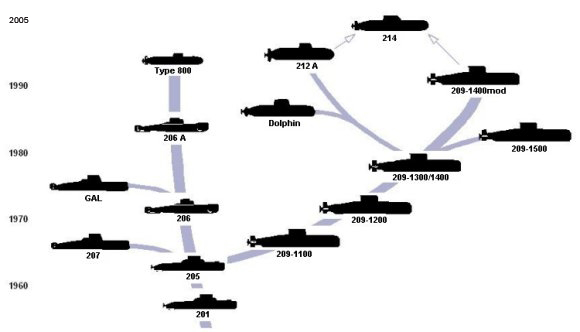
The Israeli AIP Dolphin 2 at just over 2,000 tonnes evolved from the HDW 209 and HDW 212. The HDW 218SG is very similar to the Dolphin 2 in length and beam. See model of the 218SG later revealed.
---


Where will the Type 218SG fit on this HDW submarine tree?
-------------------------

For the latest on Sweden vs Germany see June 11, 2014’s Australia's Future Submarine - Swedish vs German Claims http://gentleseas.blogspot.com.au/2014/06/australias-future-submarine-swedish-vs.html .

After two decades of buying renovated submarines from Kockums Singapore will  buy two new-build submarines designated HDW 218SG. Significantly the 218SGs are from Thyssenkrupp Marine System (TKMS) German submarine division HDW rather than from Kockumss which TKMS also owns. The 218SGs will be built at HDW's shipyard in the northern German port of Kiel.

Singapore's Defence Ministry (Mindef) signed the purchase deal with TKMS on November 29, 2013 to buy two the 218SGs.  The contract was likely to be worth more than 1 billion euros (US$1.36 billion).

In hindsight this website's November 13, 2013 article http://gentleseas.blogspot.com.au/2013/11/germans-sinking-kockums-swedish-sub.html was an indicator that HDW winning the Singapore order was suspected by the Swedish and German media. Singapore's 218SG decision is clearly a blow to Kockums and to Sweden's Navy (which would rely on foreign sales of Kockums subs to lower unit costs of Kockums subs). Unless the Swedish Government or a Swedish firm buys back Kockums Sweden might be forced to buy its future submarines from HDW or at least TKMS owned Kockums. Also link with Saab Being Subsidized to Buy Back Kockums? of March 4, 2014  http://gentleseas.blogspot.com.au/2014/03/saab-being-subsidized-to-buy-back.html .

For Singapore there is some continuity buying customised submarines - from customised Kockums Archer and Challenger Class to customised HDW 218SG class.

I suspect HDW 218SG will be an enlarged evolution of the HDW 209, 212 or 214, perhaps like Israel's HDW built Dolphin 2s. The HDW 218SG may be larger - between 2,000 and 3,000 tons (surfaced) see http://gentleseas.blogspot.com.au/2013/12/the-hdw-218sg-probably-3000-tonne.html . Given the expected 218SG delivery date of 2020 it is unlikely that the 218SG would be radically enlarged to 4,000 tonnes (HDW 216 Class). A 4,000 tonne design would probably take longer than the seven years to develop (2013-2020). Also the 218's purchase price of around US$650 million each implies an existing design rather than a radically new 4,000 ton (surfaced) 216 which would be far more expensive.

The two 218SGs, together with two existing Kockums Archer Class submarines, will replace the four ageing Challenger Class submarines, built in the 1960s and acquired by Singapore in the 1990s, which will be progressively retired from service. This follows Singaporean Defence Minister Ng Hen's comments in March 2013 about Mindef's plan to replace the Challenger submarines.

The 218SG contract includes a logistics package and the training of Singaporean crew in Germany. The 218SGs will have significantly improved capabilities including new build fuel cell Air Independent Propulsion (AIP) which significantly increases a  submarine’s  underwater range and hence reduces the risk of detection.

TKMS indicated Singapore Technologies Electronics, a unit of defence conglomerate Singapore Technologies Engineering Ltd , would co-develop the submarines' tailor-made combat system with Atlas Elektronik GmbH, a joint venture of ThyssenKrupp and European aerospace group EADS. Atlas already builds combat systems for other HDW subs including the Israeli Dolphin Class.
  
Singapore's projected defence budget for 2013 is Sg$12.34 billion (US$9.84 billion) up from 2012's Sg$11.83 billion in 2012. Under Singaporean law all able-bodied men must serve for two years in the military upon turning 18, providing additional manpower on top of the estimated 20,000 regulars. Singapore, surrounded by far larger neighbours has pursued a robust  defence strategy since its complicated split from Malaysia in 1965. In part due to this large neighbour situation Singapore has cemented close relations with the US, Australian and Israeli military for decades.

For some Comments made in September 2009 which envisaged market distortion between HDW and Kockums see this website's earlier article on Singapore's Archer and Challenger Class submarines at http://gentleseas.blogspot.com.au/2009/09/singapore-submarine-development.html .
--------------------------------

 http://www.straitstimes.com/breaking-news/singapore/story/mindef-buys-2-new-submarines-which-will-be-delivered-2020-20131202

http://www.nst.com.my/latest/singapore-to-acquire-two-submarines-from-german-firm-1.419154:

http://in.reuters.com/article/2013/12/02/thyssenkrupp-submarines-idINL5N0JH37T20131202

-
Pete

November 13, 2013

Germans sinking Kockums Swedish sub maker?


For the latest on Sweden-Saab vs TKMS-HDW-Kockums see June 11, 2014’s Australia's Future Submarine - Swedish vs German Claims http://gentleseas.blogspot.com.au/2014/06/australias-future-submarine-swedish-vs.html . It is unclear whether Germany or Sweden hold the strongest intellectual property rights to the Stirling AIP. 

For information about Singapore's December 2, 2013, decision to buy two HDW 218SG subs instead of a Kockums sub at http://gentleseas.blogspot.com.au/2013/12/singapore-buying-two-hdw-218sg.html
------------------------


Very simplified artist's conception of ThyssenKrupp Marine Systems' preferred product - largest sub of the HDW range, the future HDW 216. Note the rotary multi-purpose VLS behind the sail-fin.
----------------

See information about Singapore's December 2, 2013, decision to buy two HDW 218SG subs instead of a Kockums sub at http://gentleseas.blogspot.com.au/2013/12/singapore-buying-two-hdw-218sg.html and Saab Being Subsidized to Buy Back Kockums? of March 4, 2014  http://gentleseas.blogspot.com.au/2014/03/saab-being-subsidized-to-buy-back.html .

The Local ("Germany's News in English") has produced this disturbing October 15, 2013 report about an internal corporate threat to the continued functioning of Kockum's Submarine division.

Whether this downgrades Kockum's continued ability to support its Singaporean-Archer Class and Australian-Collin's Class submarine customers remains to be seen.

Does this put Kockums' future submarine A26  at risk of preventing it from being a contender for Australia's large conventional SEA 1000 future submarine project?

Is Kockums' new parent company (German) ThyssenKrupp Marine Systems giving preferential treatment to its competing German HDW 212-214 and 216 submarine products? Note, concerning submarines, the ThyssenKrupp Marine Systems  website only features the HDW products.

The report in full is below http://www.thelocal.de/national/20131015-52407.html :

"Germans look to sink Swedish sub maker"
15 October 2013
"A German industrial giant is waging a campaign of "internal warfare" against one of its own firms - Sweden's flagship submarine manufacturer Kockums - putting key defence deals at risk, sources have told The Local.
German industrial conglomerate ThyssenKrupp bought Kockums in 2005 to form part of what is known as ThyssenKrupp Marine Systems (TKMS), a firm which also owns German submarine maker HDW, a direct competitor of Kockums.

A source told The Local that the purchase was aimed at getting rid of Germany’s Swedish submarine rival and that TKMS was jeopardizing Swedish export deals for submarines with the Australian and Singaporean governments.

"The purchase of Kockums wasn't aimed at consolidating the naval industry and creating synergies, but at getting rid of a competitor," a source in Germany with direct knowledge of the situation told The Local.

Kockums and its predecessors have been building ships for the Swedish navy for centuries at the Karlskrona shipyard in southern Sweden that now serves as the base of the company's Swedish operations.

But according to a German naval manufacturing consultant with ties to TKMS, ThyssenKrupp is actively trying to sabotage Kockums export operations to the advantage of Germany’s HDW, a strategy he dubbed "TKMS über alles" and slammed as "suicide".

The Germans' efforts to sink Sweden's submarine industry have been ongoing since at least 2011, according to the source, when TKMS CEO Hans Christoph Atzpodien denied Kockums the opportunity to bid on a project in Singapore for the construction of new submarines, despite the Swedish firm's long-standing relationship in the country.

Earlier this year, the German firm decreed that the Swedish shipbuilder officially change its corporate name to ThyssenKrupp Marine Systems, scrapping the Kockums brand name that has been a part of Swedish industry since the early 1800s.

'A raging war is taking place'

In August, during a meeting in Bonn, Germany with officials from Singapore defence agency DSTA held, Atzpodien claimed that Kockums "would no longer be capable of designing and building submarines", according to the source.

"A raging war is taking place between Kockums and TKMS," he said, explaining that the Singapore deal has brought the situation into sharp relief.

Among other things, Atzpodien disparaged Kockums plans for a new A26 class of submarine, claiming the Swedish firm didn't have enough engineers to complete the project, and that it was sure to be plagued with cost overruns and delays.

"Atzpodien has systematically ejected Kockums from the discussions and has barred Kockums from Singapore," the source explained.

TKMS has also complicated Kockums' chances for new contracts in Australia, another country where the Swedish shipbuilder has a strong presence, having designed and built six Collins-class submarines in the 1990s in what was one of the largest export deals ever at the time.

But Kockums found itself left out of a 2012 initial call for proposals from Australia to replace the aging subs with an off the shelf solution, while its German-based competitor and sister company HDW was one of three European firms asked to participate.

Earlier this year, however, Australia and Sweden did ink a deal allowing for Kockums to take part in the project, dubbed SEA 1000, which calls for the building of 12 new submarines.

But in the meantime, TKMS purchased an Australian naval defence firm, Australian Marine Technologies, that "could do the same job as Kockums could have done on its own," the source said.

"TKMS has here again torpedoed all the efforts of Kockums to run this future competition because it has already created its own footprint," the source told The Local.

A Swedish saviour?

The Swedish government, as well as officials with the primary defence procurement agency, the Defence Materiel Administration (FMV), has been made aware of the situation and have become so unhappy they have asked Swedish defence contractor Saab to look into a possible purchase of Kockums, a source within the Swedish defence industry told The Local.

"Discussions are taking place right now," according to the source, who agreed that TKMS is trying to strangle Sweden's ship building industry.

"The only reason TKMS owns Kockums is to stop them from exporting," the Swedish source explained, adding that the Swedish firm "could not exist" without export contracts.

Allan Widman, a Liberal Party (Folkpartiet) MP from Malmö and the party's defence policy spokesman said he is "worried" about Kockum's future in light of the rift with TKMS.

"Submarine building capabilities are essential for our armed forces and our ability to defend ourselves," he told The Local, adding that he had heard a number of "industry rumours" about the discord between TKMS and Kockums.

Adding to his concern is the fact that two years have passed since the Swedish parliament Riksdag approved funding for the development of the A26 submarine for the Swedish navy, but nothing has happened, reportedly due to concerns over ThyssenKrupp's ownership of Kockums.

"I hope Kockums isn't prevented from doing business with other countries. It's not constructive," said Widman, adding he would welcome Swedish ownership for the Karlskrona-based shipbuilder.

"I would have no objection to private Swedish ownership of Kockums," he said when asked about the Saab deal.

However, if the Swedish and German firms can't strike a suitable deal to resolve the situation, Widman said the dispute may require a "political solution".

"This is a matter that's vital to our national security," he said, stressing that he hopes both Germany and Sweden can maintain submarine building capacity.

"In the end, however, it may require a political dialogue between Sweden and Germany to find a suitable solution."

When reached by The Local for comment on the Saab-Kockums negotiations, a Saab spokesman refused to comment.

"We don't speculate on rumours like that," the spokesman said.

A spokesperson with FMV also chose not to comment citing an "ongoing procurement".

A spokesman with Kockums in Sweden also refused to comment on the reported disunity within TKMS, while spokeswoman with TKMS in Germany said the company was "unable to comment on market rumours"."
--------------------------------------

A comment on the above post:

"Anonymous said...
"This is a matter that's vital to our national security," --- So why Kockums was offered to a German company first time? What is the problem for Sweden to buy German submarines like Poland did?

"Earlier this year, however, Australia and Sweden did ink a deal allowing for Kockums to take part in the project, dubbed SEA 1000, which calls for the building of 12 new submarines."
This is quite wrong. The deal was Sweden donated intellectual property rights to Australia.
http://www.aspistrategist.org.au/australia-and-sweden-burying-the-hatchet/
Now Australia tries to build with these rights a new Collins-class on its own - good luck!

The Collins-class disaster was partly related to the inability of Kockums to control the project properly. TKMS owned HDW has much more knowledge with license building of submarines. It worked for South Korea. [South Korea has 9 South Korean derivatives Chang Bogo class of the HDW 209 and 3 derivatives Son Won-il class of the HDW 214]

Why should TKMS allow Kockums to design a new A26 submarine while HDW at the same time works on Type210mod? Would GM allow Opel to design quite the same type of car Holden is working on? [as the number of the HDW 210 suggest it is smaller than the HDW 212-214. Specifically the 6 existing HDW 210 mod are of the Norwegian Navy Ula Class http://www.defenseindustrydaily.com/Ula-Tech-Norways-Next-Submarine-Fleet-07609/ and  http://www.network54.com/Forum/211833/thread/1231528114/HDW+Introduces+Type+210mod+Submarine
]
Kockums makes fine Corvettes like the UK makes fine wings for Airbus. Great Britain will never again produce big passenger aircraft on its own.

How well of is Saab Automobile today without a big company in the background?
November 14, 2013"

Pete's Comment

In addition to preventing Kockums being competitive TKMS acquisition of Kockums provide an opportunity to officially or unofficially shift intellectual property (including A26 design information) from Kockums to HDW?

Does this have an Australian dimension concerning German-HDW access to Collins' confidential design and business details?

Pete