Showing posts with label DSME. Show all posts

April 16, 2015

South Korean Submarines, 3,000+ ton KSS-III, Nuclear Potential

See detail on possible South Korean nuclear submarine technology in redded KSS-N sub-heading below.

One of South Korea's (international convention of just "Korea" now used) nine Chang Bogo class (KSS-Is). Korea is completing a sale of three to Indonesia.
---

One of Korea's four Son Won-Il class (KSS-IIs) in commision - five to go. Larger than the KSS-I and AIP equipped. Looks like a pre-launch ceremony. 
---

With the KSS-III being described as a "3,000 tonne submarine" for a decade the above dimensions (very similar to the single hull Collins) may be accurate. The "3,000 t" would be surfaced displacement.
---

A larger KSS-III? If its length is really 83.5 m and breadth/beam 7.7 m, then compared with the Collins (77.4 m, 7.8 m) the KSS-III's displacement appears to be around 3,400 tonnes (surfaced) and 3,800 tonnes (submerged). There are many other variables in estimating displacement of course! Other possibilities are that the above is a "4,000 t" nuclear KSS-N? or 83.5 is propaganda to equal the Soryu's 84 m length.
---

Another model of what the KSS-III may turn out like. It appears to have 6 VLS hatches but a 6 missile Vertical Multi Purpose Lock (VMPL) is more likely.
---

South Korea (international convention of just "Korea" now used) has a long and competitive ship-building tradition. Korea has the world's largest ship-building industry - with 41% of world market share (in first quarter 2015). This has put Korea in a good position to build German TKMS-HDW designed submarines (from kits?) since 1990. Korea has also has submarine export success and is perhaps well prepared to develop a 3,000-4,000 tonne conventional submarine. It faces threats even greater than Japan does - having a land border with North Korea and in much closer proximity to China. The Korean Navy has publicised its creation of a Submarine Command for reasons difficult to discern but perhaps to suggest an eventual capability of a pre-emptive or second strike nuclear deterrent.

South Korea's KSS-I, KSS-II and KSS-III building program suggest a goal of having a rolling average of at least 18 submarines operational and perhaps 22 to match Japan's medium term goal. The so-called "indigenous" submarine (KSS-III) project may still draw heavily on TKMS-HDW technology but "indigenous" also provides ambiguity if Korea needs to develop KSS-III into a nuclear propelled submarine "KSS-N" possibly nuclear armed. 

South Korea's strategy includes the creation of a pre-emptive strike "kill chain" (of threat detection, decision making-authorisation and (mainly missile) pre-emptive strike) against North Korea. Submarines would be a (or the) principal pre-emptive strike and counter-strike platform. Subsonic cruise missiles are generally too slow for these roles - making supersonic+ cruise and ballistic missiles the logical solution.


Used South Korean has two Dolgorae class mini submarines (above) launched 1990 and 1991, 175 tons, with two small 410mm torpedo tubes. They have crews of 14 and may be used for surveillance and perhaps special forces. They were acquired by South Korea to obtain initial experience with the basics of operating a submarine force and to train surface ASW ships in the detection of subs.

In 2011 South Korea indicated it would be building new mini-subs, known as KSS-500As, weighing 510 tons. They may operate only on Lithium-ion Batteries and diesel engines. 

KSS-Is and KSS-IIs

Korea's navy operates:

- 9 Chang Bogo class (KSS-I), a variant of the TKMS-HDW type 209/1200. In 2011 Daewoo Shipbuilding & Marine Engineering (DSME) won a contract to supply Indonesia with two pre-assembled Chang Bogos (to be delivered probably in 2016-2017) with a third Chang Bogo to be assembled in Indonesia (perhaps the beginning of an indigenous Indonesian production line!). The 9 KSS-Is have been regularly upgraded which may extend their service life past the usual 30 years. A major future upgrade may be Lithium-ion batteries fully or partly replacing lead-acid batteries - although such a retrofit may be very difficult. See NTI document for names of specific, commissioned KSS-Is and KSS-IIs up to 2011.

-  4 Son Won-Il class (KSS-II) as at April 2015. Five more are due to be commissioned by 2020. These are variants of the TKMS-HDW Type 214 submarines. Hyundai Heavy Industries (HHI) built the first three (commissioned 2007-2009). DSME, HHI and STX Offshore & Shipbuilding are alternately building the second batch of six with one of the six commissioned in December 2014 and the final one due to be commissioned in 2018. Like the KSS-Is the KSS-IIs carry some US built Harpoon missiles for anti-ship and possibly land attack. Like the KSS-Is the KSS-IIs are orientated to a surveillance, anti-shipping, anti-submarine and (a short range) land attack capability. 

KSS-III, 3,000-4,000 tonne Design - Conventional and Potentially Nuclear  

There will be eventually 9 (KSS-III) 3,000-4,000 tonne submarines.  See the 3rd and 4th pictues above that contain varying dimentions attributed to the KSS-III (also called "DSX-3000") which indicate its surfaced displacement may be anywhere between 3,000 and 3,400 tonnes. DSME will be the main designer. The lead KSS-III boat began development in November 2014 at DSME's submarine yard at Okpo. It my be a major step forward in utilising Lithium-ion Batteries (LIBs). The second batch of KSS-IIIs (especially if they use new technology LIBs) may take 8 years to build and launch (2024) and then 3 years to commission (about 2027). 

The larger size of the KSS-III will permit it to include some of the latest submarine technologies, including:

- large diameter unmanned underwater vehicles (LDUUVs)
- Seal/diver delivery vehicles (SDVs)
- dry-wet cells for special forces in dinghies/divers/Seals
- VLS or more probably the major advance of Vertical Multi Purpose Lock (VMPL) capable of launching 1,500+ km cruise and Harpoon missiles,, VMPLs are also capable of launching LDUUVs and SDVs. 

As well as retaining fuel cell (or less likely Stirling) AIP, KSS-IIIs could also incorporate features from the TKMS-HDW Dolphin 2 including the large rudder system and reinforced hull bottom which allow such a large SSK to operate in shallow, littoral waters. Also Germany's TKMS-HDW could provide assistance using features from the so-far drawing board only HDW 216 (intended to be a 3,000+ tonne design). 

One additional reason Korea is going the indigenously developed submarine route is that international political pressure on Germany would probably prevent Germany from openly assisting South Korea to develop the KSS-III in the medium-long term into a nuclear propelled KSS-N submarine, possibly armed with nuclear weapons.

The capability to use Tomahawk or indigenous Hyunmoo-3 series cruise missiles of 1,500+ km (far longer than the 140 km range KSS-I/KSS-IIs UGM-84 Harpoons) potentially makes the KSS-III much more effective against such additional threats as China and Russia. The future KSS-IIIs may also be capable of firing ballastic missiles.

The US may have been politically unwilling to supply the Tomahawk to Korea. Instead Korea appears to have incorporated many of Tomahawk's features into the Hyunmoo-3 series. By building an indigenous missile, warhead ambiguity is introduced. Korea is one of those countries (like Japan) that could develop a nuclear weapon in less than a year. Miniaturisation may be a major hurdle but a Hyunmoo-3 (or other cruise missiles) could trade range to achieve a heavier warhead than 500 kg.

KSS-III could best be described as multi-purpose. For a medium sized navy like Korea's KSS-IIIs (or KSS-Ns) could combine some of the capabilities that larger navies cover more comprehensively with distinctly different types, such as SSKs, SSNs, SSGNs and SSBNs. 

KSS-N, a Nuclear Development of the KSS-III? 

Korea appears to have long maintained an option of a KSS-N (also called KSSX-N and SSX) a 4,000+ ton nuclear propelled development of the KSS-III. On past plans see Globalsecurity.com report. However to date any plan has not occurred due to pressure from all of Korea's neighbours, US opposition and the necessity of building an indigenous submarine rather than a submarine that heavily relies on a foreign country (Germany). Also a nuclear propelled Korean submarine would diminish any chance that North Korea would remove/destroy its nuclear weapons and ballistic missiles. Korea might develop the KSS-N submarine if threats against it sufficiently increase and/or US military support diminishes.

Korea has long and extensive experience building nuclear power reactors - mostly large but still useful in any future development of submarine reactors. Interestingly DSME (as at April 2015) appears to be designing a "nuclear propulsion [surface] ship". This would have the legitimate purpose of meeting market demand for nuclear propelled, very large, ice-breaking, oil and LNG tankers. This activity also provides dual-use potential for submerged nuclear propulsion. 

In terms of an actual reactor technology path the Korea Atomic Energy Research Institute (KAERI) is also operating and further developing a small 100 MW ("SMART") pressurised water reactor with a output (at least) that may suite a 4,000 ton KSS-N. The SMART reactor's main current weakness is that it uses 5% enriched Uranium (U) 235 providing a poor power to size/weight ratio. 5% means SMART presently needs three year (overly frequent) refueling. Korea probably could legitimately develop the SMART at a higher (ice breaker surface ship) U enrichment percentage to make it much more useful as a submarine reactor. Korea has been seeking IAEA-US permission to develop a greater U enrichment capability but has been blocked. Although at a small amount-laboratory level Korea has a proven Uranium enrichment ability.

So Korea's indigenous submarine (KSS-III) program is well worth watching for its potential.

I'll do an article on North Korea's submarine situation in the future.

More Sources


Pete

February 20, 2014

Indonesia to build a Chang Bogo Submarine and Uncertainty


Numbers of Attack Submarines in 2009 (orange blocks) and Projected for 2025 (red blocks). Note key Indonesian politicians and admirals project 12 Indonesian submarines by 2025.
--


Model of a DSME Chang Bogo (Type 209) Submarine. Indonesia is buying three from South Korea's DSME. One of  the three will be built at PT PAL’s shipyard at Surabaya, East Java, Indonesia.


PETE'S COMMENT

The Jakarta Post  has reported that Indonesia's third (Improved) Chang Bogo (Type 209) Class submarine (lets call it "Submarine 3") will not be built in South Korea but at PT PAL’s shipyard at Surabaya, East Java, Indonesia. In the Jakarta Post article comments by Indonesia Defense Minister Purnomo Yusgiantoro then carry the possibility that Indonesia's other nine (Submarines 4 to 12) might also be Indonesian built. Please connect with Submarine Matters'  Indonesia Revisits Buying Kilos and Indonesia Decides to By Korean Made. and most recently:

South Korean Submarines, 3,000+ ton KSS-III, Nuclear Potential of April 16, 2014 which comments on Chang Bogo's South Korea has built for its own Navy and for Indonesia.

ARTICLES

The Jakarta Post article, February 18, 2014  http://www.thejakartapost.com/news/2014/02/18/pt-pal-gets-more-funds-build-submarine.html reads:

"PT PAL gets more funds to build submarine 
The Jakarta Post, Jakarta | National | Tue, February 18 2014, 9:54 AM

The House of Representatives’ Commission I has approved the disbursement of US$250 million this year to state-owned shipyard PT PAL to build the country’s first submarine with technical assistance from South Korea.
Commission I deputy chairman TB Hasanuddin said that the construction would start in April.
Indonesia signed a contract in 2011 with Daewoo Shipbuilding and Marine Engineering (DSME) to build three submarines worth some $1.07 billion. Two will be built in Korea while the third will be built in PT PAL’s facilities in Surabaya, East Java.
The contract requires that the work starts in Surabaya by November at the latest otherwise the contract will be void and the third one has to be built in Korea.
“We approved the plan and appointed the Finance Ministry to channel the funding to PT PAL through the State-Owned Enterprise Ministry as bridging finance,” Hasanuddin said in a coordination meeting with several ministries, the Navy and the Army on Monday afternoon.
PT PAL needs the additional capital not only to improve its financial position but also to acquire specialized equipment to build submarines. The company has the capability to build surface ships but not submarines. 
Deputy Finance Minister Bambang Brodjonegoro said the funds would be injected as state capital (PMN) over three years.
He said the government would disburse $180 million this year consisting of $30 million for consultation costs and $150 million for infrastructure. The remaining $70 million is for personnel.
Defense Minister Purnomo Yusgiantoro said that that the PMN would have value-added benefits for the local defense industry, including the ability to meet the need for 12 submarines by the Navy to ensure adequate defense.
Purnomo added that the South Korean technical assistance had begun in 2013, with the sending of Indonesian engineers to that country to learn the techniques of submarine manufacturing.
“The third one will be constructed by 200 Indonesian engineers and under the supervision of DSME,” he said.
“There will be a transfer of technology in this project.”
Previously, Navy chief of staff Adm. Marsetio said that Indonesia currently had two German-made submarines, KRI Cakra and KRI Nenggala, which were built in the 1980s. They will be decommissioned in 2020. (gda/nvn)"

A further Jakarta Post article, February 20, 2014 http://www.thejakartapost.com/news/2014/02/20/local-weapons-ramped.html provides additional information:

"...The work on [Submarine 3] will start in 2015, it is slated for completion in 2018 [probably by 2020, not "2018"]....Despite the order of three submarines from Korea, [Defense Industry Policy Committee (KKIP)] implementation team head, Adm. (ret) Sumardjono said that Defense Minister Purnomo Yusgiantoro had also set a policy to procure Kilo-class submarines from Russia in motion.

“This is a stop-gap measure as we need 12 submarines to safeguard our waters,” he said.”

FURTHER COMMENT

In terms of economies-of-scale its logical that if/when PT PAL and DSME build a Chang Bogo (Submarine 3) in Surabaya that this would be the beginning of a production run of additional Indonesia built Chang Bogos. But Indonesia appears to be encouraging uncertainty through also negotiating with Russia for new or used Kilos. 

In a confusing way Indonesia appears to be seeking better price, credit and commission deals from South Korea (the logical choice for Submarines 4 to 12) and from Russia (perhaps the less likely choice for Submarines 4 to 12). 
Pete

January 13, 2014

Southeast Asian States Buying Submarines - Palu Naval Base

The site of Indonesia's developing Palu Naval Base in Central Sulawesi (Celebes). Significantly Palu Naval Base is close to the oil rich Ambalat sea block, claimed by Indonesia and Malaysia, just east of East Kalimantan.  
------------

In April 2013 Indonesian Navy Chief of Staff Admiral Marsetio (second right), at the developing Palu Naval Base, Palu, Central Sulawesi. Indonesia's three new Chang Bogo class HDW 209 submarines and other vessels will be based at Palu.
-----------  

Australian Emeritus Professor Carl Thayer  has written an interesting article on the buildup of conventional  subs in Southeast Asia. The article, dated January 3, 2014, is at http://thediplomat.com/2014/01/southeast-asian-states-deploy-conventional-submarines/

"Southeast Asian States Deploy Conventional Submarines

On December 31, Vietnamese media reported the delivery of the first Russian Project 636 Varshavyanka-class (enhanced Kilo) conventional submarine to Cam Ranh Bay. The sub was transported from the port of St. Petersburg on the heavy lift vessel Rolldock Sea.
The submarine was accompanied by experts from Admiralty Shipyards in St. Petersburg who will undertake final work before the formal handover ceremonies. The submarine will be named HQ 182 Hanoi. The last of the remaining five Project 636 Varshavyanka-class submarines is expected to be delivered by 2016.
In late November, during the visit of Vietnam’s party Secretary General Nguyen Phu Trong to India, it was announced that India would provide training for up to 500 submarines as part of its defense cooperation program with Vietnam. Training will be conducted at the Indian Navy’s modern submarine training center INS Satavahana in Visakhapatnam. The Indian Navy has operated Russian Kilo-class submarines since the mid-1980s.
The arrival of HQ 182 Hanoi provides a timely reminder that regional navies are embarking on naval modernization programs that increasingly include the acquisition of conventional submarines.
As long ago as 1967 Indonesia became one of the first Southeast Asian countries to acquire an undersea capability when it took delivery of a batch of Soviet Whiskey-class submarines. These were later replaced in 1978 by two West German diesel submarines.
In 2012 Indonesia’s Defense Ministry announced it was planning to expand its submarine fleet to twelve by 2020. Twelve is the minimum number of submarines required to cover strategic choke points or maritime entry passages into the  archipelago.
At present Indonesia has an order for three ["Chang Bogo" class] HDW 209 submarines that are being built in South Korea by Daewoo Shipbuilding and Marine Engineering in cooperation with PT PAL Indonesia. The U-209s are expected to be delivered between 2015 and 2016.
In addition, Indonesia is mulling two options. The first option is to buy and modify used Russian Kilo-class submarines. An Indonesian technical team headed by Navy Chief of Staff Admiral Marsetio will visit Russia this month to inspect the submarines and associated weaponry. It will report on the cost and feasibility of this option.
Indonesian sources report that the Kilo-option is attractive because the submarine can be armed with either the supersonic Yakhont or Klub-S cruise missiles. The latter can be fired underwater and strike surface targets up to 400 kilometers away.
Indonesia’s second option is to purchase new submarines from South Korea. This option is attractive because the new submarines are compatible with existing port infrastructure.
Press reports indicate that Indonesia’s new submarines will be berthed at the recently built Palu Naval Base in Central Sulawesi. These submarines would be able to operate in the deep waters around Indonesia’s eastern islands.
In late November Singapore announced that it had signed a contract for the purchase of two new Type 218SG conventional submarines from ThyssenKrupp Marine Systems in Germany. The sales contract included provisions for servicing and crew training in Germany.
Singapore’s submarines will be outfitted with the Air Independent Propulsion system and are expected to be delivered by 2020. The new submarines will replace four older Challenger-class submarines and will join the two refurbished Archer-class (formerly Swedish Västergötland-class) submarines to form Singapore’s undersea fleet.
Malaysia acquired two two Scorpène-class submarines from France following a contract signed in 2002. The two [Scorpene submarines], RMN Tunku Abdul Rahman and RMN Tun Abdul Razak  entered service in 2007 and 2009, respectively. They are based at Sepanggar, Sabah. In May 2012 Malaysia indicated that any further submarine acquisitions would depend on the availability of funding. That year Malaysia signed a contract for the purchase of a Submarine Escape and Rescue Service vessel to be built in Singapore.
In June 2013, Myanmar Army Chief Senior General Min Aung Hlaing entered into discussions with Russian officials for the purchase of two-Kilo class submarines. That same month it was reported that twenty officers and ratings began basic submarine familiarization and training in Pakistan at its Submarine Training Center PNS Bahadur. These two developments underscore reports that Myanmar intends to crease a submarine force by 2015.
In April 2011 Thailand entered the market for the purchase of two to six decommissioned German Type 206A diesel submarines for $220 million. Weighing in at 500 tonnes submerged displacement, they are among the world’s smallest attack submarines. A change of government in July 2011 and internal differences between the new Defense Minister and the Navy resulted in the expiration of Thailand’s options and the shelving of this project.
In October 2013 it was reported that the Royal Thai Navy will include the purchase of three submarines as part of its next ten-year procurement process. Meanwhile, Thailand has commenced construction of facilities for a submarine training center and base at the Sattahip Naval Base in Chon Buri. This base is expected to be completed in March this year and will be equipped with a Submarine Command Team Trainer.
Last year the Royal Thai Navy sent eighteen officers for a thirty-two week submarine training course in Germany and another ten officers for an eight-week training course in South Korea.
In the early years of the Aquino Administration in the Philippines, submarines were reportedly included on a Department of National Defense “wish list” for procurement under an armed forces modernization program. The acquisition of submarines appears has been quietly dropped.
Within the next five years to a decade, Southeast Asian waters, and the South China Sea in particular, will witness a marked rise in the deployment of conventional submarines by regional states. This will make the South China Sea even more congested.
The acquisition of submarine forces will add a fourth dimension to regional war-fighting capabilities – air, land, sea and sub-surface. Submarines will be able to engage in reconnaissance and intelligence gathering, mine laying, anti-ship warfare and long-range strikes.
There appears to have been very little discussion by naval chiefs among the members of the Association of Southeast Asian Nations (ASEAN) about the implications of this development. At the most basic level, few of the ASEAN countries are equipped to assist one of their submarines in distress. Singapore and Malaysia, however, are the exceptions. In late 2008 Singapore launched the MV Swift Rescue, a submarine support vessel equipped with two Deep Search and Rescue vessels.
Singapore has been at the forefront in promoting cooperation in submarine rescue among regional navies in the event of a misadventure. Agreements have been signed with Australia, Indonesia and Vietnam."
BACKGROUND

Concerning Palu Naval Base sited close to the oil rich Ambalat sea block, off East Kalimantan, claimed by Indonesia and by Malaysia, see the 2009 article Indonesia Gets Apology From Malaysian Navy Over Latest Ambalat Flare Up at http://gentleseas.blogspot.com.au/2009/06/indonesia-gets-apology-from-malaysian.html.
-
Pete

July 2, 2013

Indonesia Decides to Buy Korean Made Submarines


An HDW 209 Type 1400 (this particular sub, S31, is Tamoio part of Brazil's Tupi Class) in what looks like "Sepetiba" Rio de Janeiro's harbour. Indonesia's three new submarines will be similar. 
-


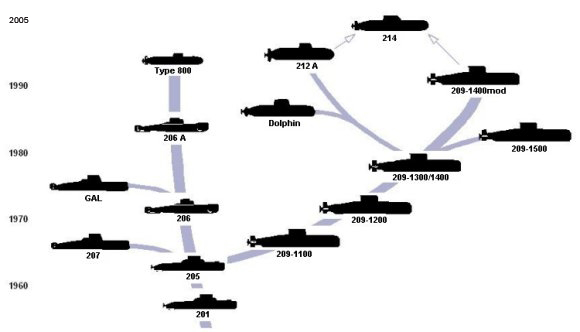
The HDW family tree with HDW 209 on several branches - click to expand.
-
While North Korea is undergoing a tense and hopefully predictable transition to a new "Emperor?" of the Kim Dynasty (possibly Kim Jonghe Un) South Korea has its first submarine export order. Blending reports from The Jakarta Post (December 22, 2011) (South) Korea Herald (December 21, 2011) and South Korea's Chosun Ilbo (December 21, 2011):

The Indonesian Defence Ministry and Daewoo Shipbuilding Marine Engineering (DSME) signed the contract on Tuesday December 20, 2011 for South Korea to build three submarines for the Indonesian Navy. Delivery may be in 2015-2016 with commissioning by 2018. These submarines are South Korean Improved Chang Bogo Class derivatives of the German designed HDW 209. It is inevitable that incorporated into these two submarines is technology developed for the HDW 214. HDW 214s are HDW's main current submarine for export.

The contract was signed by the Indonesian Defence Ministry's Defence Facilities Agency chief, Maj. Gen. Ediwan Prabowo, and DSME President and CEO Nam Tae-sang.

Under the contract, the two submarines built in South Korea will be in cooperation with Indonesian state-owned shipbuilder PT PAL.

Ministry spokesman Brig. Gen. Hartin Asrind told the Jakarta Post over the phone that the contract was worth US$1.07 billion.

Indonesia’s signing of a contract to procure three submarines from a South Korean company is an effort to keep pace with other countries in the region such as Malaysia, Singapore, Vietnam and Australia.

The Improved Chang Bogo Class will weigh approximately 1,400 tons surfaced and 1,600 tons submerged, be 61.3 meters long, will carry up to 40 crew members and have eight weapons tubes for 14 torpedoes, mines, missiles (US Harpoon and/or Indian BrahMos?) and other weaponry.

The three new submarines will replace Indonesia’s two old HDW 206 Cakra Class submarines; the KRI Cakra and KRI Nenggala (both launched in 1977). As submarines inevitably rust/corrode and expansion-contraction causes metal fatigue after 30 years the 36 year old KRI Cakra and KRI Nenggala are likely to be scrapped.

Other Submarine Forces (and Acquisitions) in Indonesia's Region

• Australia, 6 Australian built, Swedish Kockums designed Collins Class commissioned in 1996-2003 with 12 future Australian built "SEA 1000" Class subs for possible introduction 2030 onwards.

• Malaysia, 2 French built Scorpene Submarines KD Tunku Abdul Rahman Class commissioned in 2009 http://gentleseas.blogspot.com.au/2009/09/malaysias-first-ever-submarine-scorpene.html

• Singapore, 4 Swedish built Challenger Class commissioned 1999-2001 and 2 Swedish built AIP Archer Class see http://gentleseas.blogspot.com.au/2009/09/singapore-submarine-development.html

• Vietnam, 4 to 6 Russia built Kilo Subs to be commissioned 2015-2019 http://gentleseas.blogspot.com.au/2009/12/tentative-vietnamese-plans-to-buy-kilo.html
-
See also Indonesian-Malaysian clashes over the future Ambalat undersea oil field - one reason why both countries have bought new submarines - http://gentleseas.blogspot.com.au/2009/06/indonesia-gets-apology-from-malaysian.html
-
Pete