Showing posts sorted by relevance for query 218sg. Sort by date Show all posts

June 17, 2020

Singapore’s Type 218SG (Invincible-class) submarine ISSUES

On June 15, 2020 new commenter “retortPouch” made some comments on Singapore’s current 2 Archer-class submarines, Type 214s and, in much greater detail Singapore’s Type 218SG Invincible-class submarines. retortPouch numbered the sections 1) to 13). There will eventually be 4 x 218SGs. Pete has added many links (other than the 3 Key CUTAWAY links, from retortPouch):

“1) It's almost certain that the Archers will be kept in service for a while longer maintaining a six boat fleet [ie. 2 Challenger-class, the 2 Archers and 2 x 218SGs (due for delivery 2021-22)] . The Archers are said to have had significant upgrades c.a. 2010 for which one particular Dr. Tan Beng Hock won the Defense Technology Prize in 2013.

2) It's actually very informative to make a comparison between the three HDW/TKMS Type 214 derivatives: the
"basic" 214, the Turkish 214TN Reis-class and the 218SG.


Key CUTAWAY links:


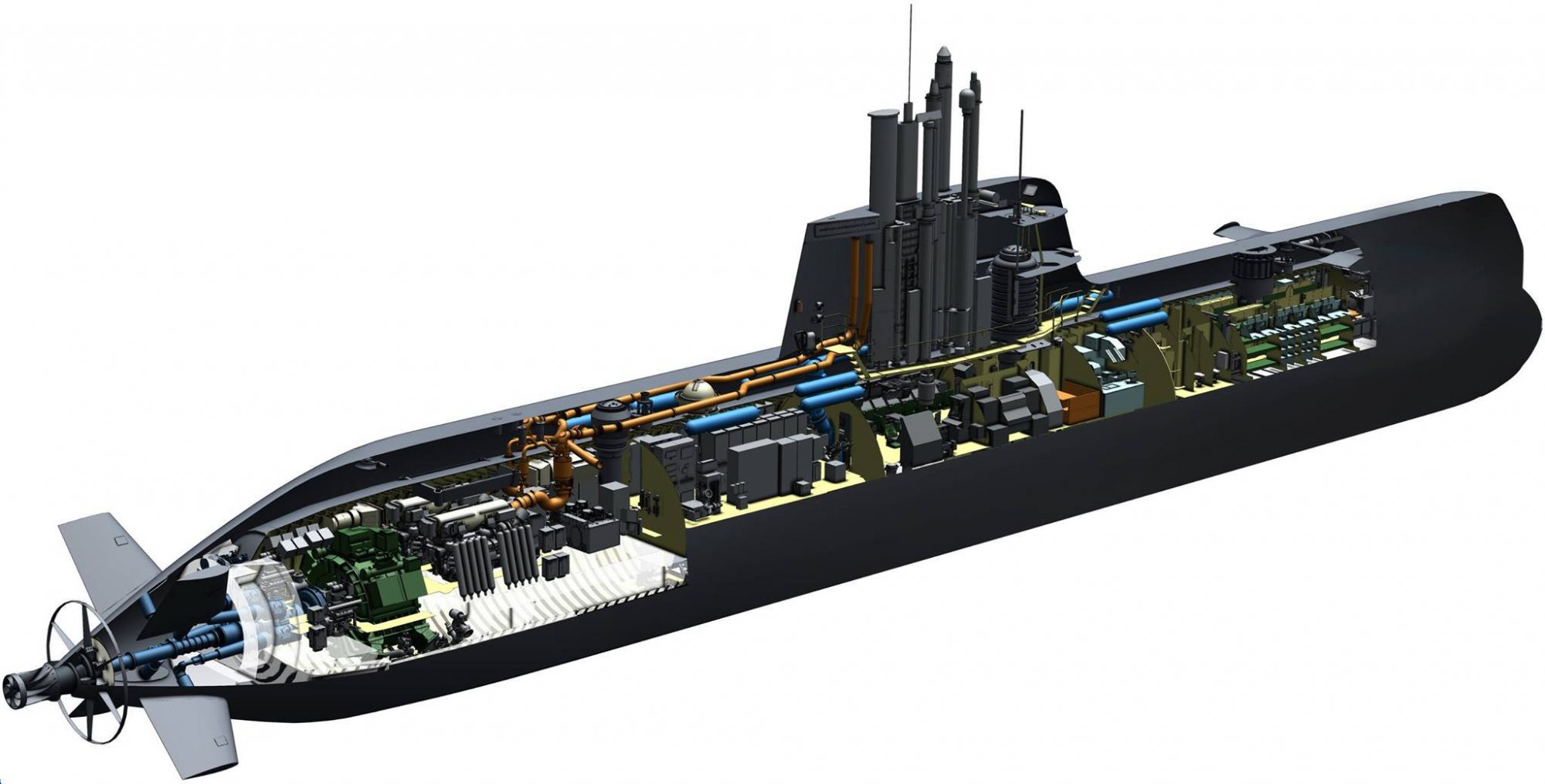
a) 218SG largest cutaway (above – click here for a greatly enlarged image) (Cutaway courtesy https://www.naval.com.br/blog/2019/02/18/invincible-primeiro-submarino-type-218sg-de-singapura-e-lancado-na-alemanha/ )
---


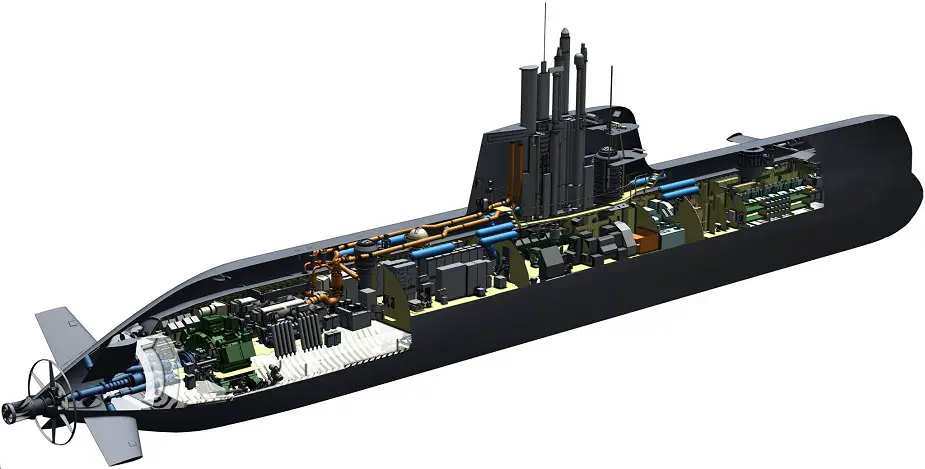
b) Turkish Type 214TN "Reis" variant. Largest cutaway (above – click here for enlarged image) (Cutaway courtesy https://www.monch.com/mpg/news/naval-channel/4361-turksub.html )
---


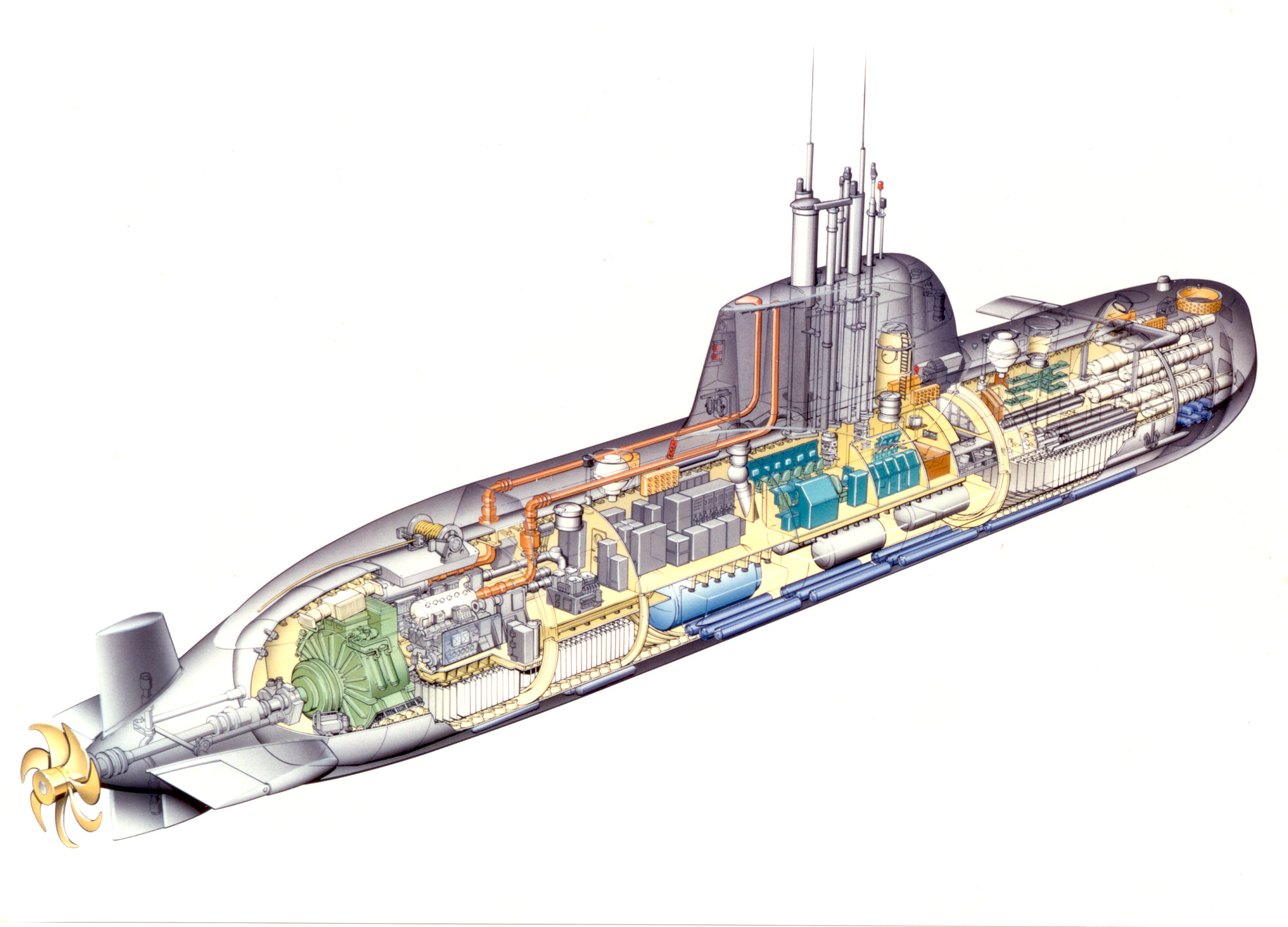
c) Generic Type 214 above. For Largest cutaway (click here) (Cutaway courtesy http://www.naval.com.br/blog/wp-content/uploads/2008/12/u-214-schnittbild.jpg )
---

3) Comparing the cutaway diagrams, using the central console as a central point of reference for size, we see that there is about a two and a half meter extension fore of the sail, and about a similar extension aft of the sail compared to the generic 214.

4) The area with bunk beds in the 218SG is almost certainly a reconfigurable space serving alternate duty as Spec Ops hotel, or Torpedo/Payload Room, or part of each at the same time. It is however the same size (between the Galley and the start of the Torpedo launch tubes) as that on the 214TN/Reis class.

5) [AARONQFW advises that compared to the Turkish Reis 214 variant (ie. 214TN), about 1 meter of the extension aft of the sail is in the engine room, about 1 meter is an enlarged combat center, and about half a meter is an enlarged technology room.] Try scaling it identically and superimposing the images to see. Maybe the 218SG's shtick really is "engaging targets at longer range" as the Defence Ministry puts it, and remote sensing/distributed swarm tactics with UUVs to "sense targets at greater range". Perhaps it is fitted for the DM2A4 ER SeaHake torpedo? See the SeaHake arms-showed here 
https://www.youtube.com/watch?v=TYvt3tU2yqU .

6) The extension aft of the 218SG sail seems to be distributed throughout the engine room, and in the cutaway it appears to be used as empty space, but the cutaway seems to omit a lot of important things; it's almost like somebody turned off a few layers on a Computer Aided Design (CAD) rendering. We can only speculate (and I encourage you to speculate!) as to what might be contained in the engine room, because it's not typical of the Singaporean military to sacrifice equipment for comfort. If anything their stuff is chronically over modified.

7) The 218SG might not have a Horizontal Multi-Purpose Lock (HMPL) for Special Operations (“SEAL” diver) delivery; the airlock might be located in the base of the sail instead like the German and Italian Type 212As and the Greek Type 214s. However, no pictures are forthcoming of the 218SG sail itself. There is however, one picture of the 218SG bow during the February 18, 2019 commissioning ceremony on Alamy Stock Photos here, showing that like the classic 214s, the hydrophone and most of the larger sonar equipment is probably housed below the torpedo tubes. [Pete has used a Straits Times' image below due to copyright concerns]. 


Type 218SG Invincible-class  Bow from the Straits Times, February 18, 2019.
---

8) The 218SG screw/propeller is obviously missing from the cutaway (which makes you wonder why they omitted the screw when HDW screws are very well photographed), and there are no extant pictures of the 218SG's screw. However, the cutaway shows a Propeller Boss Cap Fins (PBCF) in place of the traditional hub, and a large ring like shroud for several very thin, straight blades, probably non rotating. A very interesting device which I have not seen anywhere else. It have something to do with flow optimization, or it might have something to do with reducing cavitation. I recall some years ago on your blog a commenter said it had to do with a torpedo or towed array; as far as I can tell this is not the case since there are no torpedo tubes to the rear, and plenty of submarines with towed arrays function well without it.

9) The 218SG is quite a thin submarine with respect to draught. It's unlike the German/Italian Type 212A and Israeli Dolphin 1s and 2s, (which are more similar to each other than to the 214 derived series), and is probably not a true double decked design.

10) Depending on how long you think the Upgraded Västergötland-class [becoming Singapore’s 2 Archer-class] [and the Swedish Navy’s 2] Sodermanland-class Stirling subs can endure underwater, the 218SG has anywhere between 3 and 6 weeks' endurance (half again compared to Archer class, according to the Singapore’s Defence Ministry). My guess is that the rear of the 218SG is used to house more Liquid Oxygen LOX / Metal Hydride MH, or more batteries. If it's batteries, then it's got to be lithium ion, because lead acids are too bulky and there's no point having more of them then. By a back of the envelope calculation, you'd need 13 to 14 tonnes of LOX to go 2,880 nautical miles, or 4 knots continuously at 60 to 70 percent reactant efficiency (which is ballpark for 4 knots for the SINAVY PEM 120kW cells, at 60 to 70kW total propulsion load) for 30 days. This works out to about 11 cubic meters of LOX (and a smaller volume of MH), which is quite a bit but not so much.

[Note retortPouch later wrote: “Sorry, I forgot to account for cell voltage in the basic calculation, the quantity can be divided by 0.6 for standard fuel cells giving 22 tonnes or 19 cubic meters of LOX, however Siemens claims the SINAVY PEM 120kW models run at about 1 volt cell voltage, which makes the calculation accidentally correct.”]

The alternative is between 100 cubic meters to 300 cubic meters worth of Lithium-ion batteries (LIBs). Instead of a full LIB solution, the 218SG might employ a very large load of LOX, perhaps up to 20 cubic meters worth for recharging, and a larger than normal volume of batteries, which might be LIB. HDW/TKMS is known to have explored LIBs for the Type 216 [offered to Australia up to 2016 under the SEA 1000 competition], and as early as c. 2009, the below linked Singapore publication states specifically that HDW is researching replacing lead acid with lithium ion. In that case, the advantage would be a much larger sprint/surface reserve battery capability, mitigating the problem with the old Swedish subs.

See Introduction to Submarine Design by Singapore’s (?) Ong Li Koon, Liu Chee Kong and Toh Chee Wee at https://www.dsta.gov.sg/docs/default-source/dsta-about/introduction-to-submarine-design.pdf?sfvrsn=2

11) At the [TKMS? Kiel?] dockyard, the bottom of the [218SG?] hull seems to be much blockier than the TKMS-Israeli Dolphin or classic Type 214. I speculate that it might provide extra strength, external reactant storage, and larger sensors. At the commissioning dockyard, I could not find any photo evidence of a side payload bay.

12) The contract price for the first two 218SG subs was stated in press releases to include logistics, training and the actual construction. At US$900 million per sub, if we assume half the costs go to logistics (spares) and training, the remaining half goes to the sub, which is about half again more expensive than the classic 214s that Korea and Greece received, which went for about US$300 million. The 218SG's construction costs are in the ballpark for a Type 212A but of course this is the purest kind of speculation.

13) Funnily enough, the diagram of the 218SG linked above, which the Singaporean Ministry of Defence released, appears to be an isometric projection, whereas the 214 and 214TN(?) are both orthographic projections. It's as if they just took a screenshot in AutoCAD and released it to the publicity people. Cheap on the minor, splurge on the major, classic.

The 218SG might actually be shape up to be the smallest oceangoing capable submarine in service. Its shtick might be long submerged range, long engagement range, and long sensor range in a distributed swarm."

retortPouch

December 3, 2013

Singapore buying two HDW 218SG submarines - Sweden's loss


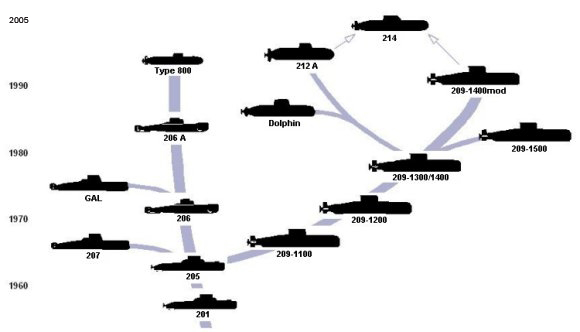
The Israeli AIP Dolphin 2 at just over 2,000 tonnes evolved from the HDW 209 and HDW 212. The HDW 218SG is very similar to the Dolphin 2 in length and beam. See model of the 218SG later revealed.
---


Where will the Type 218SG fit on this HDW submarine tree?
-------------------------

For the latest on Sweden vs Germany see June 11, 2014’s Australia's Future Submarine - Swedish vs German Claims http://gentleseas.blogspot.com.au/2014/06/australias-future-submarine-swedish-vs.html .

After two decades of buying renovated submarines from Kockums Singapore will  buy two new-build submarines designated HDW 218SG. Significantly the 218SGs are from Thyssenkrupp Marine System (TKMS) German submarine division HDW rather than from Kockumss which TKMS also owns. The 218SGs will be built at HDW's shipyard in the northern German port of Kiel.

Singapore's Defence Ministry (Mindef) signed the purchase deal with TKMS on November 29, 2013 to buy two the 218SGs.  The contract was likely to be worth more than 1 billion euros (US$1.36 billion).

In hindsight this website's November 13, 2013 article http://gentleseas.blogspot.com.au/2013/11/germans-sinking-kockums-swedish-sub.html was an indicator that HDW winning the Singapore order was suspected by the Swedish and German media. Singapore's 218SG decision is clearly a blow to Kockums and to Sweden's Navy (which would rely on foreign sales of Kockums subs to lower unit costs of Kockums subs). Unless the Swedish Government or a Swedish firm buys back Kockums Sweden might be forced to buy its future submarines from HDW or at least TKMS owned Kockums. Also link with Saab Being Subsidized to Buy Back Kockums? of March 4, 2014  http://gentleseas.blogspot.com.au/2014/03/saab-being-subsidized-to-buy-back.html .

For Singapore there is some continuity buying customised submarines - from customised Kockums Archer and Challenger Class to customised HDW 218SG class.

I suspect HDW 218SG will be an enlarged evolution of the HDW 209, 212 or 214, perhaps like Israel's HDW built Dolphin 2s. The HDW 218SG may be larger - between 2,000 and 3,000 tons (surfaced) see http://gentleseas.blogspot.com.au/2013/12/the-hdw-218sg-probably-3000-tonne.html . Given the expected 218SG delivery date of 2020 it is unlikely that the 218SG would be radically enlarged to 4,000 tonnes (HDW 216 Class). A 4,000 tonne design would probably take longer than the seven years to develop (2013-2020). Also the 218's purchase price of around US$650 million each implies an existing design rather than a radically new 4,000 ton (surfaced) 216 which would be far more expensive.

The two 218SGs, together with two existing Kockums Archer Class submarines, will replace the four ageing Challenger Class submarines, built in the 1960s and acquired by Singapore in the 1990s, which will be progressively retired from service. This follows Singaporean Defence Minister Ng Hen's comments in March 2013 about Mindef's plan to replace the Challenger submarines.

The 218SG contract includes a logistics package and the training of Singaporean crew in Germany. The 218SGs will have significantly improved capabilities including new build fuel cell Air Independent Propulsion (AIP) which significantly increases a  submarine’s  underwater range and hence reduces the risk of detection.

TKMS indicated Singapore Technologies Electronics, a unit of defence conglomerate Singapore Technologies Engineering Ltd , would co-develop the submarines' tailor-made combat system with Atlas Elektronik GmbH, a joint venture of ThyssenKrupp and European aerospace group EADS. Atlas already builds combat systems for other HDW subs including the Israeli Dolphin Class.
  
Singapore's projected defence budget for 2013 is Sg$12.34 billion (US$9.84 billion) up from 2012's Sg$11.83 billion in 2012. Under Singaporean law all able-bodied men must serve for two years in the military upon turning 18, providing additional manpower on top of the estimated 20,000 regulars. Singapore, surrounded by far larger neighbours has pursued a robust  defence strategy since its complicated split from Malaysia in 1965. In part due to this large neighbour situation Singapore has cemented close relations with the US, Australian and Israeli military for decades.

For some Comments made in September 2009 which envisaged market distortion between HDW and Kockums see this website's earlier article on Singapore's Archer and Challenger Class submarines at http://gentleseas.blogspot.com.au/2009/09/singapore-submarine-development.html .
--------------------------------

 http://www.straitstimes.com/breaking-news/singapore/story/mindef-buys-2-new-submarines-which-will-be-delivered-2020-20131202

http://www.nst.com.my/latest/singapore-to-acquire-two-submarines-from-german-firm-1.419154:

http://in.reuters.com/article/2013/12/02/thyssenkrupp-submarines-idINL5N0JH37T20131202

-
Pete

December 6, 2013

The HDW 218SG - 2,000-4,000 tonne submarine [proved to be 2,000-2,200 tonnes]

Diagram of HDW 216 arrangement. A 2,000 to 4,000 tonne HDW 218SG submarine (same as or smaller than a HDW 216) would have long range for Asia-Pacific conditions. The design would include greater diesel and battery capacity, AIP and possibly a vertical multi-purpose lock (VMPL) permitting vertical launch capabilities. A horizontal lock, in place of 2 torpedo tubes, might provide be an alternative to a VMPL.
-------------------------

Note - the predictions in this 2013 article proved to be wrong (it happens!). When Singapore's Type 218SG was launched on February 18, 2019 its weight proved to be 2,000 tonnes (surfaced) and 2,200 tonnes (submerged) with no reported unusual innovations (like a VMPL).

This article follows on from earlier article http://gentleseas.blogspot.com.au/2013/12/singapore-buying-two-hdw-218sg.html announcing Singapore's December 2, 2013, decision to buy two HDW 218SG subs. The HDW 218SG might be a 3000 to 4,000 tonne submarine - for the following reasons:

  • HDW is increasingly reliant on its Asia-Pacific customer base. Asia-Pacific customers need longer range submarines and other features such as land attack missile capability. In terms of size this signifies a evolution from below 2,000 tonne HDW 212/214 subs built mainly for European (Baltic, Arctic Ocean, North Atlantic) conditions to a 2,000+ tonne design (see below) for Asia-Pacific (Indian and Pacific Oceans) conditions.

  • TKMS-Kockums already has experience in helping to design considerably larger than the European size. That experience is in building the 3,000 tonne Collins Class. TKMS bought Kockums not only to remove Kockums as a competitor to HDW but to utilise Kockums' experience, workforce, technology and design information - including the process of building a  larger submarine.
  • HDW is developing the 2,000+ to 4,000 tonne, 218 (Asia-Pacific) design not only for Singaporean but for the Australian, Canadian and Indian markets. 
  • The 218SG build schedule (for launch around 2019 - 2021) coincides with South Korea's building schedule (from 2018) for its planned 3,000 tonne submarine the KSS-III (D-3000). South Korean subs to date have heavily relied on HDW 209  (KSS-I) and HDW 214 (KSS-II) designs. This pattern suggests that the 3,000 KSS-III will also be supported by HDW design work despite South Korea's claims of a wholly "indigenous" KSS-III design.
  • A 2,000 to 4,000 tonne submarine could incorporate heavier battery, increased diesel oil and large  AIP capacity for increased Asia-Pacific range requirements.  Advice here is "the 218SG will have 240-320kw PEM fuel cell AIP (offering 22-30 days at 5 kts)".  Heavier batteries can also allow longer range submerged operation with higher discretion (non-snorkel use) rates against (mainly) Chinese sensor platforms. 
  • A 2,000 to 4,000 tonne submarine would also have the range to permit Singaporean use of refuelling-replenishment bases belonging to its US and Australian allies. Such bases include Diego Garcia, Guam, Pearl Harbor and Rockingham (Australia).

Conclusions

The HDW 218SG is most probably designed for long-range Asia-Pacific conditions, all requiring a 2,000 - 4,000 tonne displacement. SG signifies a subset of HDW 218 customized for Singaporean conditions - including air-conditioning for tropical weather, hull-anechoic coating optimized for warmer sea use and a Singaporean-specialized combat system. The HDW 218SG probably represents HDW's latest export submarine design for launch around 2018 and first delivery around 2020.

The designation 218 (neither 214 nor 216) provides uncertainty over the 218's features and weight. This uncertainty provides advantages for Singapore's national security and commercial-competitive secrecy for HDW. HDW would also wish to avoid any mid-build headlines like those experienced by Navantia over the S-80 - see the S-80's weight problems at http://gentleseas.blogspot.com.au/2012/06/australias-future-submarine-selection-s.html .

By not specifying the 218's weight this also permits flexibility in balancing desirable features, within Singapore's expected tonnage parametres, without politicized assumptions. Development of a 218SG somewhere in the 2,000 - 4,000 weight range also may have implications for HDW's likely tendering for Australia's future submarine SEA 1000 project.

Pete

February 20, 2019

Singapore’s Alliance Anxieties and Submarine Setup (Part 1)

With February 18, 2019's launch of Singapore's first Invincible-class Type 218SG submarine I think it time to talk about some more general Singaporean alliance issues and some submarine aspects.

ALLIANCES

Singapore’s highly strategic geographical position (Map below) and political maturity means it is an integral member of the Western Alliance. Singapore is at one end of the Strait of Malacca choke-point and at the southern end of the South China Sea. So, despite its minute size, Singapore is a highly valued country in military, economic and intelligence terms. To top it off Singapore’s good command of English may make it the:

-  the country in Southeast Asia most trusted by Fives Eyes (Japan, Germany, the Netherlands and
    Israel might also be associate members), and
-   an associate member of the still loose US, Japan, Australia, India “Quadrilateral
     eg. a Singaporean frigate was at MALABAR 2007 

Singapore is therefore a trusted owner of the (almost) most sensitive Western weapons:


-  including the US tailor-made made Boeing F-15SG,
-  In January 2019, Singapore announced its plan to buy a small number of F-35As for an evaluation
    of capabilities and suitability before deciding on more F-35As to replace the aging F-16 fleet.
-  Up to 4 x US Navy Littoral Combat Ships operate out of Singapore Harbour under US 7th Fleet,
    Task Force 73 command.
-  US nuclear submarines visit Singapore around every 2 years (eg. 2015 and 2017).
-   Singapore has a close intelligence, including Special Forces, relationship with Israel. This is partly
     because Singapore like Israel, is a small nervous nation in a region of large Muslim countries. 
     Singapore like Israel also faces regional Islamic terrorism.

Singapore defense anxieties explain why it is the 5th highest defense spender, per capita, in the world.

SINGAPORE'S SUBMARINES

Germany’s TKMS has tailor-made Singapore's 218SG submarine with a more advanced than usual Atlas Elektronik Combat System. TKMS has also supplied the German (Siemens' (?)) air independent propulsion (AIP) system (tailored to Singapore's warm water enviroment). This is all highly sensitive and very expensive equipment. Looking 42 seconds into the Youtube below, the 218SG is also likely to use 2 x MTU 12V 4000 diesels. 


Singapore has maintained a 4 submarine navy of the Challenger class, part replaced by 2 x Archer class, for 22 years. As the first 2 x 218SGs are delivered/commissioned in 2021-2022 (see graphic) the remaining 2 Challengers will be retired. When the second tranche of 2 x 218SGs are commissioned in the mid-2020s the 2 x Archer class will be retired, thus forming an all 218SG force of 4. There are many tactical, logistical and safety advantages in having an all-the-same submarine force.

To prepare for the 218SGs Singapore has been given better access than usual to the Type 212A’s of the German Navy and I suspect access to Israel’s Dolphin 2 (AIP) submarines. This is given the Dolphin 2’s share very similar specifications and some tasks with the 218SG. While the Dolphin 2 has nuclear armed Tomahawk-like missiles (forget the "Popeye Turbo" cover...) the 218SG won’t have any, of course.  


Model of  TKMS Type 218SG taken at IMDEX ASIA, Singapore, May 19-21, 2015 (Photo of model courtesy Defense Studies blog)
---


Official Singapore Navy Youtube.
---


SUBMARINE GEOGRAPHY


The islands and undersea rocks on the approaches (like the Singapore Strait) to the Strait of Malacca provide many places for experienced Singaporean submarine captains to sit, hiding, on the shallow seafloor. (Map courtesy welt-atlas).

-  Air independent propulsion (AIP), that Singpore has heavily invested in, is a major tactical and
    safety advantage, when hiding motionless.
-  Note the reinforced hull bottom of the TKMS built Israeli Dolphin 2 - much like the 218SG, 
    I expect. 
-  In the Photo and (official) Youtube above can be seen the 218SG’s X plane rudder. The rudder is
    ideal for tight turning and gentle maneuvering in the tight seafloor spaces, rocks and holes.  

The shallows increase the likelihood of Singapore's subs colliding with rocks, seafloor, ships and with other subs. Submarine sonar for navigation is more than usually distorted in the shallows, so the Singaporean Navy's decades of experience is very important. 

See What the 218SG is used for? (Part 2) which includes weapons details, on Friday, 22 February 2019.

Pete

February 22, 2019

What Singapore's Type 218SG Submarines Might Be Used For (Part 2)

The most official 18 February 2019 indicator of what Singapore's new Invincible class Type 218SG submarine will be used for is less controversial non-state threats: terrorists, pirates, smugglers of arms, drugs and of people. 

But much more should be added (below) including Singaporean submarines defending against and monitoring Chinese ship, submarine and land targets. 

The emphasis given to AIP in Singapore's current 2 x Archer class (Stirling AIP) and 4 future 218SGs (fuel cell AIP) suggest short to medium range missions will be common. This is because AIP is heavy and of diminishing utlilty on longer range missions. 

SENSORS

The 218SG's Atlas Elektronik combat system, with some US add-ons, will retain many existing capabilities and add new ones. Many missions around Singapore Island (map below) and the Malacca Strait will be on AIP (for around 2 weeks) only. Much of this short range work is (will be) for electronic warfare (eg. signals interception). Such interception "targets" can more publically include the non-state actors (eg. detecting short range terrorist/pirate/smuggler radio signals).

Once a submarine senses a target a submarines weapons are too heavy and expensive (more than 
US$1 million per torpedo or missile) to destroy a small boat. Also you'd blow up people who may only be suspects and blow up all evidence! Instead a submarine (using tethered signal buoy beaming to satellite?) may alert a Singapore Police Coast Guard boat or Navy patrol vessel (maybe launching a smaller rigid hulled boat) to deal with the target boat more "gently".

With only 28 officers-sailors needing accommodation on 218SGs, on special missions there may be space for:

-  around 6 intercept operators/linguists with 6 work stations 
or
-  around 10 divers-special forces and their equipment (one mission fighting terrorists).

Networked with Singapore's submarines in combatting and monitoring threats includes other Singaporean, US and other allied platforms. Platforms include land based or connected sensors, seabed (long range SOSUS) broader ocean sensors and shorter range (RAP/FDS) sensors strung across the Malacca Strait seabed and nodes on/near Singapore main island and islets. On seabed sensors see https://gentleseas.blogspot.com/2019/01/possible-sosus-rapfds-arrays-western.html .

Possibly networked with and informing subs are human intelligence/police/border/customs, overt press, patrol boats, frigates, LCSs, aircraft/UAVs, land-based radar and intercept stations and satellites. 

PATROLS - TAILING

All these networked sensors can help cue submarines to tail Chinese submarines on surfaced "innocent passage" through the Malacca Strait and more so Chinese subs who decide to pass through submerged. 

SSKs like the 218SG are too slow to shadow Chinese SSNs and SSBNs. But (with Japanese submarines doing the northern leg shadow) 218SGs could do the southern leg shadow of Chinese Song and AIP Yuan class SSKs.  

Only at long ranges into the Pacific (including South China Sea) and Indian Ocean would Singapore's submarines be a little more autonomous of all this network help. Looking at Germany's Type 212A as a minimum, the 218SG may have a range of around 8,000nm at around 4 to 8 knots combined snorting and surfaced. Such a range would allow a 218SG to:

-  patrol oil strategic lines of communication (SLOCs) between the mid-Indian Ocean
    (eg. Diego Garcia or India's east coast bases) and Singapore.
 or
-   Singapore to Taiwan and return (maybe keeping an eye on the southern China
    coast) using aerials extended from the fin/sail, tethered buoys or work-to-submarine UUVs.

Singapore's submarines (as with the surface navy) all the way to the Persian Gulf oil area, can contribute to longer range protection of the oil/gas/chemical tanker route. This includes tankers eastwards across the Indian Ocean to Singapore's refinery/chemical facilities.


Map of Singapore. Consisting of one main island and 62 islets. Ongoing land reclamation projects have increased Singapore's land area from 582 km2 in the 1960s to 724.2 km2 in 2018. This geography provides many places for 218SG to sit waiting on the seabed, between islets while monitoring many things. (Map courtesy Geology(dot)com)
---

Broader map of the Strait of Malacca/Malacca Strait (of great strategic and economic value) and the much smaller Strait of Singapore(Map courtesy welt-atlas).
---

WEAPONS HELP

Another way to estimate what the 218SG may be used for is to look at the Combat System - Weapons suite.

Singapore does not appear to be using the submarine weapons of its main ally, the US, other than possibly the US made Harpoon anti-ship and land attack missile. Singapore’s Air Force and Navy use the Harpoon. In the submarine launch mode the Harpoon is called UGM-84 with a range of up to 140 km (75 nm) against ship and land targets.


Other than the Harpoon it is more likely that Singapore is using weapons compatible with its Atlas Elektronik Combat System. Judging by the weapons on the top of the TKMS line German Navy Type 212A, Singapore’s Type 218SG will use:
-  the Atlas Elektronik developed DM2A4 "SeaHake mod 4" 533mm heavyweight torpedo (HWT).
    This is noting Singapore is not listed as a US Mark 48 HWT operator.
-  With 8 torpedo tubes this provides room for deployment of at least 16 naval mines and/or 
-  8 or more medium sized UUVs (which can be weaponised, making them highly mobile very smart
    mines to defend Singapore or to block Chinese access to the Strait of Malacca and other
    chokepoints).
-  Germany (including TKMS) is developing the small short (20km) range missile known as
    the IDAS (Interactive Defence and Attack System for Submarines) used for surface to air, 
     anti-ship (eg. anti-pirate smuggler boats) and (light) land attack.

I see no evidence Singapore is using the US made Tomahawk longer range cruise missile, for submarines and other platforms (yet). There is a possibility the 218SG already has, or can be retrofitted with, a vertical multi-purpose lock (VMPL). This could vertically launch 6 Tomahawk cruise missiles (or similar), launch a large UUV, diver delivery vehicle or be used for special forces equipment storage.

SOME USEFUL SOURCES

-  Submarine Matters' February 19 and 20 2019.

-  Sebastien Roblin at The National Interest. March 2, 2019, with cited halfway down Sebastien's
    article.

-  Singapore's Straits Times, Feb 18-20, 2019.

-  Wikipedia to Feb 19, 2019 including

-  Janes Feb 19, 2019.

-  The Independent, Feb 19, 2019.

Singapore’s Ministry of Defence, February 18, 2019, including:


Pete

August 29, 2024

Singapore Navy: MRCV and Type 218SG update, August 2024

 There have been recent updates to two major Republic of Singapore (RSN) procurement programs, the Multirole Combat Vessel (MRCV) and the Invincible-class (Type-218SG) AIP SSK. 

screenshot from Saab video

Saab announces contract for MRCV composite superstructure.

We've been tracking Singapore’s MRCV project for several years. From speculation in 2020, the project’s official announcement in 2023, to the start of construction in March 2024.  

Saab has now announced that it will provide the composite superstructure for the six MRCVs, highlighting the forward superstructure, which includes the bridge and integrated sensor mast.


Note that this video is a modification of the official MRCV video graphics released last year and does not show the final ship design.

Saab provided the composite superstructure for Singapore’s Independence-class Littoral Mission Vessels (LMV), which uses an integrated Command Centre for Bridge, CIC and Engineering control, which is explained in the following video:


With the far larger MRCV, battle space management will be its primary role, with multiple sensors, UAV/UUV/USVs and weapons operating simultaneously. I thus expect the class to use a Combat Management Centre separate from bridge control.

A unique agreement sees Saab, in partnership with OMT, as the developers of the overall concept design, while ST Engineering handles production, procurement and system integration. Singapore’s Defense Science and Technology Agency (DSTA) has project oversight.

The MRCV project will see six vessels join the RSN from 2028, replacing the Victory Class Missile Corvettes. Naval News, with its detailed coverage from 4th May IMDEX 2023, has indicated that the MRCVs will be large ships with 10,000-tonne displacement.


The First Type 218SG sub is the second to arrive in Singapore.

According to Janes, the first-in-class Type 218SG SSK has made the journey from Keil, Germany to Singapore on the heavy transport ship MV Rolldock Star. 

Image: posted on 'X' @DarthFreder

Invincible was launched by TKMS in February 2019, and remained in German waters to conduct crew training for the new submarine class. RSS Impeccable, the second boat, was launched in December 2022, and arrived in Singapore in July 2023, on the MV Rolldock Storm, is expected to commission at the end of this year. 


With Invincible now in Singapore, it is conceivable that both Type 218SG submarines will commission together, and replace the last two Challenger-class boats (ex-Sjoormen-class), RSS Conqueror and RSS Chieftain, which were launched in 1967/68 and have served Singapore for twenty years.

The last two Type 218SG boats are still in TKMS yard hands in Kiel, Germany. RSS Illustrious was launched simultaneously with RSS Impeccable in 2022, and probably took over crew training, while RSS Inimitable, launched in March 2024, is currently dockside fitting out. It’s likely that once the fourth boat has completed its builder’s trials, both subs will ship to Singapore together, likely in early 2025.

February 19, 2019

Launch of first Invincible class TKMS Type 218SG for Singapore

See Singapore’s Straits Times, February 18, 2019 article

"Invincible, first of Singapore's biggest and most advanced submarines, launches in Germany"

at https://www.straitstimes.com/singapore/singapores-first-type-218sg-submarine-launched-in-germany-named-invincible

This concerns Republic of Singapore "Ship" (RSS) Invincible - name allotted to the first of four TKMS 218SG's ordered by Singapore in 2013 and first launched in Germany on February 18, 2019.

Submarine Matters' coverage of the Type 218SG goes back to 2013 and 2015 (with specifications) with many other articles at https://gentleseas.blogspot.com/search?q=218sg

Also see the wikipeadia entry quoting Submarine Matters at https://en.wikipedia.org/wiki/Invincible-class_submarine#cite_note-gentleseas-6


(Source Singaporean Ministry of Defence via Singapore's Straits Times February 18, 2019). 
---


Tomorrow details on what Singapore's submarines do.

Pete

June 23, 2020

Extra Issues: Singapore's 218SG (Invincible-class) Submarines


The 218SGs largest cutaway diagram (above – click here for a greatly enlarged image) (Cutaway courtesy https://www.naval.com.br/blog/2019/02/18/invincible-primeiro-submarino-type-218sg-de-singapura-e-lancado-na-alemanha/ )
---

Since SubMatts’ most recent article on Singapore’s Type 218SG Invincible-class submarine Anonymous and retortPouch have provided very interesting extra comments. These are summarised below:

Section 1.

Looking at Cutaway above provided by retortPouch, Anonymous has made the following comments on Singapore’s Type 218SG Invincible-class submarine: (hereinafter called just 218). The 218 will not be purely single hulled or double hulled but instead “mixed hulled”. This is with an inner pressure hull steel shell estimated at HY100 throughout but also outer hull sections surrounded by FRP (Fibre Reinforced Plastic). Between the hulls are fuel and seawater buoyancy tanks and such fittings as sonars, other sensors and ejectors as well as tanks which can more safely store flammable/explosive Hydrogen packaged (more safely) in Metal Hydride (MH) form.

If HY100 pressure hull steel is used (as in Type 214s) this is likely magnetic and allows the submarine to dive to ocean depths with water pressure equivalent to 100,000 pounds per square inch (psi) or 690MPa. This steel’s thermal conductivity is estimated to be 34 W/mK) making it a “conductor”.

It is possible that the 218 will use HY80 (560MPa) pressure hull steel (as used in Type 212As) which has the advantage of being non-magnetic, hence less detectable. However if the 218 (shaped like a 214 has HY80 steel (like a 212) then the 218's whole hull structure (supporting frameworks and all) will need to have been revised from scratch, rather than closely copying an existing structure.

Non-pressure “outer parts” of the 218 hull use FRP also called “composite” materials which have an estimated thermal conductivity of (0.5-0.1W/mK) making them semi thermal insulators.

The following is very complex. Heat from reactions in the 218's Proton-exchange membrane fuel cells (PEMFCAIP is used for heating of liquid inside fuel cylinders. An FRP plate might act as a rupture vessel to prevent  leakage of hydrogen from MH cylinders. FRP plates are fixed by bolts (white spots) not because of non-magnetism, but because of thermal/heat insulation of fuel cylinders in the space between pressure hull and FRP plates. A MH cylinders are encased within a cylinder surrounded by liquid (maybe diesel fuel). Cool liquid is carried into a fuel cylinder at hydrogen loading and cools hydrogen absorbing metal inside the MH cylinders. Hot liquid is carried in a fuel cylinder at hydrogen generation and heats MH inside of a MH cylinder to generate hydrogen.

Section 2. On other issues - from retortPouch:


Correction: It turns out Singapore's 2 Archer-class submarines will be retired after 2024, as indicated by 2019 plans.

Furthermore:

a) as of 2019, the 218s will not be armed with land attack missiles, however

b) it is likely, by the phrasing of the author, that it will be able to operate UUVs. Other relevant items come in the last few paragraphs, like underwater submarine safety/codes of conduct.

218 going through sea trials, shared on Twitter by David Boey, original article here https://www.shz.de/regionales/kiel/neues-u-boot-invincible-auf-der-kieler-foerde-zu-sehen-id28288867.html ; photos courtesy Rolf Dunkel.

Tpenghui/Faithkeeper confirms, via TKMS marketing that the 218 will have a new design of ultraquiet screw/propeller, and the large ring, as suspected, was to optimise flow, and make it cleaner for the screw. [see second photograph of the IMDEX Asia 2015 model]

Tpenghui/Faithkeeper confirms that the pressure hull will be steel, however the upper angled "tent", and the massive keel structures will be made of non-steel, non-magnetic materials to reduce the magnetic signature of the sub. [This can tie in with discussion of combination of pressure hull steel and FRG/composites in Section 1. above].

4) The 218s will come with vertical locks (possibly not vertical multi-purpose locks (VMPLs) but probably not the sail lock solution) to launch divers and UUVs.

This is an old model photo from the 2017 TKMS booth at IMDEX Asia, taken by Tim Fish/@sweeneygov, look at the cutouts on the top surface of the "tent". [Also see IMDEX Asia 2015 models].

Anonymous and retortPouch