October 12, 2023

Vietnam's Gradual Tilt to the West for Arms

Shawn Chung and I have been discussing Vietnam’s gradual drift away from almost total reliance on Russia for weapons. Many old Soviet and Russian weapons arm the Vietnamese army, air force and navy. There appear to be early signs of Vietnam pivoting towards the US for weapons.

Vietnam acquiring weapons from Russia and maintaining them is becoming more complicated due to: the Ukraine War international embargo on Russian weapons; possibility of Western sanctions if Vietnam does buy Russian weapons; shortages of Russian weapon spare parts and ammunition; and, difficulty of Russia repairing Vietnamese weapon systems.

Vietnam will find it hard to keep its Su-30s, bought from Russia, flying for another year... unless Vietnam does deals with India's Hindustan Aeronautics Limited (HAL) for sustainment. The same goes for Vietnam’s 6 x Kilo submarines, the first of which was launched more than 10 years ago, and while they could use a civilian shipyard for refurbishment (the Vietnamese Navy submarine base looks like it has one drydock for hull scraping), they may also look to India for fleet sustainment. Vietnam has recently acquired 2 x Pohang-class corvettes from South Korea. 

Vietnam has also looked for value for money by buying SPYDER medium range SAMs from Israel, but there's a very long way to go.  

Vietnam in Southeast Asia uneasily sharing a lot of land border and overlapping sea-space with China (Map courtesy Asia Society).

Malaysia operates Su-30s and 8 x F/A-18Ds. Indonesia operates Su-27s, Su-30s and F-16s. This means the US exporting F-16s to Vietnam is unremarkable. 

Singapore operates F-16s, F-15s and is acquiring F-35Bs. Indonesia is acquiring 24 of the latest F-15EXs. The US doesn’t look like exporting F-35s to other Southeast Asian nations.

Vietnam had close relations with China during much of the First Indochina War and all of the Second Indochina War. But overall Vietnam is reluctant to buy weapons from China given Vietnam and China fought 22 wars against each other over the last 2,000 years – the last ending in 1991. Vietnam is also in a South China Sea (SCS) dispute with China. Given this SCS dispute, in May 2017 the US delivered 6 x Defiant-class patrol boats to the Vietnam Coast Guard.  

So the West is doing well to provide some support to Vietnam in Vietnam’s friction against China. Meanwhile the Ukraine-Russia War is providing an opportune time to reduce Vietnam’s reliance on Russia for weapons. Vietnam is still very friendly with Russia, but this will change as Vietnam's economy continues to pivot West.
October 6, 2023

AI and NSA Software Programs

I often comment as Pete on the US IntelNews website.

Sometimes comments do not get through - as with IntelNews article NSA, CIA senior officials address artificial intelligence threats and opportunities of Oct 2, 2023. 

So, having no contact with any intelligence agency, anywhere, I’ll attempt to comment on that Oct 2 article now. 

I assume it likely the NSA utilizes Artificial Intelligence (AI) to develop very large software programs for cyber defensive and cyber offensive purposes. 

Defensively software programs, created with AI assistance, might be able to detect, isolate and further react to major cyber-attacks much more quickly than human "cyberwarriors" have been previously able. 

Offensively AI could be helping develop and then deploy large programs, of a magnitude or two of lines of code larger than the widely publicized Stuxnet program. 

Stuxnet reputedly spread beyond the intentions of its creators. So there would need to be failsafe software limits preventing partial AI developed cyber programs spreading.

Trump’s indirect Gift to his Russian Friends & Chinese Enemies

https://www.theguardian.com/us-news/2023/oct/06/donald-trump-us-nuclear-submarines-potentially-sensitive-information-australian-billionaire-anthony-pratt

Pete Comment

Australian "Pratt then allegedly shar[ing] the information about submarines" is also a gift to those in the USN and Congress who argue Australia is a potentially weak link in the protect US submarine secrets chain. 

October 5, 2023

From Israel's Popeye Turbo SLCM to an SLHM Requirement

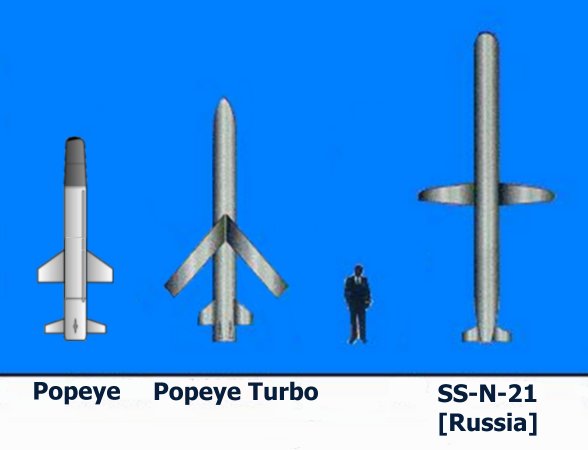
Israel's suspected Popeye Turbo nuclear tipped Submarine Lauched Cruise Missile (SLCM) is feeling its age and interceptability. The following details its limitations along with broader comments on Israel's missile landscape.

Israel has the most technologically advanced missile arsenal in the Middle East. Israel has a large domestic arms industrial base and is/has been involved in many foreign joint ventures. This is particularly with the US, India (likely for Popeye Turbo testing in 2002 and definitely in developing the Barak 1 SAM and Barak 8 SAM) and decades ago France, to develop world class missile systems. 

Israel domestically produces numerous UAVs, cruise, ballistic and now hypersonic missiles informed by the performance of missiles and UAVs in the Russia-Ukraine War. Russian cruise and ballistic missiles are proving more easily shot down than hypersonic missiles.

The Popeye Turbo SLCM, possibly around 6.5m long and maybe within a float upward container of around 645mm diameter. (Artwork and rough estimated dimentions derived from FAS).
---

Israel might be assuming that its subsonic or supersonic Popeye Turbo SLCMs may well be shot down by Israel’s Muslim neighbors (with Iran being the top target). This is especially if the Popeye Turbo’s range hasn’t improved beyond 1,500km with a 200kg warhead of 200 kiloton yield [with likely a boosted weapon]. 1,800km with a 100kg warhead might be more practical.

A range of 1,800km still means Israel’s Dolphin 1 and 2 class submarines are limited to a relatively small predictable launch area west of their Haifa Naval Base if their target is Tehran. The range limitations of the Popeye Turbos would make for fairly direct route, improving the chances that Iran’s S-300 SAMs or, in future, S-400 SAMs might intercept them.

Modern Turkish, Egyptian and Russian submarines might also make life difficult for Israeli Dolphins that occupy predictable launch areas.

Alternate launch areas in the:

-  Red Sea involve the need for Dolphin SSBs to surface (or be easily detected) travelling through the Suez Canal, or

-  Arabian Sea involve Dolphin SSBs covering a huge multiple-refuel distance around the southern tip of Africa.

Hence Israel needs a longer range and preferably faster submarine launched missile that doesn't have the predictable trajectory of a ballistic missile. Israel may be developing a, what I call, Submarine Launched Hypersonic Missile (with a brand new acronym "SLHM"). A faster missile, with a heavier warhead travelling in dense atmosphere, while fighting gravity, will almost inevitably be heavier and taller than the Popeye Turbo.  

This may be a variant of the Arrow family of long range anti-ballistic hypersonic missiles. The constantly improving Arrow Program has been an Israeli-US joint venture since 1986. It is considered one of the most advanced missile defense programs currently in existence [14][15]  A long range missile built for defensive purposes can always be of offensive value. 

More on Monday on the Arrow 3 and 4.

October 4, 2023

Hypersonic Missiles for US, Australian & Even Israeli? Subs

Some interesting hypersonic snippets on US led hypersonic missile developments.

Under AUKUS Pillar 2

“The AUKUS partners will work together to accelerate development of advanced hypersonic and counter-hypersonic capabilities.” [Official AUKUS Fact Sheet, April 5, 2022].  Also see Wiki.

Australia and the US have been cooperating on the development of hypersonic missiles since 2020 after signing an agreement to "flight test full-size prototype hypersonic cruise missiles" under the [Boeing and Lockheed Martin preliminary designed Southern Cross Integrated Flight Research Experiment (SCIFiRE). contract] [97][98][99]

Lockheed Martin Awarded $1.1 Billion Initial Contract To Provide Nation's First Sea-Based Hypersonic [Conventional Prompt] Strike Capability: February 17, 2023 … [Conventional Prompt Strike] CPS shares a common [integrated support system] AUR with the Army LRHW and can be launched from multiple platforms including surface ships, submarines, and land-based mobile launchers.

+++++++++++++++++

“Leading Hypersonic Solutions"

"Lockheed Martin is partnering with DARPA, the U.S. Air Force, the U.S. Army, and the U.S. Navy to transition hypersonic concepts to operational reality. Discover why hypersonics are a key to battlefield supremacy and an essential element in national defense."


[In the Youtube, uploaded by LM in 2022, here and above] 

"Lockheed Martin’s Chief Technology Officer and VP Steve Walker and VP, Advanced Program Development, Space Eric Scherff explain the advantages of hypersonic systems and Lockheed Martin's expertise in scaling complex weapon systems and leadership in hypersonics.”

++++++++++++++++++

Tomorrow we'll take a look at the US (Boeing)-Israeli Arrow 3 Hypersonic missile. "The missile's reported flight range is up to 2,400 km"  and

"Another advantage mentioned was the ability to launch the Arrow 3 from advanced missile boats." 

October 1, 2023

Australia's Future SSN-AUKUS Nuclear Weapons

In Australia's future SSN-AUKUS case these UK designed SSGNs are likely to feature VLS and beams larger than the current Astutes' 11.3m. These would be more than adequate to accommodate a missile the 9.86m size of the old Polaris A3 MIRVed ballistic missile. These A3s had a range of 4,600km - more than adequate to hit Beijing from a launch point east of the Japanese home islands.