Showing posts with label Kilo class. Show all posts

May 13, 2015

North Korea's alleged new SINPO class submarine and missile test

 I have added several extra hyperlinks, comments in [ ] brackets and a photo (particularly concerning the suspected missiles, Golf and SINPO-class submarines) relevant to the following article.

That article is by Sean Gallagher at arstechnica published May 12, 2015 concerning North Korea's   alleged submarine launch of a ballistic missile. The submarine and missile details will need to be fully verified by intelligence agencies before they are taken as fact. 

On May 13, 2015, US intelligence said North Korea (NK) may have achieved what is called a limited compressed gas ejection test. This is called a perhaps 200 meter "cold launch" in the vertical launch business. 

Other US theories that the missile test did not happen in the way NK said or did not happen at all, are:

- NK launched the missile from a barge-sea platform, not a submarine, and/or
- the missile was a non-working dummy capable of cold launch but nothing else, and/or
- NK photoshopped the missile images below, making up the whole "event".

Despite these doubts South Korea is more than usually concerned. NK has proven it can conduct real nuclear tests and has tested ballistic missiles with, at least, proven medium ranges (ie. between 1,000 km and 3,000 km). Now NK is working towards an SLBM capability. Hence South Korea (and the US) are exploring strategies and tactics to react to NK SLBMs. See my April 16, 2015 article which mentions a future South Korea "Kill Chain" pre-emptive strike capability.

The arstechnica string is http://arstechnica.com/tech-policy/2015/05/north-korea-test-launches-polaris-1-ballistic-missile-from-submarine/ :

"North Korea test-launches “Polaris-1” ballistic missile from submarine


Analysts say DPRK missile subs could threaten Japan, South Korea in five years.
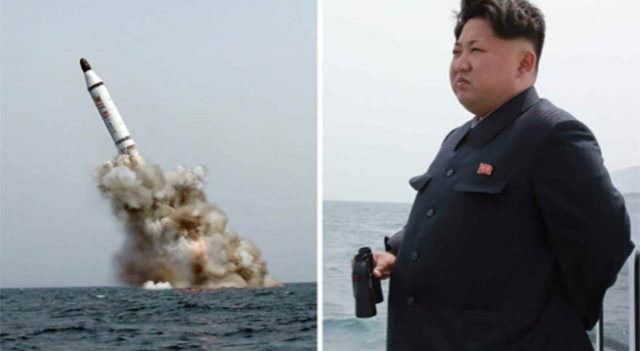


Kim Jong-un watches as North Korea's navy successfully test-launches a ballistic missile from a submarine on May 9.

On May 9, a Korean People's Army Naval Force submarine test-launched a ballistic missile off the eastern coast of North Korea. The test launch, reported by North Korea's Rodong Sinmun newspaper, only traveled about 150 meters, according to South Korean defense officials. But it demonstrated that North Korea had developed the capability of performing submerged launches of missiles well ahead of previous intelligence estimates. Based on the launch, South Korean officials now believe that North Korea could have a limited submarine-launched missile capability deployed to its fleet of submarines within the next five years.
The test comes as South Korea nears a decision on the deployment of a Terminal High Altitude Area Defense (THAAD) anti-ballistic missile system. China has been pressuring South Korea to not allow the deployment, but an earlier, barge-based test of the submarine-launchable missile (named "Polaris-1" by North Korea) on April 22 has made the deployment more likely.
North Korean press images of Kim Jong-un's successful supervision of the "Polaris-1" launch.
Polaris-1 [possibly a BM25-Musudan] [possibly also called "KN-11" or "KN-02"] is apparently a close copy of a Soviet-era R-27 ...SLBM...liquid-fuel SS-N-6 "Serb." This is the third test launch of the missile this year, but it is the first [possibly] submarine launch. Developed in apparent violation of a UN resolution banning North Korean ballistic missile development, the missile could have a range of about 1,500 miles.
The original R-27 was capable of carrying three independent nuclear warheads. An explosion of an R-27 missile caused by a reaction between a seawater leak and fuel residue aboard the Soviet "Yankee" class ballistic missile sub K-219 in 1986 off of Bermuda led to one of the most tense moments in the late Cold War (later breathlessly and inaccurately recounted in one of the worst submarine movies ever, Hostile Waters).
North Korean leader Kim Jong-un, who had previously planned to travel to Russia over the weekend but then cancelled his plans last week, was on hand to observe the launch. "He stressed that the acquisition of the technology of firing ballistic missile from a strategic submarine underwater made it possible for the KPA to possess a world-level strategic weapon capable of striking and wiping out in any waters the hostile forces infringing upon the sovereignty and dignity of Songun Korea and conduct any underwater operation," reported the Korean Central News Agency, North Korea's government news service.

SINPO Class Submarine
Almost all of North Korea's existing submarine fleet is made up of diesel-electric submarines with limited range, including about 20 based on the 1950s Soviet Project 633 ("Romeo") design imported from China or locally built. [North Korea reportedly operates 22 (or 20) Romeo class submarines. Seven were directly imported from China between 1973 and 1975, and the remainder locally assembled with Chinese supplied parts between 1976 and 1995. One apparently sank in an accident in 1985. Four Chinese imported units are based on North Korea’s western coast.]
A new submarine with one or two vertical missile launch tubes in its sail was spotted being built at North Korea's Sinpo South Shipyard last summer. [see photo inserted below
[North Korea's new "SINPO class" submarine (also see) considered capable of launching up to 3 SLBMs - Photo Courtesy http://38north.org/2015/01/jbermudez010815/. 38north wonders "Exactly what missile system would be used in a ballistic missile submarine (SSB) is purely speculative at this point. Several possibilities are a shorter naval version of the Musudan intermediate-range ballistic missile, a Nodong medium-range ballistic missile, naval versions of the solid-fuelled KN-02 short-range ballistic missile or an entirely new system."

Wiki contributors wonder whether the SINPO's design may be derived from old Yugoslav Heroj and Sava small sub designs [1] and/or from medium sized Soviet/Russian Kilo class, or Golf class designs. Wiki also estimated SINPO's weight as "1,000-1,500 tons", length "65.5 meters" and range "1,500 nautical miles". It is difficult to know whether SINPO is diesel-electric or only has a battery (just electric)]
North Korea also obtained 10 Soviet Golf-II diesel-electric ballistic missile submarines, built in the late 1950s, from Russia in 1994. The Golf-II, or "Project 629A," submarines, which are capable of carrying three SLBMs, were transferred by Russia as scrap to North Korea. However, it is now believed that North Korea has been working on reactivating some of the subs and that one was used for the test launch this weekend.
The Golf-II class [Fourteen Golf Is were extensively modified  in 1966–1972 to carry larger, longer range missiles, becoming known as 629A's by the Soviet Navy and Golf IIs by NATO.] carried the R-27 missile toward the end of its active duty in the Soviet Navy and had an operational range of 9,500 nautical miles (about 11,000 miles). They were capable of 17 knots (about 20 mph) when running on the surface and 12 knots (about 14 mph) when submerged. So in theory, a North Korean Golf-II submarine could get in range of the United States for a launch, but it would require being at sea for two to three months to get close enough to strike, transiting a lot of open ocean. The Korean Peoples' Army Navy is mostly a coastal force with no deep-water experience, and diesel subs transiting the Pacific would be easy targets for US sensors and patrols.
The bigger concern is that these subs could evade detection in Korean coastal waters and launch attacks against South Korea and Japan with little warning. Jeffrey Lewis of the California-based Monterey Institute of International Studies told Reuters, "While North Korea's submarines are not especially effective, the challenge of finding even a small number of specific submarines armed with missiles would be quite a challenge.""
Pete

April 21, 2015

Vietnam's (Russian speaking) Kilo Submarine Service

Vietnam ordered 6 Improved Kilo 636s with at least three received from Russia so far.

On April 30, 2015 it was reported that Vietnam has been acquiring 50 anti-ship and land attack 3M-14E Klub (SS-N-27A “Sizzler”) supersonic cruise missiles for its Kilos. Russia has already delivered 28 Klubs to Vietnam over the last two years. Those Klubs may have a range beyond 300km.

Vietnam's Tuoi Tre News reports, April 21, 2015 perceived importance of Russian language training and importance of instilling group feeling in Vietnamese Kilo submarine crews. I wonder if it would be true to say that the Vietnamese are natural soldiers and sailors - given all the wars-threats they've had to face. With Russian and Chinese help Vietnam beat the US and Australia and other allies by the early-mid 1970s (though few here will admit it). Russia, the US and India are now all involved in establishing closer relations with Vietnam - for economic reasons and as part of a wider contain China strategy. The string for the Tuoi Tre News article is  http://tuoitrenews.vn/features/27604/life-at-kiloclass-submarine-brigade-in-vietnam. The article is also reproduced (with photos retained) at Talk Vietnam http://www.talkvietnam.com/2015/04/life-at-kilo-class-submarine-brigade-in-vietnam/ :
 
"Life at Kilo-class submarine brigade in Vietnam"
A Tuoi Tre (Youth) newspaper contributor has expressed her marvel at the wholehearted dedication, rigorous training, and diligent study of the Russian language among the sailors stationed at a submarine base in central Vietnam after a recent visit.
The Tuoi Tre contributor narrated her memorable experiences during her trip to Submarine Brigade 189 under the Vietnam People's Navy.
The brigade is based in the Cam Ranh Military Port, which is situated in Khanh Hoa Province.
Before the brigade was founded in June 2011, selected soldiers joined a training course in Russia in October 2010 prior to passing on what they had learned to their colleagues and juniors at home.
However, rigorous training began well before that.
Over 30 years ago, Submarine Regiment 196 came into being and boasted well-qualified human resources.
Many members of the regiment's force were later transferred to the current Submarine Brigade 189.
Younger recruits to the brigade all excel in technical training, have good physique and stamina, and cope well under pressure.
One of the initial challenges involved newcomers spinning over 100 times and they were requested to regain balance shortly after the spinning came to a stop.
They also took on an immense challenge which required them to stay in a compressed air chamber with its pressure equivalent to that at a depth of 50 to 70 meters.
Such strenuous challenges now become their everyday routines.
Training in dispute management aboard the sub!

The "sailors' arduous physical training did not surprise theTuoi Tre contributor as much as their single-minded devotion to honing their professional skills and command of Russian."

---

[Drill and discipline are a key part of training.]

During her trip to the Russian-supported Submarine Training Center, which is located inside the Cam Ranh Military Port, she was amazed at the perplexingly intricate simulations, diagrams, and annotations written in Russian.
The center is one of Southeast Asia's most state-of-the-art facilities.
An officer affirmed that the sailors and staff there all have an adequate grasp of Russian.
The sailors’ eagerness to learn the Russian language was confirmed after the Tuoi Tre contributor met Team 7, which was once trained in India.
On Friday evening, the members did not watch films or sing together.
The 40-year-old team leader and his juniors as young as 24 years old were totally engrossed in their Russian studies.
Trained in Russia, the Tuoi Tre contributor sought permission to join their learning session.
Her keen observations showed that even those who just took up the language a few months back and mostly learn by teaching themselves are surprisingly proficient in the language.
The Russian experts who the Tuoi Tre contributor briefly talked to earlier during the trip gave them profuse compliments on their diligence, brightness, and willingness to learn.
The brigade received two Kilo-class submarines 182-Hanoi and 183-Ho Chi Minh City over one year ago but the officers and sailors have been in full control of the vessels.
They do not need accompanying Russian experts during their trips that last several days under the sea.
Vietnam signed a contract to buy six Kilo-class subs from Russia during Prime Minister Nguyen Tan Dung’s visit to Moscow in 2009.
Officers and hands on the 184-Hai Phong Submarine also manoeuvered the ship with relative ease thanks to their adequate grasp of the Russian language.
Apart from taking classes in professional skills, the sailors spend 3.5 hours from 7:30 pm to 11:00 pm every day but they still can get up at 6:00 the next morning for a three-kilometer run.
The officers insist only Russian be used in many of their internal meetings.  
No room for errors
Safety and teamwork are the utmost priority among submarine sailors.
“There’s no room whatsoever for errors, as they may cost lives,” the head of Submarine Brigade 189 stressed.
One of the stories which the Tuoi Tre contributor found most compelling was the sonar radar operators’ keen sense of hearing to detect all passing ships of various sizes.
During highly authentic emergency exit drills, whenever some problem arose in a chamber, instead of getting out, the sailors inside that chamber were required to lock themselves tight in and work on the problem in order not to affect other chambers.
The sailors and their special work thrive on their mutual understanding, trust, and willingness to sacrifice for their comrades.
More surprises in store
The Tuoi Tre contributor went from one surprise to another during her stay with Submarine Brigade 189.
One of them was how the male officers and sailors managed to keep their all-white uniforms speckless and crease-free, which is quite a challenge for many housewives [thems fighten words!].
The Tuoi Tre contributor also kept pondering over why all the naval soldiers boast such flawlessly white teeth.
According to Dau Van Hoang, captain of the 184-Hai Phong Submarine, the first priority for submarine sailors is having decay-free teeth.
“Inside the submarines, where oxygen is such a scarcity for several days on end, the entire crew members stay alive on a mixture of air, of which oxygen makes up a mere 29 percent or even a lower percentage,” he explained.
“The exhaled air is always recycled to be inhaled again. If one has decaying teeth, the air would be rendered unusable,” Hoang said with a beaming smile, showing off his immaculately white teeth.
In one of the intriguing stories the Tuoi Tre contributor was told during her trip, Lieutenant Vu Van Dung, of Team 7, was prepared to get married, with his marriage date fixed.
However, he was sent to India for a task right before the wedding.
The two families decided to proceed with the wedding anyway, and Dung’s bride and her family agreed to carry out the bridal ceremony through Skype, a chatting program.
On the wedding day, the bride, the two families, their relatives, and friends celebrated the big day in Vietnam, while the groom attended the ceremony and party through Skype.


A Kilo submarine docks proudly at the Cam Ranh Military Port in Khanh Hoa Province. Photo: Tuoi Tre
Russian-made Kilo-class submarines, dubbed “black holes in the ocean” for its astonishing ability to vanish into the depth of the ocean, were built on a pilot basis during the mid-1990s.
Four electric-diesel Kilo-class subs have been handed over to Vietnam.
The fifth one, [HQ-186 Da Nang] left the Admiralty shipping yard in Russia on a trial run on April 1, 2015.
The sixth, [HQ-187] Vung Tau, whose building began in May last year, is expected to be transferred to Vietnam [in 2016].
"
Pete

April 5, 2015

Chinese Type 093A or 093G SSN armed with YJ-18 Carrier Killer Missiles

What may be 3 Chinese Type 093A/093G SSN or SSGN submarines. An obviously blurry photo of a clarity far below military satellite standards. Nothing as clear as "reading a car's number plate". 
---
What may be a Chinese 093A/093G SSN or SSGN submarine with a vertical launch system with two types of missile [?] and pump jet propulsion.
---
Probably one of China's older model Type 093 "Shang" class SSNs.
---
Depiction of a Klub-Sizzler submarine launched missile which may be similar to China's YJ-18 anti-ship missile.
---

Ecns of China reported April 3, 2015 a new version of China's Type 093 (NATO "Shang class") SSN. The new version is variously named Type 093A or 093G. The ability of 093A/093G to mount vertically launched YJ-18 anti-ship missiles may cause the 093A/093G to be called an SSGN. There  seem to be no reliable photos of the YJ-18.

If the longer length and other differences of the Type 093A/093Gs are accurate it is possible China may eventually rename them Type 095s. The 095 is expected to feature unobservable features including an advanced reactor, lower acoustic signature and the visible VLS tubes (with VLS noted on the 093As/093Gs).

Just a note of caution that the 093A/093G reports seem to rely on 3rd or 4th hand Taiwanese sources in the information loop. The message that 093A/093Gs with their missiles are "carrier killers" of course worries the US. A message that directs more US military attention weapons-money-opportunities to Taiwan is beneficial to Taiwan. Taiwan definitly needs US help to pressure some country to help Taiwan build or acquire four new submarines.

Application of the term "carrier killer" to the YJ-18 should not imply that the YJ-18 is a new threat. There may be many similarities between the 093A/093G's YJ-18 anti-ship missile and the BrahMos, Yakhont or Klub-Sizzler. Significantly the Klub-Sizzler has already been fitted by Russia to China's 12 Russian built Kilo class submarines. Now China is taking the evolutionary (no game-changing) step of fitting Klub equivalents (YJ-18s) to faster moving and longer submerged Type 093A/093Gs.

All this missile activity is not a major departure from conventional and nuclear propelled submarines pre-existing torpedos capabilities - with torpedos being able to "kill"/destroy carriers and other major warships.

The YJ-18 may also owe some design attributes to the YJ-12 "a supersonic Chinese anti-ship missile developed in the 1990s".

Comment - while the YJ-18 sounds like an awesome weapon the hierarchical autonomy, tactics and efficiency of their human operators are very important. The human element is often mistakenly disregarded. How smoothly the YJ-18s fit into China's broader network of anti-shipping sensors is also a consideration.

The report from Ecns of China, April 3, 2015 has the string http://www.ecns.cn/military/2015/04-03/160484.shtml and is below  .

[Chinese PLA] "Navy to get 3 new nuclear subs

   
2015-04-03 09:07China DailyEditor: Si Huan
Three cutting-edge nuclear-powered attack submarines have been manufactured and will soon be commissioned by the Chinese navy, according to media reports.

China Central Television showed a satellite picture earlier this week of three submarines anchored at an unidentified port [see first picture above - very blurry], saying the vessels are China's most advanced Type-093G nuclear-powered attack submarines, just completed by a Chinese shipyard and a waiting delivery.

With a teardrop hull, the submarine is longer than its predecessor, the Type-093, and has a vertical launching system, the report said.

Another article carried by the People's Liberation Army navy's website said the Type-093G's wing-shaped cross-section [?] is designed to improve speed and mobility as well as reduce noise, and that the vertical launcher is capable of delivering the country's latest YJ-18 supersonic anti-ship missile.

China established its nuclear-powered submarine force in the early 1970s but had never shown it to the outside world until 2009, when two nuclear submarines took part in a parade marking the 60th anniversary of the PLA navy's founding.

The Type-093G is reported to be an upgraded version of Type-093, China's second-generation nuclear-powered attack submarine, which entered active service several years ago.

Cui Yiliang, editor-in-chief of Modern Ships magazine, said: "Though China was comparatively late in developing advanced nuclear-powered submarines such as the Type-093G, we used a lot of the most cutting-edge technologies and equipment on our submarines, enabling them to compete with their foreign counterparts."

He noted that China has researched the vertical launching system for many years and has installed it on other submarines and surface ships.

"Judging from the vessel's design, the Type-093G should have strong anti-ship and counter-submarine capabilities," said Yin Zhuo, a senior expert with the navy. "It is also likely to be upgraded with the capability of striking land targets with cruise missiles in the near future."

He added that the navy has formed a reliable logistics system for its nuclear submarine fleet.
Liu Jiangping, a naval equipment expert in Beijing who had served in the PLA navy for decades, said the vessel's vertical launching system enables the submarine to launch long-distance strikes from underwater, increasing the vessel's survivability in war.

The strategic force of the PLA navy now has about four nuclear-powered Type-094 ballistic missile submarines, up to six Type-093 nuclear-powered attack submarines and about three old Type-091 nuclear-powered attack submarines, CCTV quoted foreign media reports as saying.[note the report of six 093's may be Taiwanese deception. Wikipedia (see its sidebar) based on US DoD reports reported only 2 active 093s in June 2014. Wikipedia's sidebar agrees there are 3 active 091s however ].  
---

Another report, from Deagel.com, last updated February 4, 2015, goes into much more detail on the YJ-18 anti-ship missile. The similarity to BrahMos, Yakhont or Klub-Sizzler in function is obvious. The report's string is http://www.deagel.com/Anti-Ship-Missiles/YJ-18_a002884001.aspx :

"YJ-18 [Missile]


Description:

The YingJi-18 (YJ-18 or Eagle/Hawk-18) is a vertically-launched, long-range, supersonic, sea-skimming anti-ship missile designed by China to kill US Navy's Aegis-equipped destroyers or its equivalents provided to Japan, South Korea or European Navies. The YJ-18 is planned for deployment by the newest People's Liberation Army Navy (PLAN) Type 052D class destroyers and subsequently may be incorporated into existing destroyers and submarines as part of a modernization effort. Its guidance system consists of an advanced inertial navigation, maybe backed by the Beidou Chinese GPS, plus an active radar seeker in the terminal phase. Besides, a built-in data link allows the carrier ship to update the target's location. The Aegis-killer missile existence was first reported in 2013 with an entry into service expected by 2014 or later.

The YJ-18 missile is equipped with a 300 kg high explosive (HE) warhead capable of taking out a destroyer-sized ship. The HE warhead can be replaced by an anti-radiation/electromagnetic pulse warhead that is said can take down up to 60 percent of the enemy ship's electronic systems at a range of 50 meters after detonating. After the vertical launch the missile's turbojet engine is capable of flying at a cruise speed of Mach 0.8 for about 180 kilometers after that point the warhead section separates and a solid rocket engine ignites allowing at a top speed of Mach 2.5-3 for about 40 kilometers. The missile can maneuver at 10G acceleration to avoid enemy interception by air-to-air or surface-air missiles. The missile design and performance is very similar to Russia's 3M54E [Klub-Sizzler] which may have been the template for the YJ-18."

Pete

March 23, 2015

Suspected Russian submarine snagging a Scottish trawler net

The "Butt of Lewis" Lewis Point, Outer Hebrides, Scotland at the top of the map. The "Butt"/Point is  the closest point where a suspected encounter with a Russian submarine occurred. On the right is the UK (Scottish) mainland.
---

Faslane Naval Base is in Gare Loch. A Russian submarine may regularly stay on station around 50km or more out to sea.
---
Several UK media outlets have carried a mid-March 2015 report that a submarine snagged on a large net almost dragged a UK (Scottish) trawler under. The reported encounter occurred near the "Butt of Lewis" Lewis Point, Outer Hebrides, Scotland. 

If it was a Russian submarine it was probably a Russian attack submarine (Kilo SSK or Akula SSN) submarine from the Russian Northern or Baltic Fleets. Russian SSBNs would steer clear of northern Scotland where the encounter occurred.

One of the Russian Kilos or Akulas submarines was probably travelling to or from its regular surveillance area where UK (and perhaps US) submarines enter and leave the Faslane Naval Base (HMNB Clyde) 40 km northwest of Glasgow, Scotland. The Russian submarines would ideally wish to follow UK/US submarines leaving Faslane and also intercept UK telecommunications.

Submarine-Trawler Incidents Have a Long History

The revelation of a possible Russian submarine encounter follows more than 100 years of submarines accidentally damaging or wrecking trawlers through net snags and also collisions.

In 2005 the Guardian reported: "Large submarines have also been caught in fishing nets, but usually, the trawlers come off worse. In 1990, four fishermen died when their trawler was dragged under by a British submarine on a training exercise off the west coast of Scotland. A few weeks later, an American submarine ploughed into the nets of a trawler from Northern Ireland, making the vessel heave before ripping the net from its winches."

Submarine collisions destroying small ships also occur. In February 2001, while conducting an emergency main ballast tank blow off the coast of Oahu USS Greeneville struck and sank the 191-foot (58 m) Japanese fishery high school training ship Ehime Maru.

Pete

March 6, 2015

Misleading advice to US Congress on Chinese Submarine Numbers?

The US Navy has used 13 Chinese MING-class (Type 33 to 35A) training submarines (based on the German Type XXI U-Boat, 1945) to boost the Chinese submarine fleet to a threatening "more than 60" which means 61.
---

The US Navy and the Pentagon have always been totally truthful in their advice to Congress or that is the ideal, anyway.   

The latest example are comments of a senior US Admiral in late February 25, 2015 who said  “[China's] submarine force has grown over a tremendous rate. They now have more diesel and nuclear attack submarines than we have so they’ve passed us in total quantity - but in quality they are still not there,”  

"but in quality they are still not there” is correct.  

Admiral M's use of flowery language - particularly China is building some "fairly amazing submarines" - should put any cynical politician on guard. 

So how many submarines does China have? The answer from the Pentagon is "more than 60"

The Pentagon's Annual Report to Congress: China Report 2014 (ever after called China Report 2014) reported on Page 7 "more than 60 submarines" and on Pages 7-8 actual submarines types and quantities were identified - which were less than 60. These were: 

-  3 JIN-class (Type 094) second generation SSBN. The JL-2 SLBM's are still being tested and PLAN doctrine suggests the JL-2s are not usually carried, for security and political reasons. 

-  2 SHANG-class (Type 093) second generation SSNs are in service,


-  4 HAN-class (Type 091) "aging" first generation SSNs  . These rely on 1960s technology. China Report 2014 does not specify numbers. However only 5 were built of which at least 1 is considered decommissioned.

-   12 YUAN-class SSP (called Type 039A or Type 041) as the 039A has very little resemblance to the 039 it is commonly referred to as the Type 041. The Type 039A/041 possibly has Stirling Air Independent Propulsion (AIP) sold to China by Sweden

-  13 SONG-class SS (Type 039)


-  12 KILO-class submarines acquired from Russia in the 1990s and 2000s

The China Report 2014 only details 46 submarines. 

Question: So how is "more than 60" derived?

Answer: reach 61 Chinese submarines (presumably) by adding:

-  13 MING-class (Type 033 to 035A). These are 1950's technology that are not mentioned in China Report 2014. They are used by China for training only. These are totally obsolete, being closely based on the 70 year old Russian ROMEO-class which in turn were based on Germany's Type XXI U-Boat of World War Two. Two of them may now be going to the navy of Bangladesh. Figure of 13 here. MINGs may be equivalent to US post-war GUPPY uprades. and

-  2  XIA-class (Type 092) SSBNs. They are 1970s technology and also are not mentioned in China Report 2014. One may be active. The other is considered lost in an accident.

So "more than 60" means 61. One of those 61 (a XIA) may be permanenetly submerged and two MINGs might soon be gifted to Bangladesh - hence 58 on publically known figures - and that is a stretch. 

Meanwhile "A spokeswoman said the U.S. Navy had 71 commissioned U.S. submarines." 

It should be left to the reader to assess whether Admiral M and the China Report 2014 are accurate or misleading.

FURTHER ANALYSIS


There is a vast gulf in quality and also availability of the US’s 52 all nuclear propelled attack submarines (SSNs) verses China’s 6 SSNs and 50 diesel-electric (SSKs). The US has paid a much higher price for nuclear submarines because they are of much higher quality overall than conventionally propelled submarines.

It is hard to measure quality but such measures like generation, displacement and crew size would be indicative.

Within the US submarine service the average US attack sub would be 5th Generation nuclear Los Angeles http://en.wikipedia.org/wiki/Los_Angeles-class_submarine of:
- 6,000 tons surfaced
- combined Blue/Gold crew size 2 x 130 = 260, giving it at least twice the availability of a one crew Chinese sub.

The average Chinese attack sub is 2nd generation diesel/electric Song Class http://en.wikipedia.org/wiki/Type_039_submarine .
- probably 2,000 tons surfaced
- crew of 60.

In terms of number of US attack subs this US Navy Fact File of August 2014  http://www.navy.mil/navydata/fact_display.asp?cid=4100&tid=100&ct=4
 indicates about 53 SSNs, including:

  3     Seawolf
41-2  Los Angeles (maybe 2 less since Aug 2014?)
11     Virginias (including North Dakota commissioned Oct 2014)
------
53 Attack submarines nuclear (SSN)

14 Ohio SSBN
  4 Ohio SSGN
-----
71 Total US Submarines

This is verses a total of 61 Total Chinese submarines - of which 56 or 57 may be attack subs.

A small number of Chinese submariners would have gained experience on the two 2nd Generation Shang class SSNs.

Some USN submariners may have gained experience on SSKs of US allies.

A good comment on the pattern of US Navy-Pentagon fear mongering is here.

Pete

January 2, 2015

Bangladesh, Philippine, Burma and Thailand Submarine Issues

One of China's remaining Type 035 Ming-class conventional submarine soon to be scrapped or sold off to Bangladesh (and other small nations?).
---

A Russian built Kilo conventional submarine - main users are Russia, India and China. Vietnam is a growing operator (having bought 6).
---

India feels threatened by the prospect of increasing Chinese submarine proliferation in the Indian Ocean. Such proliferation comes through such means as:

-  Chinese anti-piracy conventional and nuclear propelled subs moving across the Indian Ocean for operations off the Horn of Africa,
-  submarine visits to such ports as Columbo, Sri Lanka, and
-  sale of Chinese subs to such Indian neighbours as Bangladesh (around 2019) and perhaps in future to Burma and Pakistan (see India's "West Coast Worries").

For more than a year there have been reports of a pending sale of obsolescent Chinese Ming-class submarines to Bangladesh. See my article http://gentleseas.blogspot.com.au/2013/12/china-selling-two-type-035-ming-class.html of December 24, 2013. It is highly likely that, after expected delivery of the Mings in 2019, part of a Bangladesh Ming crew and on-shore maintainers would be Chinese for a transition period. This would cause a range of anxieties in India.

In late 2014 Indian intelligence and the Indian Ministry of External Affairs have pushed the possibility (or for India a hope) that Bangladesh might buy Russian submarines instead.

It is unclear whether these "Russian" Submarines would be:
- new build Kilos (surely too expensive for Bangladesh without credit-finance)
- used Kilos from Russia (cheaper but probably unreliable with a short remaining service life) or
- ex-Indian Kilos (cheaper but probably unreliable with a short remaining service life).

Two nations that probably will not buy submarines in the short to medium term are:

- the Philippines (it usually receives low-or-no cost used naval and coastguard vessels) - see http://thediplomat.com/2014/12/the-philippine-navys-submarine-quest/  December 31, 2013, 

- Thailand - http://thediplomat.com/2015/01/thailand-eyes-submarine-fleet/, January 4, 2015,
  Pete's Comment: If Thailand bought used Ming subs from China Thailand might receive them in 2019 - depending on Chinese modifications. Used Kilos are harder to estimate. If Thailand prefered 2 or 3 new submarines costs would be much higher and involve:
- significant lead times for negotiating, ordering and building submarines - generally around 6 years for a new customer like Thailand
- in the case of South Korea as a supplier a backlog of pre-existing orders might perhaps cause delays. This may mean a minimum delivery year of 2020 for Thailand to receive the first sub then add 3 years for commissioning (tests, trials and training) the sub into the Thai Navy ie. 2023.

Pete