Showing posts sorted by relevance for query bangladesh. Sort by date Show all posts

March 17, 2017

Bangladesh's 2 Ming Submarines are part Chinese Crewed

COMMENT

China is putting India's two nuclear submarines (INS Arihant and INS Chakra II) at Fleet Base East, Vishakhapatnam, Bay of Bengal, Indian Ocean, under regular surveillance and kinetic threat of sinking. Chinese SSNs and SSKs frequenting the Bay of Bengal provide platforms for this surveillance, but the long China to Bay of Bengal (and return) missions are exhausting for Chinese crews. The missions are also well observed, through Malacca Strait/Andaman Sea sensors and Chinese submarine and submarine tender port stops in nearby Sri Lanka

So the two Bangladeshi Mings, partly manned (and likely part officered) by Chinese crews offer more regular, more covert, surveillance opportunities. China sold the Mings to Bangladesh at the heavily discounted $100 million each, partly because of this bi-nation crewing value to China.

YOUTUBE REPORTS

On March 12, 2017 Bangladeshi Prime Minister, Sheikh Hasina, officially commissioned the 2 refurbished Chinese built Type 035G (NATO designation "Ming") class submarines, BNS Nabajatra and BNS Joyjatra.

Youtube 1.

This November 2016, 7 minute, Youtube here in English is an excellent analytical discussion of Why did Bangladesh Buy from China? Journalist/Editor, Bharat Bhushan interviews the Indian ex-High Commissioner to Dhaka/Bangladesh, Pinak Ranjan Chakravarty.
------------------------------------------------------------------------------------------------

Youtube 2.

The following Youtube I think is mainly spoken in Bengali with a long stretch. 6:10 to 7:40. in English.

50 seconds obvious update modification to the bow sonar

1:23 good shot of the 2 Mings out of the water on a lift ship

2:00 Bangladesh initially interested in buying Songs ($250 million per Song) and S20s but couldn’t 
        afford even the Chinese discount prices

2:25 the last two Mings China built have AIP [probably used as testbeds for the Yuan’s Stirling
        AIP]

2:30 Bangladesh paid $203 million Total for the 2 Mings

3:10 Bangladesh’s confrontations with Myanmar/Burma around 2008 finally convinced
        Bangladesh to buy subs. There were also, yet unproven, suspicions Myanmar might buy subs

3:40 Bangladesh needs assistance from many Chinese crew for operation of the 2 Mings

5:00 the 2 Mings may just be the first of a larger Bangladeshi submarine service

6:10 to 7:40 gives Specifications, especially for weapons and propulsion in English

7:18 admission the Ming’s quite old Yu-1 torpedos were “reverse engineered” by China from 
        Russian Type 53-51 torpedos

Please connect with Submarine Matters' China selling two Type 035 Ming-class submarines to Bangladesh of December 24, 2013.

Pete

December 24, 2013

China selling two Type 035 Ming-class submarines to Bangladesh

Chinese Type 035 Ming-class submarines. Two Mings are being sold to Bangladesh for delivery 2019.
------------------

http://thediplomat.com/2013/12/china-to-sell-bangladesh-2-submarines/ based on a Bangladeshi New Age article http://newagebd.com/detail.php?date=2013-12-20&nid=77363#.Urjor2fxvX5

The Ming-class submarines (Type 035) are medium sized diesel-electric submarines. In the 1960s China reverse engineered the Russian Romeo Class into the Chinese Romeo-class Type 033. The Ming-class Type 035 were developed in the 1970s from the Romeo Type 033. China built more than 20 Mings from the 1980s to 2000s in part as a hedge against more risky, higher tech conventional sub projects being delayed particularly the Song-class, Type 039 submarine


Globalsecurity reports that compared to the Romeos the Ming features more powerful diesel-electric propulsion, higher battery capacity, improved propeller and maneuverability, improved seakeeping and underwater endurance and is quieter. 

Chinese Defence Today reports that the Ming has a improved, more streamlined hull design than the Romeos, new engine gearing, all resulting in increased submerged speed. transferring mechanism were used to achieve a higher underwater speed. The Ming also has an improved combat system.


On February 28, 2014 Ahmed Sharif provided some valuable clarifying comments:
"Bangladesh's submarine program is at least 10 years old. In March 2004, a govt. minister told the Parliament about buying 4 subs by 2012. But due to political turmoil, the program got delayed, until late 2008, when a naval confrontation with Myanmar accelerated everything. The program got more acceleration after reports of Myanmar Navy's plans to acquire subs. Over the years, at least 100 sailors received submarine training both in Turkey and in China. There's no reason to believe that the subs would be operated by 17 sailors. Of course initial operation may require Chinese help, but Bangladesh Navy sets a high standard in training and operations, which indicates that even if there is Chinese assistance, it would be for a very short period of time. And these subs are arriving in 2015, not in 2019. This was recently confirmed by a high-placed govt. official to the media. And on another note, the 2 subs are likely to be first batch of a bigger submarine arm. Things are likely to be determined by the economic growth of the country."

SPECIFICATIONS  for China's Type 035 Ming-class submarinefrom in Chinese Defence Today dated May 10, 2006, include: 

TORPEDOES

Eight 533mm torpedo tubes (6 bow, 2 stern), carrying a total of 18 torpedoes in tubes and storage racks. Alternatively the submarine can carry 32 mines in its tubes.

The Yu-4 (SAET-60) is a passive homing torpedo designed to attack surface targets up to 15km at a speed of 40 knots. The high-explosive warhead weights 400kg.

The Yu-1 is reverse engineered from the Russian Type 53-51, which was designed to attack surface targets with a maximum range of 9.2km at a speed of 39 knots, or 3.7km at 51 knots. The high-explosive warhead weights 400kg.

SENSORS

Fitted with a Pike Jaw hull-mounted, medium-frequency for active and passive search and attack. Later Mings are also equipped with a Sintra DUUX 5 low-frequency passive ranging and interception. The Ming has an I-band surface search radar (NATO code-name: Snoop Tray).

Countermeasures include electronic support measures (ESM), radar warning receiver and direction-finder.

PROPULSION

Diesel-electric arrangement, consisting of 2 Shaanxi 6E 390 ZC1 diesel rated at 5,200hp (3.82MW), with 2 Xiangtan alternators and 2 shafts.

Displacement (Surface): 1,584 tons
Displacement (Submerged): 2,113 tons
Length: 76m
Beam: 7.6m
Draft: 5.1m
Speed: (Surfaced) 15 knots, (Dived) 18 knots, (S
norting) 10 knots 
Diviing Depth: N/A
Endurance: 8000 miles at 8 knots snorting, 330 at 4 knots dived.
Crew: 57 (10 officers)

PETE's COMMENT

It must be remembered that the Ming is a improvement on basic 1950s Russian submarines. Its (pre-teardrop) design and electronics may make the current Ming equivalent to a British Oberon Class submarine of the early 1970s. That said the Ming is inexpensive so Bangladesh can probably afford two.

Bangladesh's two Mings, when handed over by 2019 are probably strongest in brown and green water defensive warfare in the northern Bay of Bengal around Chittagong.
-
Pete

January 2, 2015

Bangladesh, Philippine, Burma and Thailand Submarine Issues

One of China's remaining Type 035 Ming-class conventional submarine soon to be scrapped or sold off to Bangladesh (and other small nations?).
---

A Russian built Kilo conventional submarine - main users are Russia, India and China. Vietnam is a growing operator (having bought 6).
---

India feels threatened by the prospect of increasing Chinese submarine proliferation in the Indian Ocean. Such proliferation comes through such means as:

-  Chinese anti-piracy conventional and nuclear propelled subs moving across the Indian Ocean for operations off the Horn of Africa,
-  submarine visits to such ports as Columbo, Sri Lanka, and
-  sale of Chinese subs to such Indian neighbours as Bangladesh (around 2019) and perhaps in future to Burma and Pakistan (see India's "West Coast Worries").

For more than a year there have been reports of a pending sale of obsolescent Chinese Ming-class submarines to Bangladesh. See my article http://gentleseas.blogspot.com.au/2013/12/china-selling-two-type-035-ming-class.html of December 24, 2013. It is highly likely that, after expected delivery of the Mings in 2019, part of a Bangladesh Ming crew and on-shore maintainers would be Chinese for a transition period. This would cause a range of anxieties in India.

In late 2014 Indian intelligence and the Indian Ministry of External Affairs have pushed the possibility (or for India a hope) that Bangladesh might buy Russian submarines instead.

It is unclear whether these "Russian" Submarines would be:
- new build Kilos (surely too expensive for Bangladesh without credit-finance)
- used Kilos from Russia (cheaper but probably unreliable with a short remaining service life) or
- ex-Indian Kilos (cheaper but probably unreliable with a short remaining service life).

Two nations that probably will not buy submarines in the short to medium term are:

- the Philippines (it usually receives low-or-no cost used naval and coastguard vessels) - see http://thediplomat.com/2014/12/the-philippine-navys-submarine-quest/  December 31, 2013

- Thailandhttp://thediplomat.com/2015/01/thailand-eyes-submarine-fleet/, January 4, 2015,
  Pete's Comment: If Thailand bought used Ming subs from China Thailand might receive them in 2019 - depending on Chinese modifications. Used Kilos are harder to estimate. If Thailand prefered 2 or 3 new submarines costs would be much higher and involve:
- significant lead times for negotiating, ordering and building submarines - generally around 6 years for a new customer like Thailand
- in the case of South Korea as a supplier a backlog of pre-existing orders might perhaps cause delays. This may mean a minimum delivery year of 2020 for Thailand to receive the first sub then add 3 years for commissioning (tests, trials and training) the sub into the Thai Navy ie. 2023.

Pete

December 7, 2014

South Asian Submarine Issues

Sandeep Unnithan of India Today, December 4, 2014, has produced a higly detailed article on South Asian submarine issues - and also an excellent map. I have added some hyperlinks and additional comments and some corrections in [square brackets] to the article. It may take India 20 years to deploy K4 SLBMs (not yet developed) in Indian SSBNs (not yet launched). Article string is http://indiatoday.intoday.in/story/china-submarine-noose-using-undersea-vessels-to-project-power-in-india/1/405191.html :

China's submarine noose around India

Submarine game: How China is using undersea vessels to project power in India's neighbourhood
  December 4, 2014 


Four decades after the 1971 India-Pakistan war, India's intelligence agencies are once again scanning a stretch of coastline in southern Bangladesh. Cox's Bazar [in what was East Pakistan - now Bangladesh]  was rocketed and strafed by [the old] INS Vikrant's fighter aircraft to cut off the enemy's retreat into the Bay of Bengal. Today, 43 years later, it sets the stage for China's dramatic entry into India's eastern seaboard.

Assessments from [Indian external intelligence service known as] the Research and Analysis Wing (RAW) and naval intelligence say the Bangladesh Navy will station two ex-Chinese Ming-class submarines on bases that are less than 1,000 km away from [India's main east coast naval base] Visakhapatnam, home to the Indian Navy's nuclear powered submarine fleet  [INS Chakra II and INS Arihant] and the Defence Research and Development Organisation's (DRDO) missile test ranges at Balasore.

The developments on India's Arabian Sea flank are equally ominous. Intelligence officials say that over the next decade, China will help Pakistan field submarines with the ability to launch nuclear-tipped missiles from sea. Submarines, analysts say, are China's instrument of choice to not just challenge the Indian Navy's strategy of sea domination but also to undermine India's second-strike capability. These developments have been accompanied by a flurry of Chinese submarine appearances in the Indian Ocean this year-Beijing sent two nuclear submarines and a conventional submarine. Two of them made port calls in Colombo [Sri Lanka], triggering concern in New Delhi.

Toehold in the Bay

"No one interested in geopolitics can afford to ignore the Bay of Bengal any longer," [semi-governmental US] geopolitical analyst Robert Kaplan wrote in a seminal essay in Stratfor in November. "This is the newold centre of the world, joining the two demographic immensities of the Indian subcontinent and East Asia." For India, the Bay of Bengal is the launch pad for a 'Look East' policy that has received renewed attention under [Indian] Prime Minister Narendra Modi.

The Indian Navy is enhancing force levels at its Visakhapatnam naval base even as it has begun building a secret base for a proposed fleet of nuclearpowered submarines at Rambilli [at what will be INS Vasha] , south of Visakhapatnam.

[Future Indian SSBN Base INS Varsha]

[Wikipedia's at length advice is http://en.wikipedia.org/wiki/INS_Varsha will "de-congest the Visakhapatnam Port, which is used by both the navy and the civilian Ministry of Shipping. The navy's dockyards at Vizag are facing shortage of berthing space due to the rapid expansion of the Eastern fleet, which grew from 15 major warships in 2006 to 46 in 2012, and is still expanding. Varsha will have a large near-by [east coast] facility of the [west coast headquartered] Bhabha Atomic Research Centre (BARC), and will include modern nuclear engineering support facilities and extensive crew accommodation. It is designed to support the fleet of 8-12 Arihant-class [SSBN] nuclear submarines to be built for the Indian Navy. It will also have underground pens to hide the submarines from spy satellites and protect them from enemy air attacks. The navy is seeking foreign technical assistance [French or Russian?] pertaining to nuclear safety features for the base.[5] While designed principally as a nuclear submarine support facility, the new base can accommodate other naval vessels because of the Indian Navy's expansion. This facility has been compared to the top-secret [Sanya] Hainan nuclear submarine base for the Chinese PLA Navy. This east coast base expansion program by the Indian Navy was started due to India's Look East policy and the Chinese naval expansion into the region.[1][3][6]
In addition to Project Varsha, in late 2009, the Hindustan Shipyard Limited (HSL), located at Visakhapatnam, was transferred from the Ministry of Shipping to theMinistry of Defence in order to support the Arihant-class nuclear submarine construction program. These new vessels will be based at INS Varsha.[1][7] INR1.6 billion (US$26 million) were sanctioned for the project in the 2011-12 budget, of which INR580 million (US$9 million) were for civil works and the balance INR1 billion(US$16 million) were for setting up a VLF communication system.[8]]

[Article continues] "Equipped [in 5 years time? with the "B05" more widely called "K-15", SLBMs] with the 700-km range, the Arihant-class submarines will have to patrol closer to the shores of a potential adversary. But equipped [in 20 years time?] with the 3,500-km range K-4 missiles currently being developed by the DRDO, the Arihant and her sister submarines can cover both Pakistan and [part of China] with nuclear-tipped missiles from within the Bay of Bengal, providing the "robust second-strike capability" as stated in India's nuclear doctrine.

Inputs suggest Bangladesh has acquired land and fenced locations at the Kutubdia Channel near Cox's Bazar and the Rabnabad Channel near West Bengal. Kutubdia, intelligence officials say, is likely to feature enclosed concrete 'pens' to hide submarines. The possibility of Chinese submarines using this base provides a fresh equation to the strategic calculus.

"Our submarines become susceptible to tracking from the time they leave harbour," says veteran submariner and former Southern Naval Command chief vice-admiral K.N. Sushil (retired). "But a far more worrying strategy is China's ability to be able to threaten our assured second-strike capability. That effectively tips the deterrence balance."

West Coast Worries

Of greater long-term worry to Indian analysts is a strategic submarine project China finalised with Pakistan in 2010. Intelligence sources say this three-part programme will transform the Pakistan Navy into a strategic force capable of launching a sea-based nuclear weapons strike [initially from Pakistan's French designed Agosta Khalid class SSKs]. Pakistan will build two types of submarines with Chinese assistance: the Project S-26 and Project S-30. The vessels are to be built at the Submarine Rebuild Complex (SRC) facility being developed at Ormara, west of Karachi. Intelligence sources believe the S-30 submarines are based on the Chinese Qing [apparently an export version of China's Type 041 Yuan class SSK] of 3,000-tonne which can launch three 1,500-km range nuclear-tipped cruise missiles from its conning tower.

[The purported Projects 26 and 30 tie in with rumours for several years that China might sell some SSKs to Pakistan. The more public reason the sale has not occurred is that Pakistan doesn't not have the money. Also it was only recently that Pakistan upgraded its 3 Agosta-Khalid SSKs with AIP. Perhaps political pressure on China and Pakistan from India and the US has delayed such a Chinese submarine sale. Also perhaps financial pressure on Pakistan [in terms of overt and covert US aid money] has terminated or delayed such a China-Pakistan submarine deal.]

A [Pakistani-Chinese] Very Low Frequency (VLF) station at Turbat, in southern Balochistan, will communicate with these submerged strategic submarines [and probably Chinese subs in the Indian Ocean]. The Project S-26 and S-30 submarines will augment Pakistan's fleet of five French-built submarines, enhance their ability to challenge the Indian Navy's aircraft carrier battle groups and carry a stealthy nuclear deterrent. "Submarines are highly effective force multipliers because they tie down large numbers of naval forces," says a senior naval official.

Steel sharks on silk route

Speaking in Indonesia's Parliament last October, Chinese President Xi Jinping articulated a "21st century Maritime Silk Road". His vision calls for investments in port facilities across south and south-east Asia to complement a north Asian route. This year, the People's Liberation Army Navy (PLAN) put steel into Xi's vision. In February, a Shang class nuclear-powered attack submarine made China's first declared deployment in the Indian Ocean. This was followed by port calls made by a [Chinese Type 091 Han class SSN in November 2014] in Colombo to coincide with a state visit by President Xi [CORRECTION: preceded by a visit from a Chinese Type 039 Song class SSK in September 2014].

China's heightened activity in the Indian Ocean region is underscored by investments in a new port in Gwadar at the mouth of the Strait of Hormuz, Hambantota port in Sri Lanka, a container facility in Chittagong and Kyaukpyu port in Myanmar. "Such developments have sharpened China's geopolitical rivalry with India, which enjoys an immense geographic advantage in the Indian Ocean," says Brahma Chellaney of the Centre for Policy Research. "Aspects related to their (Chinese) deployment in international waters are part of securing their maritime interests," Navy chief Admiral Robin K. Dhowan told journalists in Delhi on December 3.

China's new military posture reflects the 'Malacca dilemma' faced by the world's largest oil importer. Close to 80 per cent of China's crude oil imports of 11 million barrels per day, the life blood of its economy, is shipped through the narrow Malacca Strait. Any disruption to this could threaten its economic growth. "Hence, China's economic interests in the Indian Ocean have now taken on an overt military dimension," says an intelligence official.

Naval intelligence officials who correctly predicted that China would use anti-piracy patrols as a pretext for deployments in the Indian Ocean feel vindicated. Their prognosis of this game of 'weiqi'-a game of Chinese chess which uses encirclement, is gloomy. "A full-scale Chinese deployment in the Indian Ocean is inevitable," an admiral told India Today.

"You can only watch it and prepare yourself for it." The preparations include acquisitions of long-range maritime patrol aircraft such as the US-made P8-I Poseidon, investment in anti-submarine warfare and inducting new submarines and helicopters to fill up critical deficiencies in force levels.

Measured Response

China's submarine thrust into South Asia coincides with Narendra Modi's renewed emphasis on securing India's perimeter. "India's response has to be nuanced, a mixture of coercion and largesse," says Jayadeva Ranade, a former RAW official and member of the National Security Advisory Board. While the [previous Indian Government of former Prime Minister] Manmohan Singh-led UPA government scoffed at encirclement theories, the new Government is clearly concerned over the creeping Chinese presence.

National Security Adviser Ajit Doval voiced India's concerns at the 'Galle Dialogue' in Sri Lanka on December 1. He cited a 1971 United Nations General Assembly (UNGA) resolution mooted by Sri Lanka calling on the "great powers to halt further escalation and expansion of their military presence in the Indian Ocean".

India's defence diplomacy has been severely limited by its inability to offer military hardware to offset the Chinese presence. Over half the military hardware of Bangladesh and Sri Lanka are of Chinese origin. In 2008, India called off a plan to transfer the INS Vela to the Myanmar Navy when it discovered the vintage Russian-built submarine was past its service life.

When plans to transfer hardware materialise, they are too feeble to make a difference-a solitary helicopter such as the one gifted to Nepal by Modi in November and a small ex-Indian naval patrol craft gifted to Seychelles recently. Often, there is a demand for capabilities where India itself is deficient. Bangladeshi officials stumped Indian Ministry of External Affairs (MEA) officials last year when they asked India, and not China, to provide submarines. The Indian Navy is down to just 13 aging conventional submarines. The MEA suggested Bangladesh buy Russian submarines instead. Their efforts are yet to bear fruit. It is a gap China willingly fills."

Link this with Submarine Matters' India's Plans for 21 More Subs including SSNs of August 24, 2014

Pete

November 15, 2012

World Bank Research including Sea Level Rise


 -
 Not connected with the World Bank paper - presumably the fate of Manhattan of a 5+ metre sea level rise (SLR).
 
The World Bank appears to be involved with a great deal of research http://econ.worldbank.org/WBSITE/EXTERNAL/EXTDEC/EXTRESEARCH/0,,menuPK:469435~pagePK:64165236~piPK:64165141~theSitePK:469382,00.html :

on energy and the environment http://econ.worldbank.org/WBSITE/EXTERNAL/EXTDEC/EXTRESEARCH/EXTPROGRAMS/EXTEAER/0,,menuPK:5991692~pagePK:64168176~piPK:64168140~theSitePK:5991650,00.html

encompassing climate change
http://econ.worldbank.org/WBSITE/EXTERNAL/EXTDEC/EXTRESEARCH/EXTPROGRAMS/EXTEAER/0,,contentMDK:22200707~pagePK:64168182~piPK:64168060~theSitePK:5991650,00.html

As an example of what the World Bank researches - one easily visualized climate change risk and process is sea level rise. The World Bank has produced a 2007 
Policy Research Working Paper  "The impact of sea level rise on developing countries : a comparative analysis" http://econ.worldbank.org/external/default/main?ImgPagePK=64202988&entityID=000016406_20070209161430&pagePK=64165259&theSitePK=469382&piPK=585673

The Summary reads:

"Sea level rise (SLR) due to climate change is a serious global threat. The scientific evidence is now overwhelming. Continued growth of greenhouse gas emissions and associated global warming could well promote SLR of 1m-3m in this century, and unexpectedly rapid breakup of the Greenland and West Antarctic ice sheets might produce a 5m SLR. In this paper, the authors have assessed the consequences of continued SLR for 84 developing countries. Geographic Information System (GIS) software has been used to overlay the best available, spatially-disaggregated global data on critical impact elements (land, population, agriculture, urban extent, wetlands, and GDP) with the inundation zones projected for 1-5m SLR. The results reveal that hundreds of millions of people in the developing world are likely to be displaced by SLR within this century, and accompanying economic and ecological damage will be severe for many. At the country level, results are extremely skewed, with severe impacts limited to a relatively small number of countries. For these countries (such as Vietnam, A. R. of Egypt, and The Bahamas), however, the consequences of SLR are potentially catastrophic. For many others, including some of the largest (such as China), the absolute magnitudes of potential impacts are very large. At the other extreme, many developing countries experience limited impacts. Among regions, East Asia and the Middle East and North Africa exhibit the greatest relative impacts. To date, there is little evidence that the international community has seriously considered the implications of SLR for population location and infrastructure planning in developing countries. The authors hope that the information provided in this paper will encourage immediate planning for adaptation.

The Paper concludes:

"Even if greenhouse gas (GHG) emissions were stabilized in the near future, thermal  expansion and deglaciation would continue to raise the sea level for many decades.

 Continued growth of GHG emissions and associated global warming could well promote SLR [sea level rise] of 1m-3m in this century, and unexpectedly rapid breakup of the Greenland and  West Antarctic ice sheets might produce a 5m SLR. In this paper, we have assessed  the consequences of continued SLR for 84 developing countries.            

Our results are  extremely skewed, with severe impacts limited to a relatively small number of countries. For these countries (e.g., Vietnam, A.R. of Egypt, The Bahamas), however, the consequences of SLR are potentially catastrophic. [bolded by Pete for emphasis] For many others, including some of  the largest (e.g., China), the absolute magnitudes of potential impacts are very large. At the other extreme, many developing countries experience limited impacts.             

Among  regions, East Asia and Middle East/North Africa exhibit the greatest relative impacts. In this conclusion, we would like to highlight two important implications of our findings. First, the overall magnitudes for the developing world are sobering: Within this century,  hundreds of millions of people are likely to be displaced by SLR; accompanying  economic and ecological damage will be severe for many. The world has not previously  faced a crisis on this scale, and planning for adaptation should begin immediately. Second, international resource allocation strategies should recognize the skewed impact distribution that we have documented in this paper. Some countries will be little-affected  by SLR, while others will be so heavily impacted that their national integrity may be threatened. Given the scarcity of available resources, it would seem sensible to allocate  aid according to degree of threat.

 Under the provisions of the United Nations Framework Convention on Climate Change (UNFCCC), some work has begun on National Adaptation Programmes of Action  (NAPAs). These are intended to facilitate the identification of priority activities, including  adaptation to SLR, for the least-developed countries. To date however, only 8 countries  have developed comprehensive NAPAs: Bangladesh, Bhutan, Comoros, Djibouti,  Malawi, Mauritania, Niger and Samoa. Of these, five are coastal states with potential  SLR problems. For comparison, our summary above reveals 10 poor countries that will be very severely impacted by SLR. With the exceptions of Bangladesh and Mauritania, none are included in the NAPA list above: Benin, Guyana, Suriname, A.R. of Egypt, The Gambia, Guinea-Bissau, Mauritania, Vietnam, Bangladesh and Sri Lanka. Many other developing countries will also experience significant impacts.

 We should reiterate that these results are not speculative: The current atmospheric concentration of GHG's is sufficient to drive global warming well into the next century, and much higher concentrations will undoubtedly be reached before any global  agreement can be implemented. For precautionary planning purposes, SLR in the range of 1m - 3m should therefore be regarded as realistic. To date, however, there is little evidence that the international community has seriously considered the implications for  population location and infrastructure planning in many developing countries. We hope  that the information provided in this paper will encourage more rapid action on this front."


June 27, 2015

Chinese Yuan Submarines for Thailand and Pakistan?

What may well be a Chinese Type 039A "Yuan" class submarine. An S-26T derivative may be  exported to Thailand.
---

For the latest on Thailand's on-again, off-again interest in submarines see Submarine Matters Does Thailand Need Submarines At All? August 12, 2015.

To go back three months mDeletey post Thailand may eventually purchase two submarines, March 25, 2015  identified the possibility the Thai Navy may want two diesel-powered submarines with displacement of 2,400-3,000 tonnes. The source said the Chinese-made Yuan class is favoured by the committee due to its specifications. The "U-class" [do they mean U-209 class?] from South Korea and Germany also pinged the sonar screen." 

Later, on June 25, 2015. a Bangkok Post article indicated:
the navy said a committee working on a plan to buy submarines has finalised its option - it's likely to go for the Chinese-made submarines - and will submit the proposal to the cabinet for approval next month...The 36-billion-baht [US$1.07 Billion] budget covers two submarines, as well as maintenance and training of the navy's personnel. Some reports say China has offered special, undisclosed packages to win the deal. Sources in the navy said there are two short-listed countries. China is the No.1 option, followed by South Korea."

The next day (June 26, 2015) the Bangkok Post reported China is offering three submarines (“12 billion baht [US$355 million] each”) with Germany or South Korea possible second choices and Russia, Sweden and France eliminated.

COMMENT

The unusual decision making process of the Navy declaring a possible result may be a strong encouragement for the Cabinet to finally make a decision after much submarine acquisition hesitancy over the years. Lack of Navy clarity on whether it will get three or two submarines, for the US$Billion total, might indicate the Navy is hoping for three.

China is an unconfirmed choice with room that the Thailand may still be aiming for a better deal from South Korea or Germany before the Thai Cabinet (including the dominant Army representation) makes the final decision.

If China is finally chosen then a submarine with some features of the large Type 039A "Yuan" class submarines and some features of the smaller Type 035 Ming class is possible. The result of this Yuan-Ming combination may be the "S-20" with specifications including: 1,850 tons (surfaced), Range: 8,000 nm at 16 kn, crew of 38, with or without Stirling AIP. China more specifically may be offering a Yuan S-26T (T for Thailand) version .

Three new subs (with support and training) for US$1 Billion is mysteriously cheap. Despite the Yuan S-20 or S-26T drawing-board designs it is unclear whether China is offering:

-  new build submarines?

-  used and refurbished?

-  Stirling AIP included?

Chinese Submarines sold to Bangladesh and maybe Pakistan (?)

China’s submarine sales at low prices campaign is a major new political phenomenon. Economically this is in competition with European, South Korean and potential Japanese suppliers. In late 2013 China had its first submarine export success in concluding a deal to sell two obsolete Type 035 “Ming” class submarines to Bangladesh

Pakistan has long repeated claims over the years that China is “about to” export varying numbers of submarines to Pakistan. To date this has appeared wishful thinking - however a more substantial news article has come to hand that records a visit of a Chinese Yuan to Karachi around May 22-29, 2015 - it being possible the Pakistan's body politic are being provided a pre-purchase or pre-gift inspection.

In the area of possibilities North Korea is always a potential recipient of submarines as is Myanmar. The Philippines and Cambodia are other ASEAN countries without submarines so far.

Pete

August 2, 2019

India's old, symbolic, submarine, INS Sindhuvir, to Myanmar

India is discussing with Myanmar the part symbolic transfer, perhaps in late 2019, of one of India’s Russian-made Kilo-class SSKs to Myanmar's Navy. To achieve a late 2019 transfer, India will need to refit (including derust) the submarine very quickly indeed at India’s usually slow east coast Vishakhapatnam/Vizag naval shipyard.

This news comes from a July 30 2019 report in India’s Economic Times. Russia, which will need to supply many essential spare parts, is in agreement with the transfer.


The submarine in question has been identified as INS Sindhuvir. Sindhuvirlaunched in Russia in 1987is 32 years old, that is, already past its 30 year use-by-date. Age means Sindhuvir will be a constant and expensive maintenance headache for Myanmar and India. A large team of Indian crewman and shore based maintainers will be needed in Myanmar for several years to transfer their skills to the Myanmar Navy. Also any major "deep" maintenance of Sindhuvir will still need to take place at an Indian naval shipyard. 
The Myanmar Navy has no experience in operating and maintaining submarines. Myanmar’s possession of just one submarine does not mean Myanmar will have an operational submarine capability. Myanmar would need 2 submarines and ideally 3 to have 1 always available for operations. Sindhuvir's age and training role mean Myanmar will need to soon order 2 or 3 new or young second hand subs to have a viable and ongoing submarine arm.
Myanmar’s most plausible future strategic opponents are Bangladesh (with 2 old ex Chinese Ming class submarines) and Thailand (which will eventually receive 3 new-build modified Yuan class submarines from China). Most of Myanmar’s tensions with Bangladesh and Thailand are now mainly over cross border illegal immigrant/refugee flows.
The other major naval powers in the region (the US, India and China) are simply too large for Myanmar to strategically face and in any case they do not have hostile relations with Myanmar.
Sindhuvir’s age and Myanmar’s lack of experience mean the Sindhuvir will primarily be a training, regime prestige vessel and symbol of good relations with India. For a first submarine Sindhuvir is very large at up to 3,100 tonnes submerged (see right sidebar). This is a large sub to operate in Myanmar's mostly very shallow (less than 200m deep) coastal waters (see the depth map below). 
Myanmar’s Navy is primarily a policing/coastguard one with 2 modern light frigates, an old frigate, 3 corvettes and a gaggle of patrol boats of various sizes and ages. 
That Myanmar is acquiring its first submarine from India/Russia instead of China (on Myanmar’s border) indicates Myanmar is balancing its relations with those 3 powers.

At top left, much of Myanmar's coastal region is very shallow (less than  200m) to operate a submarine as large as INS Sindhuvir.
---

INS Sindhuvir is an early model Kilo (Project 877) class submarine (specifications above), with high maintenance needs already, due to its 1987 launch age of 32. 
---

INS Sindhuvir 2 years ago (Photo courtesy The Hindu)
---

Pete

January 2, 2022

China Selling Submarine Competition in Bay of Bengal

Nicky has raised the issue:

"Hi Pete, What's your take on China gifting Myanmar the Type035B Ming class Submarine. Even though the submarine is an old design from the old soviet Romeo class Submarine. Do they still have any value in the submarine community today."


The Bay of Bengal. A focus of strategic competition between small navies newly (or soon to be) supplied with Chinese submarines. The Bay is also an arena of competition between the large Indian and Chinese navies.
---


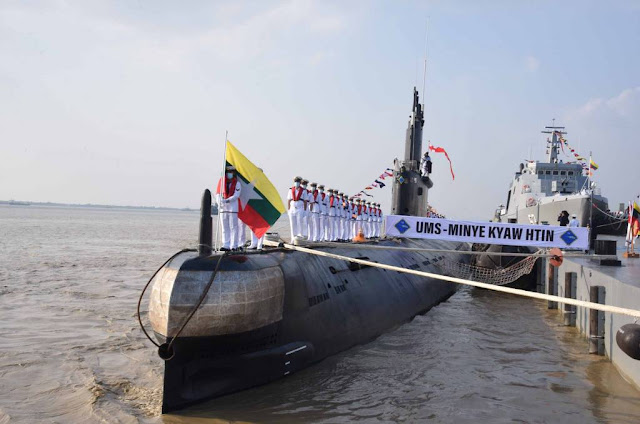
China's delivered, in December 2021, the old Type 035 (NATO reporting name "Ming class") submarine newly named UMS Minye Kyaw Htin (photo above). This sub does not give Myanmar operational combat power. Rather it provides a training sub for Myanmar and for China it:

-  justifies a long term naval and military intelligence presence of Chinese advisers (particularly Chinese engineer and other officers) who need to be present on the submarine at sea while justifying additional Chinese advisers at Myanmar shore bases.

-  this training sub might generate sale of Chinese submarines to Myanmar for further Chinese intelligence iopportunities, power projection and profit. These future subs would be used operationally.

-  is a response to China's strategic competitor India's March 2020 provision of the old Sindhughosh/Kilo-class submarine, to Myanmar. That sub is the former INS Sindhuvir (S58) renamed UMS Minye Theinkhathu in Myanmar service, also used for training.[30][31][33]  

- creates Chinese built submarine competition with other small navies, namely:
  : Bangladesh with the two Type 035s China supplied in 2016 and
  : Thailand. China is supplying three expert spec Yuans (designated S26Ts to
     Thailand. This is noting Thailand's east coast Gulf of Thailand is too shallow for
     daytime operations. Thailand's Yuan variants will likely spend more time operating in the
     deeper waters of Andaman Sea/Bay of Bengal off Thailand's west coast.

The subs provided to Bangladesh and now Myanmar, with some Chinese trainer officers on board, provides extra opportunities in the Bay of Bengal for China to spy on Indian submarines entering and leaving India's main east coast/Bay of Bengal submarine/naval base at Visakhapatnam aka Vizag. 

Creation of submarine competition by selling subs to strategic competitors can be a very lucrative dynamic for submarine building companies/countries. Germany's TKMS selling Type 209, 212 and or 214 subs is a case in point in creating Mediterranean Sea competition. In the Mediterranean TKMS has built or supplied submarine parts for the navies of Greece vs Turkey. Egypt and again Turkey vs Israel, also Portugal and supplying designs and parts for Italy. 

China has the growing political influence and industrial muscle to increasingly create regional markets amongst strategic competitors.

March 6, 2015

Misleading advice to US Congress on Chinese Submarine Numbers?

The US Navy has used 13 Chinese MING-class (Type 33 to 35A) training submarines (based on the German Type XXI U-Boat, 1945) to boost the Chinese submarine fleet to a threatening "more than 60" which means 61.
---

The US Navy and the Pentagon have always been totally truthful in their advice to Congress or that is the ideal, anyway.   

The latest example are comments of a senior US Admiral in late February 25, 2015 who said  “[China's] submarine force has grown over a tremendous rate. They now have more diesel and nuclear attack submarines than we have so they’ve passed us in total quantity - but in quality they are still not there,”  

"but in quality they are still not there” is correct.  

Admiral M's use of flowery language - particularly China is building some "fairly amazing submarines" - should put any cynical politician on guard. 

So how many submarines does China have? The answer from the Pentagon is "more than 60"

The Pentagon's Annual Report to Congress: China Report 2014 (ever after called China Report 2014) reported on Page 7 "more than 60 submarines" and on Pages 7-8 actual submarines types and quantities were identified - which were less than 60. These were: 

-  3 JIN-class (Type 094) second generation SSBN. The JL-2 SLBM's are still being tested and PLAN doctrine suggests the JL-2s are not usually carried, for security and political reasons. 

-  SHANG-class (Type 093) second generation SSNs are in service,


-  HAN-class (Type 091) "aging" first generation SSNs  . These rely on 1960s technology. China Report 2014 does not specify numbers. However only 5 were built of which at least 1 is considered decommissioned.

-   12 YUAN-class SSP (called Type 039A or Type 041) as the 039A has very little resemblance to the 039 it is commonly referred to as the Type 041. The Type 039A/041 possibly has Stirling Air Independent Propulsion (AIP) sold to China by Sweden

-  13 SONG-class SS (Type 039)


-  12 KILO-class submarines acquired from Russia in the 1990s and 2000s

The China Report 2014 only details 46 submarines. 

Question: So how is "more than 60" derived?

Answer: reach 61 Chinese submarines (presumably) by adding:

-  13 MING-class (Type 033 to 035A). These are 1950's technology that are not mentioned in China Report 2014. They are used by China for training only. These are totally obsolete, being closely based on the 70 year old Russian ROMEO-class which in turn were based on Germany's Type XXI U-Boat of World War Two. Two of them may now be going to the navy of Bangladesh. Figure of 13 here. MINGs may be equivalent to US post-war GUPPY uprades. and

-  2  XIA-class (Type 092) SSBNs. They are 1970s technology and also are not mentioned in China Report 2014. One may be active. The other is considered lost in an accident.

So "more than 60" means 61. One of those 61 (a XIA) may be permanenetly submerged and two MINGs might soon be gifted to Bangladesh - hence 58 on publically known figures - and that is a stretch. 

Meanwhile "A spokeswoman said the U.S. Navy had 71 commissioned U.S. submarines." 

It should be left to the reader to assess whether Admiral M and the China Report 2014 are accurate or misleading.

FURTHER ANALYSIS


There is a vast gulf in quality and also availability of the US’s 52 all nuclear propelled attack submarines (SSNs) verses China’s 6 SSNs and 50 diesel-electric (SSKs). The US has paid a much higher price for nuclear submarines because they are of much higher quality overall than conventionally propelled submarines.

It is hard to measure quality but such measures like generation, displacement and crew size would be indicative.

Within the US submarine service the average US attack sub would be 5th Generation nuclear Los Angeles http://en.wikipedia.org/wiki/Los_Angeles-class_submarine of:
- 6,000 tons surfaced
- combined Blue/Gold crew size 2 x 130 = 260, giving it at least twice the availability of a one crew Chinese sub.

The average Chinese attack sub is 2nd generation diesel/electric Song Class http://en.wikipedia.org/wiki/Type_039_submarine .
- probably 2,000 tons surfaced
- crew of 60.

In terms of number of US attack subs this US Navy Fact File of August 2014  http://www.navy.mil/navydata/fact_display.asp?cid=4100&tid=100&ct=4
 indicates about 53 SSNs, including:

  3     Seawolf
41-2  Los Angeles (maybe 2 less since Aug 2014?)
11     Virginias (including North Dakota commissioned Oct 2014)
------
53 Attack submarines nuclear (SSN)

14 Ohio SSBN
  4 Ohio SSGN
-----
71 Total US Submarines

This is verses a total of 61 Total Chinese submarines - of which 56 or 57 may be attack subs.

A small number of Chinese submariners would have gained experience on the two 2nd Generation Shang class SSNs.

Some USN submariners may have gained experience on SSKs of US allies.

A good comment on the pattern of US Navy-Pentagon fear mongering is here.

Pete