Showing posts sorted by relevance for query a26 kockums. Sort by date Show all posts

September 5, 2017

Saab Kockums Concept Proposal of Three A26 SSK Variants

Kockums, since it returned to Swedish ownership (bought by Saab) in July 2014, has been trying to find foreign buyers for the A26 and variants. In 2014 a variant concept was the 4,000 ton Type 612, which Kockums attempted to market to Australia in the future submarine (SEA 1000) competition. France's DCNS (now Naval Group) won the Australian competition. 

So Saab Kockums is still searching for foreign customers, but, the market has many competing submarine suppliers. Kockums is now attempting to sell the A26 in three sizes.

Navyrecognition provided details on August 31, 2017 concerning Saab Kockums concept proposal of three A26 SSK variants (illustrated at Artwork A. below).

Artwork A. Saab Kockums August 31, 2017 concept proposal of three A26 SSK variants.  Artwork courtesy Saab Kockums via navyrecognition
---

Pete Comment/Background

Using the Saab via navyrecognition details the three A26 variants in Artwork A consist of:

The "Pelagic" (Open Sea) variant can perhaps relate to Baltic, Mediterranean, Arabian and Caribbean Sea use. This variant is small – 50m long, about 1,000 tons (surfaced), 4,000nm range at 10 knots. Endurance at patrol speed is over 20 days assisted by the AIP module. Standard complement is 17 to 25. Saab Kockums may have the best chance of selling these small submarines to smaller navy customers including those who use subs for non-state threats, eg. Canada and Latin American countries in alliance with the US countering drug smuggling.

The Oceanic variant is the "baseline" A26 with two being built for the Swedish Navy. A26 Oceanic is 65m long, around 1,900 tons to 2,000 tons (surfaced), range over 6,500nm at 10 knots. Endurance at patrol speed is over 30 day assisted by the AIP module. Standard complement is 17 to 35. [Presumably around 10 Special Forces can be accommodated?]. I assume four A26 Oceanic variants of approximately 2,300 tons (surfaced) are being offered to the Dutch Navy as Walrus replacements.

The Oceanic (Extended Range) variant is a stretched version A26. It is longer than 80m, over 3,000 tons (surfaced). Range is over 10,000nm at 10 knots. Endurance at patrol speed is over 50 days assisted by the AIP module. Standard complement is 20 to 50. [Presumably around 10 Special Forces can be accommodated?]. 

Saab Kockums will have a battle selling the Oceanic and Oceanic (Extended Range) variants given TKMS is already established selling larger than the usual (1,800 ton submarines) to Israel, Singapore and designs to South Korea. India may be the best remaining slightly large  submarine customer under Project 75I.

Artwork B. Saab Kockums concept proposal of the Vertical Launch System (VLS) or Vertical Multi-Purpose Lock (VMPL) module(s) option that can be fitted to A26 SSK variants. Artwork courtesy Saab Kockums via Submarine Matters via navyrecognition.  
---

Pete

November 13, 2013

Germans sinking Kockums Swedish sub maker?


For the latest on Sweden-Saab vs TKMS-HDW-Kockums see June 11, 2014’s Australia's Future Submarine - Swedish vs German Claims http://gentleseas.blogspot.com.au/2014/06/australias-future-submarine-swedish-vs.html . It is unclear whether Germany or Sweden hold the strongest intellectual property rights to the Stirling AIP. 

For information about Singapore's December 2, 2013, decision to buy two HDW 218SG subs instead of a Kockums sub at http://gentleseas.blogspot.com.au/2013/12/singapore-buying-two-hdw-218sg.html
------------------------


Very simplified artist's conception of ThyssenKrupp Marine Systems' preferred product - largest sub of the HDW range, the future HDW 216. Note the rotary multi-purpose VLS behind the sail-fin.
----------------

See information about Singapore's December 2, 2013, decision to buy two HDW 218SG subs instead of a Kockums sub at http://gentleseas.blogspot.com.au/2013/12/singapore-buying-two-hdw-218sg.html and Saab Being Subsidized to Buy Back Kockums? of March 4, 2014  http://gentleseas.blogspot.com.au/2014/03/saab-being-subsidized-to-buy-back.html .

The Local ("Germany's News in English") has produced this disturbing October 15, 2013 report about an internal corporate threat to the continued functioning of Kockum's Submarine division.

Whether this downgrades Kockum's continued ability to support its Singaporean-Archer Class and Australian-Collin's Class submarine customers remains to be seen.

Does this put Kockums' future submarine A26  at risk of preventing it from being a contender for Australia's large conventional SEA 1000 future submarine project?

Is Kockums' new parent company (German) ThyssenKrupp Marine Systems giving preferential treatment to its competing German HDW 212-214 and 216 submarine products? Note, concerning submarines, the ThyssenKrupp Marine Systems  website only features the HDW products.

The report in full is below http://www.thelocal.de/national/20131015-52407.html :

"Germans look to sink Swedish sub maker"
15 October 2013
"A German industrial giant is waging a campaign of "internal warfare" against one of its own firms - Sweden's flagship submarine manufacturer Kockums - putting key defence deals at risk, sources have told The Local.
German industrial conglomerate ThyssenKrupp bought Kockums in 2005 to form part of what is known as ThyssenKrupp Marine Systems (TKMS), a firm which also owns German submarine maker HDW, a direct competitor of Kockums.

A source told The Local that the purchase was aimed at getting rid of Germany’s Swedish submarine rival and that TKMS was jeopardizing Swedish export deals for submarines with the Australian and Singaporean governments.

"The purchase of Kockums wasn't aimed at consolidating the naval industry and creating synergies, but at getting rid of a competitor," a source in Germany with direct knowledge of the situation told The Local.

Kockums and its predecessors have been building ships for the Swedish navy for centuries at the Karlskrona shipyard in southern Sweden that now serves as the base of the company's Swedish operations.

But according to a German naval manufacturing consultant with ties to TKMS, ThyssenKrupp is actively trying to sabotage Kockums export operations to the advantage of Germany’s HDW, a strategy he dubbed "TKMS über alles" and slammed as "suicide".

The Germans' efforts to sink Sweden's submarine industry have been ongoing since at least 2011, according to the source, when TKMS CEO Hans Christoph Atzpodien denied Kockums the opportunity to bid on a project in Singapore for the construction of new submarines, despite the Swedish firm's long-standing relationship in the country.

Earlier this year, the German firm decreed that the Swedish shipbuilder officially change its corporate name to ThyssenKrupp Marine Systems, scrapping the Kockums brand name that has been a part of Swedish industry since the early 1800s.

'A raging war is taking place'

In August, during a meeting in Bonn, Germany with officials from Singapore defence agency DSTA held, Atzpodien claimed that Kockums "would no longer be capable of designing and building submarines", according to the source.

"A raging war is taking place between Kockums and TKMS," he said, explaining that the Singapore deal has brought the situation into sharp relief.

Among other things, Atzpodien disparaged Kockums plans for a new A26 class of submarine, claiming the Swedish firm didn't have enough engineers to complete the project, and that it was sure to be plagued with cost overruns and delays.

"Atzpodien has systematically ejected Kockums from the discussions and has barred Kockums from Singapore," the source explained.

TKMS has also complicated Kockums' chances for new contracts in Australia, another country where the Swedish shipbuilder has a strong presence, having designed and built six Collins-class submarines in the 1990s in what was one of the largest export deals ever at the time.

But Kockums found itself left out of a 2012 initial call for proposals from Australia to replace the aging subs with an off the shelf solution, while its German-based competitor and sister company HDW was one of three European firms asked to participate.

Earlier this year, however, Australia and Sweden did ink a deal allowing for Kockums to take part in the project, dubbed SEA 1000, which calls for the building of 12 new submarines.

But in the meantime, TKMS purchased an Australian naval defence firm, Australian Marine Technologies, that "could do the same job as Kockums could have done on its own," the source said.

"TKMS has here again torpedoed all the efforts of Kockums to run this future competition because it has already created its own footprint," the source told The Local.

A Swedish saviour?

The Swedish government, as well as officials with the primary defence procurement agency, the Defence Materiel Administration (FMV), has been made aware of the situation and have become so unhappy they have asked Swedish defence contractor Saab to look into a possible purchase of Kockums, a source within the Swedish defence industry told The Local.

"Discussions are taking place right now," according to the source, who agreed that TKMS is trying to strangle Sweden's ship building industry.

"The only reason TKMS owns Kockums is to stop them from exporting," the Swedish source explained, adding that the Swedish firm "could not exist" without export contracts.

Allan Widman, a Liberal Party (Folkpartiet) MP from Malmö and the party's defence policy spokesman said he is "worried" about Kockum's future in light of the rift with TKMS.

"Submarine building capabilities are essential for our armed forces and our ability to defend ourselves," he told The Local, adding that he had heard a number of "industry rumours" about the discord between TKMS and Kockums.

Adding to his concern is the fact that two years have passed since the Swedish parliament Riksdag approved funding for the development of the A26 submarine for the Swedish navy, but nothing has happened, reportedly due to concerns over ThyssenKrupp's ownership of Kockums.

"I hope Kockums isn't prevented from doing business with other countries. It's not constructive," said Widman, adding he would welcome Swedish ownership for the Karlskrona-based shipbuilder.

"I would have no objection to private Swedish ownership of Kockums," he said when asked about the Saab deal.

However, if the Swedish and German firms can't strike a suitable deal to resolve the situation, Widman said the dispute may require a "political solution".

"This is a matter that's vital to our national security," he said, stressing that he hopes both Germany and Sweden can maintain submarine building capacity.

"In the end, however, it may require a political dialogue between Sweden and Germany to find a suitable solution."

When reached by The Local for comment on the Saab-Kockums negotiations, a Saab spokesman refused to comment.

"We don't speculate on rumours like that," the spokesman said.

A spokesperson with FMV also chose not to comment citing an "ongoing procurement".

A spokesman with Kockums in Sweden also refused to comment on the reported disunity within TKMS, while spokeswoman with TKMS in Germany said the company was "unable to comment on market rumours"."
--------------------------------------

A comment on the above post:

"Anonymous said...
"This is a matter that's vital to our national security," --- So why Kockums was offered to a German company first time? What is the problem for Sweden to buy German submarines like Poland did?

"Earlier this year, however, Australia and Sweden did ink a deal allowing for Kockums to take part in the project, dubbed SEA 1000, which calls for the building of 12 new submarines."
This is quite wrong. The deal was Sweden donated intellectual property rights to Australia.
http://www.aspistrategist.org.au/australia-and-sweden-burying-the-hatchet/
Now Australia tries to build with these rights a new Collins-class on its own - good luck!

The Collins-class disaster was partly related to the inability of Kockums to control the project properly. TKMS owned HDW has much more knowledge with license building of submarines. It worked for South Korea. [South Korea has 9 South Korean derivatives Chang Bogo class of the HDW 209 and 3 derivatives Son Won-il class of the HDW 214]

Why should TKMS allow Kockums to design a new A26 submarine while HDW at the same time works on Type210mod? Would GM allow Opel to design quite the same type of car Holden is working on? [as the number of the HDW 210 suggest it is smaller than the HDW 212-214. Specifically the 6 existing HDW 210 mod are of the Norwegian Navy Ula Class http://www.defenseindustrydaily.com/Ula-Tech-Norways-Next-Submarine-Fleet-07609/ and  http://www.network54.com/Forum/211833/thread/1231528114/HDW+Introduces+Type+210mod+Submarine
]
Kockums makes fine Corvettes like the UK makes fine wings for Airbus. Great Britain will never again produce big passenger aircraft on its own.

How well of is Saab Automobile today without a big company in the background?
November 14, 2013"

Pete's Comment

In addition to preventing Kockums being competitive TKMS acquisition of Kockums provide an opportunity to officially or unofficially shift intellectual property (including A26 design information) from Kockums to HDW?

Does this have an Australian dimension concerning German-HDW access to Collins' confidential design and business details?

Pete

March 14, 2014

Corporate Battle Between SAAB and TKMS Over Kockums

The reality of corporate battles (Cartoon courtesy of CartoonStock.com).
---------

For the latest on this issue see June 11, 2014’s Australia's Future Submarine - Swedish vs German Claims http://gentleseas.blogspot.com.au/2014/06/australias-future-submarine-swedish-vs.html . It is unclear whether Germany or Sweden hold the strongest intellectual property rights to the Stirling AIP.

The current corporate confrontation between SAAB and TKMS underlines the need for Australia future submarine project (SEA 1000) to be (reasonably) technically self reliant and flexible enough to tolerate changes in the threat-strategic environment, corporate and broader international economic environment. Australia needs as much autonomy as possible in intellectual property, spare parts and test facilities. 

Connect the current escalation in corporate conflict between SAAB and TKMS over Kockums with:

- Kockums loss of its traditional Singapore customer to HDW – see Singapore Buying Two HDW 218SG Submarines – Sweden’s Loss of December 3, 2013http://gentleseas.blogspot.com.au/2013/12/singapore-buying-two-hdw-218sg.html , and

- German’s Sinking Kockum’s Swedish Sub-Maker of November 13, 2013 http://gentleseas.blogspot.com.au/2013/11/germans-sinking-kockums-swedish-sub.html .

ARTICLE

Birgitta Forsberg of affars Valdern (translated from Swedish) of March 12, 2014 reports http://www.affarsvarlden.se/hem/nyheter/article3811470.ece :

"Thyssen Krupp ask FMV stop Saab"

"Kockums German owners ThyssenKrupp ask FMV stopping Saab from recruiting top people from Kockums.

n a letter to Lena Erixon, Director General for Defence Materiel Administration, [known as]  FMV, asking the head of the German Thyssen Krupp Marine Division, Dr. Hans Atzpodien FMV stopping Saab from recruiting key personnel from Kockums.
Thyssen Krupp wholly owns Kockums but has for years thwarted Kockums from exporting submarines because the Germans also owns the German shipyard HDW where they would rather control the business. Recently, FMV enough of the Germans' delaying tactics when it came to ordering a Swedish Kockums and instead asked Saab to do a feasibility study on Sweden's future submarines.As a result of the Saab has recently recruited top people from Kockums and also went yesterday, Tuesday, issued a press release that the company seeking employees for its shipping division.
The letter writing Atzpodien addition to the Thyssen-Krupp
§  - will support the export of the planned Swedish submarine A26
§  - is willing to negotiate a contract to sell the A26 to Sweden
§  - is willing to offer Swedish authorities influence at board level in Kockums or at least greater  transparency in company
§  - want to invest in to let Kockums produce a small submarine (up to thousand tons)
§  is willing to develop Kockums
§  - wants Kockums and HDW cooperate closer without infringing on the patents FMV own

His Atzpodien and Lena Erixon has a meeting scheduled for 18 March and it's ahead of the meeting that Atzpodien written the letter.

But the offer of influence has come before, and that the Germans want the Swedes to focus on small submarines, while the German shipyard HDW may take the major orders, are also known. According to a source, who sees the whole thing as a way to get Kockums out of the way as a competitor, there is no bigger market for small submarines. In other words, it is doubtful whether FMV soothed by letter. 
The whole thing is complicated by other agreements between Kockums and FMV, including for servicing submarines." ENDS

--------------------------

COMMENT

Joakim Wohlfeil on March 14, 2014 sent the following comment to Australia by the Indian Ocean:

"Breaking news update ;-) The Submarine war between Sweden and Germany escalates !!
SAAB has succeeded to recruit the full technical management team at Kockum, including the manager for the submarine division Per Nilsson and are now actively seeking to recruit the remaining ca. 230 engineers. (http://www.affarsvarlden.se/hem/nyheter/article3811470.ece ["Thyssen Krupp ask FMV stop Saab" see above].

According to local press in Malmö the engineers being feed up with ThyssenKrupp are joining SAAB en masse. As the Swedish government are the formal owners of the construction patent and drawings of all Swedish submarines SAAB could actually perform a hostile take-over without paying anything to ThyssenKrupp. (and this seems to happened with the blessing of the Swedish government).

2 days ago, ThyssenKrupp formally protested to the Swedish government ([the Defence Materiel Administration known as] FMV) and demanded they should stop SAAB´s hostile recruitment campaign.

In return Thyssen Krupp has offered.
- ThyssenKrupp will not block the procurement process of A26 and approve that it will be built in Sweden
- Thyssen Krupp will allow Kockums to market A26 for export (however it´s not said if the condition that HDW can see and approve Kockums export offerings will be lifted)
- Repeating the offer Sweden besides of A26 will be the new centre for small submarines (an offer that has earlier been rejected by Kockums employees and the Swedish government).

However, if Sweden suddenly seems to sit on the upside, ThyssenKrupp can answer with obstructing the upgrades and service of Swedish naval crafts that is contracted to the still ThyssenKrupp owned Kockums industriers (TKMD)"

Pete

June 30, 2026

Poland orders three Saab A-26 Type submarines, leases HSwMS Sodermanland

My ‘chats’ with Pete in the comments section of articles on Submarine Matters often meander away from the subject topic (eg. VSL in AIP boats). By coincidence, our recent discussion on diver/UUV lockout systems and Saab is bang on topic, as Poland has just ordered three A26-type submarines from Saab. These A26s are expected to be commissioned into the Polish Navy by 2038.


A26 in Polish Navy service. Image: Saab
---

This order, worth approximately Swedish Krona (SEK) 47 billion (USD 4.8 billion), includes Saab “establishing maintenance, repair, and overhaul (MRO) capabilities in Poland in close collaboration with Polish industry, thereby supporting strategic autonomy for Poland”. Sweden is also leasing His Swedish Majesty's Ship HSwMS Sodermanland (see Wikipedia file) to Poland from 2026 to 2032 for training, and to “rapidly reinforce” Poland’s underwater capacity. Sodermanland is a forty-year-old submarine that received an overhaul in 2014-2016 and a lifetime extension in 2022. It will allow Polish submariners to train on Swedish systems, in preparation for the A26-class.

Sweden's official announcement also indicated that Poland will participate "in Sweden’s test and experiment activities with the HMS Blekinge and HMS Skåne", Sweden's A26 boats, which would mean that Poland is a development partner of the entire program, not simply an end-user customer.


A fascinating interview, here and above. How much can a Swedish Captain tell a Polish journalist on TV? Uploaded June 26, 2026 in Poland. TV Poland (TVP) World's Maciej Mikoson (pronounced Machi Emikos) interviews Royal Swedish Navy Captain Kenth Gutensparr, Project Manager and Coordinator for the training and support in the Swedish-Polish three A26 Orka Program. They discuss Sweden’s role regarding such issues as how long it will take to train Polish submariners to operate the A26s. Captain Gutensparr paints a discrete picture of Polish and Swedish strategic capabilities in the Baltic for the next decade.


Shawn C’s commentary

Poland’s selection of the A26 in 2025 was seen by many as a godsend for a long-running submarine development program which began in 2010. Ordered in 2015 for delivery in 2022, the first A26 boat, HSwMS Blekinge, was laid down in June 2022, and is now expected for delivery in 2031.

In 2012, I fully expected Singapore, which had bought seven used submarines from Sweden's Kockums (before it was sold to Germany's TKMS) to order the A26, as this would lead to a billion-dollar cash infusion to Kockums to enable it to build its infrastructure. Then there were allegations (reported by SubMatts) that TKMS blocked Kockums from responding to Singapore’s 2012 submarine contest. This contributed to TKMS winning an order in 2013 for what is now currently six Invincible-class (TKMS Type-218SG) submarines. 

Kockums was then bought out by Saab in 2014, which coincidentally was also the year Russia illegally occupied the Ukrainian provinces of Crimea and Donbas. Saab immediately restarted the A26 program, with Sweden placing it's order for two A26s  in 2015.

In 2024, Sweden, now a NATO member with expanded treaty commitments, still has outdated submarine yards at Karlskrona and Landskrona. Those yards have not built new submarines since the last Gotland-class boat, HSwMS Halland, was launched in 1996! So Poland’s ‘buy-in’ on the A26 should see significant Polish investment and industrial offsets, including technical staff training and technology transfer, as Polish companies become part of the A26 project supply chain. In Poland, Sweden also gains a naval partner with the facilities to build 7,000-ton modern warships, which Saab currently lacks. 

Sweden also had a follow-on plan in 2024 to replace the three Gotland boats with smaller A30 boats (see last paragraph here) in the late 2030s. But with Poland's order of three A26s, Saab Kockums will soon have a hot production yard and achieve economies of scale, so we could see follow-on orders for the A26 from Sweden.

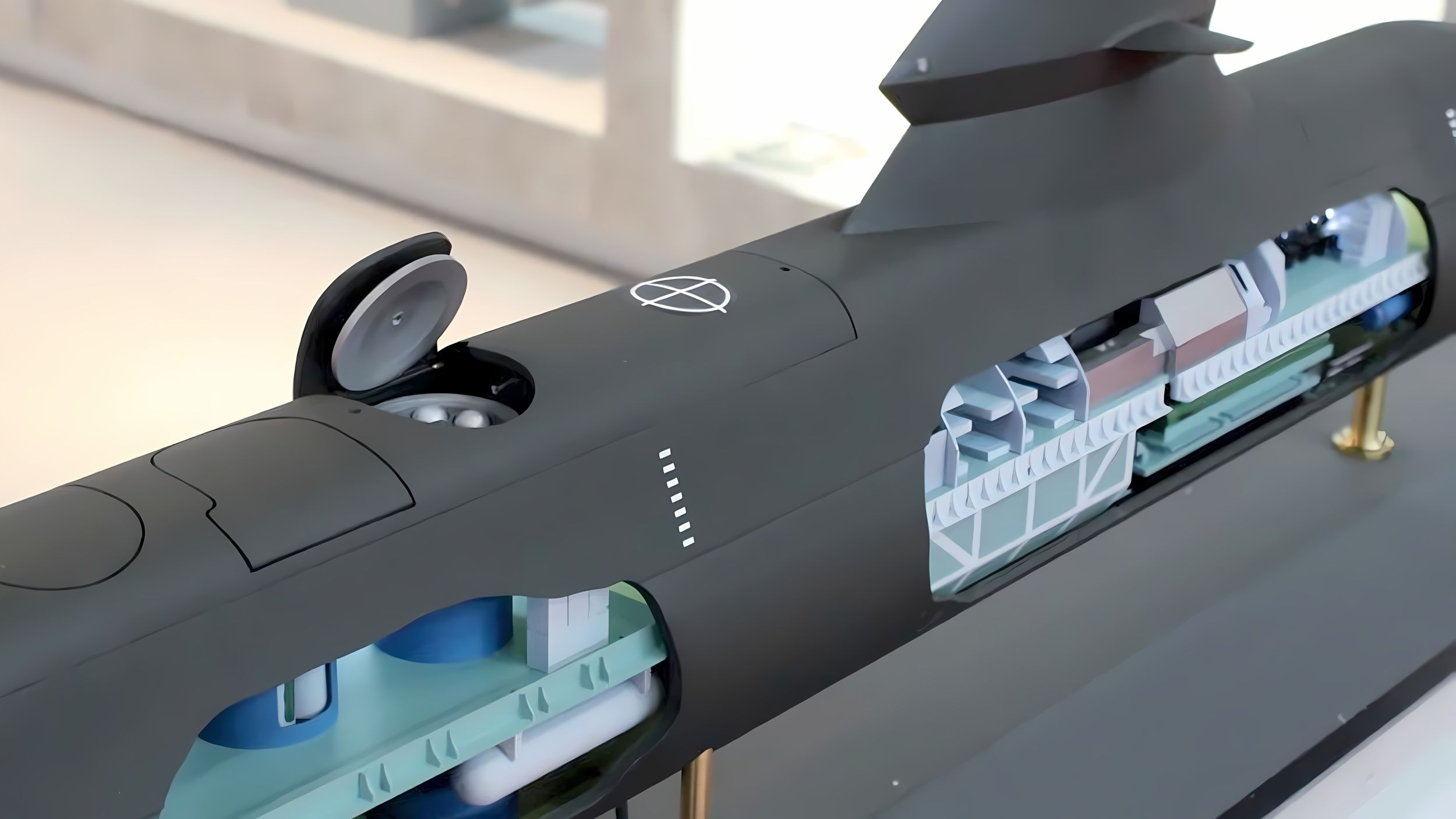
No information on the systems and weapons fit of Poland's A26 has been revealed, though Saab did display a possible Polish model with vertical launch systems (VLS) at defence trade shows. As Pete mentioned in his article on Canada's CPSP, a VSL module would add a significant displacement to a 2,000-ton AIP submarine, impacting range, speed and endurance.


Saab A26 model with VLS. Image: militaraktuell.at
---

Could Polish A26s come equipped with Saab's Horizontal Multi-purpose Lock (HMPL), also called the Multi-Mission Portal (MMP)? This is very likely, considering that the A26 is optimised for the constrained waters of the Baltic Sea, and Saab has a Large Uncrewed Undersea Vehicle (LUUV) that fits. The Lock/Portal's diameter might be anywhere between 1m and 1.5m.


The A26's HMPL/MMP under development in a Saab workshop. Image: Screenshot from a segment 4 to 8 minutes into this navalnews.com video
---


April 22, 2014

Sweden's Submarine Export Behaviour


The Gotland Class sub leased to US.


An instructor for Collins Class cryptologic systems explains his job.
---
For the latest on this issue see June 11, 2014’s Australia's Future Submarine - Swedish vs German Claims http://gentleseas.blogspot.com.au/2014/06/australias-future-submarine-swedish-vs.html . It is unclear whether Germany or Sweden hold the strongest intellectual property rights to the Stirling AIP.

With all the controversy of Saab, TKMS (and related HDW) in the news its timely to recall Sweden's submarine export activity since the 1980s. The article below of July 23, 2013 is from the Nuclear Threat Intiative (NTI) http://www.nti.org/analysis/articles/sweden-submarine-import-and-export-behavior/ :


Sweden Submarine...Export Behavior

July 23, 2013
Imports  Sweden is an exporter of submarines and does not import them.
Exports
Kockums
Producing submarines for the Swedish Navy since 1914, the Swedish shipyard Kockums did not begin exporting its vessels until the 1980s, in large part due to Sweden's policy of neutrality in international conflicts. This neutrality position, in turn, has led some countries to view Sweden as an unreliable supplier. [1] Sweden's change in export behavior in the 1980s has been attributed to increasing development costs, which were amplified by its strategy of frequently introducing new classes, but only producing a few boats in each class. To retain the ability to develop new boats continuously without facing increasingly prohibitive costs, Sweden decided to export its vessels to achieve economies of scale. [2]

In 1999, Kockums was incorporated into Germany's Howaldtswerke-Deutsche Werft (HDW), [Pete's Comment - With the end of the Cold War Sweden could no longer support Kockums through Swedish defence purchases. Kockums' export activity (including the Collins) was inadequate. Hence the Swedish government permitted Kockums to be taken over by HDW in 1999. TKMS then took over HDW-Kockums in 2005.] and as of 5 January 2005 is part of ThyssenKrupp Marine Systems (TKMS). Kockums offers three submarine classes for export:
  • Gotland-class: hybrid diesel-electric/AIP patrol submarines, with an AIP system based on the Stirling engine;
  • Västergötland-class: diesel-electric patrol submarines;
  • Collins-class: diesel-electric, ocean-going, long-range patrol submarines, designed for the Australian Navy.

Submarine Table for Sweden
 

In 1987 Kockums was granted a contract to supply the Australian Navy with six Collins-class vessels, and formed the Australian Submarine Corporation (ASC) to construct the submarines locally. Kockums held 49% of ASC's shares, while the Australian government controlled the remainder. When Kockums became part of HDW in 1999, the German company was interested in acquiring ASC as well, and nearly reached an agreement to do so with Australian authorities. [3] However, the Australian government instead decided to acquire Kockums' shares of ASC with the intent of subsequently selling the shares as a complete package in order to maintain access to the U.S. technology used in the Collins-class submarines. [4] Subsequently, Kockums and the Australian government became embroiled in a legal battle over payment for welding repairs made to one of Australia's submarines, and intellectual property rights for future upgrades. [5] The dispute was finally settled in 2004, but the Australian government has had difficulties privatizing ASC and has yet to sell the company. [6]
Kockums attempted to market an export version of the Gotland-class to Thailand, but the deal fell through as a result of financial difficulties experienced by the Southeast Asian country. [7] The company was also a finalist for a sale to India, a deal HDW later secured. [8] More success was achieved with Singapore, which acquired a total of four modernized former Royal Swedish Navy Sjöormen-class boats (Challenger-class in Singapore) in the 1990s, and ordered two Västergötland-class vessels (Archer-class in Singapore) in November 2005. [9] The two Västergötland-class boats, which first entered service with the Royal Swedish Navy in 1986 and 1987, underwent modernization with AIP systems and conversion for tropical water operation before being delivered to Singapore. [10] The contract also includes a logistics package and training for the crews by the Swedish Navy in Karlskrona. [11] In December 2011 the first submarine, the RSS Archer (ex-HMS Hälsingland), was commissioned into Singapore's Navy. [12] The RSS Swordsman was commissioned in April 2013. [13]

Kockums also refits deployed submarines with its Stirling AIP system via a plug-in. [14] For example, it refitted a former Swedish Navy Näcken-class submarine with AIP and leased it to the Danish Navy from 2001 to 2004. [15] In July 2005, Kockums announced that it would produce Stirling engines for the Japanese Maritime Self-Defense Force (JMSDF), which decided to include AIP on all new boats. [16] While Kockums is supplying the engines, Kawasaki Heavy Industries is assembling the AIP systems. [17] The first submarine of the JMSDF equipped with Stirling engines, the Soryu (SS-501) was laid down in March 2005, launched in December 2007, and commissioned in March 2009. Four more Soryu-class boats have since been commissioned at a rate of roughly one per year. [18]

In the early 2000s, Kockums developed the Viking concept, a hybrid diesel-electric/AIP (Stirling) patrol submarine initially intended to replace aging units in the Danish, Swedish, and Norwegian navies. [19] Kockums initially cooperated on the vessels with Denmark's Odense Steel Shipyard using Danish, Norwegian and Swedish funding. However, Norway opted out of the project in 2003, while Denmark decided in June 2003 to cease funding the project in its 2005 to 2009 Defense Plan, throwing Viking's financing into question. [20] In June 2004, moreover, the Danish parliament decided to stop operating submarines altogether. [21]

Although the failure of the Viking project ended the prospect of cooperation with other Nordic countries, Kockums received a contract to design a new submarine, called the A26, for the Swedish Navy. [22] The A26 features the Stirling AIP system and will be designed with advanced stealth technologies for performing intelligence missions. [23] Kockums has yet to begin construction, but if it follows through on the order for Sweden the company could market the A26 for export as well.

September 26, 2024

Singapore commissions two Invincible-class (Type-218SG) submarines

Update 26 September 2024 - added videos and response to Pete.

On the 24th of September 2024, Singapore commissioned the first two Type-218SG Invincible-class SSK AIPs into the Republic of Singapore Navy service. In a morning ceremony, Prime Minister and Minister of Finance Lawrence Wong officiated the full commissioning of the RSS Invincible and RSS Impecabble. 
Image: Naval News (Singapore MINDEF image)

The ceremony was live-streamed on YouTube, and as I cannot insert that video on this blog, please goto: 

https://www.youtube.com/live/SBDRIwK9tlA?si=eu71yalnXYlZuA_w&t=1831


As I’ve written in a previous post, two boats, the RSS Illustrious and RSS Inimitable remain in Kiel, Germany, where they are now expected to return to Singapore by 2028, according to the Singapore MINDEF press release.


The Invincibles are the third generation of submarines to enter commission in the RSN, and are also the first built-for-purpose class, as the Challenger- and Archer class came from Kockum’s used submarine lot. The last two Challenger boats, RSS Conqueror and RSS Chieftain, are still in RSN service, 55 years after their launch, and will soon be decommissioned - I expect this to occur by the end of 2024.

Singapore's Ministry of Defense also held a media showcase of the upgraded submarine simulator centre that trains the RSNs future submariners. Trainees undergo a nine-month training course that includes operations in a full-motion dive simulator, and training simulators for engineering, including a battery compartment. The new simulator is from Rheinmetall and will allow Singapore to train qualified sub-crews in-country,

According to an article by defence correspondent Mike Yeo, the 2,000-tonne displacement Invincible-class has 50% more underwater endurance than the six weeks of the Archer class, while automation has reduced its crew size to 28, all with their own berths (including female submariners).  


The 2013 Kockums-block

Pete has commented that "Singapore made the correct decision buying the current technology Invincible from Germany rather than risk lateness and cost overruns with the new technology A26 from Sweden."

Pete and I have had over a decade of exchanges on this topic, including his 2013 article about TKMS's involvement in Kockums, which I called 'the Kockums-block'.

Singapore has a long military export relationship with Sweden, going back to the 1970s, and specifically with Kockums - Singapore purchased four new Landsort-class mine countermeasure vessels in 1991, the Bedok-class, followed by four Challenger-class submarines (actually five, the last boat was used as a parts donor) in 1995 and the two Archer-class boats in 2005. Kockums was sold to TKMS in 2005, as part of the HDW group.

Kockums had one project with the Swedish Navy in the 2000s, the Visby-class corvettes, so its export work for Singapore (including 4 Kockums V4-275R Stirling Engines) kept the company in the black until the long-delayed A26 project started, with Sweden signing a contract with Kockums in 2010. 

By 2014 two facts emerged:
1. In December 2013, Singapore selected TKMS to build two submarines (eventually the 4 Invincibles), the only other bidder was Naval Group. Kockums was 'not allowed' to bid.
2. Russia annexed Crimea, causing every nation in Europe to reevaluate their military, and Sweden suddenly discovered that after three years, there was nothing done by Kockums with the A26 except glitzy marketing graphics.

My own belief is that Singapore would eventually invest in the A26 project (potentially worth US$2-3 billion then) - but the 'Kock-up' torpedoed this investment, leading to the Swedish government raid on Kockums in May 2014 and its eventual sale to Saab.

An overall explanation of this situation, which led to Saab purchasing Kockums from TKMS, from the Swedish side, can be read here.

At the end of all this, Singapore acquired 4 next-generation submarines from TKMS, and still works with Saab Kockums, for the composite superstructure of the Independence-class LMV and the overall design concept of the upcoming MRCV, as well as delivering six composite superstructures


March 4, 2014

Saab Being Subsidized To Buy Back Kockums?

A possible design for Kockums' A26. Will it ever be built? (Courtesy of Kockums' website

Christopher Harress of International Business Times, March 3, 2014 reports http://www.ibtimes.com/saab-angling-take-control-thyssenkrupp-submarine-yard-sweden-1559035
:
"Saab Is Angling To Take Control Of ThyssenKrupp Submarine Yard In Sweden"


Three years ago, Kockums, the Swedish national submarine manufacturer was sold by the Swedish government to Germany’s ThyssenKrupp, but after uncertainty over jobs and boat building guarantees, it appears the Swedish government is angling for Saab to take control of the Malmo-based ship-building yard.

In a clear statement of intent, Sweden’s procurement agency FMV announced on Feb. 27 that it was allocating $3.84 million to test whether or not Saab had the ability to design and build the next generation of Swedish submarine.
The move was spawned by disappointment coming from the Swedish Defense Ministry that Thyssen wouldn’t give guarantees that ThyssenKrupp Marine Systems, what Thyssen renamed the old Kockums yard in Malmo, would continue to be a large-vessel producer in the region. Additionally, the ministry was concerned because Thyssen hadn’t provided fixed prices for the delivery of two new A26 generation subs and mid-life refits for the Gotland-class submarine.
That said, the failure for TKMS to get finalize those contracts has put jobs in jeopardy, says Thyssen. But Saab’s emergence as a possible buyer for the yard, according to the Swedish Defense Ministry, is because it’s believed that Thyssen is going to reorganize the 1000 unionized workers in Malmo and is to begin the manufacturing of small-sized subs and surface vessels up to 1000 tons. The New A26 class boats and those awaiting refit are around 1900 tons.
The Swedish government procurement agency has said that Thyssen’s reluctance to ioffer fixed prices for the new boats and upgrades means it is currently not possible to move forward to the build stage as it is not practical, sustainable or best use of taxpayer’s money.
Saab has contended that it could meet the needs to design, build and refit submarines, however, it has declined to comment suggestions that it might take control of the TKMS yard." 
ENDS 
COMMENT
Please connect with Singapore's December 2, 2013, decision to buy two HDW 218SG subs instead of the  purchasing Kockums' submarines  http://gentleseas.blogspot.com.au/2013/12/singapore-buying-two-hdw-218sg.html and  http://gentleseas.blogspot.com.au/2013/11/germans-sinking-kockums-swedish-sub.html 

This development begs questions. Why did the Swedish Government sell Kockums to its German competitors in the first place? Swedes may also want to know how much government money will be required to fund the buyback of Kockums? Also how much government money will Kockums need to build two new A26 generation submarines and for the mid-life refits for the Gotland-class submarines (two or all three)? 
Meanwhile US company DefenseNews reported on the same matter, but failed its geography test - by placing Helsinki in Sweden - see http://www.defensenews.com/article/20140302/DEFREG01/303020012/Saab-Maneuvers-Buy-Swedish-Submarine-Maker?odyssey=mod_sectionstories naughty!
Pete

November 5, 2018

Kockum's Mark 5 Stirling engine for A26 and Maybe Walrus Replacement

Anonymous in Comments on November 5, 2018 has kindly provided details discussing the Kockum's Mark 5 Stirling engine that will likely be incorporated into the SAAB A26 and maybe into the SAAB-Damen Walrus replacement:

The SAAB A26 and SAAB-Damen Walrus concept, will likely have an evolution of the current (in Gotland class) Kockums Mark 3 Stirling engine v4-275R Mark 3 [4]. The evolution-next version being likely the Mark 5 [1], but there is little information on the Mark 5. The Mark 5 evolution is discussed at [2] and [3]. The evolution may provide increased diving depth and a longer submerged period.

[1] 
R. Bitzinger and Haris Vlavianos “Emerging Critical Technologies and Security in the Asia-Pacific” 2016, Page 100, “Sweden’s next generation submarine, Kockums A26-currently in development, will incorporate the latest and most modern and refined Stirling AIP technology-MK 5 version.”

[2] ibid, Page 101, “Stirling engine operates at a pressure of 20 bars, which limits the submarine’s depth to 200m, unless power consuming and potentially noisy exhaust gas intensifier is used.”

[3] 
https://saab.com/region/saab-australia/about-saab-australia/latest-news/stories/stories---australia/2015/super-stealthy-saab-submarines/ 
Scrolling down half way to “Air Independent Propulsion” you come to the diagrams, reproduced below. 


-  diagram on left (above) is the current Kockums Stirling Mark 3 (on Gotland class) 

-  diagram on right (above) is the Kockums Stirling Mark 5 to be fitted on the future A26s.
   The c
ombustor and insulator are omitted from this right diagram. For the Mark 5 to achieve higher 
   efficiency are improvements in:
   =  The heater (cylindrical pipes (inside of engine) connected top of piston cylinder) improves heat
        transfer.
   
=  The heat insulation has presumably reduced heat loss, thus elevating combustion temperature
        and pressure. If the Mark 5 can tolerate pressure increases from 20 bars to 25 bars, the A26's 

        depth at which it can operate the AIP increases from 200m to 250m. This improvement will
        provide a longer submerged period. But an significant increase in speed is not expected,
        because speed is proportional to square-cubes of AIP output.

The Mark 5's generator is omitted (in the middle figure), but, the size of the generator does not seem to have changed. If the Mark 5's combuster size has not changed, the size of the Mark 5 AIP's (engine + generator) will not have significantly changed.


[4] Sweden's Gotland class submarines each use two v4-275R Stirling engines (each rated at 75kW) 
      see this Submarine Matters articleWhile Japan's Soryu Mark 1s use four Kawasaki Kockums
      V4-275R. China's Type 039A Yuans may use three or four Kockums V4-275R.

More recent and detailed data on Kockum's Mark 5 Stirling engine may well alter this current appreciation.

Anonymous (with Pete translating into standard English)

December 15, 2014

Swedish Bid for Australian Future Submarine Selection

Artist's conception of a Swedish A26 submarine operating in littoral waters while deploying special forces divers. Graphic courtesy of Saab site .
---

Sweden's early December 2014 claims might be summarised as:

Sweden is designing the A26 which will be around 2,000 ton surfaced. Australia’s government indicated it has received an unsolicited bid from Saab for an enlarged design. Sweden's claims that this includes a lower price than its competitors. Sweden would facilitate the smooth flow of Japanese submarine [Stirling air independent propulsion (AIP)] technology from the Soryu Class sub. Sweden also promises substantial technology transfer and industrial offsets for Australia, including jobs in Adelaide during the build phase.

See more here: http://www.defenseindustrydaily.com/saab-story-swedens-new-submarines-024760/
Sweden wasn’t part of the Australian government’s initial submarine evaluations, because Kockums was barred from export activities by its then corporate parent TKMS. This also prevented Sweden from bidding for Singapore's 2013 two SSK selection - subsequently won by Germany's HDW [as the 218SG proposal]. Saab Kockums is also offering to take ASC and Australian Navy engineers and technicians to work on its new A26 design in Sweden.
 -----------------------------------------------------
PETE'S COMMENTS

The current A26 design or an enlarged Australian version might be competitive with the German Type 214 or enlarged Type 216 respectively. Sweden's Saab and its subsidiary Kockums need to develop the A26 rapidly not only to be competitive in submarine sales but to face the resurgent Russian threat.

France (offering the existing Scorpene and overweight 4,700 ton (surfaced) "conventional version" of the Barracuda SSN) has been distrusted by Anglo counties in the long term and in the short term due to the proposed sale of Mistral amphibious assault ships to Russia.

Sweden overall has national knowledge (including FMV and Kockums) of submarine building but Sweden hasn't built submarines (the Gotlands) since 1996 or arguably Collins since 2001. Kockums under German control heavily modified two ex-Västergötland class subs - relaunching them in 2009 and 2010 for Singapore as two AIP equipped Archer class subs.

On lowest price claims - price is very elastic - more an artform of itemisation than an accounting science.

Given the Soryu is less than 3,000 tons surfaced Australia is probably not wedded to 4,000 ton surfaced designs anymore.

Japan may be extricating itself from Swedish intellectual property issues by leaving Stirling AIPs out of the Soryu Mark 2s.

Technology transfer and training are strengths with the European contenders - something probably difficult for Japan.

Some offsets are probably a necessary political and technical benefit or burden for the Australian Government vis a vis South Australia and unions.

Pete