Showing posts sorted by date for query a26 kockums. Sort by relevance Show all posts

June 30, 2026

Poland orders three Saab A-26 Type submarines, leases HSwMS Sodermanland

My ‘chats’ with Pete in the comments section of articles on Submarine Matters often meander away from the subject topic (eg. VSL in AIP boats). By coincidence, our recent discussion on diver/UUV lockout systems and Saab is bang on topic, as Poland has just ordered three A26-type submarines from Saab. These A26s are expected to be commissioned into the Polish Navy by 2038.


A26 in Polish Navy service. Image: Saab
---

This order, worth approximately Swedish Krona (SEK) 47 billion (USD 4.8 billion), includes Saab “establishing maintenance, repair, and overhaul (MRO) capabilities in Poland in close collaboration with Polish industry, thereby supporting strategic autonomy for Poland”. Sweden is also leasing His Swedish Majesty's Ship HSwMS Sodermanland (see Wikipedia file) to Poland from 2026 to 2032 for training, and to “rapidly reinforce” Poland’s underwater capacity. Sodermanland is a forty-year-old submarine that received an overhaul in 2014-2016 and a lifetime extension in 2022. It will allow Polish submariners to train on Swedish systems, in preparation for the A26-class.

Sweden's official announcement also indicated that Poland will participate "in Sweden’s test and experiment activities with the HMS Blekinge and HMS Skåne", Sweden's A26 boats, which would mean that Poland is a development partner of the entire program, not simply an end-user customer.


A fascinating interview, here and above. How much can a Swedish Captain tell a Polish journalist on TV? Uploaded June 26, 2026 in Poland. TV Poland (TVP) World's Maciej Mikoson (pronounced Machi Emikos) interviews Royal Swedish Navy Captain Kenth Gutensparr, Project Manager and Coordinator for the training and support in the Swedish-Polish three A26 Orka Program. They discuss Sweden’s role regarding such issues as how long it will take to train Polish submariners to operate the A26s. Captain Gutensparr paints a discrete picture of Polish and Swedish strategic capabilities in the Baltic for the next decade.


Shawn C’s commentary

Poland’s selection of the A26 in 2025 was seen by many as a godsend for a long-running submarine development program which began in 2010. Ordered in 2015 for delivery in 2022, the first A26 boat, HSwMS Blekinge, was laid down in June 2022, and is now expected for delivery in 2031.

In 2012, I fully expected Singapore, which had bought seven used submarines from Sweden's Kockums (before it was sold to Germany's TKMS) to order the A26, as this would lead to a billion-dollar cash infusion to Kockums to enable it to build its infrastructure. Then there were allegations (reported by SubMatts) that TKMS blocked Kockums from responding to Singapore’s 2012 submarine contest. This contributed to TKMS winning an order in 2013 for what is now currently six Invincible-class (TKMS Type-218SG) submarines. 

Kockums was then bought out by Saab in 2014, which coincidentally was also the year Russia illegally occupied the Ukrainian provinces of Crimea and Donbas. Saab immediately restarted the A26 program, with Sweden placing it's order for two A26s  in 2015.

In 2024, Sweden, now a NATO member with expanded treaty commitments, still has outdated submarine yards at Karlskrona and Landskrona. Those yards have not built new submarines since the last Gotland-class boat, HSwMS Halland, was launched in 1996! So Poland’s ‘buy-in’ on the A26 should see significant Polish investment and industrial offsets, including technical staff training and technology transfer, as Polish companies become part of the A26 project supply chain. In Poland, Sweden also gains a naval partner with the facilities to build 7,000-ton modern warships, which Saab currently lacks. 

Sweden also had a follow-on plan in 2024 to replace the three Gotland boats with smaller A30 boats (see last paragraph here) in the late 2030s. But with Poland's order of three A26s, Saab Kockums will soon have a hot production yard and achieve economies of scale, so we could see follow-on orders for the A26 from Sweden.

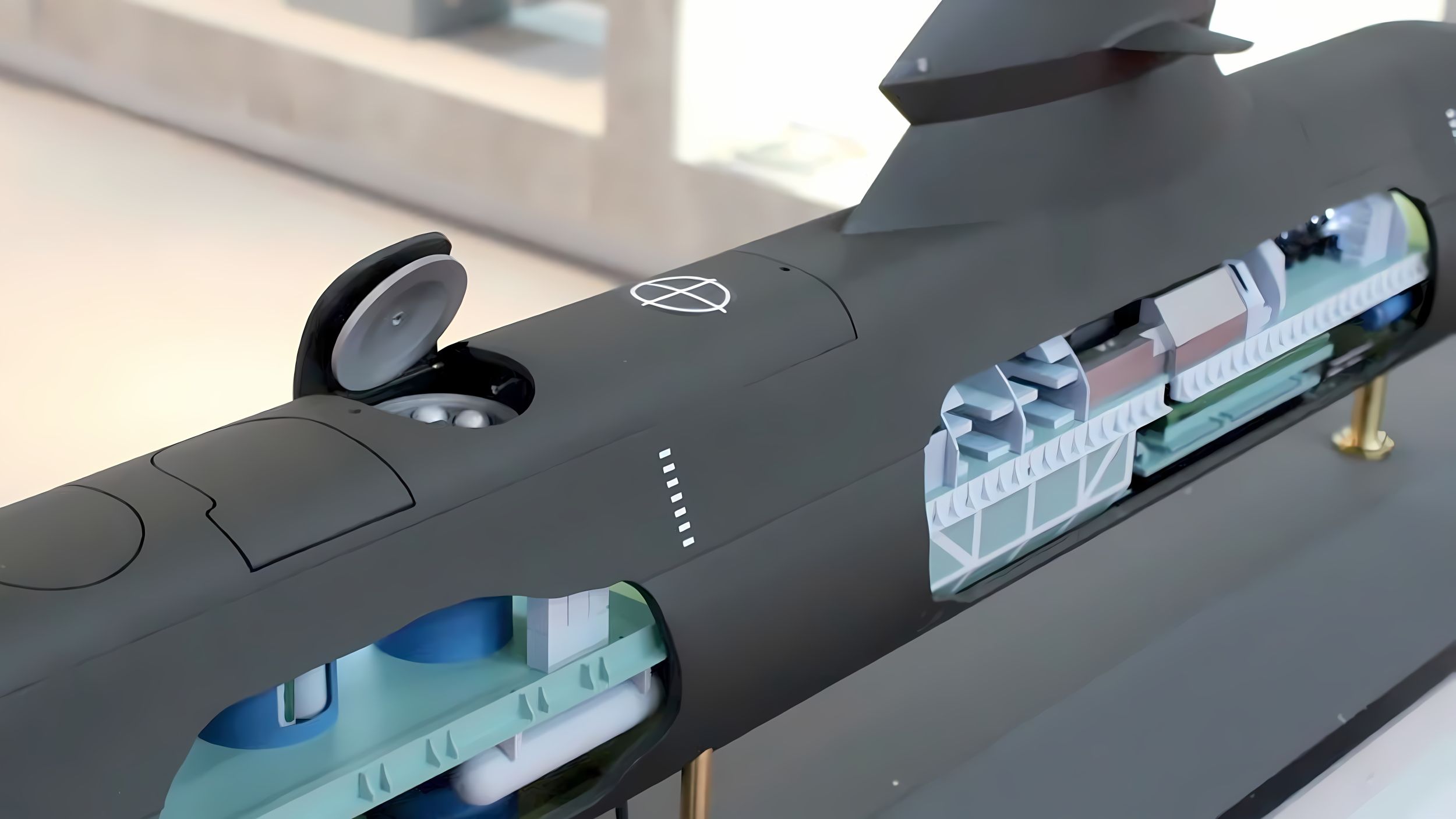
No information on the systems and weapons fit of Poland's A26 has been revealed, though Saab did display a possible Polish model with vertical launch systems (VLS) at defence trade shows. As Pete mentioned in his article on Canada's CPSP, a VSL module would add a significant displacement to a 2,000-ton AIP submarine, impacting range, speed and endurance.


Saab A26 model with VLS. Image: militaraktuell.at
---

Could Polish A26s come equipped with Saab's Horizontal Multi-purpose Lock (HMPL), also called the Multi-Mission Portal (MMP)? This is very likely, considering that the A26 is optimised for the constrained waters of the Baltic Sea, and Saab has a Large Uncrewed Undersea Vehicle (LUUV) that fits. The Lock/Portal's diameter might be anywhere between 1m and 1.5m.


The A26's HMPL/MMP under development in a Saab workshop. Image: Screenshot from a segment 4 to 8 minutes into this navalnews.com video
---


November 30, 2025

New Submarines and more! November 2025 roundup

Pete has already written about the Polish A26 selection, and here's my 2 sens (Malaysian sens - worth about 0.7 Australian cents).

I've commented on the A26 programme over the years, but its issues basically come down to the Swedish concept of neutrality, which ended when it joined NATO in March 2024. The A26s for Poland will have newly developed horizontal multi-mission portals and vertical launch systems. 

With the cost of military research and development increasing in the last three decades, Sweden found it difficult to fund its replacement programs, and therefore tried to partner 'unaligned' nations to help fund arms development. While Brazil emerged as a major buyer and contributor to the SAAB Gripen E fighter program, no such nation emerged for the A26 submarine program.

I'm certain the Swedish government of the day expected one of Kockums' biggest export customers, Singapore (which at this point had bought seven used submarines and two new minesweepers), would emerge as an export customer for the A26, but TKMS's ownership of Kockums prevented this, and in November 2013 TKMS won the tender for the Type 218SGs to Singapore (which has matured to a six boat program) It was only in June 2015 that Sweden began its struggle to build the first two A26s alone, with no economies of scale or cash injection that would have been provided by a foreign order. 

Poland's selection of the A26 is a move of significant political implications, no less so as this was first announced by the Swedes. This implies that Sweden places a great deal of importance on this government-to-government deal, as this is Sweden's first major defence deal as a NATO member, and will deepen defence cooperation with the Poles. It is not a joke to call the A26 a submarine built for the Baltic, and I expect a massive investment in Polish naval shipbuilding. This will also benefit Sweden, which does not have a domestic military shipyard capable of handling warships larger than 2,000 tonnes.

Sweden’s Lulea-class frigate program is expected to select a design in 2026. While the Naval Group Defense and Intervention Frigate (FDI) has had a lot of recent press, a tie-in with Poland could include Polish shipyards building additional Type 31 frigates for Sweden. We may see a ‘Baltic Naval Force’ in 2030 with Polish sailors training in Swedish submarines, and Swedish sailors on Polish frigates. 

This was not the only submarine-related news in November 2025, so here's a brief round-up.

Turkish Reis-class. Second of Six Type-214TN boats launched

Image: Navalnews.com
---

TKMS has announced the delivery of the second Reis-class (Types-214TN) boat, the TCG Hizirreis (S331), for the Turkish Navy.

The Type-214TN is the Turkish version of the popular Type-214 export AIP design, which is in service with the Greek, Portuguese and South Korean navies. Turkey ordered six boats in 2009, all built at the Gölcük Naval Shipyards, and production seems to be on track, with a boat delivered every two years.

Brazilian Riachuelo-class. Fourth boat launched.

image: Naval Group
---

Speaking of popular submarine export designs, Brazil has launched the fourth and last boat in the Riachuelo-class, an enlarged derivative of the DCNS Scorpene.

This should indicate that Brazil is now entering the last phase of its PROSUB program - the start of production on the SN-10 Álvaro Alberto nuclear submarine, which has an expected delivery date of 2034.

Spanish S-80-class. Second boat now afloat after October launch.

Image: Navantia
---

Following on from its ceremonial launch in October 2025, Spain's S-82 Narciso Monturiol has been floated out of a floating dock in preparation for its harbour trials. The second of four S-80 Issac Peral-class boats, the S-82 Narciso Monturiol was built without an AIP module. This is because Navantia's BEST bioethanol AIP system was developed too late to be installed in the first two boats. They will receive the AIP module in a later upgrade.

While two working S-80 boats will improve Navantia's export sales chances, with the first boat visiting Egypt in early November, the current lack of an operating AIP system was a major factor that led to the Indian rejection of the design.


September 26, 2024

Singapore commissions two Invincible-class (Type-218SG) submarines

Update 26 September 2024 - added videos and response to Pete.

On the 24th of September 2024, Singapore commissioned the first two Type-218SG Invincible-class SSK AIPs into the Republic of Singapore Navy service. In a morning ceremony, Prime Minister and Minister of Finance Lawrence Wong officiated the full commissioning of the RSS Invincible and RSS Impecabble. 
Image: Naval News (Singapore MINDEF image)

The ceremony was live-streamed on YouTube, and as I cannot insert that video on this blog, please goto: 

https://www.youtube.com/live/SBDRIwK9tlA?si=eu71yalnXYlZuA_w&t=1831


As I’ve written in a previous post, two boats, the RSS Illustrious and RSS Inimitable remain in Kiel, Germany, where they are now expected to return to Singapore by 2028, according to the Singapore MINDEF press release.


The Invincibles are the third generation of submarines to enter commission in the RSN, and are also the first built-for-purpose class, as the Challenger- and Archer class came from Kockum’s used submarine lot. The last two Challenger boats, RSS Conqueror and RSS Chieftain, are still in RSN service, 55 years after their launch, and will soon be decommissioned - I expect this to occur by the end of 2024.

Singapore's Ministry of Defense also held a media showcase of the upgraded submarine simulator centre that trains the RSNs future submariners. Trainees undergo a nine-month training course that includes operations in a full-motion dive simulator, and training simulators for engineering, including a battery compartment. The new simulator is from Rheinmetall and will allow Singapore to train qualified sub-crews in-country,

According to an article by defence correspondent Mike Yeo, the 2,000-tonne displacement Invincible-class has 50% more underwater endurance than the six weeks of the Archer class, while automation has reduced its crew size to 28, all with their own berths (including female submariners).  


The 2013 Kockums-block

Pete has commented that "Singapore made the correct decision buying the current technology Invincible from Germany rather than risk lateness and cost overruns with the new technology A26 from Sweden."

Pete and I have had over a decade of exchanges on this topic, including his 2013 article about TKMS's involvement in Kockums, which I called 'the Kockums-block'.

Singapore has a long military export relationship with Sweden, going back to the 1970s, and specifically with Kockums - Singapore purchased four new Landsort-class mine countermeasure vessels in 1991, the Bedok-class, followed by four Challenger-class submarines (actually five, the last boat was used as a parts donor) in 1995 and the two Archer-class boats in 2005. Kockums was sold to TKMS in 2005, as part of the HDW group.

Kockums had one project with the Swedish Navy in the 2000s, the Visby-class corvettes, so its export work for Singapore (including 4 Kockums V4-275R Stirling Engines) kept the company in the black until the long-delayed A26 project started, with Sweden signing a contract with Kockums in 2010. 

By 2014 two facts emerged:
1. In December 2013, Singapore selected TKMS to build two submarines (eventually the 4 Invincibles), the only other bidder was Naval Group. Kockums was 'not allowed' to bid.
2. Russia annexed Crimea, causing every nation in Europe to reevaluate their military, and Sweden suddenly discovered that after three years, there was nothing done by Kockums with the A26 except glitzy marketing graphics.

My own belief is that Singapore would eventually invest in the A26 project (potentially worth US$2-3 billion then) - but the 'Kock-up' torpedoed this investment, leading to the Swedish government raid on Kockums in May 2014 and its eventual sale to Saab.

An overall explanation of this situation, which led to Saab purchasing Kockums from TKMS, from the Swedish side, can be read here.

At the end of all this, Singapore acquired 4 next-generation submarines from TKMS, and still works with Saab Kockums, for the composite superstructure of the Independence-class LMV and the overall design concept of the upcoming MRCV, as well as delivering six composite superstructures. 


March 31, 2024

New NATO Country Sweden's Ship & Sub Challenges

Indomitable commentator Shawn Chung discussed offline Sweden's Chief of Navy Rear Admiral Ewa Ann-Sofi Haslum talking about updates in the Youtube here and below. 


The Chief of the Swedish Navy spoke to Naval News on the side-lines of Sydney's Indo-Pacific 2023 and Sea Power Conference, held in November 2023. Like most senior Swedish officers she speaks English clearly. 4:50 in she foreshadows Sweden will eventually order the "[A]30...next generation submarine" to eventually replace the A26 Blekinge-class. She spoke about the challenges the Swedish Navy is facing, especially with NATO membership and seabed warfare. One the latter she talked about the sabotage of the NordStream undersea gas pipelines. 

[Pete Comment: The US has been implacably opposed to these pipelines delivering Russian gas to Europe. The relative lack of West European curiosity as to who blew up those pipelines on Sept 26, 2022 might suggest the country with the motive and best equipment to do so.]

Sweden will be eventually replacing the 73m long Visby-class large patrol boat sized vessel with the future >100m long large corvette sized Lulea-class future surface combatant, https://www.navalnews.com/naval-news/2023/06/swedens-future-surface-combatant-to-be-known-as-lulea-class/ which looks a bit like some of the designs that were bandied about for Singapore's future MRCVs.  

Little is known about the Lulea-class (which has four ships named after Swedish coastal cities) - the size and capabilities are unknown, except it will be larger than a standard  corvette (over 100m), as Sweden now will participate in NATO naval missions. The Swedish Navy also wants the ships from 2030, which is quite a rush.. like the 6 MRCVs (from 2028), so we may find out at a later date that the Lulea-class hulls could be produced in Denmark, or Singapore, and delivered to Saab Kockums for outfitting. 

Saab Kockums has a three decade relationship with Singapore - The Bedok-class mine countermeasure vessels are Landsort-class variants. Singapore emptied out Kockum's used submarine yard by buying the Sjoormen-class (renamed Challenger-class) in the late 1990s, and two Vastergotland (now the Archer-class) in the 2010s. Saab Kockums also contributed to the design of the Independence-class littoral mission vessel. 

I also reckon that the Swedish government was lining up Singapore to buy into the A26, but the various issues with Kockums in 2014 (then owned by TKMS) scuppered any deal. Sweden basically lost over $3 billion that would have kickstarted the A26 program.

Further Background

Wiki advises "In January 2021 Saab Kockums was awarded a contract for the product definition phase of the Visby gen 2 corvettes by the Swedish Defence Materiel Administration (FMV). These [still patrol boat sized] ships were intended to be an evolved version of the Visby-class corvettes currently in service with the Swedish Navy. 

However, a rapidly changing geopolitical situation in large part due to the 2022 Russian invasion of Ukraine and Sweden's subsequent application to join NATO led to the cancellation of the Visby gen 2 in favour of a clean sheet design, the [corvette sized, with many more missiles] Luleå class."

December 6, 2022

Walrus Replacement Process: Excellent Description

Giving great insights into Dutch politics “Locum” made very interesting comments on the Walrus Replacement Process, on December 5, 2022 at 8:12 AM and 8:13 AM, as follows.

"Das Boot, Which Boat?

[Which submarine type may replace the Netherland’s 4 Walrus-class submarines?]

The 73 meter long TKMS Type 212CD submerged tonnage is 3,200 (metric) tonnes. While the 80+ meter long Type 212CD E’s submerged displacement is 3,500 tonnes.

The prototype and launching customer for the Type 212CD E is the [Israeli] 'Dolphin 3' / Dakar-class. 

The English Wikipedia page of the Dutch Walrus class states incorrectly that TKMS is offering the future "Type 212CD". In fact TKMS is offering the larger Type 212CD E derivative that has 80 - 90 % commonality with the Type 212CD. (For comparison: the French Tigre helicopter and Aussie Tiger Armed Reconnaissance Helicopter (ARH) have a commonality of 80 %). The 212CD E [offered to] the Netherlands comes without the VLS. And the standard DM2A4 Sea Hake torpedo's will be swapped for the Mk 48.

Long range cruise missiles in the eventually Dutch 212CD E's will be launched via the torpedo tubes.

The Dutch navy originally specified the Thales 2076 sonar. This is because since WW2 the Dutch navy have been cooperating with the UK Royal Navy's submarine service. However, the sensor equipment has a significant impact on the overall submarine design. Therefore the integration of the Thales 2076 into, for example the Type 212CD E or the Shortfin Barracuda, would be [excessively expensive]. So the Dutch navy dropped the Thales 2076 requirement for the Walrus replacement.

Politics & Industrial Participation

The Walrus wiki page is correct about 2 conflicting groups. One group, the Dutch navy and Netherlands industry, want a Walrus 2.0 [as large and capable as the existing Walrus subs]. So the Dutch navy has the most freedom to fulfil their requirements and the Dutch industrial participation will be maximal.

The other group wants to import a submarine, at the lowest possible costs and risks [this would be a smaller typical Eurosub, perhaps only 2,200 tonnes submerged].

Wiki is incorrect, in stating that the Walrus replacement process started in “November 2014”. The then Dutch Secretary of Defense Ms Jeanine Hennis-Plasschaert had already signed in the first half of 2013 a Memoranda of Understanding with Norway and Germany regarding close submarine development (then called Type 212 NG [Next Generation]). The planned in-service date for the first Walrus replacement was, at that stage, envisaged to be 2025.

January 2015. Damen Schelde and Saab-Kockums signed a deal to design a Walrus replacement together. (Saab-Kockums offered the Type 712 or C71 a purely Swedish design [based on the future A26].) The reason for this is that the Netherlands had already lost the [indigenous capability to design and build submarines in 1994]. In 1994, the Dutch government decided not to replace the 2 Zwaardvis (Swordfish) class boats. Therefore the Dutch submarine service was cut form 6 to just 4 boats. The Dutch submarine manufacturer RDM (Rotterdam Droogdok Maatschappij, which translates as Rotterdam Drydock Society) managed to survive until 2004. After that, the Dutch lost at least 20% of their submarine building knowledge.

The then SecDef Jeanine Hennis was certainly not pleased with this Damen-Saab  cooperation. Because it made her choice for the winning shipyard more difficult. However, this Damen-Saab cooperation was backed by the Dutch navy and Dutch industry.

Consensus & Compromise

The Dutch Low Lands are mostly flat and have often a low sky of clouds. If you are sticking out your head with a great idea or achievement, it will be 'chopped off'.

And ten Dutchmen have 10 often conflicting opinions.

So in the Netherlands decisions are always taken when there is a consensus by compromise between these often conflicting groups / parties.

With no consensus in 2013 - 2015, first the decision for a new boat was delayed 2 years. Not only the Department of Defense, but also the Department of Finance, the Dept. of Foreign Affairs, Dept. of Trade (Economic Affairs) and the Dept. of General Affairs (the Prime Minister) became involved. Five departments with often conflicting political agendas.

So a 'sounding board' (klankbord) [committee] for the Walrus replacement was set up. This small group, included a former Air Force general and a former Shell Oil CEO, but had no (former) Dutch navy official. Their conclusion: was an options list for the Walrus-replacement:

1. [large] expeditionary subs,
2. [smaller] homeland defense (coastal) boats,
3. unmanned / autonomous boats, and
4: no replacement at all.

Next step was an approx 1 year research period to set up a "future vision" for the Dutch submarine service. [But] the Dutch navy had already, in 2012-2013, expressed their general requirements for an expeditionary Walrus-replacement, in a crystal clear and public way.

2017. The SecDef, 'just to make this process easier' [not], added Navantia and DCNS (now Naval Group) to the shortlist.

2018 - 2019. The Walrus-replacement process was delayed again by approx 1 year. Because politicians wanted to secure the Dutch industrial participation in the Walrus-replacement process.

The resulting Defense Industry Strategy (DIS), was in fact '20 year old wine in new bags'.

December 2019, Navantia was chucked out, the afterwards given reason was that the S-80 Plus-class boat did not offer enough functionality. The Acquisition phase was started with the dialogue sub-phase by submitting the third (!) Request For Information to Saab-Kockums, TKMS and the Naval Group.

In the spring of 2020, the Walrus-replacement process was delayed again, because the Dutch General Accountability Office (Algemene Rekenkamer) wanted an audit.

In this audit , the same questions were asked again, questions same as those asked by the "sounding board (klankbord)" of 2015 / 2016.

December 2021. The current 'purple' (joint DoD wide) Dutch Defense Materiel Organisation (DMO) is smaller than the former 'blue only' Directorate Materiel Royal Dutch Navy. This DMO lacks the capacity and capability to do this dialogue with 3-4 shipyards at the same time. Because the Dutch have still made no choice for a shipyard. Their Request for Proposals had to be vague, in order not to give away classified specifications to third parties. And the shipyards 'kept their cards close to their chests' too.

This made the dialogue phase ineffective and it was stopped at the end of 2021.

The process was made faster and simpler, by setting up a Request For Quotations, which were sent at November 16, 2022. 

The 3 shipyards need approx 6 - 9 months to set up their quotations. The Dutch DoD expects that the winner will be announced at the end of 2023. The Dutch DoD demands that the time from building to commissioning takes a maximum of 10 years.

The current plan is that the first 2 Walrus-replacement boats enter service between 2034 - 2037.

Locum"

November 28, 2022

Future Dutch Submarine RFQ: "3,200 tonnes"

Submarine Matters has been monitoring the Netherlands' Future Dutch Submarines (aka Walrus-class submarine replacement) process since 2015.

All credit to a (likely) Dutchman (codename “Kevin”) and more recently non-Dutch /Kjell for describing the Netherlands submarine needs and the replacement process. See this overview of the process.

On November 16, 2022 Netherlands Ministry of Defense Press Release (reproduced by Naval News) indicated:

Today, as previously discussed with the House, the Ministry of Defense has [issued a Request for Quotations (RFQ)] for 4 new submarines from 3 candidate shipyards. The candidate yards are Naval Group , Saab Kockums and ThyssenKrupp Marine Systems. They are expected to submit their bids around the [northern summer - June to August] 2023.

Defense then needs a number of months to analyse the detailed bids. Based on predetermined requirements and award criteria, the Ministry of Defense decides which yard is allowed to build the boats. One of the award criteria is the participation of Dutch companies in the development, construction and maintenance of important systems of the boat. Defense also wants as much Dutch involvement as possible to strengthen the technological and industrial base. The winning yard must sign an agreement for this with the Ministry of Economic Affairs and Climate Policy.”

++++++++++++

On November 27, 2022 /Kjell identified the Naval News Youtubes, with the intrepid Xavier Vavasseur, interviewing the 3 bidders and Dutch DMO to the extent possible, including:

Naval Group - Around Nov 24, 2022 “Naval Group's Conventional Barracuda” 1:25 maybe pumpjet, benefitting from France’s Barracuda SSN [and maybe Attack-class  SSK] programs. Mediterranean, Caribbean seas, Atlantic, Indian oceans, seabed capable. All quieting technologies included https://youtu.be/B3Agdn7_CJA

SAAB Damen - Around Nov 24, 2022 “Saab C71 Submarine (based on A26)” Offering Multi-mission Portal, UK Sonars offered. Can have modular extensions, Dutch technical/maintenance autonomy important. https://youtu.be/oaRwYfxRpJA

TKMS - Youtube around Nov 25, 2022 “Type 212CD E” ie. the 212 Common Design, Extended Range sufficient to transit Netherlands to Dutch Caribbean several weeks on station, then transit back. Maybe 3,200 tonnes submerged. At 1:40 what look like 10 vertical launch doors are apparent https://youtu.be/91OaZFdprTY

Dutch DMO Requirements - Youtube around Nov 23, 2022 “Dutch Naval Programs at NEDS 2022: Submarines” Dutch Admiral (Director Defense Materiel Organisation (DMO)) saying new subs will need to have all capabilities of the Walrus class [implicitly range, so same/more diesel fuel, so higher displacement likely] https://youtu.be/vj_oFLqsfww . Portion on subs is at 1:40 to 7:10.

++++++++++++

The Nov 16, 2022 Press Release was foreshadowed in an earlier, September 30, 2022 Netherlands Ministry of Defense Press Release https://www.defensie.nl/actueel/nieuws/2022/09/30/belangrijke-mijlpaal-vervanging-onderzeeboten-offerteaanvraag-gereed indicating ability to carry “long range missiles” is a requirement.

+++++++++++++

Pete Comment

It is unknown whether the Dutch Navy requires Lithium-ion Batteries (LIBs) and/or AIP for the future subs. Some past commenters have considered Naval Group and TKMS less likely winners because the Dutch don’t like being dominated by these large neighbours. Then again, having lost the Australian order Naval Group’s SSK Division might be very hungry – thus maybe offering the lowest price. But who knows?!

July 5, 2021

Naval Group and LOTE Still Best Sub Solutions for Australia

I am writing in response to Lee McCurtayne's comment of July 4, 2021 regarding future submarine options for Australia.

One problem the Ausralian Government (AusG) has if it wanted to work with SAAB to build a Collins 2 is Australia and Naval Group (NG) have already signed legal contracts to design and build Australia's future Attack class subs. 

The AusG is accountable to taxpayers and voters. As Australia moves toward a Federal Election (on or after August 7, 2021 or on or before May 21, 2022) the AusG does not want to be seen as vacillating over South Australia's very electorally sensitive submarine building industry. Furthermore A$500+ million has already been paid to NG. If a contract was terminated by the AusG then NG could demand at least a A$500 millions breach-of-contract compensation penalty with attendant bad press. Not a good look for the AusG.

In contrast political instability would rule if a Collins 2 was started at this late stage. Nothing has been signed with SAAB-Kockums (or Japan of Germany's TKMS for that matter). Non-NG negotiations, contract signing, design work, construction and testing of a Non-NG future sub might still mean delivery to the RAN after 2030 (maybe simultaneously or even after NG's Attack class).

SAAB's medium sized extended range (ER) A26 is only a paper design. The early ER concept is also likely much smaller (just over 80m long and 3,000+ tonnes) than the large 97m, 4,500 tonne (surfaced) (likely 4,800 tonne submerged) future submarine Australia wants and needs. 

No conventional sub, even an Attack class or Collins 2, would be “Regionally Superior" for Australia. That would take an SSN - with only Naval Group in a position to sell SSNs, in the medium-long term, to Australia. This is  specifically the NG Suffren-Barracuda SSN which has a lower proliferation sensitivity LEU (on dangerous HEU vs LEU scroll 1/6th way down) reactor. 

Meanwhile the only other viable SSN sources, the US and UK, have expressed no serious interest in supplying SSNs to Australia. SSNs are locked up by F-22 like US not-for-export-extreme sensitivity rules. UK reactors based on a US design and US reactors themselves are not for export as they are nuclear proliferation blocked due to their 90+% (bomb grade) HEU fuel cores.

Australia can't afford any "dual build" of Attack class and Collins 2s or to build Attack class while spending the 7+ years to buy an "interim submarine". We can barely afford the Attack class by itself and only have the submarine building facilities for one class at a time. 

As I have said in the past, a viable interim solution is the AusG's long held solution, which will also harness SAAB-Kockums expertise. That is the delayed "life of type extension (LOTE)" which is still not easy or cheap. The LOTE "...will ensure there is no capability gap before the Attack class submarines enter service in the...2030s."

February 25, 2021

Election Winning Sub Deals: Japan Delay or French SSN?

Following this article and in response to my friend GhalibKabir’s interesting comment I comment:

Over concerns about the level of Australian content in French Naval Group's Attack-class submarine project the Morrison Government's negotiations with Naval Group Chairman and CEO, Pierre Eric Pommellet, are largely window dressing. Determining "what is Australian content" is more a public relations art than a logistical science.

Back in 2016, and to win that year's Federal Election, the Turnbull Government prematurely chose a future submarine builder (Naval Group) as a sweetener to win one or two critical South Australia seats. Those seats actually won Turnbull the election and South Australians continue to rejoice in having the $10 Billions new submarine construction contract in their state. The higher the cost of a defence project the more political it is - vested interests and all.

But the Turnbull Government's choice happened so quickly that the contractual basis was largely open ended in Naval Group's favour. Now all Australian taxpayers are living with that reality today in terms of an open ended, rising, project price. 

In late February 2021 it is unlikely the Morrison Government would take the risky domestic political step of ending the Naval Group contract. But there is hope. South Australia remains hypersensitive to threats to its main manufacturing money earner, the submarine contract. 

Morrison is now acutely vulnerable because in mid February 2021 Federal Member of Parliament Craig Kelly put serious pressure on the Coalition after leaving for the crossbench. This means Morrison’s Coalition government only needs to lose one seat in South Australia (in a possible October 2021 Election) for Federal Labor to win Government.

Also Defence Minister Linda Reynolds is already under major political pressure over the alleged rape of a female staff member.

Regarding 
Japan or Saab as possible submarine building alternatives to Naval Group:

Japan would probably offer the cheapest build in South Australia but we would still be talking actual commissioning in the 2030s. 

In 2016, China overall was in Australia's good books, as Australia's major trade partner, with the strategic threat China posed far secondary.  Australian academics and policymakers were concerned Japan expected too much of a major submarine deal adding up to a closer strategic alliance between Japan and Australia. China being the major threat to Japanese and Australian allies.

Now in 2021 China is recognised as the major regional threat. If a submarine deal strengthened the (Australia, Japan, US, India) Quad that would be a good thing. The new Biden administration can do much to persuade Japan to leave its no-big-foreign-arms-deal-experience comfort zone and again think seriously of helping Australia build a variant of the latest Japanese sub (now the Taigei class).

Meanwhile Sweden's Saab-Kockums has yet to prove (after a 20 year hiatus) that it can turn out new subs efficiently. Saab's A26 Blekinge class has still not been launched even for Saab’s own Swedish Navy. The last new subs Kockums built were the unpopular Collins (HMAS Rankin launched 2001). Also there is the RAN's, Australian politicians' and the publics’ bad memory of numerous Kockums technical, cost and attitudinal problems in the building of the Collins (eg. the defective diesels are still in the Collins and still limit its performance). Furthermore Sweden was not even in the future submarine 2016 shortlist (which consisted of France, Germany and Japan).

Morrison could talk to Japan (which is hurting financially because of the de facto cancelled Olympics) in order to reignite sub-builders KHI and MHI enthusiasm for an Australian sub deal. Although it would take about 7 years for Japan to design an especially large, long enough range,  Australian submarine. Prime Minister Morrison would need to be brave to indicate to South Australia that Japan could be a viable alternative to Naval Group. 
_____________

Naval Group's Barracuda/Suffren class SSN is a better answer:

This Naval Group submarine design is ready now - no 10 year development delay. A nuclear propelled attack sub (SSN) most directly answers Australia's long distance/fast transit mission needs and is truely "regionally superior".

Many nuclear proliferation concerns can be countered that unlike US and UK SSNs, that use weapons grade HEU in their submarine reactors, the French SSN uses more legally and politically permissable LEU.  

South Australian voters can be assured that Australia is still sticking with a Naval Group submarine build in South Australia - main difference is that its a nuclear propelled submarine.

See influential conservative Australian commentator Peta Credlin explaining the SSN case. Although in contrast to her UK or US SSN suggestion I'd argue the French SSN is a more viable buy. This is in many respects, including the French SSN is smaller implicitly cheaper, needs a far smaller crew, has a low proliferation reactor, and France has a better record selling sensitive nuclear gear than the US or UK.

It would be better not to combine hence conflate the highly specialised French SSN reactors issue (these would be refueled in France) with the perpetually too-hard-basket issue of land based nuclear energy reactors in Australia.

Repeated public enquiries in Australia have indicated the public are against land energy reactors - making land reactors a scorching hot political potato that may take decades to resolve in favour of.

February 18, 2021

Saab Offering 2 Types of Sub to the Dutch: L/D Ratios.

Following this article Locum on February 9 has provided some interesting comments which have prompted Pete to look into L/D ratios: a pretty complex, controversial topic.

Length of a submarine / Diameter of a sub = (L/D) ratio, a key measure. A L/D ratio of 7.0 may be good for a coastal (littoral brown water) submarine. A submarine with good oceanic (blue water) qualities ideally has a ratio around 10 up to 11.5. 

The Netherlands Navy and Defense Ministry want, a largish, around 2,900 tonne, tailor-made sub. But this is expensive. Such a sub would have range longer than 10,000nm miles at 10kn cruising speed for the shortest possible transit time. This would be good for missions from the Netherlands to the Dutch Caribbean (monitoring and/or special forces) or Netherlands through Mediterranean to the Middle East (electronic and ASW monitoring).

A lot of people, even some Dutch politicians, think that a Saab-Kockums A26 Oceanic Extended Range concept is the best contender for the Walrus replacement.

A. Saab-Kockums may be offering the Netherlands two designs. That is:

-  A26 Oceanic of 65m/ (maybe) 6.75m 2,000 tonnes (surfaced), 6,500nm at 10kn sub yielding a L/D ratio of 9.63. Its very close to standard Blekinge A26 dimensions. This makes it cheaper, hence of the type most of the (non-Navy/non-Defense Ministry) economic ministries want.

OR

- A26 Oceanic (Extended Range) An 80m long (diameter unknown lets say 7.8m) L/D of 10.26 3,000 tonne (surfaced) 10,000nm at 10kn. Around 3,300 tonnes (submerged). Greater weight alone makes it a more expensive choice, however its dimensions are similar to Kockums operational Collins sub. Its around the dimensions the Netherlands Navy wants. But that navy can then shoot lower, to 2,700 tonnes, and thus appear conciliatory.

B. Naval Group is offering versions of the Barracuda and Scorpene [Dimensions, hence L/D unknown, being kept Secret.]

C. TKMS is offering the Type 212CD E. [Dimensions, hence L/D unknown, being kept Secret?]

------------------

Navantia was offering the S-80 Plus. [Though note “Navantia was not accepted as a bidder.” by the Netherlands’ future submarine selection panel.]

Drawing illustrates a submarine's L/D ratio, wherein Diameter (D) of Hull is a proportion of Length (L) of Hull. In this example L/D ratio is quite good 8.75 (where L = 8.75 D). See upper right corner of Drawing. (Drawing courtesy Google Images which Google located from this source).
---

L/D ratio imposes hydrodynamic efficiency, but this ratio is also governed by the type of missions a particular nation's submarines performs.

Low L/D allows rapid turns (to clear the baffles) and rapid tactical changes in direction (good for dodging other subs, ship’s hulls and even torpedos). Low L/D also allows for easier steering around rocks and narrows and a more compact shape to fit in seafloor "holes" (eg. in the Mediterranean or Baltic Seas).

A higher ratio makes for more efficient oceanic-blue water travel (surfaced, snorting of fully submerged).