Showing posts with label Syria. Show all posts

March 31, 2015

Israeli Publicity on Nuclear Capability of its Dolphin 2 Submarines - Yakhont, BrahMos


The upper image is a Dolphin 2 - for size comparison and to indicate the fuel cell AIP additions. Lower submarine image highlights the high number of torpedo/missile tubes - apparently ten on the Dolphin 1s and 2s - useful for rapid nuclear missile launch. (Diagram courtesy Next Navy)
---
Most probably very similar to the Russian-made P-800 Oniks, Yakhont , NATO reporting name SS-N-26 "Strobile" is the Russian-Indian BrahMos (above) . The mach 2.8 end run makes Yakhont and BrahMos difficult to detect and shoot down in time. With a probable land attack capability and air-launched range longer than the notional 290km they will be a proliferating weapon to watch. (Diagram courtesy - Russian for "Military Parity" website).
---

Here's the BrahMos missile showing its capabilities in land, ship and submarine launch. Its ability to hit what look like 2-4 m targets supports claims of +2/-2 m accuracy.
---

In terms of relevance to Australia the ability of Germany's TKMS-HDW to tailor-make largish Dolphin 2 (2,000+ ton (surfaced)) warm water, submarines for Israel implies a capability to successfully tailor-make future submarines for Australia.

In late March 2015 much of the Israeli media (eg. a haaretz article of March 30, 2015) seem to be carrying Israeli government generated news of technical progress with the ISS Tanin nuclear capable submarine. Tanin appears to be the most complete of Israel's Dolphin 2 class SSKs. It does not appear the Tanin is anywhere near formal commissioning - so why the publicity? 

The media reports substantially carry mention of the nuclear second strike capabilities of the Dolphins. This is a subject that requires Israeli Government permission to be published.

The reason to mention second strike appears to be Syrian government acquisition and possible deployment of Russian-made P-800 Yakhont, NATO reporting codename SS-N-26 "Strobile" - a supersonic cruise missiles. What has Israel worried is not so much the usual anti-shipping role but more the Yakhont's land attack capability. 

With Syria's record of using Sarin gas on crude warheads against civilians Israel's worry about the Oniks would be considerable. Syrian use of radiological warheads might also be feasible and of course high explosive. The chances of Sunni rebels or Sunni governments acquiring Yakhonts adds an extra worry. See my May 21, 2013 article on Israeli airstrikes on Syria.

Media stories on Israeli second strike would of course have a "put pressure on Iran" intent as well.

In an added twist India and Russia are jointly developing the BrahMos version of the Yakhont. India wishes to market BrahMos to several countries in the Asia-Pacific. Meanwhile Russia has already supplied the Yakhont in Australia's region to Indonesia and Vietnam

Please link with Submarine Matters' Israeli Dolphin Sub, Nuclear Armed, Conventionally Propelled, February 25, 2012 which mentions possible Israeli developed nuclear warheads on submarine launched Harpoon missiles (SLCMs). Israel's current nuclear SLCM may be the socalled Popeye Turbo or perhaps an Israeli version of the (jointly developed?) Indian K-15 small ballistic missile. The Dolphin 1s and 2's extraordinarily high number of ten torpedo tubes (including 4 unusually large 650mm tubes) implies the ability to rapidly launch ten nuclear land attack missiles. 

The sequence of the Dolphin 2s being delivered by Germany then modified/completed in Israel (Haifa) is a bit puzzling. Based on "Boats" but updated:

Dolphin 1 class
  • Dolphin – delivered May 1998 – commissioned 1999
  • Leviathan (trans. "Leviathan" or "whale") – delivered 1999 – commissioned 2000
  • Tekumah (trans. "Revival") – delivered 2000 – commissioned 2000
AIP Dolphin 2 class
  • Tanin (trans. "Tannin" or "Crocodile") – delivered 23 Sept 2014 - enter service 2015, commisioning 2015 or 2016?
  • Rahav (trans. "Splendour") – delivered 29 April 2013 - enter service in 2015 or 2016?
  • Name not assigned yet. Ordered 21 March 2012. Enter service in 2017 or 2018?

Tanin was apparently received months after Rahav yet Rahav will be completed later. 

Much of the Israeli modification/completion would be for the electronics and loading fitout for the nuclear missiles. Publicity about Germany in 2012 being overly knowledgable and helpful to Israel regarding the nuclear missile loading fitout must have resulted in Israel taking over that whole job. Perhaps Israel's procedures are not fully developed - hence the Tanin-Rahav completion anomaly.

Pete

June 23, 2014

Iraq: the ISIS crisis


Something I had published on Australia's ON LINE opinion on Friday June 20, 2014 http://www.onlineopinion.com.au/view.asp?article=16422 indicating "The US is neither all-seeing nor all-powerful. Australia, if it wants to be active in Iraq, cannot act alone so it must follow some country’s lead. With the US inevitably pivoting to Eastern European commitments (Ukraine) and Middle Eastern commitments (ISIS) Australia needs to contribute in some way to the shifting geo-political picture." :

Iraq: the ISIS crisis

By Peter Coates - posted Friday, 20 June 2014

The bloody progression of Islamic State in Iraq and Syria (ISIS) rebel forces to the outskirts of Baghdad continues with a wide range of outcomes possible. The rapid expansion of ISIS (also known as Islamic State in Iraq and the Levant (ISIL)) has come as a shock. This article attempts to present some issues that have received inadequate attention in mainstream media reporting on the ISIS crisis.

Although Islamic Sunni-Shiite hatreds have existed for around 1,400 years the Sunni rebels of ISIS are an unusually violent problem. This map gives one idea of how central Iraq is in the region and of the refugee (internally displaced people (IDPs)) problem created by ISIS’ advance. This smaller map is of the ISIS advance itself.

ISIS’ presence in Syria and Iraq is probably boosting the risk of international terrorism. It is Iraq’s huge amounts of oil, however, that differentiate Iraq from Syria. Several years of frequent suicide bombings in Iraq have sparked little media attention but ISIS seizing Iraqi regional cities and oilfields has rattled surrounding countries and is driving up world oil prices.

Unlike Syria, with few Westerners, Iraq hosts a large Western foreign contractor-government employee presence due mainly to oil.The UK Daily Mail reports that the US embassy in Baghdad's Green Zone has around 5,000 personnel making it the largest US embassy in the world. This may indicate that that US embassy is part of a huge diplomatic cocktail circuit or perhaps it has other functional priorities?

A powerful presence of Western government representatives in Iraq also responds to conflicting concerns of Iraq’s Shiite and Sunni neighbours. Iran has reportedly sent as many as 2,000 men from Quds special forces units of Iran's Revolutionary Guard into Iraq to boost defences against ISIS in and around Baghdad. This indicates how close the Shiite leadership of Iraq is to the Shiite’s leading Iran. It is also significant that Iraq has not protested against Syrian airstrikes launched by Syria’s Shiite government against ISIS convoys actually within Iraq (near the town of Al Qaim).

Sunni dominated governments, including Saudi Arabia and smaller Arab Gulf states, are nervous that regionally powerful Iranian forces may combine with Iraq’s to present a large Shiite military threat. Hence ISIS is semi-openly recruiting in Saudi Arabia. Iraq’s neighbours and the international economy generally are also concerned about rapid fluctuations in world oil price and production levels caused by the ISIS crisis.

It is unclear whether US military activity concerning Iraq will mainly be an airstrike or evacuation mission (or both). Iraq’s Sunni dominated neighbours may well decide not to host any US aircraft or drones that might kill ISIS Sunni rebels. To adjust to this limitation the US military reports that a US fleet is now sitting in the Persian (Arabian) Gulf. This fleet consists of: the carrier USS George H.W. Bush (helicopters for evacuation, strike aircraft and intelligence collection); the cruiser USS Philippine Sea (able to fire at least 122 cruise missiles); and three destroyers each able to fire 90 cruise missiles. Also in the fleet is the USS Mesa Verde an amphibious warship that can carry 800 marines, helicopters and Osprey tilt rotorcraft. The Age has published an article presenting eight military options Obama might be considering.

Baghdad’s location might make a Western evacuation by helicopter or road difficult. Baghdad is a 1,200 km round trip from the US fleet in the Persian Gulf and alternatively it would be a long trip by road south to Kuwait or Saudi Arabia. Baghdad is however a short road or helicopter trip to the Iranian border, hence Western talks with Iran probably include evacuation scenarios.

It was unclear whether Abbott’s comments relating to Iraq (when he met President Obama several days ago) ran too far in advance of any consultation with the Australian public, Parliament or Abbott’s own party room (see this youtube). How Australia could aid any US military or evacuation effort is a question mark. Australian assistance might be in the shape of use of one of Australia’s new E-7A Wedgetail aircraft for force communication or one of our Orions to gather intelligence. If the Iraq crisis runs into weeks or months the deployment of one of our ANZAC frigates might contribute to the US fleet effort. Some Australian army special forces might also be sent to contribute to the protection force [written before the Australian Government announced it was sending 30 SAS to Baghdad as a protection force] for the Western community in Baghdad’s Green Zone.

In the last 48 hours Iraq has formerly asked the US to launch airstrikes against ISIS. Critics from the right and left will damn the US for anything it does or doesn’t do. The US is neither all-seeing nor all-powerful. Australia, if it wants to be active in Iraq, cannot act alone so it must follow some country’s lead. With the US inevitably pivoting to Eastern European commitments (Ukraine) and Middle Eastern commitments (ISIS) Australia needs to contribute in some way to the shifting geo-political picture.

Pete

July 12, 2013

An R2P troop intervention into Syria dangerous for West


US TV show host Rachel Maddow with clips from US Rightwingers who advocate active involvement of Western forces in the Syrian Civil War.

My Comment

But there are also those from the Centre and Left who  argue that a Western Responsibility to Protect (R2P) intervention with Western troops "Boots" on the ground, is necessary to defend the Syrian people against the Syrian Assad Government.

There is a very real risk that a Western troop intervention that destroys the Syrian Army would be seen as yet another Western invasion and occupation of a Muslim Middle Eastern country.

If such an intervention occurred the civil war might rapidly become an anti-Western insurgency with former soldiers of Assad's army, Shiite Hezbollah militia and the Sunni "rebel" opposition forces all fighting Western troops. This is what happened in Iraq after the 2003 Western invasion - something that should not be repeated.

Pete

May 21, 2013

Israel's Realpolitikal Concern About Syria


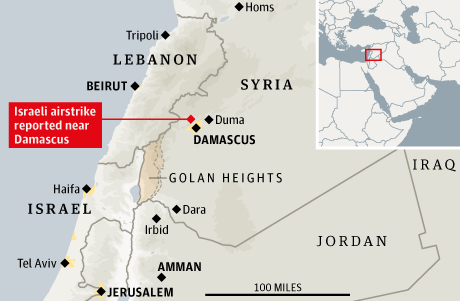
Rough location of Israel's January 2013 airstrike(s) on Syria.
---


Israel's late January 2013 airstrike(s) perhaps on a Syrian convoy with missiles for Hezbollah and/or on a Syrian chemical weapon research-production facility.

----------------------------------------

The following is an excellent commentary on Israel's recent historical and current concerns about Syria. The commentary is by Professor Itamar Rabinovich, Vice Chairman of the (Israeli) Institute for National Security Studies (INSS) Board of Directors, former president of Tel Aviv University and a former Israeli ambassador to Washington. Commentary is at http://www.inss.org.il/publications.php?cat=21&incat=&read=11464

“The Devil We Know” Revisited: Israeli Thinking on the Future of the Assad Regime  INSS Insight No. 427, May 19, 2013 by Rabinovich, Itamar.         
 
On May 17, 2013, The Times of London quoted “Israeli intelligence sources” who argued that “an intact, but weakened, Assad regime would be preferable for the country and for the whole troubled region.” The paper went on to quote “a senior Israeli intelligence officer” in the north of the country: “Better the devil we know than the demons we can only imagine if Syria falls into chaos and the extremists from across the Arab world gain a foothold there.” We do not know who the Israeli sources were, but the Times story provides a window into the deliberations and disagreements within Israel’s national security establishment as to the country’s priorities with regard to Syria.

The expression “the devil we know” was famously used by former Prime Minister Ariel Sharon in 2005 when he explained to President George W. Bush why he opposed the US President’s desire to topple Bashar al-Assad. President Bush became hostile to the Syrian President who supported the rebellion in Iraq against the US occupation and opened his borders to jihadi infiltrators and military equipment in support of the rebellion. While not enamored of the Syrian President, Sharon thought that from Israel’s perspective it was preferable to have a familiar regime in Damascus rather than face an uncertain future and the prospect of the Muslim Brotherhood, the only organized opposition in Syria, taking over the country. Assad was Iran’s ally and provided it with a land bridge to Hizbollah in Lebanon and supported Hamas and Islamic Jihad. But he did maintain a quiet border in the Golan Heights and inherited his father’s reputation as a familiar, and on the whole, predictable enemy. Throughout his political career and his five years as prime minister, Sharon opposed the idea of a settlement with Syria and withdrawal from the Golan that was part and parcel of such a settlement.

Israel’s perspective changed in 2006 after the Second Lebanon War. For Prime Minister Olmert, who succeeded Sharon, the war demonstrated the severity of the threat posed to Israel by the Iran-Syria-Hizbollah axis. The conclusion he drew, with the support of the defense establishment, was that it was a high priority for Israel to dismantle this axis and to do it primarily by pulling the Syrian brick out of the Iranian dominated wall. To this end, in early 2007 he began a Turkish mediated effort to explore the prospect of an Israeli-Syrian settlement. The negotiation lasted until its collapse in December 2008, although it was temporarily suspended in September 2007 when according to foreign sources Israel destroyed the North Korean-built Syrian nuclear reactor in al-Kibar. It could be argued that there was no point in negotiating a settlement with a Syrian president capable of such radical action, but Olmert calculated that this was all the more reason to defuse the conflict with Syria. He and others were also impressed by the fact that Assad displayed maturity and self control when he refrained from retaliating after being humiliated by the attack.

Another Syrian-Israeli negotiation was conducted in 2010-2011, during the final two years of Benjamin Netanyahu’s previous tenure, through mediators on behalf of the Obama administration. According to these mediators, this was a very serious negotiation, Netanyahu’s public rejection of a withdrawal from the Golan Heights notwithstanding. The outbreak of the Syrian crisis in March 2011 put an end to this negotiation as well.

The Syrian crisis, which began as a series of demonstrations and developed into a brutal civil war and a sectarian conflict, transformed Israel’s view of Assad and his regime. The Syrian civil war soon became a focal point of regional and international conflict. On the regional level, it became a conflict between Iran and its adversaries. Iran and its proxy, Hizbollah, have invested huge efforts to protect this strategic asset. Iran’s rivals such as Saudi Arabia, Turkey, Qatar, and Jordan have extended support to the opposition. Internationally, Russia, and to a lesser extent China, are providing the Assad regime with a defensive shield in the Security Council and other forums. Russia also continues to provide Assad’s regime with sophisticated weapon systems. For Russia, protecting its investment in Syria and preventing it from falling into the US orbit is a high priority.

As a neighbor with a high stake in Syria’s future, Israel must decide on its own preferences. Early on, Israel chose a passive stance. Whatever its preferences, it calculated, correctly, that its ability to affect the outcome of the civil war was limited. It has no influence on Syria’s domestic politics and if it were to extend any support to the opposition it would play into the regime’s hands. Assad and his spokesmen argued from the outset that this was not a genuine domestic rebellion but a conspiracy hatched from the outside, and the regime would seize the opportunity to embarrass the opposition by pointing to any Israeli link or support. At the same time, Israel made it clear that it had its own red lines vis-à-vis Syria. It announced that it would interrupt the transfer of sophisticated, game changing weapon systems to the hands of terrorist groups, be they Hizbollah or the jihadi groups that have come to play an important role in the Syrian armed opposition. In January 2013, Israel reportedly destroyed a cache of missiles in the Damascus area en route to Lebanon. In order not to embarrass the regime and to minimize the risk of retaliation, Israel took no credit for this action. But in May 2013, Israel acted twice and in a manner that could not be secret. Clearly, Iran, Syria, and Hizbollah were upping the ante. So was Russia, which is about to provide Syria with sophisticated S-300 missiles whose entry into the Syrian-Lebanese arena is unacceptable to Israel. Israel may find itself in a cycle of violence in which it acts again and again against arms transfers via Syria to Hizbollah, eventually triggering a response, whether by Syria or by Hizbollah. It was in this context that an Israel official stated last week to the New York Times that should Assad retaliate, Israel will topple his regime, meaning that the destruction of Assad’s air force and armor by Israel would lead to the opposition victory. Be that as it may, Israel finds itself deeply involved in the regional and international conflict over Syria’s future as well as in the question of the regime’s future.

Indeed, there is a debate within the Israeli defense establishment as to the desirable outcome of the Syrian civil war. Some argue, in line of what was said to the London Times, that at the end of the day is it better for Israel that Assad remain in power, probably as a weakened ruler over part of the country. Their argument is that given the strength of the jihadi and Islamist elements among the militias fighting against the regime, a jihadi or Islamist takeover or a state of anarchy with jihadi elements free to launch terrorist activities is the most severe threat to Israel’s security. Against this backdrop, Assad once again becomes “the devil we know.” Others argue that the continuation of Assad’s regime in the service of Iran and in close partnership with Hizbollah presents a graver threat to Israel’s national security. They further argue that it is of course not desirable that jihadi groups take over Syria of parts of Syria, but that Syria is not the Sinai and Israel would be able to act if confronted with terrorist threats from Syria.

This latter school of thought is the more convincing. Bashar al-Assad demonstrated his ability to take radical dangerous actions when he built a nuclear reactor in league with North Korea. He demonstrated his willingness to brutalize his own population and use missiles and chemical weapons against it. He is now purely a tool in the service of Iran. This, however, does not mean that Israel should come out openly against Assad and the future of his regime. Israel’s recent entanglement in the Russian-American conflict over the future of Syria is a negative development. While protecting its vital security interests, it should seek to return to the policy it pursued during most of the civil war, i.e., refrain to the best of its ability from being drawn into the crisis and into Syrian politics, and protect its vital security interests firmly, but cautiously and discretely."