Showing posts with label Israel. Show all posts

March 31, 2015

Israeli Publicity on Nuclear Capability of its Dolphin 2 Submarines - Yakhont, BrahMos


The upper image is a Dolphin 2 - for size comparison and to indicate the fuel cell AIP additions. Lower submarine image highlights the high number of torpedo/missile tubes - apparently ten on the Dolphin 1s and 2s - useful for rapid nuclear missile launch. (Diagram courtesy Next Navy)
---
Most probably very similar to the Russian-made P-800 Oniks, Yakhont , NATO reporting name SS-N-26 "Strobile" is the Russian-Indian BrahMos (above) . The mach 2.8 end run makes Yakhont and BrahMos difficult to detect and shoot down in time. With a probable land attack capability and air-launched range longer than the notional 290km they will be a proliferating weapon to watch. (Diagram courtesy - Russian for "Military Parity" website).
---

Here's the BrahMos missile showing its capabilities in land, ship and submarine launch. Its ability to hit what look like 2-4 m targets supports claims of +2/-2 m accuracy.
---

In terms of relevance to Australia the ability of Germany's TKMS-HDW to tailor-make largish Dolphin 2 (2,000+ ton (surfaced)) warm water, submarines for Israel implies a capability to successfully tailor-make future submarines for Australia.

In late March 2015 much of the Israeli media (eg. a haaretz article of March 30, 2015) seem to be carrying Israeli government generated news of technical progress with the ISS Tanin nuclear capable submarine. Tanin appears to be the most complete of Israel's Dolphin 2 class SSKs. It does not appear the Tanin is anywhere near formal commissioning - so why the publicity? 

The media reports substantially carry mention of the nuclear second strike capabilities of the Dolphins. This is a subject that requires Israeli Government permission to be published.

The reason to mention second strike appears to be Syrian government acquisition and possible deployment of Russian-made P-800 Yakhont, NATO reporting codename SS-N-26 "Strobile" - a supersonic cruise missiles. What has Israel worried is not so much the usual anti-shipping role but more the Yakhont's land attack capability. 

With Syria's record of using Sarin gas on crude warheads against civilians Israel's worry about the Oniks would be considerable. Syrian use of radiological warheads might also be feasible and of course high explosive. The chances of Sunni rebels or Sunni governments acquiring Yakhonts adds an extra worry. See my May 21, 2013 article on Israeli airstrikes on Syria.

Media stories on Israeli second strike would of course have a "put pressure on Iran" intent as well.

In an added twist India and Russia are jointly developing the BrahMos version of the Yakhont. India wishes to market BrahMos to several countries in the Asia-Pacific. Meanwhile Russia has already supplied the Yakhont in Australia's region to Indonesia and Vietnam

Please link with Submarine Matters' Israeli Dolphin Sub, Nuclear Armed, Conventionally Propelled, February 25, 2012 which mentions possible Israeli developed nuclear warheads on submarine launched Harpoon missiles (SLCMs). Israel's current nuclear SLCM may be the socalled Popeye Turbo or perhaps an Israeli version of the (jointly developed?) Indian K-15 small ballistic missile. The Dolphin 1s and 2's extraordinarily high number of ten torpedo tubes (including 4 unusually large 650mm tubes) implies the ability to rapidly launch ten nuclear land attack missiles. 

The sequence of the Dolphin 2s being delivered by Germany then modified/completed in Israel (Haifa) is a bit puzzling. Based on "Boats" but updated:

Dolphin 1 class
  • Dolphin – delivered May 1998 – commissioned 1999
  • Leviathan (trans. "Leviathan" or "whale") – delivered 1999 – commissioned 2000
  • Tekumah (trans. "Revival") – delivered 2000 – commissioned 2000
AIP Dolphin 2 class
  • Tanin (trans. "Tannin" or "Crocodile") – delivered 23 Sept 2014 - enter service 2015, commisioning 2015 or 2016?
  • Rahav (trans. "Splendour") – delivered 29 April 2013 - enter service in 2015 or 2016?
  • Name not assigned yet. Ordered 21 March 2012. Enter service in 2017 or 2018?

Tanin was apparently received months after Rahav yet Rahav will be completed later. 

Much of the Israeli modification/completion would be for the electronics and loading fitout for the nuclear missiles. Publicity about Germany in 2012 being overly knowledgable and helpful to Israel regarding the nuclear missile loading fitout must have resulted in Israel taking over that whole job. Perhaps Israel's procedures are not fully developed - hence the Tanin-Rahav completion anomaly.

Pete

March 5, 2015

Abbott's Choice of Japan Possibly Influences Defence Testimony

Australia's Senator Nick Xenophon. He comes to Senator Committe meetings well prepared with research. He then asks questions defence officers would prefer he forgot.
--- 

As the Abbott Government has already chosen Japan's Soryu even the most senior defence officials are limited in what they can say to Australian Senate Committees. To provide full and accurate answer to Senators risks being considered disloyal to Australia's (current) Prime Minister Abbott's decision - increasingly know as the Captain's Pick. Put another way accurate information should be avoided if it potentially provides ammunition for politicians who oppose the Japan decision.

Australia has stated a preference for the US submarine AN/BYG-1 combat system (made for US weapons) and US Admiral Thomas is enthusiastic that Australia buy the Soryu. The implication from this is that the US is more likely to supply its combat system with associated US weapons if Australia chooses Japan's Soryu, 

Like many countries Australia has a number of Senate Committees that seek answers from defence civilian and armed services officers. In late February 2015 in a Senate Committee meeting Senator Nick Xenophon (from South Australia) asked questions concerning Australia's known preference in “competitive evaluation process” for a submarine that is highly compatible with, or already uses US weapons. The relevant US weapons include the Harpoon (short-medium range) cruise missile, Mark 48 heavyweight torpedo, and, in future, the Tomahawk (longer range) cruise missile.

More specifically Senator Xenophon asked Australia’s Chief of Navy and the head of the Defence Material Organisation (DMO) whether Australia's defence sector could reply to the Senate Committee's Question on Notice 171. See Committee Meeting transcript 3/4s way down. Question 171, (d)(iii) was:


"Do any German designed submarines carry US weapons (e.g. Mk 48s torpedoes [any variant] or Harpoon missiles)?" 

To this they responded that:

 “Defence is not aware of any German designed submarines that carry US weapons”.

Senator Xenophon then pointed out that a range of Wikipedia articles and official US government documents confirmed that a number of German designed submarines used or can use some US weapons, including those owned by South Korea (in Australia’s region) Greece, Turkey, Israel and Brazil.  

.. Senator Xenophon commented"Would you understand, Mr King [Head of DMO], that I would be concerned of an error of that nature given the significance? I am concerned that, with such a fundamental error, are you not making decisions on a preferred combat system with US based weapons on the presumption that other combat systems are not compatible with US weapons, which in turn could influence the choice of submarine? You can see my point."

Most have accepted the response to Senator Xenophon as ignorance or oversight, but there is an equally likely explanation.

The head of the Navy and the head of DMO would have been aware that those who oppose "build in Japan" (such as Senator Xenophon) would have been able to use "German built submarines can use US weapons" as an argument for "build German designed submarines in South Australia". 

Naturally Abbott does not want Xenophon or the Labor opposition to be able to say "but the Navy  and DMO have already indicated that "compatibility with US weapons" is a non-argument when claiming Japan's Soryu is preferable to the German contender". 

The defence heads therefore had to rely on seeming ignorance. To provide political ammunition to Senator Xenophon would be entering into the highly political submarine selection issue, after all... 

Another possibility is that the Prime Minister's Office took carriage of the question, provided the wrong answer and the defence heads were forced to live with it. It has already been established that the Prime Minister's Office has taken much of the political carriage of the Soryu issue. After this office handled the Senate Committees questions the defence heads had to wear the acute embarrassment at the Senate committee meeting on the day.

So all this mean's that Abbott's Captain's pick of Japan's Soryu, for the sake of alliance with Japan and the US's advocacy of the Soryu, is influencing otherwise expert testimony on Australia's multi billion (taxpayer) dollar submarine selection.
---


This is the testimony in question given to Senator Xenophon, on US weapons on German designed submarines, at the Senate Committee meeting.

May 21, 2013

Israel's Realpolitikal Concern About Syria


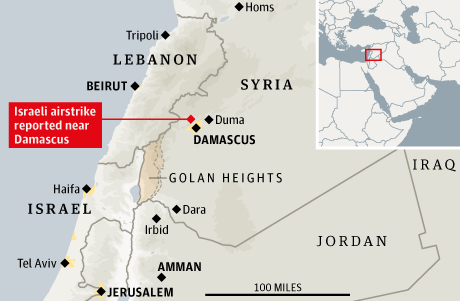
Rough location of Israel's January 2013 airstrike(s) on Syria.
---


Israel's late January 2013 airstrike(s) perhaps on a Syrian convoy with missiles for Hezbollah and/or on a Syrian chemical weapon research-production facility.

----------------------------------------

The following is an excellent commentary on Israel's recent historical and current concerns about Syria. The commentary is by Professor Itamar Rabinovich, Vice Chairman of the (Israeli) Institute for National Security Studies (INSS) Board of Directors, former president of Tel Aviv University and a former Israeli ambassador to Washington. Commentary is at http://www.inss.org.il/publications.php?cat=21&incat=&read=11464

“The Devil We Know” Revisited: Israeli Thinking on the Future of the Assad Regime  INSS Insight No. 427, May 19, 2013 by Rabinovich, Itamar.         
 
On May 17, 2013, The Times of London quoted “Israeli intelligence sources” who argued that “an intact, but weakened, Assad regime would be preferable for the country and for the whole troubled region.” The paper went on to quote “a senior Israeli intelligence officer” in the north of the country: “Better the devil we know than the demons we can only imagine if Syria falls into chaos and the extremists from across the Arab world gain a foothold there.” We do not know who the Israeli sources were, but the Times story provides a window into the deliberations and disagreements within Israel’s national security establishment as to the country’s priorities with regard to Syria.

The expression “the devil we know” was famously used by former Prime Minister Ariel Sharon in 2005 when he explained to President George W. Bush why he opposed the US President’s desire to topple Bashar al-Assad. President Bush became hostile to the Syrian President who supported the rebellion in Iraq against the US occupation and opened his borders to jihadi infiltrators and military equipment in support of the rebellion. While not enamored of the Syrian President, Sharon thought that from Israel’s perspective it was preferable to have a familiar regime in Damascus rather than face an uncertain future and the prospect of the Muslim Brotherhood, the only organized opposition in Syria, taking over the country. Assad was Iran’s ally and provided it with a land bridge to Hizbollah in Lebanon and supported Hamas and Islamic Jihad. But he did maintain a quiet border in the Golan Heights and inherited his father’s reputation as a familiar, and on the whole, predictable enemy. Throughout his political career and his five years as prime minister, Sharon opposed the idea of a settlement with Syria and withdrawal from the Golan that was part and parcel of such a settlement.

Israel’s perspective changed in 2006 after the Second Lebanon War. For Prime Minister Olmert, who succeeded Sharon, the war demonstrated the severity of the threat posed to Israel by the Iran-Syria-Hizbollah axis. The conclusion he drew, with the support of the defense establishment, was that it was a high priority for Israel to dismantle this axis and to do it primarily by pulling the Syrian brick out of the Iranian dominated wall. To this end, in early 2007 he began a Turkish mediated effort to explore the prospect of an Israeli-Syrian settlement. The negotiation lasted until its collapse in December 2008, although it was temporarily suspended in September 2007 when according to foreign sources Israel destroyed the North Korean-built Syrian nuclear reactor in al-Kibar. It could be argued that there was no point in negotiating a settlement with a Syrian president capable of such radical action, but Olmert calculated that this was all the more reason to defuse the conflict with Syria. He and others were also impressed by the fact that Assad displayed maturity and self control when he refrained from retaliating after being humiliated by the attack.

Another Syrian-Israeli negotiation was conducted in 2010-2011, during the final two years of Benjamin Netanyahu’s previous tenure, through mediators on behalf of the Obama administration. According to these mediators, this was a very serious negotiation, Netanyahu’s public rejection of a withdrawal from the Golan Heights notwithstanding. The outbreak of the Syrian crisis in March 2011 put an end to this negotiation as well.

The Syrian crisis, which began as a series of demonstrations and developed into a brutal civil war and a sectarian conflict, transformed Israel’s view of Assad and his regime. The Syrian civil war soon became a focal point of regional and international conflict. On the regional level, it became a conflict between Iran and its adversaries. Iran and its proxy, Hizbollah, have invested huge efforts to protect this strategic asset. Iran’s rivals such as Saudi Arabia, Turkey, Qatar, and Jordan have extended support to the opposition. Internationally, Russia, and to a lesser extent China, are providing the Assad regime with a defensive shield in the Security Council and other forums. Russia also continues to provide Assad’s regime with sophisticated weapon systems. For Russia, protecting its investment in Syria and preventing it from falling into the US orbit is a high priority.

As a neighbor with a high stake in Syria’s future, Israel must decide on its own preferences. Early on, Israel chose a passive stance. Whatever its preferences, it calculated, correctly, that its ability to affect the outcome of the civil war was limited. It has no influence on Syria’s domestic politics and if it were to extend any support to the opposition it would play into the regime’s hands. Assad and his spokesmen argued from the outset that this was not a genuine domestic rebellion but a conspiracy hatched from the outside, and the regime would seize the opportunity to embarrass the opposition by pointing to any Israeli link or support. At the same time, Israel made it clear that it had its own red lines vis-à-vis Syria. It announced that it would interrupt the transfer of sophisticated, game changing weapon systems to the hands of terrorist groups, be they Hizbollah or the jihadi groups that have come to play an important role in the Syrian armed opposition. In January 2013, Israel reportedly destroyed a cache of missiles in the Damascus area en route to Lebanon. In order not to embarrass the regime and to minimize the risk of retaliation, Israel took no credit for this action. But in May 2013, Israel acted twice and in a manner that could not be secret. Clearly, Iran, Syria, and Hizbollah were upping the ante. So was Russia, which is about to provide Syria with sophisticated S-300 missiles whose entry into the Syrian-Lebanese arena is unacceptable to Israel. Israel may find itself in a cycle of violence in which it acts again and again against arms transfers via Syria to Hizbollah, eventually triggering a response, whether by Syria or by Hizbollah. It was in this context that an Israel official stated last week to the New York Times that should Assad retaliate, Israel will topple his regime, meaning that the destruction of Assad’s air force and armor by Israel would lead to the opposition victory. Be that as it may, Israel finds itself deeply involved in the regional and international conflict over Syria’s future as well as in the question of the regime’s future.

Indeed, there is a debate within the Israeli defense establishment as to the desirable outcome of the Syrian civil war. Some argue, in line of what was said to the London Times, that at the end of the day is it better for Israel that Assad remain in power, probably as a weakened ruler over part of the country. Their argument is that given the strength of the jihadi and Islamist elements among the militias fighting against the regime, a jihadi or Islamist takeover or a state of anarchy with jihadi elements free to launch terrorist activities is the most severe threat to Israel’s security. Against this backdrop, Assad once again becomes “the devil we know.” Others argue that the continuation of Assad’s regime in the service of Iran and in close partnership with Hizbollah presents a graver threat to Israel’s national security. They further argue that it is of course not desirable that jihadi groups take over Syria of parts of Syria, but that Syria is not the Sinai and Israel would be able to act if confronted with terrorist threats from Syria.

This latter school of thought is the more convincing. Bashar al-Assad demonstrated his ability to take radical dangerous actions when he built a nuclear reactor in league with North Korea. He demonstrated his willingness to brutalize his own population and use missiles and chemical weapons against it. He is now purely a tool in the service of Iran. This, however, does not mean that Israel should come out openly against Assad and the future of his regime. Israel’s recent entanglement in the Russian-American conflict over the future of Syria is a negative development. While protecting its vital security interests, it should seek to return to the policy it pursued during most of the civil war, i.e., refrain to the best of its ability from being drawn into the crisis and into Syrian politics, and protect its vital security interests firmly, but cautiously and discretely."

July 4, 2012

Likely Israeli "Spy" killed in Christchurch, New Zealand, Feb 2011 Earthquake.

First Published July 20, 2011

Map marking the location of the 2011 Christchurch Earthquake, New Zealand.
----


Photo from Israel's YNet news of Mossad case officer Ofer Mizrahi before his last  fatal mission, when he was crushed by the Christchurch earthquake 2011.
---


The remains of Ofer's crushed van after the most devastating, Christchurch Earthquake (via YNet news).
---

My comments are in [ ] brackets and at end. msnbc.com (Asia Pacific) June 20, 2011 reports:

CHRISTCHURCH, New Zealand — One of the victims of the February [2011] earthquake in Christchurch, New Zealand may have been an Israeli spy [intelligence officer who had the job of collecting NZ passports for later use by Mossad, Shin-Bet or Israeli military intelligence] according to a report in The Southland Times.

The man, Ofer Benyamin Mizrahi, 24, was carrying five [NZ] passports with him at the time of his death, according to the Times. The newspaper's reports centered around a possible breach of New Zealand's national police computers. The Times said police and [New Zealand's Security Intelligence Service] SIS. were investigating.

New Zealand's Prime Minister John Key, who was in Los Angeles Tuesday, declined to comment on the report other than to say "there had been no misuse of the police computer system or New Zealand passports by Israeli citizens," The Southland Times reported.

Mizrahi was one of three Israelis who died in the Feb. 22, 2011. earthquake, according to the Israeli media outlet Haaretz. Around 120 Israelis were living in the area around Christchurch at the time of the 6.3 magnitude quake, which destroyed most of the central business district in the southern city of Christchurch.

Misrahi and three other people were in a van that was crushed by a falling pillar. Misrahi was killed, but the others were able to extricate themselves, the The Southland Times said.

Mizrahi's three companions, one man and two women, photographed the crushed van and rendezvoused at a city square that Israeli officials had designated an "emergency meeting point," then were able to travel back to Israel within 12 hours, The Southland Times said.

[further proof that the passport gathering activity was an extensive and expensive Israeli operation comes from this: ] New Zealand authorities later confronted an "unaccredited Israeli search and rescue squad" and [armed New Zealand special weapons squad guards disarmed the Israeli "squad"] from the sealed-off area in the city, the Times said. This Israeli squad was one of two private search parties brought from Israel to New Zealand, without prior coordination with local authorities in New Zealand, [Israel's] Haaretz reported.

Israel's ambassador to the South Pacific region, Shemi Tzur [putting on a bold face] said the spy reports were "science fiction," The Southland Times said. New Zealand police say they are confident their computer system is secure.


COMMENT

Israel obtains and uses "real" passports from popular, obscure accent, neutral countries, like New Zealand, for Israel's worldwide intelligence operations.

Invaluable Wikipedia reports that Israeli agents visiting NZ were earlier caught red-handed in 2004 attempting to acquire NZ passports:


"In July 2004, New Zealand imposed diplomatic sanctions on Israel over an incident in which two Australian based Israelis, Uriel Kelman and Eli Cara , who were allegedly working for Mossad, attempted to fraudulently obtain New Zealand passports by claiming the identity of a severely disabled man. Israeli Foreign Minister Silvan Shalom later apologized to New Zealand for their actions.

New Zealand cancelled several other passports believed to have been obtained by Israeli agents. Both Kelman and Cara served half of their six-month sentences and, upon release, were deported to Israel see
http://en.wikipedia.org/wiki/Mossad#New_Zealand.

Here is Israel's national anthem, Hatikva or "Hope" not because Ofer was Israeli but in memory of him as a fellow intelligence officer dying on the job.

February 24, 2012

New Isreali Technology for Syrian Raid

Two seat Israeli F-16I
---

From DefenseTech, November 2, 2007, comes "Another Look at the Israel v Syria Raid"

"Israel used several new intelligence-gathering and strike technologies in its raid on Syria. New details of the attack involve a train of capabilities extending from satellite observations to precision bombing of the suspect facility on Sept. 6.

The launch of a new satellite this summer allowed the integration of several advanced technologies including electro-optical imaging from space, image-enhancing algorithms, scene-matching guidance for precision weapons and the use of advanced targeting pods carried by the Israeli Air Force's two-man F-16Is (the pods are not available on F-15Is).

In a series of interviews, several specialists detailed the technologies and how they were used. "Reality is more impressive than your imagination in some areas,"says a senior military officer.

Space observations provided early planning details for the raid. The important satellite for the Syrian raid was Ofeq-7 launched on June 11th. It has multi-spectral and high resolution electro-optical sensors and a resolution of less than a half-meter, far better than that provided by earlier Israeli satellites.

The space images were then improved by specialized imagery enhancement algorithms to sharpen pictures for planning precision bombing attacks.

The primary aircraft for the Syrian raid were some of the new, two-man Lockheed Martin F-16Is (Sufa or Storm) that Lockheed Martin began delivering to the Israeli Air Force in Feb. 2004. The backseater is a weapons systems officer who can focus on targeting and electronic warfare while the pilot focuses on flying and evading air defenses. Conformal fuel tanks give the fighters an unrefueled combat radius of over 500 mi. which matches the unrefueled range of F-15Is which would normally escort a flight of strike aircraft.

Sensors on the $45 million F-16I include a APG-68(v)9 radar with high-resolution synthetic aperture radar mapping capability and about 30% more range that other mechanically scanned radars.

But more importantly for this raid, the fighter had the Litening targeting pod. Its EO imagery can be used for seeker cueing. That imagery can also be used for scene-matching with the observations made by the satellite."

Comment and Background

Ofeq-7 satellite

The Ofeq-7 satellite is the designation of a series of Israeli reconnaissance satellites. All Ofeq satellites have been launched on Shavit rockets from Palmachim Air Force Base in Israel, on the Mediterranean coast. The Low Earth Orbit satellites complete one earth orbit every 90 minutes. The satellite launches caused Israel to become the ninth nation to launch satellites. Both the satellites and the launchers were designed and manufactured by Israel Aerospace Industries (IAI).

While exact technical details and capabilities are classified, it is assumed that the Ofeq satellites have ultraviolet and visible imaging sensors, and an effective operational lifespan of 1-3 years. Some early reports stated the reconnaissance capabilities as such that would allow "reading license plates in Baghdad", but that can be ruled out on grounds of physical optics. Other reports more plausibly place the imaging resolution at 0.8 meters for Ofeq 5.

Ofeq's east-to-west orbit at 36 degrees inclination is phased to give optimal daylight coverage of the Middle East. Ofeq makes a half-dozen or so daylight passes per day over Israel and the surrounding countries, whereas U.S. and Russian spysats only get one or two passes per day from their higher inclination orbits. This optimal coverage degrades after several months, nevertheless keeping a very good coverage of the Middle East.

AN/APG-68v(9) F-16I aircraft radar

The AN/APG-68v(9) radar referred to above has improved resolution, increased range and lighter weight than previous radars. The AN/APG-68v(9)'s SAR (Synthetic aperture radar) capability uses enhanced software algorithms. Resolution in the cross range (azimuth) dimension is achieved by synthesizing a large antenna aperture using the motion of the radar platform as the synthesis basis. In brief, the movement of the radar plenum is what synthesizes the larger radar area.

The key to SAR is the data processing, of the reflected or returned information, which by the usage of software algorithmic design performs the SAR image focusing, so that the radar appears to provide ultra high resolution of the returned SAR image.
.
The AN/APG-68v(9) was not at all developedd in Isreal but bought by (probably using tied US military aid money) from Northrop Grumman. In theory Northrop Grumman will even be selling Pakistan 54 AN/APG-68v(9) sets by 2010.

Pete