May 20, 2015

North Korean Submarines - Useful Stratfor Analysis and Diagram


The following Stratfor analysis of May 19, 2015 North Korea's Submarine Problem is republished with permission of Stratfor.

"North Korea recently [claimed it] tested its new KN-11 submarine-launched ballistic missile, part of a program to develop weapons technology beyond ground-based systems.
Submarine-launched ballistic missiles would give North Korea two distinct advantages. First, they would extend the reach of North Korea's missile systems, theoretically enabling it to strike targets outside of ground-based missile range. Second, submarine-launched missiles, because they are offshore and mobile, would give North Korea a second-strike capability, allowing it to retaliate against attacks on its land-based nuclear bases and launch pads.
These benefits assume, however, that North Korean submarines have two important characteristics: sufficient size to carry ballistic missiles and an adequate level of endurance, or the amount of time a vessel can remain at sea unsupported.
The smallest submarine to ever carry a submarine-launched ballistic missile is the Soviet Zulu IV-class. It displaces approximately 2,000 metric tons of water carrying its one to two nuclear ballistic missiles. It is also heavier than the Type 033, currently North Korea's largest model. Pyongyang will need bigger vessels in the future to carry one to two missiles in an operational capacity. To carry more would require a new and entirely different class of submarine.
Submarines would also need to be able to continue without support long enough to reach targets beyond the range of land-based missiles. In order to fulfill a second-strike role, vessels would need to be deployed for months far from vulnerable ports and be ready for counterattack. Even with modifications, North Korea's Type 033 submarines cannot meet these endurance requirements.
Without an adequate submarine, the resources Pyongyang is investing in new missile technology will not improve the capability of its existing land-based missile program, and a suitable ballistic missile submarine would take several years to complete. Until then, the missiles under development will not provide the major benefits associated with a submarine-launched system."
MY COMMENT

I agree with most of the above. However some countries are developing miniature ballistic missiles and supersonic cruise missiles that can perform the role of the tradition large (Polaris and larger) SLBM. This miniaturisation can potentially allows submarines smaller than 2,000 tons to fire supersonic missiles (though not necessarily ballistic missiles). For example India is developing the mini K-15 ballistic missile for submarine. This is in addition to the supersonic BrahMos cruise missile and Klub cruise missile. The Klub is supersonic and torpedo tube launched.

It may not be essential for a submarine to be "deployed for months". If a submarine has evaded enemy sensors it might be a threat after 4 days travel - in which time an SSK might have arrived at a desired launch point 1,000 nautical miles from port.

Pete

South Korea's Undersea Anti-Submarine Sensor Network - Part of SEAWEB

North Korea Naval Bases and Fleet HQs. One might expect mini-submarines to operate out of Sagin Ni (under West Sea Fleet Command). Sinpo - Mayang Do and Chaho are listed as Submarine Bases (under East Sea Fleet Command).
---

The SEAWEB Network goes by other names such as Fixed Surveillance System (FSS large PDF file - see pages 128-129) (, older term IUSS and oldest (SOSUS). SEAWEB includes sonar, LIDAR, optical CCTV, infrared, chemical sniffing and SIGINT amongst other sensors. (Courtesy US Navy in 2006, but since then the revolution in sensor technology and data management and storage has made SEAWEB a major unsung Western asset. South Korea's undersea sensor network is just one local branch of SEAWEB.)
--- 

South Korea has had a fixed undersea sensor network for more than 60 years. This would have started with the US Navy installing seafloor SOSUS arrays and magnetic anomally-indicator loop technically. Two shocks, the sinking of ROKS Cheonan in 2010 and North Korean moves in May 2015 toward an SLBM capability, have increased attention on South Korea integrating its undersea sensor into the Kill Chain strategy and infrastructure.

The US Navy and the NSA with its supercomputers would have worked with South Korean equivalents on the collection and easy retrieval of vast amounts of data collected from the undersea sensor system. Data management is a major aspect of the US Navy-NSA SEAWEB network - which could provide thousands of data signatures of North Korea, Chinese and Russian submarines and surface shipping. SEAWEB might be seen as a highly secure Intranet where membership /participation is tied to alliance with the US. Sometimes the US would like allies to buy alot of American hardware as part of the alliance membership status. It may be that South Korean submarines would need enough of the correct computer hardware and software "keys" in SK combat systems to access the SK branch of SEAWEB. 

For possible positions of the SeaWeb as it covers East Asia see Submarine Matter's How to Trap the Chinese Dragon - SeaWeb's Fixed Undersea Array, September 4, 2015.

As a political reaction South Korea's leadership talks of new beginnings regarding the undersea sensor network, but the network has steadily evolved in capability and in geographical extend since the early 1950s.

The following are portions of a May 13, 2015 South Korean Korea Joongang Daily, article indicating South Korea intends to extend its undersea "Kill Chain" infrastructure to handle the emerging North Korean SLBM threat :

"South’s military says ‘Kill Chain’ can be extended under water...Defense Ministry spokesman Kim Min-seok …said the South has the capability to track down North Korean submarines in real time when they are in naval bases. “If we concluded that a SLBM-capable submarine is a threat, we can pre-emptively take it out.”

The military also decided to improve its systems to detect the North’s SLBMs and upgrade submarine warfare capabilities. A military official said the modifications will be made based on the “4D Strategy” to detect, defend, disrupt and destroy North Korean threats, introduced by Commander Curtis Scaparrotti of the Korea-U.S. Combined Forces Command.

The two countries aim to create an operational plan based on that strategy and it is expected to include a plan to shoot down an SLBM-capable submarine of the North.

“We have an underwater interception system to counter the North’s submarines,” said the official. “Our military can operate Kill Chains both in the air and under water. We will improve our sonar abilities in the future.” 

SOUTH KOREAS UNDERSEA SENSORS


Reports of South Korean sensors to counter mainly North Korea submarine and ship incursions have concentrated on South Korea's response to the March 2010 NK midget submarine sinking of ROKS Cheonan. But South Korea and the US would have installed undersea sensors against North Korea since the early 1950s.


The fixed undersea sensor network complements mobile undersea elements including South Korean, Japanese and US submarines, AUVs, LDUUVs and air dropped sinking sensors.

As well as undersea sensors South Korea operates ground stations, naval surface vessels and aircraft as well as interacting with US satellites and stealth drones. All these that operate infrared, optical, sonar and radar sensors to detect when North Korea submarines leave North Korean naval bases or when submarines might fire missiles. SIGINT including traffic analysis would also prove productive before, during and after submarine operations. 


Strategypage has provided several articles in 2010, 2011 and 2014 on South Korea's "SOSUS (SOund Surveillance System)" but there are many more sensor types that have been installed into South Korea's sensor network over the decades. 


The undersea system would not be limited to active and passive sonar but could utilise other sensors including:

-  magnetic anomally-indicator loop sensors which has been widely used by countries since WWII onwards  
-  vapour-chemical sniffing sensors
-  fixed undersea LIDAR
-  infrared undersea CCTV, and
-  seafloor, tethered and floating SIGINT intercept.

The Cheonan sinking would have underlined the South Korean and US need to provide many more undersea sensor arrays and nodes to make the network more sensitive, and quicker reacting to  North Korea midget submarines on battery, diver propulsion vehicles, torpedos and SLBM launches. North Korea submarines and diver vehicles operate near the South Korea coast and islands with the expectation that landform and shallow water "clutter' would mask their movements.   

In January 2011 it was reported: "South Korea's military is planning to install underwater sensors near frontier islands in the Yellow Sea to guard against attacks by North Korea's submarines. "We plan to install a number of underwater sensors to beef up defence capability in strategically important north-western islands like Baengnyeong and Yeonpyeong following the sinking of the Cheonan warship," an unidentified senior military official said. The sensors will be monitored from a control centre located on Baengnyeong island, the closest one to the border with North Korea, according to Agence France Presse."

The need to detect North Korean SLBM launches from North Korean naval bases would logically require sensors to increasingly focus on submarine activities within those bases. 

Even for an individual North Korean submarine operation South Korea and the US can lay surface vessel and air-dropped sonar buoys working to ground station, vessel and satellite - and in turn tying in with undersea sensors already there. Towed sensor arrays are also used.

Seafloor-upward floating or upward propelled mines/torpedos can be launched on command (including in peacetime) of automatically be activated/tripped in time of war. The sensor signatures give off by North Korean vessels would be relevant. 

Japan's undersea sensor network also faces the North Korean menace. Some aspects of Japan's network will be described next week.

Pete

May 19, 2015

Japan Providing Information for Future Submarine Selection

A crewmen dangerously perched on a sail-plane of a Soryu (with is submarine number removed for security).
---

What I see as the most interesting parts of a Japan Times May 18, 2015 article are:

“The National Security Council of Japan on [May 18, 2015] approved disclosing some technical data on the nation’s submarine technology to Australia, which is conducting a feasibility study on possible joint development and production of its next-generation submarine fleet…The scope of disclosure will be decided through negotiations but it will be limited to what Canberra would need for its feasibility study, the official said. Japan plans to propose joint development and production with Australia, based on Prime Minister Shinzo Abe’s earlier decision to ease the nation’s self-imposed regulations on arms exports. Complicating matters, though, many aspects of the nation’s submarine know-how have likely been classified as top secret.”

MY COMMENT

Presumably development would center on achieving longer range for “SoryuAU” and perhaps more radically a vertical launch system. I assume negotiations might be through letter/email/Embassies or Minister Nakatani talking to Minister Andrews directly at the annual 2+2 talks in Canberra or Tokyo perhaps in early June 2015. (based on last years 2+2 being in early June 2014) . 

On June 1, 2015 it was confirmed that next week Minister Andrews would meet Minister Nakatani as well as visiting the MHI and KHI submarine yards at Kobe http://www.dailytelegraph.com.au/news/breaking-news/defence-minister-to-visit-japan/story-fni0xqi3-1227378114675 . It is also likely that Andrews and Foreign Minister Bishop will meet Minister Nakatani and Foreign Minister Kishida in Tokyo at the annual 2+2 talks.

Ministers Andrews and Bishop may also be attending a 2+2 meeting in Seoul with their South Korean counterparts - maybe right now in early June.

Hours after I wrote the previous paragraph the Minister's Office or Defence advised (or confirmed to) The Australian (May 20, 12.00AM) that "Kevin Andrews will visit Japan within weeks after the country’s national security council signed off on plans to bid for the navy’s future submarine project..." This is in conjuction with the annual 2+2 talks. I'd like to think The Australian monitor Submarine Matters :-)

S has provided many useful insights and 2 internet documents - see Comments for Minister Andrews Phone Call to Minister Nakatani, May 7, 2015.

The first document was Defence Programs and Budget of Japan Overview of FY2015 Budget Request http://www.mod.go.jp/e/d_budget/pdf/261003.pdf. Very relevant parts of it are:

Page 4: "Construction of a submarine (1 ship: ¥64.4 billion)

Construct the 11th Soryu-class submarine (2,900t class) to increase the number of submarines from the current 16 to 22 ships. [Comment 11th Soryu is 27SS with AIP? and LIB? costing ¥64.4 billion? Will 28SS still be LIB no AIP?]

Improve underwater endurance [Comment – Yes Australia wants greater endurance] , etc. compared with the existing Soryu-class submarines by mounting lithium-ion batteries ○ Life extension of submarines (life extension work for 2 ships and parts procurement for 3 ships: ¥3.4 billion)

Implement life extension measures for Oyashio-class submarines in order to increase the number of submarines from the current 16 to 22 ships.[Comment – hopefully as Japan implements more life extensions Japan will be more able to build subs that can operate to the Australian goal of 30 years]

Page 18: “Increase the number of Defense Attachés, etc. (Ukraine, Poland and Australia)” [Comment – I wonder if the first Attaché in Canberra might be a senior Submarine Officer]

Page 20: “Promoting bilateral, trilateral and multilateral defense cooperation and exchanges, including those with Australia, ROK and India, as well as Japan-U.S.-Australia and Japan-U.S.-ROK defense cooperation”

I found Japanese language budget paper 2014 Fiscal Year Life Cycle Cost Management Annual Report http://www.mod.go.jp/epco/about/pdf/26lifecyclecost_houkokusyo.pdf (pages 77-80) too difficult to generate a useful picture. Even using Google Translate the document is in tables, columns with specialist language conventions used for Japanese government bureaucracy yearly budgeting. Japanese language newspaper articles are easy by comparison.

Pete

May 15, 2015

South Korean "Kill Chain" Preemptive Strike on North Korea - Problems

A South Korean preemptive ("Kill Chain") strike on North Korea would be even more complicated and dangerous than described below. To what extent would the US, Russia, China and Japan become embroiled? Note that the map may be dated 2008 as many of the orbat and budget figures are dated 2005-6 and US carrier Kitty Hawk is listed (even though decommissioned 2009). Still the locations in North Korea appear still accurate. (Click National Post to then expand image)
--- 

In relation to North Korea’s developing nuclear ballistic missile and submarine launch capabilities South Korean preemptive strike (“Kill Chain”) doctrine is under pressure. Kill Chain may be obsolete with the possibility that eventual South Korean nuclear deterrence will be needed to replace it. Over the next three days I will write three articles on this issue. This is the first.

South Korea has been pushing for an indigenous nuclear deterrence capability since the early 1970s however US pressure and promises have been sufficient for South Korea to accept US extended nuclear deterrence. Nevertheless South Korea is more advanced in ballistic missile development than is generally known. 

The pressure on South Korea’s leadership of North Korea's action over the last week is reflected in Korea Joongang Daily’s, May 13, 2015 article "Park calls for a response to North’s launch" http://koreajoongangdaily.joins.com/news/article/article.aspx?aid=3004109&cloc=joongangdaily%7Chome%7Cnewslist1. President Park is seeking an expansion of preemptive strike sensor infrastructure to handle the emerging North Korean SLBM threat.

The process and requirements of Kill Chain premptive strike were summarised by Professor Choi Jong-kun of Yonsei University, Seoul in 2013. Under this doctrine the South Korean (with presumably US assistance) intelligence and military establishment would need to react to North Korea in order to:

“1. Within one minute, South Korean intelligence must pick up signals that North Korea intends to attack preemptively; and

2. Within one minute, South Korea must establish what and where North Korea intends to attack preemptively; and

3. Within three minutes, the supreme commander of the South Korean military must be able to hand down an order to strike preemptively against North Korean targets; and

4. South Korea must attack the relevant sites in North Korea before North Korea has time to launch its own attack; and

5. South Korea must be able to establish whether its initial strikes were sufficient to eliminate the source of the intended North Korean strike; and

6. South Korea must be capable of responding to immediate North Korean counterstrikes from elsewhere."

Problems with South Korean Kill Chain preemptive strike include:

-  The role of civilian South Korean authority particularly President Park in the chain of command and decision making?

-  The role of the US military and civilian authorities? South Korea needs complete confidence that US compliance and involvement in the Kill Chain will be nearly instant.

-  South Korea and the US need complete confidence that China would allow a preemptive strike on its client-buffer state North Korea.

-  Kill Chain requires perfect knowledge that North Korea wishes to launch a major strike against South Korea. By major this means that at least one nuclear (not conventional high explosive or chemical?) missile is about to be launched at South Korea (not Japan).

-  the problem of only one nuclear missile but (say) 100+ decoy high explosive missiles?

-  All the North Korea missiles must be destroyed on their launch platforms or shot down and all NK submarines, warships, air force aircraft and disguised North Korea “civilian” ships or "civilian" aircraft capable of firing nuclear tipped ballistic OR cruise missiles or bombs must be destroyed.

-  These shoot downs and sinkings must be as close to instant and simultaneous as possible. In that regard South Korean cruise missiles might be far too slow for the job.

Without perfect knowledge South Korea could make a situation where North Korea is merely debating the notion of a strike OR only wishes a conventional missile/bomb strike a nationally fatal act be South Korea

Where South Korea commits what might be considered an unnecessary preemptive "Pearl Harbor" attack will that make South Korea an international outcast? 

An unfounded South Korea preemptive strike would almost guarantee a massive nuclear response to South Korea (and perhaps Japan) or total North Korea desire to build a nuclear response in future.

Unless regime change to North Korea took place a South Korean preemptive strike would just be the beginning of further hostilities.
--

The second article will be on South Korea's ballistic missile and nuclear history and future intentions. The third article will be on the extention of the Kill Chain to SLBM capable submarines. 

Connect with North Korea's alleged new SINPO class submarine and missile test, May 13, 2015 (below).

Pete

May 13, 2015

North Korea's alleged new SINPO class submarine and missile test

 I have added several extra hyperlinks, comments in [ ] brackets and a photo (particularly concerning the suspected missiles, Golf and SINPO-class submarines) relevant to the following article.

That article is by Sean Gallagher at arstechnica published May 12, 2015 concerning North Korea's   alleged submarine launch of a ballistic missile. The submarine and missile details will need to be fully verified by intelligence agencies before they are taken as fact. 

On May 13, 2015, US intelligence said North Korea (NK) may have achieved what is called a limited compressed gas ejection test. This is called a perhaps 200 meter "cold launch" in the vertical launch business. 

Other US theories that the missile test did not happen in the way NK said or did not happen at all, are:

- NK launched the missile from a barge-sea platform, not a submarine, and/or
- the missile was a non-working dummy capable of cold launch but nothing else, and/or
- NK photoshopped the missile images below, making up the whole "event".

Despite these doubts South Korea is more than usually concerned. NK has proven it can conduct real nuclear tests and has tested ballistic missiles with, at least, proven medium ranges (ie. between 1,000 km and 3,000 km). Now NK is working towards an SLBM capability. Hence South Korea (and the US) are exploring strategies and tactics to react to NK SLBMs. See my April 16, 2015 article which mentions a future South Korea "Kill Chain" pre-emptive strike capability.

The arstechnica string is http://arstechnica.com/tech-policy/2015/05/north-korea-test-launches-polaris-1-ballistic-missile-from-submarine/ :

"North Korea test-launches “Polaris-1” ballistic missile from submarine


Analysts say DPRK missile subs could threaten Japan, South Korea in five years.


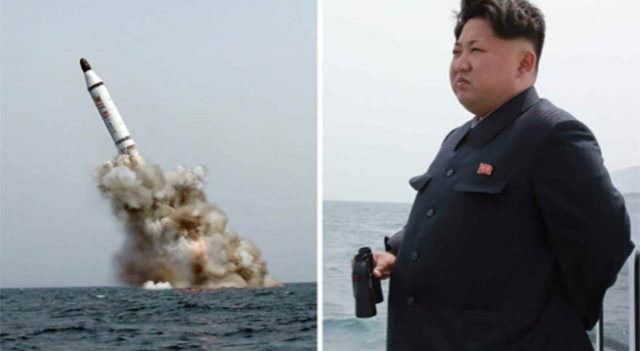
Kim Jong-un watches as North Korea's navy successfully test-launches a ballistic missile from a submarine on May 9.

On May 9, a Korean People's Army Naval Force submarine test-launched a ballistic missile off the eastern coast of North Korea. The test launch, reported by North Korea's Rodong Sinmun newspaper, only traveled about 150 meters, according to South Korean defense officials. But it demonstrated that North Korea had developed the capability of performing submerged launches of missiles well ahead of previous intelligence estimates. Based on the launch, South Korean officials now believe that North Korea could have a limited submarine-launched missile capability deployed to its fleet of submarines within the next five years.
The test comes as South Korea nears a decision on the deployment of a Terminal High Altitude Area Defense (THAAD) anti-ballistic missile system. China has been pressuring South Korea to not allow the deployment, but an earlier, barge-based test of the submarine-launchable missile (named "Polaris-1" by North Korea) on April 22 has made the deployment more likely.
North Korean press images of Kim Jong-un's successful supervision of the "Polaris-1" launch.
Polaris-1 [possibly a BM25-Musudan[possibly also called "KN-11" or "KN-02"] is apparently a close copy of a Soviet-era R-27 ...SLBM...liquid-fuel SS-N-6 "Serb." This is the third test launch of the missile this year, but it is the first [possibly] submarine launch. Developed in apparent violation of a UN resolution banning North Korean ballistic missile development, the missile could have a range of about 1,500 miles.
The original R-27 was capable of carrying three independent nuclear warheads. An explosion of an R-27 missile caused by a reaction between a seawater leak and fuel residue aboard the Soviet "Yankee" class ballistic missile sub K-219 in 1986 off of Bermuda led to one of the most tense moments in the late Cold War (later breathlessly and inaccurately recounted in one of the worst submarine movies ever, Hostile Waters).
North Korean leader Kim Jong-un, who had previously planned to travel to Russia over the weekend but then cancelled his plans last week, was on hand to observe the launch. "He stressed that the acquisition of the technology of firing ballistic missile from a strategic submarine underwater made it possible for the KPA to possess a world-level strategic weapon capable of striking and wiping out in any waters the hostile forces infringing upon the sovereignty and dignity of Songun Korea and conduct any underwater operation," reported the Korean Central News Agency, North Korea's government news service.

SINPO Class Submarine
Almost all of North Korea's existing submarine fleet is made up of diesel-electric submarines with limited range, including about 20 based on the 1950s Soviet Project 633 ("Romeo") design imported from China or locally built. [North Korea reportedly operates 22 (or 20) Romeo class submarines. Seven were directly imported from China between 1973 and 1975, and the remainder locally assembled with Chinese supplied parts between 1976 and 1995. One apparently sank in an accident in 1985. Four Chinese imported units are based on North Korea’s western coast.]
A new submarine with one or two vertical missile launch tubes in its sail was spotted being built at North Korea's Sinpo South Shipyard last summer. [see photo inserted below
[North Korea's new "SINPO class" submarine (also see) considered capable of launching up to 3 SLBMs - Photo Courtesy http://38north.org/2015/01/jbermudez010815/. 38north wonders "Exactly what missile system would be used in a ballistic missile submarine (SSB) is purely speculative at this point. Several possibilities are a shorter naval version of the Musudan intermediate-range ballistic missile, a Nodong medium-range ballistic missile, naval versions of the solid-fuelled KN-02 short-range ballistic missile or an entirely new system."

Wiki contributors wonder whether the SINPO's design may be derived from old Yugoslav Heroj and Sava small sub designs [1] and/or from medium sized Soviet/Russian Kilo class, or Golf class designs. Wiki also estimated SINPO's weight as "1,000-1,500 tons", length "65.5 meters" and range "1,500 nautical miles". It is difficult to know whether SINPO is diesel-electric or only has a battery (just electric)]
North Korea also obtained 10 Soviet Golf-II diesel-electric ballistic missile submarines, built in the late 1950s, from Russia in 1994. The Golf-II, or "Project 629A," submarines, which are capable of carrying three SLBMs, were transferred by Russia as scrap to North Korea. However, it is now believed that North Korea has been working on reactivating some of the subs and that one was used for the test launch this weekend.
The Golf-II class [Fourteen Golf Is were extensively modified  in 1966–1972 to carry larger, longer range missiles, becoming known as 629A's by the Soviet Navy and Golf IIs by NATO.] carried the R-27 missile toward the end of its active duty in the Soviet Navy and had an operational range of 9,500 nautical miles (about 11,000 miles). They were capable of 17 knots (about 20 mph) when running on the surface and 12 knots (about 14 mph) when submerged. So in theory, a North Korean Golf-II submarine could get in range of the United States for a launch, but it would require being at sea for two to three months to get close enough to strike, transiting a lot of open ocean. The Korean Peoples' Army Navy is mostly a coastal force with no deep-water experience, and diesel subs transiting the Pacific would be easy targets for US sensors and patrols.
The bigger concern is that these subs could evade detection in Korean coastal waters and launch attacks against South Korea and Japan with little warning. Jeffrey Lewis of the California-based Monterey Institute of International Studies told Reuters"While North Korea's submarines are not especially effective, the challenge of finding even a small number of specific submarines armed with missiles would be quite a challenge.""
Pete

May 12, 2015

Osama bin Laden's imprisonment from 2005 & Death May 2, 2011

---


"ON LINE opinion Australia’s e-journal of social and political debate

Bin Laden's imprisonment from 2005

By Peter Coates - posted Friday, 20 December 2013

Why do we trust President Obama's narrative that the US had no idea where Usama bin Laden (UBL) was from the time UBL fled Tora Bora in late 2001 to the time the US "discovered" his whereabouts in late 2010? Specifically was "UBL" (the acronym used by American intelligence) able to hide undetected at the Abbottabad compound from 2005 to 2010? My contention is that from 2005 UBL was not merely hiding at Abbottabad but in most respects a prisoner, behind the high walls of the compound. It is likely that UBL's imprisonment at Abbottabad from 2005 was known to small national security groups on a need-to-know basis in Pakistan, the US and (probably) UK from 2005. This article presents several arguments supporting this contention.

The imprisonment of UBL from 2005 represents a major success for the US and Pakistani intelligence services. However the few in the US who knew about this could not admit that they knew where UBL was from 2005 but chose not to kill or capture him in 2005. Equally the Pakistani leadership and its intelligence officers could not admit to cooperating with US intelligence in imprisoning UBL. UBL was, after all, a popular figure among some segments of the Pakistani population.

The depth of US intelligence coverage of Pakistan means that the US would probably have been aware of UBL's location in Pakistan from 2001. A former head of Indian foreign intelligence (RAW) provided the following information in 2011 "Do you know how many intelligence operatives work for America inside Pakistan? …There are around 3,000 [three thousand] intelligence operatives helping Americans collect information." Added to this human intelligence (HUMINT) coverage is the intensity of US signals intelligence (SIGINT) coverage of Pakistan – revealed in 2013 by Edward Snowden.

It was the job of Pakistani intelligence to know where such an infamous figure as UBL was when he lived in Pakistan. Given close contact between some Pakistani intelligence officers and UBL since the 1980s it is highly likely that Pakistan would continue to keep track of him - especially after 9/11. From 2005 the construction, purpose and maintenance of UBL's unusually large compound within the Abbottabad military suburb-base could not have occurred without the knowledge of Pakistani intelligence - which is staffed by military officers.

So why did UBL's imprisonment occur from late 2005? The late 2005 construction and occupation of the compound is in line with accounts given by UBL's wives, his Abbottabad neighbours and US "before and after" satellite imagery. 2005 marked a mixed al Qaeda-homegrown terrorist bombing of the London transport system on July 7, 2005 (later dubbed "7/7"). British intelligence would have stated loud and clear to the US and Pakistan that Britain was unhappy that UBL was still at large and still effective. 7/7 may have been a (or the) major reason for UBL being finally imprisoned in late 2005.

President Bush's pressing need in 2002 to find UBL, but lack of such a need by 2006, also points to UBL's location being known in 2005. It is significant that in 2002 Bush wanted UBL "dead or alive" but by 2006 Bush was saying capturing UBL is "not a top priority use of American resources." In line with this The Washington Post reported that the CIA paramilitary unit dedicated to capturing UBL was shut down by the Bush Administration in late 2005. The decision to shut down this "Find UBL Unit" was made because, by late 2005, the US knew where UBL was - safely imprisoned in Abbottabad.

But why imprison UBL rather than kill him? An imprisoned UBL made him an increasingly ineffectual leader – thus weakening al Qaeda. UBL also acted as a "stalking horse" permitting the monitoring by US and Pakistani intelligence of those in the al Qaeda leadership structure who remained in contact with him (2005 - 2011). The passage of information gleaned from al Qaeda helped American intelligence to head off all major al Qaeda attacks on Western countries from late 2005.

By late 2010 those in al Qaeda's leadership who were aware of UBL's imprisonment, would have become increasingly suspicious and demoralised the longer he remained immobile in Abbottabad. They would have communicated with him less and relied on him less. Through this process UBL's intelligence value to US and Pakistani intelligence declined as did the need to keep him alive. At the same time President Obama, wished to exploit the political value of "finding" and having UBL executed on Obama's watch. Hence UBL was executed in March 2011.

This article is not meant to be a criticism of the US or Pakistan. In fact if this account is accurate UBL's imprisonment constituted a successful intelligence operation - disrupting al Qaeda for five and a half years (2005 – 2011). Success has also been achieved in muzzling the mainstream media. Major intelligence operations that are successful can be kept secret for decades. Just look at the highly successful World War Two Anglo-American, Ultra SIGINT Operation which was kept officially secret for 29 years. All credit to the Pakistani leaders, Pakistani intelligence, President Obama, US intelligence and even President Bush, for making the six year Abbottabad Operation happen."