February 11, 2019

Some big problems doomed USS Fitzgerald before its fatal crash

Here is some fascinating reading reproduced by Business Insider Australia, February 9, 2019, on USS Fitzgerald's many problems before its 2017 collision. Problems in the US Navy were (are?) even worse than originally thought.

USS Fitzgerald towed into US naval base Yokosuka, southwest of Tokyo, June 2017, after collision. (Photo courtesy Spc. 1st Class Peter Burghart/US Navy via AP).
---

Submarine Matters originally reported on the fatal USS Fitzgerald collision on June 18, 2017 and on August 24, 2017.

Pete

February 8, 2019

South Korea Providing Mixed Signals Prior to Next Trump-Kim Summit

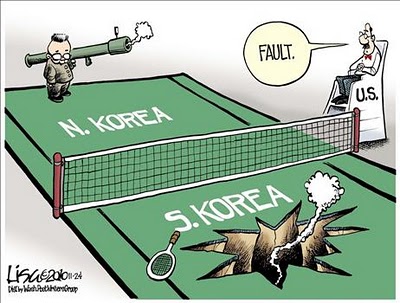
An ageless cartoon: the risk of another North Korean attack and How Should The US Prevent It?
---

The Second Trump-Kim Denuclearization Summit (in Vietnam, February 27-28, 2019) shares all the irritations as the First Summit.

On February 7, 2019 Anonymous kindly provided a comment below the article 

Trump Meeting Kim in Vietnam - Where US Abandoned South Vietnam (February 7). Pete has  further translated the comment, added additional links and provided extra comments in [...] brackets.


North Korea’s (NK’s) nuclear weapon and missile development has never stopped under the Kim dynasty no matter how much the Kims have been economical with the truth. Trump should not meet Kim Jong-un unless Trump insists on a genuine program of Complete, Verifiable and Irreversible Dismantlement (CVID). as assessed by the International Atomic Energy Agency (IAEA). [But the goal "Irreversible Dismantlement" is impossible without constant and open international inspections of NK's military nuclear facilities and missile launch sites].

The US and SK have reached a preliminary settlement of the Special Measure Agreement (SMA). The SMA involves SK financial contributions to the non-personnel military costs of stationing US personnel in SK, which is updated every 5 years. With the SMA on the way to settlement US troops should not withdraw from SK. As such a withdrawal would only encourage NK to forcibly unite the Korean Peninsula [see [1] and [2] below]. [by invading SK].

[The defense of SK is not being helped by the mixed signals SK is giving NK.]

SK has breached international sanctions by supplying petroleum products to NK [3]

Contemporaries of SK President Moon Jae-in “the so-called 386 Generation” have a leftwing view of NK and the world.


[“members of the 386 Generation are generally not as enthusiastic about US-South Korean relationships as their parents’ generation, and some have gone so far as to support the removal of US troops from the Korean peninsula altogether. Some of them are also sympathetic to the North Korean [maybe "better red than dead"?]  regime and advocate a peace agreement with North Korea at all costs.”]

[1] https://thediplomat.com/2019/02/us-south-korea-reach-preliminary-one-year-burden-sharing-agreement/ [paysite] On February 5, 2019 the US and SK reached a preliminary 1 year Burden-Sharing Agreement under which SK’s SMA contribution will rise to US$1 Billion per year.

[2] There is [mutual aid but no] automatic armed intervention clause in “Mutual Defense Treaty Between the United States and the Republic of Korea”. When NK subsequently invades SK, after a US troop withdrawal, US intervention would need the approval of the US Senate. In the worst case scenario, by the time the US tries to intervene this would be blocked by NK stationing nuclear missiles on what would be now "former SK territory".

[3] https://www.japantimes.co.jp/news/2019/01/31/asia-pacific/u-n-panel-concludes-south-korea-shipments-petroleum-north-violated-sanctions-sources-say/#.XFv1czP7TIU
“U.N. panel to accuse South Korea of violating sanctions with petroleum shipments to North, sources say”

[Pete Comment - Over the decades NK, a very poor country, has spent a large proportion of its national income on building up its nuclear weapon and missile capability. NK is therefore very unlikely to dismantle its nuclear deterrent (against yet another invasion by the US). 

The only reasonable hope is that NK slows down construction of this nuclear capability and adopts a more positive attitude to South Korea, Japan, the US and other countries

For a previous article I wrote about this issue see North Korea's Nuclear Deterrent Totally Justified of May 24, 2018 ].

Anonymous and Pete

February 7, 2019

Trump Meeting Kim in Vietnam - Where US Abandoned South Vietnam

Isn't it ironic that Kim and Trump are meeting in Vietnam of all places.

In 1973 the US signalled to North Vietnam that US support of its ally, South Vietnam, was weakening.

I wonder if South Koreans are quietly alarmed that 2019 may be seen as a negotiated US weakening of support for South Korea - against rising pressure from North Korea.

Pete

February 6, 2019

France's Barracuda SSN Submarine Launching in 2019 - Maybe

The launching of France's delayed (laid down 2007) first of class Barracuda-Suffren class SSN will free up a good part of Naval Group's design and construction labour force.

So far the main obstacle has been miniaturising France's tailored to SSBN K15 nuclear reactor (which also brings other improvements) so it will fit in the smaller Barracuda SSN hull.

Once freed up Naval Group managers, designers and builders can more fully begin to address Australia's huge Shortfin Barracuda (Attack class) SSK Program.

Pete

February 5, 2019

Western & Russian Submarine Wake Detection Sensors including "SOKS"

This Russian Akula SSN is moving from right to left. The spikes towards the front of the fin/sail are probably wake detection sensors. These are known, in Russian, as System Obnarujenia Kilvaternovo Sleda (SOKS)SOKS was first tried in 1969 on Russia’s November class SSN K-14. Later types of SOKS may have been named Colossus, Toucan, and Bullfinch. These may have been mounted on all subsequent Soviet/Russian SSNs, including the curret Akulas and Yasens.
--- 

From the mid 1950s onward submarine detectors such as “Autolycus “ (ie. aircraft mounted sensors to “sniff” submarine diesel exhaust) and search radar were being developed against the snorkels of diesel subs. These became less effective with the shift of major powers to nuclear submarines from the 1960s. Nuclear subs could run submerged, without needing to snorkel. Occasional periscope use still left SSNs vulnerable to sensitive radar.

In Russia and the West, new methods were sought to detect submerged nuclear subs. Some of these methods detected not the submarine itself, but the disturbances it made in the sea. If a sub's motion mixed layers of cold surface and underlying warm water, this would raise the apparent surface temperature slightly. 

This temperature change might be detected from infrared thermometers mounted on aircraft, UAVs,  satellites. But satellites suffered from being stationary or following predictable paths. Another platform might be the US X-37 "uncrewed space plane" whose manoeuvrability could "surprise" Chinese or Russian nuclear submarines. 

It may or may not be possible to detect a submarine by only measuring the temperature of the wake. Greater definition might be achieved by imaging the temperature of the surrounding sea. Such imaging might happen in real time, but may be assisted by preliminary studies of sea conditions using massive amounts of data (say around China's Hainan Island and Russia's Pacific SSBN Base at Rybachiy on the Kamchatka Peninsula).

Sources here, here and here.

Pete

February 1, 2019

Hypersonic Medium Range Boost-Glide Vehicles

A clear (July 3, 2018) discussion of hypersonic cruise missiles and boosted hypersonic glide vehicles. Will the physics of speed and the atmosphere causing overheating forever be an obstacle?
--- 

Drawing from KQN's 30 January 2019 comment below this Submarine Matters' article of 29 January 2019:

The French Armed Forces Minister, Florence Parly, on January 21, 2019 announced France will be developing a missile boosted, then hypersonic (Mach 5+), glide vehicle by 2021. The glide vehicle is designated the Vehicule Manoeuvrant eXperimental (V-MaX) or experimental manoeuvring vehicle in English.

There might possibly be a proliferation of 1,000-3,000 km range missiles (MRBM)
 (eg. China's DF-21)(see below) as the launch platform for hypersonic gliders.

Even though Australia has been experimenting with hypersonic flight since 2007 (if not earlier) any Australian project would need to be a joint program (with the US, UK or France) on an unknown time-frame. A launch platform might conceivably be torpedo tubes in Australia's future submarines, modified F-35As, vertical launch systems in existing Hobart class destroyers or future Hunter class frigates.

At a minimum, the modified ballistic (glide) trajectory may point to a conventional warhead, rather than a nuclear warhead (with nuclear ambiguity inviting a nuclear response (eg. from China). China is developing the hypersonic DF-ZF (previously called "WU-14" by the US).

BACKGROUND

Courtesy wiki: Boost-glide trajectories in the military sense are reentry trajectories extending the range of reentry vehicles by employing aerodynamic lift in the high upper atmosphere. 
In most examples, boost-glide roughly doubles the range over the purely ballistic trajectory. In others, a series of skips allows range to be further extended, and leads to the alternate terms skip-glide and skip reentry.
The concept was first seriously studied as a way to extend the range of ballistic missiles, but has not been used operationally in this form. The underlying aerodynamic concepts have been used to produce maneuverable reentry vehicles (MARV) to increase the accuracy of some missiles.
More recently the traditional form with an extended gliding phase has been considered as a way to reach targets while flying below their radar coverage.
"...research was eventually put to use in the Pershing II's MARV reentry vehicle. In this case, there is no extended gliding phase; the warhead uses lift only for short periods to adjust its trajectory. This is used late in the reentry process, combining data from an inertial navigation system with and Goodyear Aerospaceactive radar seeker.[17] Similar concepts have been developed for most nuclear-armed nation's theatre ballistic missiles.
In contrast to these maneuvering warhead concepts, there has been growing interest in the traditional boost-glide concept not to extend range per se, but to allow it to reach a given range while flying at a much lower altitude. The goal, in this case, is to keep the reentry vehicle below radar coverage until it enters the terminal phase.
Such a system is assumed to be used on the Chinese DF-21D anti-ship ballistic missile, which is also believed to maneuver during the terminal phase to make interception more difficult. 
China's later DF-26, a development of the DP-21, may be armed with the WU-14 later named DF-ZF, a hypersonic glide vehicle that has been successfully tested six times by the Chinese.[18] Similar efforts by Russia led to the Kholod and Igla hypersonic test projects, and more recently the Yu-71 hypersonic glide vehicle which can be carried by RS-28 Sarmat.[19][20]
Hypersonic Glide Vehicles could be used for delivering quick nuclear decapitating strikes.[22]
In March 2018, Russia unveiled hypersonic glide vehicle Avangard.

COUNTER-MEASURES

While flying below the operational envelope of Exoatmospheric Kill Vehicles, the tradeoff with HGVs in comparison to conventional MIRVs are many-fold, including no needle in a haystack protection from missile decoys and both less speed and altitude as they near the target, all of these characteristics result in HGVs having poorer survivability odds when placed against lower-tier interceptors.[24] 
Some examples of which include the high thrust mach-10 Sprint missile, its US derivatives and the still operational mach-17 Russian 53T6, ABM-3 Gazelle. Moreover, the possible re-emergence of nuclear or hit-to-kill stratosphere reaching guns, guided and triggered by forward operating flight-path sensors (such as the 2016 Hypervelocity Projectile (HVP) in development for the M109 howitzer) also will decrease HGV survivability odds.
Other more speculative counter-hypersonic vehicle measures may involve laser or rail gun technologies.[25]

KQN, Wiki and Pete