July 12, 2015

India Accelerating its Project-75(I) Future Submarine Selection

Model of a Russian drawing-board design Amur 1650 being marketed by state-run arms seller Rosoboronexport for India's new submarine project P-75(I). Amur's strengths include much in common with India's current Kilos and Amur might be able to be fitted with joint Indian-Russian BrahMos cruise missiles or Klubs as land attack and anti-shipping weapons. An Amur weakness is the lack of a mature AIP system.
---

Comment

Increasing number of Chinese submarines are visiting or even patrolling the Indian Ocean. This is causing increasing concerns in India. With India's small mainly aging submarine fleet India may be accelerating its Project-75(I) to buy 6 new AIP equipped SSKs. China can also extend its naval power through selling Type 039A Yuan SSKs to Thailand and Pakistan along with the two Ming class submarines China is selling to Bangladesh.

Article

Rahul Singh for the Hindustan Times, July 12, 2015 has written an excellent summary of the Indian submarine fleet's current state of play. Singh does not make the frequent mistake of reproducing Indian Government visions of building x numbers of SSNs and SSBNs in short time periods. Rahul Singh's article is at http://www.hindustantimes.com/business-news/govt-shortlists-5-shipyards-for-rs-64-000-cr-submarines-project/article1-1368341.aspx :

"Govt shortlists 5 shipyards for Rs 64,000-cr submarines project


Rahul Singh, Hindustantimes.com , New Delhi | Updated: Jul 12, 2015 


Five Indian shipyards, including the one in which Reliance Group chairman Anil Ambani recently picked up controlling stake, have been shortlisted by a top government committee to compete for a Rs 64,000-crore [US$10 Billion] [1 crore = 10 million then convert Indian Rupees to US$] project to build high-tech submarines for the navy.

Six advanced submarines will be built under project P-75(I). One of the costliest projects under the Make in India programme, it is expected to scale up the navy’s undersea warfare capabilities and is critical to counter the rapid expansion of China’s submarine fleet.

The shipyards shortlisted by the high-powered panel are Mazagon Dock Limited, Hindustan Shipyard Limited, Cochin Shipyard Limited and private sector yards Pipavav and Larsen & Toubro, a top government official told HT. Ambani’s Reliance Infrastructure bought controlling stake in Pipavav this March.[could shipyards be considered the Indian partners to the foreign contenders?]

The shipyards, identified after a seven-month rigorous process, will be invited to submit bids to build the submarines in partnership with foreign yards of their choice.

[Project-75(I) Contenders Countries/Companies that have shown interest and their products are:

-  Germany’s TKMS - HDW Type 214

-  Russia’s Rubin Design Bureau - Amur 1650 (as a sweetner Russia has offered to make India the "regional hub" for mainly Kilo submarine upgrades)

-  French DCNS – Scorpene

-  Spain’s Navantia - S-80 class, and 

-  Sweden’s Saab-Kockums - A26]

The new submarines will have the capability to operate underwater for several weeks with air-independent propulsion systems, greater strike power against land targets and improved stealth features that make them harder to detect.

Already, six Scorpene submarines are being built at the Mazagon Dock Ltd with technology from DCNS under a Rs 23,562-crore [US$3.72 Billion] project [called "P-75"]. But the first of these will be ready only by late 2016, almost five years behind schedule [due to Indian hesitation and perhaps slow defence expenditure].

India currently operates 13 ageing conventional submarines:

[- 10 (now 9) Kilos India (Sindhughosh class) mainly delivered in 1980s - so mainly aging but refitting is extending the lives of 9. One, the Sindhurakshak, exploded and sank in 2013 and may well be unrepairable.

- 4 HDW Type 209 (Shishumar class) of which 2 launched around 1984 and commissioned 1986. Two commissiond 1992 and 1994.]

[India also has a semi active(?) part Russian crewed/advised(?)] Akula-II nuclear-powered attack boat [INS Chakra] leased from Russia at Rs 5,500 crore [per year?]. 

In contrast, China’s submarine fleet is growing in numbers and sophistication – Beijing possesses 53 diesel-electric attack submarines [especially Yuan under mass production], five nuclear attack submarines and four nuclear ballistic missile submarines. [and Pakistan has 5 Agosta SSKs, 3 of which have AIP].


India will complete its nuclear triad — the ability to launch strategic weapons from land, air and sea — only when it inducts the indigenous ballistic missile submarine, Arihant. The boat will carry out weapon trials later this year, including the testing of nuclear-capable [B-05 is a new name for the K-15 Sagarika] submarine-launched ballistic missile. The navy, however, has refused to set a deadline for the submarine to take up deterrence patrols."

Pete
July 9, 2015

AIP for Australia's Future Submarines? July 2015 Debate.

Pete's Comment

There are tradeoffs (strengths and weaknesses) with any AIP system including fuel cell. It is significant that Japan and India's DRDO appear to be interested in developing their own fuel cell AIPs. Australia relies on lead acid batteries (LABs) with no AIP for the Collins and with improved Li-ion batteries (LIBs) Australia may not choose any AIP for the future submarine.

Article

Geoff Slocombe writing for ASPI's The Strategist on June 18, 2015 has authored a thought provoking article on many aspects of submarine function, particularly AIP systems and LIBs. Geoff Slocombe's article was first published at http://www.aspistrategist.org.au/air-independent-propulsion-is-a-must-for-australias-next-submarines/ :

"Air Independent Propulsion is a must for Australia’s next submarines


18 Jun 2015|

SHARE

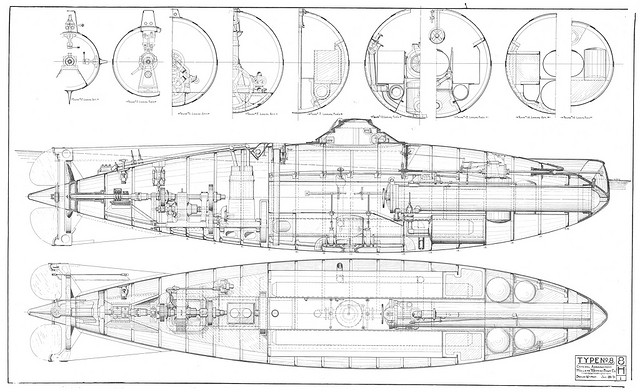
Holland Type 8 Sub
The definitive statement on the roles and required capabilities of future Australian submarines must await the release of Defence White Paper 2015 and associated Force Posture Review, both due in August-September this year.
It seems likely that Australia’s area of operational submarine missions, as opposed to training and exercises, will be focused principally on our north-west approaches; the Malacca, Singapore, Sunda and Lombok Straits; and the South China Sea.
Potential roles for the future submarines could include intelligence gathering, surveillance, reconnaissance, insertion and extraction of divers or special forces, attacking enemy submarines and their surface warships, mine laying, together with other littoral or choke point operations. Effective prosecution of these roles will necessitate that the submarines go about their business undetected—meaning that apart from transits between their Australian base to around 200 nautical miles from their operational area, they’ll need to spend all of their actual mission time underwater.
A conventional diesel electric submarine travelling relatively slowly still has to recharge its lead acid accumulators every few days, by coming up to periscope depth so that its snorkel can take in air for the diesel generators. Modern surface, airborne and satellite sensors have become so sensitive that they can readily track surface wakes, acoustic and thermal signatures caused by snorkels, diesel engines and their exhausts. Submarine designers and Navy submariners use an indiscretion ratio to indicate the proportion of mission time a submarine is detectable while charging its batteries. For conventional modem submarines the indiscretion ratio ranges typically 7-10% on patrol at 4 knots, and 20-30% in transit at 8-10 knots.
This is where Air Independent Propulsion (AIP) comes in. It offers the possibility of increasing underwater endurance by a factor of up to three or four, which reduces the indiscretion ratio significantly.
AIP isn’t a new concept. In 1945, the Allies captured German submarine U1406 which used an early form of AIP.
Fast-forward to the 1990s when Sweden’s Kockums developed their Stirling AIP engine which was fitted to three new build submarines of the HSwMS Gotland-class. In 2005 the US Navy leased Gotland initially for a year and were devastated to discover that it could penetrate their defensive screen undetected when running under AIP. On one famous occasion Gotland got close enough to new CVN Ronald Reagan to take photos of it, then slipped away unnoticed.
If an AIP-fitted submarine realises it’s been detected, it has the escape option of diving deep and slowly, making its silent escape over several days. Underwater endurance can be up to 20 days.
AIP is about two separate choices. The kinds of batteries used in a submarine’s design, and the technology available to generate electricity deep underwater, which directly drives the submarine’s engine and supplies other electrical requirements.
Once batteries are chosen for a design, they can’t be swapped for different technologies. Currently, focus is on the promise of Lithium ion Batteries (LiB), which offer significant weight, space and power advantages over classic lead acid accumulators.
Power required to propel a submarine is proportional to the cube of hull speed. To cruise at low speed, LiBs require about half the space of classic accumulators, but at higher speeds they require around 25% of classic accumulator space to provide the same propulsive power. This means more LiBs can be fitted in place of classic accumulators, offering greater underwater endurance. Dependent on their chemistry, if LiBs become overheated or overcharged they can experience thermal runaway, damaged cells and even a fire or explosion. Therefore, the right selection of chemistry—together with stringent control systems—are required to prevent this happening.
The three Competitive Evaluation Process (CEP) contenders should consider offering different AIP electricity generation systems to power the main engine and other electrical systems deep underwater, rather than off batteries. Japan traditionally has used the Kawasaki Kockums Stirling engine and France the MESMA system, both driving generators and less efficient than Germany’s HDW/Siemens fuel cell plant configurations which produce electricity directly.
The invisibility AIP offers is an obvious advantage, but are there any downsides? Yes. Installing AIP increases length and weight of submarines; requires pressurised liquid oxygen (LOX) storage on-board and supply for all three technologies; MESMA and the Stirling engine have some acoustic noise from moving parts; and production costs increase the submarine’s unit cost by around 10%.
DWP 2015 has to analyse and make recommendations for capabilities still needed in place and effective into the 2050s and beyond. Given the stealth advantages of AIP in most likely roles, is this a capability that Australia can afford not to choose?
A SEA 1000 project team spokesperson advised that:
The Competitive Evaluation Process offers participants the opportunity to propose the use of technologies they consider best meet Australia’s requirements for the Future Submarine, which extend to considerations of through-life costs, schedule, risk, design and safety, and sustainment as well as capability.
AIP has not been specified as required in the CEP creating uncertainty about how much importance Defence attaches to this capability in the Future Submarine Program. Surely they would want their next submarines to be significantly less detectable, and therefore much more effective, when carrying out missions close to potential adversary locations.
Let’s hope the Government makes the right decision on AIP capability, and it becomes  a mandatory requirement.

July 7, 2015

Liberals in South Australia Nervous about Build in Japan

Respected Liberal Member for Hindmarsh, Matt Williams, stands to lose his seat if Prime Minister Abbott carries through the "build in Japan" Captain's Pick.
-------------------

Portrait of an Abbott supporter. 
Cabinet Minister for Education Christopher Pyne (Liberal, South Australia) may lose his  seat of Sturt.
--- 

There remain cracks in Prime Minister Abbott's Coalition Liberal Party over the "build in Japan" submarine issue. Federal Liberals in South Australia are concerned that they will lose their jobs (Federal seats - electorates) if Abbott makes his "build in Japan" Captain's Pick. Even Cabinet Minister (for Education) Christopher Pyne a Liberal and close Abbott supporter, may lose his seat. 

Eliza Borrello, ABC News Online, has written the following revealing article, July 7, 2015 http://www.abc.net.au/news/2015-07-07/japanese-submarine-contract-would-threaten-federal-seats-in-sa/6599998:

"Liberals fear South Australian seats at risk if submarine contract goes to Japan

With the state still reeling from the loss of thousands of car manufacturing jobs, employment remains a hot button political issue.Liberal MPs say they fear several of their federal seats in South Australia could be at risk if the Government gives Japan the contract for the next fleet of submarines.
Liberal sources have told the ABC the contract for the next fleet of submarines will play a big role in its fortunes at the next federal election.
One Liberal said seats like Hindmarsh, held by first-term MP Matt Williams, would be under threat if the contract goes to Japan.
"I don't think it would be an electoral wipe-out ... [but] it would make it really hard for guys like Matt," he said.
"The easiest option [politically] would be for it to be done in South Australia."
Another MP said it would compound the risk of Lower House seats going to Independent Senator Nick Xenophon's party.
"[A] Japanese build would take Xenophon from a potential problem to a real threat," he said.
"A local build may not even see him run Lower House candidates."
But Hindmarsh MP Matt Williams said he would not speculate on talk he may lose his seat and was confident there would be more jobs in South Australia.
I can give an absolute, categoric guarantee there will be more sub jobs in SA.
Prime Minister Tony Abbott
"I'm working as hard as anyone with some of my colleagues to maximise the opportunities and the jobs in South Australia for the defence ship industries, having meetings with senior Government ministers who are listening to the various options," he said.
"The Government has already committed to at least 500 more jobs in various areas of the next submarines project which is good news for South Australia.
"We've also got the frigate program which we'd hope to get some work for South Australia so there's opportunities for the defence sector and industry in South Australia."
Prime Minister Tony Abbott said while the Government was yet to decide how or where the submarines would be built, he gave a guarantee there would be more jobs for South Australian ship builders.
"Whatever happens, I can give an absolute, categoric guarantee there will be more sub jobs in SA and I think that's what South Australians understandably want," [Abbott] said.
"They want a good deal for our country. They want a good deal for their state. They want the best possible submarines and that's what we are determined to deliver."
The Government is running what it has called a competitive evaluation process for the contract — which could go to France, Japan or Germany.
In February, Defence Minister Kevin Andrews said he expected significant work would be undertaken in Australia, particularly during the build phase, leading to the creation of at least 500 new jobs.
Mr Andrews said many of those jobs would be in South Australia."
Pete

July 5, 2015

Russian Submarine Swarm Tactics Against Carrier Groups

Russia's Yasen (aka Severodvinsk) class SSN up to 40 (8 x 5) SLCMs using the VLS, 8 x 650mm torpedo tubes (and 2 x 533mm). Deep diving to 600m.
---

Another diagram of the Yasen SSN (not "Graney") partly Russia's response to the Seawolf SSN.
---


Inside an Akula 2 (commentary in Russian). Youtube uploaded April 2011. Large 8,500 tons (surfaced). No command center digital displays shown. Like other Russian weapons it looks low-tech but this also means "rugged" less delicate electronics to go wrong.  After the Nerpa disaster there is a gas drill.  
---

MHalBlaub's and Vigilis' have been having an interesting discussion at Current Heavyweight Russian Torpedos, July 1, 2015. This has prompted me to write about Russia's potential use of its most potent current torpedo, the over-the-horizon Type 65 650mm. This torpedo is unlikely to be used alone with its host submarine. Instead the host submarine for the 650mm (which seem restricted to Akula and Yasen SSNs) would launch these torpedos as part of a swarm attack also involving cruise missiles launched by that submarine This may be in the context of a medium intensity war  against high value targets, especially strike or amphibious carrier groups.

It appears Russia would logically take on a carrier group with a swarm attack both for targeting  (directing or redirecting) weapons and to overcome the defences of the escorts. Technological change has improved the ease of targeting. There are also improvements in Akula and Yasen launched cruise missiles (eg. the SS-N-27A "Sizzler"/Klub-S and a future SLCM the SS-N-26 "Strobile" (aka P-800 Oniks/Yakhont related to the Indo-Russian BrahMos)). These SLCMs need not be individual actors but can work as a team  eg. a higher altitude Klub working as scout to direct a simultaneous attack of sea-skimming Klubs and pre-launched 650mm torpedos to complicate the job of the carrier group escorts. 

The scouting Klub could coordinate the other missiles with direct radio links and coordinate the torpedos via satellite, mother sub and other links in the Russian SeaWeb. Submarine launched UAVs (small and stealthy) could also be part of the Russian communications (SeaWeb) network.

So Russian satellites, missiles and UAVs can all offer solutions to avoid the Russian over-the-horizon 650mm torpedos hitting the wrong targets. 

China may also have the capability to organise such a swarm attack (also noting China has the DF-21D anti-ship (or anti-sub) ballistic missile. 

A second Russian sub may be present that is closer to (in the path of) the carrier group. The second submarine might perhaps be a Kilo SSK that can deploy its shorter range 533mm torpedos and Klubs at the carrier group. The Kilo may also be well positioned to detect (passive sonar) any approach  of a US SSN that may well be a forward escort for the carrier group. In the major task of detroying a carrier group there may be a third submarine (an SSN) for redundancy. I'm hoping the US wins of course!

The land attack capabilities of Klub, Yakhont and other Russian SLCMs also improves the prospects of attacking a carrier group while in port. 

FIGURES

Russia has altered its SSN weapons' mix for the technical, strategic and and tactical reasons touched on in the description above.

Figures are that:

-  Kilo SSKs - in Russian service since 1982 - 6 x 533mm (18 x torpedos/missiles or 24 mines).

-  Akula SSNs (in service since 1984) are recorded as having 4 × 533mm torpedo tubes (28 x Type 53 torpedoes) and 4 x 650mm torpedo tubes (12 x Type 65 torpedoes) 

-  Yasen SSNs (Severodvinsk (first of class) in service 2014) being introduced with:

- 32 (8x4) VLS missiles OR can launch

- 40 (8x5) VLS missiles Klub or other SLCMs

Significantly the Yasen's heavy SLCM capability is supplemented by an increased 650mm torpedo capability (8 x 650mm torpedo tubes and 2 x 533mm).

CONCLUSION

So the Yasen's increase in number of quick launchable SLCMs and 650mm torpedos implies a rapid fire swarm intent. 

China, with its history of adopting Russian naval weapons and tactics, presents a special risk to US carrier groups in the South China Sea and open ocean.

"New Interceptor and Carrier-Killer Nuclear Submarines"

A report in the Moscow Times, July 5, 2015 "Russia Plans New Interceptor and Carrier Killer Nuclear Submarines" merely describes Russia's regular intention to gradually develop an SSN-SSGN replacement to follow on from the Yasen.  The generalist press are attracted by the terms "Interceptor and Carrier Killer" just as the generalists have been attracted by such terms a "stealth submarine" in the past. Such a post Yasen submarine might enter initial service in 2035.

Pete

July 1, 2015

Current Heavyweight Russian Torpedos

Russian Type 53 (533mm) torpedos inside a Kilo 877EKM submarine. (Courtesy http://www.naval-technology.com/projects/kilo877/ ) which advises:

 "The Type 877EKM has six 533mm torpedo tubes and carries 18 heavyweight torpedoes (six in the tubes and 12 on the racks), with an automatic rapid loader. 

[Only] Two targets can be engaged simultaneously. Two of the launch tubes can fire the TEST-71MKE TV electric homing torpedo, which has an active sonar homing system with TV guidance which allows the operator to manually switch to an alternative target, and can manoeuvre in two axes. It weighs 1,820kg with a 205kg explosive charge. 

The submarine is also fitted with UGST wake-homing torpedoes. This torpedo weighs 2,200kg with a 200kg explosive charge. It has a range of up to 40km, and a depth of search of up to 500m. The tubes are also capable of deploying 24 mines."
----------------------


Countries have used anti-torpedo measures for over a century. Sinodefenceforum explains a recent project "The US Navy is actively developing and testing a comprehensive anti-torpedo weapon system that is called the Surface ShipTorpedo Defense (SSTD) system [diagram above] consisting of  [sensors and target acuisition and] a Countermeasure Anti-Torpedo (CAT) against incoming enemy torpedos of all types.
------------------------

Three main types of heavyweight Russian torpedos include:

-  Type 53 - a 533mm torpedo. Possibly the most common Russian torpedo type. The Type 53 torpedo family contain numerous possible types of sensors including sonar, TV, magnetic, wake pressure and contact etc. They may home into a surface ship's wake or a stationary ship. The 53-65 became operational in 1965, while the 53-65K and 53-65M both became operational in 1969. The 53-65KE is an exported version. China received an unknown number of 53-65KE torpedoes from Russia after purchasing 4 Kilo class submarines in the 1990s. The Type 53 torpedo is carried by almost all Russian submarines, including Kilo class and  Akula class. Range: 18+ km, Speed: 83 km/h (45 kt), Warhead: 307.6 kilograms.

-  Type 65 for 650mm torpedos originally developed to counter US Navy aircraft carrier battle groups, large merchant ships like supertankers, and advanced enemy submarines. Russian officials believe that a 65-76A modification of this torpedo is responsible for the explosion of the Kursk. Range: 50 km at 93 km/h (50 knots), 100 km at 56 km/h. Homing: active/passive sonar and wire guidance. Warhead: 450/557 kg high explosive. Propulsion probably gas-turbine powered by hydrogen peroxide, kerosene and compressed air fuel. Driving contra-rotating propellers.

If a Type 65 is fired at over-the-horizon extreme range such platforms as satellites or UAVs may provide final aiming information (for example against a carrier battle group). Klub missiles, launched by the submarine, might also assist in aiming - as well as the Klubs directly tarketing the carrier battle group.

-  VA-111 Shkval torpedo - Russia's most publicized torpedo due to its unusually rare propulsion. This extremely noisy 533mm rocket powered torpedo is supercavitating . It is  thought to be used as a revenge weapon (when the host sub is about to be destroyed) hence the host sub being detected, due to it launching a noisy Shkval, is a low consideration. Only 2, 1 or none might be carried on most Russian subs.

MHalblaub's mention at of Russian torpedos is useful. MHalblaub  advises that “The Russian do use a hypergolic propellant (Kerosene + hydrogen peroxide) for torpedoes (remember the Kursk!)" The Kursk leakage of its hydrogen peroxide fuel onto metals and oxides in a Type 65 or 53 torpedo, resulting in a chemical reaction that culminated in an explosion of the fuel and a kerosene tank and the Kursk's eventual destruction.

On Submarine Matters: Russian heavyweight torpedos under development; Russian lightweight torpedos; and Russian naval mines will also be considered.

Pete

Two A26s Ordered by Sweden

Saab-Kockum's new video on the A26. (Courtesy Saab A26 website)
---

Sweden's AFP/The Local (news@thelocal.se) reports June 30, 2015 http://www.thelocal.se/20150630/saab-signs-deal-worth-billions-for-swedish-subs:

Saab signs deal worth billions for Swedish subs
[What the two new A26s might look like. (Artwork by Saab AB)]

Saab signs deal worth billions for Swedish subs

UPDATED: A deal between Swedish defence giant Saab and Sweden's military for two submarines worth 8.6 billion kronor (US$1.04 billion) is set to boost jobs in the Nordic country, chief executive Håkan Buskhe said on [June 30, 2015].
“We are of course very pleased,” Saab chief executive Håkan Buskhe told reporters at a press conference in Visby, where he is attending Sweden's politics festival Almedalen Week.
He said the order would create around one hundred jobs at the Swedish defence and security company.
“This means some hundred new employees in both Malmö and Karlskrona,” he said.
The order from the Swedish Defence Materiel Administration (FMV) covers the construction of two new Type A26 submarines, as well as a mid-life upgrade for two Gotland-class submarines.
Deliveries of the two new subs will take place in 2022 and 2024, Saab said in a statement.
The upgraded subs will be delivered in late 2018 and late 2019.
Saab said the A26 was a high-tech submarine with “long-endurance submerged performance and excellent manoeuvrability in all waters”.
It added the new subs would be “highly survivable thanks to modern underwater stealth technology and a unique heritage of shock resistant design”.
The subs will be powered by conventional diesel-electric propulsion machinery and equipped with the Kockums Stirling Air-Independent Propulsion (AIP) system, making them difficult to detect.
In April, the Swedish government announced plans to raise defence spending by 10.2 billion kronor ($1.18 billion) for 2016-2020, mostly to modernize ships to detect and intercept submarines, amid increasing Russian military activity in the Baltic Sea region.
Sweden has a long-standing tradition of military non-alliance, but support for Nato membership has increased in recent years, largely due to fears of a potentially aggressive Russia.
A major poll last month suggested that nearly one in three think Sweden should join the defence alliance. 
AFP/The Local (news@thelocal.se)"
---------------------------------------------------------------------------------
COMMENT

At around 1,900 tonnes (surfaced or submerged?) the A26 will be much heavier than Sweden is used to. This would be a large sub to move in the very shallow and narrow waters of its mainly Baltic operating area. The A26's size will improve Sweden's ability to confront Russian forces outside the Baltic - in the North, Norwegian or Barents Seas.


With a large horizontal diver/diver delivery vehicle tube large displacement UUVs (LDUUVs) could be launched to more safely approach the Russian Baltic Fleet's Base at Kaliningrad Oblast (an enclave). 

Sweden is accustomed to working with 1,500 tonne (surfaced) Gotlands and 1,400 tonne (surfaced) Sodermanlands. One reason Sweden may be building A26s at 1,900 tonnes is to provide a sub with increased export potential to the Asia-Pacific market where ever heavier subs are being bought. It is possible a smaller version A26 might also be exported to Poland and Norway and larger version to Canada and the Netherlands.

While the two A26s are being built and 2 Gotlands overhauled Sweden will rely on three subs - the two Sodermanlands and the third Gotland class.

Pete