Showing posts with label Singapore. Show all posts

February 20, 2015

Possible Japanese Submarine Deployment Area


Differing submarine patrol areas strung along China's First Island Chain. Japan's submarine patrol area may be from Kyushu, along the Ryukyu island chain (which includes Okinawa), south to Taiwan, then across the Bashi Channel (Luzon Strait) down to Luzon Island, Philippines.
---


Part of the "First Island Chain" is what Japan calls the Senkaku Islands. A potential China-Japan-(maybe)Taiwan flashpoint due to undersea oil deposits. These deposits may become economically extractable as oil prices rise and technology permits. 
---

Below is an interesting snippet which may reflect how Japan's submarine fleet is deployed:

Tetsuo Kotani, U.S.-Japan Allied Maritime Strategy: Balancing the Rise of Maritime China, (Strategic Japan, Japan Chair) Center for Strategic & International Studies (CSIS), Washington DC, April 2014, pp. 1-15. http://csis.org/files/publication/140422_Kotani_USJapanAlliance.pdf wrote on page 12:

"In addition, the submarine fleet will be increased from 16 to 22. Due to the lack of Chinese ASW capabilities, the expansion of the submarine fleet enhances sea-denial capability vis-à-vis the PLAN. To patrol the waters along southwestern Japan, it is estimated that at least eight submarines are necessary (six for the Okinawa island chain [Japan to Taiwan] and two for the Bashi Channel [also called (Luzon StraitTaiwan to Luzon island, Philippines]. Typically, a [submarine] requires two backups for training and maintenance. Thus a submarine fleet of 24 is ideal, but a fleet of 22 provides more operational flexibility than the current fleet of 16. [35] On the other hand, for the effective use of the reinforced submarine fleet, the JMSDF needs to recruit and train more submariners." 

[35] =  [retired Vice Admiral] Masao Kobayashi, “Sensuikan 22 sekitaiseino Kaijoboei” [Maritime Defense under a 22-Submarine Force], Gunji Kenkyu [Japan Military Review], December 2011. http://gunken.jp/blog/archives/2011/11/10_0000.php

COMMENTS

Page 1, 2nd paragraph indicates Japan's submarine deployments may, in part, respond to "Beijing’s attempts to deny access by other maritime powers to its Near Seas (the Yellow Sea and the East and South China Seas), which are enclosed by the first island chain (a chain of islands from Kyushu, Okinawa, to Taiwan and Borneo)." 

Japanese strategy using all forces, including submarines, is partly to provide a blockading force (in time of conflict) to keep China forces and trade bottled up in China's near seas. Japan, its SSK owning allies, and the US SSN force could also block Chinese naval vessels and supplies (such as oil) from reaching China. 

As the CSIS excerpt above indicates Japan's main submarine patrol area would be from the the southern home island of Kyushu, along the Ryukyu island chain (which includes Okinawa), south to Taiwan, then across the Bashi Channel (Luzon Strait) down to Luzon Island, Philippines. 

Countries in the region may make frequent use of undersea arrays (along with future use of UUVs (including wavegliders)), particularly in narrow straits and harbour mouths. Such use would diminish reliance on virtually stationary submarines guarding critical straits and harbour mouths. 

South Korea would monitor movements in all the congested seas and straits near South Korea. In those seas are threats or possible competitors North Korea, China, Russia and Japan itself.

The US with its wide ranging SSNs may guard some straits and narrows but the speed and range of its SSNs allow open ocean (blue water) coverage throughout the Pacific, Indian Oceans and under receding Arctic ice to the Atlantic Ocean. US SSNs can act as backup to the SSK navies (Japan, South Korea, Singapore, Australia) particularly against Russian and Chinese SSNs. All of the allies would directly or indirectly (via the US as the common ally) work together under the blanket term SeaWeb.

Naturally submarines are not the only blockers or monitors and don't work alone. Other platforms (surface warships, surveillance satellites, UAVs, UUVs, patrol aircraft including helicopters, land based missiles and ground stations (deploying radar, intercept and other arrays)) can work with submarines in the whole defence mix

Pete

December 3, 2013

Singapore buying two HDW 218SG submarines - Sweden's loss


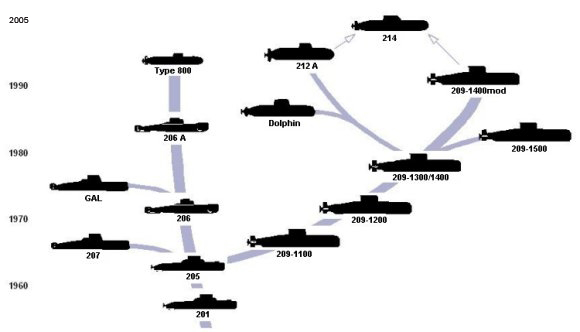
The Israeli AIP Dolphin 2 at just over 2,000 tonnes evolved from the HDW 209 and HDW 212. The HDW 218SG is very similar to the Dolphin 2 in length and beam. See model of the 218SG later revealed.
---


Where will the Type 218SG fit on this HDW submarine tree?
-------------------------

For the latest on Sweden vs Germany see June 11, 2014’s Australia's Future Submarine - Swedish vs German Claims http://gentleseas.blogspot.com.au/2014/06/australias-future-submarine-swedish-vs.html .

After two decades of buying renovated submarines from Kockums Singapore will  buy two new-build submarines designated HDW 218SG. Significantly the 218SGs are from Thyssenkrupp Marine System (TKMS) German submarine division HDW rather than from Kockumss which TKMS also owns. The 218SGs will be built at HDW's shipyard in the northern German port of Kiel.

Singapore's Defence Ministry (Mindef) signed the purchase deal with TKMS on November 29, 2013 to buy two the 218SGs.  The contract was likely to be worth more than 1 billion euros (US$1.36 billion).

In hindsight this website's November 13, 2013 article http://gentleseas.blogspot.com.au/2013/11/germans-sinking-kockums-swedish-sub.html was an indicator that HDW winning the Singapore order was suspected by the Swedish and German media. Singapore's 218SG decision is clearly a blow to Kockums and to Sweden's Navy (which would rely on foreign sales of Kockums subs to lower unit costs of Kockums subs). Unless the Swedish Government or a Swedish firm buys back Kockums Sweden might be forced to buy its future submarines from HDW or at least TKMS owned Kockums. Also link with Saab Being Subsidized to Buy Back Kockums? of March 4, 2014  http://gentleseas.blogspot.com.au/2014/03/saab-being-subsidized-to-buy-back.html .

For Singapore there is some continuity buying customised submarines - from customised Kockums Archer and Challenger Class to customised HDW 218SG class.

I suspect HDW 218SG will be an enlarged evolution of the HDW 209, 212 or 214, perhaps like Israel's HDW built Dolphin 2s. The HDW 218SG may be larger - between 2,000 and 3,000 tons (surfaced) see http://gentleseas.blogspot.com.au/2013/12/the-hdw-218sg-probably-3000-tonne.html . Given the expected 218SG delivery date of 2020 it is unlikely that the 218SG would be radically enlarged to 4,000 tonnes (HDW 216 Class). A 4,000 tonne design would probably take longer than the seven years to develop (2013-2020). Also the 218's purchase price of around US$650 million each implies an existing design rather than a radically new 4,000 ton (surfaced) 216 which would be far more expensive.

The two 218SGs, together with two existing Kockums Archer Class submarines, will replace the four ageing Challenger Class submarines, built in the 1960s and acquired by Singapore in the 1990s, which will be progressively retired from service. This follows Singaporean Defence Minister Ng Hen's comments in March 2013 about Mindef's plan to replace the Challenger submarines.

The 218SG contract includes a logistics package and the training of Singaporean crew in Germany. The 218SGs will have significantly improved capabilities including new build fuel cell Air Independent Propulsion (AIP) which significantly increases a  submarine’s  underwater range and hence reduces the risk of detection.

TKMS indicated Singapore Technologies Electronics, a unit of defence conglomerate Singapore Technologies Engineering Ltd , would co-develop the submarines' tailor-made combat system with Atlas Elektronik GmbH, a joint venture of ThyssenKrupp and European aerospace group EADS. Atlas already builds combat systems for other HDW subs including the Israeli Dolphin Class.
  
Singapore's projected defence budget for 2013 is Sg$12.34 billion (US$9.84 billion) up from 2012's Sg$11.83 billion in 2012. Under Singaporean law all able-bodied men must serve for two years in the military upon turning 18, providing additional manpower on top of the estimated 20,000 regulars. Singapore, surrounded by far larger neighbours has pursued a robust  defence strategy since its complicated split from Malaysia in 1965. In part due to this large neighbour situation Singapore has cemented close relations with the US, Australian and Israeli military for decades.

For some Comments made in September 2009 which envisaged market distortion between HDW and Kockums see this website's earlier article on Singapore's Archer and Challenger Class submarines at http://gentleseas.blogspot.com.au/2009/09/singapore-submarine-development.html .
--------------------------------

 http://www.straitstimes.com/breaking-news/singapore/story/mindef-buys-2-new-submarines-which-will-be-delivered-2020-20131202

http://www.nst.com.my/latest/singapore-to-acquire-two-submarines-from-german-firm-1.419154:

http://in.reuters.com/article/2013/12/02/thyssenkrupp-submarines-idINL5N0JH37T20131202

-
Pete