The removal of "open tender", promised by Prime Minister Abbott on February 8-9, 2015, and its replacement on February 10, 2015 with "competitive evaluation proces" underlines that Australia's selection of a future submarine:
- involves political considerations at the level of Prime Minister that are paramount
- therefore decisions are being made at the level of Prime Minister, his subordinate Prime Minister's Office and his subordinate Department of Prime Minister & Cabinet. These (mostly) men have already drawn advice from many Departments including Defence
- put another way the hundreds of technical considerations that would have been considered important in a tender are less important or have already been decided on
- there is no room left for submarine experts in the Navy, DMO or broader Defence Department to imagine that the now obsolete term "tender" could contradict the decision of the Prime Minister
- the Prime Minister level decision probably has been made with Japanese Prime Minister Abe - that Australia will buy the Soryu. Abbott probably made a Captain's Pick of the Soryu
- the Soryu decision is made for political, economic and strategic reasons. Those reasons include:
: the US wants Japan to supply the submarine for US reasons (economic, alliance dynamics, political, technical etc). Those reasons include the US preference that Japan's submarine sale serves as a source of income and encouragement for an expanded Japanese defence budget and to help Japan build an alliance system. The US is also selective as to which nations it will supply the its highly sensitive submarine combat system
: the Soryu involves less technical and economic risk compared to the unbuilt competing bids (HDW 216, DCNS SMX Ocean and Saab-Kockums 4,000 ton Type 61)
: a deal with Japan is because Japan (not Germany, Sweden and France) is an important Australian regional ally that can offer many future benefits in strategic support, information sharing and broader trade areas.
: buying the 3,000 ton (surfaced) Soryu should involve lower price and shorter lead-times than
buying the competing 4,000 ton (surfaced) drawing board only competitors.
Basically, whether the selection is called "open tender" or "competitive evaluation", the same person, Prime Minister Tony Abbott, is making the same decision for the same reasons. Due to US (and to a lesser extent Japanese) preferences those reasons would apply to any Coalition Prime Minister that might replace Tony Abbott.
A Labor Prime Minister may or may not be swayed by some Build in Australia (union, ideological, electoral) reasons. As Labor Opposition Leader Shorten completely supported Australia following the US back into Iraq it is very likely that Shorten would also adhere to the US policy on Austrralia choosing the Soryu.
It is unknown whether Japan (including Mitsubishi and Kawasaki) would be prepared to resolve many Australia public misgivings, by agreeing to do much of the Soryu build in Australia. I already take is as given that the major Australian industrial input will be ASC doing some work on the evolved AN/BYG-1 combat system - also Australia making some of the submarine steel.
I would say the only way to defeat the Soryu "bid" would be to appreciate Australia's budget crisis. This is to respond by offering a submarine at vastly lower price. That could not be achieved with a 4,000 ton (surfaced) design. Only modifications of existing submarines (around 2,000+ tons) have a chance of beating the existing Soryu submarine.
Pete
Showing posts with label HDW 216. Show all posts
Showing posts with label HDW 216. Show all posts
May 23, 2014
Australia's Future Submarines - Some Considerations

A MOTS solution for Australia's future submarine?
For the latest on Sweden vs Germany see June 11, 2014’s Australia's Future Submarine - Swedish vs German Claims http://gentleseas.blogspot.com.au/2014/06/australias-future-submarine-swedish-vs.html . It is unclear whether Germany or Sweden hold the strongest intellectual property rights to the Stirling AIP.
Australia's future submarine decision making process is at the very basic stage of what do we want, when and why? Concerning when? - the usual complex decision making cycle will mean the first of the new submarines will probably be launched on or after 2030 the last in about 2040. The six or more submarines will have the usual thirty year operating life meaning they will be with us until 2070.
It was assumed that such basic issues had been ironed out under the previous Labor government. However Australia new (since September 2013) Coalition Government claims nothing has been resolved other than the future submarine will be: conventional diesel-electric; probably larger than the Collins; not necessarily 12 submarines; and the submarines will probably be assembled in Adelaide, South Australia.
The major challenge for the future submarine will be improvements in anti-submarine sensor technology in the operating areas of Australian submarines. Australian submarines would be most vulnerable to detection if they were on the surface. Surface movement might have been possible in World War Two, but today surface movement would be too detectable even at night. This is due to the increasing presence of efficient sensors on satellites, ships, UAVs, fixed undersea arrays and manned aircraft. Diesel electric submarines must "snort" for short periods - that is suck in air while the submarine is close to the surface. The air is used principally to drive the diesel engines to recharge the batteries. The period of the snorting process (known as the "indiscretion rate") renders the submarine vulnerable to detection by many types of sensors because the snorkel must be run on the surface, the submarine is running shallow and the diesel engines are relatively noisy when running.
Longer periods and longer travel distances of quiet operation is thus desirable and likely to be present in Australia's future submarines. The Australian solution might be AIP achieved by Stirling, Fuel Cell or MESMA and/or increased battery capacity (possibly Lithium ion). All these solutions add to the weight and size to the submarine.
Australia also has to consider the 3,000 km each way transit distances to travel from the major bases at Fleet Base West, Rockingham, Western Australia and Sydney 6,000 km to northern Australian waters. For a conventional submarine to transit those distances quietly takes much longer than SSNs travelling at 30+ knots. Due to secure transit requirements 2,000 ton European theatre submarine designs are inadequate. Hence European MOTS won't meet Australian needs. Japanese MOTS in the shape of the 4,000 tonne Soryu might meet Australian needs. The HDW 216 if it is a sufficiently developed design (perhaps present in Singapore's HDW 218SG) might possibly meet Australia's range-discretion-endurance needs.
If Australia could select ANY submarine design it would probably be a current US, UK or French SSN MOTS. The most efficient energy source in terms of power to weight and discrete operation is nuclear. This would address Australia's transit speed, range, endurance, and other operational needs (not only in littoral waters) while more compatible with US alliance requirements. However, for Australian domestic political reasons, the nuclear option is banned.
In terms of comparative cost the higher capabilities of nuclear propulsion, along with shorter maintenance rotations, would mean that fewer SSNs would be required - perhaps down to 4 blue-gold crewed SSNs instead of 6-8 single crew SSKs. This may make an SSN force equivalent in cost to a more numerous SSK force. The rising nuclear propulsion capabilities of regional powers, China and India, must also be considered and, to an extent, countered. Japan could also develop nuclear propulsion rapidly.
It has long been envisaged that Australia's future submarines might field Tomahawk cruise missiles for land attack. It is conceivable that during these submarines' operating lives (through to 2070) that the warheads might not all be conventional. It would be risky to entrust Australia's possible future missile arsenal to the limitations of SSK operation.
Pete
December 6, 2013
The HDW 218SG - 2,000-4,000 tonne submarine [proved to be 2,000-2,200 tonnes]

Diagram of HDW 216 arrangement. A 2,000 to 4,000 tonne HDW 218SG submarine (same as or smaller than a HDW 216) would have long range for Asia-Pacific conditions. The design would include greater diesel and battery capacity, AIP and possibly a vertical multi-purpose lock (VMPL) permitting vertical launch capabilities. A horizontal lock, in place of 2 torpedo tubes, might provide be an alternative to a VMPL.
-------------------------
Note - the predictions in this 2013 article proved to be wrong (it happens!). When Singapore's Type 218SG was launched on February 18, 2019 its weight proved to be 2,000 tonnes (surfaced) and 2,200 tonnes (submerged) with no reported unusual innovations (like a VMPL).
This article follows on from earlier article http://gentleseas.blogspot.com.au/2013/12/singapore-buying-two-hdw-218sg.html announcing Singapore's December 2, 2013, decision to buy two HDW 218SG subs. The HDW 218SG might be a 3000 to 4,000 tonne submarine - for the following reasons:
- HDW is increasingly reliant on its Asia-Pacific customer base. Asia-Pacific customers need longer range submarines and other features such as land attack missile capability. In terms of size this signifies a evolution from below 2,000 tonne HDW 212/214 subs built mainly for European (Baltic, Arctic Ocean, North Atlantic) conditions to a 2,000+ tonne design (see below) for Asia-Pacific (Indian and Pacific Oceans) conditions.
- TKMS-Kockums already has experience in helping to design considerably larger than the European size. That experience is in building the 3,000 tonne Collins Class. TKMS bought Kockums not only to remove Kockums as a competitor to HDW but to utilise Kockums' experience, workforce, technology and design information - including the process of building a larger submarine.
- HDW is developing the 2,000+ to 4,000 tonne, 218 (Asia-Pacific) design not only for Singaporean but for the Australian, Canadian and Indian markets.
- The 218SG build schedule (for launch around 2019 - 2021) coincides with South Korea's building schedule (from 2018) for its planned 3,000 tonne submarine the KSS-III (D-3000). South Korean subs to date have heavily relied on HDW 209 (KSS-I) and HDW 214 (KSS-II) designs. This pattern suggests that the 3,000 KSS-III will also be supported by HDW design work despite South Korea's claims of a wholly "indigenous" KSS-III design.
- A 2,000 to 4,000 tonne submarine could incorporate heavier battery, increased diesel oil and large AIP capacity for increased Asia-Pacific range requirements. Advice here is "the 218SG will have 240-320kw PEM fuel cell AIP (offering 22-30 days at 5 kts)". Heavier batteries can also allow longer range submerged operation with higher discretion (non-snorkel use) rates against (mainly) Chinese sensor platforms.
- A 2,000 to 4,000 tonne submarine would also have the range to permit Singaporean use of refuelling-replenishment bases belonging to its US and Australian allies. Such bases include Diego Garcia, Guam, Pearl Harbor and Rockingham (Australia).
Conclusions
The HDW 218SG is most probably designed for long-range Asia-Pacific conditions, all requiring a 2,000 - 4,000 tonne displacement. SG signifies a subset of HDW 218 customized for Singaporean conditions - including air-conditioning for tropical weather, hull-anechoic coating optimized for warmer sea use and a Singaporean-specialized combat system. The HDW 218SG probably represents HDW's latest export submarine design for launch around 2018 and first delivery around 2020.
The designation 218 (neither 214 nor 216) provides uncertainty over the 218's features and weight. This uncertainty provides advantages for Singapore's national security and commercial-competitive secrecy for HDW. HDW would also wish to avoid any mid-build headlines like those experienced by Navantia over the S-80 - see the S-80's weight problems at http://gentleseas.blogspot.com.au/2012/06/australias-future-submarine-selection-s.html .
By not specifying the 218's weight this also permits flexibility in balancing desirable features, within Singapore's expected tonnage parametres, without politicized assumptions. Development of a 218SG somewhere in the 2,000 - 4,000 weight range also may have implications for HDW's likely tendering for Australia's future submarine SEA 1000 project.
Pete
December 3, 2013
Singapore buying two HDW 218SG submarines - Sweden's loss


The Israeli AIP Dolphin 2 at just over 2,000 tonnes evolved from the HDW 209 and HDW 212. The HDW 218SG is very similar to the Dolphin 2 in length and beam. See model of the 218SG later revealed.
---
---
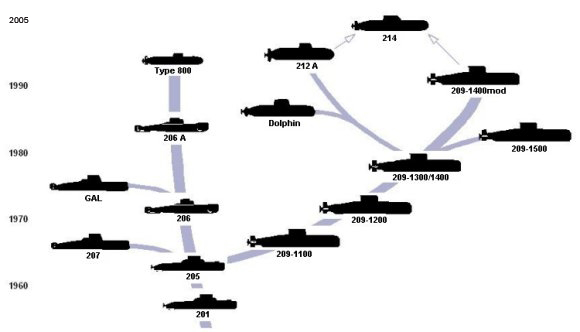
Where will the Type 218SG fit on this HDW submarine tree?
-------------------------
For the latest on Sweden vs Germany see June 11, 2014’s Australia's Future Submarine - Swedish vs German Claims http://gentleseas.blogspot.com.au/2014/06/australias-future-submarine-swedish-vs.html .
Singapore's Defence Ministry (Mindef) signed the purchase deal with TKMS on November 29, 2013 to buy two the 218SGs. The contract was likely to be worth more than 1 billion euros (US$1.36 billion).
In hindsight this website's November 13, 2013 article http://gentleseas.blogspot.com.au/2013/11/germans-sinking-kockums-swedish-sub.html was an indicator that HDW winning the Singapore order was suspected by the Swedish and German media. Singapore's 218SG decision is clearly a blow to Kockums and to Sweden's Navy (which would rely on foreign sales of Kockums subs to lower unit costs of Kockums subs). Unless the Swedish Government or a Swedish firm buys back Kockums Sweden might be forced to buy its future submarines from HDW or at least TKMS owned Kockums. Also link with Saab Being Subsidized to Buy Back Kockums? of March 4, 2014 http://gentleseas.blogspot.com.au/2014/03/saab-being-subsidized-to-buy-back.html .
For Singapore there is some continuity buying customised submarines - from customised Kockums Archer and Challenger Class to customised HDW 218SG class.
I suspect HDW 218SG will be an enlarged evolution of the HDW 209, 212 or 214, perhaps like Israel's HDW built Dolphin 2s. The HDW 218SG may be larger - between 2,000 and 3,000 tons (surfaced) see http://gentleseas.blogspot.com.au/2013/12/the-hdw-218sg-probably-3000-tonne.html . Given the expected 218SG delivery date of 2020 it is unlikely that the 218SG would be radically enlarged to 4,000 tonnes (HDW 216 Class). A 4,000 tonne design would probably take longer than the seven years to develop (2013-2020). Also the 218's purchase price of around US$650 million each implies an existing design rather than a radically new 4,000 ton (surfaced) 216 which would be far more expensive.
The two 218SGs, together with two existing Kockums Archer Class submarines, will replace the four ageing Challenger Class submarines, built in the 1960s and acquired by Singapore in the 1990s, which will be progressively retired from service. This follows Singaporean Defence Minister Ng Hen's comments in March 2013 about Mindef's plan to replace the Challenger submarines.
The 218SG contract includes a logistics package and the training of Singaporean crew in Germany. The 218SGs will have significantly improved capabilities including new build fuel cell Air Independent Propulsion (AIP) which significantly increases a submarine’s underwater range and hence reduces the risk of detection.
TKMS indicated Singapore Technologies Electronics, a unit of defence conglomerate Singapore Technologies Engineering Ltd , would co-develop the submarines' tailor-made combat system with Atlas Elektronik GmbH, a joint venture of ThyssenKrupp and European aerospace group EADS. Atlas already builds combat systems for other HDW subs including the Israeli Dolphin Class.
Singapore's projected defence budget for 2013 is Sg$12.34 billion (US$9.84 billion) up from 2012's Sg$11.83 billion in 2012. Under Singaporean law all able-bodied men must serve for two years in the military upon turning 18, providing additional manpower on top of the estimated 20,000 regulars. Singapore, surrounded by far larger neighbours has pursued a robust defence strategy since its complicated split from Malaysia in 1965. In part due to this large neighbour situation Singapore has cemented close relations with the US, Australian and Israeli military for decades.
For some Comments made in September 2009 which envisaged market distortion between HDW and Kockums see this website's earlier article on Singapore's Archer and Challenger Class submarines at http://gentleseas.blogspot.com.au/2009/09/singapore-submarine-development.html .
For some Comments made in September 2009 which envisaged market distortion between HDW and Kockums see this website's earlier article on Singapore's Archer and Challenger Class submarines at http://gentleseas.blogspot.com.au/2009/09/singapore-submarine-development.html .
--------------------------------
Many of the above details are from several media reports of December 2, 2013 and a TKMS Press Release of the same date:
http://www.nst.com.my/latest/singapore-to-acquire-two-submarines-from-german-firm-1.419154:
http://in.reuters.com/article/2013/12/02/thyssenkrupp-submarines-idINL5N0JH37T20131202
TKMS Press Release December 2, 2013, http://www.thyssenkrupp.com/en/presse/art_detail.html&eid=TKBase_1385989544737_761385703
-Pete
November 30, 2013
Australian SEA 1000 future submaine - an S-80 development or HDW 216?

A rough sketch of the Navantia S-80 submarine. This sub is still being built-developed and might be launched in 2015.
--------------------
Concerning my article of November 22, 2013, "Ongoing debate on Australia's SEA 1000 future submarine requirements." http://gentleseas.blogspot.com.au/2013/11/ongoing-debate-on-australias-sea-1000.html MHalblaub commented:"Hi Pete,
do you think the US are unreliable allies? That was my thought reading RAN has to shadow a fast going nuclear powered submarine (SNN) for a week. I doubt that there will be within the next 10 years any technique for a conventional submarine to maintain submerged about 20 knots for more than 24 hours. Therefore the only solution would be a SNN, to wait or to trust the US.
I am well aware that the small HDW 210mod falls short of the SEA 1000 requirements. In my eyes these requirements are the wet dreams of some Admirals.
A greater range would be useful. A bigger weapons load is nice to have. The 8+ VLS are also a nice to have but they could also be tube launched. Btw Popeyes in action: http://voiceofrussia.com/news/2013_07_14/Israel-hits-Syria-to-destroy-Russian-made-Yakhont-anti-ship-missiles-3943/
The British Astute-class submarines can also fire Tomahawks without an US combat system.
The problem for Royal Australian Navy will be the gap between Collins-class retirement and entry into service of SEA 1000 submarines. Australia can throw a lot of money after the Collins-class to keep them running until 2030. Today the price for one HDW Type 210 is about the costs Australia needs to maintain Collins-class for one year. The maintenance costs for Collins-class will awfully rise in the future.
My advice would be to order as soon as possible 6 Type 210mod/A 26 to fill this gap. 5 submarines should be built in Australia. That will give Australia time and knowledge to design a proper submarine. This interim solution would also save a lot of money and add capabilities.
Australia should not try to reinvent wheels that already exist in far better quality. E.g. engines, AIP, combat system, … That will lead to a troubled and outdated son of Collins – just like the father.
Regards,
MHalblaub
(I tried two times to log me in …)
AIP: Direct Methanol Fuel Cell: http://www.sfc-defense.com/products
November 22, 2013"
-------------------------
Pete's Comments
My response is that I think the US are reliable allies that provide Australia with security benefits in peacetime and would be an essential ally if Australia faced an enemy too big for Australia to handle alone.
You are right that no non-nuclear propulsion would allow an Australian submarine to shadow a fast moving SSN for a week. And yes the only options are for an Australian SSN or reliance on US SSNs to do fast moving shadowing.
It is true the SEA 1000 requirements are very ambitious. They would require a unique, new, very large diesel-electric submarine (SSK) or an SSN.
The value of a VLS is its flexibility eg. for: a divers wet-dry chamber; a hatch for a mini "piggyback" sub; and to fire cruise or small ballistic missiles. For missile firing the main value of a VLS is the low indiscretion factor - meaning the sub can fire all (say) 8 missiles very quickly - reducing that chance that the sub will be detected while firing. Using horizontal tubes probably involves "slow time" reloads of missiles or of follow-up torpedos.
Regarding http://voiceofrussia.com/news/2013_07_14/Israel-hits-Syria-to-destroy-Russian-made-Yakhont-anti-ship-missiles-3943/ its quite possible Popeyes were not used. The target was in range of Israel's Harpoon SLCMs. It would therefore have been unnecessary for Israel to use its (perhaps) 1,500 km range Popeye SLCMs and there would have been a risk a malfunctioning Popeye would crash and then its technical secrets might be revealed. If the Popeye SLCMs have a 1,500 km range (see http://www.nti.org/analysis/articles/israel-submarine-capabilities/) its more likely they would be used for targets deep inland like Tehran or even Riyadh.
Yes its true the British Astute class SSN is a possibility. However any purchase of a French or UK SSN has the disadvantage that their maintenance-repair bases are around 20,000 km away in Northern Europe or effectively further if the Suez Canal is blocked in wartime. Meanwhile the US provides some SSN maintenance facilities much closer in Diego Garcia, Guam and certainly Pearl Harbour.
The Royal Australian Navy would be very aware that an "interim" sub choice might become permanent. The fixed costs of any sub choice are high - therefore making interim highly uneconomic as would running two different sub types simultaneously.
In any case the HDW 210 is basically the smallest of the HDW range (with the even smaller HDW 206 being phased out). This makes the HDW 210 the least likely HDW Australia might buy. The bigger the better in terms of range and endurance - making a very large version of the HDW 212-214 basically a HDW 800 Dolphin+ the most likely buy from HDW.
An HDW Dolphin+ is on the way to an even larger (but technically and financially high risk) HDW 216 in response to SEA 1000 requirements. It needs to be remembered though that the US (Lockheed Martin) may well not make its highly developed combat system available to HDW. Against this HDW is probably the world's most experienced and productive builder of conventional diesel-electric subs.
In contrast I understand Lockheed Martin is placing its combat system into the Spanish Navantia S-80. It is significant that Australia might have confidence in dealing with Navantia in submarine development because I believe Australia has a positive relationship with Navantia in the current Canberra LHD and Hobart AWD projects. Against this Navantia has never independently built and then launched an operational submarine. Navantia has also had no independent experience building subs for export or assisting a customer to build a sub
Possibly I'm overrating the importance of the Lockheed Martin SUBICs combat system in the SEA 1000 submarine selection - see http://www.asiapacificdefencereporter.com/articles/193/SEA-1000-COMBAT-SYSTEMS-SELECTION-FOR-SEA-1000 .
While Kockums submarine division's future is in doubt Australia developing an A26 or any other Kockums design is unlikely.
Definitely "Australia should not try to reinvent wheels" and should avoid a repeat of the Collins experience.
I also have had problems logging-in or commenting on some blogger-blogspot sites - probably some technical problem involving blogger-blogspot or even of its Google owner.
Regards
Pete
November 21, 2013
Australian SEA 1000 Future Submarine, shipbuilding-budgeting issues

For the latest on Sweden's Saab perhap's buying ASC see June 11, 2014’s Australia's Future Submarine - Swedish vs German Claims http://gentleseas.blogspot.com.au/2014/06/australias-future-submarine-swedish-vs.html . It is unclear whether Germany or Sweden hold the strongest intellectual property rights to the Stirling AIP.
A rough sketch of what Australia may want in its SEA 1000 future submarine project. Nuclear or diesel-electric propelled, if diesel-electric then additionally AIP or very large advanced battery capacity, multi-use vertical launch system, US combat system, US weapons including Tomahawk. Probably the not yet developed HDW 216, an enlarged DCNS Scorpene and in development Spanish S-80 are front runners with the SEA 1000 program planners. US Virginia Class, UK or French nuclear attack subs are outside chances. The chance that Swedish Kockums might be chosen (again) is reduced due to the Collins experience and TKMS-HDW.
A rough sketch of what Australia may want in its SEA 1000 future submarine project. Nuclear or diesel-electric propelled, if diesel-electric then additionally AIP or very large advanced battery capacity, multi-use vertical launch system, US combat system, US weapons including Tomahawk. Probably the not yet developed HDW 216, an enlarged DCNS Scorpene and in development Spanish S-80 are front runners with the SEA 1000 program planners. US Virginia Class, UK or French nuclear attack subs are outside chances. The chance that Swedish Kockums might be chosen (again) is reduced due to the Collins experience and TKMS-HDW.
------------------------
Australia's new centre-conservative Coalition Government has made no decision on what its project SEA 1000 future submarine will consist of. The previous centre-left Labor Government (voted out in September 2013) indicated in White Papers and other reviews that 12 future submarines would be constructed from around 2025 to around 2035. The previous Government decided these submarines would be large (up to 4,500 tonne) and hence of unique design, diesel-electric, built in Adelaide, South Australia and that they would probably use the US combat system and US conventional weapons (including the Tomahawk cruise missile). These unique large diesel-electric may effectively be Collins Mk. IIs but not built with Kockums as a major contractor unless TKMS negotiates deals in that direction. The Labor decision was made due to several considerations including:
- economic-industry development potential for the depressed South Australia economy
- popular with Labor's trade union constituency
- Federal and State level electoral considerations ie. votes in South Australia
- ideological anti-nuclear grounds, including popularity with Labor's Green Party ally and
- technical grounds (mainly that Australia possessed no nuclear propulsion support industry, that is if we needed one at all...)
Australia's new conservative Liberal-National Coalition Government has not yet made a decision on what will be in the SEA 1000 future submarine in part because:
- the new Coalition Government has only been in power for two and a half months
- the highly complex 30+ billion dollar project deserves several long reviews
- Australia does not currently have the Defence money to fund the project
- naval shipbuilding and budgeting for Australia is currently taken up by the 2 Canberra Class Landing Helicopter Docks (LHDs) and the 3 Hobart Class (Aegis) Air Warfare Destroyers (AWDs) projects under construction, and
- the issue is still unresolved under the new Government as to whether Australia may buy nuclear propelled attack submarines rather than diesel-electric
Its not necessarily set in stone that 12 subs will be built rather than 6 diesel-electric or 4 to 6 nuclear propelled. The built in Australia requirement is not a given. Industry-jobs-votes requirements in Australia may be met in other ways including offset agreements and heavy maintenance facilities constructed in Australia including nuclear propulsion support (if needed...).
If, as is likely, 4 Virginia Class can do the job of 12 diesel-electric Collins Mk. IIs then on the crucial issue of lower overall price, a deal is possible.
A final Australian decision may take 4 years into the new Government ie 2017.
In terms of arguments favouring nuclear propelled Phil Radford a freelance writer, based in Sydney, has written the following article of May 15, 2013 in the Australian Strategic Policy Institute (ASPI's) The Strategist http://www.aspistrategist.org.au/a-farewell-to-nuclear-submarines-for-now/
A farewell to nuclear submarines, for now
The Defence White Paper signals full-steam ahead for Australia’s most expensive defence project ever: the design and construction, in Australia, of 12 conventionally-powered submarines. With A$200m committed to funding initial designs, however, the enormity of the challenge will start to surface. Australia now has to create submarines with greater range and endurance than anything built by countries with generations of experience.
Hopefully, Canberra analysed its alternatives to the point of exhaustion. In about two years’ time, Adelaide will start to fill up with the 1,500-or-so foreign draughtsmen and engineers that RAND says Australia will have to import, just to execute the design work. And as these experienced submarine designers wrestle with the performance parameters set by government, they’ll pose one very awkward question: “Why are you asking us to design a nuclear-powered submarine without a nuclear engine?”
Currently, the government has no answer. The White Paper simply says that “consideration of a nuclear powered submarine capability [… has been] ruled out”. This reticence is mistake. As Collins Mk II rises from the drawing board, the case for purchasing nuclear-powered boats will only get stronger.
First, consider the money. The projected cost of an all-new 4,000 tonne conventional boat is estimated by ASPI to be over A$3 billion, which includes all project costs. This is approximately the same as the sail-away cost of a much larger Virginia class nuclear submarine off an established production line, and could even be more than a French or British nuclear submarine which would almost certainly sail away for less than $2 billion. Defence would still have to purchase the support systems to get the boats into Australian service, but the industrial and program costs sunk into getting a first-in-class to work would be borne by someone else.
Besides being less risky to procure, these nuclear-powered vessels would be far more powerful than conventionally-powered boats. They could arrive on station faster, stay there longer, carry more weapons, and fight more aggressively. As a deterrent, they’d be many times more formidable.
The Royal Australian Navy might play a simple war game once the new design matures. They could invite a retired American submarine captain over and say : “Sir, to achieve a specific objective in the middle of the Pacific or Indian oceans you have a straight choice between having, under your command, one single nuclear-powered boat, or ‘X’ number of our Collins Mk.II?” Even at this distance, his ‘X’ is likely to be two or three. Expressed as an opportunity cost in dollars, the answer is horrendous.
The objections to going nuclear are clear; but as the challenges of Collins Mk.II become less opaque, the question will be: did the Government diligently and unemotionally address them?
If the over-riding justification for an Australia-built fleet is operational independence, then Government should look squarely at what the current fleet delivers. Only one third of the Collins fleet is generally seaworthy. Refitting them takes four to five times the work required on similar comparable European vessels. And upgrading them requires US help for the most complex elements—the sensors, combat system and weapons.
Australia could almost certainly sustain a fleet of nuclear boats to a higher level of operational availability than currently possible. Neither the US nor UK boats ever need refuelling. The core is closed for the lifetime of the submarine, so the additional nuclear engineering required for through-life support is modest. Establishing a first-class nuclear-boat maintenance facility in Australia would be expensive, but pales beside the gargantuan cost of re-launching the Australian Submarine Corporate (ASC) as a construction yard.
Alternatively, Australia could avoid the cost and political risk of building maintenance facilities here, and instead operate the boats on a similar cycle to the United States Navy’s Guam-based submarines. This would mean the submarines having only a small maintenance footprint here and returning to US West Coast for periodic refits, which is pretty much how the RAAF maintains its fleet of C-17 strategic transports.
In either case, you don’t need a construction yard to maintain a submarine. The activities are quite different. British nuclear boats never re-visit the Barrow yard where they are built.
Nor would the fact Australia’s boats were foreign-built boats necessarily diminish the country’s strategic independence. There’s a fundamental difference between depending on an ally to come to your aid (which, in extremis, Australia does now) and depending on your ally not to obstruct you from paying to defend yourself. That’s why the UK ultimately trusts US not to abuse its position as the supplier–owner of its Trident ballistic missiles, on which the UK’s independent deterrent relies.
Does the case against nuclear boats ultimately rest, then, on Australian jobs foregone? That flank, too, is exposed. Re-booting ASC will merely kick-start thousands of careers that will go nowhere once each design and construction phase is complete. Better, surely, to play the international defence procurement game, and trade jobs on submarines for offsets in industries where Australia can build competitive advantage—and careers with a future.
The stakes couldn’t be higher. Asia is rising and submarines will become Australia’s primary defence asset for many decades. For now, the government has passed on the one weapon that could deliver genuine independent strategic security. But like a pair of lethal mines, cost and capability are floating right in the path Australia’s home-grown subs. This won’t be the last we hear of Australia’s nuclear option.
Phil Radford is a freelance writer, based in Sydney. He specialises in naval strategy and defence procurement."
November 13, 2013
Germans sinking Kockums Swedish sub maker?
For the latest on Sweden-Saab vs TKMS-HDW-Kockums see June 11, 2014’s Australia's Future Submarine - Swedish vs German Claims http://gentleseas.blogspot.com.au/2014/06/australias-future-submarine-swedish-vs.html . It is unclear whether Germany or Sweden hold the strongest intellectual property rights to the Stirling AIP.
For information about Singapore's December 2, 2013, decision to buy two HDW 218SG subs instead of a Kockums sub at http://gentleseas.blogspot.com.au/2013/12/singapore-buying-two-hdw-218sg.html
------------------------

Very simplified artist's conception of ThyssenKrupp Marine Systems' preferred product - largest sub of the HDW range, the future HDW 216. Note the rotary multi-purpose VLS behind the sail-fin.
----------------
See information about Singapore's December 2, 2013, decision to buy two HDW 218SG subs instead of a Kockums sub at http://gentleseas.blogspot.com.au/2013/12/singapore-buying-two-hdw-218sg.html and Saab Being Subsidized to Buy Back Kockums? of March 4, 2014 http://gentleseas.blogspot.com.au/2014/03/saab-being-subsidized-to-buy-back.html .
The Local ("Germany's News in English") has produced this disturbing October 15, 2013 report about an internal corporate threat to the continued functioning of Kockum's Submarine division.
Whether this downgrades Kockum's continued ability to support its Singaporean-Archer Class and Australian-Collin's Class submarine customers remains to be seen.
Does this put Kockums' future submarine A26 at risk of preventing it from being a contender for Australia's large conventional SEA 1000 future submarine project?
Is Kockums' new parent company (German) ThyssenKrupp Marine Systems giving preferential treatment to its competing German HDW 212-214 and 216 submarine products? Note, concerning submarines, the ThyssenKrupp Marine Systems website only features the HDW products.
The report in full is below http://www.thelocal.de/national/20131015-52407.html :
"Germans look to sink Swedish sub maker"
15 October 2013
"A German industrial giant is waging a campaign of "internal warfare" against one of its own firms - Sweden's flagship submarine manufacturer Kockums - putting key defence deals at risk, sources have told The Local.
A source told The Local that the purchase was aimed at getting rid of Germany’s Swedish submarine rival and that TKMS was jeopardizing Swedish export deals for submarines with the Australian and Singaporean governments.
"The purchase of Kockums wasn't aimed at consolidating the naval industry and creating synergies, but at getting rid of a competitor," a source in Germany with direct knowledge of the situation told The Local.
Kockums and its predecessors have been building ships for the Swedish navy for centuries at the Karlskrona shipyard in southern Sweden that now serves as the base of the company's Swedish operations.
But according to a German naval manufacturing consultant with ties to TKMS, ThyssenKrupp is actively trying to sabotage Kockums export operations to the advantage of Germany’s HDW, a strategy he dubbed "TKMS über alles" and slammed as "suicide".
The Germans' efforts to sink Sweden's submarine industry have been ongoing since at least 2011, according to the source, when TKMS CEO Hans Christoph Atzpodien denied Kockums the opportunity to bid on a project in Singapore for the construction of new submarines, despite the Swedish firm's long-standing relationship in the country.
Earlier this year, the German firm decreed that the Swedish shipbuilder officially change its corporate name to ThyssenKrupp Marine Systems, scrapping the Kockums brand name that has been a part of Swedish industry since the early 1800s.
'A raging war is taking place'
In August, during a meeting in Bonn, Germany with officials from Singapore defence agency DSTA held, Atzpodien claimed that Kockums "would no longer be capable of designing and building submarines", according to the source.
"A raging war is taking place between Kockums and TKMS," he said, explaining that the Singapore deal has brought the situation into sharp relief.
Among other things, Atzpodien disparaged Kockums plans for a new A26 class of submarine, claiming the Swedish firm didn't have enough engineers to complete the project, and that it was sure to be plagued with cost overruns and delays.
"Atzpodien has systematically ejected Kockums from the discussions and has barred Kockums from Singapore," the source explained.
TKMS has also complicated Kockums' chances for new contracts in Australia, another country where the Swedish shipbuilder has a strong presence, having designed and built six Collins-class submarines in the 1990s in what was one of the largest export deals ever at the time.
But Kockums found itself left out of a 2012 initial call for proposals from Australia to replace the aging subs with an off the shelf solution, while its German-based competitor and sister company HDW was one of three European firms asked to participate.
Earlier this year, however, Australia and Sweden did ink a deal allowing for Kockums to take part in the project, dubbed SEA 1000, which calls for the building of 12 new submarines.
But in the meantime, TKMS purchased an Australian naval defence firm, Australian Marine Technologies, that "could do the same job as Kockums could have done on its own," the source said.
"TKMS has here again torpedoed all the efforts of Kockums to run this future competition because it has already created its own footprint," the source told The Local.
A Swedish saviour?
The Swedish government, as well as officials with the primary defence procurement agency, the Defence Materiel Administration (FMV), has been made aware of the situation and have become so unhappy they have asked Swedish defence contractor Saab to look into a possible purchase of Kockums, a source within the Swedish defence industry told The Local.
"Discussions are taking place right now," according to the source, who agreed that TKMS is trying to strangle Sweden's ship building industry.
"The only reason TKMS owns Kockums is to stop them from exporting," the Swedish source explained, adding that the Swedish firm "could not exist" without export contracts.
Allan Widman, a Liberal Party (Folkpartiet) MP from Malmö and the party's defence policy spokesman said he is "worried" about Kockum's future in light of the rift with TKMS.
"Submarine building capabilities are essential for our armed forces and our ability to defend ourselves," he told The Local, adding that he had heard a number of "industry rumours" about the discord between TKMS and Kockums.
Adding to his concern is the fact that two years have passed since the Swedish parliament Riksdag approved funding for the development of the A26 submarine for the Swedish navy, but nothing has happened, reportedly due to concerns over ThyssenKrupp's ownership of Kockums.
"I hope Kockums isn't prevented from doing business with other countries. It's not constructive," said Widman, adding he would welcome Swedish ownership for the Karlskrona-based shipbuilder.
"I would have no objection to private Swedish ownership of Kockums," he said when asked about the Saab deal.
However, if the Swedish and German firms can't strike a suitable deal to resolve the situation, Widman said the dispute may require a "political solution".
"This is a matter that's vital to our national security," he said, stressing that he hopes both Germany and Sweden can maintain submarine building capacity.
"In the end, however, it may require a political dialogue between Sweden and Germany to find a suitable solution."
When reached by The Local for comment on the Saab-Kockums negotiations, a Saab spokesman refused to comment.
"We don't speculate on rumours like that," the spokesman said.
A spokesperson with FMV also chose not to comment citing an "ongoing procurement".
A spokesman with Kockums in Sweden also refused to comment on the reported disunity within TKMS, while spokeswoman with TKMS in Germany said the company was "unable to comment on market rumours"."
--------------------------------------
A comment on the above post:
"Anonymous said...
"This is a matter that's vital to our national security," --- So why Kockums was offered to a German company first time? What is the problem for Sweden to buy German submarines like Poland did?
"Earlier this year, however, Australia and Sweden did ink a deal allowing for Kockums to take part in the project, dubbed SEA 1000, which calls for the building of 12 new submarines."
This is quite wrong. The deal was Sweden donated intellectual property rights to Australia.
http://www.aspistrategist.org.au/australia-and-sweden-burying-the-hatchet/
Now Australia tries to build with these rights a new Collins-class on its own - good luck!
The Collins-class disaster was partly related to the inability of Kockums to control the project properly. TKMS owned HDW has much more knowledge with license building of submarines. It worked for South Korea. [South Korea has 9 South Korean derivatives Chang Bogo class of the HDW 209 and 3 derivatives Son Won-il class of the HDW 214]
Why should TKMS allow Kockums to design a new A26 submarine while HDW at the same time works on Type210mod? Would GM allow Opel to design quite the same type of car Holden is working on? [as the number of the HDW 210 suggest it is smaller than the HDW 212-214. Specifically the 6 existing HDW 210 mod are of the Norwegian Navy Ula Class http://www.defenseindustrydaily.com/Ula-Tech-Norways-Next-Submarine-Fleet-07609/ and http://www.network54.com/Forum/211833/thread/1231528114/HDW+Introduces+Type+210mod+Submarine
]
Kockums makes fine Corvettes like the UK makes fine wings for Airbus. Great Britain will never again produce big passenger aircraft on its own.
How well of is Saab Automobile today without a big company in the background?
Subscribe to:
Posts (Atom)
Pete's Comment
In addition to preventing Kockums being competitive TKMS acquisition of Kockums provide an opportunity to officially or unofficially shift intellectual property (including A26 design information) from Kockums to HDW?
Does this have an Australian dimension concerning German-HDW access to Collins' confidential design and business details?
Pete