September 25, 2015

DCNS's Shortfin Barracuda Bid Becoming Clearer

(above) Xavier Mesnet, Development and Marketing Director, Submarines and Surface Ships, DCNS, speaks about DCNS's efforts in support of Shortfin Barracuda for SEA 1000 CEP. 

DCNS also plans to compete in the future frigate (SEA 5000) and smaller patrol vessel (SEA 1180) evaluations. 
---


While current French SSNs and SSBNs are shown in this Youtube the computer aided design and command center interiors that go into them would be similar in an Australian Shortfin Barracuda. 
---

DCNS Group opened its DCNS Australia subsidiary on November 19, 2014. 

PETE's COMMENT

The prospects of French competitor DCNS (led in Australia by Sean Costello former Chief-of-Staff to former Defence Minister David Johnston) may have improved now that a hybrid or full build of the future submarine may occur in Australia.  

DCNS's Shortfin Barracuda bid is firming up as the milestones for the Barracuda SSN become closer.

"Anonymous" (below) speaks with authority and there are no noticeable language differences that require cleaning up.

ANONYMOUS's COMMENTS

In Comments for Submarine Matters’ article Shortfin Barracuda Bid Maybe Competitive But Still Sketchy of September 16, 2015. “Anonymous” on September 20, 2015 10:11 AM said:

“Barracuda first of type construction is complete. The next 6-8 months will be spent getting systems on line, with sea trials likely to start before mid-2016. So it's safe to say that the level of risk is being rapidly reduced.

The extent of changes from SSN to SSK is greatly exaggerated on this blog. The front half of the sub will barely change at all. They may simply convert some of the trim tanks to dual use for more transit fuel. There is already storage for some fuel aboard as evidenced by the presence of two emergency diesels. 

Only one hull section (rearmost propulsion section) will require complete redesign, in order to accommodate diesels, fuel and batteries. This involves a scaling of the Scorpene propulsion module, using similar components. Hardly revolutionary stuff however. There will certainly be no arbitrary down-scaling of hull thickness, or complete redesign of 80% of the hull components.

All the talk about methanol reforming is off base. The AIP solution - if required by the client - will be 2nd generation fuel cell. This has been demonstrated at scale, on land, so is somewhat more advanced than just a paper design, though still early days. If the customer is smart, they will order the first sub without AIP, and give the technology time to mature. Better to retrofit a fully mature AIP module at a later date, than to make such a critical selection now when the technology is advancing so fast (certainly faster than the submarine build process!).

Without AIP, Shortfin will be closer to 4,200t (surfaced), having one less hull module than Barracuda SSN. The reduced length to diameter would actually improve drag.

The US may indeed kill Shortfin Barracuda by denying integration of their combat system and weapons. DCNS have expressed their willingness to work with whatever combat system the RAN wants.”

Pete

September 24, 2015

China's South China Sea Island Base Building

Map 1. Around one half of the world's sea trade (including oil tankers) moves from the Indian Ocean, through the Strait of Malacca and into the South China Sea to major markets in China, Japan, Taiwan and South Korea. The South China Sea can be blocked by China - facilitated by the reef-islands China is turning into bases in the Spratly and Paracel islands (Map 1. courtesy http://fareasternpotato.blogspot.com.au/)
---

In April 2015 there were increasing reports that China was militarising:
-  Cuarteron Reef - an artificial island where China has built a powerful surveillance radar. The reef is to the right of LONDON REEFS (see above in Spratly Islands on map above), and
-  Scarborough Reef or Shoal, in the sea about 400 km west of Manila (see mao above). 

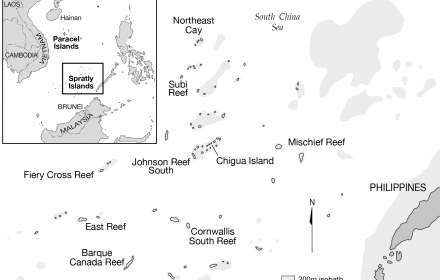
Map 2. Simplified map of Spratly Islands showing China's developing naval and air bases at Fiery Cross Reef, Subi Reef and Mischief Reef. 
---

The Spratly Islands is an ongoing territorial dispute between Brunei, China, Malaysia, the Philippines, Taiwan, and Vietnam. The dispute involves low-level military pressure techniques (such as military occupation of disputed territory, reef base building, sea "militia" actions, coastguard vessels and low flying aircraft harassment) to advance strategic land and undersea oil/gas claims. The sea is heavily used by cargo and warships on it and aircraft over it. All of the above countries except Brunei occupy some of the islands-reefs. The US, India, Japan and Russia are also involved. 

The Paracel Islands in the northern South China Sea are also heavily contested.

Australia's new Prime Minister, Turnbull, made a foreign policy statement on September 21, 2015, which roundly criticised China for its increasingly aggressive activities in the South China Sea (which particularly means the Spratlys as they are nearer to Australia than other disputed islands). He described China as "pushing the envelope". 

China's building of naval and air bases (using rapid sand dredging landfill) in the South China Sea is driving a geographical wedge between (Australia and some Southeast Asian nations) and their strategic and economic allies in Northeast Asia (including Japan and South Korea).


--------------------------------------------------------------------------------

CHINESE WEAPONS BEING ESTABLISHED ON ISLANDS-REEFS OF THE SOUTH CHINA SEA


This island-reef base building has implications for Western/free world submarine operations as it will enhance China's anti-submarine warfare (ASW) capabilities in terms of future deployment on the island bases of such weapons/sensors as:

-  undersea sensor arrays possibly extending from Mischief Reef (see Map 3. below) to China's Hainan Island or the Chinese mainland. "It appears that three acoustic monitoring sensors are linked up to different underwater fibre-optic detection networks."

- ASW aircraft (eg. the Orion like the Y-8Q fixed wing MPA (see below) and helicopters like the future Z-18F (see below)

- strike fighters (like the J-16, J-10)

- emerging air superiority fighters like the future J-31 (see model below) and  J-20 . The stealthy J-20, J-XX,  J-21, J-25 and J-31 are competing 2 engine, long range design concepts with one or two  deployed around 2022. They may be ideally suited to over water operations over the South China Sea. They look similar to the F-22 and/or F-35 but currently lack sufficiently powerful engines, adequate electronic stealth and radar absorbent material (RAM) coating.

- refueling aircraft

- anti-aircraft and anti-missile missiles

- missiles (cruise and ballistic) with ASW, anti-shipping and land attack capabilities

- ASW warships including new Type 056 corvettes (photo below) and Type 052C detroyers

- island-reef based radar, satellite up/downlink and signals interception stations

Map 3. An increasingly effective anti-submarine (and anti-ship) measure is undersea arrays which connect sensors and can be laced with mines (for remote electronic activation in wartime). China may well have laid a fixed undersea array from (aptly named) Mischief Reef (above map) to Sanya naval base on China's Hainan Island. (Map courtesy Quartz website)
---

China's new Type 056 corvette with numerous sonars (including towed array) and several weapons for ASW ops (Photo courtesy Navy Recognition website)
---

Next Generation Chinese Z-18F ASW helicopter for finding, tracking and destroying enemy submarines. It is to be outfitted with a sonobuoy launcher, forward looking infrared radar (FLIR) system multi-mode 360° surveillance radar mounted under nose, a dipping sonar, and four weapon stations to carry anti-submarine torpedoes, depth charges and air-to-surface missiles. (Graphic courtesy Chinese Military Review) 
---


Chinese Y-8Q GX6 maritime patrol aircraft with an outsize magnetic anomally detector tail boom. Obvious similarities with US P-3 Orion and Russia's Ilyshin Il-38. (Photo courtesy Chinese Military Review)
------------------------------------------------------------------------------------------------

CHINA's ISLAND-REEF BASES IN THE SPRATLYS

Below I concentrate on the three most controversial and extensive Chinese air and naval base building efforts in the Spratlys. These are at Fiery Cross Reef, Subi Reef and Mischief Reef. 

Fiery Cross (or Yongshu in Chinese) Reef below - Satellite photographs indicate China had almost finished an enclosed harbour and 3,000 meter airstrip below,

Fiery Cross Reef (above) is shown in this handout satellite image dated September 3, 2015 (Satellite image via Reuters).

---------------------------------------------------------------------------------------------

Subi Reef (or "Zhubi" in Chinese) below - with three photos indicating China's rapid progress in sand dredging landfill - April 2015, June 2015 and by August 2015 Subi is almost a completely enclosed harbour. Port facilities and a 3,000 meter airstrip will soon be built.


(Satellite image courtesy Victor Robert Lee and Digital Globe via The Diplomat) 

Subi (or Zhubi) Reef (above) 2 months later in August 8, 2015 (Satellite image courtesy CSIS/AMTI via Reuters)

--------------------------------------------------------------------------------------

Mischief Reef - image below shows a dredged sand retaining wall around an area 3,000 meters long for a runway and harbour, matching similar work on Subi and Fiery Cross.
Mischief Reef satellite image (above) dated September 8, 2015 and provided by CSIS Asia Maritime Transparency Initiative/Digital Globe September 14, 2015. (Photo via Reuters)

------------------------------------------------------------------------------------

As the three reefs are near the Philippines that country is now seeking renewed US involvement in defence issues if at all possible. Japan is also assisting the Philippines with patrol boats and aircraft.

Other Spratly reefs China may be militarising include Gaven Reef, Hughes Reef, Johnson Reef  and Cuarteron Reef.

Vietnam is also concerned about the rapid Chinese buildup, hence Vietnam is also seeking and receiving political and some military support from the US, Russia and India.

It appears China's main justification in claiming the South China Sea is the name South China Sea. With rising Chinese national power comes expectations of control in this rising power's region - a type of Chinese Monroe Doctrine.

Pete

September 23, 2015

Industry Minister Christopher Pyne Preempts Major Defence Policy

Industry Minister Christopher Pyne in full flight. His backing of his home state (South Australia) over other states and his manner may not have made him totally Defence Force compatible.
---

The Turnbull Government’s submarine build policies are becoming clearer in the direction of full build in Australia not just a 70% hybrid build as previously expressed. The policies of Defence Minister Marise Payne may have been pre-empted by Federal Minister for Industry, Christopher Pyne [Pyne/Payne will cause confusion…] when Christopher Pyne said the words below on Australia’s ABC, September 23, 2015 http://www.abc.net.au/news/2015-09-23/pyne-gives-strong-indication-of-adelaide-sub-build/6797870:

Ministers Christopher Pyne, Jamie Briggs give strong indication of Adelaide submarine build

Federal Industry Minister Christopher Pyne has given his strongest indication yet that a full domestic build of Australia's next fleet of submarines will take place in Adelaide.

During an interview on 891 ABC [radio] Adelaide [on September 23, 2015], the SA-based MP said he wanted the State and Federal Governments to work together.

"The SA Government and Federal Government, will come up [with] a proposal, I hope, for a full domestic build at Osborne,[in Adelaide, South Australia]" he said.

Firms from Germany, France and Japan are competing to build the submarines after former Prime Minister Tony Abbott broke his pre-election promise in 2013 and put the tender out to what he called a "competitive evaluation process".

The South Australian Government wants the Coalition to honour its previous commitment to build the replacement to the Collins Class fleet at Techport, the shipbuilding facility it owns at Osborne in Adelaide.

…Mr Pyne was tipped to take over as Minister for Defence from Kevin Andrews in Prime Minister Malcolm Turnbull's recent cabinet reshuffle but the role was instead handed to NSW Senator Marise Payne. [Pete’s Comment - perhaps it was thought Christopher Pyne would too strongly back the interests of South Australia over the interests of other states.]


Pete

September 22, 2015

The US Continues to Influence Australia's Future Submarine Selection in Many Ways

The senior member of Australia's future submarine Expert Advisory Panel, former US Secretary of the Navy, Professor Donald C. Winter (former Corporate Vice President Northrop Grumman). The competitive evaluation process (CEP) has apparently already selected the US made combat system. (Photograph courtesy US Navy)
---
A major challenge for new Defence Minister Payne and Prime Minister Turnbull, concerning the future submarine project, is handling the influence and involvement of the US.

70% of the future submarine may be built in Australia but if Australia accepts the US's pro Japan bid policy then Japan will win. Australia will have to tolerate Japanese inexperience while   Japan attempts to develop the build in Australia project. This may be expensive and risky for Australia.

US influence and involvement issues include:

1.  Australia's on the record preference for the US combat system

the combat system includes all the sensors (many different sonars...periscopes for visual and optronics, passive and active radar), communications, navigation, all the weapons ...and the Tactical Data Handling System where all the information is processed and displayed to the operators (mostly in chairs watching computer screens).

- the combat system may amount to 30% of the cost of the submarine.
-  On February 20, 2015 Defence Minister Andrews declared: "...the Government has endorsed a set of key strategic requirements for our future submarines:...c) The combat system and heavyweight torpedo jointly developed between the United States and Australia as the preferred combat system and main armament." 
-  the US combat system has been modified at high expense then integrated into the Collins
-  see further Australian Ministerial and Defence-DMO support and planning for future use of the US combat system  

2.  Given the highly confidential nature of combat system technology (and its reliance on US SeaWeb sensor infrastructure) it may be effectively up to the US which country such technology can be transferred to.
- US technology transfer powers may limit Australian decision-making and also influence how our future submarines are built.
- It is widely believed in the submarine industry that the US would not wish combat system technology transferred to French submarine builders.
- as the US is believed to have already transferred much of its combat system technology to Japan it is assumed that integration of the combat system into a future Australian submarine designed by Japan would not be a problem.
-  parts of the US combat system have been integrated with some German (TKMS) designed submarines. Such as Lockheed Martin modifying Brazil's Tupi (Type 209) class submarines to use US Mark 48 torpedoes  . So TKMS may stand between Japan and France in terms of ease of integration of the US combat system.
-  perhaps to reinforce that the US combat system will go into the future Australian submarine Lockheed Martin has announced that it is opening up a Combat System for Australia office at Mawson Lakes, Adelaide, in November 2015 "The laboratory is all about risk reduction. It gives us the flexibility to work with the SEA 1000 hull designers and combat subsystem providers in every step of the process" said Raydon Gates [Chief Executive, Lockheed Martin Australia].

3.  The US public endorsement of the Japanese Soryu submarine as the best large submarine may be a continuing US policy.
-  Such a US policy my be counter to Australian media and broader public expectations that the German and French bids are clearly stronger.
-  US pressure on Japan to more fully enter alliances has cost the Abe Government in terms of Japanese public popularity. Japan winning Australia's future submarine competition could be seen as  a reward for Abe's trouble.
-  in terms of proconsular imperium Vice Adm. Robert Thomas, commander of the U.S. Navy’s 7th Fleet, reportedly said Oct. 24 [2014] in Tokyo that then-Australian Defence Minister David Johnston was very interested in Japan’s Soryu-class subs. “I talked to him about it four years ago and I said: ‘You want to find the finest diesel-electric submarine made on the planet - it’s made at Kobe works in Japan,’

4.  In terms of the Expert Advisory Panel the US has further influence in the submarine selection process.
-  Of the four Expert Advisory Panellists for the Competitive Evaluation Process (CEP) the most senior is an American, Donald C. Winter. He is "senior" by virtue of his position as a former senior politician (US Secretary of the Navy) and former Corporate Vice President Northrop Grumman 
-  This may favour Japan and the US stake in the combat system.

5. The US combat system (known as the AN/BYG-1) is closely integrated with the Collins' current  weapons including: the American made Mark 48 torpedoes and Harpoon anti-ship cruise missiles. The combat system is also tailored to the long range US Tomahawk land attack cruise missile system that Australia wishes to mount in the future submarine.

6. There is an argument that integrating the whole US combat system into the winning competitor's submarine design in Australia is more efficient in terms of minimising contractual disputes, commercial-in-confidence problems and US and Australian national security problems.

7. There is a counter argument that greater technical and cost efficiencies can be achieved by integrating the US combat system with the standard systems already used by the three competitors; France (DCNS), Germany (TKMS) and Japan (KHI, MHI and Japanese Government).

Along the lines of 7. - at Submarine Matters' Turnbull Govt New Policy - 70% Future Submarine to Be Built in Australia, September 17, 2015 "MHalblaub" (on behalf of Germany) made some interesting comments on September 21, 2015 8:58 PM along the lines:

Regarding "the combat system I have to mention a few thoughts:
- Australia is accustomed to a US system. The US combat system offers inherited access to the US  SeaWeb.
- on the other hand each submarine type offered has a [standard] combat system which is slotted into  other combat systems.

So the question is which way is the better solution?
- fit an US combat system into a submarine or 
- fit features of the US combat system into a [one of the 3 competitors standard] combat systems.

I am under the impression the German ISUS system uses the consoles for either mission related jobs (like sonar tracking) or for submarine system related issues (like monitoring the engines). Each console can do every job. So a US system needs also to operate the whole submarine.

ISUS can already be modified to work with [long range land attack missiles. ISUS already is capable of operating a wide variety of torpedoes including the US Mark 48 torpedo and missiles including the US Harpoon... and other weapon systems.]

So what would be easier? Implement some SeaWeb features into an existing system with the Australian knowledge of the US combat system or implement all the other things into an US system?

It was also a wrong strategy to chose the US System without any competition. I can imagine the price..."


---

Just some of the components of the US made AN/BYG-1 Combat System. The AN/BYG-1 will very likely be integrated into Australia's Future Submarine.

FINAL COMMENT

Australia needs to do more than just look at the US combat system in response to US influence, Collins carryover or due to Australian defence sector conservatism.

Non-US options or options that can be plugged into US hardware include:

-  France's SUBTICS http://www.gican.asso.fr/content/subtics  


-  The Japanese combat system may be too immersed in Japanese language-culture to be reasonably transferable – see this link to the Soryu’s combat system “Equipment” (right-click mouse to translate into English). 

Pete

September 21, 2015

Australia's $90 Billion Naval Shipbuilding More Complex Under New Government

Artist's conception of what an expanded Civmec, Henderson, WA, facility would look like if the future submarines were assembled there. (Image courtesy communitynews)


The diagram above is courtesy The Daily Telegraph August 20, 2015. Note this is based on Defence Teaming Australia advice in mid August 2015, under different Abbott Government conditions. The $17 Billion might be for 8 submarines. 

While the promise of 70% of submarine work in Australia has been mentioned by the outgoing defence minister Andrews in Parliament this is not yet a formal commitment. 70% involves complex costings over a 20 year period.

The new Australian Defence Minister, Marise Payne, will be faced with a highly complex $90 Billion shipbuilding situation. 

She and the whole Australian Federal Cabinet will have to:

-  plan, conduct and complete submarine/ship selections which heavily rely on the knowledge/designs/industrial capacity/contractural clarity of overseas companies

-  decide on political priorities at the federal and state level (including rewards for past, present, future loyalty to the Turnbull government)

-  ensuring votes and jobs at the Turnbull federal and state levels

-  divide shipbuilding work (for submarines, frigates and patrol vessels) across four major shipbuilding states (South Australia, Western Australia, Victoria and New South Wales)

-  other Australian states and territories will also need to be given sub and shipbuilding work that they can efficiently do. 

More detail on the four majors:

-  home of the Australian Submarine Corporation (ASC) in Adelaide
-  ASC's efficiency was/is low as seen in the Collins build and the current Air Warfare Destoyers build (3 for $10 Billion - so far) about 200% over the price of highly efficient shipbuilding countries (eg. South Korea and Spain) 
-  But politically the votes of the 6 Federal Members of Parliament from South Australia were essential for Turnbull to become Prime Minister. 
-  Industry Minister Christopher Pyne is from South Australia

-  its relatively efficient shipbuilder, Austal, is at Henderson, south of Perth. 
-  on September 25, 2015 Civmec, also at Henderson, proposed that it could build the submarines (see artist's conception of an expanded Civmec facility above). 
-  Henderson is near Australia's main submarine base HMAS Stirling at Rockingham. 
-  making Henderson a logical place to assemble submarines and maintain them. 
-  But politically that may be impossible, even though Julie Bishop, a key kingmaker of Turnbull, is from Western Australia.
- Austal's Mobile Alabama shipyard builds the Independence class littoral combat ship.

Victoria 
-  relatively efficient shipbuilder BAE Systems Australia is at Williamstown dockyard near Melbourne, 
-  has a highly efficient record of building 10 x ANZAC class frigates 
-  and more lately handled the completion of the 2 x Canberra class Landing Helicopter Dock (LHDs)

New South Wales (NSW)
-  Forgacs in Newcastle and in Tomago are involved in ship maintenance and building of ship modules
- Newcastle is in close proximity to Sydney (the main Fleet Base East) and other naval facilities on Australia's east coast such as Jervis Bay (NSW) and several in Queensland.

So the handling of the $90 Billion project, for the submarines, frigates and patrol vessels, is Defence Minister Payne's main challenge and may make or break the Turnbull Government.

Pete

September 20, 2015

Senator Marise Payne - Australia's first female Defence Minister


Senator Marise Payne, 51, has become Australia's first female Defence Minister. 

She is:

-  known as solid and a quiet achiever
-  politically a moderate 
-  from New South Wales
-  strong background in strategic and foreign policy
-  a member of the Senate Foreign Affairs, Defence and Trade Committee
-  listed as “Senator for Western Sydney”
-  she is preferable to other contenders for the job, who were Joe Hockey (no longer a Minister) and Christopher Pyne (he is nicknamed "the poodle" :-)
-  Germany is the other country I can think of with a female Defence Minister.

Also some comments from the Sydney Morning Herald.

---------------------------------------------------------------------------------------------

Bio details on Marise Payne's website http://www.marisepayne.com/biography are:

“After growing up in Sydney and the NSW Southern Highlands, Marise Payne went on to complete her education at MLC School, Burwood and her Bachelor of Arts and Laws at the University of NSW.

A member of the Liberal Party since 1982, Marise was the National Young Liberal Movement's first female President. She also served on the NSW Liberal State Executive for 10 years and at branch and electorate levels.

Having served as a political adviser to some of the most significant figures in Liberal politics of their time, Marise went on to a career as a public affairs adviser in the finance industry.

In 1997 Marise filled a casual vacancy to represent the people of New South Wales in the Australian Senate, making her inaugural speech on 2 September 1997. She was then elected in 2001, 2007 and 2013.

Marise has served as Shadow Minister for Indigenous Development and Employment, Shadow Minister for COAG [Council of Australian Governments] and Shadow Minister for Housing. She plays an active role in the Senate and has been a member of both Joint and Senate committees, including as Chair of the Joint Standing Committee on Foreign Affairs, Defence and Trade and as Chair of its Human Rights subcommittee.  

In 2013 Marise was appointed as Minister for Human Services in the Abbott Government.
From its inception in 2003, Marise was co-convenor of the Parliamentary Friends of Dementia (PFOD) group until February 2011 and is currently co-Chair of the Parliamentary Friends of Rugby League group.

Based in western Sydney for over ten years, Marise has come to know the local community well and now works alongside local organisations and businesses to help the region develop its great potential.

Outside parliament, Marise continues to work in the community on issues as diverse as human rights, emerging technologies and the implications of our ageing population.

Away from politics, she is a committed fan of the St George/Illawarra NRL team and the Geelong Cats, an enthusiastic supporter of the arts in Australia, spends as much time as she can in the Southern Highlands and she cooks for therapy. Marise and her partner live in a newly built home in Mulgoa."
 

 (with those relevant to defence-submarines bolded)

Prime Minister - Malcolm Turnbull
Deputy Prime Minister and Infrastructure and Regional Development Minister - Warren Truss
Cabinet Secretary
 - Arthur Sinodinis 
Indigenous Affairs Minister - Nigel Scullion
Foreign Minister - Julie Bishop 
Trade and Investment Minister - Andrew Robb 
Attorney General - George Brandis
Treasurer - Scott Morrison 
Assistant Treasurer and Small Business Minister - Kelly O'Dwyer 
Finance Minister - Mathias Cormann 
Agriculture and Water Minister - Barnaby Joyce
Industry, Innovation and Science Minister - Christopher Pyne 
Resources, Energy and Northern Australia Minister - Josh Frydenberg
Immigration and Border Protection Minister - Peter Dutton
Environment Minister - Greg Hunt
Health and Sport Minister - Sussan Ley
Defence Minister - Marise Payne 
Communications and Arts Minister - Mitch Fifield
Employment Minister and Minister for Women - Michaelia Cash 
Social Services Minister - Christian Porter 
Education and Training Minister
 - Simon Birmingham
"

Pete