February 28, 2013

F-35 being sold with promise of a hypersonic missile?


Also see my March 3, 2013 post http://gentleseas.blogspot.com.au/2013/03/has-black-rattlrs-missile-been-rolled.html on whether a RATTLERS derivative is, in fact, Lockheed Martin's "sweetener" for its F-35 sales.

Is an unpublisized missile being used as a major selling point for the F-35 Joint Strike Fighter (JSF)? With constant delays and cost overruns is Lockeed Martin attempting to entice potential F-35 buyers by combining the sale with a smaller derivative of the X-51? Is this smaller missile being advertized in confidential forums as a "game changer"? 

If the missile is a miniaturized derivative of the X-51 it would be a hypersonic, very advanced missile indeed. The smaller missile might be "paper" only or perhaps under US development and may not be mature until delivery of the F-35 to foreign customers from 2018-2020 onwards. Such a missile would need to be small enough to fit within the F-35's stealthy body. Hypersonic speed is generally considered Mach 5 or above.

---------------


A JASSM on display.
---
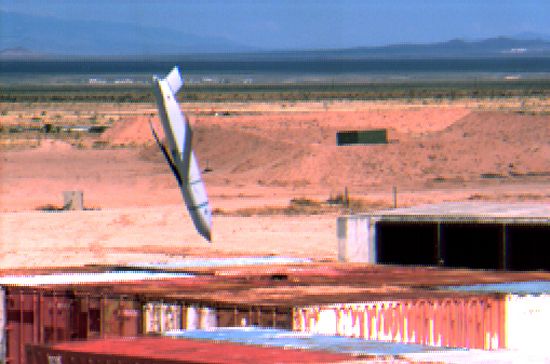
 

JASSM about to hit a steel reinforced concrete target. In this case the whole missile is in the end run. But it is also possible that the warhead could detach and be rocket propelled to higher Mach speeds shortly before it hits a target.
---
 
If the missile is less advanced and more publicized it may be a version of the stealthy, turbojet, cruise missile AGM-158 JASSM (Joint Air-to-Surface Standoff Missile) that has been slightly reduced in size to fit inside an F-35. Deploying such a JASSM externally on hardpoints is considered to adversely effect the F-35's stealth profile.

The JASSM is now coming into service with the USAF and Australian Airforce (RAAF).  It may be that the JASSM, nominally considered subsonic, is actually supersonic if it incorporates the type of engine technology used to power the "super cruise" F-22 Raptor.

There may be an end run for the JASSM where the warhead detaches and then accelerates into the high supersonic to hypersonic range. Such acceleration in a vertical dive might be heavily reliant on a rocket motor. Given some artillery shells now have rocket assist the incorporation of such a feature in the JASSM's 450 kg (1000 lb) WDU-42/B penetrator warhead is quite possible.

----------------


A third possibility is a mixed propulsion missile equivalent to the already developed Indian-Russian BrahMos. The majority of flight for such a missile may be subsonically perhaps using a turbojet, then alter its flight profile moving to a high supersonic or hypersonic end run powered by a ramjet, scramjet or rocket engine. See this article from Defense Update of February 6, 2013 "Aero-India 2013: The Indian Air-Force Plans to Induct BrahMos by 2015" concerning deployment of BrahMos including air-launching it from India's Su-30MKI fighter-bombers  http://defense-update.com/20130206_the-indian-air-force-plans-to-induct-brahmos-by-2015.html .

Higher velocity in all three missile possibilities provides a greater element of surprise, with it increased survivability as its harder to shoot down a faster missile - with reduced time for the target to deploy flares or other decoys. A faster missile also has higher kinetic energy to penetrate earth/rock/concrete (or a ship's hull) more deeply.

High kinetic energy would be particularly sought after by the US and Israel with regard to Iran's (and perhaps North Korea's) deeply dug in nuclear sites.

-----------------------

What caught my eye was a transcript of Four Corners "Reach for the sky" documentary on Australia's ABC, February 18, 2013 http://www.abc.net.au/4corners/stories/2013/02/18/3690317.htm :

"[civilian presenter] ANDREW FOWLER: And it's even got a weapon that's a closely guarded secret.

LT. GENERAL CHRIS BOGDAN, EXECUTIVE OFFICER, F-35 JOINT PROGRAM OFFICE: Those are the crown jewels of the program and that's what makes the F-35 special.

ANDREW FOWLER: So asserting that to the public, it's really saying 'trust us'?"

--------------------------------------

I then spotted the following article: Wired - Danger Room June 7, 2012 reports http://www.wired.com/dangerroom/2012/06/hypersonic-missiles/ :

"Air Force Wants Hypersonic Missiles for Stealth Jets"

"For decades, the military has tried — with little success — to build missiles capable of traveling at breakneck, hypersonic speeds. Missile tests, however, have been uneven, with repeated failures punctuated by the occasional stunning success. Now the [US] Air Force is taking a bigger role by seeking to build another hypersonic missile, this time for its stealth fighter jets.

The Air Force’s desired “High Speed Strike Weapon” would travel at five times the speed of sound or faster, theoretically launching from a stealthy F-22 Raptor jet or a future F-35 Joint Strike Fighter, and traveling so fast and at such long distances as to render an enemy’s anti-aircraft systems defunct. The Air Force’s Research Laboratory Munitions Directorate is gathering possible design partners later this month at Elgin Air Force Base in Florida before any solicitation. According to an Air Force notice, whatever prototype gets built will ultimately need to strike “time-critical” targets — on the move, possibly — from “tactically relevant standoff distances.”

If it can be done, the weapon will “be representative of an air-breathing hypersonic missile system” that can tough it out in “the most stringent environments presented to us in the next decade,” said Steven Walker, the Air Force’s deputy assistant secretary for science, technology and engineering, in written testimony to the House Armed Services Committee in February.

That’s the hope, at least. The U.S. military has a mixed record with hypersonics. Last August, the Pentagon’s pizza-shaped Falcon Hypersonic Technology Vehicle 2 failed for a second (and likely final) time, crashing into the Pacific during a test flight.

But the Army’s Advanced Hypersonic Weapon did much better during a test in November. Two years ago, the Air Force successfully flew its X-51 WaveRider scramjet missile http://www.wired.com/dangerroom/2007/06/mach_5_missile_/ at speeds of Mach 5 for 200 seconds after launching it off a B-52 bomber. A later test, though, ended with engine failure.

...There are other technical challenges in launching a scramjet missile from a fighter jet instead of a sub-orbital rocket or a B-52, though. It’ll still need to have air-breathing engines that compresses the air around the missile into a supersonic mixture of oxygen and fuel — absent a turbine.

But it will also need to be small enough to be carried by a jet fighter while carrying the necessary advanced navigation controls, precision guidance tools and sophisticated sensors, plus the warhead. The service will also still have to find the right mixture of composite materials like titanium and tungsten (among others) to hold up under the enormous heat generated by Mach 5, Mach 6 and even faster flight.

The Air Force is requesting a whopping 150 percent increase in funding for the program, from $6.2 million now to $15.4 million in 2013 in one “thrust” of weapons development, according to subscription-required InsideDefense. That’s a lot of money for a missile that may not work."

COMMENT

The sales strategy for the F-35 may therefore be heavily reliant on the missile that comes with the sale - if that missile already exists or can be completed by 2018.

Pete

February 23, 2013

Hyderabad bombings


"Hyderabad bomb investigators examine links with Islamist militant group"

At least 12 people have been killed and many injured in Thursday, February 21, 2013's two bomb attacks in the southern Indian city of Hyderabad. Hyderabad, a city of 10 million in the state of Andhra Pradesh, is a hub of India's IT industry and has a mixed population of Muslims and Hindus.”

Authorities were examining whether the Indian Mujahideen, thought to have a link with militants in neighbouring Pakistan, might have carried out the attack, said an investigator, speaking on condition of anonymity.

India's recent execution of an Islamic militant is being examined as a possible motive for the bombings, he said. [that was “the hanging of Mohammed Afzal Guru, a Kashmiri militant killed nearly two weeks ago. He was executed for his involvement in a 2001 attack on India's parliament that killed 14 people, including five gunmen.”]

Police have not yet detained anyone in connection with Thursday evening's attacks, the first major terrorist bombings in India since 2011.

…The bombs were attached to two bicycles about 150 metres (500ft) apart, Shinde said. He said, in addition to the dead, 119 others were injured. WHOLE ARTICLE.


Australia's ABC News, February 22, 2013 reports:

"Cricket Australia monitoring safety in Hyderabad"

Cricket Australia (CA) is denying reports the team will refuse to travel to next week's second Test against India in Hyderabad following bombings in the city.

WHOLE ARTICLE

February 20, 2013

Yuri Dolgorukiy first of the Borey Class SSBNs Enters Service


Click on image to enlarge
-
 

The Yuri Dolgorukiy SSBN, lead vessel of the Borey Class, in port.
 

Since the end of the Soviet Union in 1991 the construction of new Russian SSNs and SSBNs has been severely constrained by lack of money, movement of skilled labour to other industries or overseas and a consequent partial loss of "corporate knowledge" on how to develop new submarines  and new ballistic missiles.

With Yuri Dolgorukiy  now in service this may indicate the Russian submarine industry is reviving. Nevertheeless open sources are unable to reveal essential elements, such as the effectiveness of submarine sensors, SLBM stealth and the quality and morale of submarine crews.

 Customers like India have been essential in injecting money into Russian submarine programs - particularly of the Akula class SSN.

Ten Borey Class SSBNs are planned. Less numerous than the 18 submarine US Ohio Class . The future US SSBN-X Class, with only 12 planned, follows the trend towards fewer SSBNs with fewer SLBMs.

Because the Yuri Dolgorukiy is the lead vessel of the Borey Class it is also known as the Dolgorukiy class after the name of the lead vessel

The Voice of Russia, January 22, 2013 reports: http://english.ruvr.ru/2013_01_22/Borey-class-nuclear-powered-ballistic-missile-submarine-Yuri-Dolgorukiy-will-provide-Russia-with-effective-nuclear-deterrent/ :
 
"Borey-class nuclear-powered ballistic-missile submarine Yuri Dolgorukiy will provide Russia with effective nuclear deterrent"

 On January 10th Russia’s next-generation 'Borey'-class nuclear-powered ballistic-missile submarine (SSBN) 'Yuri Dolgorukiy' officially entered service with the Russian navy’s Northern Fleet.

Professor Thomas Fedyszyn, the Chair of the Europe-Russia Studies Group in the US Naval War College, suggests that the development of 'Boreys' is the first crucial step in Russia's attempts to modernize and revitalize its aging military-industrial complex. As a first move towards modernization, the production of new submarines is likely to encourage construction of other sophisticated machines which will be able to protect Moscow's economic interests in the Arctic.Equipped with the most advanced weaponry, the new submarine will also provide Russia with an effective nuclear deterrence capability. Crucially, while the might of the new submarine cannot be underestimated, the expert argues that for the moment 'Boreys' should not be viewed as Moscow's bid for naval dominance nor a threat to the NATO." WHOLE ARTICLE
Pete

February 18, 2013

Iran involved in North Korean nuclear test?

 
It is unclear what Mohsen Fakhrizadeh-Mahabadi (the "father of Iran's nuclear program") looks like. Is this him?
 -
The following article might be balanced or might be a way for Israel to leverage North Korea's nuclear test to maintain fears of a nuclear Iran. The Jerusalem Post, February 2013 (drawing on a UK Sunday Times article) reports http://www.jpost.com/IranianThreat/News/Article.aspx?id=303499 :

'Iranian nuclear chief observed Korean nuke test'

Western officials say Mohsen Fakhrizadeh-Mahabadi is believed to have been in N.Korea for test, 'The Sunday Times' reports [ http://www.thesundaytimes.co.uk/sto/news/world_news/Middle_East/article1215608.ece ].

The alleged father of Iran's nuclear program, Mohsen Fakhrizadeh-Mahabadi, is believed to have been present in North Korea last week in order to observe its third nuclear test, Britain's The Sunday Times reported citing Western intelligence sources.

According to the sources, Fakhrizadeh-Mahabadi was responsible for the development of a warhead "small enough to fit on to one of the ballistic missiles developed by Iran from North Korean prototypes," the report stated.

...The report echoes comments made earlier in the week by a security expert that the nuclear test may have also been carried out on behalf of Iran, and in the presence of Iranian atomic scientists.

...It remains unclear whether the North Koreans detonated a plutonium- based nuclear device or one that was based on enriched uranium on Tuesday. The latter option would further suggest increased cooperation with Iran, he added...."

A broader Israeli commentary on Iran's nuclear program is here http://www.debka.com/article/22771/US-plan-for-UN-to-endorse-Khamenei%E2%80%99s-fatwa-Shock-in-Jerusalem
-
Pete

February 13, 2013

North Korea's 3rd Nuclear Test - 6 to 7 Kilotons

Click to expand.

At an estimated 6 to 7 kilotons (a kiloton being the explosive equivalent of 1,000 tons of TNT) this 2013 test represents North Korea's second probably successful nuclear test. The first (2006) test of less than one kiloton, is widely considered to have been a "fizzle". Fizzle means not a full or correct fission of explosive material producing a lower yield than expected (in this case by North Korea).

The second (2009) test of a Plutonium device is considered North Korea's first successful test. The third (2013) test is believed to have the added degree of difficulty of being a miniaturized (warhead size) device. This third test may also have added significance if it was  North Korea's first test primarily using Highly Enriched Uranium (HEU eg. 80%+ U235).

The South Korean Defense Ministry estimated a yield of 6 to 7 kilotons (based on US-South Korean seismic monitoring) http://abcnews.go.com/International/north-korea-nuclear-test-highly-provocative-obama/story?id=18474237.

This article indicates the difficulty of measuring yield http://lewis.armscontrolwonk.com/archive/6288/making-yield-estimates#more-3242 . There needs to be considerable discussion and compromise between various yield estimates, from different locations, using differing sensors-sources to arrive at an agreed and always approximate yield range.

More complete data on yield, Plutonium or HEU and possibly other nuclear device characteristics might be available from the US - based on various collection methods, including WC-135 Constant Phoenix (see aircraft and basing details below). One or more WC-135 Constant Phoenix aircraft might need to fly from Nebraska, collect air samples in North Korea's region and assess the air samples back in Nebraska to provide more publicized data.

Although the test was underground minute amounts of explosive gases and dust (from vents or blast doors and seals when opened) will enter the atmosphere permitting collection and analysis. Data from US (and perhaps Chinese, Russian and South Korean) satellite, drone and other aircraft data would be crossed checked with ground and ship based data to reach estimates as to the explosive yield, in kilotons, for the 3rd nuclear test. Also type of chemical explosive (such as Plutonium and/or Highly Enriched Uranium, Tritium?) used and perhaps physical size of the nuclear device (bomb).

WHY HAS NORTH KOREA HELD NUCLEAR WEAPON TESTS?


Most nuclear powers carry out several weapons tests to evolve devices into reliable weapons, under different environmental conditions, using differing explosive types (Plutonium, HEU, boosted fission, on the way to fusion (thermonuclear) weapons). Testing is also to explore different weapon delivery methods requiring differing warhead characteristics. For North Korea (NK) warheads would differ for ballistic missiles, free-fall jet aircraft delivered bombs, cruise missiles, maybe artillery shells, perhaps bombs wired into submarines or torpedoes or in shipping containers,

Reasons why NK is going nuclear at all may include:
- prestige/pride for NK as a nation, regime and God-leader under otherwise barely legitimate rule. Illegitimacy (no right to rule) includes NK being unable to look after (e.g.. feed) its own people and not allowing non-Kims to choose a leader outside of the Kim dynasty
- deterrence against all the countries that have traditionally invaded it over past millennia-decades, including Russia, Japan, China and more recently the US and South Korea.

- as a counterweight to the conventional superiority of the militaries in the above countries.

NK is clearly odd that it is not one part of a symmetrical, Mutually Assured Destruction (MAD) relationship unlike what the US-Soviet Union used to be and perhaps the relationship of India-Pakistan now.

Given NK's massive poverty as a nation there is also puzzling irrationality as to how it relies on nuclear blackmail as its main foreign policy - to coerce aid and diplomatic backdowns from surrounding countries and Great Powers?
 
CONTEXT ON THE EARLY SEISMIC ESTIMATES OF YIELD

There are many classified sources and methods to estimate yield but seismic measures http://en.wikipedia.org/wiki/Seismometer are usually the methods that are publicly cited. One reason is that these measurements of vibration appear to be intuitive. Another reason is that seismic measuring equipment is usually commonly available civilian equipment used for measuring earthquakes, volcanic activity and other natural phenomena. See http://www.examiner.com/article/north-korea-tests-nuclear-weapon-underground-recorded-on-usgs-seismographs  which indicates:

"The United States Geological Survey (USGS) recorded a 5.1 tremor on the Richter Scale in North Korea early Tuesday in what was first believed to be, and later confirmed, an underground nuclear weapon test by the North Korean government. The country's previous tests, carried out in 2006 and 2009, were substantially smaller."

"The explosion was recorded by USGS seismographs about 24km (15mi) ENE of Sungjibaegam, North Korea at a very shallow depth of less than 1 km. [next bit very significant] The USGS later changed the classification of this event to a nuclear explosion based on Ambassador Rice's statements at the United Nations Security Council Stakeout."

Some details on a USGS website here http://earthquake.usgs.gov/earthquakes/eventpage/usc000f5t0#summary

[My Commeents] Complicating the public release of info is that the USGS would probably send the CIA/State Department/White House more information than is publicly available.

The USGS seismic data (and more seismic data from CIA's and US military's own seismic sensors) would be mixed with information from other air/sea/land/space sensors and data passed by other countries (eg. China, Russia, Japan) before public statements by US and South Korea are made.

Then, I imagine, additional data will arrive and then meetings held (in the US and between Six Party Talks as well as between UN Security Council members) on how much information to release and when. These ongoing processes will generate new or altered public announcements over the next few days, even weeks.

Judging by minimal mention of North Korea in the State of the Union Address it seems the US doesn't want to glorify this new North Korean "achievement". So much information may be long delayed.


TWO OF THE AERIAL SENSORS

Much depends on atmospheric and other nuclear data collected by:
- US RQ-170 Sentinel (stealth) drones
 which are reportedly working in or for the 5th Reconnaissance Squadron at Osan Air Base. This base is a USAF facility located in the Songtan section of Pyeongtaek City, South Korea, 64 km (40 mi) south of Seoul. Such drones would fly just outside of North Korean airspace to collect radioactive cloud (and other chemical reaction) air samples.
See http://www.nytimes.com/2011/12/08/world/middleeast/drone-crash-in-iran-reveals-secret-us-surveillance-bid.html?_r=0  [In relation to Iran and also North Korea] "American satellites have been trained on...nuclear facilities. But the RQ-170 Sentinel, which can fly at an altitude of 50,000 feet, is considered vital to the effort. While an orbiting surveillance satellite can observe a location for only a few minutes at a time, a drone can loiter for hours, sending a video feed as people move about the site. Such a “pattern of life,” as it is called, can give crucial clues to the nature of the work being done, the equipment used and the size of the work force. …In addition to video cameras, independent experts say the [RQ-170 Sentinel] drone almost certainly carries communications intercept equipment and sensors that can detect tiny amounts of radioactive isotopes and other chemicals that can give away nuclear research.
News reports in South Korea in 2009 said the United States planned to base the RQ-170 drone there to fly surveillance missions over North Korea, whose nuclear and missile programs are a top American intelligence target."
-  the WC-135 Constant Phoenix
Background - The US Boeing 707 sized WC-135 Constant Phoenixs are all in the USAF's 55th Strategic Reconnaissance Wing based at Offutt Air Force Base, Nebraska, USA. The WC-135 collects samples from the atmosphere for the purpose of detecting and identifying nuclear explosions. It is also informally referred to as the "weather bird" or "the sniffer" by workers on the program….The Constant Phoenix’s modifications are primarily related to the aircraft's on-board atmospheric collection suite, which allows the mission crew to detect radioactive debris "clouds" in real time."
-
Pete