June 9, 2020

China's Electronic Mass Surveillance System in Hong Kong Soon: Part 2

In addition to 91 million Communist Party members who, at the human intelligence level (humint) level, are required to report disloyalty to China's Ministry of State Security China has a vast electronic/internet mass surveillance system. Much of this effort is in Hong Kong already, but the new security laws will make coverage even more intense.

1. 
"Mass surveillance in China is the network of monitoring systems used by the Chinese Communist Party to supervise the lives of Chinese citizens.[1] It is primarily conducted through the government, although non-publicized corporate surveillance in connection with the Chinese government has been speculated to occur. China monitors its citizens through Internet, camera as well as through other digital technologies.[2][3] Mass surveillance in China is closely related to its Social Credit System, [see flow chart below at 2. ] and has significantly expanded under the China Internet Security Law and with the help of local companies like Tencent, Dahua Technology, Hikvision, SenseTime, ByteDance,[4] Megvii, Huawei and ZTE, among many others.[5][6][7][8][9][10][11][12] 

As of 2019, it is estimated that 200 million monitoring CCTV cameras of the "Skynet" system have been put to use in mainland China, four times as many surveillance cameras in the United States.[2][13][14] By 2020, the number of surveillance cameras in mainland China is expected to reach 626 million.[15][16][17]"

In connection with camera surveillance, the Chinese government is developing a social credit system that rates the trustworthiness of [Chinese and soon Hong Kong] citizens by analyzing their social behaviors and collecting fiscal and government data.
[79][80][81] After capturing people's activities and identifying them through facial recognition techniques, the government links their activities to this personal credit rating so that the information is stored in a quantifiable and measurable way. 

Under this algorithmic surveillance system, people, their identities, and their actions are connected to a citizen score.[82] By utilizing information gathered about the citizens' activities captured by cameras and analyzing them with AI and data mining techniques, the state calculates and updates their citizen scores regularly. 

Participation in this system is currently voluntary but will become mandatory in 2020.[3][80][82] Many Chinese citizens have already started using the Sesame Credit created and operated by Alibaba, an e-commerce company.[82] The Sesame Credit is designed such that those with good credit scores can live a more convenient life than others with low credits scores.[3][80] For instance, people with high credit scores do not need to pay deposits when checking in at hotels and can obtain visas more quickly than others.[79][80] On the other hand, people with low credit scores cannot easily eat in restaurants, register at hotels, purchase products, or travel freely.[79][80]"

MORE SEE https://en.wikipedia.org/wiki/Mass_surveillance_in_China

____________________________________________________

2.

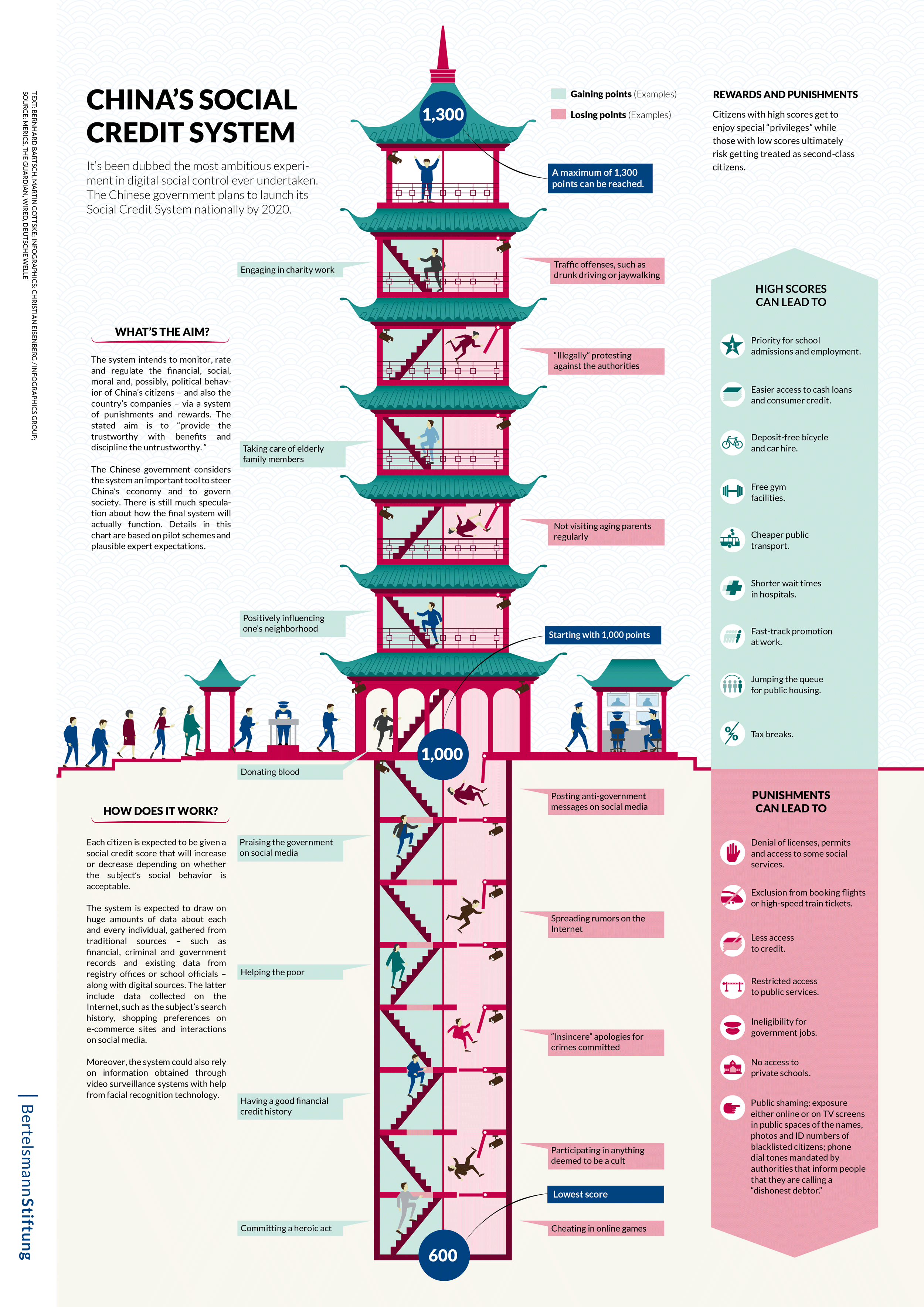
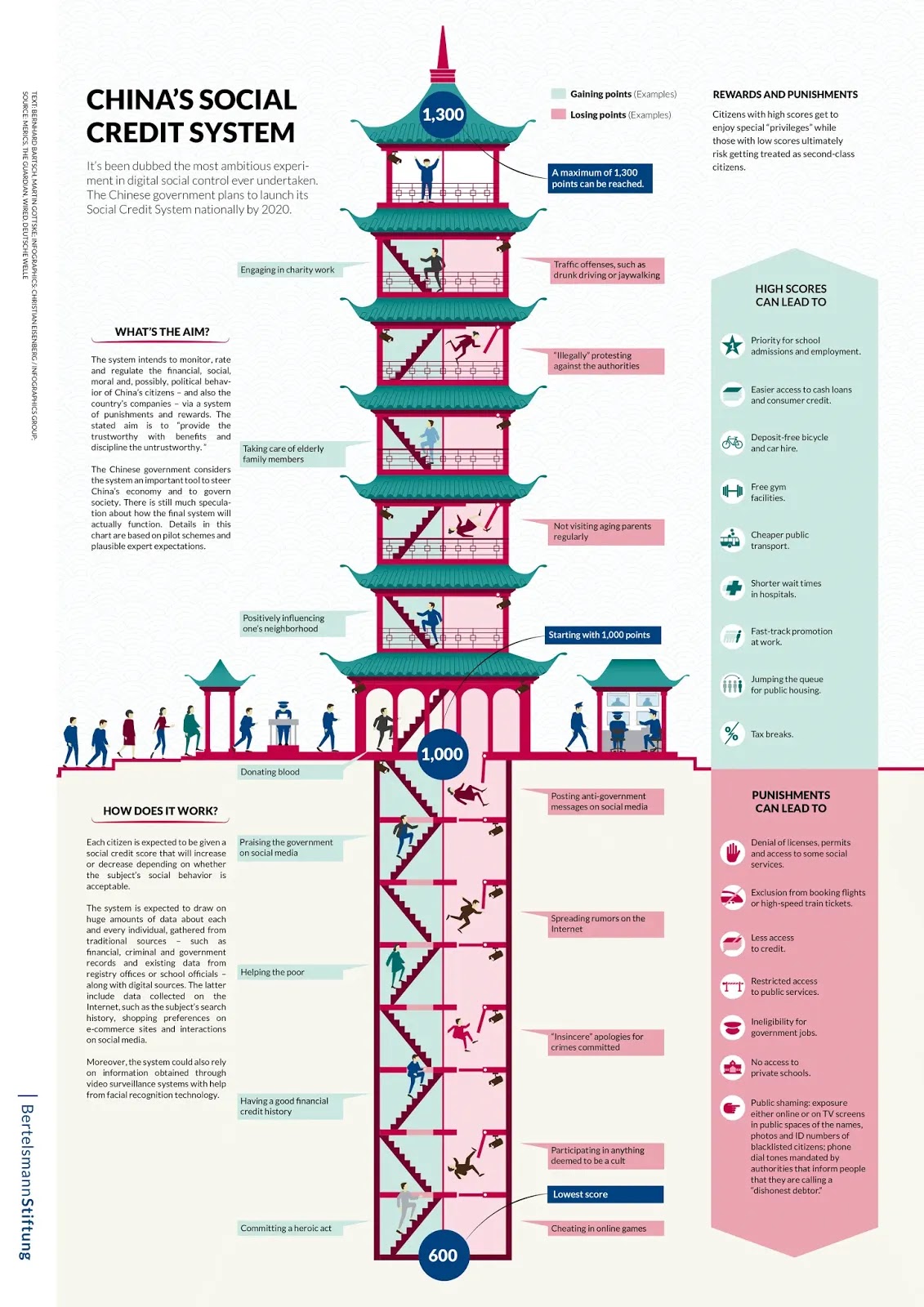
China's Social Credit System, including Travel Ban and other restrictions. Click here to vastly expand image so its readable. (Image courtesy https://nhglobalpartners.com/chinas-social-credit-system-explained/ ).

Scary!!

How to Start World War Three, in South China Sea.

https://edition.cnn.com/2020/06/07/asia/china-malaysia-indonesia-south-china-sea-intl-hnk/index.html

"...The Malaysian-authorized drill ship, the West Capella, was looking for resources in waters also claimed by Beijing, when a Chinese survey vessel, accompanied by coast guard ships, sailed into the area and began conducting scans, according to satellite images analyzed by the Asia Maritime Transparency Institute (AMTI).

Malaysia deployed naval vessels to the area, which were later backed by US warships that had been on joint exercises in the South China Sea..."

June 8, 2020

Chinese Civilian Security & Intelligence in Hong Kong: Part 1

Following on from China’s military spying on people in Hong Kong there are many more civilian intelligence employees and their informants doing the spying. Their targets include:

-  of course, current and former protesters who might retrospectively be charged with
   breaking the new security laws when enacted in a few weeks/months

-  anti-communist, pro-democracy figures (even if they haven’t attended a protest), and

-  those who have been recorded in contact with foreign representatives in Hong Kong,
   especially those Hong Kongese observed talking to or “receiving orders from” the
   US Consulate General in Hong Kong

The peak Chinese civilian external intelligence and internal security agency is the Ministry of State Security (MSS) whose public website (even in English) is here (at https://www.12339.gov.cn/.
 "12339" appears to be the MSS phone number that Chinese citizens can call to inform on somebody! So even if many in Hong Kong see themselves as separate from China they can still be monitored by MSS. To be precise monitored by MSS area Bureau No. 4 and by MSS Bureau No. 14 (responsible for "inspecting mail and telecommunications" which would work with, of be part of, China's NSA.)

Hong Kong in light green and only 1,104 square kms in size, has many islands and borders mainland China. Shenzhen can be seen just over the border. (Map courtesy TravelChinaGuide . com)
---

MSS officers in Hong Kong (population 7.5 million) no doubt number in their thousands. Many more may commute daily from the neighbouring city of Shenzhen (population 24 million). Also Hong Kongese can be monitored from MSS/Chinese NSA officers working at more remote surveillance terminals in Beijing, Shanghai or any other mainland Chinese area.

Pete

June 5, 2020

Chinese Military Security & Intelligence Already in Hong Kong

China's one party Parliament in Beijing decided on May 28, 2020 to apply China's national security laws to Hong Kong. This is unsurprising as I predicted on July 2, 2019 that this may happen, saying:

"Perhaps a broader circle of democracy activists in Hong Kong will also be arrested. The Beijing Government can suspend the legal convention that the PLA cannot interfere in Hong Kong's internal affairs. This is because the PLA has always had an underlying or active role in internal security for all regions of China." 


National security laws in most developed countries, including China, cover 4 categories:


-  terrorism, 
-  foreign interference, 
-  secession and 
-  generally subversion. 

Secession and subversion would include undermining the authority of China. even including insults to the National Anthem. 


Apart from the obvious police presence what most people inside and outside Hong Kong don't know is that China already draws on 10s of 1,000s of people including military/PLA (see below) and civilian agencies (I'll discuss them on Monday). 

Some are inside Hong Kong and even more outside (operating remote security technology that focusses on Hong Kong) to address the 4 categories.

China’s Armed Forces Garrison in Hong Kong


The People's Liberation Army's (PLA's) Hong Kong Garrison has more than 12,000 men headquartered in the PLA’s 28 storey Hong Kong Building (aka the “Prince of Wales Building” (image below courtesy "Exploringlife")) in the center of the city. 


The Garrison previously concentrated on external defence but under Beijing’s legal changes will grow significantly and with an internal security mission – especially against protesters.

Elements of the Garrison include:


-  Army (infantry, artillery, special operations commandos, armoured vehicles (with machine guns) and (significantly) an “intelligence gathering battalion”. That intelligence gathering battalion may supply some of the manpower for China's NSA to monitor landline communications/internet and mobile phones in Hong Kong, undersea cable traffic going through entering/leaving and satellite communications.

-  
Navy, and

-  
Air Force (especially helicopters carrying troops, sensors and door gunners).

The Garrison is under direct leadership of Beijing’s Central Military Commission. The Garrison's local commander is Major General Chen Daoxiang (2019–present) and the Garrison’s essential Political Commissar is Major General Cai Yongzhong (2018–present who makes sure the PLA loyally carries out the Communist Party's commands).

More about Hong Kong's civilian security intelligence apparatus on Monday.

-----------------------------------------------------------------------------------------------

In scenes intentionally evoking the cannot-be-talked-about Tiananmen Square Massacre is the Video above which includes:

0 to 40 seconds in     - dark, forbidding music, footage of PLA troops firing assault rifles, aiming a
                                    
handgun, firing sniper's rifle

40 to 58 seconds       - anti-riot drill against student-like "protesters"

58s - 1min 25 secs    - armoured cars (can be called "wheeled armoured personnel carriers") crushing
                                    
barricades, barbed wire, water canon, protesters herded under guard, 14.5mm
                                    heavy 
machine guns, more armoured cars

1min 25secs to 2min - off on tangent showing PLA's naval, attack helicopter, artillery-missile and
                                     anti-aircraft might


2min 2secs to the End - happy music, the peaceful alternative of military parades in front of
                                      appreciative, patriotic, cheering crowds and PLA civil assistance roles,
                                      raising flag, gaily goose-stepping.

June 2, 2020

British submarines "spied on" Northern Ireland

HMS Cachalot 
---

Flowing from yesterday’s article here is a rare case of country carrying out operational submarine surveillance of its own territory.

The account below was published at Spanish language website https://www.elsnorkel.com/ on May 10, 2020 at the link https://www.elsnorkel.com/2020/05/operaciones-especiales-submarinos-britanicos-conflicto-Irlanda.html

It was written in Spanish by  Law Professor Mariano Sciaroni [his details are below the article] from Argentina and translated into English at Submarine Matters. Pete has added a large number of links with additional explanation.in square [brackets]. 

“Special Operations British submarines in the Northern Ireland conflict.”

“In the early days of 1975, an order from the Clyde [Submarine] Naval Base (Flag Officer in Scotland and Northern Ireland - FOSNI in charge of operations) arrived at HMS Cachalot (a Porpoise class diesel-electric) submarine, to bring on board special forces for a mission. The code name for the Operation was Awless.”

The conflict in Northern Ireland [known as “The Troubles” for public relations reasons and to avoid  the "war" exclusion that would have rendered Northern Irish property insurance policies valueless!] was in full swing in the mid-1970s. It must be remembered that the warring factions were the unionists (mostly Protestants), who wanted to remain tied to the United Kingdom and, on the other hand, the republicans (Catholics), who were a minority in the population and advocated an independent Northern Ireland. and/or uniting it with the Republic of Ireland.

In 1969 the British Army had intervened (within the framework of Operation Banner), which was initially received as a guarantor of peace against the various armed arms of the opposing communities. However, the deaths of unarmed civilians by 1 PARA (1st Battalion, Parachute Regiment) on “Bloody Sunday” (January 30, 1972) had led to a rejection by the Republican population of what was quickly considered a [British Army] force of occupation and [which “backed’ the Protestant unionist cause]. This led to increased Catholic support for the Provisional Irish Republican Army (PIRA).

In a complex conflict, Operation Granada (a code name for patrols of Royal Navy and Royal Marine elements in support of army units) began to gain its own momentum. Their presence in the vicinity of the Northern Irish coast had a dissuasive purpose in general, but also a concrete utility, which was to prevent weapons, ammunition and explosives from reaching the [Protestant and Catholic paramilitary] combatants by sea.

British submarines were no strangers to that operation.

HMS Cachalot (SSK), Operation Awless, Jan 1975

“In the early days of 1975, an order from the Clyde [Submarine] Naval Base (Flag Officer in Scotland and Northern Ireland - FOSNI in charge of operations) arrived at HMS Cachalot a Porpoise class diesel-electric submarine (SSK), to bring on board Special Boat Service (SBS)
commandos for a mission. The code name for the Operation was Awless.”

Intelligence had been received information that the PIRA was planning to land weapons on the coast in the near future, with indications of the possible areas where this would occur.

The orders received implied that the HMS Cachalot had to set sail with 6th Squadron Special Boat Service (SBS) commandos, who would disembark from January 11, 1975 near Torr Head in three small canoes (or kayaks) and would be recovered on the January 16, 1975 in the vicinity from Garron Point. The submarine was to remain in the vicinity until the SBS commandos returned. The operation was extremely secretive (this was emphasized at all times) but, as the PIRA was deemed to lack the ability to intercept electronic emissions, the discreet use of the submarine's radar was authorized.
A Sea King helicopter section of the 819 Naval Air Squadron would be on alert for any problems that might occur during the operation.

Once ashore, the commandos were to analyse possible enemy landing zones in the area (Group X, four men), as well as establish an observation post (Group Y, with the two remaining men).

HMS Cachalot finally set sail from its usual base in Faslane, Scotland, without further complications and, after a short navigation, arrived at the area of operations at night on January 11, 1975. There, at a distance, HMS Cachalot made a first distant reconnaissance of the landing area (on the surface and without navigation lights), with the SBS commandos observing the coast with their [then rare] night vision goggles and, just later, a periscope reconnaissance was carried out at a very short distance (less than a mile from the coast).

However, the bad weather and a rough sea complicated the kayak launching phase (which was carried out with HMS Cachalot on the surface), making it clear that the launches needeed to be made at two different points off the coast.

While the Group Y kayak was able to be launched in marginal conditions and HMS Cachalot headed for its next launch point, the first of the Group X kayaks rolled over. The mission having to be temporarily aborted until the kayak and the men were recovered. The weather was so bad that it was only possible to disembark the members of Group X on January 14, 1975 at 23.54 hours (London time). HMS Cachalot withdrew from the shore, remaining submerged.

The recovery phase, which had been postponed to the early hours of the January 17, 1975, was not easy either. HMS Kirkliston a Royal Navy Ton class minesweeper almost collided with HMS Cachalot when he at periscope depth. HMS Kirkliston was not alerted to the presence of HMS Cachalot or the SBS, and (such was the secrecy) that the sub and SBS were not authorized to contact HMS Kirkliston. Problems from the SBS on the ground led to only two kayaks showing up to be picked up by HMS Cachalot. Meanwhile the remaining members of the SBS patrol were exfiltrated by ground means (ie. they hitched a ride with a surprised civilian who drove by in a vehicle! :).

Despite all these problems (including that one of the SBS had to be hospitalized with “Trench foot”), HMS Cachalot’s commander considered the mission "very successful".

The Submarine Force Commander (FOSM) had the same opinion, but he also indicated that many of the dangers faced could be avoided in the future by having his submarines with an image intensifier in the periscope (such as it was being developed for the Swiftsure-class nuclear attack submarines (SSNs)) and thus be able to carry out shoreline reconnaissance at night.

The Force Commander's appreciation was quickly received and the Oberon-class submarine (successor to the Porpoise class) HMS Osiris was entrusted to conduct a patrol with an image intensifier in late July 1975.

HMS Osiris (SSK) Operation Artelot, July 1975

The January 1975 Operation had been codenamed Awless, but the Commander-in-Chief of the Fleet quickly asked for a name change for post January operations to Operation Artelot, to avoid confusion.
However, Operation Artelot was doomed from the start. The radio equipment on the HMS Osiris and the communications plan were deficient, without a direct channel of communication with military or police forces that could immediately exploit the intelligence the submarine obtained.

HMS Osiris arrived at the area of operations on July 24, 1975 and began to carry out reconnaissance and surveillance of the coast, using the two periscopes (observation and attack) at night and sporadically using the [thinner, therefore harder to see by arms smugglers] attack periscope during daylight hours. The [relatively new, therefore problem prone] night vision equipment was deficient, only being able to detect a darkened target within 1,000 yards. In all cases, the MAE [surveillance?] equipment was also exposed, as well as [any weapons smuggler] HF and VHF communications monitored.

It is worth adding that HMS Osiris withdrew from the coast in the afternoons on the July 25 and 26, 1975 to recharge batteries using its snorkel.

The only suspicious contact occurred at 21.00 (9pm London time) on July 27, when two small motor boats were detected in the vicinity of Red Bay and, although at first they were taken to be fishermen, a second glance found that they had no fishing equipment. Also, a small white light came from the shore, appearing to be a signal to the two motor boats.

But the boats were already long gone when a message from HMS Osiris was received by military and police forces informing them of this rare situation. HMS Kirkliston was sent to investigate, but it was too late.

However, being a moderately successful operational concept, the mission was repeated between November 16 and 18, 1975, using the submarine HMS Opossum [another Oberon class sub]. But HMS Opossum had the same problems with communications as its twin HMS Osiris.

[Despite clearly little progress...] By the end of 1975 (which had turned into a particularly bloody year in the Northern Ireland conflict), the Flag Officer Submarines (FOSM) Force Command considered such patrols to be an "appropriate use of resources", recommending to the commander in command of the fleet to continue with them, even to the detriment of other scheduled operations.

HMS Cachalot returns, Operation Aver, Jan 1976

HMS Cachalot was then appointed again for a new covert surveillance patrol to prevent arms and explosives trafficking in the conflict zone. As an improvement on the two previous operations, emphasis was placed on the security and speed of communications with the various ground units. This was achieved by mounting a radiotelephone on the submarine.

In this way, Operation Aver started January 1976. HMS Cachalot did not have important contacts, despite the fact that it monitored several merchant ships and the fishing fleet that operated in the vicinity of its designated area. HMS Cachalot had the support of the Ton-class minesweeper HMS Bildeston. 

The communications did not fail, and the reports of those involved mention the improvement in the command and control of operations, as well as that the coordination worked perfectly. FOSNI considered that Operation Aver "successfully tested the changes recently introduced for the command and control of submarines used in support of Operation Grenada." Submarine missions in support of Operation Grenada continued until the late 1970s and possibly later.

An interesting use of submarines for coastal surveillance, in the context of a low intensity conflict.
A lesson for the present and future.

Mariano Sciaroni is a lawyer, has a Master's in Strategy and Geopolitics and a postgraduate course in Contemporary Military History from the Argentine Army's Superior War College. He is also a member of the Argentine Institute of Military History. He is professor of procedural law at the Faculty of Law of the Argentine Catholic University and Reserve Lieutenant of the Argentine Army. He has published two books and dozens of articles on military history, published in Argentina, the United States, the United Kingdom, Germany, and Russia. [and, of course, is a Contributor to elSnorkel . com]
More Mariano Sciaroni Articles here.   Email: marcantilan (a) yahoo.com.ar 

A short account of HMS Cachalot, the SBS and Troubles surveillance is here.

June 1, 2020

Disruption of 1970s US & USSR Arms Supplies to Provisional IRA

With relevance to tomorrow's Submarine Matters’ article:

“Provisional Irish Republican Army arms importation into Ireland for use in Northern Ireland began in the early 1970s. With these weapons it conducted an armed campaign against the British state in Northern Ireland. 

In the early stages of the Troubles, during the period 1969–1972, the Provisional IRA was poorly armed. They had access to weapons remaining from the IRA's failed Border Campaign between 1956 and 1962, but these weapons were outdated and unsuitable for a modern campaign.

To continue and escalate their armed campaign, the IRA needed to be better equipped, which meant securing modern small arms.

The IRA's main gun runner in the United States was George Harrison [not a Beatle of course], an IRA veteran, resident in New York since 1938...In 1971, the Royal Ulster Constabulary (RUC) had already seized 700 modern weapons from the IRA, including 2 tonnes of high explosive and 157,000 rounds of ammunition, most of which were of American manufacture.”

The FBI did much to arrest and disrupt US citizen exports of arms by sea to the IRA in Northern Ireland.

Other exports by sea to the IRA came from a complex network of suppliers including USSR and East German intelligence services using, or working with, Middle Eastern and Western Euro-terrorist cut-outs. The USSR considered aid as one way of boosting the USSR’s international revolutionary  credentials. USSR aid also weakened (if ever so little) the armed forces of a key NATO country (Britain). USSR aid further complicated the British Government’s prolonged, overall poor political record in Ireland.

The British Army was the largest and most visible British regular armed force fighting in the Troubles but the Royal Navy also played a part, little discussed in English - until tomorrow.