August 20, 2013

Pakistani Nuclear Forces 2011 - Megatons of Comfort

Click on chart to download readable full size version.
(Graph courtesy of FAS Strategic Security Blog)

 Hans M. Kristensen and Robert S. Norris of FAS Strategic Security Blog report (17 July 2011) that Pakistan’s nuclear arsenal has doubled since 2004 and could double again in the next 10 years if the current trend continues. Kristensen and Norris continue:

“The latest Nuclear Notebook on Pakistan’s nuclear forces is available on the Bulletin of the Atomic Scientists web site. Since our previous Notebook on Pakistan in 2009 there have been several important developments.

Based on our own estimates, official statements, and fissile material production estimates produced by the International Panel of Fissile Materials, we conclude that Pakistan’s current nuclear weapons stockpile of 90-110 warheads might increase to 150-200 within the next decade. This would bring the Pakistani stockpile within range of the British stockpile, the smallest of the original five nuclear weapon states, but still far from that of France (despite some recent news reports to the contrary).

This development is precipitated by the anticipated introduction of several new nuclear delivery systems over the next years, including cruise missiles and short-range ballistic missiles. The capabilities of these new systems will significantly change the composition and nature of Pakistan’s nuclear posture.

India is following this development closely and is also modernizing its nuclear arsenal and fissile material production capability. The growing size, diversity, and capabilities of the Pakistani and Indian nuclear postures challenge their pledge to only acquire a minimum deterrent. Bilateral arms control talks and international pressure are urgently needed to halt what is already the world’s fastest growing nuclear arms race."

-
Pete

August 19, 2013

India helped US U-2s spy on China and Russia


A taxiing U-2 in its earlier 1960s configuration. Perhaps of the type that operated out of Charbatia Air Base in Orissa State, Eastern India, 1964-1967. Earlier U-2s had secretly operated from Badabare Air Force base, near Peshawar in Pakistan.

From the excellent US website IntelNews, August 19, 2013 http://intelnews.org/2013/08/19/01-1324/

"Report reveals secret US-India Cold War collaboration"

By JOSEPH FITSANAKIS | intelNews.org |

During much of the Cold War, India enjoyed a close diplomatic and military relationship with the Soviet Union. But a newly declassified document reveals that the South Asian country allowed the United States to spy on the Soviets using its airspace. The revelation is contained in a 400-page history of the American U-2 reconnaissance aircraft program authored on behalf of the US Central Intelligence Agency (CIA). The formerly classified document, written in 1992 by CIA historians Gregory Pedlow and Donald Welzenbach, is titled: The Central Intelligence Agency and Overhead Reconnaissance: The U-2 and OXCART Programs, 1954-1974. It was declassified last week in response to a 2005 Freedom of Information Act request filed by Jeffrey T. Richelson, Senior Fellow at George Washington University’s National Security Archive.

The Central Intelligence Agency had been involved in U-2 reconnaissance missions since 1954, when the spy program began. Known officially as Project HOMERUN, the U-2 program was a joint effort by the CIA and the National Security Agency that surreptitiously gathered signals and photographic intelligence on Soviet military sites. The program, which has been described by some historians as one of the most successful intelligence projects in US history, relied on the U-2’s ability to fly beyond 70,000 feet over the Soviet Union, thus avoiding detection or attack by Soviet forces. That assumption, however, proved to have been false. In reality, Soviet radars had been able to detect nearly every U-2 flight over Soviet territory.

Eventually, on May 1, 1960, Soviet forces managed to shoot down one of the U-2 flights using a surface-to-air missile. This led to the so-called ‘U-2 incident’, during which India sided firmly with the Soviet Union, criticizing the US for violating Soviet airspace.

But New Delhi’s attitude to the U-2 program appears to have changed drastically following the Sino-Indian conflict on October 1962, when Chinese forces launched a series of armed incursions into Indian territory, killing over 1,000 soldiers. Soon afterwards, India approached the US and asked for military assistance; the US response was to offer to deploy U-2 airplanes from in Thailand, in order to spy on the Chinese forces along India’s eastern flank. India’s Prime Minister, Jawaharlal Nehru, agreed to allow the U-2 aircraft to refuel in Indian airspace.

According to the CIA history of the U-2 program, the Chinese detected the spy flights and logged official protests with both India and the US. But New Delhi’s response was to intensify its cooperation with Washington.

In early 1963, during a visit to India by US President John F. Kennedy, India offered to build an air base on its territory to be used exclusively by the CIA. The Agency made use of the Charbatia Air Base, in eastern India, for nearly four years, from 1964 to 1967, to spy on both China and the Soviet Union’s missile bases in Kazakhstan. It is not known whether the Soviets were aware of this secret collaboration between India and the US.

The declassified history is now available in full on the National Security Archive’s website."
-
Pete

August 18, 2013

Launch of INS Vikrant, India's first locally built aircraft carrier


INS Vikrant, India's first locally built carrier, at its launch on August 12, 2013. The lack of an island and other essentials indicate it will need 3 or 4 more years until construction ends. Then 3 to 4 years of trials before it goes into service.
 
 
There are some in Pakistan whose knee-jerk reaction is to match what India has in every weapon category. As indicated below aircraft carriers are very large and expensive. They are of greater use for long range power projection than defensive uses. A country also needs a minimum of two or three. As all Pakistani ports and exit points are in easy reach of Indian airpower Pakistani carriers would be highly vulnerable in wartime. The opportunity costs suggest Pakistan would be better off building more submarines than an aircraft carrier or three.
 

http://articles.timesofindia.indiatimes.com/2013-08-12/india/41331820_1_aircraft-carrier-warship-defence-minister-ak-antony:

"India launches first indigenous aircraft carrier INS Vikrant"

On August 12, 2013 India launched its first locally built aircraft carrier, INS Vikrant, of 37,500 tonnes at Kochi shipyard, on India's southern west coast. It is almost four-and-a-half years after its keel was laid. Vikrant will probably be in regular service in 2020.

Vikrant will carry 12 MiG-29Ks and eventually 8 HAL Tejas light fighters, as well as 10 medium-large helicopters. Launch of jets will be by ski-jump and landing by conventional arrestor gear - similar to Russia's Admiral Kuznetsov.

One excellent comment from Bob at http://warships1discussionboards.yuku.com/topic/23711/India-Launches-New-Carrier?page=1#.UhA5c51-_X4 is:

"The project has suffered terrible delays and monstrous cost overruns from the beginning. Designing a carrier from scratch is no easy feat, but toss in India’s lack of experience constructing large warships and notoriously corrupt & inefficient military procurement process, and it was headed for trouble from the start. Add to this the problems with system integration that come from sourcing material, weapons, electronics, propulsion, power generation, design work, aircraft, and other parts of the weapons system from hundreds of different companies in a half dozen different countries around the world. And top it off with the fact that some of these countries do not get along, and they speak half dozen different languages, and it is a bit of a minor miracle that the thing got built at all.

India has never designed a large warship before, let alone a carrier with rather unique design requirements. The nations with conventional carrier experience do not build ski-ramp carriers; the nations that build ski ramp carriers for Harrier-type planes do not build ones large enough to operate high-performance fixed wing aircraft like the MiG-29, Rafale, or F-18 from. Russia comes closest, but when India started this process in 1999 the Admiral Kuznetsov design was already 20 years old, and the ship had spent more time under repair that it had at sea. Not that the Russians have ever really mastered carrier operations even now, but back then the whole Russian carrier project looked like a dud.

Once they got past the design weirdness, there were monumental construction problems. India signed a big contract with Russia to purchase all the shipbuilding grade structural steel, three basic types for use in various parts of the hull, over 26,000 tons to flow to the project in a steady stream over several years. But Russia proved incapable of delivering it at all, let alone on time and on budget. So there was a long and costly delay while India basically built three new steel mills and set up a shipbuilding grade steel industry from scratch to meet the needs of the project. No small task considering not only the quantity, but also the quality needed as compared to the usual rebar-quality re-rolled steel that comes out of Indian mills.

Then actual construction started, but there was no dock large enough for the ship. So they started in a dock too small for the hull- it would have to be assembled to about 20,000 tons out of about half of the over 850 lift blocks, floated out, and finished in a larger dock that was to be built. But changes in plans resulted in the ship being floated out at only about 17,000 tons, with construction continuing in a basin until a large dock was finally finished, which allow the ship to be out of the water for propulsion installation.

Then the Indian company providing the main gears dropped the ball and design took much longer than expected. Then there was an issue with the generators, which if I recall correctly were destroyed in some train accident, and the replacements were both delayed and initially installed incorrectly. System integration was not seamless either, as the turbines and control systems were from other countries.

Now issues are popping up with the planned integration of the radars, combat information systems, weapons, electronics, and other systems, as they were all purchased from different nations and not really designed to work together.

All this adds up to five years worth of delays between keel laying and commissioning, and a ship that costs something like 3 times initial estimates.

So the fact that India did not just walk away, and has instead decided to build the second in the series without any foreign help, shows just how committed they are, with budgetary concerns taking a back seat to getting the job done."
-
Pete

August 16, 2013

Tragic loss of 18 crew on INS Sindhurakshak


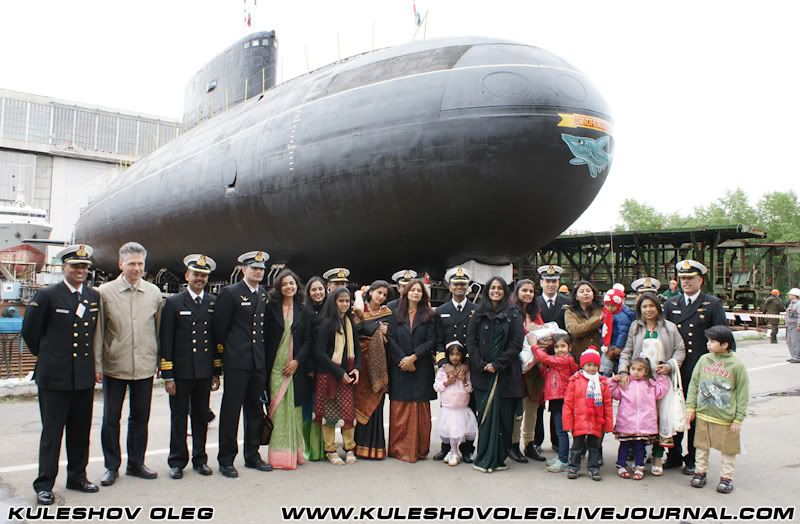
INS Sindhurakshak officers and family in happier times.
-
 
This news story has been carried internationally including US (Yahoo), UK (BBC) news outlets and wire services (including REUTERS).

There has been a tragic loss of 18 crewman on INS Sindhurakshak due to explosions . Based on previous incident-explosions on diesel-electric submarines one possible cause may be the buildup of hydrogen,  from battery charging operations, then ignition by flame or sparks - see http://www.hindustantimes.com/India-news/NewDelhi/INS-Sindhurakshak-hydrogen-concentration-may-have-triggered-explosion/Article1-1108159.aspx . Leakage of missile or torpedo propellant fuel then ignition then explosion of  warheads is possible.

The Sydney Morning Herald based on The New York Times, August 17, 2013 reports "Officials believe that a small explosion within the submarine set off two huge blasts from its onboard munitions. Video of the explosions seems to show two separate bursts that threw flames hundreds of feet into the air." http://www.smh.com.au/world/divers-recover-4-bodies-from-sunken-indian-submarine-ins-sindhurakshak-20130817-2s31i.html


Yahoo via REUTERS reports August 16, 2013 on the tragic loss of 18 crewman on INS Sindhurakshak http://news.yahoo.com/bodies-two-sailors-found-indian-submarine-wreckage-045322241.html

"Indian navy says three bodies found in submarine, no chance of survivors

By Sanjeev Miglani

NEW DELHI (Reuters) - - India's navy said on Friday divers had found the bodies of three sailors who were on board a submarine badly damaged by a fire and explosions and that it was unlikely any of 15 other missing crew members would be found alive.

Eighteen sailors were missing after weapons stored in the forward section of the Russian-built INS Sindhurakshak exploded in the middle of Tuesday night, causing a fire as it lay berthed in Mumbai, the navy's worst losses in more than four decades.

"The state of these bodies and conditions within the submarine leads to firm conclusion that finding any surviving personnel within the submarine is unlikely," the navy said in a statement.

"The damage and destruction within the submarine around the control room area indicates that the feasibility of locating bodies of personnel in the forward part of the submarine is also very remote as the explosion and very high temperatures, which melted steel within, would have incinerated the bodies too."

The sinking of the diesel-powered submarine is the biggest blow for the navy, both in terms of lives and the loss of a vessel, since a frigate was sunk in the 1971 war with Pakistan.

It has turned the spotlight on the navy's ageing submarine fleet even as it spends billions of rupees on aircraft carriers to counter the rising influence of the Chinese navy in the Indian Ocean.

The Sindhurakshak is a Kilo class vessel, which were built in former Soviet and later Russian shipyards for the Indian navy from 1985 to 2000. The navy has 10 of the submarines and four German HDW boats.

A defense source said the navy did not have a deep submergence rescue vehicle that other navies use to save trapped sailors, although in this case the incident occurred while it was docked and not in the deep seas.

The navy said divers couldn't enter the Sindhurakshak for more than 12 hours because of boiling water inside parts of the vessel. Access was "almost impossible due to jammed doors and hatches, distorted ladders, oily and muddy waters".

Only one diver could work at a time initially to clear a path inside the submarine. Divers are trying to reach further inside to find the remaining bodies, the navy said.

A naval board of inquiry has been ordered into how weapons went off while the vessel was berthed in the high-security Mumbai base.

Weapons on board such a submarine include torpedoes and missiles that are launched over long ranges above water."
-
Pete

August 13, 2013

More non-state based cyber-warfare between Indians and Pakistanis


The Oslo (Norway) based Norman Security group reported cyber-warfare between non-state Indian entities dubbed HangOver against Pakistani users in this report http://blogs.norman.com/2013/security-research/the-hangover-report .

Pakistani users included the Pakistani subsidiary of Norwegian telco Telenor - see http://www.theregister.co.uk/2013/08/07/india_cyberespionage/.

The usual ambiguity over "who done it" but the likelihood that state based attackers would be more difficult to detect applies.

This Norman report was carried (minus graphics, computer code and other technical detail) in the South Asian media including the following report in the Indian Express, May 21, 2013 http://www.indianexpress.com/news/sophisticated-indian-cyberattacks-targeted-pak-military-sites-report/1118547/ :

'Sophisticated' Indian cyberattacks targeted Pak military sites: Report

Manu Pubby : New Delhi, Tue May 21 2013

"Cyber analysts in Norway have claimed that hackers based in India have been targeting government and military agencies in Pakistan for the last three years, extracting information of national security interest to India.

The "sophisticated" attacks originated from an extensive, "non-state" cyberattack infrastructure, and used decoy links, including those that referred to this year's beheading incident on the Line of Control and rebel movements in the Northeast, as bait, according to a report released Monday by the Oslo-based Norman Shark group.

The alleged cyberattack network — referred to as "Operation HangOver" in the report — was apparently unearthed as cyber analysts investigated an industrial espionage attack on the Norwegian telecom firm Telenor.

The report has not identified the Pakistani agencies that were targeted, but has hinted that these included several sensitive military targets that would be of interest to India. The primary goal of the network seems to have been "surveillance against national security interests", says the report.

The report says there is no evidence of "state sponsorship" for Operation Hangover. But it names several private Indian hacker groups, including those based in New Delhi, as being behind the attack.

The hackers allegedly exploited vulnerabilities in software to plant Trojans in computers across the world, primarily in Pakistan, that then extracted information and sent it back over the Internet.

There are no details yet on how much data might have been leaked, but the report claims that the network became active in 2010, peaked last year, and continues to be active currently.

"Based on analysis of IP addresses collected from criminal data stores discovered during the investigation, it appears that potential victims have been targeted in over a dozen countries, most heavily represented by Pakistan, Iran, and the United States. Targets include government, military and civilian organisations," the report says.

The Trojans planted by the network were inadvertently downloaded by users who viewed files or photographs pertaining to Indian military and rebel movements. A Pakistan government site was infected, for example, after a picture of soldiers praying near the Siachen glacier was downloaded, says the report.

Another link that was allegedly used for infection was an article and satellite image of the Mendhar area on the Line of Control that saw heightened tension this year after the beheading of an Indian soldier by Pakistani army regulars.

Other baits were related to rebel movements in Punjab and Nagaland.

"The attackers went to great length to make the social engineering aspects of the attack appear as credible and applicable as possible," the report says."
-
Pete 

August 12, 2013

China's, India's and Pakistan's Future Nuclear Rivalry

Click on map to expand to clarity.

The following are excerpts from an article Nuclear Weapons Stability or Anarchy in the 21st Century: China, India, and Pakistan, dated February 25, 2011 by Thomas W. Graham, Ph.D.

The article carries this disclaimer: "The views expressed in this paper are those of this author and do not reflect Brookhaven National Laboratory, the Department of Energy  [America's nuclear weapon development umbrella organisation (DOE)] or any other organization. The analysis is based entirely on open source and unclassified information."

While the following is largely opinion the proximity of the author to the '"coal face" of America's nuclear weapons research industry makes his words more significant.

http://www.npolicy.org/article_file/Nuclear_Weapons_Stability_or_Anarchy_in_the_21st_Century__China,_India,_and_Pakistan_250211_1545.pdf

"...Current conventional wisdoms suggest [future] change in nuclear status and politics will be incremental. This may turn out to be tragically wrong if global nuclear dogma is influenced strongly by the unstable triangular nuclear weapons competition among China, India, and Pakistan. Three indicators are worth watching to foreshadow whether the world will move toward nuclear stability or anarchy in South West Asia.
  • First, will countries stabilize their operationally deployed nuclear forces at the approximate level of 150-200, 300-500 or larger?
  • Second, will these three countries adopt compatible and increasingly stable nuclear postures or will they continue to cling to three divergent nuclear postures?
  • Third, will future military crises be resolved with or without use or threatened use of nuclear weapons?
...to help us assess forthcoming global nuclear stability, it is imperative to take a fresh look at the dynamics of contemporary nuclear force structures and modernization in South West Asia.

...China, India, and Pakistan will continue to maintain three mutually incompatible nuclear doctrines. Multiple drivers for nuclear force modernization in each country will provide sufficient domestic and bureaucratic political pressure to expand and modernize nuclear weapons for decades to come.


Given this situation, proposed arms control treaties such as the CTBT and FMCT will not be implemented. Both proposed agreements are opposed by all three countries to varying degrees. The roots of their opposition are not being addressed seriously with policy research, strategic planning, or diplomacy.

…The United States has adopted a neo-Cold War nuclear posture to keep a few European allies quiet and to avoid a major bureaucratic fight between the White House and a few civilian Pentagon officials who work closely with Republican allies on Capital Hill. …Perhaps the administration’s logic was that it perceived the demonstration effect of a fundamentally new American nuclear posture would have little significant impact on thinking in China, India, and Pakistan.

So why pay a short term domestic political price for the prospects of marginal increases in long-term stability? However, absent such a fundamental change and serious discussions between the U.S. and China, one can predict with a high degree of confidence that business as usual will produce nuclear arms races in South West Asia for decades.

Other reasons to sustain a business as usual approach are obvious. America will continue to spend approximately ten billion dollars per year on national missile defense to neutralize potent domestic constituencies regardless of technical feasibility and negative impact on Russia and China.

The United States does not want to think seriously about steps it could take to address the Kashmir conflict because it is so complex, India’s position has been set in stone for decades, and it is easier to think of India as a global economic power sympathetic to American values.

The United States has not invested in civilian governance and rebuilding civil administrative capability in Pakistan because the military is the only functioning entity in the country in the short term. Honest and capable civilian political leadership in Pakistan is almost entirely lacking and will take many years to develop and mature.

Pakistani born Islamic terrorists and “India-phobic and paranoid” Pakistani strategic culture is acknowledged by American decision makers as a key problem, but American decisions and actions are focused almost exclusively on the war on terror. The perception persists in both Washington and Islamabad that “the U.S. needs Pakistan more than Pakistan needs the U.S."

In this context, adding the nuclear weapons issue to an overly crowded policy agenda with Pakistan will definitely over-load the circuits. The net result is probably that Pakistan leaders have concluded they can build as many nuclear weapons as they can produce plutonium and highly enriched uranium. They will take symbolic steps to better secure nuclear materials and weapons, but the question of “how much is enough” is off the table.

If this business as usual situation continues, the world should ready itself for a very rough ride in terms of nuclear weapons in the next two decades of the 21st century. South West Asia will be the dominant driver to an unstable world our children will rightly accuse us of having ignored to their peril. American decision makers in the 1980s chose to ignore on the ground realities after the Soviets were defeated in Afghanistan.

The blow back next time will be orders of magnitude larger and more tragic." See WHOLE ARTICLE.
-
Pete