February 12, 2013

Life near North Korea


South Korea - nuclear bomb wise a dangerous country to live in. In blue is the current track of the KTX Express.
-

PETE'S COMMENT 

After reading this evocative article below I assume worldly South Koreans are quietly fatalistic. Though many might blot North Korea out of their minds just to get through the day.

I wonder if people in India feel fatalistic about Pakistan in a similar way?

----------------------------------
Strategypage, February 12, 2013 On Point reports:  http://www.strategypage.com/on_point/2013021222182.aspx
"Nuclear Endgame on the Korean Peninsula?
by Austin Bay, February 12, 2013
Last October, while riding on South Korea's KTX express train from Seoul to Cheonan, I glanced at one of the rail car's video monitors just as a chilling yet cyclically familiar news flash lit the screen: "North Korea threatens South Korea with nuclear war."

The KTX onboard video system provides English, Chinese and Japanese translations of news and passenger information updates. Geography and history influence the language choices -- the Korean Peninsula sits between China and Japan, the U.S. is South Korea's closest ally -- but economics is the most pertinent reason. In the 21st century, Korean, English, Chinese and Japanese are global money languages, and the KTX caters to business passengers. I pegged the officious gentlemen seated three rows up as Chinese. Like me, he was looking at the monitor. Chinese characters superseded the English alert, Japanese followed the Chinese.
Then a live video feed of the very fast train's current speed -- 304, no make that 305 kilometers per hour, quite a clip -- completely replaced the news flash. I wondered how my fellow passenger had assessed North Korea's message. One of the more interesting secret State Department cables released by Wikileaks quoted senior Chinese foreign ministry officials as admitting North Korea's ruling clique is certifiably nuts.

I went back to gazing out the window, at a valley filled with lush rice paddies, the rice plants yellow and ripe. A day or so earlier, I'd read a wire service report that North Korea faced yet another crop failure and unless donor nations responded immediately, the wretched souls ruled by the Kim family's hereditary communist dictatorship would once again face starvation. Yes, I thought, the starving North had just threatened the hardworking, productive and, as a result, well-fed South with nuclear immolation. The North's extortion racket in a rice kernel: Feed us, or we will kill you en masse.
With this week's nuclear test (Feb. 12, 2013) the cycle of threat continues, this time backed by an impressive bang.

The test demonstrates that despite years of coaxing the Kim regime with economic development projects (like the Kaesong Industrial Zone) and years of plying the dictatorship with rice, heavy oil and other goodies, the North continues to develop the military capabilities to make good on its threat of nuclear war.
The test also serves notice that the Korean War isn't over, and unfortunately some people need reminding. Last month, President Barack Obama proclaimed that a decade of war is ending. North Korean propagandists declared that current dictator, Kim Jong Un, had ordered the test as a response to "ferocious" U.S. hostility and "violent" opposition to North Korea's sovereign right to peacefully launch satellites. See, North Korea claims its December 2012 ballistic missile launch was all about civilian satellites, not testing a delivery system capable of hitting Seoul, Tokyo and Honolulu. Initial seismic analysis indicates the nuclear test had the punch of a 6 to 8 kiloton weapon. Though roughly half the power of the Hiroshima bomb, that's more than big enough to incinerate Pearl Harbor and the beach at Waikiki.

It is very probable that North Korea provides Iran's Islamic dictatorship with nuclear and missile technology, so North Korea's nuclear menace extends beyond East Asia and the Pacific to Central Asia, Europe and Africa.

China's official reaction was surprisingly tough, given that Beijing has been the North's chief benefactor and sponsor, but China has global economic interests that North Korean nukes and their Iranian offspring may imperil. China expressed firm opposition to the test. The Obama administration is calling for stiffer international sanctions to punish North Korea, but China is the only nation that can impose meaningful sanctions on the Kim regime. Beijing has never done so.

South Korea has won the economic, social and cultural dimensions of the Korean War. The only unsettled component is the one that puts the KTX, Seoul's nightclubs and the lush rice fields at risk: the military confrontation. Unless China acts decisively to end North Korea's nuclear quest, this week's multi-kiloton blast may lead South Korea and Japan to conclude the military dimension must be won as well."
-
Pete
North Korean Nuclear Test Imminent?


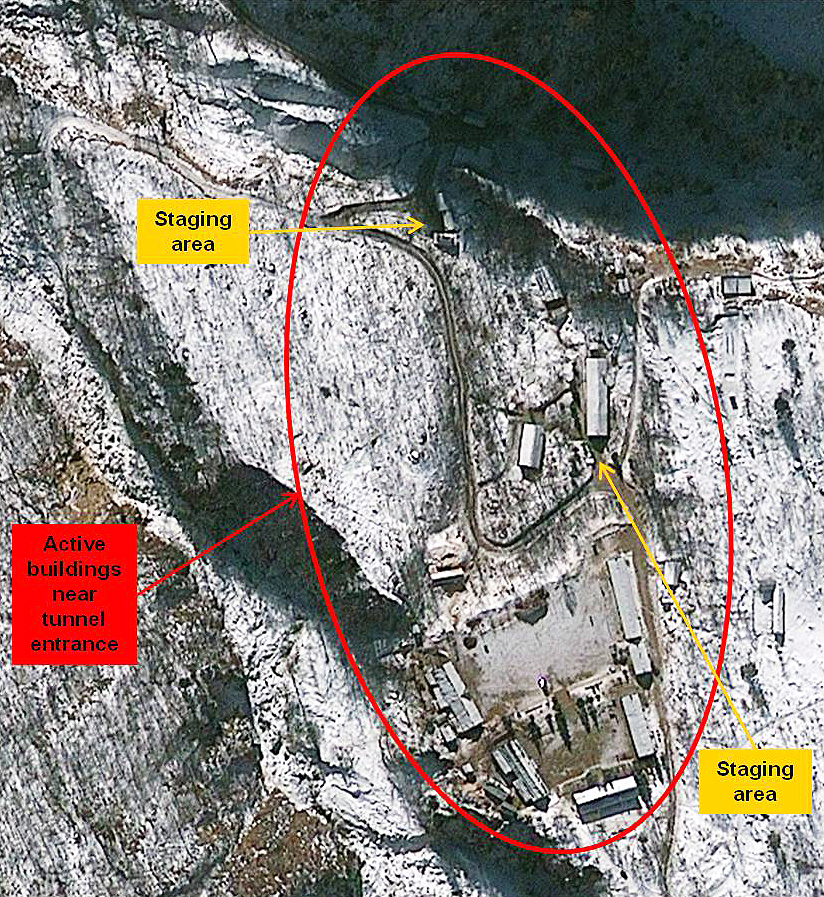
Photo above from http://www.scmp.com/news/asia/article/1137842/activity-seen-north-korea-atomic-test-site with caption "This January 4 [2013] satellite image shows North Korea's Punggye-ri test facility where roads have been kept clear of snow over the past month. Photo: AP. [article further states] ...The North’s two previous detonations in 2006 and 2009 followed a similar pattern of a missile launch, followed by UN measures, followed by a nuclear test".


Map indicates Phunggye-ri [re] North Korea's 2006 nuclear test site and site of the test (probably) in the next few hours or days. Nearby Kilju was the 2009 test site.

-----------------------------------------

Separately Agency France Press via The Age, February 12, 2013, reports http://www.theage.com.au/world/n-korea-withdraws-from-nuclear-test-site-20130212-2e9gz.html

"N Korea withdraws from nuclear test site

Seoul: North Korea has pulled manpower and equipment out of its nuclear test site, says a report, which cites the move as a possible sign of an imminent blast.

South Korea's Yonhap news agency says Seoul has been keeping close watch on the underground Punggye-ri nuclear test site, as no movement of manpower and equipment has been observed there since Friday.

The agency quoted an unnamed source as saying the apparent withdrawal could point to a nuclear test being carried out soon.

...Seoul has predicted Pyongyang may carry out its third nuclear test between the end of the holiday and the late leader Kim Jong-il's birthday on February 16, Yonhap said..." WHOLE ARTICLE
-
Pete

February 11, 2013

Songs: by Julie Fowlis Sings in Gaelic & English

Songs below are by Julie Fowlis http://www.juliefowlis.com/about/ :

"Brought up on North Uist in Scotland’s Outer Hebrides, Fowlis has been a proud standard bearer for Gaelic music and culture over the course of a solo career."

 "My Love Is On The High Seas" in Gaelic below:


-------------------------------


see also "Touch the Sky" in English the Brave Soundtrack -   http://www.youtube.com/watch?v=5WzJUb4Su54&feature=share&list=AL94UKMTqg-9Ak0qPdQ7FlHxBk4Ui53M9J

------------------------------------------

A lovely version of "Ashokan Farewell" with lyrics sung by Priscilla Herdman  http://youtu.be/3XanZlZ1zzc
-
Pete

February 6, 2013

Hypersonic "BrahMos-2" - Name Misleading

DRDO's mockup (above) of the Hypersonic Technology Demonstrator Vehicle (HSTDV) which may be developed into a missile called the "BrahMos-2". BrahMos-2 would have a completely different shape and propulsion to the existing BrahMos.
---
  
Update of February 2013

See this article from Defense Update of February 6, 2013 "Aero-India 2013: The Indian Air-Force Plans to Induct BrahMos by 2015" concerning deployment of BrahMos including air-launching it from India's Su-30MKI fighter-bombers .

Douglas Barrie, Aviation Week [dead link], on August 28, 2008 made the following points:

"Indian defense executives took the opportunity of a recent weapons exhibition in Moscow to once again raise the issue of a “successor” to the Indo-Russian Brahmos rocket-ramjet powered cruise missile.


However, given the performance aspirations for the weapon - dubbed Brahmos-2 – the name would likely be the only commonality with the present Brahmos.


The Brahmos is a variant of the NPO Mashinostroenia 3M-55 Onyx [/Yakhont] (SS-NX-26) anti-ship missile. It has a cruise speed on the order of Mach 2.6. Sivathanu Pillai, the CEO at the Brahmos company, has repeatedly suggested the follow on – Brahmos-2 – will be a hypersonic weapon. Brahmos is a partnership between NPO Mashinostroenia and India’s Defense Research and Development Organisation (DRDO). 


The 3M-55 is a capable weapon but neither the propulsion system nor the airframe design or materials are remotely suitable for a hypersonic weapon. Scramjet or hybrid ramjet propulsion would be required for an air-breathing weapon, with advanced materials technology, possibly including active cooling, needed to deal with the temperatures generated at such speeds.

Exactly how Brahmos-2 relates to the DRDO’s Hypersonic Technology Demonstrator Vehicle (HSTDV) program has also yet to become clear.


Pillai told the Russian news agency Interfax that he also wanted the Brahmos-2 to be “invisible”.

While this could present an issue in the infra-red spectrum, given airframe heating, NPO Mashinostroenia already has a track record in working on passive and active low observable technology in the radio frequency spectrum for high altitude cruise weapons.
Its 3M-25 Meteorit strategic cruise missile, which was never fielded, was associated with a plasma-generation system believed to be intended to reduce the radar cross-section of the missile by shielding the air intake and possibly the nose section. Bill Sweetman adds: Also, take a look at the BrahMos displayed in Moscow last week:

Russia has a long-standing interest in hypersonic cruise missile technology, while India is also exploring technologies applicable to this area through the likes of the HSTDV. Brahmos-2, should it ever progress, could prove to be a very interesting weapon."


Additional Background

Aviation Week & Space Technology 11/05/2007, page 65 - reproduced


"The Defense Research and Development Laboratory’s  [now DRDO] Hypersonic Technology Demonstrator Vehicle (HSTDV) is intended to attain autonomous scramjet flight for 20 sec., using a solid rocket launch booster. The research will also inform India’s interest in reusable launch vehicles.


The eventual target is to reach Mach 6.5 at an altitude of 32.5 km. (20 mi.). Initial flight testing is aimed at validating the aerodynamics of the air vehicle, as well as its thermal properties and scramjet engine performance.


A mock-up of the HSTDV was shown at the Aero India exhibition in Bangalore in February (see photo 1), and S. Panneerselvam, the DRDL’s project director, says engineers aim to begin flight testing a full-scale air-breathing model powered by a 1,300-lb.-thrust scramjet engine as early as next year.


The HSTDV’s shape, on which future cruise missile technology could be based, is evident in this mock-up shown at Aero India in February [2007]."
[Source unclear] The Defense Research and Development Laboratory’s Hypersonic Technology Demonstrator Vehicle (HSTDV) is intended to attain autonomous scramjet flight for 20 sec., using a solid rocket launch booster. The research will also inform India’s interest in reusable launch vehicles. The eventual target is to reach Mach 6.5 at an altitude of 32.5 km. (20 mi.).

Initial flight testing is aimed at validating the aerodynamics of the air vehicle, as well as its thermal properties and scramjet engine performance. A mock-up of the HSTDV was shown at the Aero India exhibition in Bangalore in February (see photo), and S. Panneerselvam, the DRDL’s project director, says engineers aim to begin flight testing a full-scale air-breathing model powered by a 1,300-lb.-thrust scramjet engine as early as next year.

The HSTDV’s shape, on which future cruise missile technology could be based, is evident in this mock-up shown at Aero India in February [2007]
 

February 3, 2013

Russian Sacrifice at Stalingrad: 1942-1943

Motherland Statue (in Volgograd formerly Stalingrad) commemorating the Battle of  Stalingrad.
---

German advance (Summer 1942) into the oil-rich Stalingrad region. Now called Volgograd, it sits on the Volga River, which runs from north to south, toward the Caspian Sea. 
---

February 2, 2013 marks the 70th anniversary of the end, in 1943, of the 200-day Battle of Stalingrad.

More is written in our "Anglosphere" about "Monty'sSecond Battle of El Alamein than about the vastly higher casualty, more significant, more German-breaking, Battle of Stalingrad. 

Language, the need to build up national symbols, create Monty the hero, the Cold War and ignorance of English speakers about warfare outside the Anglosphere, comes into the Russia ignoring mythology.

Russians have never been thanked enough, by the West, for Russians doing most of the fighting and dying against Hitler.

In this huge battle, the German commanding General (then 
Field Marshal) Paulus's Sixth Army suffered not only its first major defeat, but one that essentially paved the way for the collapse of the Third Reich.   

The battle of Stalingrad has also inspired two sharply contrasting films in recent years that are both available on home video. German director Joseph Vilsmaier's 1993 Stalingrad is a powerful antiwar film that focuses on the disintegration of the German army under the combined forces of the Russian  Army and brutal Russian winter.


Made in 2001, Jean-Jacques Annaud's Enemy at the Gates is much less successful. Although Annaud is French and his film was made in Europe (with the largest budget in the continent's history), Enemy at the Gates represents a Hollywoodization of material that would defy such a treatment. Instead of focusing on the large unit battle that made the German defeat possible, Annaud would have us believe that victory revolved around the feats of an individual Russian sniper with needy Russian women snipers dependent on him.


Russia had something that Germany sorely lacked: sheer numbers. Vast numbers of inexperienced youth were drafted into action, with very little training. Often one rifle between 2 or 3 men during infantry assaults. This led to enormous casualties in face of the better-trained and equipped German Army. 


In early autumn the fighting had concentrated in the rubble strewn streets of downtown Stalingrad.


While urban trench warfare proceeded through the end of 1942, Russia was operating munitions factories twenty-four hours a day in the Eastern part of the country not yet under German control, as Russia fed in huge numbers of reinforcements to grind down the German front which then was isolated as a pocket. 


The stubborn fighting in Stalingrad prevented the Germans moving eastwards. New Russian Divisions assembled against weak Romanian and Hungarian divisions which were allies of the Germans, on the German line. In a pincer movement the Russians broke though these weak German-ally divisions and then surrounded the German Army from the north and south. This counter-attack coincided with the full extreme Russian winter for which the German army had little winter clothing and poor munitions (including German tank engines that simply froze). 


Russian counterattack (Operation Uranus, November 1942 on) to trap German 6th Army at Stalingrad. 

---


The Germans became short of food, ammunition and water, many froze. Hitler had gambled that the fighting would be long over prior to the onset of winter. To survive, many Germans removed the underclothing of dead Russian soldiers or wrapped rags around their shoes.


German losses at Stalingrad were high. Paulus's German Sixth Army began its campaign with 600,000 soldiers. On January 31, 1943, he disobeyed Hitler and surrendered. On February 2 1943 Paulus had only 91,000 still alive when they became prisoners. Of those taken captive, only 6,000 lived to return to Germany, years after the war.


The Russians recovered 250,000 German and Romanian corpses in and around Stalingrad and total Axis deaths (Germans, Romanians, Italians, and Hungarians) are estimated at 800,000.


At one key battle for control of (the tractor) factory, there were more casualties than during the entire German invasion of France. Official Russian military historians estimate that 1,100,000 Russian soldiers lost their lives in the campaign to defend the city, all this in a span of six months. 

Russian children in Stalingrad (now Volgograd) honour the memory of the millions of Russian soldiers who died in World War Two fighting the Germans.
---

February 2, 2013

Top US Admiral on Australia and Indian Ocean


From Agency France Press as reported in Australian newspapers, February 2, 2013, (eg. http://www.theaustralian.com.au/national-affairs/foreign-affairs/australia-critical-to-us-asia-strategy/story-fn59nm2j-1226566823943  )

"Australia 'critical' to US Asia strategy"  

AUSTRALIA is a "critical pillar" in the US pivot to Asia and the rebalancing of its military strategy, the region's most senior American commander says.

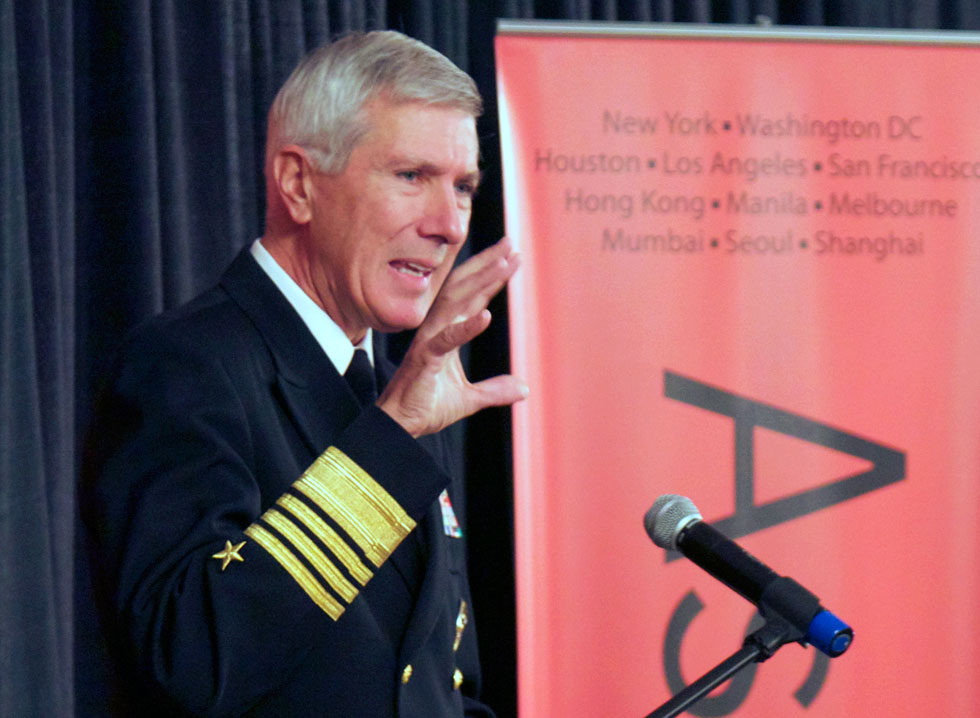
Chief of US Pacific Command (PACOM) [Admiral] Samuel Locklear, speaking in a teleconference from Hawaii, said the key US ally was vital in the world order that is emerging for the 21st Century.

Admiral Locklear said the challenges the US faced included climate change, maritime security, disaster relief and cyber security.

“All those things I view from the PACOM headquarters here, Australia is a critical pillar of the strategy we have here,” Admiral Locklear said.

“When... I go down to Canberra and I sit and I look at the world map from Australia being in the centre of it, I get a very different view than I get from Hawaii or from Washington DC.

“And I start to have a sense of the things of the security environment that concerned people of Australia as well as people in Indonesia, in India and other countries.”

Admiral Locklear said seen from this perspective, the Indian Ocean is a vital strategic region that cannot be thought of separately from the Asia-Pacific.

“When we look at our relationship with Australia, number one, a very good close ally, historically has been alongside with the US many times in the past, and I think will hopefully continue in the future,” he said.

The US military is to station a powerful radar and a space telescope in Australia as part of a refocusing of priorities, the two countries announced in November.

The two sides also conferred on increasing the number of US Marines deploying to Darwin.

US Defence Secretary Leon Panetta described it as “major leap forward in bilateral space cooperation and an important new frontier in the United States' rebalance to the Asia-Pacific region”.

In his first term as US President, Barack Obama said he wanted to refocus foreign policy on Asia, in a move that has been much trailed as a “pivot”."