Showing posts with label Sinpo class. Show all posts

May 15, 2015

South Korean "Kill Chain" Preemptive Strike on North Korea - Problems

A South Korean preemptive ("Kill Chain") strike on North Korea would be even more complicated and dangerous than described below. To what extent would the US, Russia, China and Japan become embroiled? Note that the map may be dated 2008 as many of the orbat and budget figures are dated 2005-6 and US carrier Kitty Hawk is listed (even though decommissioned 2009). Still the locations in North Korea appear still accurate. (Click National Post to then expand image)
--- 

In relation to North Korea’s developing nuclear ballistic missile and submarine launch capabilities South Korean preemptive strike (“Kill Chain”) doctrine is under pressure. Kill Chain may be obsolete with the possibility that eventual South Korean nuclear deterrence will be needed to replace it. Over the next three days I will write three articles on this issue. This is the first.

South Korea has been pushing for an indigenous nuclear deterrence capability since the early 1970s however US pressure and promises have been sufficient for South Korea to accept US extended nuclear deterrence. Nevertheless South Korea is more advanced in ballistic missile development than is generally known. 

The pressure on South Korea’s leadership of North Korea's action over the last week is reflected in Korea Joongang Daily’s, May 13, 2015 article "Park calls for a response to North’s launch" http://koreajoongangdaily.joins.com/news/article/article.aspx?aid=3004109&cloc=joongangdaily%7Chome%7Cnewslist1. President Park is seeking an expansion of preemptive strike sensor infrastructure to handle the emerging North Korean SLBM threat.

The process and requirements of Kill Chain premptive strike were summarised by Professor Choi Jong-kun of Yonsei University, Seoul in 2013. Under this doctrine the South Korean (with presumably US assistance) intelligence and military establishment would need to react to North Korea in order to:

“1. Within one minute, South Korean intelligence must pick up signals that North Korea intends to attack preemptively; and

2. Within one minute, South Korea must establish what and where North Korea intends to attack preemptively; and

3. Within three minutes, the supreme commander of the South Korean military must be able to hand down an order to strike preemptively against North Korean targets; and

4. South Korea must attack the relevant sites in North Korea before North Korea has time to launch its own attack; and

5. South Korea must be able to establish whether its initial strikes were sufficient to eliminate the source of the intended North Korean strike; and

6. South Korea must be capable of responding to immediate North Korean counterstrikes from elsewhere."

Problems with South Korean Kill Chain preemptive strike include:

-  The role of civilian South Korean authority particularly President Park in the chain of command and decision making?

-  The role of the US military and civilian authorities? South Korea needs complete confidence that US compliance and involvement in the Kill Chain will be nearly instant.

-  South Korea and the US need complete confidence that China would allow a preemptive strike on its client-buffer state North Korea.

-  Kill Chain requires perfect knowledge that North Korea wishes to launch a major strike against South Korea. By major this means that at least one nuclear (not conventional high explosive or chemical?) missile is about to be launched at South Korea (not Japan).

-  the problem of only one nuclear missile but (say) 100+ decoy high explosive missiles?

-  All the North Korea missiles must be destroyed on their launch platforms or shot down and all NK submarines, warships, air force aircraft and disguised North Korea “civilian” ships or "civilian" aircraft capable of firing nuclear tipped ballistic OR cruise missiles or bombs must be destroyed.

-  These shoot downs and sinkings must be as close to instant and simultaneous as possible. In that regard South Korean cruise missiles might be far too slow for the job.

Without perfect knowledge South Korea could make a situation where North Korea is merely debating the notion of a strike OR only wishes a conventional missile/bomb strike a nationally fatal act be South Korea

Where South Korea commits what might be considered an unnecessary preemptive "Pearl Harbor" attack will that make South Korea an international outcast? 

An unfounded South Korea preemptive strike would almost guarantee a massive nuclear response to South Korea (and perhaps Japan) or total North Korea desire to build a nuclear response in future.

Unless regime change to North Korea took place a South Korean preemptive strike would just be the beginning of further hostilities.
--

The second article will be on South Korea's ballistic missile and nuclear history and future intentions. The third article will be on the extention of the Kill Chain to SLBM capable submarines. 

Connect with North Korea's alleged new SINPO class submarine and missile test, May 13, 2015 (below).

Pete

May 13, 2015

North Korea's alleged new SINPO class submarine and missile test

 I have added several extra hyperlinks, comments in [ ] brackets and a photo (particularly concerning the suspected missiles, Golf and SINPO-class submarines) relevant to the following article.

That article is by Sean Gallagher at arstechnica published May 12, 2015 concerning North Korea's   alleged submarine launch of a ballistic missile. The submarine and missile details will need to be fully verified by intelligence agencies before they are taken as fact. 

On May 13, 2015, US intelligence said North Korea (NK) may have achieved what is called a limited compressed gas ejection test. This is called a perhaps 200 meter "cold launch" in the vertical launch business. 

Other US theories that the missile test did not happen in the way NK said or did not happen at all, are:

- NK launched the missile from a barge-sea platform, not a submarine, and/or
- the missile was a non-working dummy capable of cold launch but nothing else, and/or
- NK photoshopped the missile images below, making up the whole "event".

Despite these doubts South Korea is more than usually concerned. NK has proven it can conduct real nuclear tests and has tested ballistic missiles with, at least, proven medium ranges (ie. between 1,000 km and 3,000 km). Now NK is working towards an SLBM capability. Hence South Korea (and the US) are exploring strategies and tactics to react to NK SLBMs. See my April 16, 2015 article which mentions a future South Korea "Kill Chain" pre-emptive strike capability.

The arstechnica string is http://arstechnica.com/tech-policy/2015/05/north-korea-test-launches-polaris-1-ballistic-missile-from-submarine/ :

"North Korea test-launches “Polaris-1” ballistic missile from submarine


Analysts say DPRK missile subs could threaten Japan, South Korea in five years.


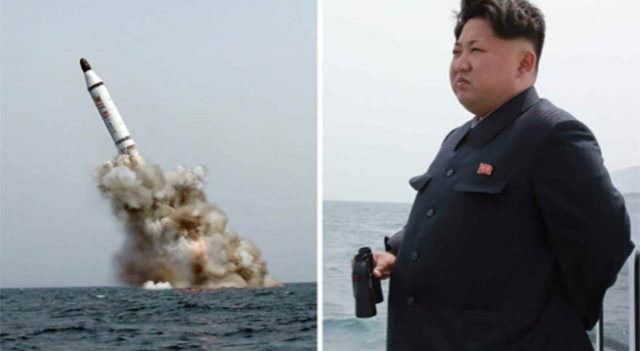
Kim Jong-un watches as North Korea's navy successfully test-launches a ballistic missile from a submarine on May 9.

On May 9, a Korean People's Army Naval Force submarine test-launched a ballistic missile off the eastern coast of North Korea. The test launch, reported by North Korea's Rodong Sinmun newspaper, only traveled about 150 meters, according to South Korean defense officials. But it demonstrated that North Korea had developed the capability of performing submerged launches of missiles well ahead of previous intelligence estimates. Based on the launch, South Korean officials now believe that North Korea could have a limited submarine-launched missile capability deployed to its fleet of submarines within the next five years.
The test comes as South Korea nears a decision on the deployment of a Terminal High Altitude Area Defense (THAAD) anti-ballistic missile system. China has been pressuring South Korea to not allow the deployment, but an earlier, barge-based test of the submarine-launchable missile (named "Polaris-1" by North Korea) on April 22 has made the deployment more likely.
North Korean press images of Kim Jong-un's successful supervision of the "Polaris-1" launch.
Polaris-1 [possibly a BM25-Musudan[possibly also called "KN-11" or "KN-02"] is apparently a close copy of a Soviet-era R-27 ...SLBM...liquid-fuel SS-N-6 "Serb." This is the third test launch of the missile this year, but it is the first [possibly] submarine launch. Developed in apparent violation of a UN resolution banning North Korean ballistic missile development, the missile could have a range of about 1,500 miles.
The original R-27 was capable of carrying three independent nuclear warheads. An explosion of an R-27 missile caused by a reaction between a seawater leak and fuel residue aboard the Soviet "Yankee" class ballistic missile sub K-219 in 1986 off of Bermuda led to one of the most tense moments in the late Cold War (later breathlessly and inaccurately recounted in one of the worst submarine movies ever, Hostile Waters).
North Korean leader Kim Jong-un, who had previously planned to travel to Russia over the weekend but then cancelled his plans last week, was on hand to observe the launch. "He stressed that the acquisition of the technology of firing ballistic missile from a strategic submarine underwater made it possible for the KPA to possess a world-level strategic weapon capable of striking and wiping out in any waters the hostile forces infringing upon the sovereignty and dignity of Songun Korea and conduct any underwater operation," reported the Korean Central News Agency, North Korea's government news service.

SINPO Class Submarine
Almost all of North Korea's existing submarine fleet is made up of diesel-electric submarines with limited range, including about 20 based on the 1950s Soviet Project 633 ("Romeo") design imported from China or locally built. [North Korea reportedly operates 22 (or 20) Romeo class submarines. Seven were directly imported from China between 1973 and 1975, and the remainder locally assembled with Chinese supplied parts between 1976 and 1995. One apparently sank in an accident in 1985. Four Chinese imported units are based on North Korea’s western coast.]
A new submarine with one or two vertical missile launch tubes in its sail was spotted being built at North Korea's Sinpo South Shipyard last summer. [see photo inserted below
[North Korea's new "SINPO class" submarine (also see) considered capable of launching up to 3 SLBMs - Photo Courtesy http://38north.org/2015/01/jbermudez010815/. 38north wonders "Exactly what missile system would be used in a ballistic missile submarine (SSB) is purely speculative at this point. Several possibilities are a shorter naval version of the Musudan intermediate-range ballistic missile, a Nodong medium-range ballistic missile, naval versions of the solid-fuelled KN-02 short-range ballistic missile or an entirely new system."

Wiki contributors wonder whether the SINPO's design may be derived from old Yugoslav Heroj and Sava small sub designs [1] and/or from medium sized Soviet/Russian Kilo class, or Golf class designs. Wiki also estimated SINPO's weight as "1,000-1,500 tons", length "65.5 meters" and range "1,500 nautical miles". It is difficult to know whether SINPO is diesel-electric or only has a battery (just electric)]
North Korea also obtained 10 Soviet Golf-II diesel-electric ballistic missile submarines, built in the late 1950s, from Russia in 1994. The Golf-II, or "Project 629A," submarines, which are capable of carrying three SLBMs, were transferred by Russia as scrap to North Korea. However, it is now believed that North Korea has been working on reactivating some of the subs and that one was used for the test launch this weekend.
The Golf-II class [Fourteen Golf Is were extensively modified  in 1966–1972 to carry larger, longer range missiles, becoming known as 629A's by the Soviet Navy and Golf IIs by NATO.] carried the R-27 missile toward the end of its active duty in the Soviet Navy and had an operational range of 9,500 nautical miles (about 11,000 miles). They were capable of 17 knots (about 20 mph) when running on the surface and 12 knots (about 14 mph) when submerged. So in theory, a North Korean Golf-II submarine could get in range of the United States for a launch, but it would require being at sea for two to three months to get close enough to strike, transiting a lot of open ocean. The Korean Peoples' Army Navy is mostly a coastal force with no deep-water experience, and diesel subs transiting the Pacific would be easy targets for US sensors and patrols.
The bigger concern is that these subs could evade detection in Korean coastal waters and launch attacks against South Korea and Japan with little warning. Jeffrey Lewis of the California-based Monterey Institute of International Studies told Reuters"While North Korea's submarines are not especially effective, the challenge of finding even a small number of specific submarines armed with missiles would be quite a challenge.""
Pete