Showing posts with label North Korea. Show all posts

May 15, 2015

South Korean "Kill Chain" Preemptive Strike on North Korea - Problems

A South Korean preemptive ("Kill Chain") strike on North Korea would be even more complicated and dangerous than described below. To what extent would the US, Russia, China and Japan become embroiled? Note that the map may be dated 2008 as many of the orbat and budget figures are dated 2005-6 and US carrier Kitty Hawk is listed (even though decommissioned 2009). Still the locations in North Korea appear still accurate. (Click National Post to then expand image)
--- 

In relation to North Korea’s developing nuclear ballistic missile and submarine launch capabilities South Korean preemptive strike (“Kill Chain”) doctrine is under pressure. Kill Chain may be obsolete with the possibility that eventual South Korean nuclear deterrence will be needed to replace it. Over the next three days I will write three articles on this issue. This is the first.

South Korea has been pushing for an indigenous nuclear deterrence capability since the early 1970s however US pressure and promises have been sufficient for South Korea to accept US extended nuclear deterrence. Nevertheless South Korea is more advanced in ballistic missile development than is generally known. 

The pressure on South Korea’s leadership of North Korea's action over the last week is reflected in Korea Joongang Daily’s, May 13, 2015 article "Park calls for a response to North’s launch" http://koreajoongangdaily.joins.com/news/article/article.aspx?aid=3004109&cloc=joongangdaily%7Chome%7Cnewslist1. President Park is seeking an expansion of preemptive strike sensor infrastructure to handle the emerging North Korean SLBM threat.

The process and requirements of Kill Chain premptive strike were summarised by Professor Choi Jong-kun of Yonsei University, Seoul in 2013. Under this doctrine the South Korean (with presumably US assistance) intelligence and military establishment would need to react to North Korea in order to:

“1. Within one minute, South Korean intelligence must pick up signals that North Korea intends to attack preemptively; and

2. Within one minute, South Korea must establish what and where North Korea intends to attack preemptively; and

3. Within three minutes, the supreme commander of the South Korean military must be able to hand down an order to strike preemptively against North Korean targets; and

4. South Korea must attack the relevant sites in North Korea before North Korea has time to launch its own attack; and

5. South Korea must be able to establish whether its initial strikes were sufficient to eliminate the source of the intended North Korean strike; and

6. South Korea must be capable of responding to immediate North Korean counterstrikes from elsewhere."

Problems with South Korean Kill Chain preemptive strike include:

-  The role of civilian South Korean authority particularly President Park in the chain of command and decision making?

-  The role of the US military and civilian authorities? South Korea needs complete confidence that US compliance and involvement in the Kill Chain will be nearly instant.

-  South Korea and the US need complete confidence that China would allow a preemptive strike on its client-buffer state North Korea.

-  Kill Chain requires perfect knowledge that North Korea wishes to launch a major strike against South Korea. By major this means that at least one nuclear (not conventional high explosive or chemical?) missile is about to be launched at South Korea (not Japan).

-  the problem of only one nuclear missile but (say) 100+ decoy high explosive missiles?

-  All the North Korea missiles must be destroyed on their launch platforms or shot down and all NK submarines, warships, air force aircraft and disguised North Korea “civilian” ships or "civilian" aircraft capable of firing nuclear tipped ballistic OR cruise missiles or bombs must be destroyed.

-  These shoot downs and sinkings must be as close to instant and simultaneous as possible. In that regard South Korean cruise missiles might be far too slow for the job.

Without perfect knowledge South Korea could make a situation where North Korea is merely debating the notion of a strike OR only wishes a conventional missile/bomb strike a nationally fatal act be South Korea. 

Where South Korea commits what might be considered an unnecessary preemptive "Pearl Harbor" attack will that make South Korea an international outcast? 

An unfounded South Korea preemptive strike would almost guarantee a massive nuclear response to South Korea (and perhaps Japan) or total North Korea desire to build a nuclear response in future.

Unless regime change to North Korea took place a South Korean preemptive strike would just be the beginning of further hostilities.
--

The second article will be on South Korea's ballistic missile and nuclear history and future intentions. The third article will be on the extention of the Kill Chain to SLBM capable submarines. 

Connect with North Korea's alleged new SINPO class submarine and missile test, May 13, 2015 (below).

Pete

May 13, 2015

North Korea's alleged new SINPO class submarine and missile test

 I have added several extra hyperlinks, comments in [ ] brackets and a photo (particularly concerning the suspected missiles, Golf and SINPO-class submarines) relevant to the following article.

That article is by Sean Gallagher at arstechnica published May 12, 2015 concerning North Korea's   alleged submarine launch of a ballistic missile. The submarine and missile details will need to be fully verified by intelligence agencies before they are taken as fact. 

On May 13, 2015, US intelligence said North Korea (NK) may have achieved what is called a limited compressed gas ejection test. This is called a perhaps 200 meter "cold launch" in the vertical launch business. 

Other US theories that the missile test did not happen in the way NK said or did not happen at all, are:

- NK launched the missile from a barge-sea platform, not a submarine, and/or
- the missile was a non-working dummy capable of cold launch but nothing else, and/or
- NK photoshopped the missile images below, making up the whole "event".

Despite these doubts South Korea is more than usually concerned. NK has proven it can conduct real nuclear tests and has tested ballistic missiles with, at least, proven medium ranges (ie. between 1,000 km and 3,000 km). Now NK is working towards an SLBM capability. Hence South Korea (and the US) are exploring strategies and tactics to react to NK SLBMs. See my April 16, 2015 article which mentions a future South Korea "Kill Chain" pre-emptive strike capability.

The arstechnica string is http://arstechnica.com/tech-policy/2015/05/north-korea-test-launches-polaris-1-ballistic-missile-from-submarine/ :

"North Korea test-launches “Polaris-1” ballistic missile from submarine


Analysts say DPRK missile subs could threaten Japan, South Korea in five years.


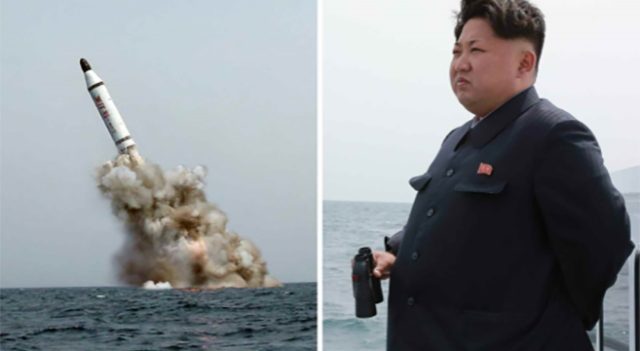
Kim Jong-un watches as North Korea's navy successfully test-launches a ballistic missile from a submarine on May 9.

On May 9, a Korean People's Army Naval Force submarine test-launched a ballistic missile off the eastern coast of North Korea. The test launch, reported by North Korea's Rodong Sinmun newspaper, only traveled about 150 meters, according to South Korean defense officials. But it demonstrated that North Korea had developed the capability of performing submerged launches of missiles well ahead of previous intelligence estimates. Based on the launch, South Korean officials now believe that North Korea could have a limited submarine-launched missile capability deployed to its fleet of submarines within the next five years.
The test comes as South Korea nears a decision on the deployment of a Terminal High Altitude Area Defense (THAAD) anti-ballistic missile system. China has been pressuring South Korea to not allow the deployment, but an earlier, barge-based test of the submarine-launchable missile (named "Polaris-1" by North Korea) on April 22 has made the deployment more likely.
North Korean press images of Kim Jong-un's successful supervision of the "Polaris-1" launch.
Polaris-1 [possibly a BM25-Musudan] [possibly also called "KN-11" or "KN-02"] is apparently a close copy of a Soviet-era R-27 ...SLBM...liquid-fuel SS-N-6 "Serb." This is the third test launch of the missile this year, but it is the first [possibly] submarine launch. Developed in apparent violation of a UN resolution banning North Korean ballistic missile development, the missile could have a range of about 1,500 miles.
The original R-27 was capable of carrying three independent nuclear warheads. An explosion of an R-27 missile caused by a reaction between a seawater leak and fuel residue aboard the Soviet "Yankee" class ballistic missile sub K-219 in 1986 off of Bermuda led to one of the most tense moments in the late Cold War (later breathlessly and inaccurately recounted in one of the worst submarine movies ever, Hostile Waters).
North Korean leader Kim Jong-un, who had previously planned to travel to Russia over the weekend but then cancelled his plans last week, was on hand to observe the launch. "He stressed that the acquisition of the technology of firing ballistic missile from a strategic submarine underwater made it possible for the KPA to possess a world-level strategic weapon capable of striking and wiping out in any waters the hostile forces infringing upon the sovereignty and dignity of Songun Korea and conduct any underwater operation," reported the Korean Central News Agency, North Korea's government news service.

SINPO Class Submarine
Almost all of North Korea's existing submarine fleet is made up of diesel-electric submarines with limited range, including about 20 based on the 1950s Soviet Project 633 ("Romeo") design imported from China or locally built. [North Korea reportedly operates 22 (or 20) Romeo class submarines. Seven were directly imported from China between 1973 and 1975, and the remainder locally assembled with Chinese supplied parts between 1976 and 1995. One apparently sank in an accident in 1985. Four Chinese imported units are based on North Korea’s western coast.]
A new submarine with one or two vertical missile launch tubes in its sail was spotted being built at North Korea's Sinpo South Shipyard last summer. [see photo inserted below
[North Korea's new "SINPO class" submarine (also see) considered capable of launching up to 3 SLBMs - Photo Courtesy http://38north.org/2015/01/jbermudez010815/. 38north wonders "Exactly what missile system would be used in a ballistic missile submarine (SSB) is purely speculative at this point. Several possibilities are a shorter naval version of the Musudan intermediate-range ballistic missile, a Nodong medium-range ballistic missile, naval versions of the solid-fuelled KN-02 short-range ballistic missile or an entirely new system."

Wiki contributors wonder whether the SINPO's design may be derived from old Yugoslav Heroj and Sava small sub designs [1] and/or from medium sized Soviet/Russian Kilo class, or Golf class designs. Wiki also estimated SINPO's weight as "1,000-1,500 tons", length "65.5 meters" and range "1,500 nautical miles". It is difficult to know whether SINPO is diesel-electric or only has a battery (just electric)]
North Korea also obtained 10 Soviet Golf-II diesel-electric ballistic missile submarines, built in the late 1950s, from Russia in 1994. The Golf-II, or "Project 629A," submarines, which are capable of carrying three SLBMs, were transferred by Russia as scrap to North Korea. However, it is now believed that North Korea has been working on reactivating some of the subs and that one was used for the test launch this weekend.
The Golf-II class [Fourteen Golf Is were extensively modified  in 1966–1972 to carry larger, longer range missiles, becoming known as 629A's by the Soviet Navy and Golf IIs by NATO.] carried the R-27 missile toward the end of its active duty in the Soviet Navy and had an operational range of 9,500 nautical miles (about 11,000 miles). They were capable of 17 knots (about 20 mph) when running on the surface and 12 knots (about 14 mph) when submerged. So in theory, a North Korean Golf-II submarine could get in range of the United States for a launch, but it would require being at sea for two to three months to get close enough to strike, transiting a lot of open ocean. The Korean Peoples' Army Navy is mostly a coastal force with no deep-water experience, and diesel subs transiting the Pacific would be easy targets for US sensors and patrols.
The bigger concern is that these subs could evade detection in Korean coastal waters and launch attacks against South Korea and Japan with little warning. Jeffrey Lewis of the California-based Monterey Institute of International Studies told Reuters, "While North Korea's submarines are not especially effective, the challenge of finding even a small number of specific submarines armed with missiles would be quite a challenge.""
Pete

April 16, 2015

South Korean Submarines, 3,000+ ton KSS-III, Nuclear Potential

See detail on possible South Korean nuclear submarine technology in redded KSS-N sub-heading below.

One of South Korea's (international convention of just "Korea" now used) nine Chang Bogo class (KSS-Is). Korea is completing a sale of three to Indonesia.
---

One of Korea's four Son Won-Il class (KSS-IIs) in commision - five to go. Larger than the KSS-I and AIP equipped. Looks like a pre-launch ceremony. 
---

With the KSS-III being described as a "3,000 tonne submarine" for a decade the above dimensions (very similar to the single hull Collins) may be accurate. The "3,000 t" would be surfaced displacement.
---

A larger KSS-III? If its length is really 83.5 m and breadth/beam 7.7 m, then compared with the Collins (77.4 m, 7.8 m) the KSS-III's displacement appears to be around 3,400 tonnes (surfaced) and 3,800 tonnes (submerged). There are many other variables in estimating displacement of course! Other possibilities are that the above is a "4,000 t" nuclear KSS-N? or 83.5 is propaganda to equal the Soryu's 84 m length.
---

Another model of what the KSS-III may turn out like. It appears to have 6 VLS hatches but a 6 missile Vertical Multi Purpose Lock (VMPL) is more likely.
---

South Korea (international convention of just "Korea" now used) has a long and competitive ship-building tradition. Korea has the world's largest ship-building industry - with 41% of world market share (in first quarter 2015). This has put Korea in a good position to build German TKMS-HDW designed submarines (from kits?) since 1990. Korea has also has submarine export success and is perhaps well prepared to develop a 3,000-4,000 tonne conventional submarine. It faces threats even greater than Japan does - having a land border with North Korea and in much closer proximity to China. The Korean Navy has publicised its creation of a Submarine Command for reasons difficult to discern but perhaps to suggest an eventual capability of a pre-emptive or second strike nuclear deterrent.

South Korea's KSS-I, KSS-II and KSS-III building program suggest a goal of having a rolling average of at least 18 submarines operational and perhaps 22 to match Japan's medium term goal. The so-called "indigenous" submarine (KSS-III) project may still draw heavily on TKMS-HDW technology but "indigenous" also provides ambiguity if Korea needs to develop KSS-III into a nuclear propelled submarine "KSS-N" possibly nuclear armed. 

South Korea's strategy includes the creation of a pre-emptive strike "kill chain" (of threat detection, decision making-authorisation and (mainly missile) pre-emptive strike) against North Korea. Submarines would be a (or the) principal pre-emptive strike and counter-strike platform. Subsonic cruise missiles are generally too slow for these roles - making supersonic+ cruise and ballistic missiles the logical solution.


Used South Korean has two Dolgorae class mini submarines (above) launched 1990 and 1991, 175 tons, with two small 410mm torpedo tubes. They have crews of 14 and may be used for surveillance and perhaps special forces. They were acquired by South Korea to obtain initial experience with the basics of operating a submarine force and to train surface ASW ships in the detection of subs.

In 2011 South Korea indicated it would be building new mini-subs, known as KSS-500As, weighing 510 tons. They may operate only on Lithium-ion Batteries and diesel engines. 

KSS-Is and KSS-IIs

Korea's navy operates:

- 9 Chang Bogo class (KSS-I), a variant of the TKMS-HDW type 209/1200. In 2011 Daewoo Shipbuilding & Marine Engineering (DSME) won a contract to supply Indonesia with two pre-assembled Chang Bogos (to be delivered probably in 2016-2017) with a third Chang Bogo to be assembled in Indonesia (perhaps the beginning of an indigenous Indonesian production line!). The 9 KSS-Is have been regularly upgraded which may extend their service life past the usual 30 years. A major future upgrade may be Lithium-ion batteries fully or partly replacing lead-acid batteries - although such a retrofit may be very difficult. See NTI document for names of specific, commissioned KSS-Is and KSS-IIs up to 2011.

-  4 Son Won-Il class (KSS-II) as at April 2015. Five more are due to be commissioned by 2020. These are variants of the TKMS-HDW Type 214 submarines. Hyundai Heavy Industries (HHI) built the first three (commissioned 2007-2009). DSME, HHI and STX Offshore & Shipbuilding are alternately building the second batch of six with one of the six commissioned in December 2014 and the final one due to be commissioned in 2018. Like the KSS-Is the KSS-IIs carry some US built Harpoon missiles for anti-ship and possibly land attack. Like the KSS-Is the KSS-IIs are orientated to a surveillance, anti-shipping, anti-submarine and (a short range) land attack capability. 

KSS-III, 3,000-4,000 tonne Design - Conventional and Potentially Nuclear  

There will be eventually 9 (KSS-III) 3,000-4,000 tonne submarines.  See the 3rd and 4th pictues above that contain varying dimentions attributed to the KSS-III (also called "DSX-3000") which indicate its surfaced displacement may be anywhere between 3,000 and 3,400 tonnes. DSME will be the main designer. The lead KSS-III boat began development in November 2014 at DSME's submarine yard at Okpo. It my be a major step forward in utilising Lithium-ion Batteries (LIBs). The second batch of KSS-IIIs (especially if they use new technology LIBs) may take 8 years to build and launch (2024) and then 3 years to commission (about 2027). 

The larger size of the KSS-III will permit it to include some of the latest submarine technologies, including:

- large diameter unmanned underwater vehicles (LDUUVs)
- Seal/diver delivery vehicles (SDVs)
- dry-wet cells for special forces in dinghies/divers/Seals
- VLS or more probably the major advance of Vertical Multi Purpose Lock (VMPL) capable of launching 1,500+ km cruise and Harpoon missiles,, VMPLs are also capable of launching LDUUVs and SDVs. 

As well as retaining fuel cell (or less likely Stirling) AIP, KSS-IIIs could also incorporate features from the TKMS-HDW Dolphin 2 including the large rudder system and reinforced hull bottom which allow such a large SSK to operate in shallow, littoral waters. Also Germany's TKMS-HDW could provide assistance using features from the so-far drawing board only HDW 216 (intended to be a 3,000+ tonne design). 

One additional reason Korea is going the indigenously developed submarine route is that international political pressure on Germany would probably prevent Germany from openly assisting South Korea to develop the KSS-III in the medium-long term into a nuclear propelled KSS-N submarine, possibly armed with nuclear weapons.

The capability to use Tomahawk or indigenous Hyunmoo-3 series cruise missiles of 1,500+ km (far longer than the 140 km range KSS-I/KSS-IIs UGM-84 Harpoons) potentially makes the KSS-III much more effective against such additional threats as China and Russia. The future KSS-IIIs may also be capable of firing ballastic missiles.

The US may have been politically unwilling to supply the Tomahawk to Korea. Instead Korea appears to have incorporated many of Tomahawk's features into the Hyunmoo-3 series. By building an indigenous missile, warhead ambiguity is introduced. Korea is one of those countries (like Japan) that could develop a nuclear weapon in less than a year. Miniaturisation may be a major hurdle but a Hyunmoo-3 (or other cruise missiles) could trade range to achieve a heavier warhead than 500 kg.

KSS-III could best be described as multi-purpose. For a medium sized navy like Korea's KSS-IIIs (or KSS-Ns) could combine some of the capabilities that larger navies cover more comprehensively with distinctly different types, such as SSKs, SSNs, SSGNs and SSBNs. 

KSS-N, a Nuclear Development of the KSS-III? 

Korea appears to have long maintained an option of a KSS-N (also called KSSX-N and SSX) a 4,000+ ton nuclear propelled development of the KSS-III. On past plans see Globalsecurity.com report. However to date any plan has not occurred due to pressure from all of Korea's neighbours, US opposition and the necessity of building an indigenous submarine rather than a submarine that heavily relies on a foreign country (Germany). Also a nuclear propelled Korean submarine would diminish any chance that North Korea would remove/destroy its nuclear weapons and ballistic missiles. Korea might develop the KSS-N submarine if threats against it sufficiently increase and/or US military support diminishes.

Korea has long and extensive experience building nuclear power reactors - mostly large but still useful in any future development of submarine reactors. Interestingly DSME (as at April 2015) appears to be designing a "nuclear propulsion [surface] ship". This would have the legitimate purpose of meeting market demand for nuclear propelled, very large, ice-breaking, oil and LNG tankers. This activity also provides dual-use potential for submerged nuclear propulsion. 

In terms of an actual reactor technology path the Korea Atomic Energy Research Institute (KAERI) is also operating and further developing a small 100 MW ("SMART") pressurised water reactor with a output (at least) that may suite a 4,000 ton KSS-N. The SMART reactor's main current weakness is that it uses 5% enriched Uranium (U) 235 providing a poor power to size/weight ratio. 5% means SMART presently needs three year (overly frequent) refueling. Korea probably could legitimately develop the SMART at a higher (ice breaker surface ship) U enrichment percentage to make it much more useful as a submarine reactor. Korea has been seeking IAEA-US permission to develop a greater U enrichment capability but has been blocked. Although at a small amount-laboratory level Korea has a proven Uranium enrichment ability.

So Korea's indigenous submarine (KSS-III) program is well worth watching for its potential.

I'll do an article on North Korea's submarine situation in the future.

More Sources


Pete

February 13, 2013

North Korea's 3rd Nuclear Test - 6 to 7 Kilotons

Click to expand.

At an estimated 6 to 7 kilotons (a kiloton being the explosive equivalent of 1,000 tons of TNT) this 2013 test represents North Korea's second probably successful nuclear test. The first (2006) test of less than one kiloton, is widely considered to have been a "fizzle". Fizzle means not a full or correct fission of explosive material producing a lower yield than expected (in this case by North Korea).

The second (2009) test of a Plutonium device is considered North Korea's first successful test. The third (2013) test is believed to have the added degree of difficulty of being a miniaturized (warhead size) device. This third test may also have added significance if it was  North Korea's first test primarily using Highly Enriched Uranium (HEU eg. 80%+ U235).

The South Korean Defense Ministry estimated a yield of 6 to 7 kilotons (based on US-South Korean seismic monitoring) http://abcnews.go.com/International/north-korea-nuclear-test-highly-provocative-obama/story?id=18474237.

This article indicates the difficulty of measuring yield http://lewis.armscontrolwonk.com/archive/6288/making-yield-estimates#more-3242 . There needs to be considerable discussion and compromise between various yield estimates, from different locations, using differing sensors-sources to arrive at an agreed and always approximate yield range.

More complete data on yield, Plutonium or HEU and possibly other nuclear device characteristics might be available from the US - based on various collection methods, including WC-135 Constant Phoenix (see aircraft and basing details below). One or more WC-135 Constant Phoenix aircraft might need to fly from Nebraska, collect air samples in North Korea's region and assess the air samples back in Nebraska to provide more publicized data.

Although the test was underground minute amounts of explosive gases and dust (from vents or blast doors and seals when opened) will enter the atmosphere permitting collection and analysis. Data from US (and perhaps Chinese, Russian and South Korean) satellite, drone and other aircraft data would be crossed checked with ground and ship based data to reach estimates as to the explosive yield, in kilotons, for the 3rd nuclear test. Also type of chemical explosive (such as Plutonium and/or Highly Enriched Uranium, Tritium?) used and perhaps physical size of the nuclear device (bomb).

WHY HAS NORTH KOREA HELD NUCLEAR WEAPON TESTS?


Most nuclear powers carry out several weapons tests to evolve devices into reliable weapons, under different environmental conditions, using differing explosive types (Plutonium, HEU, boosted fission, on the way to fusion (thermonuclear) weapons). Testing is also to explore different weapon delivery methods requiring differing warhead characteristics. For North Korea (NK) warheads would differ for ballistic missiles, free-fall jet aircraft delivered bombs, cruise missiles, maybe artillery shells, perhaps bombs wired into submarines or torpedoes or in shipping containers,

Reasons why NK is going nuclear at all may include:
- prestige/pride for NK as a nation, regime and God-leader under otherwise barely legitimate rule. Illegitimacy (no right to rule) includes NK being unable to look after (e.g.. feed) its own people and not allowing non-Kims to choose a leader outside of the Kim dynasty
- deterrence against all the countries that have traditionally invaded it over past millennia-decades, including Russia, Japan, China and more recently the US and South Korea.

- as a counterweight to the conventional superiority of the militaries in the above countries.

NK is clearly odd that it is not one part of a symmetrical, Mutually Assured Destruction (MAD) relationship unlike what the US-Soviet Union used to be and perhaps the relationship of India-Pakistan now.

Given NK's massive poverty as a nation there is also puzzling irrationality as to how it relies on nuclear blackmail as its main foreign policy - to coerce aid and diplomatic backdowns from surrounding countries and Great Powers?
 
CONTEXT ON THE EARLY SEISMIC ESTIMATES OF YIELD

There are many classified sources and methods to estimate yield but seismic measures http://en.wikipedia.org/wiki/Seismometer are usually the methods that are publicly cited. One reason is that these measurements of vibration appear to be intuitive. Another reason is that seismic measuring equipment is usually commonly available civilian equipment used for measuring earthquakes, volcanic activity and other natural phenomena. See http://www.examiner.com/article/north-korea-tests-nuclear-weapon-underground-recorded-on-usgs-seismographs  which indicates:

"The United States Geological Survey (USGS) recorded a 5.1 tremor on the Richter Scale in North Korea early Tuesday in what was first believed to be, and later confirmed, an underground nuclear weapon test by the North Korean government. The country's previous tests, carried out in 2006 and 2009, were substantially smaller."

"The explosion was recorded by USGS seismographs about 24km (15mi) ENE of Sungjibaegam, North Korea at a very shallow depth of less than 1 km. [next bit very significant] The USGS later changed the classification of this event to a nuclear explosion based on Ambassador Rice's statements at the United Nations Security Council Stakeout."

Some details on a USGS website here http://earthquake.usgs.gov/earthquakes/eventpage/usc000f5t0#summary

[My Commeents] Complicating the public release of info is that the USGS would probably send the CIA/State Department/White House more information than is publicly available.

The USGS seismic data (and more seismic data from CIA's and US military's own seismic sensors) would be mixed with information from other air/sea/land/space sensors and data passed by other countries (eg. China, Russia, Japan) before public statements by US and South Korea are made.

Then, I imagine, additional data will arrive and then meetings held (in the US and between Six Party Talks as well as between UN Security Council members) on how much information to release and when. These ongoing processes will generate new or altered public announcements over the next few days, even weeks.

Judging by minimal mention of North Korea in the State of the Union Address it seems the US doesn't want to glorify this new North Korean "achievement". So much information may be long delayed.


TWO OF THE AERIAL SENSORS

Much depends on atmospheric and other nuclear data collected by:
- US RQ-170 Sentinel (stealth) drones
 which are reportedly working in or for the 5th Reconnaissance Squadron at Osan Air Base. This base is a USAF facility located in the Songtan section of Pyeongtaek City, South Korea, 64 km (40 mi) south of Seoul. Such drones would fly just outside of North Korean airspace to collect radioactive cloud (and other chemical reaction) air samples.
See http://www.nytimes.com/2011/12/08/world/middleeast/drone-crash-in-iran-reveals-secret-us-surveillance-bid.html?_r=0  [In relation to Iran and also North Korea] "American satellites have been trained on...nuclear facilities. But the RQ-170 Sentinel, which can fly at an altitude of 50,000 feet, is considered vital to the effort. While an orbiting surveillance satellite can observe a location for only a few minutes at a time, a drone can loiter for hours, sending a video feed as people move about the site. Such a “pattern of life,” as it is called, can give crucial clues to the nature of the work being done, the equipment used and the size of the work force. …In addition to video cameras, independent experts say the [RQ-170 Sentinel] drone almost certainly carries communications intercept equipment and sensors that can detect tiny amounts of radioactive isotopes and other chemicals that can give away nuclear research.
News reports in South Korea in 2009 said the United States planned to base the RQ-170 drone there to fly surveillance missions over North Korea, whose nuclear and missile programs are a top American intelligence target."
-  the WC-135 Constant Phoenix
Background - The US Boeing 707 sized WC-135 Constant Phoenixs are all in the USAF's 55th Strategic Reconnaissance Wing based at Offutt Air Force Base, Nebraska, USA. The WC-135 collects samples from the atmosphere for the purpose of detecting and identifying nuclear explosions. It is also informally referred to as the "weather bird" or "the sniffer" by workers on the program….The Constant Phoenix’s modifications are primarily related to the aircraft's on-board atmospheric collection suite, which allows the mission crew to detect radioactive debris "clouds" in real time."
-
Pete