Showing posts with label Malaysia. Show all posts

April 21, 2014

Cyber Warfare, Sigint "Maturity" in Some Asia-Pacific Countries


To an extent Chinese state media revealed some of the PLA's cyber warfare capabilities. Its unlikely the cyber warriors depicted above would regularly wear their helmets to work. China may have the 2nd to 4th largest cyber warfare capability in the world.
--
In pursuit of Australia by the Indian Ocean’s (a non-profit nor revenue, educational site’s) interest in  non-“Five Eyes” sigint-cyber issues the following is of interest.

On April 15, 2014, ASPI’s International Cyber Policy Centre released its inaugural Cyber Maturity in the Asia-Pacific Region 2014 report (PDF). To read the complete ASPI Report see https://www.aspi.org.au/publications/cyber-maturity-in-the-asia-pacific-region-2014/ASPI_cyber_maturity_2014.pdf  

This Report analyses the ‘cyber maturity’ of some countries in the Asia–Pacific region. Cyber indicators cover whole-of-government policy and legislative structures, military organisation, business and digital economic strength and levels of cyber social awareness. The research base underpinning each of these indicator groups has collated exclusively from information in the public domain and as such this report’s conclusions are based solely on open-source material.

Page 9 of the report explains: “Military uses of cyberspace, particularly national capabilities, are a sensitive topic for all regional states, and this area requires careful consideration before engagement is sought or agreed to. What is the military’s role in cyberspace, cyber policy and cybersecurity?

Under the section What is the military’s role in cyberspace, cyber policy  and cybersecurity? for each country area the Report’s descriptions are as follows:

(page 19) Cambodia
While it appears that the Cambodian Armed Forces have at least a superficial involvement with cyber policy and security, the extent and detail of that involvement remain unclear in open-source material. Regardless of the level of defence force involvement, it’s understood that Cambodia has a ‘very limited’ capability to defend against cyberattacks.
  
(page 22) China
Open-source reporting indicates that the PLA has several bureaus that actively conduct cyber-espionage operations. The PLA has also published several doctrinal information and development articles and monographs on information warfare and the role of cyber capabilities in military operations. China’s score is reduced by the apparent lack of coordination of these activities within the PLA.

[For a long Australia by the Indian Ocean article concerning China's sigint-cyber capabilities see New US Paper on China's Defence Sigint and Infosec Service (aka PLA GSD Third Department), July 16, 2012 at http://gentleseas.blogspot.com.au/2011/11/new-us-paper-on-chinas-defence-sigint.html ]

(page 22) India
The Indian military is aware of cyber threats and has established several organs to address them, including Defence CERT, the Army Cyber Security Establishment, the Defence Information Warfare Agency, the Cyber Security Laboratory and the Military College of Telecommunication Engineering. The establishment of a Cyber Command has also been announced, although it’s unclear whether this has been implemented. India’s score reflects the Indian Defence Force’s awareness of cyber threats, but also its slow implementation and a lack of stated policy direction for military cyber capabilities.

(page 28) Indonesia
The Indonesian Defence Minister has announced the planned establishment of the Cyber Defence Operations Centre to coordinate national cybersecurity efforts, including service-specific work by the Indonesian military on cybersecurity. The centre is also slated to draft a national doctrine on cybersecurity and conduct implementation strategies across defence and other departments. The creation of a dedicated ‘cyber army’ has also been proposed. The Defence Minister explained that the force would consist of elite membership embedded in the various branches of the Indonesian military to protect domestic networks against cyberattack. It’s unclear what progress has been made on this initiative. This announcement shows that there’s awareness of cyber threats in the Indonesian military, but the response is unclear.

(page 31) Japan
The recent Japanese National Security Strategy clearly outlines Japan’s interests in cyberspace, including means to address current limitations in Japanese cyber capabilities. The Japan Self-Defense Force (JSDF) Command, Control, Communications and Computer Systems Command is charged with the development of national cyberdefence capabilities. Under the command, the JSDF established a Cyber Defense Unit. The defence force is seen to have the necessary structures in place for cyber operations. The JSDF is working to improve its capability, especially through cooperation with the US, but a shortage of qualified personnel, an inability to respond to attacks, weak capabilities and problems in information sharing within the force remain areas of concern.

(page 34) Malaysia
Reports indicate that the Malaysian Armed Forces have begun to develop capabilities to protect national assets, including from cyber threats, and the Malaysian Defence Minister has publicly supported the development of an ASEAN master plan for Southeast Asia’s cybersecurity. Malaysia’s score reflects an awareness of cyber risks within the armed forces, but is reduced by the lack of clear policy direction for the development of cyber capabilities.

(page 37) Myanmar-Burma
The Defence Services Computer Directorate, under the Army Chief of Staff, encompasses network centric warfare, military-oriented cyber capabilities and electronic warfare. The Army’s military strategy has been expanded to include cyberwarfare as part of ‘people’s war under modern conditions’. Military Affairs Security (formerly the Directorate of Defense Services Intelligence) also possesses a cyber unit, but is more politically focused, carrying out monitoring both domestically and internationally. There are suggestions that the unit’s capability has grown exponentially in recent years with the assistance of other countries in the region. Russia and China have provided training to officers, and Singapore and China have both provided physical infrastructure support.

 (page 40) North Korea
The North Korean military is believed to have highly developed cyber capabilities and a well-organised and extensive education and research program to support future operations. Unit 121 is believed to be its primary offensive cyber force; personnel estimates range from 300 to  3,000 people. It’s believed that North Korea’s military has successfully infiltrated South Korean government and private sector systems, but  there’s little understanding of the military’s defensive capabilities.

(page 43) PNG
Despite recent attempts to bolster the strength of the PNG Defence Force, which has limited capabilities and resources, cyber issues have traditionally not been a priority for the country. The 2013 Defence White Paper made reference to establishing a defensive ‘Cyber Cell’ to protect a yet to be developed ‘Integrated ICT Network’, but outlined no timelines or implementation strategies. Clear evidence of military cyber policy and capacity in cyber operations remains limited.

(page 46) Philippines
The Armed Forces of the Philippines have created a Security Operation Center with a primarily defensive role, protecting military systems. However, a higher score wasn’t given because it’s unclear to what extent the centre has been implemented.

(page 49) Singapore
The Singaporean Armed Forces have established a Cyber Defence Operations Hub, aimed at protecting domestic military networks. This indicates that there’s an awareness of cyber risks and that work is underway to address them. Singapore’s score would be higher if there were a publicly available Singaporean Armed Forces strategy or policy on how the armed forces will engage with cyber threats.

(page 52) South Korea
South Korea has a capable military cyber capacity. The Defense Information Warfare Response Center of the Defense Security Command protects military networks, while the Cyber Command unit handles wider online security. South Korea has both defensive and offensive capabilities and in February 2014 announced its intention to develop offensive cyber capabilities specifically to target North Korea’s nuclear program. However, recent allegations of military cyber unit interference in national elections reduce the country’s score for this indicator. A new Cyber Defence Department, set to be launched in May 2014, aims to halt these domestic interference issues. The new command is to be established under the Joint Chiefs of Staff, with responsibility for all cyberwarfare missions. It will also include an oversight committee and a whistleblower program.

(page 55) Thailand
The Thai military currently has limited capability and authority on cyber issues, but its leadership has expressed an interest in developing legislation to legalise the operation of a cyber army. Thailand hosted the 2013 USPACOM Cyber Endeavour program, which focused on communications and IT interoperability."


Pete

March 28, 2014

MH370: Australia building better relations with China

Grieving relatives in front of the Malaysian Embassy in Beijing.
---------

The two Chinese IL-76 transport-search aircraft on the tarmac at RAAF Pearce Air Force Base - just north of Perth in Western Australia.

Most of the passengers on MH370 were from China. Many of their relatives are in Beijing and Kuala Lumpur hoping for news. Many of the relatives may travel to Perth (Western Australia) the closest city to the suspected crash area in the Southern Indian Ocean. I wrote this article below that has been published, March 28, 2014 on Australia's On Line Opinion  http://www.onlineopinion.com.au/view.asp?article=16168 : 

"MH370: building better relations with China"

"The likely crash of MH370 into the Southern Indian Ocean raises a range of matters that will influence Australia's relations with China for years. One aspect is the presence of substantial numbers of Chinese military aircraft and warships utilising Australian military bases in Western Australia to search for MH370. Another matter is the likely entry into Perth of large numbers of grieving relatives of Chinese passengers who died in MH370. These matters have and will involve deep negotiations between Australia and China at the peak leadership, military, legal and diplomatic-consular level.

It is unusual for so many Chinese military assets to be present in Australia and operating off our coast. These aircraft and ships are of course being used for a humanitarian, soft power purposes, but as China is seen as a possible strategic problem their presence seems a little unreal. A Chinese destroyer was present at the International Fleet Review, Sydney Harbour, October 2013. However this is not the same as three or more large Chinese warships and an icebreaker operating off Western Australia for months, at least.

Two large Chinese Ilyushin transport aircraft are also involved in the search. They are operating from RAAF Pearce Air Force Base. Our airmen are unused to the constant presence of Chinese pilots and ground crew on an Australian base. In comments that might be amusing if the situation wasn't so tragic the Chinese news agency Xinhua reported from Perth, March 22, 2014: "Two highly-anticipated Chinese Air Force planes arrived Saturday …to drive the ongoing search …[The] Chinese IL-76 will be a welcome relief to the authorities here as the challenges of the task at hand begin to overwhelm available resources…The IL-76, emblazoned with a rich-red Chinese flag as well as a sky-blue hull and a white underbelly, created a rare ripple of enthusiasm across the airbase that is currently home to a large international press corp."

The likely entry into Perth of large numbers of grieving relatives, of Chinese passengers of MH370, may sadly present prolonged and unpredictable situations. Most of the relatives speak no English and have never been outside China. The Chinese tradition of recovering the bodies of next-of-kin is strong.

The anger of the relatives of Chinese MH370 passengers has been directed against the Malaysian government. Might this anger be directed against Australia as the inevitably long-term search and recovery operation continues out of Australia? Whatever happens any detection and recovery of the MH370 aircraft and of bodies (which is even more difficult) may take years. Some relatives in their grief expect authorities to rapidly know the answers when nothing can be detected and retrieved quickly. This is in a Southern Indian Ocean search area of thousands of square kilometres, where major parts of MH370 may be thousands of metres down on the sea floor.

Relatives' anger has escalated to demonstrations in Beijing itself – a city where only authorised demonstrations are permitted. The Washington Post has reported close-in official control of relatives' demonstrations against the Malaysian Embassy in Beijing. One Chinese government objective appears to be the minimisation of any possibility that relatives will blame the Chinese government itself. Prior to a demonstration of grieving relatives a few days ago plain-clothes Chinese government agents reportedly took control. This was achieved by: some concentration of relatives at one hotel; providing buses; supplying protest signs and T-shirts with authorised slogans aimed at Malaysia; close liaison with uniformed police; and, lecturing relatives on how to protest in an authorised and limited way.

As the closest landfall for MH370's recovery Australia may also become a type of witness in legal-political proceedings. Compensation and blame is a big issue. Chicago based Ribbeck Law has reportedly already filed a petition at the Cook County, Illinois Circuit Court against the Boeing corporation and Malaysian Airlines. Other lawsuits are likely. The US has provided invaluable satellite and naval support but, no doubt conspiracy theorists are developing pretexts to blame America (as in all things) for the disappearance of flight MH370.

Australian authorities in Perth and Canberra are probably liaising with China very closely on ways to avoid, tension, violence and bilateral misunderstandings. This is an extraordinary political, military, technical, humanitarian and legal matter. Australia has rarely worked with the Chinese government so closely. That Australia is working closely with China and that recovery of remains may take years is something relatives will need to understand."
-
Connect with this PerthNowNews report, "Perth’s Chinese community opens its arms to relatives of MH370 passengers", of March 27, 2014, at http://www.perthnow.com.au/news/perths-chinese-community-opens-its-arms-to-relatives-of-mh370-passengers/story-fniztvnf-1226866877508 .
-
Pete

March 10, 2014

Malaysia's two Scorpenes - delivered 2009

Malaysia's first submarine, KD Tunku Abdul Rahman, docks in Port Klang outside Kuala Lumpur, Malaysia, Thursday, September 3, 2009.
-
PETE'S COMMENT

Malaysia has a modest submarine force consisting of two Scorpenes: KD Tunku Abdul Rahmancommissioned in January 2009 and KD Tun Abdul Razak, commissioned in December 2009. Malaysia occasionally has low level naval confrontations with the Indonesia Navy over territorial boundaries and seabed oil rights (see my post about latest Ambalat flare up). Malaysia would also be sensitive about Singapore's growing submarine fleet (including Singapore's order in late 2013 of 2 HDW 218SGs). Malaysia is also in competition with countries in the northwest Pacific for resources in the South China Sea. To meet competition from Indonesia Malaysia's two Scorpenes are based at Sepanggar, Sabah. 

Scorpenes, like Australia's Collins, are attack submarines, with no capability to search for or recover crashed aircraft. Unlike most countries in the region Singapore has a highly specialised Submarines Support and Rescue Vessel (SSRV) the MV Swift RescueSSRVs are very expensive and rarely used - which explains why so few small to medium size navies have them. 

ARTICLE

Agency France Press (AFP) reported http://www.google.com/hostednews/afp/article/ALeqM5jzOLpsNfZQGbmInY3d2ZrMrvpDFg
September 3, 2009:

"PORT KLANG, Malaysia — Malaysia's first ever submarine was delivered Thursday to colourful fanfare and a royal visitor, in an acquisition that the government said "completes" the country's navy.


The European-made Scorpene submarine [with 32 crew] is the first of two commissioned from French contractor DCNS and Spain's Navantia for a combined total of 3.4 billion ringgit (961 million US dollars). The second submarine is scheduled for delivery in late 2009.

"With the arrival of the first submarine, our navy is now complete as it has an air component, a sea component and now a submarine component," Defence Minister Ahmad Zahid Hamidi told reporters.

The KD Tunku Abdul Rahman, named after the nation's first prime minister, sailed into a grand reception at the navy's deepwater Pulau Indah base in Port Klang, an hour's drive from the capital Kuala Lumpur...

Malaysian King Tuanku Mizan Zainal Abidin was given a tour of the submarine, which set sail 54 days ago from the French port of Toulon, where the vessel was built. [journey included 32 days submerged, 12 days surfaced and 10 days of docking at ports].

Naval officials said the submarine would be based in Sabah state, on Borneo island, where it will undergo fine-tuning before it is deployed in search and rescue and military exercises.

The two submarines have long attracted controversy since the deal was signed in 2002.

Malaysia's opposition claims that a 540-million-ringgit commission was paid to a close associate of now-Premier Najib Razak in brokering the deal..."
-
Pete

February 22, 2012

Indonesia Gets Apology From Malaysian Navy - Latest Ambalat Oil Confrontation


Malaysia in pink colour.
 

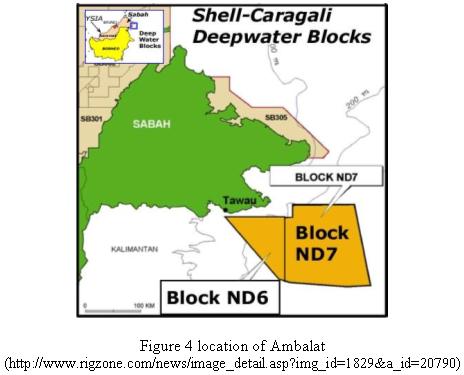
The Ambalat under-sea oil block (lower map) is the small area of water in the Celebes Sea just off Tawau. Ambalat is subject to a territorial dispute between Indonesia and Malaysia as it lies off the coast on the border of Indonesia's province of East Kalimantan and southeast of the Malaysian state of Sabah.

Malaysia refers to part of the Ambalat Block as Block ND 6 while part of the East Ambalat Block is referred to as Block ND 7. These under-sea blocks are rich in crude oil. Also shown is the Strait of Malacca, once reported by the Malaysian Navy as being too shallow for its Scorpene submarines!
-
Indonesia's ANTARA News, June 11, 2009, reports:
-
"Kuala Lumpur (ANTARA News) - Chief of the Malaysian Navy Admiral Abdul Aziz Jaafar on Wednesday offered an apology to the Indonesian people over the Ambalat issue."We offer an apology if we are considered violating Indonesian territory. We also offer an apology if any of Malaysian naval officers has been involved in a provocative act.

We will find them and take stern measures against them," Abdul Aziz said at a meeting with a five-member Indonesian parliamentary delegation at his office here.

He assured the Indonesian legislators of the Malaysian Navy`s pledge not to deploy a Scorpene submarine at the Ambalat block in a show of force."We are deploying a Scorpene submarine in the deep sea off [Kota] Kinabalu city. We cannot deploy it in the Malacca Strait which has shallow waters. We will never send Scorpene to the Sulawesi Strait [Makassar Strait?] because it will destroy coral reefs there," he said.

"To be honest, we don`t want to destroy the Indonesian people`s perception of Malaysia. We are neighboring nations who belong to the same stock," he said."I assure you that the happening will not recur. I also have made a request to hold talks with the Indonesian naval chief of staff about the issue," he said.

The Indonesian parliamentary delegation is made up of Yusron Ihza Mahendra, Shidqi Wahab, Djoko Susilo, Andreas Pareara, and Happy Bone Zulkarnaen, all of them members of the House Commission for defense, information and foreign affairs.Yusron who led the delegation said he was satisfied with the results of his meeting with the Malaysian naval chief.

Relations between the two neighboring states have become tense following reports Malaysian warships had encroached on the Indonesian territory in the Ambalat waters. Late last month, Indonesia`s KRI Untung Surapati-872 warship managed to drive away a Malaysian warship, the KD Yu-3500, which had tried to trespass Indonesian waters in the Ambalat Block. A day earlier, the Indonesian Navy`s KRI Hasanudin-366 also drove away KD Baung-3509, a helicopter of the Malaysian Maritime Enforcement Agency, and a Malaysian Beachraft which tried to enter the Ambalat Block.

Foreign Ministry spokesman Teuku Faizasyah said here on Friday Indonesia had so far sent 36 protest notes to Malaysia about border violation committed by Malaysian patrol boats in Ambalat waters."The 36th protest note was sent to Kuala Lumpur on Thursday (June 4)," he said. The latest protest note was conveyed after the foreign ministry had obtained details on the realities on the ground from the Indonesian Navy, he said.

Malaysia claims the area based on a 1979 maritime map while Indonesia bases its claim on provisions in the 1982 UN Convention on the Law of the Seas."
-
Comment
-
It is highly significant that the apology is coming from a military man rather than some lesser PR spokesman in the Malaysian Government. This may cause some bitterness amongst the Malaysian military towards their own government.
-
Malaysia has two French built Scorpene submarines, the KD Tunku Abdul Rahman and the KD Tun Abdul Razak. 
-
Pete

February 20, 2012

Further Delays to Indonesian Submarine Purchase Plans

Where have the Indonesian Kilo submarines gone? of August 26, 2009 highlighted significant contraditions in Indonesian statements concerning the purchasing process for two new submarines (to replace its two old HDW 209s) as well as lengthy delays. The following article from Jakarta Globe, October 5, 2009, implies longer delays:

"...[Navy Chief Admiral Tedjo Edhy Purdijatno] had expressed his displeasure two months ago when he heard a senior official from the Ministry of Defense tell a journalist that the government had decided to postpone the purchase. Further evidence of that decision surfaced when the submarine purchasing program was conspicuously absent from the 2010 budget approved by the House of Representative last week.

Tedjo told journalists that the Navy would get in line with the government decision to table the purchase of submarines until 2011, which means the vessels would not be received until 2014.
...He said the plan to purchase new subs had been based on current defense threats in the region, citing a low-level underwater arms race with neighboring countries like Malaysia, which has recently received the first of four [wrong - Malaysia has received one and only one more on order] French-made Scorpene subs on order.

Tedjo said due to the delays in the purchasing plans, the country would have to rely more heavily on diplomacy and other “soft power” approaches. “And we are also trying to increase the capacity of our existing fleet, such as plans to use missile launchers on patrol ships we already own,” Tedjo said.

Separately, Defense Minister Juwono Sudarsono said limitations in the defense budget had forced officials to a review all plans to purchase weaponry. “And recent natural disasters have made us switch our plans to purchase transport aircraft, ships and vehicles, rather than purchasing heavy weaponry,”..."
-
Comment
-
Given that it usually takes 5 years from announced intention to buy (2011) the Indonesian Navy may well see the first of its new submarines (probably from Russia or South Korea) in a Javanese port no earlier than 2016. Still the ability of the Navy to handle the increasing number of Indonesia's identified natural disasters is understandably a higher priority.
-
Pete

February 7, 2012

Malaysian Issues - Protests and (Separatly) Scorpene Submarines

Malaysian protester arrested by police.
-
Agence France Press reported July 14, 2011:

"US airs concerns on Malaysia crackdown"

"WASHINGTON — The United States on Wednesday voiced concern about Malaysia's weekend crackdown on an opposition-backed rally and said it would keep an eye on developments.

Riot police fired tear gas and water cannons to end Saturday's rally to demand electoral changes and arrested more than 1,600 people. One demonstrator was killed.

"We do have some concerns," State Department spokesman Mark Toner told reporters. "We... continue to stand for the right for people to freely express their democratic aspirations and express their views freely."

"I would stress that those must be peaceful demonstrations," Toner said. "We continue to monitor the situation closely."... FULL ARTICLE
-
COMMENT
-
Malaysia is in the unenviable situation of having a finely balanced ethnic mix that is similar in some respects to Fiji in the 1970s. That is the number of comparative newcomers (as early as the 15th century but mainly in the last 200 years) is similar to the number of more indigenous people. Malaysia is attempting to avoid the types of upheavals (social and in government structure) suffered in Fiji.
-
However some Malaysian laws regarding race and other democratic issues (such as a right to protest) are unacceptable to the US (with its worldwide mission of western style freedom of speech).
-
Scorpene Submarines
-
The geographic division of Malaysia between West (Peninsula) Malaysia and East (part of the island of Borneo) Malaysia separated by the South China Sea complicates Malaysian governance and strategic defence. Malaysia's purchase of two French Scorpene submarines is partly to this separation by geographical separation as well as protection of the future undersea (Ambalat) oil fields Malaysia claims.
-
Pete