September 30, 2025

Saab Kockum now offering Singaporean warships in Europe

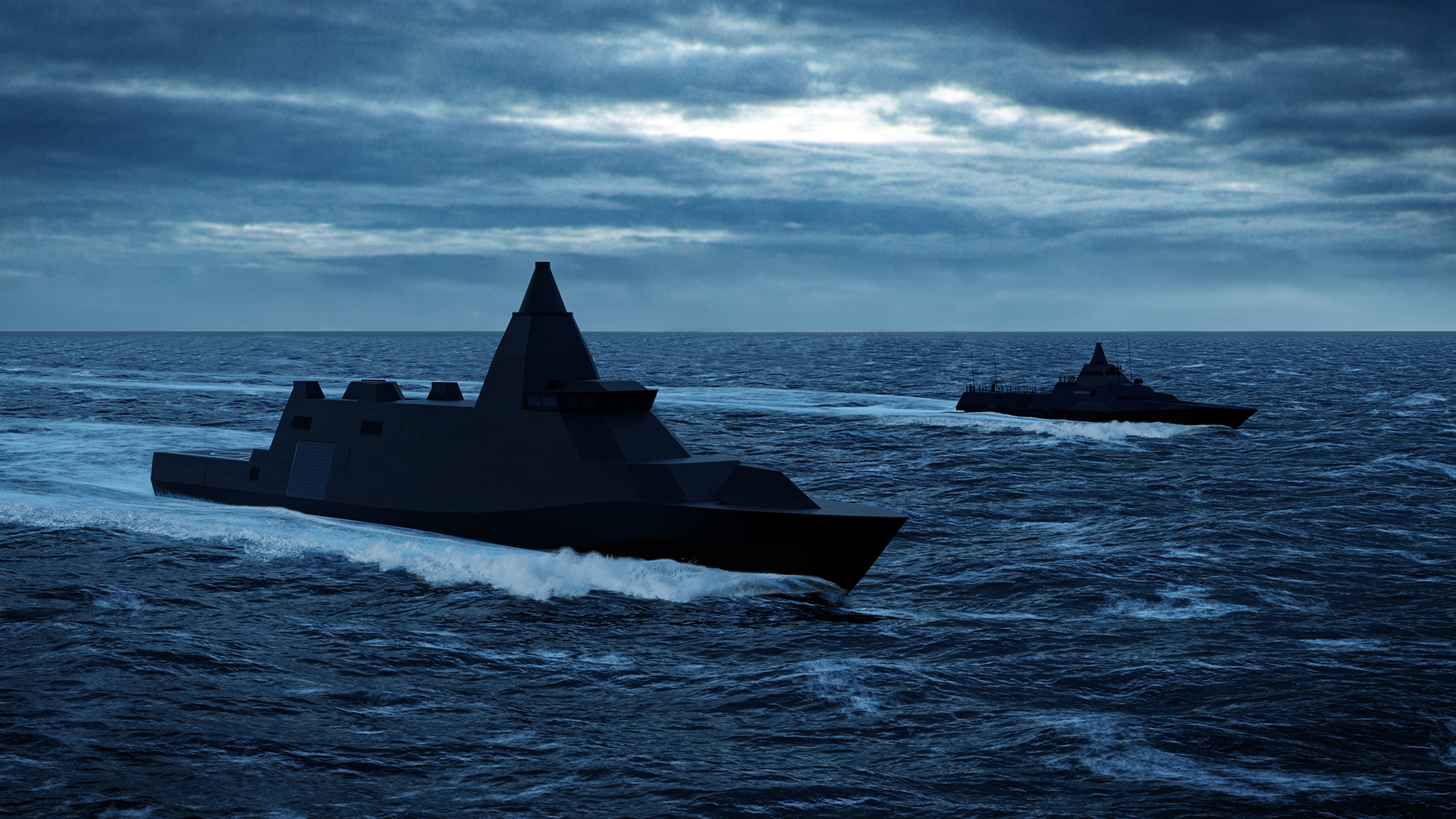
NavalNews recently published an article about Saab Kockums and ST Engineering offering the Independence-class Littoral Mission Vessel (LMV) to Estonia. The article featured a video interview with Maxwell Linton, Head of Sales for Saab Kockum at biennial UK based Defence and Security Equipment International DSEI 2025. The video (below and embedded in the article) revealed the basic model for the Ytstridsfartyg 2030 (YSF2030) or Luleå-class a >120m frigate sized "corvette" (in the middle, below). This, Sweden's next-generation surface ship program. Also of interest are the two models that were shown with the YSF model.


Image capture from Naval News video
---

Displayed alongside are models of the Republic of Singapore Navy's (RSN) upcoming 150m Multi Role Combat Vessel (MRCV) and the in service 80m Independence-class Littoral Mission Vessel (LMV). The YSF model shows its comparative size (if all models are to similar scale), and shares design similarities in the bridge, superstructure and location of a flex deck/missile deck.

Image capture from Naval News video.
---

In an article in March 2024, I mentioned that the YSF2030 program was revised due to Russia's 2022 invasion of Ukraine and Sweden's entry into NATO. The initial intent was for an around 80m Visby replacement class, which then morphed into an around 120m, larger, more capable platform to handle NATO commitments. Still, apart from a silhouette released by the Swedish Defence Material Administration (FMV), few details have been released. 

What we do know now is that Sweden still requires the first of four ships to be in service in 2030, with all four delivered by 2035. This timeline is frankly overly ambitious, which is why the FMV has also researched into 'military of the shelf' solutions such as Naval Group's FDI frigate. 

As for the Singaporean designs, Saab Kockum and Danish company Odense Maritime Technology OMT , jointly developed the design for the 6-ship 150m MRCV program from aspects of the Iver Huitfeldt-class and Visby-class. Saab will supply its composite superstructures. Saab Kockum also contributed to the design of the Independence-class LMVs and provided the composite superstructure for this class. 

As the video below elaborates, the appearance of both Singaporean warships at Saab Knockum's booth caught the eye of Xavier Vavasseur from Naval News. He spoke to Maxwell Linton about Saab offering the MRCV and LMV variants to European countries, in particular, Estonia, which requires 10-12 naval vessels by 2035 for several roles, all of which could be filled by the LMV, which has proven its modular system and unmanned capabilities in RSN service.

Estonia is also the first nation to operate the Israeli/Singaporean Blue Spear SSM


As this video shows, Linton was light on details about which European countries Saab Kockums has approached, apart from Estonia. This is likely because OMT could be positioning the MRCV for the upcoming Danish air warfare defence frigate replacement program.

September 29, 2025

"Will Laser Enrichment Be the Future of Nuclear Fuel?"

Matthew L. Wald, writing at The Breakthrough Institute website, has produced an excellent article on the political, economic and technical background of laser enrichment. Much of the article centers on Global Laser Enrichment (GLE). Wilmington, North Carolina, based GLE is a joint venture business 51% owned by Australia's SILEX and 49% owned by Cameco (a large Canadian uranium mining and enrichment company). Towards the end of his article Matthew L. Wald reveals GLE has technical competitors:

"...South African firm, ASP Isotopes, which is developing a laser system for separating isotopes of uranium and other elements. There are other laser technologies in various stages."

Matthew L Wald's article (below) is entitled "Will Laser Enrichment Be the Future of Nuclear Fuel?: The [US] Department of Energy Has an Opportunity to Support Innovation", dated April 9, 2025, at

https://thebreakthrough.org/issues/energy/will-laser-enrichment-be-the-future-of-nuclear-fuel

"Say “nuclear renaissance” and what comes to mind is new, advanced reactors, but radical innovation in the fuel supply chain would be crucial to a world with more nuclear power.

The [US] Department of Energy, with a mandate to “re-shore” reactor fuel production, is facing a decision about the vast store of depleted uranium, left over from decades of low-efficiency enrichment work. If the DOE is bold, it could open the door to a third-generation enrichment technology. The moment is ripe as Western companies and governments seek to replace Russia as a supplier of enriched uranium.

That new technology is laser enrichment, which could be used on hundreds of thousands of tons of depleted uranium to scavenge the more fissile uranium isotope, U-235, left behind in the original enrichment process. Deploying laser enrichment technology could reduce the waste disposal burden on the Energy Department and expand critical enrichment capacity without further stressing an already bottlenecked supply of uranium hexafluoride, the chemical form of uranium used in the enrichment process.

Despite extensive work since the 1980s, laser separation remains commercially unproven. And the price for a first-of-a-kind project is not clear. Any project would be high risk—far too high for most private sector investors. But, by an accident of history, it is a risk that the United States is uniquely in position to take.

Making Up for Past Wasteful Behavior

The immediate target for laser enrichment is an unusual stockpile of depleted uranium started by the Manhattan Project, continued by the Atomic Energy Commission, and now under the auspices of the DOE. This is material in which the content of uranium 235 has been reduced below the natural level of .7 percent. But the Energy Department’s stockpile has more U-235 left in it than most other stockpiles, because most of that uranium was enriched in an era before centrifuge enrichment using a more-expensive process called gaseous diffusion. In the 60s through the 90s, it was easier for the department to get the necessary quantities of enriched material by using a lot of uranium, and not being particularly thorough in plucking out the U-235. In addition, before the fall of the Soviet Union, the global market for enrichment was strong, so there was pressure to produce as much enriched material as possible, another reason that the government wasn’t very thorough. Some of the uranium “tails” have a uranium content in the range of .3 to .4 percent, meaning that the enrichment process captured only about half the available U-235.

Russian and European companies did much of their enrichment work later, in a period when demand for enrichment was weaker. Thus they had spare enrichment capacity, and nothing else to use it for, because the centrifuges cannot be turned off once they are running. So Russia and Europe ran the uranium hexafluoride through their centrifuges more thoroughly, processing the same uranium through more cycles, a technique called “underfeeding,” and produced tails at .2 percent U-235 or lower, which is less attractive for re-enrichment.

But as much as the change from gaseous diffusion to centrifuges was a technological leap, another may be coming.

Among the six companies approved by the DOE last October in an ”umbrella contract” as eligible to supply enrichment to the government was GLE, which uses lasers. It wants to start work on Government stockpiles at a former gaseous diffusion plant in Paducah, Kentucky. The material there is already compounded with fluorine, in a form called uranium hexafluoride, which is what is needed for processing with centrifuges or lasers. Eventually, the material will have to be “de-converted,” with the fluorine separated and sold for re-use. The uranium will be combined with oxygen, becoming a form of chemically inert rust. And then it will be buried, probably in Texas.

Processing it with lasers would modestly reduce the volume that must be de-converted and then buried.

“We are waiting for the DOE to issue task orders that have meaningful funding behind them,” said Nima Ashkeboussi, Vice President for Government Relations and Communications at GLE. Congress has allocated $2.7 billion for the DOE to establish an enriched uranium reserve to induce producers to make the material so that it will be ready if and when advanced reactors demand it. Most of those reactors want fuel enriched to nearly 20 percent.

The world of uranium enrichment is small, and the financial details are often opaque. GLE has not said what this would cost, but Ashkeboussi said that a first-of-a-kind plant was an opportunity to learn how to bring costs down. GLE already has a test module running at a GE campus in Wilmington, NC. (GE used to own the technology, but it is now owned 51 percent by Silex, an Australian concern that holds the patent, and 49 percent by Cameco, the big Canadian mining company that also owns part of Westinghouse.)

Ashkeboussi said that his company has acquired 650 acres adjacent to the government’s Paducah facility, and would use 200 acres to build a plant that would raise the U-235 content back up to the natural level of .7 percent. From there the company could raise it to levels useful in a light-water reactor, or it could be sold to another enrichment company to do that work. Today’s reactors run on enrichments of around 5 percent, called Low Enriched Uranium, but advanced models are designed for High Assay Low Enriched Uranium, or HALEU, approaching 20 percent.

A Market Ripe for Change

If laser operation emerges as a commercial contender, it would be entering a market where the underlying economics depend on a complicated mix of history and politics. Russia has about 40 percent of the enrichment capacity globally, and since its invasion of Ukraine, western companies are scrambling to reduce dependency.

Laser enrichment has a long history, thus far inconclusive. Like gaseous diffusion, invented as part of the Manhattan Project, and centrifuges, which supplanted gaseous diffusion in the 1990s, laser enrichment works by exploiting the very small difference in mass between the two natural forms of uranium, U-235 and U-238. In all three methods, uranium is compounded with fluorine, into uranium hexafluoride, or UF6.

Centrifuges work by spinning a few grams of the compound, in its gaseous phase, so that it is subjected to a force hundreds of thousands of times stronger than gravity. Centrifuges spit out two streams of UF6 gas, one very slightly enriched and one very slightly depleted, but when hundreds of centrifuges are arranged in series, the final product can be enriched above 90 percent. The limit for civil uranium is 20 percent.

Lasers, proponents say, do a much more thorough job in a much smaller number of passes. The laser is tuned to a frequency that differentially excites the two kinds of molecules. GLE will not describe the precise mechanism, but published sources hint that it has to do with suppressing the condensation of the molecules with U-235 so they can be separated.

Lasers can work with a smaller physical footprint – and smaller capital expense—because they handle more material than a centrifuge does.

And just as centrifuges made the process smaller and less energy-intensive, laser enrichment would continue both trends, although the energy improvement would be modest compared to the jump from gaseous diffusion to centrifuges, which cut the electricity requirement by more than 90 percent. The two trends make laser enrichment commercially attractive but also raise proliferation concerns.

GLE got a license from the Nuclear Regulatory Commission in 2012 to build a plant that could enrich up to 8 percent, and produce 6 million separative work units, or SWU, a year. (The entire American consumption is about 15 million SWU a year.) But after Fukushima, market conditions were not favorable. Lately, though, the company has been gearing up for expansion.

Adding Flexibility

The industry has historically been hesitant to expand without firm contracts in hand, because the centrifuges are designed to start up and run their entire lifetimes— decades. Lasers, though, can be turned on and off.

GLE is not alone in the field. TerraPower, which is building a fast reactor that will run on HALEU, signed an agreement last fall with the South African firm, ASP Isotopes, which is developing a laser system for separating isotopes of uranium and other elements. There are other laser technologies in various stages.

Moving towards lasers requires tolerance for risk. Over time, Democrats and Republicans have varied in their outlook on how much risk the government should take to advance technologies that would be of general benefit. Republicans pummeled the Democrats when Obama’s Energy Department loaned $535 million to an innovative solar company called Solyndra, and the company could not repay. Oddly, that ended up being a commercial risk as much as a technical one, because Solyndra’s product was delivered roughly on time and on budget, but was not viable because it had been overtaken by other solar technology.

Trump himself displayed some risk tolerance in 2018, when he signed the law creating the Advanced Reactor Demonstration Project, which heavily subsidizes the construction of two reactors that need higher enriched fuel. More recently, though, the current Trump administration has cast doubt on the value of the Advanced Research Projects Agency-Energy (known as ARPA-E, in imitation of the better-known Defense Department version, DARPA), although the new Energy Secretary, Chris Wrightsupports it.

Trump also seems likely to end some work by the Energy Department’s Loan Programs Office, which has also nurtured emerging technologies.

Laser enrichment is the kind of multi-application technology that in earlier years, the Energy Department liked to nurture. In addition to reactor fuel, there are medical isotopes that can be purified with that technology, and the silicon used in computer chips can also be processed using lasers.

Laser enrichment could be another Solyndra. Or it could be like directional drilling, 3D seismic and supercomputing, all advanced by the Department of Energy, and all contributing to the fracking revolution. Looking for an advocate with the financial stamina to try it out, and the raw material that needs processing, the logical candidate is Uncle Sam.

And the stocks of uranium hexafluoride at the department’s former enrichment sites are the logical place to start. That would recover a valuable resource, fissionable uranium, from what will eventually be waste."


SEE OTHER ARTICLES BY MATTHEW L. WALD HERE.

September 28, 2025

South Korea Exploiting "Russia Assisting North Korean Nuclear Sub" Rumour: Japan?

South Korean news website daily Korea Joong Ang on September 17, 2025 reported here :

"Russia may have supplied North with nuclear reactor, South's military says"

South Korea’s military has obtained intelligence suggesting that Russia supplied North Korea with a nuclear reactor for use in nuclear-powered submarines, and is currently working to verify the report. If confirmed, the action will have major repercussions for Seoul-Moscow relations as well as the global security order.
 
Russia is believed to have handed over two to three nuclear submarine modules to North Korea in the first half of this year, according to multiple government officials on [September 16, 2025].

These modules include the reactor, turbine and cooling system — the core components of a nuclear propulsion unit. This raises the possibility that North Korea received an entire propulsion system, including a functioning reactor. The modules were reportedly not newly manufactured but taken from decommissioned Russian submarines..."

North Korean leader Kim Jong-un inspects what appears to be a nuclear-powered strategic missile submarine [or a very large pipe] under construction at a facility in North Korea on March 8, 2025. [Photo (or animation?) from an unknown photographer of NK's official newspaper Rodong Sinmun. See when first published at https://www.nknews.org/2025/03/north-korea-releases-first-photos-of-new-nuclear-powered-missile-submarine/ ]
---

See more.

--------------------------------------------------------------------------

SHAWN COMMENT 

The decommissioned Russian modules will likely be used for North Korean (NK) nuke engineers to learn from, but we don’t know the full story - the modules could be unused components from the Amur shipyards, or from submarines scrapped in the Russian Far East, so NK could get a second hand parts kit and assemble something that works.

India returned the Chakra II/Nerpa in 2021, and she sat dockside for at least three years, so she could provide ‘scrap’ parts:
https://defence.in/threads/mystery-surrounds-future-of-ins-chakra-ii-as-satellite-imagery-reveals-it-sits-idle-at-russian-naval-base.11835/

South Korea now has a commercial SMR design, and could build an LNG carrier in the near future as a prototype. This has obvious implications to submarine naval reactors.

https://www.world-nuclear-news.org/articles/korean-designed-nuclear-powered-lng-carrier-certified

It took me a bit of searching, but I found that Samsung Heavy Industries signed a partnership with Seaborg to develop power station barges with 200-800 MWe power generation. https://enmobile.prnasia.com/releases/apac/korea-hydro-nuclear-power-samsung-heavy-industries-and-seaborg-technologies-form-consortium-to-develop-cmsr-based-floating-nuclear-power-plants-401006.shtml  

PETE COMMENT

I don't know whether "modules...comprising reactor cores, turbines and cooling systems removed from decommissioned Russian submarines." would truly be a modular concept - given all the electronic propulsion and hotel load control systems required, which would extend into the mid-front command centre half of a nuclear sub.

Also NK's ability to reverse engineer, retrofit, repair or upgrade decades old nuclear powered systems into an old or new build SSBN is doubtful.

However, this intelligence might be advantageous for South Korea (SK) given SK has been pressing the US for years to be permitted to develop nuclear powered SSNs and especially SSBNs. See 
https://gentleseas.blogspot.com/2020/10/leu-more-acceptable-for-south-korean.html

Given AUKUS now permits the US and UK to sell submarine HEU reactors to Australia (and if there is any truth in old Russian submarine reactors for NK) then France selling submarine K15 LEU reactors to SK might be increasingly equitable in proliferation terms.

Yes, there are possibilities NK could use old reactor parts.

But NK would face a new level of complexity in reverse engineering, retrofitting, repairing or upgrading decades old submarine reactors.

Thanks for https://defence.in/threads/mystery-surrounds-future-of-ins-chakra-ii-as-satellite-imagery-reveals-it-sits-idle-at-russian-naval-base.11835/

Old or refurbished Russian Akula-class SSNs or Delta-class SSBNs https://en.wikipedia.org/wiki/Delta-class_submarine or their reactors are possibilities for gifting/selling to North Korea .

Maybe the transfers would come with Russian technicians and shipyard workers to help North Korea do the NK-SSBN upgrades/repairs.

Thanks for https://www.world-nuclear-news.org/articles/korean-designed-nuclear-powered-lng-carrier-certified  If the reactor they mention is 30 to 75 MW (ELECTRICAL) then that may be sufficient for a South Korea SSBN.

In 2020 I published on South Korea's small "SMART reactor", DSME's civilian "Nuclear Propulsion Ship" proposal and the SK submarine reactor concept - see https://gentleseas.blogspot.com/2020/08/s-korean-japanese-nuclear-submarine.html . The future KSS-III Batch 3 is likely already a paper and computer generated design as nuclear powered.

SK may remain interested in France’s K15 naval reactor, used on Suffren-class SSNs. The K15 is rated at 150 MW THERMAL (MWt) while its MWe is classified (maybe 150 x 0.20 = 30 MWe).

SK has competed against its "frenemy" Japan on nuclear innovations for decades. Japan operated the failed (due to anti-nuclear protests) "Mutsu" nuclear powered ship between the 1970s-90s https://gentleseas.blogspot.com/2016/06/japanese-nuclear-propulsion-1-mutsu.html

If South Korea developed a nuclear propelled nuclear missile submarine (SSBN) Japan would likely respond by developing its own SSBN within 5 years.

September 24, 2025

Western Australian Government backs project to transform underwater defence networks

Edith Cowan University (ECU) reported on October 9, 2025 at https://www.ecu.edu.au/newsroom/articles/news/wa-government-backs-ecu-led-project-to-transform-underwater-defence-networks


“WA Government backs ECU-led project to transform underwater defence networks”

ECU "and West Australian partner Proteus Maritime has been awarded a $200,000 grant from the Western Australian Government to develop an undersea networking system to transform defence communication.

The two partners worked on the idea of an undersea mesh communications last year within the Exercise Western Dawn Innovation project, where it was named the overall winner.

The system functions like an underwater mesh network, ECU Associate Professor Iftekhar Ahmad said, enabling real-time connections between devices deep in the ocean. Rather than relying on a single hub, which could fail, each device links with others nearby, forming a resilient network that keeps information flowing even in the depths. 

"The underwater communication research team at ECU is developing advanced technologies to enhance the reliability and robustness of underwater communication across Australia's diverse undersea environments. This grant will enable the ECU team to collaborate with its industry partner in addressing critical challenges in underwater surveillance applications," Associate Professor Ahmad said.

Western Australian Defence Industries Minister, Hon Paul Papalia MLA, said the innovation will not only bolster communication between submarines, subsea drones and sensors but also potentially support scientific research as well as search and rescue operations.

"This technology will potentially give our submarines, and sea drones the upper hand with a clear line of communication even in hostile waters.

"We are proud of what our local businesses and researchers are achieving, and the State Government continue to invest in the defence sector to help it to grow," the Minister said.

The $200,000 Defence and Research Teaming grant was administered through Defence West's Defence Science Centre, which seeks to foster engagement between industry and academia to address real world problems in the defence sector."

Featuring:

September 23, 2025

Australian Invented SILEX Process Also For Weapons Grade HEU? "SILEX Treaty"

Following "Australia's Silex-GLE Completes Large Scale Uranium Enrichment Demonstration Testing" of September 17, 2025 at https://gentleseas.blogspot.com/2025/09/australias-silex-gle-completes-large.html

The Australian invented SILEX laser-based uranium enrichment process will very likely be used for parallel programs for the production of:

-  Low Enriched Uranium (LEU) less than 20% Uranium (U) 235, at the Paducah Laser Enrichment Facility (PLEF) in Kentucky, USA. Enrichment is not a linear process. Getting to 19.99% LEU might be 80% of the enrichment effort towards much higher percentages in the HEU range at US Department of Energy HEU facilities (see below and here); and 

-  (from 28 October 2029 it may become legal to use SILEX technology to enrich past 20% U-235)** ie. for Highly Enriched Uranium (HEU). PLEF enriched LEU might then be passed on to US Department of Energy HEU production facilities including the Los Alamos National Laboratory (LANL), New Mexico and Oak Ridge National Laboratory (ORNL) Tennessee, USA. HEU = more than 20% U-235 and up to 97% higher end weapons grade and for naval reactor fuel.

Los Alamos National Laboratory has a staff of 14,150. Amongst other things its mission is to "solve national security challenges" which includes "Weapons Systems" see here. See a Los Alamos documentary on Laser Isotope Separation (eg. Uranium Enrichment) below.

**  The "SILEX Treaty" of 28 October 1999, might expire after 30 or 31 years. See the wording of the "SILEX Treaty" between Australia and the USA, specifically:

[from 28 October 1999] "the agreement will remain in force for 30 years [until 28 October 2029]. It can be extended if both parties agree or terminated with one year's written notice (Article 16);"

I found out about the "SILEX Treaty" from this mention.


Here and above is Los Alamos Scientific Laboratory Presents: Laser Isotope Separation uploaded May 7, 2021 by Alan B. Carr Program Manager and the Senior Historian for the Los Alamos National Laboratory. Here is his website.

This Los Alamos documentary doesn't mention SILEX, But this may be because the documentary was made before 1982, while SILEX was developed in the 1990s. To back this up the hitherto named Los Alamos Scientific Laboratory (quoted in the documentary) was renamed the Los Alamos National Laboratory in 1981

At 10:04 into the documentary video "1976" is mentioned and reference is made to physical % enrichment limits. By 2025 there may be no % physical enrichment limitations.

Singapore hosts major Submarine Rescue Exercise while HMS Prince of Wales sails in for FPDA

Singapore is now hosting Exercise Pacific Reach 2025, a multinational Submarine Escape and Rescue exercise (SMER) with 600 participating personal from Australia, Canada, China, India, Indonesia, Italy, Japan, Malaysia, Netherlands, Singapore, the Republic of Korea, Spain, Thailand, Türkiye, United Kingdom, United Arab Emirates, Vietnam and the International Submarine Escape and Rescue Liaison Office (ISMERLO).

Image from X@indiannavy: Submarines and ships participating in Exercise Pacific Reach 2025
---


This exercise is unique as it is the first time RSS Invincible is taking part in an international exercise, alongside two other AIP submarines, ROKS Shin Dol-seok and JS Kuroshiro

A mass evacuation exercise (MASSEVEX) was staged in the waters of Changi Naval Base to simulate the evacuation of a distressed submarine, and included simulated medical treatment of decompression injuries. 

Prince of Wales returns for the Five Power Defense Arrangement (FPDABersama Lima 2025

Arriving at Changi Naval Base on 22 September 2025 was the RN flagship HMS Prince of Wales (PofW), which is on the return leg of the Carrier Strike Group CSG25 deployment. Speaking to USNI News on arrival, Commodore James Blackmore, RN CSG25 commander, highlighted that the strike group's arrival back in Singapore marks "the end of an incredible three months in this region where we have advanced military capabilities, understanding and cooperation with our partners and allies".

Image: British High Commission in Singapore. Prince of Wales berthed at Changi Naval Base
---

Prince of Wales is now taking part in Exercise Bersama Lima 25, an annual exercise for the Five Power Defense Arrangement (FPDA) between Australia, the UK, New Zealand, Malaysia and Singapore. Australia is participating with 400 ADF personnel, F-35A jets, as well as the RAN frigate HMAS Ballarat, which is part of CSG25.

As I mentioned in my July 2025 article on PofW's first visit to Singapore, the last RN aircraft carrier to take part in an FPDA exercise was HMS Invincible in 1997. 

September 17, 2025

Australia's Silex-GLE Completes Large Scale Uranium Enrichment Demonstration Testing

On September 17, 2025 Australia's Silex Systems Limited advised that Global Laser Enrichment (GLE) the exclusive licensee of the SILEX uranium enrichment technology, completed the large-scale enrichment demonstration testing campaign at its Test Loop facility in Wilmington, North Carolina. GLE has collected extensive performance data providing confidence that its laser-based uranium enrichment process will achieve TRL-6 demonstration status and can be commercially deployed.

GLE will continue its demonstration program through the course of CY2025, producing hundreds of kilograms of Low Enriched Uranium (LEU), while continuing toward building a US domestic manufacturing base and supply chain to support deployment of US domestic enrichment capacity. The results of the large-scale demonstration are subject to assessment by an independent engineering contractor, with GLE expecting to receive the completed TRL-6 assessment report by the end of CY2025.

BACKGROUND

https://www.silex.com.au/silex-technology/silex-uranium-enrichment-technology/

"Silex invented and developed the ‘SILEX’ laser isotope separation technology in Sydney during the 1990’s. The uranium enrichment application of the SILEX technology was licensed exclusively in 2006 to Global Laser Enrichment LLC (‘GLE’), a joint venture business today owned by Silex (51%) and Cameco Corporation (49%). GLE is the commercialisation vehicle for the SILEX uranium enrichment technology and is based in Wilmington, North Carolina.

The development and commercialisation program for the SILEX uranium enrichment technology is being undertaken jointly by Silex (at its Lucas Heights, Sydney facility) and GLE.

Silex and GLE have continued to accelerate construction of full-scale laser and separator equipment being deployed in GLE’s Test Loop facility in Wilmington, with the aim of completing a commercial-scale pilot demonstration (TRL-6) of the SILEX technology around mid-2025, with the completion of the TRL-6 demonstration subject to an independent assessment and report.  Attaining the TRL-6 level is a key milestone in the de-risking of the SILEX technology before the focus turns to the potential preparation for, and construction of, the first commercial SILEX uranium enrichment plant at the [Paducah Laser Enrichment Facility (PLEF)]...

The Separation of Isotopes by Laser EXcitation (SILEX) process is the only third-generation enrichment technology known to be in the advanced stages of commercial development today. The SILEX technology can effectively enrich uranium through highly selective laser excitation of the 235UF6 isotopic molecule to produce ‘reactor fuel grade’ uranium which contains an assay of U235 of around 5%. UF6 is the fluorinated gaseous form of uranium, which is made via chemical conversion from the uranium oxide produced by miners. 

The two methods of uranium enrichment used to date are Gas Diffusion (first generation – obsolete) and Gas Centrifuge (second generation). Silex’s third-generation laser-based process provides much higher enrichment process efficiency [within the US potentially right up to >90% HEU for nuclear weapons or for US/UK submarine reactor fuel] compared to these earlier methods, potentially offering significantly lower overall costs."

See the later article "Australian Invented SILEX Process Also For Weapons Grade HEU?" of September 23, 2025 at https://gentleseas.blogspot.com/2025/09/australian-invented-silex-process-also.html .

September 12, 2025

"Submarine Rotational Force" A$33 Billion AUKUS Non Event: REVISED

The decline in US SSN numbers until 2043 will prevent US second-hand SSNs being sold to Australia in the 2030s and severely limit Submarine Rotational Force numbers at HMAS Stirling in the 2030s. Australia is embarking on confusing A$multi-billion plans in the southern Perth area mainly for rare AUKUS submarines from the US and UK.

Plans include Australia spending around "$25 billion over a decade" to upgrade the Henderson shipbuilding and maintenance precinct in southern Perth, Western Australia. This, in part. aims to service SSNs. See https://www.abc.net.au/news/2025-09-13/albanese-announces-aukus-12-billion-dollar-defence-spend-perth/105770188

Australia is also spending a minimum of A$8 Billion to expand its submarine base (aka HMAS Stirling or Fleet Base West) south of Perth - money which is also going into housing for US and UK personnel and their families. The base expansion is for handling "up to" 4 US attack submarines (SSNs) and a UK Astute SSN. This is the vaunted "Submarine Rotational Force" project, under AUKUS. See https://www.abc.net.au/news/2025-09-12/inside-the-aukus-plan-to-station-american-subs-near-perth/105763818

Note - there have been loose, slow motion, rotations (or visits) of US SSNs through HMAS Stirling since 2005, if not before.

But if we build more facilities will more subs come? 

US submarine numbers will decline until at least 2043. This is tied to completion of the final US Columbia class SSBNThe Columbias are dominating US submarine production until 2042The mathematics are each of these higher priority, much larger, Columbias require the US production effort of 2.5 standard Virginias. See Industrial-Base Challenges of Building Both Columbia- and Virginia-Class Boats at https://www.congress.gov/crs-product/R41129 and endnote 37 at https://www.congress.gov/crs-product/R41129 .

The US has made major efforts to lift submarine production and maintenance for more than a decade. But the inability to attract enough skilled labour, as well as supply chain inefficiencies, has stymied these efforts.

All this means that unless the US partly transfers SSNs from US territory, like Guam, there will be no US submarines available for higher tempo rotation through  HMAS Stirling, until 2043.

Then there is the UK promise, under AUKUS, that Astute class SSNs can spend more time being rotated through HMAS Stirling. This is even less likely. The UK usually has available only two, or more often, one operational Astute(s). Due to reactor and other quality control problems the Astutes have a low rate of availability.

The main mission of these one or two operational Astutes is to protect UK SSBN  patrol activity in the Atlantic. The UK has little margin of safety to increase the rare Astute rotations (really just short visits) through HMAS Stirling.

So on top of the unlikelihood of buying US and UK SSNs this side of 2045, a significant uptick in rotations through Australia is yet another hugely expensive AUKUS gamble.

September 11, 2025

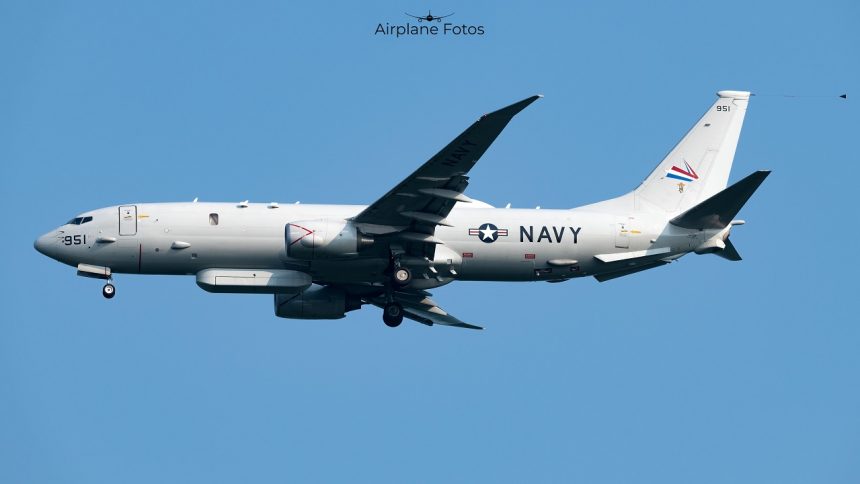
Singapore to buy 4 P-8 Poseidon MPAs: REVISED 13/08/2025

I mentioned in an article in February 2025 that Singapore was looking to replace its long serving Fokker 50 MPAs with something newer. Four Boeing P-8 Poseidons have now been selected.

Image: Wikipedia
---

The announcement came as part of a visit by Singapore’s Minister of Defence, Mr Chan Chun Sing, to the Pentagon for a meeting with the US Secretary of War, Pete Hegseth.


While the full details of the purchase are scarce at this point in time, there is some urgency in replacing the Fokker 50s, which are now 33 years old. Boeing P-8s and Airbus C-295 MPAs were referenced in the initial announcement of the MPA replacement program, but Singapore usually buys the gold standard, which is the P-8.

The P-8 Poseidon will enable the Republic of Singapore Air Force (RSAF) to conduct maritime patrols along the Sea Lines of Communication (SLOC) into the South China Sea, Andaman Sea and Gulf of Thailand.

Sea Lines of Communication and chokepoints in the Western Pacific.
Diagram from: Nagy, Stephen. (2022). Taiwan and the Indo-Pacific: Defending a global public good 
---

P-8s will also be the first RSAF airborne fixed wing asset with Anti-Submarine Warfare (ASW) capabilities, and enable Singapore a greater stand-off distance in detecting and prosecuting hostile submarines. The P-8 can also be used in other roles with an external multi-mission pod designed to accept a range of sensors and systems.  

USN P-8A Posiden testing multi-mission pod.
Image: Connor Ochs via TheAviationist)
---

Addendum

Speaking on September 13, 2025, to Singapore media at Mountain Home Air Force Base, Idaho, USA, home to the RSAF's F-15SG training squadron, Minister Chan elaborated that while the expected delivery of the P-8s would be in early 2030s, Singapore had been seeking an F-50 MPA replacement "for a few years", focusing not on platform, but capabilities, specifically "to enhance our situational awareness for the maritime security environment."

Singapore will "subsequently make announcements on other platforms that we may acquire in order to complement this capability." 


The cost to Singapore of the P-8 purchase has yet to be released, but in comparison, New Zealand ordered 4 Poseidons in 2018 - a contract then worth US$1.46 billion. All 4 aircraft for NZ were delivered by July 2023.

Singapore's evolving anti-submarine capabilities

Pete and I have chatted a number of times over the years about Singapore's antisubmarine capabilities, as it actually took a step back in 2010.

The first generation of the Republic of Singapore Navy's (RSN) ASW capabilities was the inclusion of a towed Thomson Sintra TSM 2064 variable depth sonar and A.244/S lightweight anti-submarine torpedoes with the commission of the Victory-class Missile Corvette (MCV) in 1990. 


Image: RSS Valiant, a Victory-class MCV with KD Jebat and HMAS Ballarat at Ex Kakadu 2005. Note white stern mounted VDS. Image RAN via Full Frame
---

Alongside the MCV, Singapore also commissioned 12 Fearless -class patrol vessels (PV) in 1995 with the first six equipped with Thales TSM 2362 Gudgeon hull-mounted active sonar and A.244/S lightweight ASW torpedoes. 

Thus, from 1995 to 2005, the RSN operated with 12 anti-submarine surface combatants. 

The fact that these capabilties were removed when both classes underwent MLU/SLEP from 2009 indicated that this implementation had failed, especially as these ships would need to be within 6km of a submarine to engage them with lightweight ASW torpedoes.

The second generation of the RSN's ASW capabilities arrived with the Challenger-class submarines, but we aren't going to go down the submarine rabbit hole. 

With the introduction of the Formidable-class frigates in the mid-2000s, equipped with EDO Model 980 active frequency towed sonar and S-70B Seahawk helicopters, Singapore finally had a 'proper' ASW surface combatant and its first airborne rotary ASW platform, which provided a greater stand-off range for attacks.

With the pending introduction of the MRCV from 2028, I have speculated in a previous article that Singapore will acquire a large multirole surface platform that can simultaneously handle various unmanned systems. This includes USVs with towed sonar and underwater ASW drones. But additional anti-submarine helicopters have not been ordered (at the times of this article) to coincide with the MRCV program, which may indicate that an airborne VTOL UAV for ASW could be in consideration.