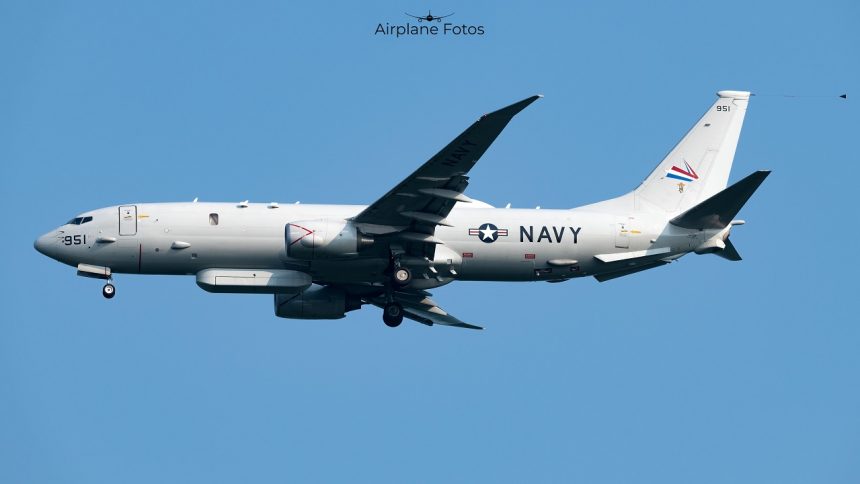
I mentioned in an article in February 2025 that Singapore was looking to replace its long serving Fokker 50 MPAs with something newer. Four Boeing P-8 Poseidons have now been selected.
 |
| Image: Wikipedia --- |
The announcement came as part of a visit by Singapore’s Minister of Defence, Mr Chan Chun Sing, to the Pentagon for a meeting with the US Secretary of War, Pete Hegseth.
While the full details of the purchase are scarce at this point in time, there is some urgency in replacing the Fokker 50s, which are now 33 years old. Boeing P-8s and Airbus C-295 MPAs were referenced in the initial announcement of the MPA replacement program, but Singapore usually buys the gold standard, which is the P-8.
The P-8 Poseidon will enable the Republic of Singapore Air Force (RSAF) to conduct maritime patrols along the Sea Lines of Communication (SLOC) into the South China Sea, Andaman Sea and Gulf of Thailand.
 |
| Sea Lines of Communication and chokepoints in the Western Pacific. Diagram from: Nagy, Stephen. (2022). Taiwan and the Indo-Pacific: Defending a global public good --- |
P-8s will also be the first RSAF airborne fixed wing asset with Anti-Submarine Warfare (ASW) capabilities, and enable Singapore a greater stand-off distance in detecting and prosecuting hostile submarines. The P-8 can also be used in other roles with an external multi-mission pod designed to accept a range of sensors and systems.
 |
| USN P-8A Posiden testing multi-mission pod. Image: Connor Ochs via TheAviationist) --- |
Addendum
Speaking on September 13, 2025, to Singapore media at Mountain Home Air Force Base, Idaho, USA, home to the RSAF's F-15SG training squadron, Minister Chan elaborated that while the expected delivery of the P-8s would be in early 2030s, Singapore had been seeking an F-50 MPA replacement "for a few years", focusing not on platform, but capabilities, specifically "to enhance our situational awareness for the maritime security environment."
Singapore will "subsequently make announcements on other platforms that we may acquire in order to complement this capability."
The cost to Singapore of the P-8 purchase has yet to be released, but in comparison, New Zealand ordered 4 Poseidons in 2018 - a contract then worth US$1.46 billion. All 4 aircraft for NZ were delivered by July 2023.
Singapore's evolving anti-submarine capabilities
Pete and I have chatted a number of times over the years about Singapore's antisubmarine capabilities, as it actually took a step back in 2010.
The first generation of the Republic of Singapore Navy's (RSN) ASW capabilities was the inclusion of a towed Thomson Sintra TSM 2064 variable depth sonar and A.244/S lightweight anti-submarine torpedoes with the commission of the Victory-class Missile Corvette (MCV) in 1990.
 |
| Image: RSS Valiant, a Victory-class MCV with KD Jebat and HMAS Ballarat at Ex Kakadu 2005. Note white stern mounted VDS. Image RAN via Full Frame. --- |
Alongside the MCV, Singapore also commissioned 12 Fearless -class patrol vessels (PV) in 1995 with the first six equipped with Thales TSM 2362 Gudgeon hull-mounted active sonar and A.244/S lightweight ASW torpedoes.
Thus, from 1995 to 2005, the RSN operated with 12 anti-submarine surface combatants.
The fact that these capabilties were removed when both classes underwent MLU/SLEP from 2009 indicated that this implementation had failed, especially as these ships would need to be within 6km of a submarine to engage them with lightweight ASW torpedoes.
The second generation of the RSN's ASW capabilities arrived with the Challenger-class submarines, but we aren't going to go down the submarine rabbit hole.
With the introduction of the Formidable-class frigates in the mid-2000s, equipped with EDO Model 980 active frequency towed sonar and S-70B Seahawk helicopters, Singapore finally had a 'proper' ASW surface combatant and its first airborne rotary ASW platform, which provided a greater stand-off range for attacks.
With the pending introduction of the MRCV from 2028, I have speculated in a previous article that Singapore will acquire a large multirole surface platform that can simultaneously handle various unmanned systems. This includes USVs with towed sonar and underwater ASW drones. But additional anti-submarine helicopters have not been ordered (at the times of this article) to coincide with the MRCV program, which may indicate that an airborne VTOL UAV for ASW could be in consideration.
3 comments:
Hi Shawn
Singapore, like Australia, buys several types of $Billion US weapons (eg. the P-8s and F-35s). All this money to the US is no longer strengthening US protection.
This is given rightwing activists, Trump and Secretary of War Hegseth are ignorant of alliance loyalties, instead recognising America First priorities and alienating name changes https://www.nbcnews.com/politics/donald-trump/trump-executive-order-rebranding-defense-department-war-department-rcna229217.
As US isolationism might be longterm, Singapore and Australia might do better buying from Europe, South Korea and Japan. Thus avoiding US disloyalty and politicly dubious entanglements, like kill switches on the US weapons we buy.
Regards Pete
Hello Pete,
Singapore does shop around the Tier One international market for the best available products that suit its requirement, otherwise it builds its own solutions, such as the MRCV, LMV, Hunter armoured fighting vehicle and the Venus USVs. The Invincible submarines are also considered a tailored solution for Singapore.
The Venus USV is also interesting as little has been mentioned about its communication suite, with most people expecting satellite comms, but Singapore has been experimenting with autonomous 5G enabled drones for at least a decade, so it’s likely that in Singapore littoral waters, these USVs use a secure military 5G network for low latency broadband.
While the F-35B and P-8s are American, they will likely have some friendly Israeli tech included, and they are the best available to Singapore.
As it currently stands Singapore purchases military systems from a mix of countries - primarily the US, Israel, Germany, France, Italy and Sweden, so if Australia has a product that fits Singapore requirements, such as Ghost Bat or Ghost Shark, then it would be purchased.
Oh, the Airbus 321 MPA is still a development project, so there’s little chance it could meet Singapore’s early 2030s deadline.
Hi Shawn
Thanks for your expanded, informative article.
Singapore is doing so much better than Australia in diversifying its international weapons sources.
Australia has taken 2 steps backwards in relying on the US for Virginia class SSNs as well as SSN-AUKUSes (also full of US equipment in its Combat System). Both classes of SSN may only reach Australia in the 2040s and end up costing more than 50% of our defence (or is that War) budget.
Even before we get the Virginias, in around 2045, we will have spent more than A$80 Billion preparing for SSNs.
Regards Pete
Post a Comment