October 20, 2014

India's Nirbhay Cruise Missile 2nd Strike Weapon


A Nirbhay cruise missile prior to testing.
----

A test of the Nirbhay cruise missile - most probably the October 17, 2014 test. 
----

PETE's COMMENT

Following a successful second test of India's Nirbhay cruise missile on October 17, 2014 it is a good time to discuss the Nirbhay's role. This second test follows the first test on March 12, 2013. Being a relatively small missile the Nirbhay (Sanskrit for "fearless") can potentially be launched by any means including land-mobile launchers, fighter-bombers, surface ships or (nuclear or conventionally propelled) submarines. The Nirbhay's warhead may be conventional high explosive, nuclear or chemical (biological is possible but increasingly unlikely). The inherent vulnerability of this subsonic cruise missile to anti-aircraft or dedicated anti-missile defences makes it less suitable as a nuclear delivery vehicle only. The dual-use or triple-use ambiguity makes it inadvisable to fire a Nirbhay as a first strike against a nuclear armed country. 

The Nirbhay might fit well into India's second strike only strategy against the most likely aggressors (Pakistan and China).  The Nirbhay's estimated range of 1,500 km would permit any part of Pakistan to be hit from Indian territory or perhaps from the Arabian Sea. From the Bay of Bengal some Chinese targets could be hit. With difficulty Nirbhay armed Indian subs could cross into the Western Pacific in order to hit some of China's major coastal cities. If fired by submarine the Nirbhay's 0.52m diameter makes it deliverable from a conventionally powered submarine's (SSK's) standard 0.533m torpedo tubes - thus giving SSKs a more potent nuclear warfare role than shorter range nuclear tipped Klub or Harpoon SLCMs allow. 

Alternatively Nirbhays could be fired from a future Indian SSN's or SSGN's vertical launch tubes - thus eventually giving India a dual-use capability for those two submarine classes. In the Indian Ocean most of India's potential targets will be non-nuclear armed countries making these dual-use subs more economical than nuclear weapon only K-15 or K-4 armed future Indian SSBNs.

Further details on the second test and comments on the Nirbhay's strategic role are at http://thediplomat.com/2014/10/meet-indias-new-nuclear-cruise-missile/ .

Pete

October 4, 2014

Soryu Submarine - Many Unknowns and Modifications Needed


A Soryu submarine SS-502 Unryu "Cloud Dragon" of the 1st Submarine Flotilla (?) in the port of Kure.
--
Graeme Dunk, writing on the Australian Strategic Policy Institute (ASPI's) blog The Strategist has written a thought provoking article of October 2, 2014,  below. Graeme argues that there are many unknowns in any purchase of Japan's Soryu as Australia's future submarine. Also many modifications would be needed for the Soryu to meet Australian requirements. The string for Graeme Dunk's article is http://www.aspistrategist.org.au/governments-and-balance-sheets-submarines-and-industry-in-australia/ :

"Governments and balance sheets—submarines and industry in Australia

2Oct 2014
It now seems a real possibility that the replacement for the Collins-class submarines might come from Japan, rather than being built in Australia as previously promised by the government. The principal argument for that proposal is the supposed cost for the capability acquired—with a figure of $25 billion being considered better value for money than the somewhat woolly $50–80 billion for the local alternative. In the Australian Financial Review on 8 September (‘Japanese subs on the way’), Prime Minister Abbott is quoted as saying that ‘The most important thing is to get the best and most capable submarines at a reasonable price for the Australian taxpayer’.
While a simple comparison of potential costs is sobering (and obviously intended to be so) the arguments presented to date have been somewhat simplistic and don’t take into account the full range of factors upon which such a decision should be based. They also show a spectacularly naïve view on what comprises capability.
In his article ‘Option J for FSM—a Japanese solution?’ Peter Briggs undertakes a comparison of the Japanese Soryu-class with the Collins-class submarine and finds that on an operational basis the Soryu doesn’t stack up as well as claimed.
What we don’t know is what’s included in the figure of $25 billion. Is it the acquisition cost only? Does it include any through-life support; and if so to what level, where? Does it include modifications to existing facilities that will be required for maintenance done in Australia, and for re-training Australia’s submariners? Does it include facilities costs in Japan to cater for a submarine that won’t be the Soryu-class—even though it might look like one from the outside? Does it include full access to the Soryu-class design and all associated intellectual property? What level of technology transfer will be provided? If it does not include all IP, what will be included and how are the risks of handling a new design to be mitigated? All of those issues have the potential vastly to inflate the stated $25 billion cost, create schedule delays, and add to the overall sovereign risk.
A similar series of questions might be aimed at the local option—although it could be reasonably assumed that the ‘$50 to $80 billion’ cost includes every cost that could conceivably be associated with a locally-built submarine. Until we get a true comparison we can’t make a sensible judgment.
What’s also clear is that the ‘Australian-Soryu’ will have a different combat system, different sonar and different weapons to the off-the-shelf version operated by the Japanese Maritime Self Defense Force. Will it also have a different propulsion system and battery to overcome the range and indiscretion-rate limitations of the Soryu? The result will be an ‘evolved-Soryu’, developed in Japan with Japanese designers and workers, rather than an ‘evolved-Collins’ developed in Australia with Australian designers and Australian workers. All the design effort to date on the evolved-Collinsand the new submarine design options will be wasted. We’ll have to—or have to pay the Japanese to—start again on the evolved-Soryu option. We’re also likely to have to pay to have the Japanese shipyards to incorporate that new design into their build program. That doesn’t seem a sensible way in which to approach the much-discussed submarine capability gap.
We seem to be heading into a strategically important decision on the basis of a short-term ‘sugar kick’ to the balance sheet, rather than sound strategic considerations. What’s required at this point is some transparency from the government—with regard to the detail of the potential purchase from Japan, and with respect to the assessment and application of strategic and sovereign risks. The pending decision is too important to be made on a whim.
Graeme Dunk is manager of Australian Business Defence Industry, a national defence industry association. Image courtesy of Flickr user mcgovernville."

October 3, 2014

China launches more ocean surveillance satellites

Long March-4B rocket carrying the Yaogan-21 satellite launched from the Taiyuan Satellite Launch Center (TSLC), known as "Base 25" in Xinzhou, Shanxi Province, North China.
---

A 2012 Long March-4B launch carrying an earlier surveillance satellite.
--

Jane's Defence Weekly's C4iSR-Maritime section reported, September 28, 2014 on the latest Chinese launches of satellites that appear to have ocean surveillance applications. Such satellites mean that surfaced submarines (not disguised in sheds or caves) would very likely be detected by Chinese military intelligence. It is unclear whether Chinese satellites can detect snorkelling-snorting submarines, yet. The article string is http://www.janes.com/article/43785/china-launches-latest-of-military-experimental-satellites


"China launches latest of military, 'experimental' satellites

28 September 2014
China launched a Long March-4B rocket carrying the Yaogan-21 remote sensing satellite and an experimental satellite, Tiantuo-2, from the Taiyuan Satellite Launch Centre [North China] on 8 September.


Tiantuo-2, which was designed and built by the National University of Defence Technology (NUDT), "will be used for scientific experiments, natural resource survey, estimation of crop yields, and disaster relief," according to Xinhua news agency.

This is the function China ascribes to most of its remote sensing satellites, but analysts believe that the Yaogan constellation is used for ocean surveillance.

The launch was the latest in a series by China. On 9 August [2014] a Long March-4C rocket launched the Yaogan-20 mission into orbit from the Jiuquan Satellite Launch Centre. While Xinhua reported the payload to be a satellite with the same purposes as the Yaogan-21, other sources indicate that the payload comprised three satellites, which were deployed in such a way that would make them suitable for operating as an ocean surveillance system.

Analysts believe that a range of sensors, encompassing electro-optical imaging, electronic intelligence (ELINT) intercept, and synthetic aperture radars, are carried by Yaogan series satellites. The first of the series, Yaogan-1, was launched on 27 April 2006 and is believed to have deployed China's first space-based synthetic aperture radar. Yaogan-9, launched on 5 March 2010, was the first deployment of a triple satellite formation, followed by similar deployments from Yaogan-16 in November 2011 and Yaogan-17 in September 2013. The Yaogan-20 triplet, which is possibly a replacement for Yaogan-9, is believed to be for ELINT, detecting ships' radar emissions, and determining emitter location through triangulation.

Internet sources, citing Xinhua, report that the experimental Tiantuo-2 carries four video cameras capable of streaming real-time data on moving objects. It is speculated that the system will be capable of tracking objects on the earth's surface using real-time ground-controlled directional alignment of the cameras. An NUDT statement reported that the satellite will be used to test technologies for more advanced video imaging satellites.

The first Chinese satellite launch of 2014 was on 31 March and was of Shijian 11-06 (SJ-11-06). Chinese media reported this as an experimental satellite and provided no further details. However, the positioning of the Shijian 11 constellation, and similarities to the launch vehicle and orbit of Shiyan Weixing 2 (SY-2), launched on 18 November 2004, which tested IR sensors, has led some analysts to believe that the purpose is to support a ballistic missile early warning system, with satellites equipped with infrared sensors to detect missile launches. SJ-11-06 is the fifth satellite in the constellation; SJ-11-04 was lost in August 2011 after failure of the second stage of the launch vehicle.

Two other launches carrying three satellites for non-military space programmes have recently taken place; from Taiyuan on 19 August and from Jiuquan on 4 September. China has a third operational satellite launch centre at Xichang in Sichuan province and a fourth is being constructed at Wenquan on Hainan Island. Chinese media have reported that the Wenquan launch centre "is almost completed and can already launch space vehicles".

It is anticipated that Wenquan will be used extensively for launches associated with the manned space programme and the Tiangong-2 space station, as it will be able to launch the larger, 5 m-diameter Long March 5 series rockets with heavier payloads. The first launch could take place later in 2014."

Connect with March 2014 article on this blog http://gentleseas.blogspot.com.au/2014/03/chinese-reconnaissance-surveillance-or.html

Pete

October 1, 2014

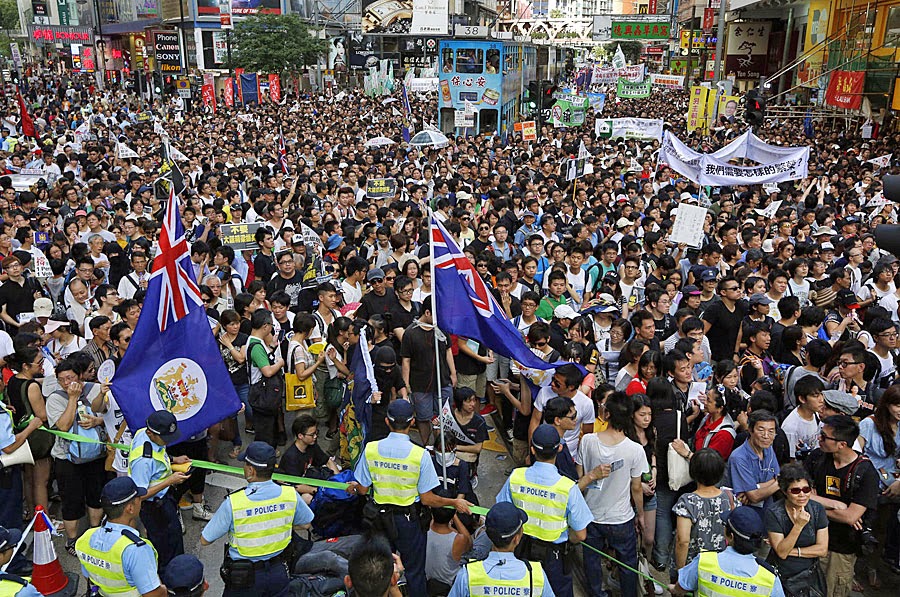
Hong Kong protests: cruisen for a bruisen Tiananmen?

Huge protests in Hong Kong. In the foreground are 2 official-up-to-1997 British-Hong Kong colonial (Chinese dragon - British lion) flags - defiantly displayed by the students.
---

Main site of the protests - next to the main PLA, Police and Hong Kong Government headquarters and intentionally blocking traffic on the city's major highways. 


I've published the following article on On Line Opinion, October 1, 2014 http://www.onlineopinion.com.au/view.asp?article=16731 :

Many thousands of Hong Kong students and broader protest groups have been defying Chinese authorities for the last few days. China's Communist Party, the ultimate ruler of Hong Kong, looks unkindly at any right to protest. The students are aiming high for a liberalised voting system freer than before. Will the tanks of the Peoples Liberation Army (PLA) crush them as they crushed an earlier generation of students at Tiananmen Square?

Two of the major figures in the protest are Joshua Wong, only 17, who lead the "Scholarism" movement against Communist indoctrination in Hong Kong schools and Benny Tai Yiu-ting, a Hong Kong University academic who created the Occupy Central With Love and Peace movement.

By mainland Chinese standards Hong Kong has it lucky – relatively prosperous, educated and almost free. Hong Kong is privileged by the "one country two systems" policy – part of the deal negotiated with Britain when Britain returned its Hong Kong colony to China in 1997. The policy allows for a version of democracy until 2047. The right of a committee to elect any candidates (no matter how communist) for leader of Hong Kong in 2017 is what the protests are about. The Communist Party wishes to appoint a small pool of authorised, pro-Communist candidates for the leadership position. As the current leader CY Leung, the "Chief Executive of Hong Kong Special Administrative Region" is suspected of being a closet member of the Communist Party he is currently the main focus of protest anger.

Hong Kong protests against the central government of Beijing itself have been limited. A continuation of the protests, particularly any aimed at Beijing involves considerable dangers for the protestors.

So far Hong Kong authorities have been using a range of tactics to handle the protests. Protestors directly defied the authorities by centring their protest next to official headquarters of the Police, PLA and Hong Kong Government (scroll down half way for map) [the map is also above this article]. On Sunday authorities first tried to disperse the protesters with police using tear gas, pepper spray and batons.However this only swelled the numbers of protesters and hardened their resolve to maintain sit-ins blocking major roads on Hong Kong island. By Monday the government withdrew the police leaving a peaceful protest that is still causing economic disruption to Hong Kong. A regular public holiday on Wednesday is expected to boost protest numbers. What happens then may be violent or peaceful.

Direct defiance of Beijing could be fatal for protesters - but they are hoping and expecting that the international media and Hong Kong's special economic status will dissuade the authorities from cracking down too hard. Adding to the unpredictability of what may happen is the relative newness of China's President Xi Jinping, who only took power in 2012. If he sees the protestors as a political threat that may spread to mainland cities the protestors may be punished severely. The Chinese President, however, would be well aware of the national shame of Tiananmen Square Massacre in 1989. In contrast most of the Hong Kong protestors would have little knowledge of Tiananmen Square because they are too young and even the Hong Kong media would censor many of the records of Beijing's more ruthless political acts.

If Beijing decides on a crackdown it is more likely that it will first send in anti-protest specialists, the paramilitary People's Armed Police (PAP), steeped in the tactics of crowd control. If the PAP is repulsed by numbers a lull may occur with the hope of peaceful dispersal through boredom. If a severe crackdown is ordered then the Tiananmen script may be dusted off with the infantry and armoured vehicles of Hong Kong's garrison being sent in. Such an attack might typically be launched at 3am to catch the students asleep and to minimise TV coverage.

Hopefully a more peaceful script will be followed. This may vary from community pressure where citizens remind the students that the economy of Hong Kong (jobs) are being disrupted with no end in sight. The Hong Kong government may plead that it will form a committee to consider student demands. Whether the government honours such an undertaking and doesn't subsequently round up the ringleaders is another thing.

An intermediate script of an arranged counter-demonstration of bussed-in Party faithful, as occurred in Great Olympic Torch mobilisation of Canberra, 2008, may also be a possibility.

In a few days we'll know what happened. The protests are bad for business in Hong Kong while a democratic Hong Kong is good for business in China. China's President Xi Jinping is an unknown quantity when his authority is really tested. In a China run by a Communist Party that is distinctly capitalist anything can happen.

Pete

September 26, 2014

Japan's Soryu - less promising Future Submarine (FSM) for Australia

Immediately below is a diagram of Australia's Collins submarine (launched 1993)

---------------
The rapid growth and turnover of Japan's 3 most recent submarines (shaded) over the last 25 years. At bottom the Harushio (launched 1989),  middle the Oyashio (launched 1996) and upper the Soryu (launched 2007)
Peter Briggs has written the excellent article below on the many downsides and risks of chosing Japan's Soryu "Option J" for Australia's Future Submarine (FSM). Peter Briggs is a retired Royal Australian Navy (RAN) submarine commanding officer and past President of the Submarine Institute of Australia.  He wrote this article on The Strategist the blog of the Australian Strategic Policy Institute (ASPI). I've put particularly interesting facts and views in red. The string for the article is http://www.aspistrategist.org.au/option-j-for-fsm-a-japanese-solution/ :

Option J for FSM—a Japanese solution?

26Sep 2014
A Collin's submarine at sunrise transiting Gage Roads. Gage Roads is the sea channel in the Indian Ocean offshore from the Collins' main base off Rockingham, Western Australia.
[ASPI's] Andrew Davies raised some interesting issues regarding the possible acquisition of Japanese submarines for Australia in his recent post, ‘Getting the submarine we want’. I’d like to take a closer look at the suitability of the Soryu.
Comparisons with the Collins class are difficult given the scarcity of published information and the fact that the Japanese platform and combat system components have been developed in an environment isolated from competition with Western/NATO suppliers.
Still, the table below provides a comparison of the Soryu and Collins class submarines using publicly available information.
CharacteristicSoryuCollinsRemarks
Surface Displacement (tonnes)2950*3100Regularly quoted displacement for Soryu (4200 tonnes) is submerged displacement, which means that Soryu carries 1300 tonnes of ballast water/external fuel. Useable space on-board is determined by the surfaced displacement. Note: since Soyru is a double hulled design some of the ballast tanks may be convertible to fuel tanks, improving the useable volume calculation.
Range (NM)6000 @ 6.5 knots9000 @ 10 knotsAustralian operations require long distance transit to reach patrol area within a reasonable timeframe. Soryu is not designed for such long transits.
Diesel Generators2 x 1400 kW3 x 1400 kWOne fewer similar powered diesels means longer snorting time for battery charging and higher indiscretion rate, i.e. reduced stealth.
Propulsion (electric motor)5900 kW5400 kWThe higher installed power on Soryu is required due to the extra ballast water carried when submerged.
Combat SystemC2 (Japanese)AN/BGY-1 (US/Aus)US based combat system fully integrated on Collins. Integration of US combat system into Soryu would be required.
TorpedoesType 89 – (Japanese)MK 48 (US/Aus)MK 48 torpedoes fully integrated on Collins. Integration of US combat system into Soryu required.
MissilesHarpoon (US)Harpoon (US)
Crew6558
Legislation and Naval RequirementsJapaneseAustralianModification of Soryu is required to meet Australian safety and technical regulatory standards.
Operational Life 16 years28 yearsChanges in design and support philosophy required for Soryu. New maintenance program required.
It’s apparent that Soryu would need to be heavily modified to meet Australian requirements, particularly for long ocean transits and patrols. This would carry cost, performance and schedule risks, and will effectively amount to a new design—it won’t be a MOTS acquisition.
The Coles Review highlighted the vital importance of establishing through-life logistic support arrangements in Australia during the submarine construction phase. For that to be done successfully it’s critical Australia has full access to the boat’s technologies—otherwise the effectiveness of the new submarines will always be reliant on the relationship with the overseas parent navy and its industrial base. To expect to access all relevant technologies during the course of an overseas build of such a complex vessel as a submarine for the initial collaboration with a country, which has no experience in such matters, is extraordinarily ambitious and inherently risky.
The cultural differences between European ship and submarine builders and ourselves have been sufficient to cause significant problems for the Collins and the Air Warfare Destroyer. The prospects for difficulties arising from cultural differences with Japan are all too apparent and real.
Careful, measured consideration of risks is required, and any proposal for a Japanese solution for the Future Submarine must address those issues. Based on the assessment possible from the limited amount of information available that doesn’t seem to have been done.
Despite the apparent political attraction of this solution, it seems most unlikely that Soryu is as capable as Collins, and it almost certainly can’t offer the sort of improvements required in FSM. Considerable development would be required before a Soryu or its successor could achieve that.
Nor can continuing political support in Japan be assumed, the current positive atmosphere is highly dependent on the personal commitment of the Japanese PM—a position that has changed 14 times in the last 15 years.
The $20bn program cost being used in the media softeners lacks any details or credibility. For example, does it include the 25–30% contingency appropriate for a developmental project with the risks and issues identified above?
Finally, all this will take time; time we don’t have if a capability gap is to be avoided. We do have time to do it properly. Using Collins as an indicator, the contract was signed in 1987 and the first submarine was delivered in 1996. While there were issues to resolve, this was a nine-year design and build program for the first of class from a greenfield site.
Option J is a distraction. An Australian-led project definition study, utilising reputable European designers, is the way ahead to provide Government with the information and maximum options for the key decisions necessary to avoid a capability gap.
Peter Briggs is a retired RAN submarine commanding officer and past President of the Submarine Institute of Australia."
PETE'S COMMENT
The article's preference that Australia work with a European submarine builder is in line with my own preference that Australia work with Germany's TKMS-HDW. For my concerns about the risks of an Australian choice of Japan's Soryu see my earlier articles on One Line Opinion

Our submarines to be built overseas?
International - 12/09/2014, and


Pete

September 25, 2014

Airstrikes on IS in Syria - the grim theatre

Map: U.S.-led airstrikes on the Islamic State and the al-Qaeda Khorasan Group in Syria.

Sources: Pentagon, CENTCOM, the Institute for the Study of War, the Long War Journal, news reports. The Washington Post.
An article I published today on On Line Opinion. The thread for the article is http://www.onlineopinion.com.au/view.asp?article=16715 .

Syrian airstrikes: same missiles, different targets


Tuesday September 23, 2014 was a busy day in a new phase of the War on Terror. As US missiles flew, jets launched and drones buzzed we slept soundly. There’s nothing like reports of airstrikes in the morning. Airstrikes have their own deadly theatre.

As with all wars in the Middle East countries have conflicting interests - though rarely has there been so much consensus against the rise of a new actor, the Islamic State (IS). IS threatens Sunni Monarchies and republics, Sunni al Qaeda, Shiites, Kurds, other minorities and Israelis.

Cruise missile targeting of Syria was expected, but didn’t happen, in August last year. But the targets are different. In the changeable world of geopolitics where morality is relative Tuesday’s targets were not the Syrian government even though it may have murdered 200,000. The Syrian government, after all, is not a threat to Israel, the US or the rest of the West including Australia. It is IS that is the main threat – so it is feeling the full force of Western anger and explosive technology.These maps give an idea of the US airbases, ships and targets in Syria.

Airstrikes generate their own theatre both for mainstream and amateur media as well as government departments. While the results are assumed to be deadly airstrike instruments detach the viewer. The last minute of this youtube is amateur footage of the bombing of Raqqa, believed to be IS’s main headquarters area. The US Defence Department took its own footage of cruise missiles being launched from the USS Arleigh Burke, a destroyer in the Red Sea. Meanwhile most of the strike aircraft came from the USS George H. W. Bush in the Persian Gulf. That carrier has the same functions as the USS Enterprise made available by the US Navy for Top Gun [a gaudy example of American culture].

IS headquarters, its leadership and vehicle parks were not the only targets. The BBC reports “The US says some of its air strikes in Syria aimed to disrupt an imminent attack on the West by al-Qaeda veterans from the so-called Khorasan group.”

President Obama’s decision to bomb IS within Syria is against his relatively pacifist nature, but it makes strategic sense as it removes one porous border that IS can operate across. The strategy also hits IS at its more established Syrian area. In some parts of Syria IS has the upper hand in a conventional military sense – with tanks – not just as an insurgency. Now IS may only be able to hide in Turkey, Lebanon or forcibly melt itself into Sunni populations - victims of IS “protection.”

As well as a sound military move Obama, in striking IS in Iraq and Syria, has pulled off a diplomatic coup that is widely supported. Support comes from the Sunni states of Bahrain, Jordan, Qatar, Saudi Arabia and the United Arab Emirates. There is tacit approval from Shiite Iran and the Shiites and Kurds in Iraq. Having made some largely symbolic diplomatic protests even Russia and China, who have their own domestic terrorism problems, appear to have accepted America’s initiative.

Obama reported the air strikes matter-of-factly without the sound bite cowboy tone of his predecessor George Bush.As the US airstrikes are against enemies of the Syrian regime Syria appears to have acquiesced. What is admitted is that the US warned the Syrian regime several hours before the airstrikes.

Australia’s new air presence (8 Super Hornets, a Wedgetail AWACS and a refueler aircraft) in the region appears an elective alliance gesture rather than a necessity by comparison. This is given the ample air assets provided by France as well as from the US Navy, Air Force and Marines (even from the US Army and CIA when drones are added). Australia’s SAS might be a more necessary contribution whether as trainers or even “advisers” who lead.

Israel appears to support the airstrikes as it always feels more secure when its US ally returns to fight in the Middle East. Israel has an ambivalent attitude to President Assad’s Syrian regime. Relations are hostile enough that Israel shot down a Syrian jetfighter in the last few days. However Israel treats the Syrian government as the devil it knows. Israel realises that if Syria were to be dominated by an anarchy of Sunni jihadis, then IS might become dominant and find some common cause with Sunni Palestinians. Israel would consider that a huge, unpredictable terrorist threat.Israel appears heartened by a wedge between its Shiite enemies - with Iran supporting the airstrikes while the Shiite militia Hezbollah opposes the strikes

This new phase in the War on Terror is a serious business, but the high-tech theatre of airstrikes also boosts US prestige and Western morale. There may be no end to this new phase for years."

Pete