June 12, 2020

Langley's Lo Hung Phúc on China - Australian Relations

A buddy from the Australia-New Zealand desk at Langley sent me the following essay. It’s by Ms Lo Hung Phúc known simply as “Phúc” by her friends and frenemies. Now Phúc’s main concern is the extent China is compromising Australia’s unquestioning strategic loyalty to the US.

A measure of US respect for Australia was the Trump Administration repeatedly getting the spelling of Australia's then Prime Minister Turnbull wrong.

Ms Phúc has come into some unexplained wealth that has raised eyebrows. Some call it Phúc’s “BBB” (Beijing Bonus Bonanza). Phúc MAY be a double for Beijing or even a triple “mole”. Who knows!

Anyways here’s Ms Phúc’s latest analysis of the threat that Australia will no longer be a vassal of  America during the unreliable, isolationist Trump Administration. For whatever reason Ms Phúc has coloured it revolutionary red...

“China hopes that Australia can have its independent China policy, and that Australia's relations with the US do not target third countries - including China.

Australia, as a key US ally, leans toward the US for security while depending on China for trade. After all, it is a Western country culturally and politically, and geographically hanging off the edge of Asia.

As a member of the Five Eyes network, an intelligence-sharing alliance among Australia, Canada, New Zealand, the UK and the US, Australia acts as a fervent US follower. When the US deems it not a good time for it to pick a fight with China at the frontline, Australia often jumps out and tests the reaction of each side.

Malcolm Turnbull, Australia's 29th prime minister, once defined the China relationship in one word - "frenemy," a portmanteau of "friend" and "enemy."

In Turnbull’s recently published memoir, he pointed to his speech during Asia's premier defense summit, the Shangri-La Dialogue, in June 2017, in which he expressed concerns over China's growing power, as the public start date of the current icy age between Australia and China.

A few months later at a conference in Melbourne, attending Australian politicians, academics and former government officials raised concerns that Australia's lack of an independent foreign policy from its conventional US-centric approach had undermined Australia's national interests.

Rational Australian experts are right in saying that Canberra's policy toward Beijing is ragged. But the question is how to save it. Australian politicians should realize that their country's security arrangements with the US and their adaptation of a rising China are not a zero-sum game.

Some Australian media have been quick to point out that China's latest Beef and Barley import suspension is revenge for an Australia-initiated inquiry into COVID-19 and called it "economic coercion."

But it's not. It's reasonable from China's point of view.

by Lo Hung Phúc”
June 11, 2020

Canadian Drug Smuggler Killed by Australian Shark

Well they say drug smuggling in shark infested waters can be dangerous. See Bob who crossed the Pacific to Australia's sunny Great Barrier Reef . Youtube below (and here ) :


Bob held his breath all the way
"Simple enough" you might say. 

But then Bob and his drugs were swallowed by something rather large. Youtube below (and here).


Moral of the story. Don't do, or smuggle, drugs. They're bad! OK!


Pete

June 9, 2020

China's Electronic Mass Surveillance System in Hong Kong Soon: Part 2

In addition to 91 million Communist Party members who, at the human intelligence level (humint) level, are required to report disloyalty to China's Ministry of State Security China has a vast electronic/internet mass surveillance system. Much of this effort is in Hong Kong already, but the new security laws will make coverage even more intense.

1. 
"Mass surveillance in China is the network of monitoring systems used by the Chinese Communist Party to supervise the lives of Chinese citizens.[1] It is primarily conducted through the government, although non-publicized corporate surveillance in connection with the Chinese government has been speculated to occur. China monitors its citizens through Internet, camera as well as through other digital technologies.[2][3] Mass surveillance in China is closely related to its Social Credit System, [see flow chart below at 2. ] and has significantly expanded under the China Internet Security Law and with the help of local companies like Tencent, Dahua Technology, Hikvision, SenseTime, ByteDance,[4] Megvii, Huawei and ZTE, among many others.[5][6][7][8][9][10][11][12] 

As of 2019, it is estimated that 200 million monitoring CCTV cameras of the "Skynet" system have been put to use in mainland China, four times as many surveillance cameras in the United States.[2][13][14] By 2020, the number of surveillance cameras in mainland China is expected to reach 626 million.[15][16][17]"

In connection with camera surveillance, the Chinese government is developing a social credit system that rates the trustworthiness of [Chinese and soon Hong Kong] citizens by analyzing their social behaviors and collecting fiscal and government data.
[79][80][81] After capturing people's activities and identifying them through facial recognition techniques, the government links their activities to this personal credit rating so that the information is stored in a quantifiable and measurable way. 

Under this algorithmic surveillance system, people, their identities, and their actions are connected to a citizen score.[82] By utilizing information gathered about the citizens' activities captured by cameras and analyzing them with AI and data mining techniques, the state calculates and updates their citizen scores regularly. 

Participation in this system is currently voluntary but will become mandatory in 2020.[3][80][82] Many Chinese citizens have already started using the Sesame Credit created and operated by Alibaba, an e-commerce company.[82] The Sesame Credit is designed such that those with good credit scores can live a more convenient life than others with low credits scores.[3][80] For instance, people with high credit scores do not need to pay deposits when checking in at hotels and can obtain visas more quickly than others.[79][80] On the other hand, people with low credit scores cannot easily eat in restaurants, register at hotels, purchase products, or travel freely.[79][80]"

MORE SEE https://en.wikipedia.org/wiki/Mass_surveillance_in_China

____________________________________________________

2.

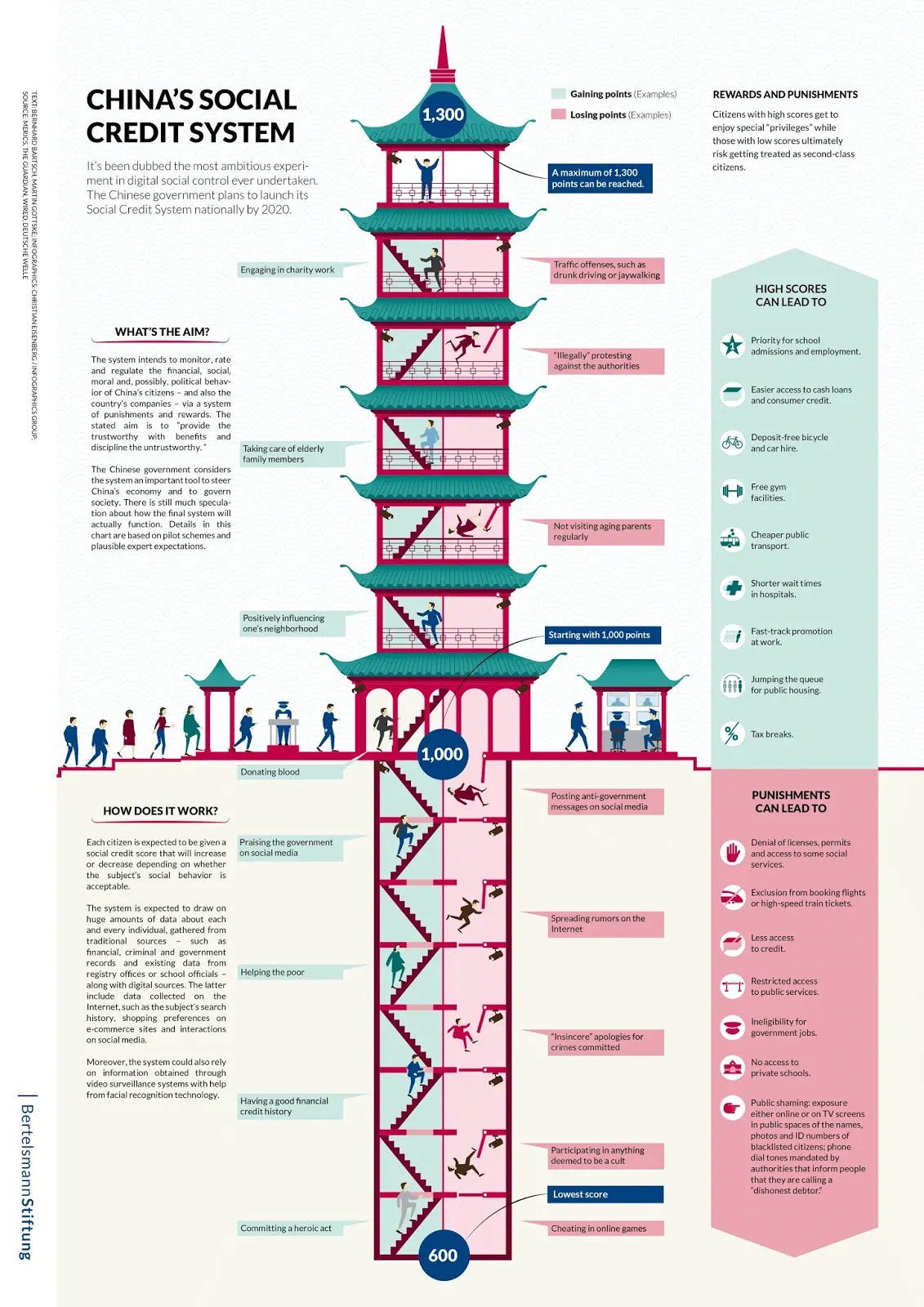
China's Social Credit System, including Travel Ban and other restrictions. Click here to vastly expand image so its readable. (Image courtesy https://nhglobalpartners.com/chinas-social-credit-system-explained/ ).

Scary!!

How to Start World War Three, in South China Sea.

https://edition.cnn.com/2020/06/07/asia/china-malaysia-indonesia-south-china-sea-intl-hnk/index.html

"...The Malaysian-authorized drill ship, the West Capella, was looking for resources in waters also claimed by Beijing, when a Chinese survey vessel, accompanied by coast guard ships, sailed into the area and began conducting scans, according to satellite images analyzed by the Asia Maritime Transparency Institute (AMTI).

Malaysia deployed naval vessels to the area, which were later backed by US warships that had been on joint exercises in the South China Sea..."

June 8, 2020

Chinese Civilian Security & Intelligence in Hong Kong: Part 1

Following on from China’s military spying on people in Hong Kong there are many more civilian intelligence employees and their informants doing the spying. Their targets include:

-  of course, current and former protesters who might retrospectively be charged with
   breaking the new security laws when enacted in a few weeks/months

-  anti-communist, pro-democracy figures (even if they haven’t attended a protest), and

-  those who have been recorded in contact with foreign representatives in Hong Kong,
   especially those Hong Kongese observed talking to or “receiving orders from” the
   US Consulate General in Hong Kong

The peak Chinese civilian external intelligence and internal security agency is the Ministry of State Security (MSS) whose public website (even in English) is here (at https://www.12339.gov.cn/.
 "12339" appears to be the MSS phone number that Chinese citizens can call to inform on somebody! So even if many in Hong Kong see themselves as separate from China they can still be monitored by MSS. To be precise monitored by MSS area Bureau No. 4 and by MSS Bureau No. 14 (responsible for "inspecting mail and telecommunications" which would work with, of be part of, China's NSA.)

Hong Kong in light green and only 1,104 square kms in size, has many islands and borders mainland China. Shenzhen can be seen just over the border. (Map courtesy TravelChinaGuide . com)
---

MSS officers in Hong Kong (population 7.5 million) no doubt number in their thousands. Many more may commute daily from the neighbouring city of Shenzhen (population 24 million). Also Hong Kongese can be monitored from MSS/Chinese NSA officers working at more remote surveillance terminals in Beijing, Shanghai or any other mainland Chinese area.

Pete

June 5, 2020

Chinese Military Security & Intelligence Already in Hong Kong

China's one party Parliament in Beijing decided on May 28, 2020 to apply China's national security laws to Hong Kong. This is unsurprising as I predicted on July 2, 2019 that this may happen, saying:

"Perhaps a broader circle of democracy activists in Hong Kong will also be arrested. The Beijing Government can suspend the legal convention that the PLA cannot interfere in Hong Kong's internal affairs. This is because the PLA has always had an underlying or active role in internal security for all regions of China." 


National security laws in most developed countries, including China, cover 4 categories:


-  terrorism, 
-  foreign interference, 
-  secession and 
-  generally subversion. 

Secession and subversion would include undermining the authority of China. even including insults to the National Anthem. 


Apart from the obvious police presence what most people inside and outside Hong Kong don't know is that China already draws on 10s of 1,000s of people including military/PLA (see below) and civilian agencies (I'll discuss them on Monday). 

Some are inside Hong Kong and even more outside (operating remote security technology that focusses on Hong Kong) to address the 4 categories.

China’s Armed Forces Garrison in Hong Kong


The People's Liberation Army's (PLA's) Hong Kong Garrison has more than 12,000 men headquartered in the PLA’s 28 storey Hong Kong Building (aka the “Prince of Wales Building” (image below courtesy "Exploringlife")) in the center of the city. 


The Garrison previously concentrated on external defence but under Beijing’s legal changes will grow significantly and with an internal security mission – especially against protesters.

Elements of the Garrison include:


-  Army (infantry, artillery, special operations commandos, armoured vehicles (with machine guns) and (significantly) an “intelligence gathering battalion”. That intelligence gathering battalion may supply some of the manpower for China's NSA to monitor landline communications/internet and mobile phones in Hong Kong, undersea cable traffic going through entering/leaving and satellite communications.

-  
Navy, and

-  
Air Force (especially helicopters carrying troops, sensors and door gunners).

The Garrison is under direct leadership of Beijing’s Central Military Commission. The Garrison's local commander is Major General Chen Daoxiang (2019–present) and the Garrison’s essential Political Commissar is Major General Cai Yongzhong (2018–present who makes sure the PLA loyally carries out the Communist Party's commands).

More about Hong Kong's civilian security intelligence apparatus on Monday.

-----------------------------------------------------------------------------------------------

In scenes intentionally evoking the cannot-be-talked-about Tiananmen Square Massacre is the Video above which includes:

0 to 40 seconds in     - dark, forbidding music, footage of PLA troops firing assault rifles, aiming a
                                    
handgun, firing sniper's rifle

40 to 58 seconds       - anti-riot drill against student-like "protesters"

58s - 1min 25 secs    - armoured cars (can be called "wheeled armoured personnel carriers") crushing
                                    
barricades, barbed wire, water canon, protesters herded under guard, 14.5mm
                                    heavy 
machine guns, more armoured cars

1min 25secs to 2min - off on tangent showing PLA's naval, attack helicopter, artillery-missile and
                                     anti-aircraft might


2min 2secs to the End - happy music, the peaceful alternative of military parades in front of
                                      appreciative, patriotic, cheering crowds and PLA civil assistance roles,
                                      raising flag, gaily goose-stepping.