February 13, 2020

Reducing the Collins & Victoria Rust Trend for Australia's Future Submarines

In response to /Kjell’s comment of February 13, 2020:

Much of the Victoria class' current maintenance problems are rust-corrosion going back as far as their long term UK storage when they were Upholders. Rust is an iron oxide while corrosion is a broader term encompasing destructive changes to iron, other metals, alloys,  ceramics and polymers


"the submarines deteriorated while in storage [sitting in seawater] and the Royal Navy was not completely forthcoming on their condition during the sale."

-----------

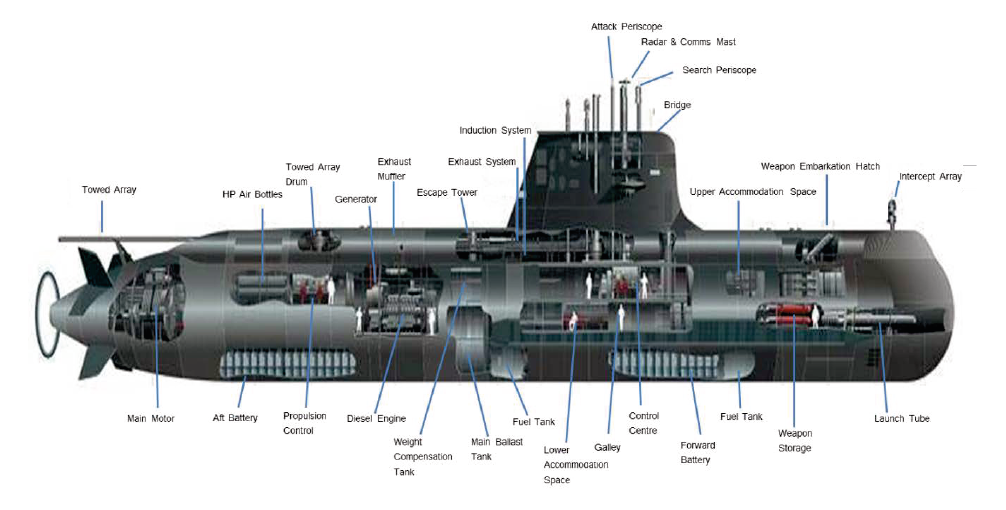
The complex fuel-water -ballast-buoyancy system of "fifteen" tanks for the Collins also suffers from excessive rust-corrosion.

See https://en.wikipedia.org/wiki/Collins-class_submarine#Propulsion_system

And see this Collins submarine image showing 2 of the Fuel Tanks and the Main Ballast Tank .

This is a major reason for the excessive A$700 million/year total maintenance bill for the Collins.

-----------

So Naval Group is especially mindful of reducing rust-corrosion problems in the 12 Australian future submarines.

Pete

February 11, 2020

Russian/Italian Joint Venture? S1000 Submarines? for Qatar?

PressTV, February 9, 2020 reports:

"Qatar is reportedly expected to acquire submarines from Italy and turn into the first Persian Gulf Arab country to operate those watercrafts.

The American business magazine Forbes reported that a new memorandum of understanding (MoU) with Italian company Fincantieri, Europe's largest shipbuilder, covers the “supply of cutting-edge naval vessels and submarines” to the Qatari Emiri Navy.


"Qatar may become the first Arab Persian Gulf state to operate submarines," the report said, adding that currently Iran is the only submarine operator in the Persian Gulf.
According to the report, the Qatari submarines, which are likely to be relatively small light ones, may be part of a much larger 5-billion-euro deal with Italy which was agreed in 2017.
...It further said that Saudi Arabia and the UAE, two of Qatar’s neighbors embroiled in a diplomatic crisis with Doha, have both stated needs to acquire submarines.
"Qatar has difficult relations these countries so the submarine acquisition could be seen, at least in part, as a response to these moves," the report added. [Pete Comment - oddly Qatar, which sits in the Persian Gulf, enjoys good relations with Iran.]

See H I Sutton's original Forbes article, of  February 4, 2020:
https://www.forbes.com/sites/hisutton/2020/02/04/qatars-massive-naval-expansion-to-include-submarines/#200f905b322e.

Pete Comment

Italian shipbuilder Fincantieri joint builds with TKMS of Germany the Type 212A/Todaro class  conventional subs.   

Fincantieri is apparently joint marketing with Russia's ROSOBORONEXPORT (with RUBIN Design Bureau as the joint builder) a smaller 1,000 - 1,100 ton concept submarine,  known as the "S1000" (see artwork with specifications below). 

S1000's "TECHNICAL INFORMATION"  section indicates the S1000 can be fitted with an Air Independent Propulsion "AIP capability (Fuel cell based) 200 kW".

As Italy is a NATO country, with access to high submarine tech, the idea of Fincantieri joint marketing with Russia the S1000 (which could be fitted with the Fuel Cell AIP system (designed in Germany? Still holding German intellectual property rights?) might be problematic.

Russian industry (in the Kilo sub ) has been unable to develop an AIP systems to compete with those of Western firms. Russia would find AIP in its Russian Navy Lada submarines to be strategically useful against the West. If Russia could at last incorporate Western AIP into its long awaited, but so far not exported, Amur 1650 and smaller Amur 950 submarines, such Russian exports could represent $Billions lost by Russia's Western submarine competitors.

Possibly Fincantieri might build much smaller submarines for Qatar (Italy has a long history building small subs) without any AIP tech/Russia complications. 


The S1000 concept submarine being marketed by Russia and Italy's Fincantieri (can include AIP).
(Artwork and specs courtesy Fincantieri)
--- 

Pete

February 7, 2020

Friday Folly: Cormorant submarine launched flying stealth drone

In the early 2000s Lockheed Martin's "Skunk Works" were developing the Multi-purpose Unmanned Aerial Vehicle (MPUAV) (Cormorant) concept. See further details by scrolling half-way down this useful National Interest article. See Lockheed's sales Youtube below.

The project was cancelled in 2008. What might be the main drawback(s) of operating Cormorant?  


Pete

February 6, 2020

Why didn't Australia choose Saab for "Son of Collins" Submarines?

At ASPI Strategist is an excellent article by Marcus Hellyer "The compounding risk in Australia’s transition to new submarines" of  February 6, 2020. 

Hellyer raises many interesting questions including: why Australia didn't build a "Son of Collins" and why Saab (which acquired Collins builder Kockums) wasn’t invited to participate in the 2015-2016 competitive evaluation process (CEP). Here is a small part of Hellyer's article:

"...[Australia's Department of] Defence has also started to reveal the scope of the life-of-type extension (LOTE) program in the 2020s] see here (page 31) and here (pages 17–22). In addition to all the usual maintenance and obsolescence management of a full-cycle docking, Defence wants to replace the Collins’ main motor, diesel generators, and electrical conversion and distribution system with new hardware made by the suppliers for the future submarine.
Interestingly, Defence has also said that these are three of the five most important systems on the future submarine. It is also looking at mast and sensor updates (for example, replacing periscopes with modern digital optronics masts) as well as combat system updates.
In short, the LOTE concept is starting to look a lot like a son of Collins—which Defence told the Senate in 2015 wasn’t worth the cost and risk involved. This poses serious questions about Defence’s risk-mitigation strategy for the submarine transition...."
See Marcus Hellyer's full, excellent article HERE.

Pete Comment
See my March 2016 articles here and here on the Collins midlife upgrade/extension issues. In addition to new hardware for the combat systems, new lead-acid batteries, more extensive than usual derusting and new sonars, adding new diesels, motors and electricals could mean more than A$1.5 Billion for each Collins. 

This price is high because these are none standard upgrades to a unique submarine type. There are no standard upgrades packages (enjoying economies of scale) that apply to TKMS Type 209s, 214s, Naval Group Scorpenes and Russian built Kilo submarines.

February 5, 2020

US New Low-Yield Nukes Also To Be Aimed at China

See "China" two-thirds the way down.

US Government funded RadioFreeEuropeRadioLiberty February 5, 2020 reports:

“U.S. Deploys New, Low-Yield Nuclear Submarine Warhead To Deter Russia”

WASHINGTON -- The U.S. Navy announced it has put into operation a low-yield, nuclear ballistic missile aboard a submarine [called submarine launched ballistic missiles (SLBMs)] as it seeks to deter adversaries like Russia.

This supplemental capability strengthens deterrence and provides the United States a prompt, more survivable low-yield strategic weapon; supports our commitment to extended deterrence,” Under Secretary of Defense for Policy John Rood said in a statement on Feb. 4.

The administration of President Donald Trump first announced its intention to deploy the W76-2 low-yield weapon in February 2018 after a review concluded there was a perception of a gap in U.S. deterrence capabilities.

The Nuclear Posture Review concluded that Russia has a strategy known as "escalate to de-escalate," in which the Kremlin would use or threaten to use low-yield nuclear weapons in a limited conventional conflict in Europe to compel the United States and NATO to back down.

"Recent Russian statements on this evolving nuclear weapons doctrine appear to lower the threshold for Moscow's first-use of nuclear weapons," the 2018 review said.

Democrats in the House of Representatives criticized the deployment of the W76-2 as “dangerous” and said the Pentagon has refused to answer Congressional questions about the weapon.

“The deployment of this warhead does nothing to make Americans safer. Instead, this destabilizing deployment further increases the potential for miscalculation during a crisis,” House Armed Services Committee Chairman Adam Smith (Democrat-Washington) said in a statement.

Russia would not be able to determine if a weapon launched from a nuclear submarine is low-yield or not, adversaries say.

[Some define the upper limit of "low-yield" as "50 kilotons"].

The Federation of American Scientists (FAS) [January 29, 2020 estimated] the W76-2 has an explosive yield of about five kilotons [equivalent to the explosive energy released by five thousand tonnes of TNTcompared with 90 kilotons for the W76-1. The atomic bomb dropped on Hiroshima had a yield of about 15 kilotons. 

The United States already has about 1,000 low-yield, nuclear weapons that can be delivered by fighter jets, FAS said. Advocates for the new submarine-based weapon say that the fighters might not be able to penetrate Russian air space.

FAS said that despite the focus on deploying the weapon to deter Russian aggression, the real target “is much more likely” to be North Korea or Iran.”

------------------------------------

FAS further commentedJanuary 29, 2020:

“The first ballistic missile submarine scheduled to deploy with the new warhead was the USSTennessee (SSBN-734), which deployed from Kings Bay Submarine Base in Georgia [USA] during the final weeks of 2019 for a deterrent patrol in the Atlantic Ocean.... We estimate that one or two of the 20 missiles on the USS Tennessee and subsequent subs will be armed with the W76-2, either singly or carrying multiple warheads...The National Security Strategy and the NPR both describe a role for nuclear weapons against “non-nuclear strategic attacks, and large-scale conventional aggression.” [hence, so far not nuclear armed Iran becomes a possible target].

---------------------------------------------------

Pete Comment

As well as intending Russia, North Korea and Iran as targets the US also may have China in mind. China may see no US equivalent to its new (probably low-yield) DF-21D anti-ship ballitic missile and DF-26 intermediate range ballistic missile. China may hope the US would hesitate to use standard higher yield 90 kiloton SLBM warheads to retaliate against DF-21D and DF-26 missiles based 100s kms inland on the Chinese mainland. US low-yield SLBMs would provide a proportionate rather than escalating US response.

China may assume that low-yield "carrier killing" DF-21D ballistic missiles may only need 5 kilotons yield to destroy US Nimitz or Ford class carriers - at the same time detroying some escort vessels in the carrier group.

Another emerging Chinese low-yield candidate may be the DF-26 with sufficient range to be "Guam busting" . Perhaps one destroying the US Naval Base Guam which hosts nuclear Submarine Squadron 15 (with 4 US SSNs). Another DF-26 might destroy the nuclear bomber capable Andersen Air Force Base on Guam which hosts B-2s (temporarily), B-1Bs and B-52s more permanently.

-----------------------------------------------------------

Low-yield concepts overlap with the "limited nuclear strike" concept that the US explored in the 1970s but then was rejected by the Carter Administration. 

The Sydney Morning Herald, December 21, 2012 reported :

"THAT America could launch a limited nuclear strike against Russia was a fashionable belief in US strategic theory of the 1970s. Policymakers thought that if Cold War tensions boiled over, they could hit selected Soviet targets in a way that controlled further escalation and forced Moscow to back down."

"Among the first targets would be the other side's command and control centres - its eyes and ears. Once blinded, a superpower - consisting of real people responding with human instincts - would not distinguish a ''controlled'' strike from a full-scale attack and would retaliate with everything it had."


Pete Comment

But that Sydney Morning Herald was written before North Korea became a nuclear threat and Iran a potential nuclear threat. Also China had not developed (likely) low-yield DF-21D and DF-26 ballistic missiles. 

Pete

February 3, 2020

Argentina may buy old Type 210 "Ula class" submarine from Norway

Argentina's La Nacion news, January 26, 2020, reports Argentina may buy one of Norway's old Type 210 "Ula" class submarines - effectively replacing the tragically sunk ARA San Juan

The specific article is https://www.lanacion.com.ar/politica/el-gobierno-negocia-con-noruega-la-compra-de-un-submarino-nid2327486 which (when right-click mouse translated) indicates:

"Although they did not [provide] abundant details, the [Argentine] Government began efforts to negotiate the possible purchase of a submarine with the naval authorities of Norway."

"It [terminated previous discussions that Argentina] had initiated with the president of Brazil, Jair Bolsonaro, for the cession of [4 old Type 209, Brazillian submarines] in an agreement destined to guarantee the joint patrolling in the South Atlantic...

...Since the tragedy of the ARA San Juan, Argentina has run out of operational submarines...."

PETE COMMENT

As Norways is buying 4 Type 212CD submarines from Germany a total of 5 more "Ula" submarines may eventually become available - perhaps for purchase by Argentina or another country (maybe Poland?).

Two Type 210 "Ula" class submarines docked at Norway's pretty Harkonsvern naval base, within the  Bergen area. (Photo courtesy Petr Šmerkl, Wikipedia)
---
  
Pete