November 26, 2018

SECRET AUSTEO Report Declassified: Australia's Iraq Preparation Problems 2002

As a contrast to the usual submarine matters, here is an Australian Report partly about Australia’s “SEALs” officially known as the “Clearance Diving Team”.

Also mentioned is that Australians were quietly training in the Middle East in 2002 for the invasion of Iraq - a year before the actual invasion. 

A problem identified by the Report is that the poor treatment of the divers "SEALs" "is blamed on an international private contractor that "prioritised its clients by profit potential"."

The news article (below) is by Australia’s government owned ABC News dated November 26, 2018 and its link: https://www.abc.net.au/news/2018-11-26/iraq-war-secrets-revealed-in-newly-declassified-report/10553150   
 
PHOTO: A member of the Australian Navy's Clearance Diving Team 3 [aka: “SEALs”] in Iraq in 2003. (Photo courtesy the Australian War Memorial via ABC News.)
---

"Australian Defence Force's Iraq war secrets revealed in newly declassified report

By ABC defence reporter Andrew Greene November 26, 2018

A secret Army study has detailed the widespread logistical problems faced by Australian forces in Iraq 15 years ago.

“Key points:

·       An elite Navy diving team had three sets of clothes and no laundry for three months
·       A combat support squadron was deployed "without … combat body armour and camouflage clothing"
·       Professor says the secrecy of the planning around Australia's involvement in Iraq led to issues”
 The report, obtained by the ABC and marked "for Australian eyes only", revealed how frontline troops were often without crucial supplies for battle and military commanders struggled to get the personnel required.
According to the 156-page document there were also deep concerns about a vaccination program for soldiers that was described as "poorly thought out".
The research, to be declassified today, was compiled by Albert Palazzo of the Australian Army's Land Warfare Studies Centre.
Dr Palazzo's report, completed in 2008, concludes the Navy's elite Clearance Diving Team 3 endured the worst logistical support, and its members were treated like "second-class citizens".
University of New South Wales Professor Clinton Fernandes, who first secured the secret study, said it detailed how ADF personnel were quietly dispatched to US CENTCOM headquarters in Florida in 2002 to begin planning the Iraq war, a year before [Australian Prime Minister] John Howard announced Australia's involvement.
"What the document shows is that the Howard Government had decided early in 2002 that it was going to join the United States in any operation in Iraq whatever it might be, but it couldn't admit this to the public or even to the Australian Defence Force (ADF) at large," he said.
"So only a few people within a very tight planning compartment were told about it.
"They had to plan in seclusion from the rest of the defence force — as a result there were lots of logistical problems."
No camouflage gear for combat support squadron.
Getting Australian personnel and equipment to the Middle East proved difficult, according to the report, because of the RAAF's "complete lack of strategic transport capability"
[Pete Comment: Australia did not acquire C-17A Strategic transport aircraft until 2006. The Hercules available in 2002 lacked sufficient range/speed/carrying capacity.] 

and the government's "inability to provide the ADF with a clear indication of its intentions and a timetable for the commitment of forces".
"By failing to make a timely announcement on the nation's participation, the Howard government succeeded in boxing itself into a corner, while at the same time abdicating one of its few strategic decision opportunities to the United States," Dr Palazzo wrote in his report.
The report describes how "commanders also encountered problems in getting the staff they wanted", often because the people with the "optimum skills" did not have valid [often diplomatic] passports and visas .
[Pete Comment: similar visa/exemption problems which required diplomatic passports for Australian Defence Force personnel recurred as a controversial issue as late as 2014].
Dr Palazzo describes force preparation as "inconsistent" and notes that units were deployed with "different levels of equipment".
"The Expeditionary Combat Support Squadron deployed without key personnel items including individual protection equipment, combat body armour and camouflage clothing," the report reads.
No laundry or fresh clothes for 'second-class' divers
According to Dr Palazzo, "the unit with the most poorly thought-out logistic plan, and the recipient of the worst support during the deployment" was the Royal Australian Navy's elite Clearance Diving Team 3.
His report said it did not take the divers long to get the "impression that they were second-class citizens as far as logistics were concerned".
Much of the poor treatment of the divers is blamed on an international private contractor that "prioritised its clients by profit potential". 

[Pete comment: For that important information see page 100 of the Report - unfortunately Totally Redacted I'm afraid :-) As revealing this information would breach Section 33(a)(iii) of “FREEDOM OF INFORMATION ACT 1982 - 

SECT 33 [being]
Documents affecting national security, defence or international relations
document is an exempt document if disclosure of the document under this Act:
(a)  would, or could reasonably be expected to, cause damage to:
      (ii)  the defence of the Commonwealth; or

      (iii)  the international relations of the Commonwealth [of Australia];”]
 "During their three months in Iraq, the divers did not receive a change of cloths (sic)," the report reads.
"They deployed with three sets of camouflage and lived in them for the duration. There were no laundry facilities at any of their locations in Iraq."
The "controversial and poorly thought-out" vaccination program to protect Australian personnel from biological weapon attacks is also heavily scrutinised in the document.
"News of the inoculation program came as a surprise to most of the troops awaiting deployment or already in the Gulf," the report reads.
"For some it caused considerable angst." [Article Text Ends]
See the actual declassified 156 page Report at Document Reader (at the bottom of the ABC News article) on which the ABC News article is based. Report is [Freedom of Information] FOI 027/18/19 declassified from SECRET AUSTEO report by Albert Palazzo “DEPLOY, SUSTAIN, RETURN AUSTRALIAN LOGISTICS AND THE WAR IN IRAQ” [Australian Army] Land Warfare Studies Centre, January 2008, at https://www.abc.net.au/news/2018-11-26/iraq-war-secrets-revealed-in-newly-declassified-report/10553150

November 23, 2018

The US Orca Extra Large UUV "XLUUV" Competition - Acoustic Testing

The competition to develop the US Navy’s Extra Large Unmanned Undersea Vehicle – XLUUV Orca has at least two initial phases: including the first phase, the design phase. In 2017, Lockheed Martin was awarded $43.2 million and Boeing $42.3 million and delivery of a technical data package.

Lockheed, on October 30, 2017, described the second phase as “a competitive production phase for up to nine vehicles” Lockheed further advised the XLUUV Orca is designed

 “to meet increasing demands for undersea operational awareness and payload delivery [eg. special hydrophones]. Key attributes include extended vehicle range, autonomy, and persistence [endurance]. Orca XLUUV will transit to an area of operation; loiter with the ability to periodically establish communications, deploy payloads, and transit home.”

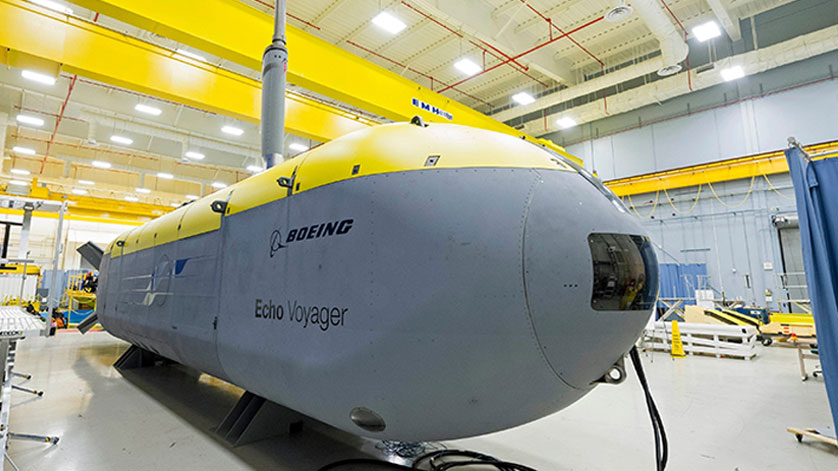
Likely shape of Boeing entrant. To develop the Echo Voyager (above) or similar Orca XLUUV entrant Boeing is working with Huntington Ingalls Industries [HII]. The Echo Voyager is 51 feet (15.55m) long. Boeing claims a 6,500 nautical mile range (on one fuel module). See SubMatt's 2016 article on the Echo Voyager's many intended capabilities.
---

Rumour is Lockheed Martin is developing a greatly enlarged "Marlin" entrant. With no Lockheed "Marlin" XLUUV being made public(?) it could be a secret project or perhaps simply hasn't been developed to a sufficient stage for public viewing (?). There are several old and existing versions of medium sized Marlin UUVs or AUVs. Above is a Marlin Mk3 - perhaps 4.9m long, 1,590kg, range 100+km and 24-60 hours endurance. Far less than the much larger Boeing Echo Voyager.  (Photo and some details here in 2013 and can be found searching AUVAC)
---

The Lockheed and Boeing XLUUVs will likely be tested at the US Navy's Lake Pend Oreille Bayview, Idaho, Acoustic Research Detachment (ARD). Testing might be part of the winning selection process. It is highly likely production models would be tested for very quiet, stealthy operation and for the efficiency of the XLUUV's sensors, including its sonars. 

Pete

Naval Group CEO in Canberra, Australia, for “Crisis Talks”

Lisa Martin has written an excellent article for the The Guardian, November 22, 2018, reporting:

"French submarine boss summoned to Canberra for crisis talks: ‘Legitimate policy differences’ and ‘personality clashes’ said to be stalling negotiations with Naval Group, tasked with building Australia’s $50bn new fleet..."

“...Naval Group chief executive Hervé Guillou travelled from Paris to [Canberra, Australia] for two days of discussions which kicked off on [November 22. 2018].

The federal government is yet to finalise a strategic partnering agreement with Naval Group, which is designing Australia’s fleet of 12 new submarines. There are hopes to have the agreement sorted by Christmas...

“...If no headway is made soon, the talks could be escalated to ministerial level or up to prime minister Scott Morrison and French president Emmanuel Macron.

“It’s understood the sticking points on negotiations include warranty issues,the level of Australian content, as well as a potential sale or merger between Naval Group and Italian shipbuilder Fincantieri.

“...Meanwhile, the federal government’s shipbuilder ASC, which is in charge of keeping six Collins subs operating until the new fleet is ready, warns Naval Group is poaching key staff...”

November 22, 2018

US Navy Submarine & ASW Landlocked Idaho, Stealth, Acoustic Research Detachment

The US Navy maintains its world's most expensive, most powerful, submarine and anti-submarine forces by maintaining large networks of bases and test facilities. Most are, of course, by the sea, but some are landlocked like the huge (by most country's standards) Lake Pend Oreille. Bayview, Idaho, Acoustic Research Detachment (ARD). 

Part of the reason for the sighting of ARD is for security. It is far from the submarine sensors and human contact of opposing forces.


Above is a seperate Youtube on what ARD does. 

From 2 minutes 35 seconds in the Youtube gets interesting when ARD's Director describes that they utilize the models to test any aspect of a submarine, the:

-  hull shape
-  materials
-  control surfaces
-  propulsor
-  even structure and systems installed inside a submarine
-  any aspect that has an impact on the submarine’s acoustic signature.

---------------------------------------------------------

Below is the official version (from the Internet November 22, 2018) of what ARD does. at https://www.navsea.navy.mil/Home/Warfare-Centers/NSWC-Carderock/Who-We-Are/Bayview-Idaho/

The 1/3 scale LSV-2 Cutthroat Virginia submarines are part of the most publically known role. 


"The [US Navy's Naval Surface Warfare Center Carderock Division (NSWCCD)] Acoustic Research Detachment (ARD) is located on Lake Pend Oreille, which is Idaho’s largest, deepest (1,150 feet), and quietest body of water providing an ideal environment for acoustic testing without the attendant problems and costs of open ocean operations. 

[The Carderock Division consists of approximately 2,000 scientists, engineers and support personnel.]

The ARD operates and supports unique Large Scale Submarine Models, Test Ranges, and acoustic test facilities utilized in conducting Research, Development, Test & Evaluation (RDT&E) of submarine acoustic stealth technology.  These state-of-the-art facilities support a wide variety of research and technology development programs ranging from submarine propulsor development to the calibration of full-scale acoustic transducers. Detachment personnel supporting the experiments form a highly capable and versatile workforce providing ARD customers a timely and quality outcome. They work closely with project scientists, engineers and technicians throughout the Carderock Division and other Navy and private organizations, to plan and conduct operations and experiments on the lake.

The results obtained during past experiments have been extremely valuable to the Navy, especially in the area of submarine propulsor design, sonar dome development, submarine construction cost avoidance, and the development of several critical submarine design features. Future plans include critical support of current and future Navy submarine design in the area of structural acoustics, hydroacoustics, propulsor development, target strength reduction, and related experiments using the unique capabilities of the ARD.  


[This is a 0.294-scale LSV-2 Cutthroat model of a Virginia (SSN-774) that is an unmanned, autonomous test vehicle for evaluating stealth technology. Weight: 205 tonnes. Length: 111 feet (34m) Beam: 10 feet (3m) Propulsion: Electric drive 3,000 shp (2.2MW?)]
--- 

The Large Scale Vehicle-2 (LSV-2), a large model of the VIRGINIA Class submarine, is being used extensively in the area of propulsor research. Large scale buoyant submarine models support testing in the area of submarine structural acoustic and hydroacoustic technology.  Target strength testing is conducted using the Intermediate Scale Measurement System (ISMS), which provides a unique acoustic test capability unsurpassed by any other available facility.

The site's technical programs typically support analytical efforts of the NSWCCD and contribute directly to the development of advanced submarine designs. These programs support the Fleet, Navy systems commands, and other defense agencies. The ARD also support private industry and research efforts of academia and our allies. 

Acoustic Research Detachment
33964 N. Main Avenue
Bayview, ID 83803-9750"


Pete

November 21, 2018

Ocean Infinity, That Found ARA San Juan, Working with US Navy

On November 19, 2018 I commented that it is possible that US Navy information of an accuracy that couldn't be made public was provided to the crew on Seabed Constructor and/or Ocean Infinity to find ARA San Juan.

Contact between the US Navy and Ocean Infinity is quite public. 


"TECHNOLOGY
OCEAN INFINITY SIGNS AGREEMENT WITH US NAVAL METEOROLOGY AND OCEANOGRAPHY COMMAND
23/07/2018

Ocean Infinity has signed a Cooperative Research and Development Agreement with the US Naval Meteorology and Oceanography Command (NMOC), based at the Space Center in Stennis, MS.  During the next five years the collaboration will focus on combining and expanding technologies relating to a broad range of deep-water platforms and sensors focused on undersea data gathering and analysis.

Ocean Infinity – the worlds’ most technologically advanced subsea operator

Since its launch in July 2017 Ocean Infinity has developed the next generation of undersea data gathering techniques.  Over the course of the last 12 months the systems and processes used by Ocean Infinity have changed materially from the initial operational concepts and ideas.  Today, no one else in the world leverages underwater technology in the same way.  Ocean Infinity’s innovative, dynamic and cost-effective approach to undersea data is of relevance to everyone who has a need or desire to better understand the ocean and seabed environment whether they be from the military, government or commercial sectors.

CEO Oliver Plunkett of Ocean Infinity commented, “We are very focused on being at the forefront of technology and this agreement to work and share knowledge with the US Navy’s experts in underwater data is an important part of maintaining our position as a world leader.  The team at Ocean Infinity have high expectations about what can be achieved and consider it a great privilege to have been given the opportunity. ”

Commander, Naval Meteorology and Oceanography Command Rear Adm. John Okon, [photo above] commented “This agreement is a natural fit between two entities striving to be at the cutting edge. Our organizations are developing integrated operational procedures which fully utilize the capabilities of autonomous platforms such as operating multiple surface and subsurface vehicles at one time to rapidly collect and disseminate critical bathymetric observations to the fleet.”"


Pete Comment

The ARA San Juan search and discovery shows that navies can perform a humanitarian service in many ways.

November 20, 2018

Recovering the submarine ARA San Juan?

Photo (from several 100m above) showing how many fragments ARA San Juan 800m has already exploded into and how likely it will crumble further. (Photo courtesy Ocean Infinity's search vessel Seabed Constructor).  
---

This is a tragedy for the relatives of ARA San Juan's crew.

-  San Juan is more than 935m down and now may weigh 2,300+ tonnes. (see right sidebar here)

-  Extremely strong, heavy, steel was crushed and exploded into fragements, or dust, by hydrogen
   explosion and by inrushing water pressure. "Pieces that were 11m, 13m and 30m
   long [and much smaller] were spotted.."

-  Recovery technology may just just break the submarine into smaller falling pieces rather than
   recover it. That is what happened in the US$Billion+ Glomar Explorer salvage expedition when
   raising a Russian submarine was attempted.

-  Even the US eventually found the Glomar Explorer expedition technically too difficult and too
   expensive.

-  Cutting of the extremely strong and heavy portions of the hull may not be possible. Its not like
   cutting the thin, light, aluminium/aluminum or thin composites of crashed airliners/planes.

-  DNA testing may prove which crew fragments have been recovered. This may be a blessing for
   some relatives, but may also raise new problems for many. Fragments of every member of
   the crew are unlikely to be recovered, meaning some families will feel forever excluded and
   wronged.

See the most full discussion (so far) of recovering San Juan in the Maritime Herald
November 19, 2018.