About subs, military/naval, missiles, nuclear weapons & politics. New Aussie subs have been just talk since 2009. Collins upgrades of partial help. UUVs help more. POTUS may cancel AUKUS Virginias in 2031 as the USN needs all SSNs to the 2040s. Australian Gov ignores US higher priority Columbia SSBNs (one/year being commissioned 2029-2041). Meaning no new Virginias 2030-41? Shawn C and Gessler are excellent authors. Pete.
The Zircon (Graphic courtesy via Russian website.)
I don't know whether the future (late 2020s) Zircon missile proves Russia can solve the heat buildup barrier to sustained hypersonic flight in the dense atmosphere. Maybe it can become hypersonic in its endrun, maybe not.
India has been talking of a joint Russian hypersonic BrahMos-II (or BrahMos-2) missile project (maybe Indian version of the Zircon?) for years. See Submarine Matters' 2013 article.
On May 24, 2016 Trump announced the cancellation of the US - (Denuclearization of) North Korea Summit which was to be held in Singapore on June 12, 2018. A 2017, page 9 Pentagon analysis (which I've just read) is similar to the May 3, 2018 comment on North Korea relying on its nuclear deterrence to prevent invasion of North Korea and Kim Dynasty regime change:
"I doubt if the neocon/militant Trump/Pompeo/Bolton would accept total withdrawal from South Korea - especially of THAAD, US aircraft and US SSN and SSGN visits to SK ports.
I think it unlikely Kim would make substantial and verifiable de-nuclearisation efforts. With timing and Devil in the Detail
If NK denuclearised it would leave itself open to "peaceful" democratic occupation by a much more attr[a]ctive wealthy SK
or the risk of a return of overwelming SK and US forces - remembering the fates of disarmed-regime changed Hussein/Iraq and Gaddafi/Libya.
Also Kim Jong-un (III) would forsake his "dynastic duty" of handing down the grim NK regime to what ever Crown Prince, Kim IV is next.”
FURTHER COMMENT It was hoped the Summit could be a positive outcome of Trump's hardline negotiating style against North Korea. But now the opportunity has been dashed. The world remains stuck with the Trump Administration's aggressively negative approach on most things. See earlier Submarine Matters' article North Korea's Nuclear Deterrent Totally Justified of May 24, 2018, on North Korea's deterrent preventing a recurrence of its history of being invaded. Pete
Causes, effects and doctrines are subtle. Before the sure handed statesman Trump and Kim meet or don't meet in Singapore on June 12, 2018 history needs recalling.
Historical mentions of Korea
are overlaid by simple moral assumptions:
- North Korea BAD
- South Korea GOOD.
From the North Korean
point of view, its status as the most invaded country in the world justifies a
nuclear deterrent to prevent regime change and merely conventional destruction. Would Kim disarm on the word of such statesman as Trump and his neocon Pompeo noting the "Libyan solution" Bolton and Pence? What would stop them?
North Korea Most Invaded?
The territory that is now North Korea has been invaded by the Chinese many times, by Mongolians, Manchus twice, Japanese several times,
Russians several times, the US three times, by UN forces (including Australians and British) twice and South Korea twice.
South Korea was no peace-loving democracy before North Korea
invaded it in the 1949 (beginning the Korean War). The invasion followed frequent South Korea vs North Korean border
clashes since 1945.
South Korea's leader, the authoritarian Syngman Rhee, killed between 14,000 and 30,000 of his own people during the Jeju uprising in 1948-49 just
before the Korean War [1].
In 1950 Rhee had between 100,000 and 200,000 South Korean Bodo League prisoners murdered [2].
North Korea's capital,
Pyongyang was bombed flat by the US Air Force during the Korea War. "By
the time of the armistice, 75 percent of Pyongyang's area was destroyed by the conventional bombing campaign, which was part of a broader U.S. bombing effort throughout
the country costing" the lives of between one and three million North Koreans by the time
the war ended [3].
Nuclear disarming North Korea, which is China's buffer zone, could bring on World War Three like nothing else.
So China has publicized the ability of its H-6K bombers to very temporarily operate (ie. land and takeoff) from Woody Island is more symbolic of visible power projection into the South China Sea (SCS) than a fundamentally new threat.
The whole SCS and surrounding nations can already be hit with more stealth and surprise by Chinese missiles from other platforms, including MRBMs, IRBMs, SLBMs and extended range SLCMs. Chinese surface ships, air-refueled jet fighters and land based cruise missiles on the islands themselves could already fire missiles at some or all of these SCS targets.
It is highly public threats, even from mainly old technology, very unstealthy, bombers, like the H-6K, that can cause anxiety in nations that have only modest anti-aircraft capabilities and generally no
anti-missile capabilities. The H-6Ks very visibility represent public and political threats. This is similar to the highly visible threat from US aircraft carrier groups when compared to the invisible and more potent threat from cruise and ballistic missile carrying US submarines.
OTHER COMMENTS
I've added links to useful comments on May 22, 2018 from:
KQN: “China is gradually
enforcing its claim on the SCS. The Nine-Dash Line has morphed into a solid line.
It is a well thought out strategy, reinforcing your territorial claims with
less than subtle threats to neighboring countries, achieving your strategic
goals while avoiding open conflicts (which would threaten the economic well
being of all). We can already predict H-6K's will
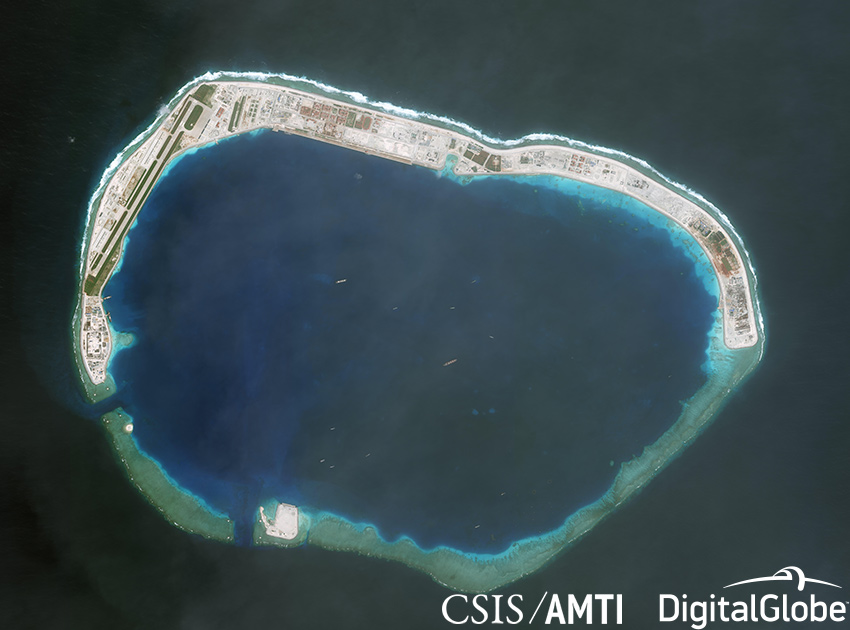
be landing next in the Spratly's. Fiery Cross, Subi and Mischief reefs all haveclass A runways, as long as the one on Woody. [See Airport Table below]. Several reinforced hangars there
are large enough for them. That will put Northern Australia and Guam within
range.” [see map below].
and
Josh “The H-6K is aerodynamically
similar to previous H-6s and Tu-16s, but the use of modern turbofans (of
Russian manufacture - the Soloviev D-30s) give it a much greater range and payload. That
said it is still a regional bomber, not an intercontinental one. Australia for
instance would be out of practical range of even cruise missiles without midair
refueling.”
The upper set of blue-black dots are potential H-6K bomber Paracel Island takeoff points, including Woody Island Air Base [see Table below]. These points put all of the South China Sea, Taiwan, Philippines, Vietnam, Laos, Cambodia, Thailand, Malaysia and Singapore within the "combat radii" of the bombers' once the bombers land attack and anti-ship cruise missiles are fired.
The lower set of dots represent H-6K bombers launched from China's Spratly Island air bases (see Table below) with combat radii extended by cruise missiles (and mid-air refueling) are able to hit all of Indonesia as well as Darwin, Australia
AIR BASES TABLE for Spratly Islands (source) and Woody Island (in Paracel Islands)
China has gone one more step in indicating it can deploy bomber power, in a theatrical way, deep into the South China Sea. This puts some more Western ships and Southeast Asian capitals, like Manila and Hanoi, into range of the cruise missiles Chinese H-6K bombers can carry. These capitals were already in range of more easily disguised land based, surface ship based and submarine based Chinese cruise missiles, not to mention IRBMs.
Like the much larger B-52s (in service 1955) the H-6Ks (airframe in service as the Russian Tu-16 in 1954) derive from very old airframes. But it is electronic countermeasures frequently updated in the B-52 and H-6K as well as their reliance on standoff cruise missiles that reduced their vulnerabilities. Their missiles keep them relevant in warfare against moderately armed enemies and they can also drop free fall bombs on less well armed insurgents or "terrorists".
ARTICLE
Hong Kong's South China Morning Postreported May 19, 2018:
"China angers US after landing warplanes, including H-6K
bomber, on South China Sea reef
Pentagon condemns military activity as ‘raising tensions
and destabilising the region’
...The Chinese air force said in a statement on its
website that several bombers, including the H-6K, its most advanced [but deployed by Russia 60 years ago!], had
conducted take-off and landing training on an island reef, though it did not
specify which one.
Hong Kong-based military observer Song Zhongping [who is really a semi-official spokesman and graduate of the PLA's Second Artillery Engineering University, no less] said the
aircraft landed on Woody Island – or Yongxing in Mandarin – the largest of the
Paracel group and southernmost of the islands claimed by Beijing in the
disputed waterway.
The aim of the exercise was to strengthen China’s
military presence in the region, after the US air force flew B-52 bombers there
during a so-called routine training mission in April [2018], which Beijing described
as “provocative move”, Song said.
The [Chinese] air force said the latest exercise had elevated its
abilities of “reaching its full territory, assaulting in full time and space,
and striking in full scope”.
Song...said the next mission for the long-range H-6K strategic bomber, which is
reported to have a combat range of up to 3,500km, might be to land on China’s
furthest outlying artificial islands.
“To boost China’s
military presence and give the PLA better control in the region, it’s possible
the H-6K will fly further in the future, to the airstrips on Fiery Cross, Subi
and Mischief reefs [in the Spratly Islands],” [Song] said.
Each of the three reefs features an airstrip,
high-frequency radar and other monitoring equipment, and lighthouses.
“In the future, the air force will conduct regular
landings on Woody and the man-made islands, although they are not yet developed
enough to be permanent military bases,” Song said..."
BACKGROUND
Woody Island with its now extended bomber capable airport (Photo courtesy AMTI.CSIS.ORG via CNN Philippines)
---
The H-6Khas a claimed
combat radius of 3,500 km (2,200 miles) and can carry up to six YJ-12 anti-ship missiles and 6
or 7 CJ-10 nuclear
or conventional warhead land attack cruise missiles ---
--
In this part unrelated Chinese propaganda video the H-6K appears at:
- 5 secs taking off possibly from Woody Island airport
- 17s two H-6Ks flying close
- 25s H-6K dropping flares as decoys against heat seeking anti-aircraft missiles
- 47s H-6K flying with J-11s?
- 53s flying towards Mischief Reef (?) but then perhaps landing on Woody Island(?)
Tomorrow I'll write how the "Woody bomber" ties into China's wider power projection geography.
The photo at top may be the J-15D Chinese carrier aircraft or the very similar J-16D Chinese airforce aircraft. These perform electronic attack or jamming an art first perfected by the UK and then US (Photo courtesy China's Daily Express ) ---
COMMENT
Just as the or electronic attackEA-18G "Growler" provides electronic warfare/jamming support to enhance the stealth capabilities of US aircraft China is also developing the J-15D and J-16D EA fast jets to obscure not yet fully developed Chinese J-20 and J-31 stealth fighters.
China's EA aircraft are just two examples of China using the world's second highest defense budget (SIPRI estimates US$228 Billion for 2017) to build the essential military backup capabilities for a formidable defence force. In contrast Russia conventional defence posture may be more threat and propaganda because Russia only has a $66 Billion budget. There are many synonyms for Electronic Attack including - Electronic Countermeasures (ECM) - Electronic Warfare (EW) - "Jamming" and "Electronic Decoys" and "Window or Chaff" may be the oldest - Artificial Intelligence (AI) is a term becoming more popular.
ARTICLE
The information below mainly draws from China's Daily Express article of April 24, 2018, on the new EA J-15D:
A New Carrier Aircraft With Electronic Attack Capabilities Appears
The Chinese navy (PLAN) has acquired a new type of carrier
aircraft, the J-15D. The J-15D is a carrier-based aircraft that mounts electronic attack pods on the tips of
its wings, underwings and perhaps centerline. The Chinese navy J-15D is similar to the Chinese Airforce J-16D (introduced in 2015).
The J-15Ds and J-16Ds serve the same purpose as the EA-18G Growler electronic fighter now deployed in the US and Australian defence forces. [Pete Comment: For other Western countries to get full value out of their F-35s they may well need to purchase equally high priced Growlers!] [Pete comment: The main difference between the naval carrier J-15D and the airforce J-16D is the J-15D would have a tail arrestor hook, stronger shock absorbers and some airframe hardening for the "controlled crash" arrested recovery operations. The naval variant J-15D would have also been developed due to commonalities of parts, systems and regular upgrades with China's common carrier jet the J-15.]
The J-15D is a two-seater (pilot
and EW officer) fast jet. It carries a variety of new types of pods for reconnaissance, attack/interference
and self-defense and can carry Eagle-Strike YJ-91
anti-radiation missiles ARMs. These
new pods provide powerful EW capabilities for land based and carrier fighter
squadrons. FURTHER COMMENT
The J-15D with wingtip and underwing electronic pods shown above. Also an underwing Eagle-Strike YJ-91 anti-radiation missile (ARM) is probably displayed. The YJ-91 would certainly have an air-to-surface capability. The YJ-91, or similar ARMs, have an air-to-air capability against large slow aircraft putting out emissions. This would enable J-15D's using YJ-91s to hit Western Airborne Warning and Control System (AWACS) aircraft at long range (100+ km) (eg. E-2s, E-3s, Australian E-7A Wedgetails and surveillance aircraft like Australian AP-3C Orions). (Photo from China's Daily Express )