March 2, 2016

Lockheed Martin's RMMV anti-mine drone may be shelved

The US Navy may shelve Lockheed Martin's Remote Minehunting System (RMS) also Remote Multi-Mission Vehicle (RMMV) program.
---
 Lockheed Martin's Remote Minehunting System (RMS) used sonars and other sensors to find mines. (Diagram courtesy panzercho)
---


"Lockheed Martin's Billion-Dollar Drone Submarine Faces Cancellation"

“And two rivals hope to profit from Lockheed's misfortune

The U.S. Navy is suspending purchases of Lockheed Martin's (NYSE:LMT) drone minisubs, and switching to an alternative product -- probably from General Dynamics …Maybe.

…The Navy has already spent more than $700 million on the "drone" in question, actually a batch of 10 remote multi-mission vehicles (RMMV) designed to operate from Navy Littoral Combat Ships on minesweeping missions. Each drone is essentially a remote-controlled minisubmarine designed to locate and mark anti-ship mines for later disposal by its mothership.

…15 years of development have failed to fix problems with the minisubs, which broke down 14 times over 300 hours of testing in recent sea trials. The Pentagon's assessment: RMMV is "not ... operationally effective."


…Bloomberg reported earlier this week that the Navy is considering several alternatives to Lockheed's drone. The leading contender right now appears to be General Dynamics' Knifefish, a similar submarine drone, which the Navy was already planning to deploy for the minesweeping mission in 2017. At an estimated $1 billion for 48 units, Knifefish promises to be a cheaper and perhaps a more effective minehunter than what Lockheed Martin is offering. [also competing is a]  Common Unmanned Surface Vehicle from Textron. 

The rapidly growing range of unmanned surface vehicles (USVs) and unmanned undersea vehicles (UUVs) (see the RMS middle-left).
---

Pete

March 1, 2016

Arguments by John White for the TKMS Bid

Cutaway depiction of TKMS-HDWs Type 216 - its within requirement 4,000 ton displacement offers the options of, LIBs, AIP, one or more Vertical Multi-Purpose Locks (VMPL) behind the sail and/or the option of two 650+ mm Horizontal Multi-Purpose Locks (HMPL) in the bow (Diagram courtesy Submarine Dossier)
---

Is buying from Japan, without major defence export experience since 1938, worth the risk of another failed Australian submarine project? See COMMENT section below.

Also see an excellent article from ASPI. Submarine Matters has long been discussing the very complex issue of Lithium-ion Batteries (LIBs) in comparison with the latest AIP technology.

ASPI's Strategist published an article of March 1, 2016 by Dr John White, Chairman, TKMS Australia, entitled:

Naval shipbuilding in Australia: into the digital age:

Part of this TKMS article http://www.aspistrategist.org.au/naval-shipbuilding-in-australia-into-the-digital-age/ is:

"Andrew Davies is off-base on Lithium-ion batteries, which have been developed by TKMS over a number of years. Such a battery was successfully trialled in the Planet Solar, a solar powered trimaran that sailed around the world. New safer chemistry is undergoing trials and will be at Technical Readiness Level (TRL) 9 for the Future Submarine Project. Andrew also misunderstood the energy density difference between batteries (lead or lithium) and a reformer-fed AIP System. AIP reduces the snort frequency significantly. While it’s not critical in peacetime operations it becomes a matter of life or death in a hostile or highly-contested patrol area.
Mark Thomson’s questioning of Rough Order of Magnitude estimates from the CEP might be true of Japan or DCNS, but tkMS’s ‘hot production line’ is overlooked by Mark. tkMS’s cost includes 28,000 line items interrogated and scaled as necessary using tried and tested methods to arrive at a cost. The 163 submarines contracted by tkMS have all been on a fixed price. While it’s difficult for stop-start production lines to maintain meaningful supply chain data, tkMS doesn’t have that problem.
Commentators who question the efficacy of the CEP are wide of the mark. It will identify the best submarine partner provided they possess experience across these key conditions:
  •         A track record of exporting submarine technology
  •         English as the technical language used in the exporting shipyard
  •         The partner has a current hot production line
  •         The partner employs at least 800 submarine technologists with a minimum of 10 years of           experience
  •         A parent navy relationship
  •         A binding Government commitment to Australia
If these criteria were applied we would have avoided problems with both the Collins-class and the Air Warfare Destroyers. tkMS and Germany meet all of these criteria and without question are a safe pair of hands. If Australia wants to get it right and reform naval shipbuilding tkMS has the right credentials for the job."
COMMENT
Building submarines involves great expense - an increasingly important issue given declining Australian Government revenue to pay for competing defence items and civilian (health, education and welfare) items. Twelve submarines will likely decline to six as sense prevails.
A new class of submarines also involves considerable technical risk. Experience building many different classes of submarines for overseas customers reduces risk. If strategic relationship (with Japan and the US) were not over-riding criteria then TKMS would likely have the strongest bid. 
Looking at precedent. But for misplaced confidence in Kockums at the final stage, TKMS-HDW would have won the Collins tender in the 1980s. Kockums, steeped in tailor-making submarines only for its own navy, and in the Baltic Sea environment, won the Collins tender. Australia is constantly overhauling the Collins diesels (by necessity driven over longer distances in their Indo-Pacific missions) to reinforce the poor choices made in the 1980s.
Is history repeating itself like a slow-motion train wreck? Since 1938 Japan has only built submarines for its own Navy. And since the 1960s Japanese submarines have only been used for a rigidly defined set of missions in Northeast Asia...venturing no further south than Northern Luzon.
In our choice of submarines, lets steal defeat from the jaws of victory again. Its only $10 Billions in  taxpayers' money until its ours :)
Pete

Slight delay in Indonesia accommodating two Chang Bogo submarines

PT Pal builds naval vessels at its shipyard at Surabaya, Java, Indonesia. PT Pal will assemble Indonesia's third Improved Chang Bogo (Type 209) submarine.
---

Larger ports in Indonesia are in red, including Surabaya (currently HQ of Indonesia's Eastern Fleet Command).
---

Nany Afrida and Wahyoe Boediwardhana of the The Jakarta Post, February 29, 2016 report http://www.thejakartapost.com/news/2016/02/29/ri-pushes-back-deadlines-after-delay-submarine-infrastructure.html   

"RI pushes back deadlines after delay on submarine infrastructure

(Jakarta/Surabaya) The government is still working on the infrastructure needed to accommodate three new [Improved Chang Bogo Type 209] submarines from South Korea, with the project scheduled to be completed in December.

Based on the procurement contract between the government and Daewoo Shipbuilding Marine Engineering (DSME), the submarines were scheduled to be delivered last year and this year.

Now, the Defense Ministry has revealed that South Korea will be ready to deliver the [two] submarines by September [2016], however, as Indonesia has yet to complete the necessary infrastructure, the delivery has been postponed until December [2016].

“The government has disbursed Rp 1.5 trillion [US$112.1 million] to PT PAL for building the submarine infrastructure, including hangars and floating equipment,” Rear Admiral Leonardi, chief of the Defense Ministry’s procurement center toldThe Jakarta Post in Jakarta recently.

It was reported that the Defense Ministry and DSME signed the contract for the three Chang Bogo-class submarines in 2011. The contract was worth $1.07 billion.

Under the contract, two submarines would be built in South Korea in cooperation with state-owned shipbuilder PT PAL, while the third submarine would be built at PT PAL’s facilities in Surabaya [Pete comment - the 3rd will probably be launched in 2020]..

Leonardi said that besides infrastructure preparation, Indonesia also needed to train the crew members and operators who would be building the submarine in Surabaya, East Java.

...According to [
PT PAL production director Edy Widarto]  PT PAL’s new submarine infrastructure will have the capacity to build or restore two submarines at once.

...Edy acknowledged that there was a delay in the plan due to budget disbursement issues. However, he asserted that submarine modules would be delivered from South Korea in December [2016], and that PAL would start to assemble [the 3rd submarine] in January 2017.

Edy said PT PAL would assemble the modules under the supervision of DSME’s experts.

...PT PAL is an experienced ship builder, the company having built several warships for the Indonesian armed forces (TNI) and also products for sale overseas.

In addition to Chang Bogo-class submarines, the Indonesian Navy has revealed its plans to purchase another two new Kilo-class submarines from Russia to expand its fleet. The procurement is part of a strategic plan for 2015 to 2019.

However, the Navy has yet to decide on which type of Kilo-class submarines to order.
Submarines, with their stealth capacity, are regarded as effective deterrents and Indonesian needs at least 12 such vessels to protect its territory.

The Navy currently operates two German-made submarines, the KRI Cakra [link in Indonesian] (401) and KRI Nenggala (402), which were built in the 1980s. The vessels are due to be decommissioned in 2020. [see WHOLE ARTICLE]

-------------------------------------------------------------

The Japan Times, March 19, 2015 reported:

"Maritime disputes

Indonesia shares maritime economic boundaries with at least 10 countries, including India and Australia, and its waters take in the Straits of Malacca, one of the world’s busiest shipping lanes that links the economies of India, China and Japan.

The nation’s seas include parts of the South China Sea, where China is locked in territorial disputes with multiple nations and claims areas near Indonesia’s Natuna Islands.
President Xi Jinping has made a navy with longer reach a priority to boost China’s claims in the South China Sea and East China Sea.
Indonesia has sought to stay out of its neighbors’ spats with China and is not an official claimant to areas in dispute. But it has said China’s interpretation of its nine dash-line map — the basis for its territorial claims — is seeping into Indonesia’s exclusive economic zone.
Supandi said he’s not worried about a challenge from China in the Natuna Islands, as China’s not interested in them. Indonesia has four to five ships patrolling the area, which houses a naval and air force base, he said."
COMMENT
The Indonesian Navy's desire to have 12 submarine - the same number as Australia's 12 Future Submarines is probably intentional rather than coincidental. Both navies can point to the 12 the other plans to have. Even if the Indonesian Navy receives six and Australian Navy eight both navies will be happy with more subs than they had before. 
Perhaps Indonesia's most pressing maritime dispute is over rights to oil resources at the Ambalat undersea block near the Malaysian (Sabah) and Indonesian (Kalimantan) border.
See earlier informations on Indonesia's Chang Bogo and Kilo issues at Submarine Matter's Indonesia revisits buying Kilo submarines, January 31, 2014
Pete

February 28, 2016

Australia's high cost, less than "regionally superior" Future Submarines

Prime Minister Turnbull and Defence Minister Payne (on left of fin) at sea. The Turnbull Government is suffering much political and financial inertia - so launching the 2016 Defence White Paper provides a much needed "achievement" (Cartoon by David Rowe via AFR Feb 25, 2016).
---

The Turnbull Government's 2016 Defence White Paper (DWP) (PDF 10MB) includes breathtaking dollar figures calculated to win votes for the imminent Election. But unfortunately the submarines will not  be “regionally superior” (claimed on DWP pages 19, 21, 90, 91 and 115). They will, however, be the most expensive conventional submarine in world history.

It is unfortunate that the upfront cost of Australia’s 12 Future Submarines will be unusually high for mere conventional diesel-electric submarines, at A$55 Billion or more (see Table below). As they will be conventional they will not be “regionally superior.” The "superior" accolade goes to the nuclear propelled attack submarines (SSNs) belonging to China, Russia, (in future India), France, UK and the US that frequent or at least transit the Asia-Pacific (frequently called "Indo-Pacific") Region.

In terms of China - perhaps the most likely future enemy - China’s Type 093 SSNs will remain superior in the critical areas of range, speed and fully submerged (not loud diesel) operation. China's  future Type 095 SSNs (likely to be launched before 2030 (long PDF 10MB, December 2015, CRS Report RL33153 to Congress, page 87)) will be even more regionally superior than Australia’s shorter range, slower, noisier (when on diesel) and more vulnerable (when snorting) Future Submarines. Friendly India is also planning to build SSNs before 2030. So Australia's "regionally superior" claim will turn out even more wide of the mark.

This less than "superior" submarines will not come cheap. Australia will be paying the highest cost ever envisaged for merely conventional submarines. Australia’s News.com points out, February 25, 2016: “The ongoing cost over the lifetime of the 12 submarines could be as much $100 billion, putting the total cost at $150 billion. Defence officials and industry experts consistently say acquisition is only one third of the cost.” 

The A$55 Billion upfront cost of the 12 Submarines is from the “Future Submarine Program” items on "Table 6: Summary of key investment decisions from FY 2016–17 to FY 2025‑26." below. This is on page 89, 2016 Integrated Investment Program

Program title
Program Timeframe
*Approximate investment value
Future Submarine Program – Evaluation
Scheduled for approval†
Less than $100m
Future Submarine Program – Design and Construction
2018–2057
>$50bn
Future Submarine Program – Weapons and Systems
2018–2045
$5bn–$6bn
*  “The figures in the table cover the acquisition element of the programs. There will be additional investment in whole-of-life sustainment and operating costs for each program. All figures are calculated on an out-turned price basis ^.”

^ Out-turned dollars methodology recognises that the dollar is worth less over time. Out-turning a project budget takes into account the planned increases in overall Defence spending due to inflationary pressures. It is very difficult to estimate out-turned price as this involves:
- estimating inflation in Australia and in the US and France and
- estimating estimating exchange rates of the A$ with US$ and Euro.
- all over a period out to 2057. 

The Federal Government has been careful to make only vague statements that the submarines will be built in South Australia. This keeps open the option of an overseas build if (as seems apparent) the Australian costs are too high. If built in Australia:

- Australia will need to go to the expense of building a Future Submarine shipyard. This is when Japan, Germany and France have perfectly good submarine building yards in their own countries (which enjoy economies of scale)

- an Australian build may involve another 200% over world price burden, as is occurring with the AWDs

- many other Australian companies will need to be created and integrated into the 12 submarine build. Many will then close down at the end of the project - as happened with the Collins Project.

 I wonder how cheaply the submarines could be built in Japan, Germany or France?
 This would involve adding:
 the A$50 Billion Acquisition cost
 + A$6 Billion for Weapons and [Combat] System
Maybe also consider the A$100 Billion whole-of-lfe sustainment estimate.
Perhaps the submarines will all be assembled in Australia or all overseas.

Pete

February 26, 2016

Defence White Paper Release Increases Chances of an Early Election

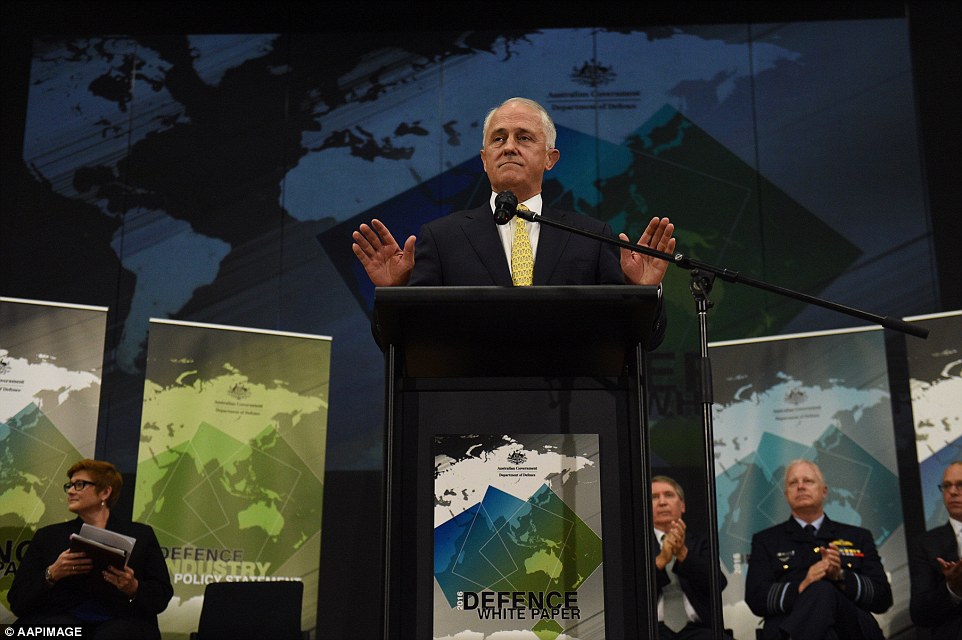
Prime Minister Turnbull, statesmanlike, delivering the Defence White Paper yesterday - a good time to trigger an Early Election (soon). (Photo courtesy AAP via Capital Bay News)
---

Australian Defence White Papers are political documents with electoral aims due to their overt (or implied) spending promises. Ztev Konrad made some relevant comments along these lines in Comments [at 26/2/16 7:35 AM].

The 2016 Defence White Paper (DWP) has considerable next Election relevance although the vast sums being quoted by the Australian Government are unaffordable for the foreseeable future.

Normally the more respectable Australian strategic websites (even government funded think tanks) will not comment on the electoral choices of political bosses. Politically freethinking Submarine Matters cares not.

On February 8, 2016 I wrote Australian Tax Problems May Mean Early Election on Australia's falling tax base - government problems raising taxes - inability to fund popular programs including health, education and welfare. This all means budget shortfall. All increasing the chances that a Government may wish to go to Election before announcing an austerity Budget. 

The Government of Australian Prime Minister Turnbull's declining voting prospects (now running 50% - 50% with the Labor Opposition) are likely to be addressed by Turnbull before the opposition Labor Party becomes too popular. Like strategic competition its a zero sum game. Labor is creeping up in popularity a position likely to jump upwards after Turnbull releases an unpopular Budget in May 2016. 

I posit that there is a 60% likelihood that Turnball wants to go to a double dissolution triggered  Election in April 2016, before he has to present a very unpopular Federal Budget (set for May 10, 2016).

On February 26, 2016 The (Melbourne) Age commented "Turnbull is now actively weighing the double-dissolution option. And he is being urged to go soon by some who've been at this game a lot longer than he, among them the electorally canny Christopher Pyne.

ELECTORAL SIGNIFICANCE OF THE DEFENCE WHITE PAPER (DWP)

Defence usually rates lower on the spending list than health, education and welfare unless there are compelling reasons like strategic need and votes. 

The DWP received a remarkably popular reception. Even the Labor Opposition have given it a seal of approval (bipartisan support).

The DWP underlines strategic need = China overall, particularly in the South China Sea. Voters made nervous rally around the incumbent chief ie. Turnbull's Government.

All of the spending promises in the DWP target votes particularly in the political swing state of South Australia. Manufacturing, design and sales communities all over Australia envisage that the DWP offers business and jobs.

It appears the DWP was published earlier than the "in first quarter 2016" expected. Governments are usually tardy - but the late norm of 31 March 2016 did not happen. Publishing a politically major document now gives political advantage electorally.

Turnbull has been positioning his Government for an early Election in other ways including:

- The Turnbull Government is attempting to pass a measure with a time-frame just before an early election can be organised. To remove pesky minor parties and independents in the Senate “The government hopes to have the laws passed, after a short inquiry, before Parliament rises on March 17 2016… Labor is split internally over the issue, with leader Bill Shorten declining to outline his party's position on [February 22, 2016].”

-  Turnbull has been making extravagant, out-of-character attacks on the opposition eg. Labor's proposed tax policies will "slash the value of Australian homes" which indicate he is worried about his Government's popularity.

-  Turnbull's courting of a more effective leader of his National Party Coalition partner, Barnaby Joyce. His relations with frequently brittle Joyce are currently good, implying good governance, though this political honeymoon cannot last.

Two bills dealing with restoring the building industry watchdog, which could provide a trigger for a double dissolution election, will be the subject of a public hearing on Thursday [March 4], ahead of the final report being tabled on March 15.

So like most major political documents the timing of the Defence White Paper's release was not arbitrary. Its Electoral significance can be demonstrated.

Pete

February 25, 2016

2016 Defence White Paper: Submarine Matters Much Across Sub Issues Raised

For "regionally superior submarines/boats" see Defence White Paper (A.) pages 19, 21, 90, 91 and 115. (Poster sourced via The Guardian)

Australia's 2016 Defence White Paper has been published today - see the Homepage at  http://www.defence.gov.au/whitepaper/ .

It consists of the traditional:
A.  2016 Defence White Paper document (large PDF of 10 MB), 191 pages (itself quite long): http://www.defence.gov.au/whitepaper/Docs/2016-Defence-White-Paper.pdf

But what makes it a huge reading and assessment task is that its 191 pages and there are two additional documents (published with it) which are:

B.  2016 Integrated Investment Program (PDF 5MB) http://www.defence.gov.au/whitepaper/Docs/2016-Defence-Integrated-Investment-Program.pdf, 123 pages, and

C.  2016 Defence Industry Policy Statement (PDF 5MB) http://www.defence.gov.au/whitepaper/Docs/2016-Defence-Industry-Policy-Statement.pdf , 79 pages.

WORKPLAN

Today I'll just stick to highlighting/extracting mentions of submarine(s) with some bolding and [Bracketed comments on particularly curious parts]. 

Mid next week I'll comment more broadly on A. though with special mention on naval issues, missiles and jets. Might write on electronic intelligence (if the authorities have spared me still).

Then comment on following weeks on subs, naval, missiles and jets in B. and C. 

Writing an overall assessment of all three documents would be better published in late March 2016.

Between White Paper writing will be the usual writing on subs, missiles and jets from around the world as they hit the news.

Returning to:

A.  2016 Defence White Paper (large PDF of 10 MB), 191 pages: http://www.defence.gov.au/whitepaper/Docs/2016-Defence-White-Paper.pdf

One way to analyse it is keyword search to identify frequency of hits and where they are:

Hit Ctrl + F for keyword search, which yields:

70 references to submarine(s) (of which 13 “anti-submarine” have been excluded). Most submarine(s) are in “Chapter Four: The Future Australian Defence Force” pages 83 to 115. Particularly in the Submarine section, pages 90 to 92.

REFERENCES TO SUBMARINE(S) include:

Page 19
The submarine force will be increased from 6 to 12 regionally superior submarines with a high degree of interoperability with the United States.

Page 21
The Government will ensure that the future submarine project provides a regionally superior [better than China's SSNs?] capability and value-for-money for Australian taxpayers while maximising the involvement of Australian defence industry. The competitive evaluation process, which is underway, will provide a clear pathway for Australian defence industry to maximise its involvement in the project, without compromising capability, cost or the project schedule. More detail on the Government’s shipbuilding plans are set out in Chapter Four

Page 42
2.11 China’s Navy is now the largest in Asia. By 2020 China’s submarine force is likely to grow to more than 70 submarines. China also possesses the largest air force in Asia, and is pursuing advanced fifth-generation fighter aircraft capabilities. China’s military modernisation includes more-capable special forces, aviation and command and control networks and it is also investing in new technologies including space and cyber capabilities.

Page 50
2.41 Within the broader Indo-Pacific region, in the next two decades, half of the world’s submarines will be operating in the region.

On Page 90 begins the key Section “Submarines” including:

4.25 Submarines are an essential part of Australia’s naval capability, providing a strategic advantage in terms of surveillance and protection of our maritime approaches. The Government has determined that regionally superior submarines with a high degree of interoperability with the United States are required to provide Australia with an effective deterrent, including by making a meaningful contribution to anti-submarine warfare operations in our region. The key capabilities of the future submarine will include: anti-submarine warfare; anti-surface warfare; intelligence, surveillance and reconnaissance; and support to special operations.

4.26 The Government will increase the size of the submarine force from six to 12 boats. The doubling in size of the submarine fleet recognises that Australia will face a more challenging maritime environment in the decades ahead. By 2035, around half of the world’s submarines will be operating in the Indo-Pacific region where Australia’s interests are most engaged. Australia has one of the largest maritime domains in the world and we need the capacity to defend and further our interests from the Pacific to the Indian Oceans and from the areas to our north to the Southern Ocean. Submarines are a powerful instrument for deterring conflict and a potent weapon should conflict occur.

Page 91 
4.27 Australia’s new submarines will be supported by upgrades to enablers and facilities such as wharves and port facilities [does this mean extra facilities up north in Broome or Townsville?], as well as simulators, training and submarine rescue systems. The key strategic requirements for the future submarines include a range and endurance similar to the Collins Class submarine, sensor performance and stealth characteristics which are superior to the Collins Class, and upgraded versions of the AN/BYG-1 combat system and Mark 48 MOD 7 heavyweight torpedo jointly developed between the United States and Australia as the preferred combat system and main armament. The new submarines will have advanced communications systems to link with other Navy ships and aircraft to conduct anti-submarine warfare operations.

4.28 The acquisition of the 12 future submarines will commence in 2016 with the first submarines likely to begin entering service in the early 2030s. Construction of the 12 new submarines will extend into the late 2040s to 2050 timeframe. The length of the construction process will mean that Australia will need to be planning the follow-on submarine well before the last new submarine enters service. To ensure no capability gap and the ability to progress development of a replacement submarine in the 2050s, the Government has decided to implement a rolling acquisition program for Australia’s submarine fleet. A rolling acquisition program will ensure that Australia is able to maintain a fleet of 12 regionally superior submarines as submarine and anti-submarine technologies develop over the coming decades. [Note that Japan's building style is more "rolling" with slight upgrades to each sub, rather than European batch building.] 

4.29 During the long life of the new submarines, the rapid rate of technological change and ongoing evolution of Australia’s strategic circumstances will continue. As part of the rolling acquisition program, a review based on strategic circumstances at the time, and developments in submarine technology, will be conducted in the late 2020s to consider whether the configuration of the submarines remains suitable or whether consideration of other specifications should commence.
 [If a "review based on strategic circumstances" means that an increased China threat then demands SSNs, then SSNs may be appropriate].

Page 92
4.30 The future submarine program is the largest defence procurement program in Australia’s history. The Government has already committed to maximising Australian industry involvement in the submarine program, without compromising cost, capability, schedule or risk. The Government will announce the results of a Competitive Evaluation Process in 2016.

4.31 The Government will also continue to make appropriate investments in the existing Collins Class fleet, including priority capability enhancements, obsolescence management and fleet sustainment, to ensure Australia’s potent and agile submarine capability is maintained until the introduction of the future submarine fleet. This will include upgrades to the Collins Class communications and sensor capabilities.

4.32 This investment will build on recent improvements to Collins Class availability. In 2011–12, Collins Class availability was about half that of the international benchmark and in the past there had been up to three submarines undergoing long-term maintenance. Following the 2012 Coles Review and implementation of a comprehensive and innovative transformation plan, there has been a major improvement in the availability of the Collins Class, and Defence is on track to reach the international benchmark for submarine availability by mid-2016. By mid-2016, the submarine HMAS Farncomb will have completed the first two-year full cycle docking in Adelaide – a maintenance activity that formerly took over three years to complete. From then onwards only one Collins Class submarine will be in Adelaide for full cycle docking. Defence will continue to work closely with industry to implement reforms to optimise Collins Class availability, reliability and capability.
[Improving the overhaul-sustainment rate will be good. Having more than 5 Commanders to Captain the subs (+ other hard to keep crew members) would also be good. Thinking 8 Commanders for a rolling 8-9 subs will be important.]

[end of submarine only section]

Page 111
4.108 . Innovation also includes developing new and more efficient ways of maintaining ADF equipment, such as transforming the management of the Collins Class submarines to maximise their availability for operations.

Page 114 
4.118 The Government has already announced 500 dedicated jobs in the new submarine program for combat system integration, design assurance and land-based testing.

4.121 France, Germany and Japan, are participating in the future submarine Competitive Evaluation Process, which will assess their ability to partner with Australia to deliver the future submarines. These potential international partners have been invited to provide options for an overseas, Australian or hybrid build program, and to seek opportunities for Australian defence industry participation in the future submarine Program. A decision on which international partner will be selected will be made in 2016.

Pages 114 and 115
4.122 The Government will also ensure a long-term industrial capability to deliver support to Australia’s submarines in both construction and sustainment. A rolling acquisition program for the submarine fleet means managing the acquisition of submarines to ensure Australia maintains, over the long term, a fleet of 12 regionally superior boats that are fit for purpose in the period in which they will be operating. A rolling program of acquiring submarines will provide long-term planning certainty for Australian industry, allowing those Australian companies involved in the submarine program to invest in the capabilities needed to support their involvement in the construction and sustainment activities.
[Again returning to the very rolling nature of Japanese sub building (from the 1960s to the present). Part of that is due to shorter submarine operational life - maybe up to 22 years, but not the US-European standard of 30 years. In view of this how long subs can last (must they last 30 years?) is a major issue.]

Page 147 
…with further growth [in ADF positions] beyond the decade to operate the larger submarine fleet in particular. The generation of crews with the appropriate mix of skills and experience must be carefully managed to meet the challenging growth needed to operate Navy’s new submarines and surface ships. [Indeed]

Page 171 
7.25 Proper planning for the acquisition of complex equipment and systems takes years of analysis and careful decision-making before acquisitions can commence. This is only proper for the expenditure of billions of dollars involving decades of effort. New submarines and frigates, for example, will be brought into service from the 2020s until well into the 2040s and will operate into the second half of this century.

Page 179 
8.12 As Chapter Four and the Integrated Investment Program accompanying the White Paper highlight, substantial new investment will be required in the first half of the 2020s, including for the acquisition of the future submarines and frigates, which will be major drivers of Defence expenditure. The majority of the additional funding to 2025–26 will be provided from 2019–20 to meet these requirements.


COMMENT

There is much more on submarines in documents B. and C.

Happy to report that Submarine Matters, over the last 18 months, has coincidentally, been very much across these issues raised in Defence White Paper A. 

Pete