April 17, 2012

South Korean Submarine Developments

A very sketchy artist's impression. Might the KSS-III to be launched from 2020 look like this?
--------------
Click to expand. Is the proposed DSX-3000 the same as the KSS-III?
--------------------------

Please connect with Submarine Matters latest South Korea update South Korean Submarines, 3,000 Ton KSS-III, Nuclear Potential of April 15, 2015.

From The Korea Times, May 10, 2009 comes:

"The Ministry of National Defense plans to deploy 3,000-ton [surfaced, 3,500 ton submerged] attack submarines after 2020, a two-year delay from the original Defense Reform 2020 initiative, a report said Sunday.

...The development of an [indigenous] 3,000 ton KSS-III submarine is a key part of the Navy's modernization programs. The KSS-III sub is to be fitted with domestically built submarine combat systems aimed at automating target detection, tracking, threat assessment and weapon control, according to Navy officials.

[Is the proposed DSX-3000 the same as the KSS-III?]

The 1-trillion-won heavy attack submarine will also be armed with indigenous ship-to-ground cruise missiles and be capable of underwater operations for up to 50 days with an advanced Air Independent Propulsion (AIP) system, they said. The AIP system has improved the submarine's underwater performance and gives it stealth capability." full article
-
A Korean nuclear propelled submarine option?:
On South Korea's past consideration of a 4,000 ton nuclear propelled submarine (various names including "KSSX-N") option see this globalsecurity.com report. 
-

South Korea's top in-service submarine at the moment is the 1,800 ton Son Won-Il (KSS-II) class. It is a HDW U-214 sub built under licence by Hyundai. Two are in service with four more to be built.
The photo is from "Manoeuvre' in Maritime Asia" a very interesting website on South Korean naval matters that I've just come upon.
-
Drawn from http://en.wikipedia.org/wiki/KSS-III - The first KSS-III ship will be ready for service by 2022. The previous plan was to have an operational unit ready by 2017. Due to the relatively heavy displacement of the ship (3000~3500 tons) and the fact that it will be built with local Korean technologies (sensitive technologies might be blocked from export) this new class of ship will have the Vertical Launch System, the first submarine in the Republic of Korea Navy to have this kind of capability. It will also have many other improvements compared to its predecessors.

- Pete

April 11, 2012

Trident Debate - Cruise Missiles Ineffective in Leading a UK Nuclear First Strike

-
One of four British Vanguard Class SSBN - at its Scottish base area (from UK DailyMail).
-
-
The UK Trident missile system on the current Vanguard submarine platform (from UK DailyMail).
-
-
A British Royal Navy Tomahawk Cruise missile - which may replace UK Trident - or more likely a mixed Trident ballistic and cruise missiles on each sub solution..
-
-
The UK has been unable to decide for the last decade or so whether it will replace its Trident SLBMs (its only current SSBN missiles) with an updated SSBN of 3 or 4 subs. The UK might choose nuclear tipped cruise missiles as the new deterrent or a combination of Trident and cruise. Fortunately US Multiple All-Up-Round Canister (MAC) technology could provide for each Trident tube to carry a Trident ballistic missile (with several MIRV'd warhead) or up to 7 Tomahawk cruise missiles. 
The issue of Britain's post Vanguard SSBN nuclear armed submarines is naturally an issue for the Royal Navy, Ministry of Defence, UK financial departments, shipyards, unions and pacifists. Many pacifists argue for no replacement SSBNs or Tomahawk cruise only.
Concerning ballistic missiles vs cruise, the UK Ministry of Defence appears to primarily rely on the alleged technical disadvantages of cruise (in terms of payload, range, speed and vulnerability) compared to ballistic missiles - see The Future of United Kingdom's Nuclear Deterrent (Trident White Paper) 2006, page 25 http://www.mod.uk/nr/rdonlyres/ac00dd79-76d6-4fe3-91a1-6a56b03c092f/0/defencewhitepaper2006_cm6994.pdf .

I've conjured up the scenario of a first strike by Britain against a nuclear enemy to highlight the downsides of cruise. Speed (in a first strike scenario - say against Russia, China or a nuclear armed Iran) might be the most compelling issue. If a ballistic missile armed enemy detects a UK cruise missile attack early on (say by satellite infrared detection or signals traffic analysis) - the enemy may be able to launch and complete a second strike even before the UK cruise missiles have hit their targets.
The risk exists that UK cruise would arrive too late, destroying, the enemy's now empty missile silos and truck/train mobile launchers. The enemy (particularly an efficient Russia or China with S-400 SAMs) may also have shot down a significant number of UK cruise.
Trident also permits rapid multiplication of a nuclear warheads by producing theoretically up to 12 MIRVs (or a mix of MIRVs and decoys) per Trident missile. While cruise's are very stealthy they can't split into MIRVs.

Another problem with cruise is the inherent ambiguity of that missile mode with both nuclear and conventional traditions. The enemy may not know whether a UK cruise missile attack consists of all nuclear, some non-nuclear WMD, all conventionally armed warheads or a mixture. An enemy may therefore cover all UK cruise possibilities with a nuclear response against UK targets.
An untrustworthy future Iran may also work on a nuclear missile use them or lose them basis due to Iran's likely relatively small number of ballistic missiles within the next two decades. Hence any US, UK, Israeli, or French concept that conventional weapons are "safer" when used against a nuclear state may all go horribly wrong and lead to nuclear retaliation by that state (especially a newly nuclear armed state that has only "narrow" nuclear options). 

 The deterrent "benefit" of nuclear MAD also becomes more complex if conventional, or non-nuclear WMD's make uncertain the 'comfortable certainties' of nuclear MAD.

I agree that the option of installing four Trident missiles tubes in perhaps four  modified Astute SSN's may avoid the vast development costs and inevitable time delay of building four new (single role) Trident/cruise SSBN's. See http://navy-matters.beedall.com/astute.htm (scrolling 3/4s down):
 

Satellite Detection of Submarines.


Please connect with Submarine Matter’s:


-  China Launches More Ocean Surveillance Satellites – October 3, 2014 http://gentleseas.blogspot.com.au/2014/10/china-launches-more-surveillance.html and

-  Chinese Military and “Dual-Use” Satellies – March 16, 2014 http://gentleseas.blogspot.com.au/2014/03/chinese-reconnaissance-surveillance-or.html
------------------------------

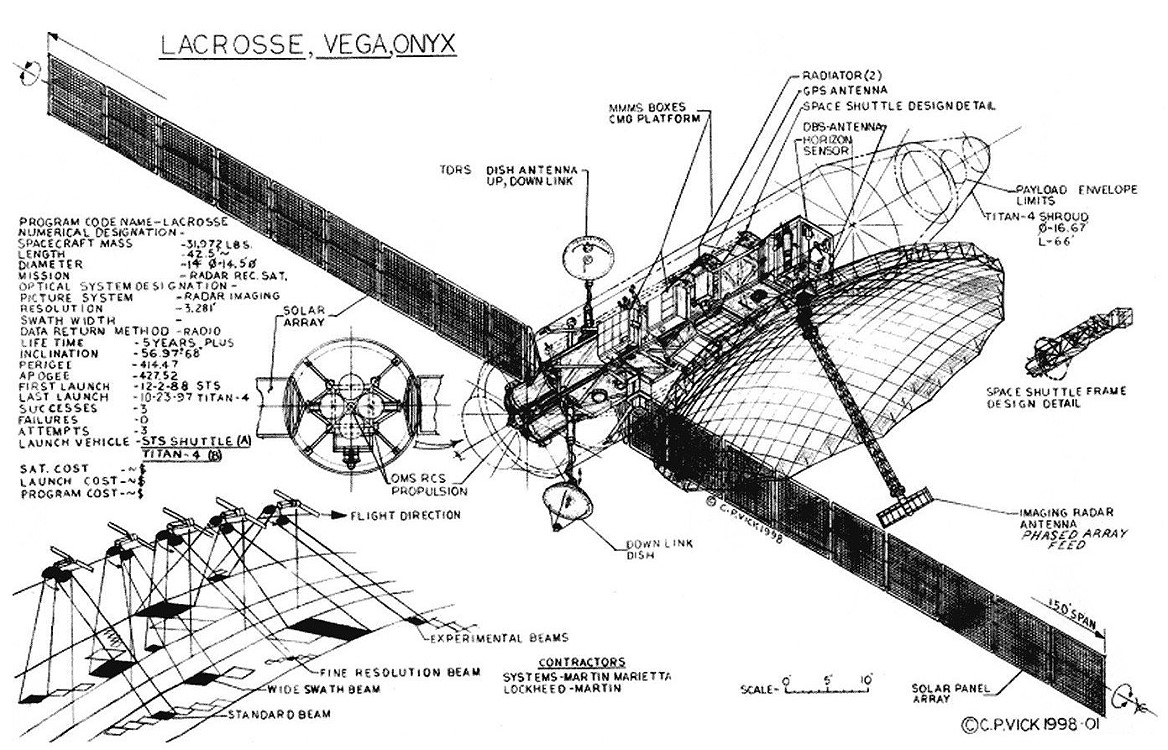
The US Lacrosse Satellite uses Synthetic Aperture Radar to see through cloud cover and is possibly sensitive enough to detect Chinese submarine snorkels, periscopes and wakes. Asia Times Online published this groundbreaking article US satellites shadow China's submarines on May 13, 2010, concerning satellite (and Space Shuttle) detection of submarines.

The article's author, Peter J Brown, is a a satellite journalist from Maine, USA who was part of the team that worked on the 1991 PBS documentary, Submarine: Steel Boats, Iron Men.

I've reproduced the whole long article, partly because articles with sensitive information have a habit of being quietly pulled off the Internet. My extra comments are between {....} brackets.

"US satellites shadow China's submarines

By Peter J Brown, May 13, 2010

The People's Liberation Army's Navy (PLAN) submarines cannot spot United States satellites high overhead as the submarines leave their bases at Sanya on Hainan Island, Qingdao in Shandong province and Ningbo in Zhejiang province, and head for deeper water. {However Chinese optical and radio telescopes on the ground can see the US Low Earth Orbiting (LEO) satellites in question and then transmit their presence to Chinese submarines. Chinese satellites may also be able to detect US satellites}.

Plenty of very deep water can be found in the South China Sea, {which is one reason why China built the Hainan-Sanya submarine base on the perimetre of the South China Sea} especially in the zone north of the Spratly Islands, east of the Paracels, and south of the Luzon Strait.

"A more challenging area for submarines to operate undetected is the East China Sea, which is quite shallow from the Chinese coastline up to the Okinawa Trough with a depth of only 30 to 60 fathoms {55 to 110 metres} in most places," said associate professor Peter Dutton with the China Maritime Studies Institute at the US Naval War College.

"Much of the water space [in the South China Sea] is more than 2,000 fathoms {3,658 meters}deep," said Dutton.

Detecting submarines via satellite is a form of Non-Acoustic Anti-Submarine Warfare (NAASW){see DARPA activity here . Lasers, infrared and other detectors and synthetic aperture radar (SAR) {such as the US "Lacrosse" satellite} in space may be used as part of this NAASW activity. Satellites might see subtle undersea disturbances caused by submarines, watch wave patterns on or beneath the sea surface, or detect subtle variations in ocean temperature.

This is not to be confused with satellite communications, nor is an "EO" or "Earth Observation" satellite to be confused with "EO" as in an "Electro-Optical" means of detecting submarines.

Over the next 18 months, the US National Reconnaissance Office (NRO) - operator of the US spy satellite fleet - is planning multiple satellite launches, and China must assume that one or more of these new US surveillance satellites will help support US Navy efforts to locate and track PLAN submarines.

Satellites form a network along with undersea sensors and detectors fixed on the sea floor or drifting in the open ocean as well as devices mounted on other submarines, ships, unmanned undersea vehicles (UUVs), aircraft, helicopters and unmanned aerial vehicles (UAVs).

Many are skeptical that satellites can perform NAASW missions effectively, reliably and at reasonable cost.

"The natural disturbances of the sea surface due to wind and tides, it seems to me, are very likely to mask any disturbance due to a submarine passage, and so even if this were a viable detection technique, it seems to me so limited in application that it would not be worth the investment," said one former US Navy sonar expert.

In April, a source told RIA Novosti, a Russian newspaper, that Russia had developed a novel satellite module "used for both defense and civilian purposes, in particular, providing meteorological data", and it can "carry out remote sensing of the sea and detect submerged submarines". This will be tested in space perhaps as early as next year. [1]

"Submarine detection, by any means, is a classified and highly guarded topic. The fact that the Russians are talking about it is the most interesting aspect of this announcement," said Brian Whitehouse, president of Nova Scotia-based OEA Technologies, Inc. He co-authored a paper with Daniel Hutt in 2008 about spaceborne sensors, ocean intelligence, and the maritime battlespace. [2]

The satellite in question is apparently the first of three small Russian Kanopus (Konopus) remote sensing satellites.

"This satellite is planned for 2011 and it will carry an Earth observing payload that includes a sensor for studying the underwater light environment," said Dr Jonathan McDowell, an astrophysicist at the Massachusetts-based Harvard-Smithsonian Center for Astrophysics who is also the editor of Jonathan's Space Report. "I cannot evaluate the claim that this will let them detect the wakes of submarines.{see Wavelet-Based detection algorithms obviously high tech and super-computer enabled} I do not believe that such technology is being used operationally at the moment {If it were it would be highly classified - perhaps on the USNS Impeccable with a bit of DARPA, USN Intelligence and NSA assistance}. I am not aware of relevant flight experiments, but they may have occurred."

Russia has previously demonstrated its satellite sub-hunting skills. Swedish satellite expert Sven Grahn identified the Russian Almaz-1 satellite which was launched in 1991 as a submarine-detection satellite that could see the surface wake or trail of a submerged sub. Besides this satellite, the Russians deployed other large, nuclear-powered and radar-equipped ocean surveillance satellites.

"Russian satellites known as RORSATs used radar to track surface ships, but the US Navy was not concerned that our subs could be detected, much less tracked. The signals, even if they existed, would be so wrapped into random noise that extracting any usable intelligence from them proved impossible," author James Oberg, a top US expert on Soviet and Russian space programs, told Asia Times Online. "The cancellation of that [Soviet] satellite program followed at least three accidental re-entries of debris. The laws of physics compelled them to orbit as low as possible, creating high air drag."

The theoretical boundary below which satellites cannot successfully maintain their orbits is approximately 160 kilometers above the Earth.

The Soviet space station Mir may have served as a platform for related research activities in the same way that the US Skylab once served as a platform for space radar testing in 1970s.

In the late 1990s, sub-hunting satellites made headlines. An American scientist, Peter Lee, was caught and convicted of passing sensitive information to China about the so-called Radar Ocean Imaging (ROI) joint project which involved the United K and the US. A decision by the US Navy based on concerns about further disclosures about the nature and scope of the ROI project echoes to this day.

"Peter Lee's case was they had this guy giving this very sensitive data to the Chinese on underwater detection of submarines. They ran into this case where the navy wouldn't allow a court case against him because of the data. So they had a bargain plea, and he got off, basically. For stealing very high-level stuff, he gets probably, what, a couple of months in a halfway house," former US ambassador to China, James Lilley, told PBS in 2004. [3]

China obtained relevant information from Russia, too.

"Chinese experts reportedly received technical assistance from Russian satellite experts in years following the Soviet Union's collapse," said associate professor Andrew Erickson at the China Maritime Studies Institute. "Specialists at the State Key Laboratory of Satellite Ocean Environmental Dynamics have researched ship detection using [SAR]."

Maritime surveillance became a top priority at the national level when China's so-called, "863 State High-Technology Development Plan" was activated. And China's fleet of Haiyang ocean surveillance satellites will grow to three when Haiyang-2A is launched later this year

Prior to the ROI program, the US SEASAT ocean satellite project which was launched by the US National Aeronautics and Space Administration (NASA) in 1978 carried a SAR into space for maritime surveillance purposes. After just over 100 days in space, SEASAT suddenly stopped working due to a short circuit in the design of its solar panels.

"Rumors suggested it had been turned off or sabotaged. There was a claim that SEASAT had mapped a field of World War 2-era shipwrecks on the floor of the English Channel," said Oberg.

A US Navy oceanographer from Australia, Paul Scully-Power, who became the first oceanographer in space, flew on the space shuttle Challenger (STS - 41G) in 1984. The US Navy later admitted that the mission had successfully detected the undersea or internal waves generated by a submarine which had been tracked successfully at relatively shallow depths. This was deemed, "incredibly important to us" and was reported by the Washington Post in 1985 - quoting a senior US Navy admiral at the time. [4]

In mid-May, by the way, the final flight of the space shuttle Atlantis (STS-132) will include a longtime submariner, US Navy captain Stephen Bowen.

According to naval analyst and author Norman Polmar, certain satellites can track submarine wakes, but are unable to do so continuously nor all the time, and not in all underwater environments. A submarine's depth, and speed along with the characteristics of the ocean bottom and water clarity, among other things, come into play here.

"A submarine is a relatively small, finite object - perhaps 300 to 500 feet [91 meters to 152 meters] in length in most cases - but the submarine's wake is persistent and stretches out for miles," said Polmar.

While the PLAN submarine fleet is the largest and most diverse in Asia, and very soon the fastest growing in the world, the PLAN's nuclear submarines are relatively easy to find. It is the diesel/electric submarines - and those equipped with so-called air-independent propulsion systems in particular - that are much harder to detect.

"The US Office of Naval Intelligence's unclassified July 2009 report on the PLAN suggests that some of the PLAN's diesel submarines are already extremely quiet, but its nuclear submarines remain relatively noisy," said Erickson.

US satellites play an increasingly important communications role in ASW, and are critical to the US Navy's Persistent Littoral Undersea Surveillance Network (PLUSNet), ForceNet and Sea Shield programs, to name a few. In addition, the US Defense Advanced Research Projects Agency (DARPA) is funding the Tactical Relay Information Network which uses lasers to instantly beam vital messages to submerged US subs as they are underway and perhaps chasing down other subs.

This writer speculates that as many as a dozen countries have operated sensors aboard satellites involved in some form of NAASW research. Others may disagree with this assessment.

Whitehouse and Hutt, for example, stated that, "many of these sensors are not of immediate practical benefit to military operations".

Keep in mind that commercial satellite ventures, and public - private partnerships such as Germany's RapidEye AG offer all sorts of satellite imagery.

Smaller, less expensive satellites possibly flying in formation over the ocean may offer significant advantages here. They can train their sensors and cameras on a single spot as they pass by in formation. California-based Microcosm Inc, for example, is developing the NanoEye small-satellite system, which comes equipped with basic or advanced electro-optical and infrared sensor payloads.

"Smaller satellites flying in formation may seem attractive for reasons of cost and coverage, but larger satellites offer far more advantages in terms of real capabilities," said Polmar. "Simply because of their small size, the smaller satellites are less capable, offer less electrical power and you cannot put much on them unlike much larger satellites."

The real advantage comes from the entire satellite-enabled infrastructure - or systems of systems - which links the powerful space-based sensors and detectors with those mounted on surrounding ships, subs, UUVs, aircraft, helicopters and UAVs - including the new "Sea Avenger" - so that all this surveillance data merges together to form a "common undersea picture" which can be instantly shared across the entire ASW community.

Aircraft and UAVs lingering overhead can mimic surveillance satellites, and their presence is an important aspect of the US "Maritime Domain Awareness" strategy. Another option involves inserting additional maritime surveillance assets above conventional aircraft and UAVs, and beneath the satellites.

For example, the US Navy is interested in DARPA's "Integrated Sensor Is the Structure" (ISIS) program, which is, in effect, an integrated stratospheric airship/radar - the stratosphere is found at an altitude of roughly 10 to 50 kilometers above Earth - featuring a 600-kilometer-wide sensor radius. In fact, DARPA included a slide during a briefing last year that showed how a single ISIS on station over the Luzon Strait could conduct surveillance operations covering the entire Strait from Taiwan to the northern Philippines, and almost as far west almost as the coast of China.

"No single sensor/platform combination has all the answers. Every sensor has its limitations. As a result, each application usually involves a suite of sensors, platforms and computer-based models," said Whitehouse and Hutt.

Associate professor Kazuto Suzuki of Hokkaido University's Public Policy School described Japan's Maritime Self Defense Force (MSDF) as "one of the best ASW forces without using satellite capability".

"There is no discussion of a satellite infrastructure for ASW. Satellites are only useful for detecting activities [at submarine bases]. MSDF and the 7th Fleet of the US Navy are sharing the work for ASW, and there is a strong confidence between them," said Suzuki.

However, over the years, Japan has launched many advanced remote sensing/earth observation, meteorological, and engineering test satellites - exactly the types of satellites which are ideally suited for conducting satellite-based NAASW research and development.

One relevant joint NASA-Japan Aerospace Exploration Agency project on the International Space Station recently tested a maritime hyperspectral imager. This coincided with work on the same type of imager done as part of the US Navy's Tactical Space Innovative Naval Prototype program involving so-called TacSats and their maritime satellite links to buoys and "unattended" sensors - perhaps UUV-mounted sensors.

China routinely uses ocean-centric satellite imagery provided by the US, Japanese and Europeans. Their own undersea mapping projects such as one done recently as part of a larger and more comprehensive Chinese survey of the South China Sea rely heavily on access to this data. [5]

The world's vast oceans have not been rendered completely transparent, but for over three decades, satellites have been transforming the way we view them.

As the US Congress scrutinizes the US-Russian START (Strategic Arms Reduction Treaty) successor and possible restrictions on the future use of US submarine launch tubes for anti-missile purposes, new potential threats to submarines need to be examined carefully.

Finally, the sinking in March 2010 of the South Korean destroyer Cheonan - important evidence in the form of "satellite imagery" is surfacing although the investigation is still underway [6] - serves to remind everyone that work must continue to help thwart future surprise attacks.

Notes

1. Hotlink here Russia to build submarine-detecting satellite, RIA NOVOSTI, Apr 15, 2010.

2. Ocean intelligence in the maritime battlespace: the role of spaceborne sensors and hf radar, Canadian Military Journal, July 14, 2008.

3. PBS interviews James Lilley, PBS.org, June 4, 2003.

4. "Shuttle Flight Yields Data on Hiding Subs," The Washington Post, March 22, 1985, p A10. (Not available online.)

5. Using satellite data to map coral reefs in the South China Sea, Spie, February 21, 2007.

6. South Korea Concludes That North Korea Sank Ship, Chosun Says, Bloomberg.com, May 7, 2010."

A big thankyou to Asia Times Online (Holdings) Ltd for originally publishing the article at http://www.atimes.com/atimes/China/LE13Ad01.html . Australia by the Indian Ocean is a free, non-profit, blog, accessable to all.
-
PETE'S COMMENT

Link with the following on this "gentleseas" website

LIDAR an anti-submarine warfare sensor, January 16, 2014, http://gentleseas.blogspot.com.au/2014/01/lidar-anti-submarine-warfare-sensor.html

The DASH Program anti-submarine sensors - TRAPS & SHARK, April 8, 2013, http://gentleseas.blogspot.com.au/2013/04/the-dash-program-anti-submarine-sensors.html , and

-
Pete

Submarine reactors - thorium technology? Proliferation still constant.

Should thorium reactors be replacing this enriched uranium submarine reactor? Click on diagram to enlarge this standard uranium reactor.
-
jbmoore has spotted this article from DefenseNews November 16, 2009:
-
"The recently passed fiscal 2010 U.S. National Defense Authorization act initially contained a mandate for the Department of Defense to study thorium, a radioactive metal found abundantly in the United States that could change the future of nuclear energy. The initial section called for the Secretary of Defense and the chairman of the Joint Chiefs of Staff to "jointly carry out a study on the use of thorium-liquid fueled nuclear reactors for naval power needs." Unfortunately, this section was absent from the final version of the bill. ...
-
Thorium is a safer alternative for the U.S. Navy's nuclear-powered fleet that is more proliferation-proof than uranium, and also three times more abundant. It is not fissile on its own, but can be combined with a small amount of uranium to serve as a "feeder" material for a nuclear chain reaction.
-
Thorium cycles do not generate usable plutonium as a byproduct, and they produce as little as half the nuclear waste uranium cycles do. For these reasons, thorium can help reduce the concerns about nuclear proliferation that are commonly associated with nuclear power...article in full..
-
Comments
-
Surely only America's adversaries (the Russians and Chinese) would wish thorium reactors on the US Navy.
-
After 30 more years of further development thorium may be useful in land based reactors but at present starting with submarine reactors as testbeds for thorium possibilities seems a misapplication. Increasing use in power reactors on land would be a better start.
-
Submarine reactors need to be miniature, light and uncomplicated enough to be adjustable by the crew at sea. Thorium, I believe, puts out a relatively low amount of radioactive "power' per pound compared to the 93% enriched uranium now used in US submarine reactors. With thorium reliance - subs would either be forced to slow down or carry a much larger, heavier, more complicated thorium reactor.
-
Thorium is also a messy, substance which tends to make reactors shut down unexpectedly - not a good look under the waves. Thorium reactors generate more residue that needs cleaning out - hence more downtime for subs in port.
-
While the article extols the lower proliferation advantages of thorium for the US Navy's nuclear carriers and subs reducing the proliferation risk seems almost a contradiction in terms. They all might carry nuclear weapons when the US goes to higher stages of defence alert. Furthermore all US SSBNs carry many nuclear warheads in peacetime. Temporary proliferation is often their job.
-
Numerous US laws and policies, national security considerations and the NPT prevent export of US submarine reactors to other countries or nuclear weapons (except to the UK) . So US sub reactors, be they uranium or thorium dependent, or weapons would not be proliferated.
-
On a tangential note, the US bans proliferation to all allies except the UK see 1958 US–UK Mutual Defence Agreement ). Australia may one day be seeking nuclear propulsion assistance elsewhere - from France - as Brazil is already doing. And for weapons - French and Israeli assistance worked for South Africa.
-
Pete

April 7, 2012

China's Yuan Class Submarine related to Russian Kilo and possibly Lada classes

jbmoore drew my attention to this interesting Strategypage article of September 23, 2010, which confirms the relationship between China's Yuan submarine series and the Russian Kilo:

"China Tweaks Russian Designs - China recently launched a new diesel-electric submarine. There was no official information released, but based on photos available it appears to be another development in China's taking Russian submarine technology and adapting it for Chinese designs. China has been doing this for as long as it has been building subs (since the 1960s). But this latest version of what appears to be the Type 41 design, shows Chinese naval engineers getting more creative.

The Type 41A, or Yuan class, looks just like the Russian Kilo class. In the late 1990s, the Chinese began ordering Russian Kilo class subs, then one of the latest diesel-electric design available. Russia was selling new Kilos for about $200 million each, which is about half the price other Western nations sell similar boats for. The Kilos weigh 2,300 tons (surface displacement), have six torpedo tubes and a crew of 57. They are quiet, and can travel about 700 kilometers under water at a quiet speed of about five kilometers an hour. Kilos carry 18 torpedoes or SS-N-27 anti-ship missiles (with a range of 300 kilometers and launched underwater from the torpedo tubes.) The combination of quietness and cruise missiles makes Kilo very dangerous to American carriers. North Korea and Iran have also bought Kilos.

The Chinese have already built three Yuans, the second one an improvement on the first. These two boats have been at sea to try out the technology that was pilfered from the Russians. The third Yuan is the one just launched, and appears to be a bit different from the first two. The first Yuan appeared to be a copy of the early model Kilo (the model 877), while the second Yuan (referred to as a Type 41B) appeared to copy the late Kilos (model 636). The third Yuan may end up being a further evolution, or Type 41C. This one also appears similar to the Russian successor to the Kilo, the Lada.

The first Lada underwent three years of sea trials before they were declared fit for service last year. Another is under construction and eight are planned. The Kilo class boats entered service in the early 1980s. Russia only bought 24 of them, but exported over 30. It was considered a successful design. But just before the Cold War ended in 1991, the Soviet Navy began work on the Lada. This project was stalled during most of the 1990s by a lack of money.

The Ladas are designed to be fast attack and scouting boats. They are intended for anti-surface and anti-submarine operations as well as naval reconnaissance. These boats are said to be eight times quieter than the Kilos. This was accomplished by using anechoic (sound absorbing) tile coatings on the exterior, and a very quiet (skewed) propeller. All interior machinery was designed with silence in mind. The sensors include active and passive sonars, including towed passive sonar. The Ladas have six 533mm torpedo tubes, with 18 torpedoes and/or missiles carried. The Lada has a surface displacement of 1,750 tons, are 220 feet long and carry a crew of 38. Each crewmember has their own cabin (very small for the junior crew, but still, a big morale boost).

When submerged, the submarine can cruise at a top speed of about 39 kilometers an hour (half that on the surface) and can dive to about 800 feet. The Lada can stay at sea for as long as 50 days, and the sub can travel as much as 10,000 kilometers using its diesel engine (underwater, via the snorkel). Submerged, using battery power, the Lada can travel about 450 kilometers. There is also an electronic periscope (which goes to the surface via a cable), that includes a night vision capability and a laser range finder. The Lada was designed to accept a AIP (air independent propulsion) system. Russia was long a pioneer in AIP design, but in the last decade, Western European nations have taken the lead. Construction on the first Lada began in 1997, but money shortages delayed work for years. The first Lada boat was finally completed in 2005. A less complex version, called the Amur, is being offered for export. The new Chinese Yuan class boat is larger than the Kilos or Ladas, but has similar external design features. It will be a while before more details can be uncovered.

Preceding the Yuans was the Type 39, or Song class. This was the first Chinese sub to have the teardrop shaped hull, and was based on the predecessor of the Kilo, the Romeo class. The Type 41A was thought to be just an improved Song, but on closer examination, especially by the Russians, it looked like a clone of the Kilos. The Yuan class also have AIP (Air Independent Propulsion), which allows non-nuclear boats to stay underwater for days at a time. China currently has 13 Song class, 12 Kilo class, three Yuan class and 25 Romeo class boats. There are only three Han class SSNs, as the Chinese are still having a lot of problems with nuclear power in subs. Despite that, the Hans are going to sea, even though they are noisy and easily detected by Western sensors."

Connect With:

German Diesels and AIP? for Chinese Submarines, June 5, 2015 http://gentleseas.blogspot.com.au/2014/06/german-diesel-engines-and-aip-for.html

Russian Conventional Submarine Development – Kalina Class, April 4, 2014 http://gentleseas.blogspot.com.au/2014/04/russian-conventional-submarine.html which describes the 5 classes (generations) of Russian SSKs; and

Russian Submarine Development, Rubin Designer’s Views, January 23, 2014 http://gentleseas.blogspot.com.au/2014/01/russian-submarine-development-rubin.html

-
Pete

Tentative Vietnamese plans to buy Kilo Subs and a Russian land based reactor.

-
-

Improved Kilo Class/Project 677 Lada class/Project 1650 Amur class. Note 10 tube VLS option - something Australia should consider for its own future submarines.
-
Russia has more proposed sales of Kilo submarines than its proven capacity (typically delivered late or overprice or not at all. It is not an HDW). The agreement to sell six Kilos to Vietnam, announced in mid December 2009, is the latest paper milestone. Not only is this blog interested in nuclear enrichment and weapons but also the first and second strike platforms of choice i.e. submarines.

Vietnam has been engaged in several skirmishes over the years concerning the Spratly Islands in the South China sea. Possession of one or most of the islands has deep strategic and economic value. The islands themselves have little value, but the fishing and potential of oil reserves below them have great value. The islands are legal lodgements from which undersea zones and exploitation rights flow.

However, as Vietnam has no submarine tradition outside of owning two old midget Yugo Class submarines it will take years of expensive Russian training and control of at least the first three submarines to make Vietnam's submarine flotilla efficient and independent. Russia will regain some of the naval intelligence and military power it lost when it withdrew from Cam Ranh Bay.

Submarines are, after all are intelligence collection devices in peacetime. Essential Russian crew members and a sigint relay feed via the Vietnamese submarines to the Russian naval base at Vladivostok will be an importance asset to Russia's military presence in the western Pacific. For Vietnam submarines are an asymmetric way to counter Chinese and Taiwanese power projection into the Spratly islands. Vietnamese submarines will also provide parity with Malaysia's claims and exceed the naval power of the Filipino and Bruneian competitors.

Furthermore the asymmetric power of Vietnam's submarines will also provide limited defence of Vietnam from the risk of Chinese sea-based invasion.

DefenceStudies, December 17, 2009 reports:

MOSCOW - Vietnam and Russia signed a major arms deal and a nuclear energy agreement Dec. 15, a sign of reviving ties between Moscow and its former Soviet-era ally in Southeast Asia.

Hanoi agreed to buy Russian-made submarines and aircraft in the arms deal, which was signed in the presence of Russian Prime Minister Vladimir Putin and his visiting Vietnamese counterpart, Nguyen Tan Dung.

"Vietnam signed a contract for the purchase of submarines, planes and military equipment with the corresponding cooperation of the Russian side," Dung said in remarks translated into Russian.

Details were not released on the deal between Russian state-owned arms exporter Rosoboronexport and Vietnam's defense ministry.
However the Interfax news agency, citing an unnamed defense industry source, reported that Vietnam had agreed to buy six Russian-made submarines for a total price tag of about $2 billion (1.37 billion euros).

The six
Kilo-class diesel-electric subs would be built for the Vietnamese navy at a rate of one per year, Interfax reported.
[While Russia is supposed to have replaced new build Kilo's with the new Lada Class it appears that the "Lada Class" are now merely termed "improved Kilos".]Moscow and Hanoi also inked a deal on the construction of Vietnam's first atomic power plant.
Last month, the Vietnamese parliament approved building the country's first nuclear power station, a lucrative project that has been keenly watched by potential foreign partners.

The agreement signed in Moscow was described as a memorandum on cooperation between Vietnamese electricity company EVN and Russia's state-owned atomic energy firm Rosatom, which had been interested in the project.

"Vietnam officially invites the Russian side to cooperate in the building of the first atomic energy plant in Vietnam under adherence to the necessary conditions," Dung said.


[The Russian built reactor may be one of two 1,000 MW reactors Vietnam has planned at Phuoc Dinh in the southern Ninh Thuan province to be constructed from 2014 and come into operation from about 2020, followed by another 2000 MWe at Vinh Hai in the Ninh Hai district. These plants would be followed by a further 6000 MWe by 2030, subsequently increased to having a total of 15,000 MWe by 2030. The anticipated cost of the first two plants is about $11 billion, and some 85% of this would need to be found from overseas loans.]
-
Pete