November 30, 2013

Australian SEA 1000 future submaine - an S-80 development or HDW 216?


 A rough sketch of the Navantia S-80 submarine. This sub is still being built-developed and might be launched in 2015.
--------------------

Concerning my article of November 22, 2013, "Ongoing debate on Australia's SEA 1000 future submarine requirements." http://gentleseas.blogspot.com.au/2013/11/ongoing-debate-on-australias-sea-1000.html MHalblaub commented:

"Hi Pete,

do you think the US are unreliable allies? That was my thought reading RAN has to shadow a fast going nuclear powered submarine (SNN) for a week. I doubt that there will be within the next 10 years any technique for a conventional submarine to maintain submerged about 20 knots for more than 24 hours. Therefore the only solution would be a SNN, to wait or to trust the US.

I am well aware that the small HDW 210mod falls short of the SEA 1000 requirements. In my eyes these requirements are the wet dreams of some Admirals.

A greater range would be useful. A bigger weapons load is nice to have. The 8+ VLS are also a nice to have but they could also be tube launched. Btw Popeyes in action: http://voiceofrussia.com/news/2013_07_14/Israel-hits-Syria-to-destroy-Russian-made-Yakhont-anti-ship-missiles-3943/

The British Astute-class submarines can also fire Tomahawks without an US combat system.

The problem for Royal Australian Navy will be the gap between Collins-class retirement and entry into service of SEA 1000 submarines. Australia can throw a lot of money after the Collins-class to keep them running until 2030. Today the price for one HDW Type 210 is about the costs Australia needs to maintain Collins-class for one year. The maintenance costs for Collins-class will awfully rise in the future.

My advice would be to order as soon as possible 6 Type 210mod/A 26 to fill this gap. 5 submarines should be built in Australia. That will give Australia time and knowledge to design a proper submarine. This interim solution would also save a lot of money and add capabilities.

Australia should not try to reinvent wheels that already exist in far better quality. E.g. engines, AIP, combat system, … That will lead to a troubled and outdated son of Collins – just like the father.

Regards,
MHalblaub
(I tried two times to log me in …)

AIP: Direct Methanol Fuel Cell: http://www.sfc-defense.com/products

November 22, 2013"

-------------------------
Pete's Comments
My response is that I think the US are reliable allies that provide Australia with security benefits in peacetime and would be an essential ally if Australia faced an enemy too big for Australia to handle alone.

You are right that no non-nuclear propulsion would allow an Australian submarine to shadow a fast moving SSN for a week. And yes the only options are for an Australian SSN or reliance on US SSNs to do fast moving shadowing.

It is true the SEA 1000 requirements are very ambitious. They would require a unique, new, very large diesel-electric submarine (SSK) or an SSN.

The value of a VLS is its flexibility eg. for: a divers wet-dry chamber; a hatch for a mini "piggyback" sub; and to fire cruise or small ballistic missiles. For missile firing the main value of a VLS is the low indiscretion factor - meaning the sub can fire all (say) 8 missiles very quickly - reducing that chance that the sub will be detected while firing. Using horizontal tubes probably involves "slow time" reloads of missiles or of follow-up torpedos.

Regarding http://voiceofrussia.com/news/2013_07_14/Israel-hits-Syria-to-destroy-Russian-made-Yakhont-anti-ship-missiles-3943/ its quite possible Popeyes were not used. The target was in range of Israel's Harpoon SLCMs. It would therefore have been unnecessary for Israel to use its (perhaps) 1,500 km range Popeye SLCMs and there would have been a risk a malfunctioning Popeye would crash and then its technical secrets might be revealed. If the Popeye SLCMs have a 1,500 km range (see http://www.nti.org/analysis/articles/israel-submarine-capabilities/) its more likely they would be used for targets deep inland like Tehran or even Riyadh.

Yes its true the British Astute class SSN is a possibility. However any purchase of a French or UK SSN has the disadvantage that their maintenance-repair bases are around 20,000 km away in Northern Europe or effectively further if the Suez Canal is blocked in wartime. Meanwhile the US provides some SSN maintenance facilities much closer in Diego Garcia, Guam and certainly Pearl Harbour.

The Royal Australian Navy would be very aware that an "interim" sub choice might become permanent. The fixed costs of any sub choice are high - therefore making interim highly uneconomic as would running two different sub types simultaneously.

In any case the HDW 210 is basically the smallest of the HDW range (with the even smaller HDW 206 being phased out). This makes the HDW 210 the least likely HDW Australia might buy. The bigger the better in terms of range and endurance - making a very large version of the HDW 212-214 basically a HDW 800 Dolphin+ the most likely buy from HDW.

An HDW Dolphin+ is on the way to an even larger (but technically and financially high risk)  HDW 216 in response to SEA 1000 requirements. It needs to be remembered though that the US (Lockheed Martin) may well not make its highly developed combat system available to HDW. Against this HDW is probably the world's most experienced and productive builder of conventional diesel-electric subs.

In contrast I understand Lockheed Martin is placing its combat system into the Spanish Navantia S-80. It is significant that Australia might have confidence in dealing with Navantia in submarine development because I believe Australia has a positive relationship with Navantia in the current Canberra LHD and Hobart AWD projects. Against this Navantia has never independently built and then launched an operational submarine. Navantia has also had no independent experience building subs for export or assisting a customer to build a sub

Possibly I'm overrating the importance of the Lockheed Martin SUBICs combat system in the SEA 1000 submarine selection - see http://www.asiapacificdefencereporter.com/articles/193/SEA-1000-COMBAT-SYSTEMS-SELECTION-FOR-SEA-1000 .

While Kockums submarine division's future is in doubt Australia developing an A26 or any other Kockums design is unlikely.

Definitely "Australia should not try to reinvent wheels" and should avoid a repeat of the Collins experience.

I also have had problems logging-in or commenting on some blogger-blogspot sites - probably some technical problem involving blogger-blogspot or even of its Google owner.

Regards

Pete

November 29, 2013

Asia's Gradual Submarine Race


The first of six Russian built Kilo 636 subs for the Vietnamese Navy delivered to Vietnam in November 2013, 2,350 tons surfaced-4,000 tons submerged but no AIP.
-------------------------


 for the US Navy Institute has written a fairly comprehensive article:
 http://news.usni.org/2013/11/13/asias-submarine-race of November 13, 2013 concerning Asia's steadily developing submarine race.

"Asia’s Submarine Race"   
               

"Last week’s delivery of the improved Kilo-class submarine Ha Noi to the government of Vietnam was just the latest undersea-vessel acquisition of Asian navies. Asia is in the midst of a submarine buying spree, with most of the major powers planning substantial fleet increases over the next two decades. Two countries, Malaysia and Vietnam, have recently acquired their first submarines while a third, Thailand, is pushing to purchase its first submarines in the near future.

The trend to submarines reflects the desire of Asian countries to protect their recently acquired wealth and enduring economic interests. Much of Asia is dependent on open sea lanes to keep export-driven economies humming, and a recognition of the importance of sea power is driving a general naval expansion throughout the region.
Another, more ominous driver is the recent uptick in territorial disputes in Asian littorals, particularly those driven by China. China’s claim of the so-called “Cow’s Tongue” in the South China Sea brings it into conflict with the territorial claims of Taiwan, the Philippines, Vietnam, Malaysia, and Brunei. Meanwhile the Senkaku/Diaoyu islands in the East China Sea are claimed by China, Japan and Taiwan.
China
Fueled by a strong economy, the Chinese navy is making strides in development of a multifaceted
submarine force. One goal of Chinese submarines is to create an anti-access/area denial zone up to what it refers to as the First Island Chain, consisting of the Kuril Islands, Japan, Taiwan, and the South China Sea. The chain represents the absolute minimum to defend the Chinese mainland.
The second goal would be to enforce China’s claims on the East and South China Seas. Patrols and presence missions in the waters surrounding those areas would help press these claims.
The Chinese navy is replacing the single Xia-class (092) ballistic missile submarine with up to six modern Jin-class (094) ballistic missile submarines. Each Jin-class displaces 9,000 tons submerged and is equipped with a dozen JL-2 submarine-launched ballistic missiles. The JL-2 is estimated to have a range of 7,200 kilometers (4,475 miles) and capable of carrying up to eight nuclear warheads.
The three submarines of the Shang class (093) represent the second generation of Chinese nuclear attack submarines, the previous Han class having been a technical disappointment. Displacing 6,000 tons submerged, the Shang class features six bow-mounted 533mm torpedo tubes. Built with Russian assistance, only three ships were produced, suggesting the class was less than successful. Yet another class (095) is believed to be under development.
China also operates a range of diesel electric submarines. Nine submarines of the Yuan class (041) and the 14 of the smaller Song class (039) represent the indigenously produced fleet. Yuan-class ships displace up to 2,400 tons submerged, while the slightly smaller Song boats rate 2,200 tons submerged. Both are equipped with six bow-mounted 533mm torpedo tubes.
China also operates ten improved Kilo submarines purchased from Russia, and earlier this year placed an order for another four Lada-class subs. That latest order, despite production of the Yuan class, suggests dissatisfaction with the performance of the latter.
Russia
The Russian Pacific Fleet reflects the decline of the former Soviet navy’s submarine forces, even more so than the rest of the Russian navy. All of the submarines of the Pacific Fleet were built in the 20th century, with a good number constructed in the 1980s.
Four Borey-class ballistic missile submarines will be assigned to the Pacific Fleet in the future, replacing the fleet’s single Delta III submarine. Submarines of the Borey class displace 19,400 tons submerged and are equipped with six 533mm bow-mounted torpedo tubes and 16 SS-N-32 Bulava submarine-launched ballistic missiles. Development of the Bulava has been problematic, with nearly half of test launches ending in failure.
Four Oscar-class guided-missile submarines serve with the Pacific Fleet. Each displaces 14,500 tons submerged and carries 24 SS-N-19 anti-ship missiles. Torpedo armament is in the form of four 533mm and four 650mm bow-mounted torpedo tubes capable of firing SS-N-16 Stallion and SS-N-15 Starfish anti-submarine missiles, guided torpedoes, and Shkval supercavitating torpedoes.
The bulk of the Pacific Fleet’s submarine force lies in its attack submarines—four nuclear powered Akula-I, each displacing more than 8,000 tons submerged. Armament consists of four 533mm and four 650mm bow-mounted torpedo tubes, capable of launching SS-N-21 Sampson land-attack missiles, SS-N-15 anti-submarine missiles, torpedoes, and mines.
Finally, there are seven Kilo-class diesel-electric submarines, including three improved Kilo submarines. The Kilo-class displaces 3,100 tons submerged, and features six 533mm torpedo tubes capable of launching either SS-N-15s or torpedoes. The ship can alternately carry up to 24 mines, or a mixture thereof.
India

India’s submarine fleet, which faces both Pakistan and China, is in an increasingly precarious position. Indian submarines are growing older as plans to replace them become tangled in bureaucratic red tape, and both of India’s potential enemies’ submarine fleets grow larger and increasingly sophisticated.
India has launched its first ballistic missile submarines, the Arihant. [Possibly] Based on the Russian Akula nuclear attack submarine design, the Arihant-class features a 10-meter plug to accommodate four vertical launch silos equipped with K-15 Sagarika ballistic missiles. The 6,500-ton submerged submarine also features six 533mm torpedo tubes capable of launching torpedoes or Klub anti-ship missiles. At least three Arihant-class submarines are projected.
India also retains one Akula-1 submarine, INS Chakra, in conventional attack submarine configuration. Displacing 9,100 tons submerged, torpedo armament is identical to the Arihant class. Originally built for the Russian navy as the Nerpa, it suffered from quality control problems and a 15-year construction period. The ship is currently on a ten-year lease to India.
In addition to nuclear submarines, India operates a fleet of ten Kilo-class Russian submarines, the oldest of which is 30 years old. One submarine, Sindhurakshak, exploded in port earlier this year and was a total loss. A plan to build six submarines of the Scorpene class—1,700 ton ships equipped with torpedoes and Exocet missiles—has been repeatedly delayed because of bureaucratic and technical problems.
Pakistan
Pakistan’s sole adversary at sea is India. Pakistan maintains five submarines of the French Agosta class: two are of the original Agosta class built in the 1970s, while the other three are of the modernized Agosta 90B class. The three Agosta 90B submarines displace between 1,760 and 2,010 tons submerged, are equipped with four 533mm bow-mounted torpedo tubes capable of firing torpedoes and Exocet missiles. By 2014 all three will feature an air-independent propulsion system, making them among the most sophisticated submarines in Asia.
Japan
Japan recently declared an intent to boost its submarine fleet from 16 to 22 ships. Production of the Soryu-class diesel electric submarines continues with last week’s launch of Kokuryu (“Black Dragon”). Eight Soryu-class submarines will be built, the last of which was laid down this year. At 4,200 tons submerged, the Soryu class is one of the few regional submarines to feature air independent propulsion, technology acquired from Sweden. Armament is in the form of six 533mm torpedo tubes capable of launching Type 89 homing torpedoes and Sub Harpoon missiles.
Rounding out Japan’s submarine fleet are the 11 submarines of the Oyashio class. At 3,600 tons submerged, armament is identical to that of the Soryu class. It is not clear how Japan intends to grow its submarine fleet, but for the near future that fleet will likely include the Soryu class, the Oyashio class, and the three remaining ships of the Harushio class, 2,750 ton ships with armament identical to the other classes. The oldest Harushio submarine is only 19 years old, the average age at which Japanese subs are retired, but a time when diesel electric submarines in other navies are usually still in service.
Japan’s submarine fleet will increase its ability to create an anti-access / area denial force of its own. The Chinese Navy has regularly sortied through the Miyako Strait, the shortest route between the Eastern Fleet’s headquarters and the Western Pacific. Japanese submarines, backed up by surface and air assets, would make Chinese transit of the straits a difficult proposition.
Australia
Australia’s submarine force lies in the six ships of the Collins class. At 3,300 tons submerged, the ships are theoretically some of the most advanced diesel-electric submarines in existence, with advanced sensors and excellent performance submerged. Six bow-mounted torpedo tubes are capable of firing U.S. Mk-48 ADCAP torpedoes and Sub Harpoon anti-ship missiles.
The Collins class has been beset with problems since the lead ship entered service. Software problems, hydrodynamic flow problems, cracked propellers, engine and gearbox seal problems, and periscope vibration have all contributed to a low operational readiness rate for the submarines. At one point in 2009 only one submarine, HMAS Farncomb, was rated capable of sea duty. That is expected to improve to four submarines capable of sea duty by early 2014.
In 2009 the Australian government called for replacing the six ships of the Collins class with a dozen submarines of an advanced design. The new design likely will be either an evolution of the Collins design or something new, and will be built in Australian shipyards. In the meantime the Collins class will continue to serve, with upgrades, until at least 2030.
Singapore
Sitting astride the southern approach to the Strait of Malacca, Singapore is in close proximity to one of the most important shipping lanes in the world. Singapore has two submarines of the Archer class, submarines originally built for the Swedish navy. Although up to 25 years old, the Archer class was extensively refitted, including the addition of air-independent auxiliary engines. Each Archer class submarine displaces 1,600 tons submerged and has six bow-mounted 533mm torpedo tubes and three bow-mounted 400mm torpedo tubes. The ships also are capable of carrying up to 22 mines in external portable containers.
Singapore additionally has four submarines of the Centurion class. Also Swedish in origin, the Centurion boats were built in the late 1960s but remain in excellent condition when retired. At 1,400 tons submerged, each packs four 533mm and two 400mm bow-mounted torpedo tubes.
North Korea
The North Korean economy did not adjust well to the fall of the Soviet Union, and its navy, the service with the lowest priority in terms of resources, has particularly undergone hard times. Since then North Korea has begun constructing submarines of less than 500 tons, one of which sank the Republic of Korea Navy corvette Cheonan in 2010.
Originally the mainstay of the North Korean submarine force, the 20 Soviet-designed, Chinese-built Romeo-class diesel electric submarines are slowly being phased out in favor of the Sang-O class of coastal submarines. Up to 40 Sang-O-class ships have been produced. The Sang-O class displaces 325 tons submerged, is equipped with four 533mm torpedo tubes, and can carry up to 16 mines. At least some ships of the class are unarmed infiltration submarines designed to ferry North Korean special forces. A lengthened version, the K-300, was identified in 2011.
North Korea also operates up to 10 midget submarines of the Yono class. At 130 tons submerged, featuring two 533mm torpedo tubes, it is believed to be the type of submarine responsible for the sinking of South Korean Cheonan.
South Korea
Like the rest of the Republic of Korea Navy, the submarine force is in a period of expansion and is expected to double over the next 20 years. The current force consists of nine Type 209 submarines, built in both Germany and South Korea. The Type 209s displace 1,300 tons submerged and are equipped with four bow-mounted 533mm torpedo tubes capable of firing torpedoes and laying mines. Some ships in the class are capable of firing Sub Harpoon.
In addition to the Type 209s, a force of nine Type 214 submarines is also under construction, with three completed. At 1,800 tons submerged the 214s are heavier than their predecessors and carry twice as many torpedo tubes, all of which will be capable of firing Sub Harpoon.
A future submarine program, KSX-III, envisions nine submarines of 3,000 tons entering service around 2020.
Taiwan
Taiwan has four aging diesel-electric submarines — the oldest of which are of World War II vintage. Taiwan for some time has expressed a desire to find a replacement, but has been unable to find submarine producing countries that are willing to defy Chinese political pressure. The only potential provider of submarines, the United States, does not build diesel-electric submarines.
Vietnam
In April 2009 Vietnam signed a deal with Russia for six new so-called “Improved Kilo” (Project 636) submarines for $1.8 billion. The six diesel electric submarines will be the first Vietnamese submarines in service. Displacing 4,000 tons submerged, the Ha Noi class mounts six 533mm torpedo tubes capable of launching torpedoes or SS-N-27 (“Klub”) anti-ship missiles. The first of the six submarines, Ha Noi, was delivered to Vietnam on 7 November. The last of the boats is scheduled for delivery by 2016. Up to 50 mines may be carried as an alternative to torpedoes and missiles, an important area-denial capability.
Indonesia
The Indonesian navy’s submarine inventory currently consists of two aging submarines of the German Type 209 class, Cakra and Naggala. The submarines displace 1,400 tons submerged, have eight bow mounted torpedo tubes, and the option to lay mines. Both are over 30 years old and despite repeated refits are currently out of service awaiting upgrades. Daewoo of South Korea was contracted to modernize Cakra, which was supposed to be completed by 2013.
Indonesia’s Defense Strategic Plan 2024 calls for a fivefold increase in the number of submarines over the next 11 years. Toward that end Indonesia has ordered three modified Type 209 submarines, to be built in both South Korea and Indonesia. The 1,600 ton vessels will feature eight 533mm torpedo tubes, capable of launching a mixture of torpedoes and mines. The submarines will begin entering service in 2015, with all three completed by 2018.
Malaysia
Malaysia recently completed purchase of its first two submarines, the Scorpene-class vessels Tunku Abdul Rahman, and Tun Razak. At 1,740 tons submerged, the submarines have six 533mm torpedo tubes, capable of firing Black Shark homing torpedoes and Exocet anti-ship missiles. The submarines are not fitted with an air-independent propulsion system, but the boat’s design makes an option for future installation.
The submarines were built by the French defense contractor DCNS and Spain’s Navantia. Tunku Abdul Rahman had problems early on with her cooling system and was unable to dive, but those issues are thought to have been solved. The two submarines were purchased, along with training, for $1.1 billion. Crews for the submarines were trained locally, on board the retired French navy submarine Quessant.
Thailand
Thailand does not own any submarines, but it is laying the groundwork for a future fleet. A submarine fleet headquarters at Sattahip Naval Base will be completed in 2014. Thailand has sent officers to attend submarine training in Germany and South Korea, and will also soon complete construction of a Submarine Command Team Trainer. The Thai Ministry of Defense proposed purchasing six used Type 209 submarines from Germany in 2011, but the sale was canceled."

November 26, 2013

Mumbai 26/11 (2008) Massacre - Lest We Forget


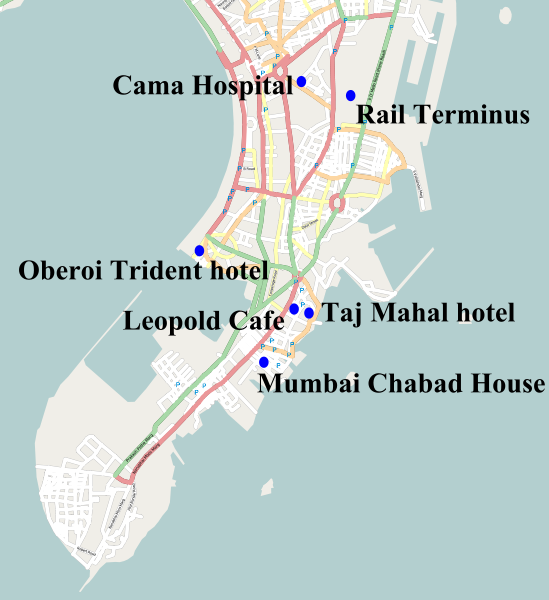
Locations of main massacres of 164 defenceless people in Mumbai. Today is the fifth anniversary. 
--------------------

Some of the survivors of the massacre (mainly guests of the Oberoi-Trident and Taj hotels). 

This is the fifth anniversary of the 2008 Mumbai attacks or massacre. These were twelve coordinated shooting and bombing attacks across Mumbai by ten Pakistani terrorists from the Lashkar-e-Taiba organisation supported by Pakistani intelligence ISI. During the massacre the terrorists communicated via SAT phones and VoiP to receive advice from their controllers in Pakistan. The attacks, which drew widespread global condemnation, began on 26 November 2008 (hence it is known as "26/11") and lasted until 29 November 2008, killing 164 defenceless people and wounding at least 308. One terrorist The one terrorist captured, Ajmal Kasab, was questioned, tried and executed four years later on 21 November 2012.

Eight of the attacks occurred in South Mumbai (see above map): at Chhatrapati Shivaji [train] Terminus, the Oberoi Trident Hotel the Taj Mahal Palace & Tower Hotel, Leopold Cafe, Cama Hospital (a women and children's hospital), the Nariman House Jewish community centre, the Metro Cinema, and a lane behind the Times of India building and St. Xavier's College.

There was also an explosion at Mazagaon, in Mumbai's port area, and in a taxi at Vile Parle. By the early morning of 28 November, all sites except for the Taj Hotel had been secured by Mumbai Police and security forces. On 29 November, India's National Security Guards (NSG) conducted Operation Black Tornado to flush out the remaining attackers; it resulted in the deaths of the last remaining attackers at the Taj hotel and ending all fighting in the attacks.

Aftermath

Many Indian civilians and many in government wanted India to retaliate through revenge commando raids or airstrikes. However the US prevailed on India to avoid escalating the Mumbai attacks-massacre into another India-Pakistan conflict. The US undertook to track down the guilty in Pakistan or wherever they were. The guilty would be arrested or when that was impossible killed by Predator-Reaper drone strikes. Since 26/11 liaison of Indian security-intelligence agencies with US security-intelligence agencies has increased greatly.

Pete

November 25, 2013

China's Space Achievements - Passing US's Manned Program


China's space program to 2012
-------------------------

 
Shenzhou 9 (click to enlarge) was a 3 person spacecraft launched 16 June 2012 of China's  Shenzhou program. Shenzhou 9 was the second spacecraft and first manned spacecraft to dock with China's Tiangong 1 space station on 18 June 2012. The Shenzhou 9 returned to Earth 29 June 2012. The mission's crew included the first Chinese female astronaut, Liu Yang.
----------------------
  
 
Great video of Shenzhou 10's launch and initial space flight on 11 June 2013, to again dock with the Tiangong 1 space station. Shenzhou means Divine or Magic Craft.
------------------------------------------


China's Long March 2F rocket used to launch the 2 latest Shenzhou (9 and 10) manned missions to the Tiangon 1.  China is planning several space rockets with a heavier payload than the Long March 2F's 8,400 kgs (to LEO) including the Long March 5 with a planned payload of 25,000 kgs (to LEO). 
---  

On November 7, 2013 Australia's Sydney Morning Herald carried an article originally in the Houston Chronicle. The Houston Chronicle is a rare news outlet interested in China's space achievements because Houston is the home of NASA's large Mission Control organisation and thus Houston has a big economic and intellectual stake in space developments.

It is remarkable how news of China's space achievements have been ignored in almost all of the Western media over the years. Westerners are simply unaware how China has progressed.

The Sydney Morning Herald  article, at http://www.smh.com.au/world/chinese-may-be-on-track-to-pass-us-in-space-20131107-2x2ix.html#ixzz2ld8rFcpB follows:

"Chinese may be on track to pass US in space"

China has the opportunity in coming years to surpass the United States in space programs, forcing the government to step up NASA funding to retain a leadership position, partner with the Chinese or risk falling behind, according to space policy experts.

Russia is the other country that currently has the capacity to launch humans into space. Its space program, however, reliant upon technology designed nearly five decades ago, is getting by on past momentum. China's [manned Shenzhou] space program, by contrast, is in ascendance.

China launched its first astronaut, Yang Liwei [Shenzhou 5 in 2003] , into space a decade ago. Since then it has made steady progress, from conducting space walks to launching a small laboratory. By 2020, China plans to complete construction of its own [full sized]  space station.

While that may seem modest compared to NASA's overall accomplishments, they signal an ambitious program that is advancing rather than regressing, space experts say.

China has provided a stable budget and ample funding for its space goals, while NASA has been tasked with large expectations in human exploration without commensurate resources.

In a widely read article in Foreign Policy earlier this year, Berry College international studies professor John Hickman argued that today's modest achievements are setting the stage a decade from now for China to be the dominant player in human space exploration. [see Hickman's article at http://www.foreignpolicy.com/articles/2013/08/02/china_is_winning_the_space_race ]

"Shift the focus to the present and they are merely unsettling," Mr Hickman wrote of China's efforts in space. "But look to the future, and there are unmistakable warning signs that China may surpass the United States and Russia to become the world's pre-eminent space-faring power."

'Makes me cringe'

Leroy Chiao, a former astronaut who commanded the International Space Station, says critics who dismiss China's advancements as "been there, done that" are missing the point.

"It really makes me cringe when you have people dismiss what they're doing by saying they're only doing what we did 50 years ago," Mr Chiao said. "We [the US] can't go to the moon right now. We [the US] can't even launch our own astronauts right now. We do have plans, but everyone knows the budgets we have in this country don't support those spaceflight plans."

In some areas, China has already surpassed the United States.

During 2011 and 2012, China conducted four launches of commercial satellites into space, whereas the United States performed just two.

Main competitor

At a recent space conference, Adam Harris, a vice president of SpaceX, the private US rocket company, identified China as the company's main competitor for future launch business.

"The Chinese government is certainly committed to furthering their program," said Mr Harris, according to the website space.com. "They've announced moon missions, they've announced further activities, and they are doing it within their country."

Among space policy experts, two of the most critical questions about China's space program concern the extent to which NASA will be allowed in coming years to partner with China and whether future Chinese gains in space will prod the United States to invest more in its own program.

By US law, NASA is prohibited from working with China's space program, and other US regulations prevent any satellite that includes US-made components from launching on Chinese rockets.

The chief obstacle to NASA collaboration with China is US Rep. Frank Wolf, a Virginia Republican, who chairs the House subcommittee overseeing the space agency's budget. Mr Wolf's opposition is rooted to China's human rights violations.

Could be left behind

But other countries, including Russia and NASA's European partners in the International Space Station, have expressed a willingness to work with China. They wanted to see China brought in as a space station partner. And it appears likely that astronauts from both Russia and Europe will fly to China's station in the 2020s.

Mr Chiao said he's concerned about a scenario in which the United States stops flying its space station [the International Space Station (ISS)] in 2020, and the international partners transfer their funds and support to the Chinese station.

[see http://www.space.com/22348-international-space-station-lifespan-2020.html "Logsdon told SPACE.com that he did not think it likely that either Japan or Europe have any enthusiasm to pony up money for the ISS after 2020....Looming in the background of the space station's future beyond 2020 is talk by Russia of starting a second-generation space station on its own, Logsdon said.
"And of course you have the Chinese station in the same time period," he added. China has launched two crews to its first space laboratory module, Tiangong 1, and plans to construct a 60-ton space station by 2020.]

If that scenario plays out, the United States could find itself locked out of space exploration while the world's other major powers are working and cooperating in space.

"If we can work with the Russians, who were our sworn enemies during the Cold War, why can't we work with the Chinese?" Mr Chiao asked. "We've been working with the Russians since the mid-1990s and there haven't been any instances of inappropriate technology transfer that I'm aware of."

A 'Sputnik moment'?

There's also the question of whether Chinese ambitions in space might push US lawmakers to give NASA a budget that allows it to meet greater spaceflight challenges.

Although the Chinese government has not set a firm time line, it has long-term plans to develop its line of Long March rockets from smaller to larger sizes such that a human mission to the moon might become feasible by 2025 or 2030.

"China plans to put their men on the moon in 2025," said Michio Kaku, a City University of New York physicist and noted science communicator. "For America, that's going to be a shock. A real wake-up call. We're going to have another 'Sputnik moment' when the Chinese put the flag on the moon."

However, when NASA has played the China card in the past to drum up more funding from lawmakers, it hasn't worked.

Mike Griffin, the space agency's administrator from 2005 to 2009, used to invoke the possibility of Chinese moon landings when seeking congressional support to fund the Constellation Program [a mercifully cancelled (larger than Apollo) US program to send astronauts to the ISS, then the Moon, then Mars], which would have returned NASA astronauts to the Moon.

President Barack Obama cancelled Constellation in 2010. Its replacement, the under-funded Space Launch System, doesn't have a destination.

"NASA in the past has tried to play up China as a competitor in space to encourage fuller funding of its human space program," said Jeff Foust, an aerospace analyst with the Futron Corporation. "It never worked." 

[from http://en.wikipedia.org/wiki/Shenzhou_10 Shenzhou 10, a manned spaceflight of China's Shenzhou program, was launched on 11 June 2013. It was China's fifth manned space mission. The mission had a crew of three astronauts: Nie Haisheng, Zhang Xiaoguang and Wang Yaping, the second Chinese female astronaut. The Shenzhou spacecraft docked with the Tiangong-1 trial space laboratory module on 13 June 2013 and the astronauts performed physical, technological, and scientific experiments while on board. Shenzhou 10 was the final mission to Tiangong 1 in this portion of the Tiangong program. On 26 June 2013, after a series of successful docking tests, Shenzhou 10 returned to Earth.]

Pete

November 22, 2013

Ongoing debate on Australia's SEA 1000 future submarine requirements.


The HDW Type 210mod "Ula Class" submarine specifically built for Norwegian conditions, with a submerged displacement of 1,150 tons.

-----------
For the latest on Australia's future submarine issue see June 11, 2014’s Australia's Future Submarine - Swedish vs German Claims http://gentleseas.blogspot.com.au/2014/06/australias-future-submarine-swedish-vs.html . 

For my preceding post "Australian SEA 1000 Future Submarine, shipbuilding-budgeting issues"   http://gentleseas.blogspot.com.au/2013/11/australian-naval-shipbuilding-and.html Anonymous has commented as follows:

"Anonymous said...


So what is the military issue behind a bigger son of Collins-class?

Range of a Collins-class submarine today is reached by even smaller submarines like Type210mod or A26. To gather intelligence a small submarine is better suited and a diesel-electric submarine is even quieter than a large Virginia-class submarine.

What about crew size? A Virginia-class submarine is manned with about 130 men. A modern Type210mod needs just 15 men (21 for 3-watch). Therefore 3 crews of Virginias 26 small submarines could be manned. For price of one Virginia class submarine Australia could get at least 4 Type210. For A$30billion Australia could buy more than 40 Type210mod.
This submarine could be built in Australia. The advantage of building a steady stream of small submarines is to include improvements in the next batch and to keep the knowledge alive how to build them.

Just 3 operational submarines are easier to track and even very fast submarines can’t be everywhere at once. Also a fast submarine is very noisy. A trip around Australia is roughly 7,000 nm. For each submarine 2,300 nm to patrol. With 26 submarines the area is less than 300 nm. With just 3 operational submarines it is very hard to lose one with a crew of over 100 men.

US combat System due to US weapons? What a nonsense! South Korea ChangBogo-class (Type 209) can fire Harpoon missiles. If Raytheon dislikes selling some Tomahawks Australia could just ask Israel about some Popeyes. Israel operates Popeyes on Dolphin-class submarines (Type 209).

Oh, more range. What about submarine tenders? Even the US Navy has a few.

Going big will result in too few submarines. Going to Virginia will add a capability already existing in the Pacific and Indian Ocean. After 6 or 12 small submarines Australia can still switch to a larger submarine type but then with better knowledge.
November 22, 2013
------------------------

On this current post I am responding with:

Hi Anonymous

The HDW 210mod and all existing SSKs (including the current sized S-80) fall far short of Australian SEA 1000 (future submarine) requirements.

The SEA 1000 submarine needs range, endurance, speed, multi-mission capabilities and weapons load far above existing SSKs.

If you compare the totality of HDW 209, 210mod ("Ula"), 212 or 214's published capabilities with Collins http://en.wikipedia.org/wiki/Collins-class_submarine you'll see the difference.

Note that SEA 1000 needs higher capabilities than even the Collins, especially for the added weapons load of 8+ Tomahawks in a VLS and an AIP capability (achieved by "usual" AIP, advanced batteries or nuclear).

Ideally an SEA 1000 should be operationally autonomous (from US SSNs) and hence capable of shadowing a fast moving SSN for at least a week.

The crew size of 135 for a Virginia being much larger than for SSKs (or the 60 for a future French Barracuda SSN) is indeed an issue.

Tomahawk is a requirement because Harpoon missiles are far too short in range for many land attack scenarios and because Tomahawk is US combat system compatible.

There are too many current uncertainties about the suspected Israeli SLCM Popeye. Popeye may include considerable "off the books" US, French and/or Indian content making it difficult for Israel to export.

Regards

Pete

November 21, 2013

Australian SEA 1000 Future Submarine, shipbuilding-budgeting issues


For the latest on Sweden's Saab perhap's buying ASC see June 11, 2014’s Australia's Future Submarine - Swedish vs German Claims http://gentleseas.blogspot.com.au/2014/06/australias-future-submarine-swedish-vs.html . It is unclear whether Germany or Sweden hold the strongest intellectual property rights to the Stirling AIP.

A rough sketch of what Australia may want in its SEA 1000 future submarine project. Nuclear or diesel-electric propelled, if diesel-electric then additionally AIP or very large advanced battery capacity, multi-use vertical launch system, US combat system, US weapons including Tomahawk. Probably the not yet developed HDW 216, an enlarged DCNS Scorpene and in development Spanish S-80 are front runners with the SEA 1000 program planners. US Virginia Class, UK or French nuclear attack subs are outside chances. The chance that Swedish Kockums might be chosen (again) is reduced due to the Collins experience and TKMS-HDW.


------------------------

Australia's new centre-conservative Coalition Government has made no decision on what its project SEA 1000 future submarine will consist of.

The previous centre-left Labor Government (voted out in September 2013) indicated in White Papers and other reviews that 12 future submarines would be constructed from around 2025 to around 2035. The previous Government decided these submarines would be large (up to 4,500 tonne) and hence of unique design, diesel-electric, built in Adelaide, South Australia and that they would probably use the US combat system and US conventional weapons (including the Tomahawk cruise missile). These unique large diesel-electric may effectively be Collins Mk. IIs but not built with Kockums as a major contractor unless TKMS negotiates deals in that direction. The Labor decision was made due to several considerations including:

- economic-industry development potential for the depressed South Australia economy

- popular with Labor's trade union constituency

- Federal and State level electoral considerations ie. votes in South Australia

- ideological anti-nuclear grounds, including popularity with Labor's Green Party ally and

- technical grounds (mainly that Australia possessed no nuclear propulsion support industry, that is if we needed one at all...)

Australia's new conservative Liberal-National Coalition Government has not yet made a decision on what will be in the SEA 1000 future submarine in part because:

- the new Coalition Government has only been in power for two and a half months

- the highly complex 30+ billion dollar project deserves several long reviews

- Australia does not currently have the Defence money to fund the project

- naval shipbuilding and budgeting for Australia is currently taken up by the 2 Canberra Class Landing Helicopter Docks (LHDs) and the 3 Hobart Class (Aegis) Air Warfare Destroyers (AWDs) projects under construction, and

- the issue is still unresolved under the new Government as to whether Australia may buy nuclear propelled attack submarines rather than diesel-electric

Its not necessarily set in stone that 12 subs will be built rather than 6 diesel-electric or 4 to 6 nuclear propelled. The built in Australia requirement is not a given. Industry-jobs-votes requirements in Australia may be met in other ways including offset agreements and heavy maintenance facilities constructed  in Australia including nuclear propulsion support (if needed...).

If, as is likely, 4 Virginia Class can do the job of 12 diesel-electric Collins Mk. IIs then on the crucial issue of lower overall price, a deal is possible.

A final Australian decision may take 4 years into the new Government ie 2017.

In terms of arguments favouring nuclear propelled Phil Radford a freelance writer, based in Sydney, has written the following article of May 15, 2013 in the Australian Strategic Policy Institute (ASPI's) The Strategist http://www.aspistrategist.org.au/a-farewell-to-nuclear-submarines-for-now/

A farewell to nuclear submarines, for now

The Defence White Paper signals full-steam ahead for Australia’s most expensive defence project ever: the design and construction, in Australia, of 12 conventionally-powered submarines. With A$200m committed to funding initial designs, however, the enormity of the challenge will start to surface. Australia now has to create submarines with greater range and endurance than anything built by countries with generations of experience.

Hopefully, Canberra analysed its alternatives to the point of exhaustion. In about two years’ time, Adelaide will start to fill up with the 1,500-or-so foreign draughtsmen and engineers that RAND says Australia will have to import, just to execute the design work. And as these experienced submarine designers wrestle with the performance parameters set by government, they’ll pose one very awkward question: “Why are you asking us to design a nuclear-powered submarine without a nuclear engine?”

Currently, the government has no answer. The White Paper simply says that “consideration of a nuclear powered submarine capability [… has been] ruled out”. This reticence is mistake. As Collins Mk II rises from the drawing board, the case for purchasing nuclear-powered boats will only get stronger.

First, consider the money. The projected cost of an all-new 4,000 tonne conventional boat is estimated by ASPI to be over A$3 billion, which includes all project costs. This is approximately the same as the sail-away cost of a much larger Virginia class nuclear submarine off an established production line, and could even be more than a French or British nuclear submarine which would almost certainly sail away for less than $2 billion. Defence would still have to purchase the support systems to get the boats into Australian service, but the industrial and program costs sunk into getting a first-in-class to work would be borne by someone else.

Besides being less risky to procure, these nuclear-powered vessels would be far more powerful than conventionally-powered boats. They could arrive on station faster, stay there longer, carry more weapons, and fight more aggressively. As a deterrent, they’d be many times more formidable.

The Royal Australian Navy might play a simple war game once the new design matures. They could invite a retired American submarine captain over and say : “Sir, to achieve a specific objective in the middle of the Pacific or Indian oceans you have a straight choice between having, under your command, one single nuclear-powered boat, or ‘X’ number of our Collins Mk.II?” Even at this distance, his ‘X’ is likely to be two or three. Expressed as an opportunity cost in dollars, the answer is horrendous.

The objections to going nuclear are clear; but as the challenges of Collins Mk.II become less opaque, the question will be: did the Government diligently and unemotionally address them?

If the over-riding justification for an Australia-built fleet is operational independence, then Government should look squarely at what the current fleet delivers. Only one third of the Collins fleet is generally seaworthy. Refitting them takes four to five times the work required on similar comparable European vessels. And upgrading them requires US help for the most complex elements—the sensors, combat system and weapons.

Australia could almost certainly sustain a fleet of nuclear boats to a higher level of operational availability than currently possible. Neither the US nor UK boats ever need refuelling. The core is closed for the lifetime of the submarine, so the additional nuclear engineering required for through-life support is modest. Establishing a first-class nuclear-boat maintenance facility in Australia would be expensive, but pales beside the gargantuan cost of re-launching the Australian Submarine Corporate (ASC) as a construction yard.

Alternatively, Australia could avoid the cost and political risk of building maintenance facilities here, and instead operate the boats on a similar cycle to the United States Navy’s Guam-based submarines. This would mean the submarines having only a small maintenance footprint here and returning to US West Coast for periodic refits, which is pretty much how the RAAF maintains its fleet of C-17 strategic transports.

In either case, you don’t need a construction yard to maintain a submarine. The activities are quite different. British nuclear boats never re-visit the Barrow yard where they are built.

Nor would the fact Australia’s boats were foreign-built boats necessarily diminish the country’s strategic independence. There’s a fundamental difference between depending on an ally to come to your aid (which, in extremis, Australia does now) and depending on your ally not to obstruct you from paying to defend yourself. That’s why the UK ultimately trusts US not to abuse its position as the supplier–owner of its Trident ballistic missiles, on which the UK’s independent deterrent relies.
Does the case against nuclear boats ultimately rest, then, on Australian jobs foregone? That flank, too, is exposed. Re-booting ASC will merely kick-start thousands of careers that will go nowhere once each design and construction phase is complete. Better, surely, to play the international defence procurement game, and trade jobs on submarines for offsets in industries where Australia can build competitive advantage—and careers with a future.

The stakes couldn’t be higher. Asia is rising and submarines will become Australia’s primary defence asset for many decades. For now, the government has passed on the one weapon that could deliver genuine independent strategic security. But like a pair of lethal mines, cost and capability are floating right in the path Australia’s home-grown subs. This won’t be the last we hear of Australia’s nuclear option.

Phil Radford is a freelance writer, based in Sydney. He specialises in naval strategy and defence procurement."