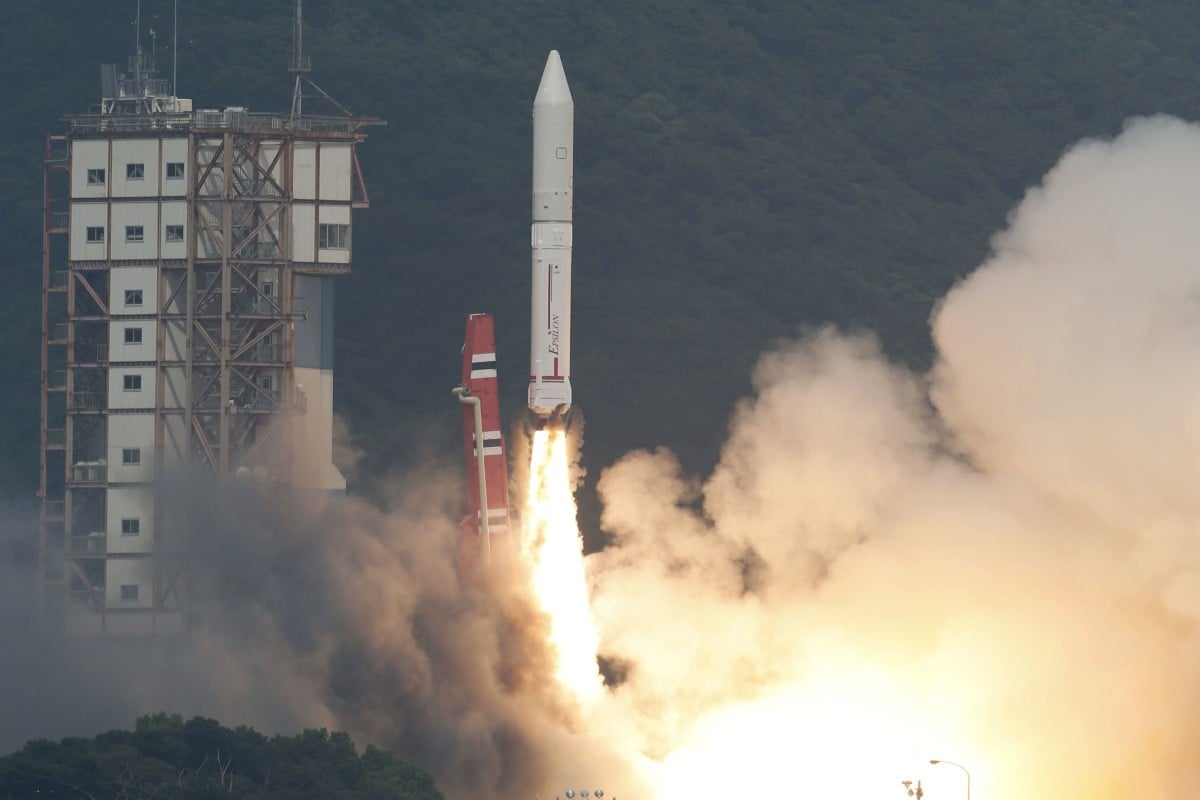
Japan ICBM capable M-5
launched into space.
Japan ICBM capable M-5
launched into space.
-
UPI's Martin Sieff reported November 5, 2008 that:
-
WASHINGTON, Nov. 5 (UPI) -- The
Japanese government is slowly moving towards a decision to launch its own early
warning ballistic missile defense satellite, the Yomiuri Shimbun newspaper reported Wednesday [Nov
5, 2008].
The Tokyo newspaper said it had received access to a
draft plan for ballistic missile defense drawn up by the
secretariat of the Japanese government's headquarters for space development
strategy. The report calls for an assessment on the value of deploying an early
warning satellite that could monitor any potentially hostile missile launch.
In addition, the draft plan recommends carrying out a
feasibility study on launching more civilian comsats -- communications satellites.
The plan also suggests Japan should start building
smaller short-range and medium-range missiles for its Defense Forces, in
addition to the bigger H-2A missiles currently in use.
The Yomiuri Shimbun said this language may be an indirect
way of pushing through approval to build the GX missile that has become a matter of some
controversy. Old-fashioned bureaucrats who are opposed to Prime Minister.
-
Taro Aso's drive
to develop a military space capability for Japan have opposed the GX project, and they
managed to get the Space Activities Commission of the nation's Education
Ministry, a stronghold for the old, cautious, pure research, non-military
tradition in Japanese official space policymaking, to take a position opposing GX
development.
-
"While many question the need to go ahead
with the GX
development project, (this plan) is -tantamount to approving it," one official
told the newspaper.
-
However, the draft plan looks set to be smoothly approved and
then implemented as national policy within the national budget for Fiscal Year
2009. The Yomiuri Shimbun said that at a meeting of the
space development strategy secretariat Tuesday, it sent the draft plan on to be
finally agreed upon at a second meeting to be held Nov.
27."
-
Comment
H2
This rocket has no direct military
missile value given its weight (445 tons) and with its strap-on booster
configuration. However launches of this rocket give Japan ongoing experience in
the use of the small and medium sized solid fuel boosters - handy for future
development of missiles smaller missiles than the M-5. Wiki suggests "The
H-IIA (H2A [or
H-2A]) is a family of liquid-fuelled rockets providing an expendable launch
system for the purpose of launching satellites into geostationary orbit."
The H-2A has been launched 14 times
since 2001 - only one failure - last launch February 23, 2008. Its maximum
payload to Low Earth Orbit (LEO) is 15 tons and to Geo Stationary Orbit 6
tons.
-
M-5
At 30.8m high, 2.5m diameter and
up to 139 tons it is clearly too big for ICBM duty however those specs are for 3
or 4 stages. Just two stages of a (say) 2m diameter scale down may be sufficient
to hit Japan's most immediate enemies North Korea and China.
When one looks at Japan's
experience, since 1966 in building the Mu
range of booster rockets (with 7 smaller rockets before the M-5)
Japan's ability to build manageable IRBMs and ICBMs is obvious.
-

It may be coincidental or
intentional that Japan progressed from "strap-on" boosters (associated with
peaceful use) in the earlier Mu series (Wiki description) to an ICBM like
configuration for the M-5.
-
The GX will move further in the direction of a space rocket as
it is projected to weigh 210 tons and has a liquid fuel upper
stage.
-
Shorter Range Missiles
Only old figures jump out about shorter range Japanese missiles. The
Japanese don't want to appear offensive, appaer to stress reliance on more
powerful US forces and don't wish to be seen as competing with the US' near
monopoly in missile production and sales.
MHI produces various anti-ship missiles
including Type-88 Surface-to-Ship Missile (SSM) and Type-90 SSM for the Japanese military
-
Specifications 1988 - Type 88 SSM1990 and Type 90 (SSM-1B), 5.1m long, 660 kg,
Turbojet,
Maximum effective range - Type 88
SSM 180 km , - Type
90 (SSM-1B) 150
km
Inertial guidance + active radar homing
Deployment - Type 88 SSM = 320 (?), Type 90 (SSM-1B) = About 40 as of 1994.
MHI also licence builds the US Patriot missile
(see MHI site)
Pete