Showing posts with label Japan. Show all posts

July 11, 2014

Australia may select Japanese Submarine

The Maritime Executive (MAREX) reported, July 9, 2014 that http://www.maritime-executive.com/article/Australia-Inches-Closer-to-Japanese-Submarine-Deal-2014-07-09 : 


July 09, 2014

Australia Inches Closer to Japanese Submarine Deal

Australian Defence Minister David Johnston hailed the signing on Wednesday of an agreement with Japan as “an important milestone”. The agreement will deepen bilateral defense science and technology cooperation.


Australia’s Prime Minister Tony Abbott and Japan’s Prime Minister Shinzo Abe signed the agreement in Canberra during Abe’s visit to Australia. “This is an important milestone in the Australia-Japan defense relationship, and an integral part of the broader efforts to strengthen our strategic partnership,” said Johnston.


The agreement will facilitate deeper bilateral defense technology cooperation, and the first project will be the Marine Hydrodynamics Project, an important topic in relation to designing a submarine’s hull to ensure its low noise, stealth capabilities and to improve propulsive efficiency. 


The sharing may not be all one-sided. Scientists from Australia have invented sound-absorbing hull and mast tiles that absorb the radio-wave pings sent out by searching sonar sets. Japan is also said to be interested in radar technology developed in Australia that has proved to be effective at shooting down incoming supersonic missiles.


Currently the Japanese constitution prevents that country from taking military defensive action on behalf of allies, but Abe is looking to change that to allow for the concept of “collective self-defense”. Consequently, allies might be more inclined to assist Japan if needed. Australia and Japan have already agreed to work together on submarine design, and this change in policy is viewed as contributing to a growing alliance between the countries. 


Australia may ask Japan for help in designing a new class of submarine or may consider buying complete submarines from Japan. Australia’s previous government had promised to build 12 submarines in Adelaide for a total cost of around $40 billion, the country’s most expensive defense project. However, the Abbott government, elected in September last year, may downsize that and is said to be considering other options.


Of-the-shelf European submarines have been rejected in the past for being too small and lacking in range for Australian conditions, so Japan’s Soryu class are now an attractive prospect given the willingness of Japan to engage with Australia on the project.


“The language being used is unprecedented in terms of speaking of the special relationship, the depth and breadth of the friendship and their preparedness to share sensitive information with us,” Australia’s minister for foreign affairs, Julie Bishop told The Australian.


However, Australia still claims to be in discussions with other countries including Germany, France, the US and Britain. “This is not the only option available to us at this stage. It’s one of a number,” Johnston says.


The ability of any Japanese submarines bought by Australia to operate with the US fleet of nuclear submarines will be a significant factor. Any new Australian submarines are likely to include the same combat system and [US Mark 48] torpedoes as the US Virginia-class nuclear-powered attack submarines and near-silent propellers developed in the US.


If Australia bought foreign off-the-shelf submarines it would be a serious setback for the local shipbuilding industry. However, after delays and cost overruns in the Air Warfare Destroyer project, the government has already chosen to build a new series of naval supply ships in either Spain or South Korea." ENDS

PETE's COMMENT

Note that Japan in the next few years plans to develop a new generation submarine to start replacing the current Soryu's by the 2030s. What the Soryu's probably don't have (vertical multi-purpose locks (VMPLs)? Lithium-ion batteries?) - which Australia probably wants - might be incorporated into Japan's next generation submarine. 

Pete
December 22, 2013

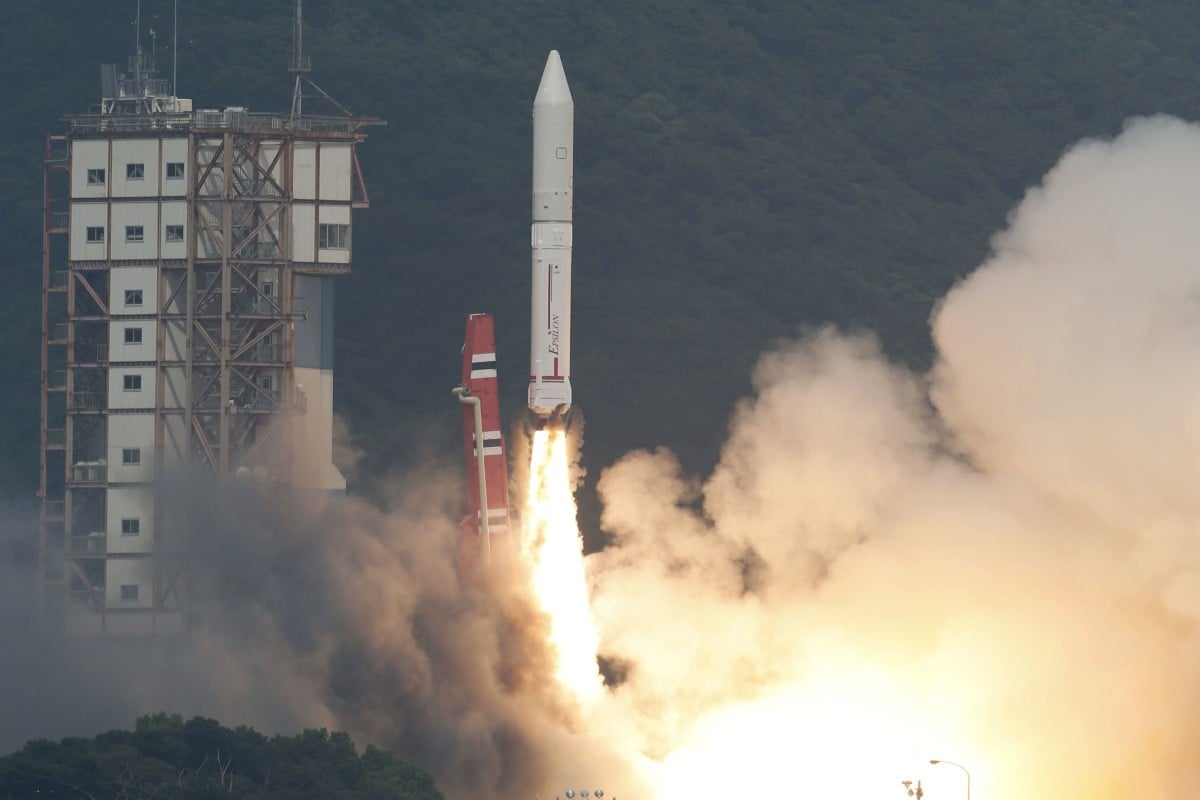
Japan's Epsilon Rocket, An ICBM in Waiting


A 3 stage Japanese Epsilon research rocket (potentially an ICBM) being launched from Uchinoura Space Center in southern Japan.
---


Specifications for the Epsilon include: Height 24.4m, Diameter 2.5m, Mass 91 tons, 3 or 4 stages. Its shape, with no strap-on boosters, is ideal for silo, rail or truck launch. Reduced to 2 stages it might provide the basis for an SLBM.

Modern ballistic missiles generally have solid fuel stages (for quicker preparation and more rugged handling) rather than liquid. So it is more than a coincidence that the first, second and third stages of the Epsilon are solid fuel.

The Epsilon's specifications are very similar to the fully developed (but then cancelled) US MX missile ICBM. For comparison the MX's specs are Height 22m, Diameter 2.3m, Weight 97 tons, 3 stages, blast yield 3 Mt total (using up to 10 MIRVs).

The extent to which the US assisted JAXA's Epsilon Project is unclear. Japan Aerospace eXploration Agency (JAXA) is Japan’s NASA equivalent. Space agencies have dual military-civilian use technology and dual-use career personnel. JAXA, and of course NASA, are dual-use - although space agencies rarely admit this. 

---------------

More see Doug Tsuruoka, "Can Japan's Epsilon rocket be used as an ICBM?" Asia Times, on January 23, 2018, at 
https://asiatimes.com/2018/01/can-japans-epsilon-rocket-used-icbm/ which answers in the affirmative.


The Japan Aerospace Exploration Agency's (JAXA) solid-fueled Epsilon rocket launched seven different satellites into orbit from Uchinoura Space Center on January 17, 2018.
---

These armament plans have raised regional concerns that Tokyo may be shedding its post-World War II pacifist defense posture.

"What is worrisomely ... is that Japan's rearmament would be met with China's reaction, which could cause regional instability," Korea National Defense University Japan researcher Park Young-june said.

The United States, however, is seen as supportive of Japan taking on a more assertive regional role, as it could be useful in meeting the challenge of China's growing military might."

Background

February 23, 2012

Japanese Rocket and Missile Expansion Possibilities

Japan ICBM capable M-5 launched into space.
-
-
UPI's Martin Sieff reported November 5, 2008 that:
-
WASHINGTON, Nov. 5 (UPI) -- The Japanese government is slowly moving towards a decision to launch its own early warning ballistic missile defense satellite, the Yomiuri Shimbun newspaper reported Wednesday [Nov 5, 2008].


The Tokyo newspaper said it had received access to a draft plan for ballistic missile defense drawn up by the secretariat of the Japanese government's headquarters for space development strategy. The report calls for an assessment on the value of deploying an early warning satellite that could monitor any potentially hostile missile launch.

In addition, the draft plan recommends carrying out a feasibility study on launching more civilian comsats -- communications satellites.

The plan also suggests Japan should start building smaller short-range and medium-range missiles for its Defense Forces, in addition to the bigger H-2A missiles currently in use.

The Yomiuri Shimbun said this language may be an indirect way of pushing through approval to build the GX missile that has become a matter of some controversy. Old-fashioned bureaucrats who are opposed to Prime Minister.
-

Taro Aso's drive to develop a military space capability for Japan have opposed the GX project, and they managed to get the Space Activities Commission of the nation's Education Ministry, a stronghold for the old, cautious, pure research, non-military tradition in Japanese official space policymaking, to take a position opposing GX development.
-
"While many question the need to go ahead with the GX development project, (this plan) is -tantamount to approving it," one official told the newspaper.
-

However, the draft plan looks set to be smoothly approved and then implemented as national policy within the national budget for Fiscal Year 2009. The Yomiuri Shimbun said that at a meeting of the space development strategy secretariat Tuesday, it sent the draft plan on to be finally agreed upon at a second meeting to be held Nov. 27."
-

Comment
-
H-2

-
This rocket has no direct military missile value given its weight (445 tons) and with its strap-on booster configuration. However launches of this rocket give Japan ongoing experience in the use of the small and medium sized solid fuel boosters - handy for future development of missiles smaller missiles than the M-5. Wiki suggests "The H-IIA (H2A [or H-2A]) is a family of liquid-fuelled rockets providing an expendable launch system for the purpose of launching satellites into geostationary orbit."

It is manufactured by Mitsubishi Heavy Industries (MHI) for the Japan Aerospace Exploration Agency, or JAXA. Launches occur at the Tanegashima Space Center. "

The H-2A has been launched 14 times since 2001 - only one failure - last launch February 23, 2008. Its maximum payload to Low Earth Orbit (LEO) is 15 tons and to Geo Stationary Orbit 6 tons.
-
See Comparison of mid-heavy lift launch systems which includes Indian GSLV.
-
M-5

-
A rocket ideal for conversion to an ICBM is Japan's M-V, M5, M-5 or Mu-5,


At 30.8m high, 2.5m diameter and up to 139 tons it is clearly too big for ICBM duty however those specs are for 3 or 4 stages. Just two stages of a (say) 2m diameter scale down may be sufficient to hit Japan's most immediate enemies North Korea and China.

-
When one looks at Japan's experience, since 1966 in building the Mu range of booster rockets (with 7 smaller rockets before the M-5) Japan's ability to build manageable IRBMs and ICBMs is obvious.

-


-
It may be coincidental or intentional that Japan progressed from "strap-on" boosters (associated with peaceful use) in the earlier Mu series (Wiki description) to an ICBM like configuration for the M-5.
-
The GX will move further in the direction of a space rocket as it is projected to weigh 210 tons and has a liquid fuel upper stage.

-
More on Japan's very short term nuclear weapons potential Japan's Potential ICBMs & Hoarding More Plutonium of April 29, 2008.
-
Shorter Range Missiles
-
Only old figures jump out about shorter range Japanese missiles. The Japanese don't want to appear offensive, appaer to stress reliance on more powerful US forces and don't wish to be seen as competing with the US' near monopoly in missile production and sales.
-

MHI produces various anti-ship missiles including Type-88 Surface-to-Ship Missile (SSM) and Type-90 SSM for the Japanese military
-
Specifications 1988 - Type 88 SSM1990 and Type 90 (SSM-1B), 5.1m long, 660 kg, Turbojet,
Maximum effective range - Type 88 SSM 180 km , - Type 90 (SSM-1B) 150 km
Inertial guidance + active radar homing
Deployment -
Type 88 SSM = 320 (?), Type 90 (SSM-1B) = About 40 as of 1994.

-
MHI also licence builds the US Patriot missile (see MHI site).

-
Japan has had the experience and capacity for decades to produce advanced ICBMs and shorter range missiles. If the Yomiuri Shimbun newspaper is accurate Japan may announce further missile plans by late Novermber 2008.

-
Indian-Japanese Space Cooperation
-
This Asia Times Online article of Nov 12, 2008 brings together many likely aspects of both India's and Japan's space programs. It begins:
-
"India and Japan's agreement in October [2008] to expand cooperation between the Indian Space Research Organization (ISRO) and the Japan Aerospace Exploration Agency (JAXA), in the field of disaster management, has the raised the ire of a China fearful that the US is masterminding a powerful space alliance between its allies in the region" and further down:


""This could be seen by some as a sensitive undertaking with obvious dual use possibilities which Japan will attempt to handle with great care. And that degree of sensitivity clearly permeates anything that ISRO and JAXA have been given the green light to develop in this instance, even though JAXA has no national security mission," said Gatling"
-

Pete