August 29, 2025

Indonesia's PT PAL Scorpene Evo Build Program & Other Ships

Indonesia’s contract with Naval Group (NG) for the production of two Scorpene Evolved (Evo)s entered into force on July 23, 2025. Both boats will be built at Indonesia’s national shipbuilder PT PAL Surabaya facilities.

This program will soon see the first batch of Indonesian ship welders sent to France for ‘technical instruction’. 50 NG personnel will eventually be stationed at the PT PAL Surabaya facilities to train 400 Indonesian engineers in submarine construction. 

According to Pierre Eric Pommellet, Chairman and CEO of NG, this will be a long-term strategic partnership with Indonesia to help establish a sovereign naval industry. Although there was no mention of the duration of the contract or how many boats will ultimately be delivered.

A Scorpene Evolved (Image: Naval Group)
---

Indonesia Business Post.com reports “the submarines will not only be constructed locally, but will also be managed, operated, and maintained entirely by Indonesian personnel, reinforcing Indonesia's long-term naval autonomy.” This project will also create thousands of highly-skilled jobs in Indonesia, especially as NG has signed a Memorandum of Understanding (MoU) with Indonesia’s National Research and Innovation Agency (BRIN) for "future maritime defense R&D."

According to Indonesia’s Chief of Naval Staff Admiral Muhammad Ali, the first boat could take up to seven or eight years to build. This is because PT PAL has to establish a local supply chain and production facilities, including the installation of a Syncrolift system for shiplift and ship transfer.

Full transfer of Scorpene Technology

NG has also transferred Scorpene technology to India and Brazil, where the ProSub program, initiated in 2009, has delivered three out of four Riachuelo-class SSKs. Brazil's SSN derivative of the Scorpene, the Alvaro Alberto, is set to launch in 2031.

Indonesia is also entering into a Defense Cooperation Agreement (DCA) with Brazil to develop missile technology (Brazil has developed the Astros II system with a range of 500km) and submarine systems. 

Image: PT PAL
---

PT PAL's major shipbuilding facility (above) is located in the city of Surabaya, co-located with the Indonesian Navy's 2nd Fleet Command. 

The Surabaya facility is currently building a Makassar-class LPD variant (also see) for the United Arab Emirates Navy, as well as two Merah Putih (Red White) frigates, which are Arrowhead 140 derivatives. 

image: From Naval News, PT PAL Surabaya facilities
---

The Scorpene Evolved is an update that provides the Indonesian Navy with the longest range Scorpene variant, using a full Li-ion configuration without an AIP module. Indonesia's Scorpene boats were offered with the Italian developed Black Shark torpedo (already used by Indonesia) the NG F21 torpedoe and MBDA Exocet SM39 SLCMs

On April 2, 2024 NG published the "Scorpène® Evolved main characteristics" below:

"Surfaced displacement: 1,600 – 2,000 tons ;

Length, overall: 72 m ;

Submerged speed: >20 knots ;

Diving depth: >300 m ;

Autonomy: >78 days on a 80 days mission ;

Submerged autonomy: >12 days ;

Crew: 31 ;

Weapons total payload: 18 ;

Weapon tubes: 6 ;

SUBTICS combat management system ;

Operational availability at sea: >240 days per year."


Image: Navalnews
---

These has been little detailed OSINT information, to date, on Indonesia's future submarine procurement. But the speed PT PAL Indonesia has so far taken at the beginning of this build program is highly indicative of the priority of this project with the Indonesian government. Once the infrastructure and supply chain have been established, there should be further orders.

The Indonesian Navy has a long-term requirement for 12 submarines. This could extend to PT PAL building up to 12 Scorpene Evo boats, including replacements for the single remaining Cakra-class (Type 209-1300) and three newer Nagapasa-class (Type 209-1400) boats now in service. There are also export possibilities to  nations, such as the Philippines and Malaysia (which operates two Scorpene SSKs).

August 25, 2025

Discussion Group Agenda I Run This Week

1. Antarctic ice may be melting increasing the risk of sea level rise and threatening Emperor Penguins https://www.abc.net.au/news/2025-08-21/iconic-antarctic-species-at-risk-amid-antarctic-regime-shift/105676324

2. Jim Chalmers Economic Reform Roundtable achieved little. Except to freeze the 2,000 page Australian Construction Code until 2029 (excluding many new updates for essential safety and quality issues) “fast-track housing approvals” (using unclear “AI”?). No tax decisions but floated tax issues on: intergenerational inequity; incentives for business investment; and challenges of us aging population (maybe more tax on our “aged wealth”). Floated slowing growth of NDIS. Nothing on Immigration.

3. Trump said no US troops for security/peacekeeping in Ukraine - leaving European countries, Canada and Aus to do it. This would be music to Putin's ears. Where these troops will be deployed is as yet unknown. Ukrainian side of Polish border? Or overflights of Ukrainian territory?

4. Many key Australian Federal ministers are retiring to lobbyist jobs that represent the fossil fuel and gambling industries. Unlike most state governments, the federal government has no independent regulator to enforce rules around lobbying. https://www.abc.net.au/news/2025-08-22/calls-for-greater-scrutiny-over-political-lobbyists/105678762

5. AI supercomputers scanned 10,000s of Indigenous dot paintings to produce quite good dot painting in seconds – using ChatGPT and Midjourney AI programs. Are the paintings produced cultural marvels or cultural theft? See lovely AI image below:

This dot painting (perhaps also influenced by van Gogh's Starry Night) in a virtual gallery, created with ChatGPT and Midjourney. (Courtesy ABC News)
---

6. In a continuing split Opposition gift for Australian Labor Prime Minister Albanese - David Littleproud ("Harry Potter" to his mates) reckons his Nationals will again promise unpopular nuclear power policies for the 2028 election. The Liberals, led by centrist Sussan Ley, don’t like nuclear or the National Party's Barnaby "redneck" Joyce's no net zero bill. https://www.abc.net.au/news/2025-08-23/nationals-leader-david-littleproud-says-nuclear-power/105689740

7. Beware Australian stock market rises eg. CBA shares are too high - and may be set for a bubble drop. What goes up and up can go down quickly. Also US and Australian share geared super funds might go down surprisingly. https://www.abc.net.au/news/2025-08-25/stock-market-valuations-soar-as-asx-wall-st-hit-records/105687206

8. Dramatic rebound for southern right whale numbers along Great Australian Bight” [and maybe on our east coast] https://www.abc.net.au/news/2025-08-22/southern-right-whale-births-increase-great-australian-bight/105678146. 


I see jumping/breaching Humpback Whales often near home, in September-October. 
---

August 22, 2025

Putin 1986 KGB Visitor to Australia, NZ, Singapore & Fiji. NEW COMMENTS

In the mid 1980s the Cold War Soviet foreign intelligence (KGB) remained busy. In the US 1985 was dubbed The Year of the Spy. Other Five Eyes countries, such as New Zealand (NZ) and Australia, were also of KGB interest. NZ politician and journalist, Bob Harvey, has collected enough evidence to identify Vladimir Putin as a KGB non-diplomatic cover “Illegalin NZ in March 1986. See “Putin's 1980s Visits to New Zealand as a KGB ILLEGAL” of August 18, 2025 at https://gentleseas.blogspot.com/2025/08/putins-1980s-visits-to-new-zealand-as.html

Putin spent most of his KGB external operational time in the relative backwater of the KGB's Dresden, East Germany, Liaison Office from 1985 to 1990. But he was more ambitious than that. So he persuaded his superiors to permit him to spend weeks or months elsewhere in 1986 for career diversity, including improving his  EnglishAlso being totally unknown in Southeast Asia and Oceania, he could securely work as an Illegal - probably using German cover. German is Putin's 2nd language. Whether Putin used a false East (or preferably West) German passport I don't know. 

In 1986 Putin advised New Zealanders he was a Bata shoe salesmen. Bata Shoe Corporation, headquartered in then communist Czechoslovakia, had/has a regional office in Singapore from which salesman visit local markets in NZ, Australia and Fiji. Singapore was a regional control station for KGB illegals in Putin's day, and it possibly remains a similar station for SVR illegals covering the 4 countries (Singapore, NZ, Australia and Fiji)

Putin could visit all 4 countries using Bata cover. As regional salesmen want to know many things Putin could plausibly ask about economic, political and labour-worker issues when he was in NZ

Bata has since 2004 been HQ based in Switzerland - meaning it is unlikely Bata now has any Russian intelligence affiliations. 

What might have drawn Putin, working as an KGB illegal, to Wellington (NZ's capital) and perhaps also to Auckland (NZ's largest city) in 1986?:

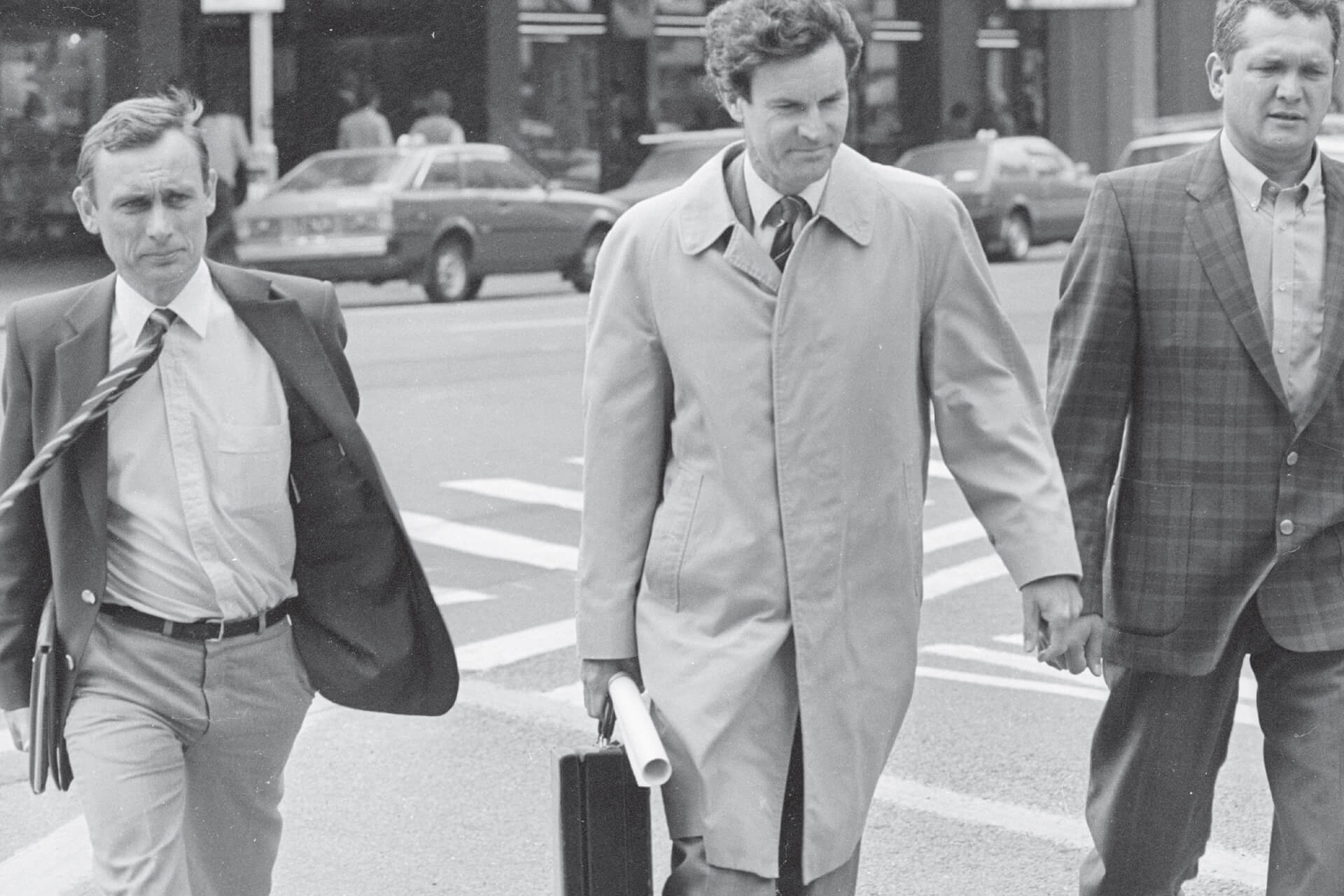
1.  The sinking of Soviet passenger ship MS Mikhail Lermontov, in NZ waters, in February 1986 was one reason Putin visited NZ in March 1986. In March 1986 Putin was a low key visitor sitting at the back of the court room inquiry into Lermontov's sinking. The inquiry was held at Lambton Quay in central Wellington. Probably it was New Zealand’s Security Intelligence Service (NZSIS) that took the photo below (Putin clearly on the left) in March 1986 outside of the court room. Once Putin rose to be head of Russia's domestic KGB successor, the FSB in 1998 his KGB past was publicly revealed. Pictures of him taken years before permitted retrospective identification of him as KGB.


The sinking of the Soviet ship Lermontov would have naturally embarrassed the Soviet Union. Putin may have wished to monitor how the captain and crew conducted themselves at the inquiry. Also he would be interested in some New Zealanders in court (eg. from the NZSIS or any remaining Moscow aligned NZ communists).

2.  Other issues drawing Putin to NZ in 1986 might be matters arising from the French DGSE’s sinking of the Rainbow Warrior (in Auckland Harbour, July 1985) including NZ anger at France and also against other Western countries https://en.wikipedia.org/wiki/Sinking_of_the_Rainbow_Warrior#Foreign_relations.

"The failure of Western leaders to condemn a violation of a friendly nation's sovereignty caused a great deal of change in New Zealand's foreign and defence policy.[33] New Zealand distanced itself from the United States, a traditional ally, and built relationships with small South Pacific nations, while retaining excellent relations with Australia and, to a lesser extent, the United Kingdom.[34]"

Also to what extent New Zealanders resented France’s further Pacific nuclear tests which only ended in 1996. Putin's freedom to operate in NZ would have improved in 1986 because NZSIS officers in Wellington and Auckland would have been preoccupied with further French bombing of Rainbow Warrior matters. So there would have been less NZSIS manpower resources to monitor Soviet spy activity, like Putin, in 1986.

3.  Putin may have assisted the fellow communist/Warsaw Pact Czechoslovakian Embassy, Wellington, owing to this matter https://en.wikipedia.org/wiki/New_Zealand_Security_Intelligence_Service#1980s_Cold_War_embassies_espionage_operations:

“In early June 2020, Radio New Zealand reported that the NZSIS had [quietly entered] the Czechoslovakian embassy in Wellington in 1986 as part of a joint operation with the British Secret Intelligence Service (MI6) to steal Warsaw Pact codebooks in order to break into the encrypted communications of Soviet-aligned countries during the Cold War…This revelation came to light as a result of an RNZ podcast series called The Service, produced by Wellington writer and documentary maker John Daniell, whose mother and step-father had both worked for the NZSIS. Daniell said that his step-father was involved in the [entry] and had claimed it was a success.” 

4.  Also there may have been no KGB or Czech intelligence officers permanently stationed in their respective embassies, in usually quiet Wellington. So a travelling KGB officer did the job, when needed. 

So Putin was based part time, in 1986, in Singapore, with visiting responsibility to NZ, Australia and Fiji. The NZSIS matched his 1986 photo to his 1998 head of FSB intelligence identity. Security intelligence agencies in Singapore, Australia and Fiji might also have photos of him on file, taken in 1986 - photos that can now permit identification of Putin 39 years later as a KGB visitor to those countries.

NEW COMMENTS

The security intelligence agencies of Singapore, NZ, Australia and Fiji may all have been aware of Putin's KGB identity. But these agencies may have been more  interested in detecting Putin's covert local contacts and KGB methods rather than arresting or expelling him. They might practice security intelligence collection more than law enforcement. 

If agencies did detect Putin an ultimate goal may have been to contact and "turn" Putin to be a double agent for the West. But clearly Putin was/is too much of a patriotic Russian for that to work.

August 18, 2025

Putin's 1980s Visits to New Zealand as a KGB ILLEGAL

--- 

PHOTO - Most probably KGB illegal  Vladimir Putin (on the left) who used an alias, in central Wellington, New Zealand, in March 1986.The 2 men on the right unknown? The one furthest right looks tough enough to protect Soviet diplomats? Photo courtesy Bob Harvey high up in the NZ Labour Party/journalist or photo taken by NZSIS which is also based in central Wellington.

See Bob Harvey's description (coloured pink/magenta) of the photo in 
Auckland's MetroMag  article below, published August 14, 2021. Bob Harvey  commented "Every day, a man with a striking resemblance to Putin sat at the back of the courtroom. He was photographed [above] outside the building on Lambton Quay. The photo is not as clear and sharp as I wanted but the more I magnified it, the more I found the resemblance to Putin’s features identified him as the mysterious courtroom visitor."

ARTICLE

Now Sir Bob Harvey, after many high level enquiries, wrote in the Auckland, New Zealand online newspaper MetroMag, August 14, 2021 at https://www.metromag.co.nz/society/putin-and-me

"Putin and Me: Bob Harvey searches for an invisible man.

Text by Bob Harvey 

Aug 14, 2021Politics

I have a confession to make: I was once in love with Lenin. I grew up in a house with my grandfather, who was an avowed communist. He’d been in the 1932 Queen St riots, seen blood on the streets, broken windows, mounted police smashing skulls, and he’d taken it all in his stride. He talked of Lenin as a demigod, able to stir a crowd and whip up a storm. One day, I thought, I’d like to do that, too.

The problem was (confession number two) that I was also a Catholic, like my grandmother. So, what was a 12-year-old boy from Newton Gully to do? Every week, I would read the communist newspaper the People’s Voice and, once a month, Russia Today. I found the images of gloriously large Russian women on tractors and carrying enormous bushels of wheat both terrifying and arousing. I would spend hours under the bedsheets with a torch gazing at their beaming faces and huge breasts. The rest, I imagine, you can guess.

When I was 17, I joined the pro-Soviet Socialist Unity Party, a breakaway group from the long-established China-aligned Communist Party. We met every second Sunday in an office on Liverpool St. We watched forbidden Russian movies, like Battleship Potemkin and Alexander Nevsky, which were smuggled into the country in large 16mm reels. They were magnificently inspirational. They were followed by lectures and discussions with businessmen who had recently visited Russia selling linen, bringing back a true picture of Russian life. Starvation, poverty and famine. On the urging of the party, I read the great Russian novels — rich and powerful tales by Tolstoy, Dostoyevsky and Chekov.

By the 60s, I had drifted away from Mother Russia and joined the Labour Party, and over the years I became a confidant and adviser, working with the leaders of New Zealand’s centre-left. In 1999, when the much-admired Labour Party president Michael Hirschfeld died in office, party leader Helen Clark asked me to take up the role. It was a bumpy ride but very successful and I felt humbled following in Hirschfeld’s footsteps. In December that year, Clark became the first woman to be elected prime minister in New Zealand history.

In the hallway outside the prime minister’s office one morning in 2000, a parliamentary clerk handed me an envelope containing 10 pages of galley proofs of a yet-to-be- published book by Greg Hallett, who later became famous for a book alleging that Hitler was a British agent. It was about Vladimir Putin’s alleged visit to New Zealand in the early 80s while he was ascending to the heights of the KGB, the Soviet Union’s main security agency. Putin was based in Germany and Singapore. One of his roles was to report on Australia, New Zealand and Fiji. Australia, as always in those days, was locked in battles with trade unionists and there was frequent port chaos. Fiji was fraught with problems in the sugar industry and with indigenous labour. According to former New Zealand prime minister Geoffrey Palmer on The Service, a 2020 RNZ podcast, the KGB was “extremely active in New Zealand and trying to penetrate our systems” and “was spying on the Labour Party”.

A week after the encounter outside the prime minister’s office, I asked Clark’s loyal and fiercely protective chief of staff, Heather Simpson (known throughout the Beehive as H2; the PM was H1), whether she knew or needed to know everything. I told her that the galley proofs had come to me unsolicited and I hadn’t a clue whether the claims about Putin visiting New Zealand were true or false. Simpson glared at me like the formidable Governess from The Chase and said she would do some checking. I got back word that Putin had indeed been to New Zealand twice, travelling under aliases.

I was suddenly a man on a mission. I realised it was a long shot so I started with former Labour Cabinet minister Warren Freer. Freer and I had worked together on the 1972 election campaign that catapulted Norman Kirk into the prime minister’s job, and I knew that, in 1955, he was the first Western politician to visit China since the communist revolution there six years before. I took early photographs of Putin and asked Freer if he recalled this man, could he remember anything about him? It took a while for Freer to remember, but he did. He [Warren Freer] thought his [Putin's alias name] name was André, a Bata shoe salesman [Bata shoes were made in then communist Czechoslovakia]. He remembered a man exactly like Putin with more hair who asked a lot of questions, loved chocolate biscuits and had “an eye for the ladies”. He recalled André’s interest in the young Helen Clark, a dead ringer for Joan Baez, minus the guitar. I was on my way.

The next step was to visit one of Labour’s greats, the Right Honourable Bob Tizard, Kirk’s deputy prime minister and at that time the longest-serving member in the Labour Party. Tizard had a rapier brain and a memory to match.

He [the Right Honourable Bob Tizard] remembered the Bata salesman who asked everyone questions about where socialism was heading in New Zealand, and who the leading advocates and dissenters were. He wanted to know about the unions, and the chances of various politicians, and about the political direction of the country. But Freer couldn’t quite pin it down as being Putin.

I moved on to the doyen of politicians, Jonathan Hunt — Speaker of the House, the longest-serving MP, and one of Clark’s favourites. I took a series of photographs of Putin at different ages. Hunt was clear in his recognition of the young man. He said he’d stayed at the Great Northern Hotel in Queen St, Auckland, and the two had had a drink together there once. He said he liked the young shoe salesman enormously.

Armed with a collection of possible evidence, I called on my old friend James McNeish, who would later go on to write the definitive book on New Zealand espionage, Dance of the Peacocks: New Zealanders in Exile at the Time of Hitler and Mao Tse-tung. McNeish was fascinated by the information and told me he had been working for 20 years trying to uncover the New Zealand spy network of double-agent Rhodes Scholars. Over many glasses of wine, we pieced together the unfortunate fall from grace of Colin Moyle, a Labour Party agriculture minister and potential future leader whose career was destroyed in 1977 by National prime minister Rob Muldoon’s infamous accusation of homosexuality. When the conversation turned to the Russians, McNeish and I worked out that if Putin had come to Wellington and stayed for any length of time, he would have gone to a gym or a dojo, and McNeish knew exactly who I should talk to.

I went to the judo academy at the top of Cuba St and met with the legendary Jako Milne, who had at one time held multiple judo and boxing titles. He’d been there since the 1960s and seemed to me to be a magnificent specimen of preserved old age. Fit and fearless, he must have been 70 when I interviewed him and asked him to recall whether a man who resembled Putin ever came to the gym

His [Jako Milne's] eyes lit up as he looked intensely at the photographs. He said he remembered the guy, that he was like an animal, a real perfectionist. He didn’t want to talk to anyone but trained intensely. He thought he was a German, with blond hair and broken English. His judo whites were bright and immaculate. He looked to be a silent assassin, like a cat on his feet, unforgettable.

“Now you’re telling me this guy runs Russia?” he said. “Jako,” I said, “he now runs the world.”

I kept visiting the past, searching for links to Putin in Auckland. I imagined him coming in again and again, with a new passport, new name. I talked to former prime minister David Lange, who simply said, “Of course, why wouldn’t he?” In true Lange style, he said, “Why don’t you ask Tim Shadbolt? I’m sure the two of them would have had a drink at the Gluepot.”

I also imagined Putin taking a taxi to Mission Bay on a hot summer’s day, taking his shirt off and lying on a towel eyeing the talent.

I started to wonder whether there was any link between the mysterious visitor and the inquiry into the February 1986 sinking of the Soviet cruise liner Mikhail Lermontov in the Marlborough Sounds [NZ]. The ship had hit rocks while under the control of the Picton harbour-master and chief pilot. Everyone on board survived except a crew member, and the liner sits still at the bottom of Te Anamāhanga/Port Gore. An inquiry [in March 1986] was quickly held into the sinking. Every day, a man with a striking resemblance to Putin sat at the back of the courtroom. He was photographed outside the building on Lambton Quay [in central Wellington, NZ].

The photo is not as clear and sharp as I wanted but the more I magnified it, the more I found the resemblance to Putin’s features identified him as the mysterious courtroom visitor.

In his 2007 book Spies and Revolutionaries: A History of New Zealand Subversion, Graeme Hunt named Bill Sutch, Ian Milner and Paddy Costello as spies. Sutch was Secretary of the Department of Industries and Commerce (1958-65), and in 1975 was put on trial for spying. He was acquitted. Hunt makes it very clear that, in his view, both Sutch and Milner were communist sympathisers and fellow travellers. In his book, he said Putin was in New Zealand in 1987 when Lange kicked Soviet diplomat Sergei Budnik out of the country over his alleged connections with the Socialist Unity Party.

I felt that with the clues coming together, there was still more that I needed to uncover. When New Zealand hosted the Asia-Pacific Economic Cooperation forum conference in September 1999, Putin was here yet again, except this time he was playing himself, as the prime minister of Russia. He was charming and social, greeting President Bill Clinton at the opening of the conference at the then Regent Hotel and later at the leaders’ grand dinner at Auckland Museum. No cover was needed, but I think that a man like Putin might have enjoyed a wander around his old haunts, a stroll down Ponsonby Rd or maybe even a waterfront drink.

In 2017, I was Champion for Auckland — Overseas Investment, and in that role I was asked by a colleague at the University of Auckland political studies department if I would host a high-level Russian delegation. I was flattered, and up for the job. The delegation was led by Alexander Drozdov, executive director of the Boris Yeltsin Presidential Centre in Yekaterinburg. He was joined by his wife, Vera Shevchenko, who had an imaginative title, something like Chairlady of Health and Spirituality of the Russian Nation. These two political power brokers were joined by Alexander Rossel, adviser to the Senator for the Sverdlovsk region. They were all devotees of Yeltsin, the first Russian president, had been part of his inner circle, and were close friends of Putin. I set up meetings with two councillors, New Zealand First leader Winston Peters, Auckland Museum and Auckland Art Gallery, and on the Saturday, I hosted a grand lunch at my beach house out at Karekare.

They wanted to talk about Yeltsin and Russian history, which they knew I liked. I opened a conversation with Drozdov and engaged him with my knowledge of Reply of the Zaporozhian Cossacks, the famous painting in the State Russian Museum in St Petersburg. It is considered one of the greatest paintings in Russian history. The Cossacks, many of them drunk, are brawling and dictating an insulting letter in reply to an ultimatum from the Ottoman Sultan, Mehmed IV. Drozdov was thrilled that I knew about the painting and told me he had commissioned an identical painting with all of his Russian political mates depicted in it. It was in his drawing room in Moscow and Putin loved it.

He [Alexander Drozdov, executive director of the Boris Yeltsin Presidential Centre in Yekaterinburg] told me he and his wife dined with Putin once a month. It was my perfect opportunity. I asked him whether Putin had been in New Zealand as a younger man. His eyes rolled and he burst out laughing. “Of course,” he said. “He is a global man and he has a fondness for New Zealand, your remoteness and your people.” I poured us all a vodka and I felt my mission and my journey had come full circle. I was a happy man.

While the surf roared below, I proposed a toast to Russia and New Zealand and to Putin and his covert visits to this country. I felt I could have passed him on the street buying a pizza in Mission Bay, or spotted him having a drink in Ponsonby. It’s a nice thought. Given all the night- mares of Donald Trump, the frailness of Joe Biden and the wackiness of Boris Johnson, Putin is probably the most powerful man on the planet. I wonder if he ever did have a beer at the Gluepot?" 

See the full MetroMag article in its original, here https://www.metromag.co.nz/society/putin-and-me
-----------------------------

For additional details, commentary and links about Putin as a KGB-Illegal visitor, in New Zealand and maybe in Australia, Singapore and Fiji, see "Putin 1986 KGB Visitor to Australia, Singapore & Fiji?" of August 22, 2025 at https://gentleseas.blogspot.com/2025/08/putin-1986-kgb-visitor-to-australia.html.

August 12, 2025

Two Chinese Vessels Collide: Subsequent Escalation?

 
Link is here. If that link times out (over weeks) also see other links, here and here
---

Pete Comment

Following footage (above) of 2 Chinese ships colliding a humiliated China may use deep fake imagery editing to show "Philippine aggression" against a Chinese Coast Guard vessel. 31 seconds into the video above two crewman (probably killed :( can be seen in the bow of the smaller Chinese vessel immediately before the larger Chinese vessel collides with it.

Things could escalate between China and the Philippines.

Report Australia's ABC News reports August 11, 2025.

Two Chinese vessels have collided [on Monday August 11] in a dramatic incident in the South China Sea.

The incident left one boat severely damaged and the fate of some of its crew members unknown.

Philippines officials said the Chinese boats were chasing a Filipino vessel before the incident occurred.

...The incident occurred near the contested Scarborough Shoal [South China Sea] as the Philippine Coast Guard escorted boats distributing aid to fishermen in the area, spokesman [Philippine] Commodore Jay Tarriela said in a statement.

..."The (China Coast Guard vessel) CCG 3104, which was chasing the (Filipino coast guard vessel) BRP Suluan at high speed, performed a risky manoeuvre from the (Philippine) vessel's starboard quarter, leading to the impact with the PLA (People's Liberation Army) Navy warship [Number 164]"   [Commodore] Tarriella said in a statement.

...At a later press briefing, [Commodore] Tarriella said that crew members aboard the smaller Chinese vessel had been visible in its front section just before the collision.

"We're not sure whether they [Chinese sailors] were able to rescue those personnel who were in front prior to the collision. But we are hoping that these personnel are in good condition," he told reporters.

...He said the Chinese crew "never responded" to the Philippine ship's offer of assistance.

...China's Ministry of Foreign Affairs did not confirm or deny the collision when asked about it by [Agency France Press] AFP.

...Monday's incident is the latest in a series of confrontations between China and the Philippines in the South China Sea, which Beijing claims almost entirely despite an international ruling that the assertion has no legal basis.

More than 60 per cent of global maritime trade passes through the disputed waterway...

The collision (above) and result (caved in bow of Chinese Coast Guard vessel (below). Photos courtesy Philippine Coast Guard via AP.

August 8, 2025

India To Be Hit With 50% US Tariffs: Russian Oil

From ABC News, August 8. 2025, https://www.abc.net.au/news/2025-08-08/trump-leveraging-peacekeeping-tariff-deals-asia/105618294

"Just days after imposing a 25 per cent tariff on Indian goods, United States President Donald Trump has increased it by another 25 per cent.

The 50 per cent tariff is set to take effect in three weeks, and comes as Mr Trump pushes for a peace deal between Russia and Ukraine.

He has accused India of profiting from Russian oil and ignoring civilian deaths in Ukraine.

The announcement of further tariffs on India was the latest indication that Mr Trump has leveraged peacekeeping in trade deals.

...India's Foreign Ministry has said the country was being unfairly singled out over its purchase of Russian oil.

Hussain Nadim, international relations lecturer at George Washington University, said India's high tariffs were the "result of India running a multi-alignment foreign policy at the global stage, benefiting both from the US and Russia."

He said not only Russian oil deals, but India's reluctance to buy American defence equipment was part of the reason why India faces higher tariffs compared to peers in the region..." 

August 7, 2025

Upgraded Mogamis Good Purchase If No MAJOR (Aus-Only) Changes

Shawn CJournalist/Editor from Singapore and fellow blogger on Submarine Matterson August 6, 2026 raised a whole range of issues. And see 2. wispywood2344 below. I respond in turn.

Australia, on August 5, 2025, ordered 3 "new FFM" now more commonly called Upgraded Mogami frigates to be built by Mitsubishi Heavy Industries (MHI) in Japan. Then 8 will be built at Henderson Shipyard, just south of Perth, Western Australia. https://en.wikipedia.org/wiki/Mogami-class_frigate#Australia

1.  Shawn commented and with my additions in [...] brackets:

I think the [Upgraded] Mogami’s, [with 32 Mark 41 VLS] are a very sensible buy for the RAN, and am a little relieved that Australia did not choose the TKMS MEKO [with only 16 VLS]. 

I had the same misgivings about the [need for 90% redesign and never produced] Naval Group Attack-class [submarines] being chosen over the [already designed and in production] Japanese Soryu-class. Integration of Japanese [electronic] systems and weapons [also interoperable with the US and hence with Australia] should be less convoluted, and the Japanese are far more ‘eager’ to partner Australia and iron out bugs and other issues.

[The Upgraded Mogamis will fortunately be built also for the Japanese Navy. Yet there is a risk Australia may want Australia-only modifications for its Mogamis. Major modifications, like hull redesigns, usually spells years of delay and way overbudget. A quantitative example might be if the Upgraded Mogami design for Australia weighed 300 tonnes (ie. 6,500 tonnes full load) more than the 6.200 tonne full load Upgraded Mogami for the Japanese Navy. See right sidebar for "6.200 tonne" (full load)]

While Henderson, WA, currently does not have a good reputation due to [being caught up in the mainly Australian government caused] debacle of the Arafura-class OPV program

[The Arafura Program suffered from mission changes. Originally it was really conceived as a, coast guard style, refugee boat interception and accommodation vessel with minimal weapons. Then that mission has largely evaporated. Now commentators wish it had been built as a heavily armed corvette.]

It is still not as ‘bad’ as Australia’s, and ASC’s, screw ups with the Attack-class and Hobart-class, and we can only hope that the Hunter-class program is on track for delivery ‘after 2030’. [See https://en.wikipedia.org/wiki/Royal_Australian_Navy#Ships_and_equipment ]

The [standard] Mogami-class program is currently in ‘hot’ production, with the 11th unit launched in July, and 12th unit, the final for the JMSDF, in the final stages of construction. This means that the [3 larger Upgraded Mogamis for Australia] could start module production in a matter of months. Common systems - the 127mm gun and Mk 41 VLS, will make it ‘relatively’ easy to integrate with [Australian made] CEA [see] CEAFAR radar and the Saab Australia Aegis combat management system. (I just realised that the CEAFAR, MK41 VLS and 5-inch gun could be recycled from retiring ANZACs) [Maybe, but their electronics may need to be later generation].

Regarding Australian Virginia boats. I really do not think the RAN will get any,
[I agree. Also the new US Chief of Navy, Admiral Daryl Claudie, has stated that low Virginia production implies none for Australia.

But with a bit of luck (and a lot of $$$) you could see USS Virginia (SSN-774)
[Oh no! An aging sub, only good for 10 more years, with more maintenance down time than younger subs.] and USS Texas (SSN-775) loaned to the RAN after 2030 [same], where they will be in their mid-20s, so will have about ten years left on their reactors. [See 
https://en.wikipedia.org/wiki/Virginia-class_submarine#Boats_in_class ]
-------------------


2.  wispywood2344, a Japanese researcher/blogger, on August 6, 2025 has kindly provided these excellent 2 videos above and below concerning Australia ordering the Upgraded Mogami frigates. wispywood2344 has been a friend for many years :)

UK Domestic Security Decisions re China a Total Mess


The video here and above, of July 3, 2025, is from an excellent new Youtube Channel MGG Geopolitics .
 
The words and links below are provided by MGG Geopolitics: