October 26, 2014

Seaweb Undersea (and broader naval) Surveillance Network


Operators of Seaweb increasingly use unmanned undersea vehicles (UUVs) and autonomous undersea vehicles (AUVs) including Wave Glider, seen above. 
---
SeaWeb comes in many sensor technologies and host platforms - US and other Western. Seaweb harnesses vast resources of data memory and processing power provided by the US Navy and  Western naval partners. Diagram sourced from http://www.docstoc.com/docs/146099687/Seaweb.
Seaweb includes a vast range of communications and surveillance systems and platforms - from satellites to sensors buried in the sea-bed and every platform in between, including Western submarines. 

Perhaps Seaweb's highest priorities are to track submarines of countries hostile to (or competing with) the West - including Russia, China, Iran and North Korea. Surface ships and on-shore naval transmitters would also be of interest.


(Diagram courtesy of the US Navy Undersea Warfare magazine http://www.navy.mil/navydata/cno/n87/usw/issue_30/art.html )


For possible positions of the SeaWeb as it covers East Asia see Submarine Matter's How to Trap the Chinese Dragon - SeaWeb's Fixed Undersea Array, September 4, 2015.

The Wall Street Journal, October 24, 2014, reported on the multi-platform Western alliance Seaweb underwater surveillance network.  


Underwater Drones Join Microphones to Listen for Chinese Nuclear Submarines
By JEREMY PAGE

 SINGAPORE—Last November [2013], an unusual experiment took place in the congested waters of Singapore just a few weeks before a Chinese nuclear attack submarine passed through the adjacent Malacca Strait

U.S. and Singaporean researchers used an underwater drone named Starfish [autonomous underwater vehicle (AUV)] to explore ways to monitor subsea activity in an experiment sponsored by the U.S. military and Singapore’s defense ministry, say people involved.

The goal of the operation, named Project Mission, was to link a Singaporean underwater surveillance system to an American one that is designed to track potentially hostile submarines. The trial was also part of a broader U.S. effort to use its own underwater drones, combined with data from friendly countries, to enhance a sub-snooping system that dates back to the early years of the Cold War.
From the 1950s, the U.S. listened for Soviet subs entering the Atlantic and Pacific oceans by stringing underwater microphones across the seabed around its coast and in strategic chokepoints, such as between the U.K. and Iceland.

These cable-linked “hydrophones” were part of a secret global network called Sound Surveillance System, or Sosus. The U.S. declassified Sosus in 1991, making it available for civilian purposes such as tracking illegal fishing or whales.
But in recent years, the U.S. and its allies have reactivated or upgraded elements of the system in Asia, partly in response to renewed Russian undersea activity, but also to monitor China’s expanding submarine capabilities. “It never went away per se, and so we—if you will—revitalized all the attributes or assets,” says Adm. Jonathan Greenert, the U.S. Chief of Naval Operations.
The U.S. is now attempting to combine those fixed seabed systems, as well as sub-hunting ships and aircraft, with mobile networks of sensors, some mounted on underwater drones that can be deployed by ships, planes or subs, say officers familiar with the plans.
At the same time, those officers say, the U.S. Navy is exploring ways to tap data from sensors used by other countries in the region, especially around chokepoints that Chinese subs must pass to reach the Pacific and Indian Oceans.
“We’re very close with the Australians in this regard, very close with the Japanese in this regard, working to a greater degree with the Koreans in this regard, the Singaporeans,” says Adm. Greenert. “The Malays, the Indonesians, are increasing their interest and willingness.”
The exact location of Sosus hydrophones in Asia remains classified. Researchers and former submariners familiar with the system say there are several arrays around Japan, which played a key role hunting for Soviet subs in the Cold War, and around Australia’s Christmas Island.
The problem with cable-based hydrophones is that they require regular maintenance and shore stations in friendly countries. Fixed seabed hydrophones can only act as a virtual trip wire, signaling that a sub is passing at that moment. They are also most effective in relatively deep water with little congestion.
Recent U.S. efforts have focused on developing mobile undersea surveillance networks for congested and shallow waters like those near China’s coast.
The U.S. Navy has deployed one such network—the Persistent Littoral Undersea Surveillance, or PLUS, system - which uses seabed sensors and unmanned vehicles that relay data via satellite. “We’ve deployed PLUS,” says Adm. Greenert. “We sent it out on a mission—I can’t tell you where—and it was effective.”
He says that PLUS requires further testing but that the Navy is already using some small undersea drones for anti-sub warfare.
The biggest obstacles: Most underwater drones run on batteries that last only a few hours, and communicating with them is tough, given how slowly data passes through water.
A U.S. Navy Bluefin-21 underwater drone — similar to those used for sub-hunting — goes into action in the search for missing Malaysia Airlines Flight MH370.ENLARGE
A U.S. Navy Bluefin-21 underwater drone — similar to those used for sub-hunting — goes into action in the search for missing Malaysia Airlines Flight MH370. REUTERS
“You can think of underwater telecommunications as being roughly where the Internet was 30 years ago,” says Mandar Chitre, an expert in underwater acoustics at the National University of Singapore who took part in the November experiment.

Singaporean developed and deployed UNET naval surveillance system

Singapore has made significant advances in underwater acoustics in recent years, developing a system called UNET that monitors undersea activity off Singapore using a network of seabed sensors, undersea drones and surface nodes that relay data over a mobile-phone network.
Singaporean waters are considered especially challenging because of varying depth, busy shipping and the snapping shrimp—a creature whose distinctive noise has long troubled undersea-warfare specialists.
The experiment in November was to link the Singaporean network to a U.S. system called Seaweb, which is being developed by the Naval Postgraduate School with funding from the Office of Naval Research. “The results were very good,” Prof. Chitre says.
A spokeswoman for Singapore’s Defense Ministry confirmed that it had co-sponsored the experiment on linking UNET to Seaweb, but didn’t respond to questions about its broader purpose or applications to anti-submarine warfare.
Public information about Seaweb shows that it aims to create a new global network of submarine sensors from the U.S., its NATO allies and other friendly countries.
“The idea behind Seaweb,” says Rear Adm. Philip Sawyer, commander of U.S. submarine forces in the Pacific, is “to network various nodes through the undersea environment and be able to tap that data and bring it where you want, whether it’s Singapore or San Diego.”
“To be able to watch and monitor everything, we need a networked system,” he says" 
The U.S. Navy is also testing another mobile sub-surveillance network, called PLUS, which uses a drone called the Remus 600, seen here.E

The U.S. Navy is also testing another mobile sub-surveillance network, called PLUS, which uses a drone called the Remus 600, seen here. KONGSBERG MARITIME
---

BACKGROUND

The article confirms Submarine Matters earlier Seaweb article of May 20, 2014 at http://gentleseas.blogspot.com.au/2014/05/us-navies-seaweb-undersea-warfare.html 

A longer description  of Seaweb is at http://calhoun.nps.edu/bitstream/handle/10945/40397/Rice_Undersea_Networked_Acoustic_Communications_UUST2002.pdf?sequence=1 .


Other "inhouse" acronyms for Australia's communications links with the US include  FORCEnet, which may mean the same thing. In the NATO context Link 22 (see large pdf document) may indicate the complexity of links for sea, land, and air communications-sensor network between the US and its North Atlantic allies - with Australia of course being geographically separated from it. Australia and the US would most probably have submarine communications-sensor links under the AUSCANNZUKUS naval Command, Control, Communications and Computers (C4) interoperability structure.


Perhaps indicative of the importance of SeaWeb “Big Data” to the functioning of Australian submarines Australian Vice Admiral (retired) David Shackleton indicated in the Lowy Interpreter, February 16, 2016: “Submarines are supported by intelligence before they deploy and continuously throughout their mission. Intelligence can come from a wide range of sources with different levels of importance, but often from highly sensitive sources that need to be protected and need special communications handling. Some elements of the combat system have to be certified to handle such sensitive information so that it can be integrated with its own onboard data, and some members of the crew need to have the appropriate access rights for its use.

Pete

October 25, 2014

Suspected Russian Mini Submarine, Divers? in Swedish Waters


The red pointer marks the site of suspected Russian submarine and/or diver activity in mid October 2014. The close proximity to Stockholm may indicate this is part of a agent drop-off or pick-up activity. Or it maybe connected to Russian electronic monitoring of nearby naval exercises, monitoring Stockholm's own telecommunications grid or tapping an undersea cable.

The many rocks and islets in Swedish waters mean complex and dangerous undersea obstructions and currents for any submarine crew unfamiliar with the conditions.  
---

The Piranha ("Losos") class mini submarine (or an updated version) may displace 220 tons surfaced - making it suited to closed waters - although more susceptible to currents. 
---
More detail on Piranha (Project 865, NATO - Losos). Photos courtesy of H I Sutton's Covert Shores.


An interesting feature of Piranha-Losos is the two tubular storage bins for diver propulsion devices (2 divers per device) which give the Piranha-Losos a characteristic hump back. It can also launch two torpedo-like diver propulsion devices . Such devices (see Sirena UME in diagram above) are suited to even shallower water and for easy diver deployment onto rocks, islets or into inlets and beaches near Stockholm.  

With Piranha-Losos entering service in the the early 1990s, these were purpose built special operations craft. The post-Soviet Russian Navy did not see the need to operate dedicated craft and they were discarded in the early 2000's after attempts to sell them abroad were unsuccessful despite considerable interest in the design. 

However Russia's resurgent military and intelligence goals under Putin may have included new mini-submarine and diver propulsion device projects. New, more stealthy, developments of the Piranha may have been completed. The necessary development trials may well have required increasingly realistic exercises. 

Was the activity off Stockholm one such evercise or was it a full operation?

Two Piranha-Losos mini-subs - with the load carry storage bins very obvious.  As well as diver propulsion devises such storage bins are capable of carrying torpedos or mines.
---

The starboard storage bin tray is seen with two Protei-5 diver propulsion devices. Photo: rcmodelsubmarines.co.uk
---
Characteristics of the Piranha-Losos mini-submarine: Length - 28.2 meters, Width - 4.8m, Displacement - 218 tons surfaced, 319 tons submerged, Speed - 7 kts surfaced, submerged speed unknown. Crew - 3 submariners + 6 (divers, other special forces or agents).

PETE'S COMMENT

I think it very likely Sweden and NATO early on had a clear idea of what type of Russian submarine(s) or divers-frogmen (if any) were involved in this latest embarrassment. Active sonar on many platforms and many other types of sensor modes would have effectively "shaped" the Russian underwater activity. Also the many technical characteristics of the Russian emergency transmissions would have pointed to the type of Russian sub or diver modes involved. 

It is more a Swedish-Russian diplomatic matter that Sweden has not divulged full details. Many of the details will be authorised-leaked in time - maybe years. 

The suspected Russian submarine (or divers) that making a distress call in Swedish waters may be a Russian  Piranha mini special forces submarine, Triton-NN or other mini submarine. Swimming divers in trouble?

The close proximity to Stockholm may indicate:

-  this is part of a agent drop-off or pick-up activity or

-   maybe connected to Russian electronic monitoring of nearby naval exercises, of Stockholm's own telecommunications grid or monitoring an undersea cable.

Less likely are full sized submarines being directly involved rather than acting as mother-ships, launch points for a diver-propulsion vehicle:

- a Russian Kilo class conventionally propelled submarine somehow involved? A Russian Kilo Class submarine - at up to 2,350 tons surfaced probably too large to operate safely in  the restricted littorals off Stockholm. Russia's more advanced Lada class submarine(s) are likely to be equally large. or

- a Lada class submarine (B-585 Saint Petersburg) involved. In which case its developing Air Independent Propulsion (AIP) system may have technically malfunctioned? or

- much less likely a nuclear propelled submarine such as the Akula class SSN involved.

Any Kilo, Lada or special forces mini-submarine would likely be from Russia's Baltic Fleet base at the enclave of Kaliningrad Oblast (bordered by the Baltic, Poland in the south and Lithuania in the north) and fairly close to Stockholm.

BACKGROUND

Suspected Russian submarines have made many embarrassing forays into Swedish waters in the past.

As usual Wikipedia proves invaluable - see entry within  http://en.wikipedia.org/wiki/Swedish_submarine_incidents#List_of_major_reported_incidents:


"October 17-23, 2014
A large military operation is launched to search for an allegedly damaged submarine in Kanholmsfjärden in the Stockholm archipelago. Encrypted transmissions sent on an emergency radio frequency used by Russian units were recorded. The sources of the transmissions were identified as a submarine and a military site in the Kaliningrad region.[13][14][15][16] On 19 October the military said there had been three separate sightings and released a picture of the unidentified submarine to the public.[17] There were also suggestions that the Russian Oil-tanker NS Concord was involved as a mother-ship for smaller underwater vehicles as it maintained a pattern of criss-crossing outside Stockholm during the investigation.[18] 

Several days later, the hunt was still on as officials were certain that foreign underwater operations were still ongoing.[19] More than 100 sightings were now reported, said Supreme Commander Göransson.[20] Paul Schwartz at Center for Stategic International Studies, CSIS, said the photograph could be a Russian Lada-class submarine.[21]"

Pete

October 20, 2014

India's Nirbhay Cruise Missile 2nd Strike Weapon


A Nirbhay cruise missile prior to testing.
----

A test of the Nirbhay cruise missile - most probably the October 17, 2014 test. 
----

PETE's COMMENT

Following a successful second test of India's Nirbhay cruise missile on October 17, 2014 it is a good time to discuss the Nirbhay's role. This second test follows the first test on March 12, 2013. Being a relatively small missile the Nirbhay (Sanskrit for "fearless") can potentially be launched by any means including land-mobile launchers, fighter-bombers, surface ships or (nuclear or conventionally propelled) submarines. The Nirbhay's warhead may be conventional high explosive, nuclear or chemical (biological is possible but increasingly unlikely). The inherent vulnerability of this subsonic cruise missile to anti-aircraft or dedicated anti-missile defences makes it less suitable as a nuclear delivery vehicle only. The dual-use or triple-use ambiguity makes it inadvisable to fire a Nirbhay as a first strike against a nuclear armed country. 

The Nirbhay might fit well into India's second strike only strategy against the most likely aggressors (Pakistan and China).  The Nirbhay's estimated range of 1,500 km would permit any part of Pakistan to be hit from Indian territory or perhaps from the Arabian Sea. From the Bay of Bengal some Chinese targets could be hit. With difficulty Nirbhay armed Indian subs could cross into the Western Pacific in order to hit some of China's major coastal cities. If fired by submarine the Nirbhay's 0.52m diameter makes it deliverable from a conventionally powered submarine's (SSK's) standard 0.533m torpedo tubes - thus giving SSKs a more potent nuclear warfare role than shorter range nuclear tipped Klub or Harpoon SLCMs allow. 

Alternatively Nirbhays could be fired from a future Indian SSN's or SSGN's vertical launch tubes - thus eventually giving India a dual-use capability for those two submarine classes. In the Indian Ocean most of India's potential targets will be non-nuclear armed countries making these dual-use subs more economical than nuclear weapon only K-15 or K-4 armed future Indian SSBNs.

Further details on the second test and comments on the Nirbhay's strategic role are at http://thediplomat.com/2014/10/meet-indias-new-nuclear-cruise-missile/ .

Pete

October 4, 2014

Soryu Submarine - Many Unknowns and Modifications Needed


A Soryu submarine SS-502 Unryu "Cloud Dragon" of the 1st Submarine Flotilla (?) in the port of Kure.
--
Graeme Dunk, writing on the Australian Strategic Policy Institute (ASPI's) blog The Strategist has written a thought provoking article of October 2, 2014,  below. Graeme argues that there are many unknowns in any purchase of Japan's Soryu as Australia's future submarine. Also many modifications would be needed for the Soryu to meet Australian requirements. The string for Graeme Dunk's article is http://www.aspistrategist.org.au/governments-and-balance-sheets-submarines-and-industry-in-australia/ :

"Governments and balance sheets—submarines and industry in Australia

2Oct 2014
It now seems a real possibility that the replacement for the Collins-class submarines might come from Japan, rather than being built in Australia as previously promised by the government. The principal argument for that proposal is the supposed cost for the capability acquired—with a figure of $25 billion being considered better value for money than the somewhat woolly $50–80 billion for the local alternative. In the Australian Financial Review on 8 September (‘Japanese subs on the way’), Prime Minister Abbott is quoted as saying that ‘The most important thing is to get the best and most capable submarines at a reasonable price for the Australian taxpayer’.
While a simple comparison of potential costs is sobering (and obviously intended to be so) the arguments presented to date have been somewhat simplistic and don’t take into account the full range of factors upon which such a decision should be based. They also show a spectacularly naïve view on what comprises capability.
In his article ‘Option J for FSM—a Japanese solution?’ Peter Briggs undertakes a comparison of the Japanese Soryu-class with the Collins-class submarine and finds that on an operational basis the Soryu doesn’t stack up as well as claimed.
What we don’t know is what’s included in the figure of $25 billion. Is it the acquisition cost only? Does it include any through-life support; and if so to what level, where? Does it include modifications to existing facilities that will be required for maintenance done in Australia, and for re-training Australia’s submariners? Does it include facilities costs in Japan to cater for a submarine that won’t be the Soryu-class—even though it might look like one from the outside? Does it include full access to the Soryu-class design and all associated intellectual property? What level of technology transfer will be provided? If it does not include all IP, what will be included and how are the risks of handling a new design to be mitigated? All of those issues have the potential vastly to inflate the stated $25 billion cost, create schedule delays, and add to the overall sovereign risk.
A similar series of questions might be aimed at the local option—although it could be reasonably assumed that the ‘$50 to $80 billion’ cost includes every cost that could conceivably be associated with a locally-built submarine. Until we get a true comparison we can’t make a sensible judgment.
What’s also clear is that the ‘Australian-Soryu’ will have a different combat system, different sonar and different weapons to the off-the-shelf version operated by the Japanese Maritime Self Defense Force. Will it also have a different propulsion system and battery to overcome the range and indiscretion-rate limitations of the Soryu? The result will be an ‘evolved-Soryu’, developed in Japan with Japanese designers and workers, rather than an ‘evolved-Collins’ developed in Australia with Australian designers and Australian workers. All the design effort to date on the evolved-Collinsand the new submarine design options will be wasted. We’ll have to—or have to pay the Japanese to—start again on the evolved-Soryu option. We’re also likely to have to pay to have the Japanese shipyards to incorporate that new design into their build program. That doesn’t seem a sensible way in which to approach the much-discussed submarine capability gap.
We seem to be heading into a strategically important decision on the basis of a short-term ‘sugar kick’ to the balance sheet, rather than sound strategic considerations. What’s required at this point is some transparency from the government—with regard to the detail of the potential purchase from Japan, and with respect to the assessment and application of strategic and sovereign risks. The pending decision is too important to be made on a whim.
Graeme Dunk is manager of Australian Business Defence Industry, a national defence industry association. Image courtesy of Flickr user mcgovernville."

October 3, 2014

China launches more ocean surveillance satellites

Long March-4B rocket carrying the Yaogan-21 satellite launched from the Taiyuan Satellite Launch Center (TSLC), known as "Base 25" in Xinzhou, Shanxi Province, North China.
---

A 2012 Long March-4B launch carrying an earlier surveillance satellite.
--

Jane's Defence Weekly's C4iSR-Maritime section reported, September 28, 2014 on the latest Chinese launches of satellites that appear to have ocean surveillance applications. Such satellites mean that surfaced submarines (not disguised in sheds or caves) would very likely be detected by Chinese military intelligence. It is unclear whether Chinese satellites can detect snorkelling-snorting submarines, yet. The article string is http://www.janes.com/article/43785/china-launches-latest-of-military-experimental-satellites


"China launches latest of military, 'experimental' satellites

28 September 2014
China launched a Long March-4B rocket carrying the Yaogan-21 remote sensing satellite and an experimental satellite, Tiantuo-2, from the Taiyuan Satellite Launch Centre [North China] on 8 September.


Tiantuo-2, which was designed and built by the National University of Defence Technology (NUDT), "will be used for scientific experiments, natural resource survey, estimation of crop yields, and disaster relief," according to Xinhua news agency.

This is the function China ascribes to most of its remote sensing satellites, but analysts believe that the Yaogan constellation is used for ocean surveillance.

The launch was the latest in a series by China. On 9 August [2014] a Long March-4C rocket launched the Yaogan-20 mission into orbit from the Jiuquan Satellite Launch Centre. While Xinhua reported the payload to be a satellite with the same purposes as the Yaogan-21, other sources indicate that the payload comprised three satellites, which were deployed in such a way that would make them suitable for operating as an ocean surveillance system.

Analysts believe that a range of sensors, encompassing electro-optical imaging, electronic intelligence (ELINT) intercept, and synthetic aperture radars, are carried by Yaogan series satellites. The first of the series, Yaogan-1, was launched on 27 April 2006 and is believed to have deployed China's first space-based synthetic aperture radar. Yaogan-9, launched on 5 March 2010, was the first deployment of a triple satellite formation, followed by similar deployments from Yaogan-16 in November 2011 and Yaogan-17 in September 2013. The Yaogan-20 triplet, which is possibly a replacement for Yaogan-9, is believed to be for ELINT, detecting ships' radar emissions, and determining emitter location through triangulation.

Internet sources, citing Xinhua, report that the experimental Tiantuo-2 carries four video cameras capable of streaming real-time data on moving objects. It is speculated that the system will be capable of tracking objects on the earth's surface using real-time ground-controlled directional alignment of the cameras. An NUDT statement reported that the satellite will be used to test technologies for more advanced video imaging satellites.

The first Chinese satellite launch of 2014 was on 31 March and was of Shijian 11-06 (SJ-11-06). Chinese media reported this as an experimental satellite and provided no further details. However, the positioning of the Shijian 11 constellation, and similarities to the launch vehicle and orbit of Shiyan Weixing 2 (SY-2), launched on 18 November 2004, which tested IR sensors, has led some analysts to believe that the purpose is to support a ballistic missile early warning system, with satellites equipped with infrared sensors to detect missile launches. SJ-11-06 is the fifth satellite in the constellation; SJ-11-04 was lost in August 2011 after failure of the second stage of the launch vehicle.

Two other launches carrying three satellites for non-military space programmes have recently taken place; from Taiyuan on 19 August and from Jiuquan on 4 September. China has a third operational satellite launch centre at Xichang in Sichuan province and a fourth is being constructed at Wenquan on Hainan Island. Chinese media have reported that the Wenquan launch centre "is almost completed and can already launch space vehicles".

It is anticipated that Wenquan will be used extensively for launches associated with the manned space programme and the Tiangong-2 space station, as it will be able to launch the larger, 5 m-diameter Long March 5 series rockets with heavier payloads. The first launch could take place later in 2014."

Connect with March 2014 article on this blog http://gentleseas.blogspot.com.au/2014/03/chinese-reconnaissance-surveillance-or.html

Pete

October 1, 2014

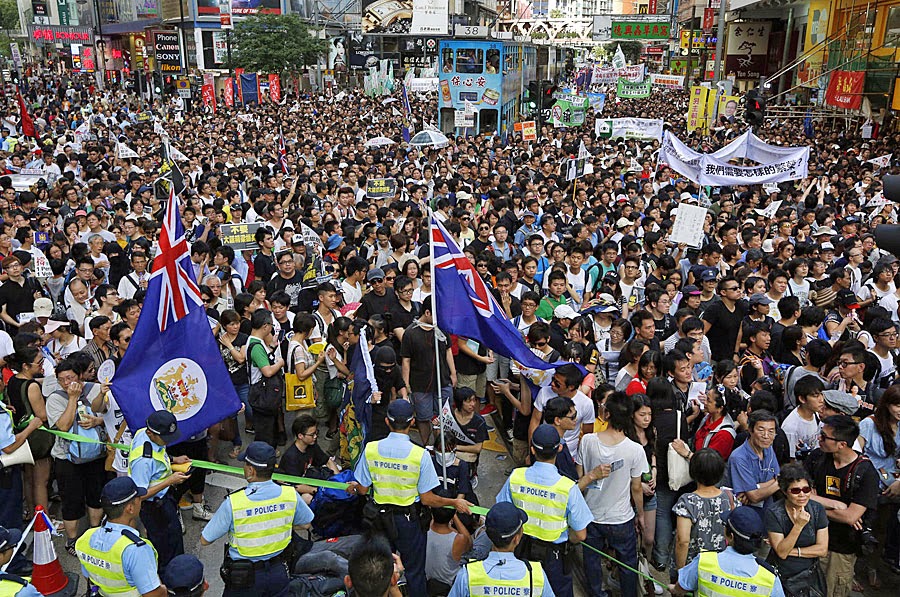
Hong Kong protests: cruisen for a bruisen Tiananmen?

Huge protests in Hong Kong. In the foreground are 2 official-up-to-1997 British-Hong Kong colonial (Chinese dragon - British lion) flags - defiantly displayed by the students.
---

Main site of the protests - next to the main PLA, Police and Hong Kong Government headquarters and intentionally blocking traffic on the city's major highways. 


I've published the following article on On Line Opinion, October 1, 2014 http://www.onlineopinion.com.au/view.asp?article=16731 :

Many thousands of Hong Kong students and broader protest groups have been defying Chinese authorities for the last few days. China's Communist Party, the ultimate ruler of Hong Kong, looks unkindly at any right to protest. The students are aiming high for a liberalised voting system freer than before. Will the tanks of the Peoples Liberation Army (PLA) crush them as they crushed an earlier generation of students at Tiananmen Square?

Two of the major figures in the protest are Joshua Wong, only 17, who lead the "Scholarism" movement against Communist indoctrination in Hong Kong schools and Benny Tai Yiu-ting, a Hong Kong University academic who created the Occupy Central With Love and Peace movement.

By mainland Chinese standards Hong Kong has it lucky – relatively prosperous, educated and almost free. Hong Kong is privileged by the "one country two systems" policy – part of the deal negotiated with Britain when Britain returned its Hong Kong colony to China in 1997. The policy allows for a version of democracy until 2047. The right of a committee to elect any candidates (no matter how communist) for leader of Hong Kong in 2017 is what the protests are about. The Communist Party wishes to appoint a small pool of authorised, pro-Communist candidates for the leadership position. As the current leader CY Leung, the "Chief Executive of Hong Kong Special Administrative Region" is suspected of being a closet member of the Communist Party he is currently the main focus of protest anger.

Hong Kong protests against the central government of Beijing itself have been limited. A continuation of the protests, particularly any aimed at Beijing involves considerable dangers for the protestors.

So far Hong Kong authorities have been using a range of tactics to handle the protests. Protestors directly defied the authorities by centring their protest next to official headquarters of the Police, PLA and Hong Kong Government (scroll down half way for map) [the map is also above this article]. On Sunday authorities first tried to disperse the protesters with police using tear gas, pepper spray and batons.However this only swelled the numbers of protesters and hardened their resolve to maintain sit-ins blocking major roads on Hong Kong island. By Monday the government withdrew the police leaving a peaceful protest that is still causing economic disruption to Hong Kong. A regular public holiday on Wednesday is expected to boost protest numbers. What happens then may be violent or peaceful.

Direct defiance of Beijing could be fatal for protesters - but they are hoping and expecting that the international media and Hong Kong's special economic status will dissuade the authorities from cracking down too hard. Adding to the unpredictability of what may happen is the relative newness of China's President Xi Jinping, who only took power in 2012. If he sees the protestors as a political threat that may spread to mainland cities the protestors may be punished severely. The Chinese President, however, would be well aware of the national shame of Tiananmen Square Massacre in 1989. In contrast most of the Hong Kong protestors would have little knowledge of Tiananmen Square because they are too young and even the Hong Kong media would censor many of the records of Beijing's more ruthless political acts.

If Beijing decides on a crackdown it is more likely that it will first send in anti-protest specialists, the paramilitary People's Armed Police (PAP), steeped in the tactics of crowd control. If the PAP is repulsed by numbers a lull may occur with the hope of peaceful dispersal through boredom. If a severe crackdown is ordered then the Tiananmen script may be dusted off with the infantry and armoured vehicles of Hong Kong's garrison being sent in. Such an attack might typically be launched at 3am to catch the students asleep and to minimise TV coverage.

Hopefully a more peaceful script will be followed. This may vary from community pressure where citizens remind the students that the economy of Hong Kong (jobs) are being disrupted with no end in sight. The Hong Kong government may plead that it will form a committee to consider student demands. Whether the government honours such an undertaking and doesn't subsequently round up the ringleaders is another thing.

An intermediate script of an arranged counter-demonstration of bussed-in Party faithful, as occurred in Great Olympic Torch mobilisation of Canberra, 2008, may also be a possibility.

In a few days we'll know what happened. The protests are bad for business in Hong Kong while a democratic Hong Kong is good for business in China. China's President Xi Jinping is an unknown quantity when his authority is really tested. In a China run by a Communist Party that is distinctly capitalist anything can happen.

Pete