February 22, 2012

Indonesia Gets Apology From Malaysian Navy - Latest Ambalat Oil Confrontation


Malaysia in pink colour.
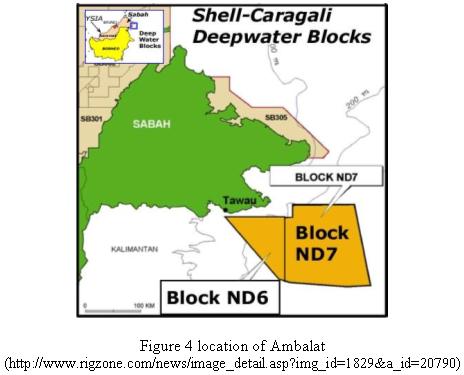
 

The Ambalat under-sea oil block (lower map) is the small area of water in the Celebes Sea just off Tawau. Ambalat is subject to a territorial dispute between Indonesia and Malaysia as it lies off the coast on the border of Indonesia's province of East Kalimantan and southeast of the Malaysian state of Sabah.

Malaysia refers to part of the Ambalat Block as Block ND 6 while part of the East Ambalat Block is referred to as Block ND 7. These under-sea blocks are rich in crude oil. Also shown is the Strait of Malacca, once reported by the Malaysian Navy as being too shallow for its Scorpene submarines!
-
Indonesia's ANTARA News, June 11, 2009, reports:
-
"Kuala Lumpur (ANTARA News) - Chief of the Malaysian Navy Admiral Abdul Aziz Jaafar on Wednesday offered an apology to the Indonesian people over the Ambalat issue."We offer an apology if we are considered violating Indonesian territory. We also offer an apology if any of Malaysian naval officers has been involved in a provocative act.

We will find them and take stern measures against them," Abdul Aziz said at a meeting with a five-member Indonesian parliamentary delegation at his office here.

He assured the Indonesian legislators of the Malaysian Navy`s pledge not to deploy a Scorpene submarine at the Ambalat block in a show of force."We are deploying a Scorpene submarine in the deep sea off [Kota] Kinabalu city. We cannot deploy it in the Malacca Strait which has shallow waters. We will never send Scorpene to the Sulawesi Strait [Makassar Strait?] because it will destroy coral reefs there," he said.

"To be honest, we don`t want to destroy the Indonesian people`s perception of Malaysia. We are neighboring nations who belong to the same stock," he said."I assure you that the happening will not recur. I also have made a request to hold talks with the Indonesian naval chief of staff about the issue," he said.

The Indonesian parliamentary delegation is made up of Yusron Ihza Mahendra, Shidqi Wahab, Djoko Susilo, Andreas Pareara, and Happy Bone Zulkarnaen, all of them members of the House Commission for defense, information and foreign affairs.Yusron who led the delegation said he was satisfied with the results of his meeting with the Malaysian naval chief.

Relations between the two neighboring states have become tense following reports Malaysian warships had encroached on the Indonesian territory in the Ambalat waters. Late last month, Indonesia`s KRI Untung Surapati-872 warship managed to drive away a Malaysian warship, the KD Yu-3500, which had tried to trespass Indonesian waters in the Ambalat Block. A day earlier, the Indonesian Navy`s KRI Hasanudin-366 also drove away KD Baung-3509, a helicopter of the Malaysian Maritime Enforcement Agency, and a Malaysian Beachraft which tried to enter the Ambalat Block.

Foreign Ministry spokesman Teuku Faizasyah said here on Friday Indonesia had so far sent 36 protest notes to Malaysia about border violation committed by Malaysian patrol boats in Ambalat waters."The 36th protest note was sent to Kuala Lumpur on Thursday (June 4)," he said. The latest protest note was conveyed after the foreign ministry had obtained details on the realities on the ground from the Indonesian Navy, he said.

Malaysia claims the area based on a 1979 maritime map while Indonesia bases its claim on provisions in the 1982 UN Convention on the Law of the Seas."
-
Comment
-
It is highly significant that the apology is coming from a military man rather than some lesser PR spokesman in the Malaysian Government. This may cause some bitterness amongst the Malaysian military towards their own government.
-
Malaysia has two French built Scorpene submarines, the KD Tunku Abdul Rahman and the KD Tun Abdul Razak. 
-
Pete

South Korean Submarines KSS-II, KSS-IIIs and Nuclear "KSSX-N" Option

Simplified cutaway of Germany's HDW U-214 AIP (designated KSS-II by South Korea). South Korea has announced it will order/build a new batch of 6 AIP KSS-IIs.
-----------------

Please connect with Submarine Matters latest South Korea update South Korean Submarines, 3,000 Ton KSS-III, Nuclear Potential of April 15, 2015

The following Submarine Matters article was originally drafted in September 2009. 

South Korea (hereinafter called "Korea") is planning a large future conventional submarine, known as KSS-III and/or "Jangbogo III" displacing 3,000 tons (submerged). 
-
Korea plans to design and build the KSS-III locally. The KSS-III will involve some advanced design and Korean production solutions of particular interest. The first KSS-III will also be built (launch date perhaps 2022) slightly ahead of Australia's future submarine (likely launch date 2027).
-
The increased tonnage of the future KSS-III suggests that Korea is looking at a larger AIP system,  much longer range or a vertical launch system (VLS) (for first or second strike against North Korea using Hyanmoo III missiles) or a combination of the three.
-
Korea's main submarine opponent is almost certainly North Korea. As North Korea is a nuclear and conventional threat to Korea and a constant infiltrator South Korea's main submarine task would probably constant intelligence gathering - including monitoring of intruding North Korean submarines. Korea also considers China a threat and (less likely) Japan or Russia.
-
Korea's advanced nuclear power industry and the announcement that France is to assist Brazil in creating a nuclear powered Scorpene raises the possibility that Korea might consider nuclear propulsion in the distant future. Only a nuclear powered submarine has the sustained speed to chase/shadow one of China's emerging SSBNs or SSNs. Cooperative tactics with US SSNs would therefore be essential.

Background on KSS-III Development

From The Korea Times, May 10, 2009 reports:

"The Ministry of National Defense plans to deploy 3,000-ton [surfaced, 3,500 ton submerged] attack submarines after 2020, a two-year delay from the original Defense Reform 2020 initiative, a report said Sunday. ...The development of an [indigenous] 3,000 ton KSS-III submarine is a key part of the Navy's modernization programs. The KSS-III sub is to be fitted with domestically built submarine combat systems aimed at automating target detection, tracking, threat assessment and weapon control, according to Navy officials. The 1-trillion-won heavy attack submarine will also be armed with indigenous ship-to-ground cruise missiles and be capable of underwater operations for up to 50 days with an advanced Air Independent Propulsion (AIP) system, they said. The AIP system has improved the submarine's underwater performance and gives it stealth capability." full article

On South Korea's past consideration of a 4,000 ton nuclear propelled submarine (various names including "KSSX-N") option see this globalsecurity.com report

Pete

February 21, 2012

Indonesia Considering Nuclear Reactor

Anti-nuclear protest in Indonesia

From The Jakarta Post of February 1, 2008:

"RI [Republic of Indonesia] nuclear plan needs further study: Gus Dur"

"The debate continues on whether Indonesia should risk using nuclear energy, amid the search for urgently-needed alternative renewable and efficient energy sources to ease dependency on costly and depleting fossil fuels.

The government has said it is looking to have its first 1,000-megawatt nuclear power plant up and running in 2017, but so far plans have only included the search for a suitable location, research and a feasibility study.

Former president Abdurrahman "Gus Dur" Wahid said Thursday there were other abundant natural resources which had not yet been maximized. He mentioned alternative energy resources including wind generators, biofuel and geothermal energy.

"We need to conduct more research and preparation, than ever before, if we are intending to build a nuclear power plant. Look at what happened in Chernobyl," he said after a seminar titled Iran's Nuclear Program: What Is It For, Can Indonesia Take A Lesson?.

A reactor exploded at the Chernobyl nuclear power plant in April 1986, in the former Soviet Union, and was the worst nuclear plant accident in history as explosions and the resulting fire sent a plume of highly radioactive fallout into the atmosphere and over an extensive geographical area.

The government, having gone from being a net oil exporter to a net importer, has chosen nuclear as an alternative to diverse energy sources, expecting sufficient and cheap end-results.

Nuclear energy is regarded by some as environmentally friendly because it emits zero carbon dioxide, but its maintenance is extremely costly and is not recommended for nations planning to use it as a small percentage of their energy supply, or who are rich in other resources.

Locals and activists have protested over the location in the Muria Peninsula in Central Java, designated for the nuclear plant, where earthquakes are frequent.

National Atomic Energy Agency (Batan) chairman Hudi Hastowo said the International Atomic Energy Agency (IAEA) had deemed the spot safe in terms of its seismic and volcanic activity.
Unlike Iran, Hudi said, Indonesia had no plans as yet to process enriched uranium, but suggested the creation of a collective enrichment center with neighboring countries.
"For instance, Germany, Belgium and the Netherlands have one together. That way, we wouldn't be suspected like what Iran is facing now," he said.


..."International law depends on who has power ... Indonesia has to make sure it can never be considered as an axis of evil or a country harboring terrorists," University of Indonesia professor Hikmahanto Juwana said. (amr) "
-
Background

Indonesia's nuclear program publicly concentrates on plans to build reactors for peaceful purposes. The national legislative organ for nuclear energy, the Nuclear Energy Control Board (BAPETEN) was founded in 1998. Indonesia's national agency for nuclear energy is BATAN.

Decades ago small scale peaceful nuclear research commenced in Indonesia. Plans for an atomic program were mostly shelved in 1997 partially due to the discovery of the Natuna Gas Field, but have been revived since 2005.

Indonesia has stated that the program will be developed in accordance with the International Atomic Energy Agency. For this reason, Mohammed ElBaradei was invited to visit the country in December 2006.

Protests against plans for nuclear power have occurred in June 2007 near Central Java as well as an upsurge in mid 2007
For research purposes, nuclear reactors have already been built in Indonesia in:
- Yogyakarta, Central Java - the Kartini reactor.
- Serpong , West Java - the MPR RSG-GA Siwabessy reactor, and in
- Bandung, West Java - the Triga Mark II nuclear research reactor.


Various locations have been proposed for building nuclear reactors for generating electricity - such as:

- Muria, Central Java, and.
- Gorontalo, in the north of Sulawesi (Celebes).

Indonesia has at least two uranium mines, Remaja-Hitam and Rirang-Tanah Merah in the west of Kalimantan (Borneo). If these uranium resources appear to be insufficient, the country has the option of importing uranium from friendly nations.
In 2006 Indonesia signed treaties for nuclear cooperation with various countries, including South Korea, Russia, Australia and the United States. Australia has indicated that it does not have problems with supplying Indonesia with uranium for peaceful purposes, and there is an agreement with a Russian company to build a floating nuclear reactor in Gorontalo.
Indonesia has various reasons for wanting to build nuclear reactors:
- Domestic energy consumption in Indonesia is growing rapidly.
- Nuclear energy will reduce dependence on petroleum, a non-renewable resourse. Indonesia, an OPEC member and long-time net oil exporter became a net importer of oil at the beginning of 2005.

- If domestic energy consumption can be provided through nuclear energy, it may be possible to export more oil.

The nuclear plans of Indonesia have met with criticism from Greenpeace and other groups and individuals. In June 2007, nearly 4,000 protesters rallied in Indonesia's Central Java, calling on the Government to abandon plans to build a nuclear power plant on the outskirts of their city. Specific concerns included the dangers posed by nuclear waste, and the location of the country on the Pacific Ring of Fire, with much geological activity, such as earthquakes and volcanic eruptions, that could pose a danger to nuclear reactors.


Comment

Given Indonesia is not a rich country I wonder whether there are additional reasons (such as the weapons option) for considering enormously expensive larger scale reactor construction?

Pete

Indian alliance against China?


-
Disputed areas and competitors (against China? With Indian backing?) in South China Sea. US DoD map as at 2010. China's activities timeline 2009-2012. Click to enlarge.
-
The Hindu wrote this article 'In South China Sea, a surprise Chinese escort for Indian ships' last month, June 14, 2012. The issues are as relevant as ever:
-
COMMENT
-
Are Indian ship visits to countries in the South China Sea a subtle way for India to support Northeast and Southeast Asian countries against China?
-
Is India looking for joint ventures to exploit South China Sea resources?
-
Or does India have strategic objectives - perhaps a loose alliance with regional countries to balance against China or even surround China?

February 20, 2012

Further Delays to Indonesian Submarine Purchase Plans

Where have the Indonesian Kilo submarines gone? of August 26, 2009 highlighted significant contraditions in Indonesian statements concerning the purchasing process for two new submarines (to replace its two old HDW 209s) as well as lengthy delays. The following article from Jakarta Globe, October 5, 2009, implies longer delays:

"...[Navy Chief Admiral Tedjo Edhy Purdijatno] had expressed his displeasure two months ago when he heard a senior official from the Ministry of Defense tell a journalist that the government had decided to postpone the purchase. Further evidence of that decision surfaced when the submarine purchasing program was conspicuously absent from the 2010 budget approved by the House of Representative last week.

Tedjo told journalists that the Navy would get in line with the government decision to table the purchase of submarines until 2011, which means the vessels would not be received until 2014.
...He said the plan to purchase new subs had been based on current defense threats in the region, citing a low-level underwater arms race with neighboring countries like Malaysia, which has recently received the first of four [wrong - Malaysia has received one and only one more on order] French-made Scorpene subs on order.

Tedjo said due to the delays in the purchasing plans, the country would have to rely more heavily on diplomacy and other “soft power” approaches. “And we are also trying to increase the capacity of our existing fleet, such as plans to use missile launchers on patrol ships we already own,” Tedjo said.

Separately, Defense Minister Juwono Sudarsono said limitations in the defense budget had forced officials to a review all plans to purchase weaponry. “And recent natural disasters have made us switch our plans to purchase transport aircraft, ships and vehicles, rather than purchasing heavy weaponry,”..."
-
Comment
-
Given that it usually takes 5 years from announced intention to buy (2011) the Indonesian Navy may well see the first of its new submarines (probably from Russia or South Korea) in a Javanese port no earlier than 2016. Still the ability of the Navy to handle the increasing number of Indonesia's identified natural disasters is understandably a higher priority.
-
Pete

February 17, 2012

Chinese Manned Spacecraft Docking Glory


 (Click to expand) the Long March 2F Rocket of the type used for the Shenzhou 9 mission
---


Transfer from Shenzhou 9 to Tiangong 1 space station 
--- 

What do Indians think of this event?

On 18 June.the manned Shenzhou 9 spacecraft docked with China’s Tiangong 1 space station - marking China's first manned spacecraft docking.  Shenzhou 9 (part of the Shenzhou Program) was launched on 16 June 2012. The mission's crew includes the first Chinese female astronaut, Liu Yang. The next planned mission is Shenzhou 10, intended for launch in 2013

Background

The Shenzhou 9 spacecraft arrived at Jiuquan Satellite Cosmodrome on April 9, 2012 and its carrier rocket, the Long March 2F (weighing 497,000 kg with  5,920.00 kN (1,330,860 lbf) of liftoff thrust) arrived on 9 May. On 9 June 2012, the Shenzhou 9 spacecraft and its carrier rocket were rolled out to launch pad in Jiuquan Satellite Cosmodrome  (located in the northwestern Gobi desert, 1,600 km from Beijing)..Shenzhou 9 is the 9th flight in China's Shenzhou program and the fourth manned spaceflight. A Chinese Long March 2F rocket was used to launch Shnezhou 9 from the remote Jiuquan Satellite Cosmodrome in the northwestern Gobi Desert.

Liu Yang joined the PLA Air Force in 1997 and qualified as a pilot before becoming the deputy head of a flight unit, holding the PLAAF rank of major. She is a veteran pilot with 1,680 hours of flying experience. After two years of astronaut training, Liu was selected for the crew of Shenzhou 9. At Tiangong 1, Liu is (officially) performing experiments in space medicine.

The two other Shenzhou 9 crew are Jing Haipeng and Liu Wang.

Pete