Showing posts with label Kilo.. Show all posts

July 2, 2013

Indonesia Decides to Buy Korean Made Submarines


An HDW 209 Type 1400 (this particular sub, S31, is Tamoio part of Brazil's Tupi Class) in what looks like "Sepetiba" Rio de Janeiro's harbour. Indonesia's three new submarines will be similar. 
-
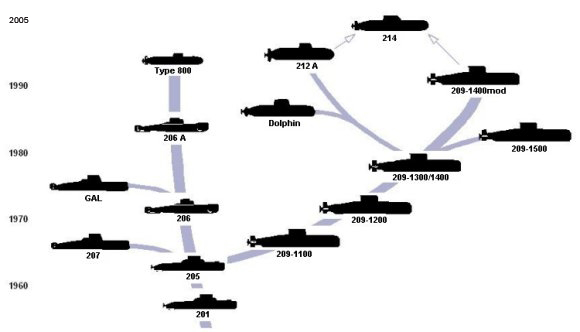

The HDW family tree with HDW 209 on several branches - click to expand.
-
While North Korea is undergoing a tense and hopefully predictable transition to a new "Emperor?" of the Kim Dynasty (possibly Kim Jonghe Un) South Korea has its first submarine export order. Blending reports from The Jakarta Post (December 22, 2011) (South) Korea Herald (December 21, 2011) and South Korea's Chosun Ilbo (December 21, 2011):

The Indonesian Defence Ministry and Daewoo Shipbuilding Marine Engineering (DSME) signed the contract on Tuesday December 20, 2011 for South Korea to build three submarines for the Indonesian Navy. Delivery may be in 2015-2016 with commissioning by 2018. These submarines are South Korean Improved Chang Bogo Class derivatives of the German designed HDW 209. It is inevitable that incorporated into these two submarines is technology developed for the HDW 214. HDW 214s are HDW's main current submarine for export.

The contract was signed by the Indonesian Defence Ministry's Defence Facilities Agency chief, Maj. Gen. Ediwan Prabowo, and DSME President and CEO Nam Tae-sang.

Under the contract, the two submarines built in South Korea will be in cooperation with Indonesian state-owned shipbuilder PT PAL.

Ministry spokesman Brig. Gen. Hartin Asrind told the Jakarta Post over the phone that the contract was worth US$1.07 billion.

Indonesia’s signing of a contract to procure three submarines from a South Korean company is an effort to keep pace with other countries in the region such as Malaysia, Singapore, Vietnam and Australia.

The Improved Chang Bogo Class will weigh approximately 1,400 tons surfaced and 1,600 tons submerged, be 61.3 meters long, will carry up to 40 crew members and have eight weapons tubes for 14 torpedoes, mines, missiles (US Harpoon and/or Indian BrahMos?) and other weaponry.

The three new submarines will replace Indonesia’s two old HDW 206 Cakra Class submarines; the KRI Cakra and KRI Nenggala (both launched in 1977). As submarines inevitably rust/corrode and expansion-contraction causes metal fatigue after 30 years the 36 year old KRI Cakra and KRI Nenggala are likely to be scrapped.

Other Submarine Forces (and Acquisitions) in Indonesia's Region

• Australia, 6 Australian built, Swedish Kockums designed Collins Class commissioned in 1996-2003 with 12 future Australian built "SEA 1000" Class subs for possible introduction 2030 onwards.

• Malaysia, 2 French built Scorpene Submarines KD Tunku Abdul Rahman Class commissioned in 2009 http://gentleseas.blogspot.com.au/2009/09/malaysias-first-ever-submarine-scorpene.html

• Singapore, 4 Swedish built Challenger Class commissioned 1999-2001 and 2 Swedish built AIP Archer Class see http://gentleseas.blogspot.com.au/2009/09/singapore-submarine-development.html

• Vietnam, 4 to 6 Russia built Kilo Subs to be commissioned 2015-2019 http://gentleseas.blogspot.com.au/2009/12/tentative-vietnamese-plans-to-buy-kilo.html
-
See also Indonesian-Malaysian clashes over the future Ambalat undersea oil field - one reason why both countries have bought new submarines - http://gentleseas.blogspot.com.au/2009/06/indonesia-gets-apology-from-malaysian.html
-
Pete

April 7, 2012

Tentative Vietnamese plans to buy Kilo Subs and a Russian land based reactor.

-
-

Improved Kilo Class/Project 677 Lada class/Project 1650 Amur class. Note 10 tube VLS option - something Australia should consider for its own future submarines.
-
Russia has more proposed sales of Kilo submarines than its proven capacity (typically delivered late or overprice or not at all. It is not an HDW). The agreement to sell six Kilos to Vietnam, announced in mid December 2009, is the latest paper milestone. Not only is this blog interested in nuclear enrichment and weapons but also the first and second strike platforms of choice i.e. submarines.

Vietnam has been engaged in several skirmishes over the years concerning the Spratly Islands in the South China sea. Possession of one or most of the islands has deep strategic and economic value. The islands themselves have little value, but the fishing and potential of oil reserves below them have great value. The islands are legal lodgements from which undersea zones and exploitation rights flow.

However, as Vietnam has no submarine tradition outside of owning two old midget Yugo Class submarines it will take years of expensive Russian training and control of at least the first three submarines to make Vietnam's submarine flotilla efficient and independent. Russia will regain some of the naval intelligence and military power it lost when it withdrew from Cam Ranh Bay.

Submarines are, after all are intelligence collection devices in peacetime. Essential Russian crew members and a sigint relay feed via the Vietnamese submarines to the Russian naval base at Vladivostok will be an importance asset to Russia's military presence in the western Pacific. For Vietnam submarines are an asymmetric way to counter Chinese and Taiwanese power projection into the Spratly islands. Vietnamese submarines will also provide parity with Malaysia's claims and exceed the naval power of the Filipino and Bruneian competitors.

Furthermore the asymmetric power of Vietnam's submarines will also provide limited defence of Vietnam from the risk of Chinese sea-based invasion.

DefenceStudies, December 17, 2009 reports:

MOSCOW - Vietnam and Russia signed a major arms deal and a nuclear energy agreement Dec. 15, a sign of reviving ties between Moscow and its former Soviet-era ally in Southeast Asia.

Hanoi agreed to buy Russian-made submarines and aircraft in the arms deal, which was signed in the presence of Russian Prime Minister Vladimir Putin and his visiting Vietnamese counterpart, Nguyen Tan Dung.

"Vietnam signed a contract for the purchase of submarines, planes and military equipment with the corresponding cooperation of the Russian side," Dung said in remarks translated into Russian.

Details were not released on the deal between Russian state-owned arms exporter Rosoboronexport and Vietnam's defense ministry.
However the Interfax news agency, citing an unnamed defense industry source, reported that Vietnam had agreed to buy six Russian-made submarines for a total price tag of about $2 billion (1.37 billion euros).

The six
Kilo-class diesel-electric subs would be built for the Vietnamese navy at a rate of one per year, Interfax reported.
[While Russia is supposed to have replaced new build Kilo's with the new Lada Class it appears that the "Lada Class" are now merely termed "improved Kilos".]Moscow and Hanoi also inked a deal on the construction of Vietnam's first atomic power plant.
Last month, the Vietnamese parliament approved building the country's first nuclear power station, a lucrative project that has been keenly watched by potential foreign partners.

The agreement signed in Moscow was described as a memorandum on cooperation between Vietnamese electricity company EVN and Russia's state-owned atomic energy firm Rosatom, which had been interested in the project.

"Vietnam officially invites the Russian side to cooperate in the building of the first atomic energy plant in Vietnam under adherence to the necessary conditions," Dung said.


[The Russian built reactor may be one of two 1,000 MW reactors Vietnam has planned at Phuoc Dinh in the southern Ninh Thuan province to be constructed from 2014 and come into operation from about 2020, followed by another 2000 MWe at Vinh Hai in the Ninh Hai district. These plants would be followed by a further 6000 MWe by 2030, subsequently increased to having a total of 15,000 MWe by 2030. The anticipated cost of the first two plants is about $11 billion, and some 85% of this would need to be found from overseas loans.]
-
Pete

February 5, 2012

Vietnam's Naval Buildup Against China - Indian and Australians Visits


[Click on Defense Industry Daily diagram to expand greatly] Improved Russian Kilo (Project 636) for Vietman - which may have sufficient improvements to be classed as a Project 677 ("Lada").
  -
Excerpts of the Financial Times June 14, 2011 which reports:

"Vietnam shift could see return of US ships"

...The historic military facility [at Cam Ranh Bay] located within one of Asia’s best natural harbours, is at the centre of a strategic push from Vietnam to counter China’s growing assertiveness over disputed waters [especially the Spratly Islands] in the commercially important South China Sea....

...Cam Ranh Bay, houses Vietnam’s small navy. The Bay extends for 20 miles north-south and is up to 10 miles wide...last year, Nguyen Tan Dung, Vietnam’s prime minister, said he would let foreign naval ships use the base again to dock, resupply and undergo repairs on a commercial basis.

The move may generate some cash once the now crumbling facilities are refurbished, security analysts say. However, the main justification for opening up the bay is to balance China’s naval dominance in the South China Sea, which encompasses key global trade routes, valuable fisheries and is thought to sit atop vast oil and gas reserves.

“Who’s going to take up the offer to visit?” says Carl Thayer, an expert on security in the South China Sea at the Australian Defence Force Academy in Canberra. “Precisely those navies that China doesn’t want in the South China Sea, including the Americans,  South Koreans Australians, and Indians.”

One senior Asian defence official argues that the US will be keenest to take advantage of the opportunity to use the base, which offers great protection from storms and is located close to key commercial shipping lanes and the disputed [Spratly] islands. “The US has a Pacific fleet and it’s been more aggressive than many other countries in trying to build closer contacts with Vietnam to counter China’s rise,” he says.

The planned reopening of the base to foreign naval vessels is a sign of the shifting global strategic sands, with China’s inexorable rise causing concern among those such as Vietnam and the US, pushing these old enemies closer together.

Although Vietnam has developed deep economic and political ties with its larger northern neighbour since the 1990s, the relationship is coming under pressure because of China’s increasingly aggressive behaviour in the South China Sea, according to Ian Storey, a fellow at the Institute of Southeast Asian Studies in Singapore, who studies maritime security.
Vietnam map
China, which recently built a large naval base on Hainan island, to the north of the disputed waters, increasingly has the capability to deploy coercive diplomacy in the South China Sea, says Mr Storey. Recent incidents where Chinese maritime surveillance vessels have tried to sabotage Vietnamese oil exploration ships show Beijing also has the political will to do so.

Hanoi has responded by seeking to internationalise the territorial dispute, calling on other claimants to some of the contested Paracel and Spratly Islands – Brunei, Malaysia, the Philippines and Taiwan – to hold joint talks and attempting to bring in the US as a mediator.


Despite macroeconomic difficulties, Vietnam has boosted its spending on military hardware, agreeing to buy a number of Sukhoi SU-30 jetfighters and six Kilo-class diesel submarines from Russia.
Once delivered in the next year or two, the submarines are expected to be based at Cam Ranh Bay, which analysts say Russia has agreed to refurbish as part of the $2bn contract to supply the craft.

...changing dynamics of global security mean that, in a twist of fate, American and Russian ships may soon be back at Cam Ranh Bay, this time working alongside each other and the Vietnamese to counterbalance an ever stronger China.

BACKGROUND ON VIETNAM'S 2009 KILO PURCHASE

http://rusnavy.com/news/navy/index.php?ELEMENT_ID=9667 "Rosoboronexport signed a delivery contract on six Project 636M diesel electric submarines to Vietnam during visit of Vietnamese Prime Minister Nguyen Tan Dung to Russia on Dec 15, 2009. All subs will be built at Admiralteyskie Verfi shipyard in St. Petersburg; rate of delivery is one sub per year. Total contract value of submarines construction makes $2.1 bln. Considering establishment of appropriate coastal infrastructure in Vietnam, delivery of arms and other systems, total sum could reach $3.2 bln." [Vietnam's Kilos may have sufficient improvements to class them as Project 677 "Lada" Submarines.]

On the Kilo see also http://www.naval-technology.com/projects/kilo/ and
http://www.defenseindustrydaily.com/Vietnam-Reportedly-Set-to-Buy-Russian-Kilo-Class-Subs-05396/
-
Pete