Showing posts with label F-35. Show all posts

January 23, 2014

India less happy with Russian PAK FA, Buying Fewer

Unfortunately for Russia's neo-Tsar and throwback to Communist Authoritarianism, Vladi (the Poisoner) Putin, compared to the US and even China, Russia has been unable to maintain financial or technical momentum on 5 Gen Jets.

India has been rightly wary of financing Russia's high risk PAK-FA:


PAK FA (T-50) estimated specifications made in 2009 - very similar to http://en.wikipedia.org/wiki/PAK_FA#Specifications now that PAK FA  has had semi-public test flights.
----------------

Robert Farley for The Diplomat, January 23, 2014 reports http://thediplomat.com/2014/01/the-hard-politics-of-fighter-aircraft-india-russia-and-the-pak-fa/ :


"The Hard Politics Of Fighter Aircraft: India, Russia, and the PAK FA"

March 11, 2013

Is the "black" RATTLRS missile an F-35 sales sweetener?

Artist's mockup of an F-35 firing a jet powered supersonic missile Revolutionary Approach To Time Critical Long Range Strike (RATTLRS)
-
It may well be that an operational missile derivative (now a "black" the US term for secret project) of the RATTLRS concept has been rolled into the sale of F-35 as a sweetener to encourage buyers for the problematic-underdeveloped F-35. Such a missile may be the secret weapon the F-35 sales team and USAF officers have been hinting at in the Australian press. 
 
The reference in the Australian press was in an Australia's ABC TV Four Corners "Reach for the sky" on February 18, 2013 http://www.abc.net.au/4corners/stories/2013/02/18/3690317.htm :

"[civilian presenter] ANDREW FOWLER: And it's even got a weapon that's a closely guarded secret.

USAF LT. GENERAL CHRIS BOGDAN, EXECUTIVE OFFICER, F-35 JOINT PROGRAM OFFICE: Those are the crown jewels of the program and that's what makes the F-35 special.

ANDREW FOWLER: So asserting that to the public, it's really saying 'trust us'?"
 
--------------------------------

RATTLRS Derivative More Likely Lockheed Martin's Secret Weapon

The US-UK Revolutionary Approach To Time Critical Long Range Strike (RATTLRS) appears to have gone "black" as it likely enters its practical-operational phase.

After some reconsideration - my February 28, 2013 post F-35 being sold with promise of a hypersonic missile? may be incorrect - as a hypersonic (Mach 5+) missile seems to involve too may technical problems to be used as a weapon in the next two decades. Hypersonic speed in the atmosphere:

- generates tremendous heat which within minutes melts available missile skin materials;
- heat adversely effects electronics;
-  and the large heat signature is unstealthy (showing up on infrared and other sensors while drawing in heat seeking SAMs or air to air missiles).

There are also range problems. The force needed to penetrate (or push aside) atmosphere at hypersonic velocity severely limits range. Two or more powerplants used to make hypersonic velocity possible involve prohibitive weigh increases which also limit range. The only way around these problems seems to be a weapon in the vacuum or "ether" of space - a role already performed by multistage ballistic missiles.

All this suggests high supersonic flight (up to Mach 4) is more appropriate for longer range, some stealth, while generating less material damaging heat. Also RATTLRS testing indicates turbo jets are capable of Mach speeds just below hypersonic.

Meanwhile it is unlikely that other missile developments mentioned in  F-35 being sold with promise of a hypersonic missile? are the "silver bullet" boosting F-35 sales. The West is unlikely to have built a missile similar to the BrahMos due to its rocket and ramjet's range limitations (officially around 300 kilometres). It is unknown to what extent the JASSM may have adopted RATTLRS technology (such as the jet engine) or whether JASSM may have in fact merged with RATTLRS.

In recognition of hypersonic heat and range problems the RATTLRS project has adopted an evolutionary approach - high supersonic speed (between Mach 3 and 4) using a single turbo-jet engine for simplicity and weight saving.


Popular Mechanics says about the RATTLRS YJ102R turbine engine "might be the most powerful turbojet on the planet—at least by weight. It’s barely bigger than two breadboxes."

Background

Rolls-Royce announced on January 12, 2009 that it had successfully completed an initial test of its advanced, high-specific thrust YJ102R engine at the Indianapolis, Indiana facility. This test is the first of a series to be performed by LibertyWorks (Rolls-Royce North American Technologies Inc) , the company's research unit, and is designed to validate critical performance criteria under its High Speed Turbine Engine Demonstration (HiSTED) contract with the US Air Force Research Laboratory (AFRL).
-
Janes provides details of the requirement and thinking behind super-hyper sonic missile systems.
"The US has been examining a range of very high-speed strike weapon concepts for a number of years. These weapons, both sea- and air-launched, have been drawn up for use against mobile and/or time-critical targets, along with hardened and buried targets. In all cases the weapons rely on the kinetic effects of a ramjet powerplant to attain the velocities needed to be effective against such target sets...The optimum penetration effect of a weapon in this class would be between 30 and 55 metres."

GlobalSecurity.org http://www.globalsecurity.org/military/systems/munitions/rattlrs.htm discusses performance requirements for RATTLRS including the jet turbine alone:

- boosting speed to Mach 3 to 4
- a range of up to 1,000 km
- can be air-launched by the F/A-18 E/F (Super Hornet), F-22 and F-35 (JSF)
- maximum missile weight of 1,800 lbs with a 500 lbs payload/warhead

Project Going "Black"

Increasing the likelihood that the F-35 builder Lockheed Martin has combined the sale with an operational RATTLRS missile development is:

GlobalSecurity.org http://www.globalsecurity.org/military/systems/munitions/rattlrs.htm :

 "On 01 February 2005 the Office of Naval Research awarded Lockheed Martin a phase two contract N00014-04-D-0068-0003 for $157,443,201 including options...Lockheed Martin is teamed with Allison Advanced Development Company [acquired by Rolls-Royce] to develop technologies that will provide an advanced Mach 4+ integrated propulsion system in an operationally traceable airframe. The YJ102R developmental engine...As of May 2009 plans called for completing the RATTLRS flight test program by the end of 2009. [as of early 2010 this flight seems not to have happened]"

Pete

February 28, 2013

F-35 being sold with promise of a hypersonic missile?


Also see my March 3, 2013 post http://gentleseas.blogspot.com.au/2013/03/has-black-rattlrs-missile-been-rolled.html on whether a RATTLERS derivative is, in fact, Lockheed Martin's "sweetener" for its F-35 sales.

Is an unpublisized missile being used as a major selling point for the F-35 Joint Strike Fighter (JSF)? With constant delays and cost overruns is Lockeed Martin attempting to entice potential F-35 buyers by combining the sale with a smaller derivative of the X-51? Is this smaller missile being advertized in confidential forums as a "game changer"? 

If the missile is a miniaturized derivative of the X-51 it would be a hypersonic, very advanced missile indeed. The smaller missile might be "paper" only or perhaps under US development and may not be mature until delivery of the F-35 to foreign customers from 2018-2020 onwards. Such a missile would need to be small enough to fit within the F-35's stealthy body. Hypersonic speed is generally considered Mach 5 or above.

---------------


A JASSM on display.
---


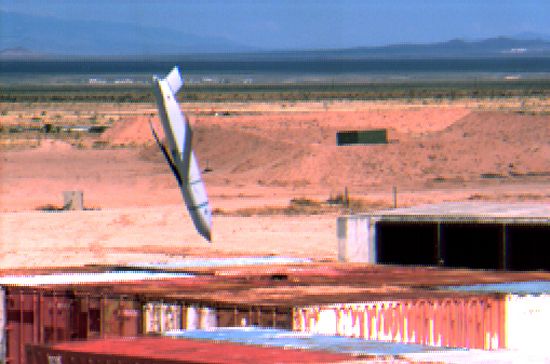
JASSM about to hit a steel reinforced concrete target. In this case the whole missile is in the end run. But it is also possible that the warhead could detach and be rocket propelled to higher Mach speeds shortly before it hits a target.
---
 
If the missile is less advanced and more publicized it may be a version of the stealthy, turbojet, cruise missile AGM-158 JASSM (Joint Air-to-Surface Standoff Missile) that has been slightly reduced in size to fit inside an F-35. Deploying such a JASSM externally on hardpoints is considered to adversely effect the F-35's stealth profile.

The JASSM is now coming into service with the USAF and Australian Airforce (RAAF).  It may be that the JASSM, nominally considered subsonic, is actually supersonic if it incorporates the type of engine technology used to power the "super cruise" F-22 Raptor.

There may be an end run for the JASSM where the warhead detaches and then accelerates into the high supersonic to hypersonic range. Such acceleration in a vertical dive might be heavily reliant on a rocket motor. Given some artillery shells now have rocket assist the incorporation of such a feature in the JASSM's 450 kg (1000 lb) WDU-42/B penetrator warhead is quite possible.

----------------


A third possibility is a mixed propulsion missile equivalent to the already developed Indian-Russian BrahMos. The majority of flight for such a missile may be subsonically perhaps using a turbojet, then alter its flight profile moving to a high supersonic or hypersonic end run powered by a ramjet, scramjet or rocket engine. See this article from Defense Update of February 6, 2013 "Aero-India 2013: The Indian Air-Force Plans to Induct BrahMos by 2015" concerning deployment of BrahMos including air-launching it from India's Su-30MKI fighter-bombers  http://defense-update.com/20130206_the-indian-air-force-plans-to-induct-brahmos-by-2015.html .

Higher velocity in all three missile possibilities provides a greater element of surprise, with it increased survivability as its harder to shoot down a faster missile - with reduced time for the target to deploy flares or other decoys. A faster missile also has higher kinetic energy to penetrate earth/rock/concrete (or a ship's hull) more deeply.

High kinetic energy would be particularly sought after by the US and Israel with regard to Iran's (and perhaps North Korea's) deeply dug in nuclear sites.

-----------------------

What caught my eye was a transcript of Four Corners "Reach for the sky" documentary on Australia's ABC, February 18, 2013 http://www.abc.net.au/4corners/stories/2013/02/18/3690317.htm :

"[civilian presenter] ANDREW FOWLER: And it's even got a weapon that's a closely guarded secret.

LT. GENERAL CHRIS BOGDAN, EXECUTIVE OFFICER, F-35 JOINT PROGRAM OFFICE: Those are the crown jewels of the program and that's what makes the F-35 special.

ANDREW FOWLER: So asserting that to the public, it's really saying 'trust us'?"

--------------------------------------

I then spotted the following article: Wired - Danger Room June 7, 2012 reports http://www.wired.com/dangerroom/2012/06/hypersonic-missiles/ :

"Air Force Wants Hypersonic Missiles for Stealth Jets"

"For decades, the military has tried — with little success — to build missiles capable of traveling at breakneck, hypersonic speeds. Missile tests, however, have been uneven, with repeated failures punctuated by the occasional stunning success. Now the [US] Air Force is taking a bigger role by seeking to build another hypersonic missile, this time for its stealth fighter jets.

The Air Force’s desired “High Speed Strike Weapon” would travel at five times the speed of sound or faster, theoretically launching from a stealthy F-22 Raptor jet or a future F-35 Joint Strike Fighter, and traveling so fast and at such long distances as to render an enemy’s anti-aircraft systems defunct. The Air Force’s Research Laboratory Munitions Directorate is gathering possible design partners later this month at Elgin Air Force Base in Florida before any solicitation. According to an Air Force notice, whatever prototype gets built will ultimately need to strike “time-critical” targets — on the move, possibly — from “tactically relevant standoff distances.”

If it can be done, the weapon will “be representative of an air-breathing hypersonic missile system” that can tough it out in “the most stringent environments presented to us in the next decade,” said Steven Walker, the Air Force’s deputy assistant secretary for science, technology and engineering, in written testimony to the House Armed Services Committee in February.

That’s the hope, at least. The U.S. military has a mixed record with hypersonics. Last August, the Pentagon’s pizza-shaped Falcon Hypersonic Technology Vehicle 2 failed for a second (and likely final) time, crashing into the Pacific during a test flight.

But the Army’s Advanced Hypersonic Weapon did much better during a test in November. Two years ago, the Air Force successfully flew its X-51 WaveRider scramjet missile http://www.wired.com/dangerroom/2007/06/mach_5_missile_/ at speeds of Mach 5 for 200 seconds after launching it off a B-52 bomber. A later test, though, ended with engine failure.

...There are other technical challenges in launching a scramjet missile from a fighter jet instead of a sub-orbital rocket or a B-52, though. It’ll still need to have air-breathing engines that compresses the air around the missile into a supersonic mixture of oxygen and fuel — absent a turbine.

But it will also need to be small enough to be carried by a jet fighter while carrying the necessary advanced navigation controls, precision guidance tools and sophisticated sensors, plus the warhead. The service will also still have to find the right mixture of composite materials like titanium and tungsten (among others) to hold up under the enormous heat generated by Mach 5, Mach 6 and even faster flight.

The Air Force is requesting a whopping 150 percent increase in funding for the program, from $6.2 million now to $15.4 million in 2013 in one “thrust” of weapons development, according to subscription-required InsideDefense. That’s a lot of money for a missile that may not work."

COMMENT

The sales strategy for the F-35 may therefore be heavily reliant on the missile that comes with the sale - if that missile already exists or can be completed by 2018.

Pete

June 12, 2012

Different F-35 Stealth Features to Different Countries. Why? and Indian MMRCA?

-
The F-35 - a serious new entrant in India's MMRCA competition?
-
This article http://defensetech.org/2011/06/23/how-stealthy-is-your-f-35/ appears to be an attempted "expose" of the unsurprising possibility of differing F-35 stealth suites for each customer country). The article talks of "the source on the Australian internet is but I don’t think he’s inside the program office". Anyone who can visualize technology transfer policy or who writes about F-35's frequently could be part of the "source" - not me of course.
-
Probably most advanced US jets would have (or have had) some differences in their export models based on such issues as the recipient country's:
.
- security record or agreed status.  Australia and perhaps only the UK and Canada have the closest security-technology treaties with the US - (probably) particularly on protection of stealth features and source codes. So Australia, Canada and the UK are well placed to get the best stealth suites outside of the US. I'm certain that the US would have numerous (less close) agreements or understandings with other counties (eg. Japan, Israel, Saudi Arabia, Germany, Denmark, Netherlands etc). However for a variety of reasons these agreements and understandings might be kept confidential.
- degree of loyalty to the US alliance including participation in US military operations (eg. being in Afghanistan)
- how important a country is to the US (eg. Canada is important due to NORAD (sharing the North American continent). Israel is always boosted on this measure as well as acquiring US weapons for lower prices or gratis
- how much each country is paying (eg. Saudi Arabia) ,
- stealth needs of the country (what stealth suite has the customer country asked for?)
- commonality of F-35 software and hardware with a country's existing wares.
- the US Government and the main supplier (Lockheed Martin) may also have legitimate marketing strategies expressed as differences in F-35 stealth features between countries.
- one wonders what the chances are of Lockheed offering the F-35 to India for India's MMRCA tender?

- another factor in the degree of F-35 stealth might be how early and fully a country invests its taxpayers money towards US national risk and Lockheed corporate risk in developing the F-35. As an early investor Australia has probably already poured around $300+ million into the F-35 project.

The Australian Government routinely sheds the odd $100 million to a $billion in defence project errors. Hence it should not be too late to bail out of the F-35 if the F-35 drags out further overtime, overbudget, below technical expectations compared to emerging Russian and Chinese developments. 
-
Perhaps the US will over the F-22 in 2020 after its loyal allies have been politically pressured (behind closed doors) into buying the one and only present "choice" - the F-35. This might be an excellent marketing strategy for Lockheed Martin and its main current host nation (the US).
-
Boeing is providing competing products mainly based on the proven F-15, specifically the F-15SE Silent [Stealthy] Eagle. The F-15 would have many electronic and supply chain commonalities with the Boeing F/A-18 Super Hornets that Australia has just received. But purchasing an advance on a proven aircraft will be shot down as it goes against all bureaucrat inclinations since 1980 which is to:
- create problems that can be solved
- over quite some years
- in  a career advancing way
- for the fragmented many concerned
- with a minimum of accountability for allies, federal and state governments, politicians, officials, senior officers, main contractors and smaller contractors
- it being only taxpayers' money shared all round.
.
This is something I wrote about Australia's F-35 in 2008, called "Don't Buy in Haste" which achieved some short-term notoriety - and hasn't been proven wrong to date.
-
Pete