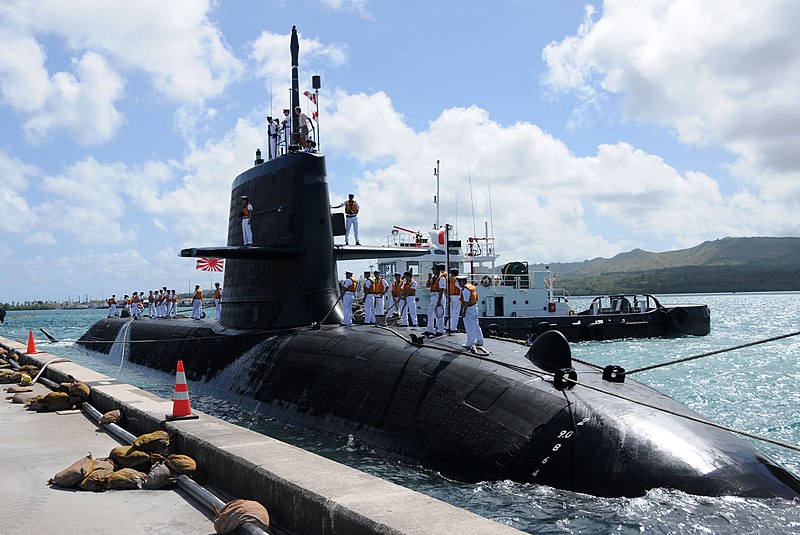
A Soryu Class submarine - in this shot visiting the US Guam naval base.
-------------
Mentioning the Soryu see the latest of June 11, 2014’s Australia's Future Submarine - Swedish vs German Claims http://gentleseas.blogspot.com.au/2014/06/australias-future-submarine-swedish-vs.html . It is unclear whether Germany or Sweden hold the strongest intellectual property rights to the Soryu's Stirling AIP. While Germany seems to have the strongest licensing rights over the Soryu's diesel.
For the latest specifically on the Soryu see:
- Australia's Future Submarine likely to be Japan's Soryu, outsiders is Germany dated September 8, 2014, and earlier
- Increasing Australian Interest in Japan's Soryu Submarine dated June 1, 2014, and
On December 7, 2013 The Australian reported:
"AUSTRALIA has asked Japan to consider providing highly advanced propulsion technology to be used in the navy's planned 12 new submarines.
[Australian] Defence Minister David Johnston has told The Weekend Australian Japanese officials had visited submarine maintenance facilities in Adelaide and talks were continuing.
In a speech to the Australian Strategic Policy Institute, Senator Johnston spoke about the Abbott government's wish to cement closer defence ties with Japan, including much closer defence-industry ties.
Senator Johnston said later he was particularly interested in the use of Japan's extremely effective submarine technology in Australia's future submarine, which is most likely to be an evolution of Australia's existing Collins-class vessels.
Japan's Soryu-class is the world's biggest and possibly the best diesel-electric submarine and Senator Johnston is particularly keen on its "drive train" - the whole propulsion system, from the propeller through to the electric motor and the diesel engine that charges the boat's batteries." See the rest of the article at
SORYU DETAILS (Pete's Comment)
The Sōryūs have a very large displacement for a diesel-electric sub (2,900 tonnes surfaced and 4,200 tonnes submerged). This compares to the Collins (3,050 tonnes surfaced and 3,350 tonnes submerged) http://en.wikipedia.org/wiki/Collins-class_submarine.
Significantly the Soryu carries a higher weapons payload than the Collins which is an important endurance-operational advantage. The Soryu carries 30 "reloads" (torpedos/Harpoon missiles) compared to 22 for the Collins.
The Soryus are fitted with air-independent propulsion (AIP) based on Kockums Stirling engines license-built by Kawasaki Heavy Industries . The diesel-electric range surfaced may be around 11,000 km with AIP range 1,000+ km. Range (how much on diesel, batteries and AIP?) is one of the most complex issues involving submarines. The Soryu is mainly heavier than the Oyashio's tonnage (2,750 tonnes surfaced and 4,000 tonnes submerged) due to the addition of the AIP.
See also Kawasaki is involved in producing "more than 80" Japanese submarines http://www.khi.co.jp/english/ship/product/submarine/index.html .
Possibilities of technology Soryu transfer from Japan to Australia particularly concerning the propulsion system were described at Japanese Media Now Openly Talking about Japan-Australia Soryu Deal, February 17, 2013 http://asw.newpacificinstitute.org/?p=11560 .
According to http://www.globalsecurity.org/military/world/japan/2900ton.htm: The Soryu features higher automation (particularly in combat systems) and computer-aided X control planes. The X rudder configuration was first developed by Kockums for the Gotland. The X rudder provides the submarine with greater manoeuvrability and also enables operation close to the seabed. As with most modern submarines the Soryu's hull is clad in anechoic coating (to reduce sonar and other forms of detection) and the interior features sound isolation of loud components. The hull is HY-80 alloy (the same as the USN's Los Angeles class SSN) steel.
Japanese subs have a short service life averaging around 20 years compared to 30 years for most SSKs. It is not known whether the Soryu's propulsion system is designed for a less than 30 year service life.
Japan's lack of experience in exporting submarines or other major weapons systems has many political, legal and technical support implications that Australia would need to resolve and feel confident about. Japan's US-2 amphibious aircraft sale to India provides a limited test of Japan's ability to export arms. A Collins II deal might test Japanese companies ability to integrate their product in simultaneous negotiations with Australian, European and US submarine arms companies.
But then again the political, strategic, and repair-maintenance advantages of choosing a propulsion design from an Asia-Pacific ally like Japan must be factored in. Such advantages would not be present if Australia purchased propulsion systems from more distant Germany (HDW), Spain (Navantia), Sweden (Kockums) or France (DCNS). Japan and Australia also have a joint interest in containing China.
One confidence booster is that the main builders and presumably sellers of the Soryu, which are Mitsubishi and Kawasaki, are highly export and customer support orientated. Such confidence would assume that the corporate culture in Mitsubishi's and Kawasaki's defence product divisions are similar or the same as their civilian product divisions.
As the Soryu combines many of the best European technological features and in a design near to SEA 1000's Asia-Pacific endurance requirements the Soryu Class propulsion system looks a promising option for Australia.
Pete

