About subs, military/naval, missiles, nuclear weapons & enrichment; political issues. New Aussie subs have been just talk since 2009. The Collins LOTE 2028-2040? might help sub availability temporarily. UUVs help. POTUS 2031 may cancel AUKUS Virginias as USN needs all SSNs to the 2040s. Australian Gov ignoring higher priority US Columbia SSBN production is minimising Virginia production until 2043. Shawn C is an excellent author. Gessler is back.
The Republic of Singapore Navy (RSN) has announced the arrival of the third Invincible-class (Type 218SG) submarine, RSS Illustrious. It sailed into Changi Naval Base on 10 April 2026, likely after it was delivered by the heavy transport ship, MV Rolldock Star, which is now anchored off Singapore.
Image: MINDEF Singapore. RSS Illustrious docks at Changi Naval Base ---
The fourth boat of the class, RSS Inimitable, was launched in April 2024, and is now completing its builder's trials in Kiel Germany. RSS Inimitable will make its own journey to Singapore before 2028.
The Invincible-class are the most modern submarines in South East Asia, and will remain so until Thailand takes delivery of its much delayed S26T in late 2028.
I originally expected the RSN to retire both Archer-class submarines with the delivery of the third and fourth Invincible-class, to keep Singapore’s operational submarine force at four advanced AIP boats. But with the follow-on order for two more Type-218SG, confirmed in May 2025, my original expectations have been torpedoed, as it is very clear that the RSN has settled on a future submarine fleet size of six boats.
While the Archer boats were originally built in the mid-1980s as the first two Vastergotland-class SSKs, both were decommissioned in 1997 after a decade of service. Sold to Singapore in 2005, they underwent an extensive refit and upgrade that included tropicalization, air conditioning and a Stirling AIP module, before commissioning into the RSN in 2011 and 2013.
While RSS Archer’s hull was built 40 years old, the boat has “only” been in commission in the RSN for 15 years, or 25 years if you include its HSwMS service. So it is quite conceivable that the RSN still regard the two Archers as capable and intend to keep them in service until the third batch of two Invincible boats is delivered by TKMS before 2034.
A [probable live test] at high altitude by ejection seat company Martin-Baker in a Meteor aircraft. (Press: Martin-Baker)
It is a live or die decision that no fighter pilot ever wants to make — and it needs to happen in milliseconds.
Pulling a jet's emergency ejection lever sets off a chain of unstoppable events.
In an instant, rocket motors under the seat ignite, blasting the crew into the air with up to 20 gs (gravitational force of Earth).
With his F-15 fighter jet plummeting towards the Atlantic Ocean at supersonic speeds [on April 18, 1995] it was retired US Air Force Captain Brian Udell's last resort.
"When I ejected, I got out with a third of a second to spare," he told the ABC.
"If I waited one-third of a second longer to pull the handle, I would have impacted the water still in my seat."
Brian Udell (right), while serving in the US Air Force in the 1990s. (Supplied)
Ejecting from a fighter jet is a decision air force personnel constantly prepare for.
They spend years training the body and mind to withstand and respond to immediate, violent trauma — and the ejection is only the start.
Early in the US war in Iran, six American aircrew safely ejected from three F-15E Strike Eagles that were mistakenly struck by Kuwaiti air defences.
Wreckage is shown at what Iran's state TV is claiming as the site of a downed American aircraft. (Reuters: Social media via Sepahnews)
After experiencing one of the fastest known fighter jet ejections in history, Captain Udell describes what the aircrew could have gone throughwhen they did the same in Iran a week ago.
And the "I am now an animal" mentality needed to survive.
The moment of ejection
Captain Udell was 31 years old when his jet malfunctioned during a training flight off the coast of North Carolina [on April 18] 1995].
He was travelling at about 3,000 metres with speeds pushing above 1,000 kilometres per hour when he gave the command to "bail out! bail out! bail out!"
The US Air Force testing an ejection for a new trainer jet in 2021. (US Air Force media)
"I distinctly remember pulling the handles," Captain Udell said.
"I remember a flash of light behind me that lit up the inside of the cockpit."
Within 0.15–0.2 seconds,the ejection handle triggers the jet's transparent canopy overhead to blow off.
Then a series of explosions shoots the seats along a rail, before a solid fuel rocket engine ignites, thrusting the crew into the air.
"There's a series of pyrotechnic sequencers that fire in rapid succession, and each one is greater than the next," Captain Udell said.
"It's designed to do this, because if the main catapult fired immediately, it would crush your spine."
Captain Udell was stationed at the Seymour Johnson Air Force Base at the time of the incident. (Supplied)
G-force spinal injuries
The crew are ejected moments apart, and launched upward to ensure enough altitude for a parachute to deploy safely.
Depending on the type of jet and scenario, pilots can be subjected to g-forces equal to 20 times the force of Earth's gravity.
When Captain Udell was catapulted from his jet, it was travelling about 1,260 km/h.
He experienced forces so strong, he said scientists and engineers came to the hospital asking, "We want to see the guy who's not supposed to be alive."
Captain Udell's weapons systems officer Dennis White did not survive the ejection.
US Air Force tests fighter jet ejection. (US Defense Department: Peter Ising)
Aaron Love, a retired US Air Force para-rescueman specifically trained to perform personnel recovery, said the intense acceleration placed extreme pressure on the spinal cord.
"It's a joke in the fighter community that an ejection makes you about three inches shorter," he told the ABC.
"There is huge spinal compression.
"There have been reports of pilots that had spinal compression that actually made them a little bit shorter."
Captain Udell broke both his legs during the violent ejection. (Supplied)
In terms of speed and force, Captain Udell said he was in a "much worse situation" than the US crew in Iran.
"When I ejected, I was supersonic. They were nowhere near that speed when they ejected," he said.
His mask ripped off, causing blood vessels in his face to burst.
"My head swelled to the size of a basketball, and my lips were puffed up like cucumbers," Captain Udell said.
He also experienced significant "flailing injuries", but they are less likely today with advances in ejection seat technology.
"That's where your arms and legs just fly out to the side and are exposed to the wind," Captain Udell said.
"Both legs were broken, my elbow was dislocated, and my shoulder was separated."
Captain Udell (right) in a photo taken in the 1990s before the incident. (Supplied)
In response to Captain Udell's incident, seats now have straps and webbing that automatically restrain a pilot's body into the safest position when the ejection lever is pulled.
Their limbs are tightly secured into a "cocoon bundle" until they slow down.
Seats today have about a 90 per cent success rate.
Preparing to hit the ground
The altitude and speed of the F-15 shot down in Iran is unknown.
He reportedly scaled a 2,100-metre ridge and hid in mountainous terrain to evade Iranian forces.
If the ejection went as planned, sensors in the seat would have indicated when the pilot's freefall had stabilised.
And when an altitude with breathable air had been reached, the main parachute would automatically deploy before the seat separated from the pilot.
Air Force members are given extensive training to deal with the physical and emotional impacts of an emergency ejection. (US Air Force: Bradley Hicks)
John Conway, defence analyst and managing director of consultants Felix Defence, said each phase of the ejection process still required a human response to control the 'fight or flight' instincts.
"The desired human response is a product of years, if not decades, of preparation and training," he said.
"Having the ability to think under extreme pressure is an important part of aircrew training, which is improving by the day as we better understand the workings of the human brain."
US Air Force F-15E Strike Eagle aircraft used in war in Iran. (US Air Force via Reuters)
A crucial moment is preparing to land after ejection, checking all equipment is in place and the body is in the right position.
The parachutes were not large enough to create a soft landing, so hitting the ground was the equivalent of jumping off a two-storey building, Mr Conway said.
"So you've got to be in a good posture for landing as well," he told the ABC.
"If you get that wrong, then you can break ankles and break your legs.
"And if you land in a mountainous, rocky area and you break your leg, then all of a sudden you've got a bleeding problem to deal with as well."
'Animal' survival mode
A survival kit drops with the pilot during a jet ejection, and a beacon sends signals to help rescuers home in on a location.
Captain Udell was determined to survive to get home to his wife, who was pregnant with their first child. (Supplied)
While waiting to be rescued, Captain Udell said one of the most important factors was having the will to survive.
He endured nearly five hours in the freezing ocean with life-threatening injuries before being rescued.
"You can only survive about three seconds if you don't have the will to survive," he said.
"In my case, my wife was four months pregnant with our first child.
"That was my will to live."
The two-seater F-15 fighter jet struck last weekend was the first American plane downed by enemy fire in the US war with Iran.
The pilot was the first to be rescued on April 3, within a few hours of being ejected into "hostile Iranian territory", US Air Force General Dan Caine said.
Dude 44 Bravo, the missing US airman, hid out in a mountain crevice, bleeding from injuries when he scaled a craggy mountain trying to evade capture.
Isolated behind enemy lines, Iran reportedly placed a $US60,000 ($85,000) bounty on his head for anyone who found him alive.
Black Hawk helicopters were used during the operation to rescue the US airman in Iran's southern Isfahan province. (Supplied: Lockheed Martin)
Captain Udell, who also worked as a survival instructor in the military, said the airman would have needed to go into a primal mindset.
"You have to have a mentality of 'I am now an animal, and I am going to be the stealthiest, quietest thing that ever lived'," he said.
"I'm going to stay off of roads, I'm going to stay off of trails, I'm going to go into the most nastiest, grossest places that a normal thinking person would never dream of going."
And the main motivator to evade capture was to avoid becoming a prisoner of war, which would be far worse.
"You have to plant in your mind that the worst day as a survivor is a thousand times better than your best day as a captive,"
Captain Udell said.
US Air Force personnel are equipped with survival vests with water pouches, signalling devices and communication aids. (US Air Force: Erin Dunkleberger)
US special forces launched a high-stakes raid into Iran to rescue the injured airman, involving more than 170 aircraft and about 200 troops, Mr Trump said.
Mr Love, the retired para-rescueman, said many ejection rescues were "terrifying events".
And the conditions in Iran would have been some of the most dangerous rescuers had faced.
"Even the environment is trying to kill you," he said.
"Helicopters don't fly well when they're heavy or when they're hot, and Iran is both of those things.
"Everything about this mission really was the most dangerous that it could possibly be."
Aaron Love (right) was part of the elite special operations forces tasked with personnel recovery, and combat search and rescue. (Supplied)
More than 50 hours after being shot down, both of the F-15 crew members were back in friendly territory, according to the US military.
Captain Udell said even when rescue was imminent, you still needed to be "a survivor".
When he was being pulled from the ocean, he was still on high-alert.
"You don't stop surviving until you get to a hospital," he said.
"It was at that point, I laid back and shut my eyes and I just kind of relaxed and all that stress, all of that adrenaline, just washed away."
Just as Israel ended the 2025
Gaza ceasefire due to it continuing to bomb, shell and occupy Gaza -
Israel is doing its utmost to frustrate the Iran-US-Israel ceasefire by
increasing its war against Hezbollah, and many more civilians, in Lebanon. Trump will blame Vance for negotiating no ceasefire deal on April 11, 2026 even though Trump's son-in-law (nepotism) Jared Kushner and golfing buddy Steve Witkoff were also key negotiators.
Israel has attempted for decades to embroil the US in a joint Israel/US air offensive against Iran. Now the joint air offensive has been triggered Netanyahu doesn't want to loosen his control over serial interventionist Trump.
Two considerations are:
- Israel Katz, Defense Minister, is even more hardline nationalist than Netanyahu, hence more strongly opposed to peace with Iran. Israel's increased bombing of Lebanon are an effort to hinder peace with Iran.
- Israel is not under domestic pressure to the extent of many countries from the decline of oil and gas via the Hormuz Strait. Israel extracts its natural gas needs (even exports gas) from its eastern Mediterranean gas fields. Israel's oil needs are 70% from Azerbaijan and Kazakhstan. These supplies mainly come via a pipeline through Turkey. Its other major oil sources include Gabon, Brazil and even Russia.
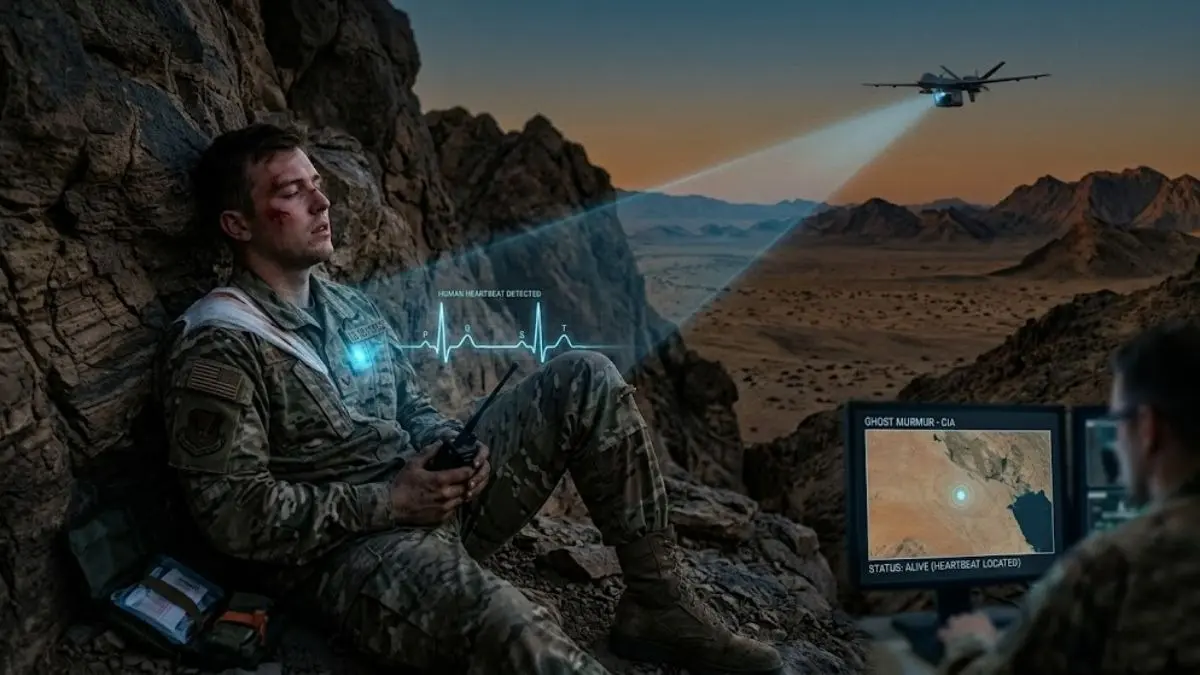
"Ghost Murmur" possibly sponsored by the CIA and possibly developed by Lockheed Martin's Skunk Works, may not yet work to low Earth orbiting (LEO) satellites or much higher Geo-stationery satellites.
Alternatively, or as well, the US War Department's DARPA may have done the sponsoring, with some research organizations like AT&T or Bell Labs doing the developing.
It is presumed Ghost Murmur works to sensors on lower altitude, slow moving
"aircraft" like UAVs and helicopters as well as being carried by US search parties on the ground.
"Ghost Murmur: What Is This US Tech That Let CIA Track Heartbeats 40 Miles Away to Find Pilot in Iran Discover how the CIA's Ghost Murmur technology used quantum magnetometry to track a wounded airman's heartbeat 40 miles away in Iran. Learn how this breakthrough tech works and why it marks a new era in military search and rescue.
Heartbeat in the Desert: How a Secret CIA Tool Tracked a Missing Pilot Miles Away
(Image above by Republic)
In the middle of a vast, silent desert in southern Iran, a wounded American airman lay hidden inside a mountain crevice, trying not to be seen, not to be heard, barely moving as enemy forces searched for him. There were no clear signals, no obvious movement, nothing that would normally give away his position. And yet, miles away, US intelligence had already found him.
Not by sight. Not by sound. But by his heartbeat.
According to a report by the New York Post, the CIA used a highly classified system known as “Ghost Murmur” to locate the missing airman, marking what sources describe as its first real-world operational use. The rescue that followed was complex and risky, but what stands out is the technology that made it possible - a system that sounds like science fiction, yet may now be very real.
How the Technology Actually Works At its core, Ghost Murmur works on a surprisingly simple idea. Every human heart produces a tiny electromagnetic signal when it beats. Under normal conditions, that signal is so faint it can only be detected in a hospital, with sensors placed directly on the chest. But this system changes the rules.
Using advances in quantum magnetometry, it can detect that same signal from far away. The technology relies on extremely sensitive sensors, reportedly built using specially engineered diamonds, that can pick up even the weakest magnetic fields. Once those signals are captured, artificial intelligence software filters out everything else - environmental noise, terrain interference, random electromagnetic activity - and isolates the unique rhythm of a human heartbeat.
Why the Desert Made It Easier The conditions in southern Iran made this an ideal testing ground. The landscape is sparse, with very little electronic interference and almost no competing human presence. At night, the contrast between a living body and the cooler desert surroundings becomes sharper, offering an additional layer of confirmation. All of this combined to give operators a rare advantage: a clean environment where even the faintest signal could stand out.
The Moment That Changed the Search The airman had activated a survival beacon at one point, but that alone wasn’t enough to pinpoint his exact location. What mattered more, according to sources quoted in the report, was that he had to briefly expose himself to send that signal. That moment may have helped Ghost Murmur lock onto him, turning a vague search into a precise detection.
Not a Magic Tool, Yet
Even with its breakthrough capability, the system is far from all-powerful. It reportedly works best in remote, low-noise environments and requires significant processing time to confirm a signal. In crowded or electronically dense areas, isolating a single heartbeat would be far more difficult. This is not a tool that sees everything everywhere, at least, not yet.
Much of Ghost Murmur remains classified, and the full extent of its capabilities is still unclear. But if the New York Post report is even partly accurate, this mission may mark a turning point - a moment where intelligence agencies proved they can track not just where someone is, but whether they are alive, by listening to the quiet, steady rhythm inside the human body.
In a place where a man had almost vanished without a trace, it was that rhythm - steady, invisible, unmistakably human - that led rescuers straight to him."