April 29, 2019

Chinese Survey US & Aussie Manus Island to Guam Submarine Channels

The US and Australia are substantially expanding the well situated Lombrum Naval Base that sits on Manus island (Papua New Guinea) in the Southwest Pacific. The US and Australia in December 2018 noticed suspicious activity of two Chinese oceanographic ships north of the Lombrum Base. Those ships include:

-  China's new research vessel Ke Xue (aka Kexue) a Type 625C research vessel, and 

-  patrol vessel Hai Ce (aka Haice) 3301. US Naval War College (page 3) gives details of "Haice"
   and "Kexue" also see


The Chinese ships performed manoeuvres interpreted as surveying potential submarine channels between Lombrum Base and the US submarine base at Guam. (Map courtesy Australia's ABC News via gfycat)
--- 

The Australia government owned ABC News on April 21, 2019 charted the Chinese ship movements and reported an expert view that:

"[The ships are likely] Establishing the baseline data around what the seabed is made out of, what the seabed terrain is like, the salinity and what thermal layers exist in the water is useful for [mineral] mining but it also helps determine the acoustic conditions for submarine operations.""

ABC News further reported:

"...Ke Xue and Hai Ce 3301, are part of a two-dozen strong Chinese "Distant-Ocean Research fleet" that has conducted expansive maritime surveys around the Philippines, Palau, Guam and Japan over the past two years"

COMMENT

Australia's conventional submarines might in future be able to utilise Lombrum/Manus as a forward base for diesel refueling. It would also put these subs in a good position to patrol north to Guam Naval Base. For a very long Australian submarine mission further refueling at Guam might permit patrols all the way to the East China Sea and back.

In terms of blameless oceanography USNS Impeccable performed a similar exercise south of  China's Yulin nuclear submarine base on Hainan island, China, in 2009. Unlike US and Australian (December 2018) courtesy towards Chinese ships near Lombrum/Manus the Chinese reception near Hainan (2009) was decidedly hostile.  

Pete

April 27, 2019

Poland May Not Have Operating Submarines For 5 Years, 2024-2029

On September 27, 2018 I reported on Poland’s Orka future submarine program to buy 3 medium sized submarines. The new submarines need to replace Poland’s 2 operating Kobben class subs (ORP Sokół and ORP Bielik - on average 54 years old) and its 33 year old Kilo class sub (ORP Orzel). 

Poland’s DziennikZbrojny.pl military portal reported April 6, 2019 about the progress of the Orka program. I've translated the report from Polish and summarised it below.


In late March 2019 the Polish Ministry of National Defense floated an armaments plan. See the naval build plan (above) published on the DziennikZbrojny report. Under the draft plan the build of the first Orka submarine will only begin in mid 2023. This means that the first Orka might only be launched in 2026-2027.

It is reported that the Orka program has ceased to be a priority for the Defense Ministry. The Ministry had planned to choose the main foreign contractor in January 2018, but this deadline has passed with little explanation. Beginning the build in 2023 means delivery to the Navy in 2028-2029 at the earliest. The construction of a modern submarine requires a minimum of 5-6 years.


By 2028-2029 the Navy’s last two operating Kobben submarines [(ORP Sokół and ORP Bielik] will be more than 60 years old – too old to operate. Meanwile the Kilo sub, ORP Orzeł (291), will have been in service for 43 years and may also need retiring before 2029.

Pete Comment

So Poland may not have operating submarines for 5 years, 2024 - 2029.

Pete

April 26, 2019

Whatever is happening to Norwegian Frigate Helge Ingstad?

So what is happening (since my December 8, 2018 article) with Norwegian frigate Helge Ingstad? Poor Helge came off worse in a collision with a tanker. Then Helge sank on November 8, 2018. Helge was raised and transported to Norway’s main Haakonsvern naval base in February/March 2019. On seeing Helge in dock initial observations include an April 15, 2019, English language report: 

after 3 months underwater Helge’s “electronics, electrical equipment, fixtures and weapons systems are all ruined by saltwater contamination and would need replacing. Coupled with the costs of repairing the hull, bringing Helge Ingstad back into service may not be worth it.”

There being few subsequent reports in English I turned to the Norwegian language media. I've  translated the following from Norwegian. The summaries are:

 A Norwegian source reports April 19, 2019 that the Norwegian inquiry into the collision-sinking may take 6 months due to the possibility of police proceedings and that radar, other navigation and communication systems/records need to be reviewed. [Pete Comment: I also suspect that the political imperative of forming a committee to finally report long after the shocking event, plays a part... Also the quality of Helge's Spanish shipbuilder, Navantia, and subsequent modifications may need assessing.]

According to a Norwegian April 23, 2019 source based on the Norwegian Armed Forced Annual Report the Helge Ingstad salvage cost the equivalent of US$84 million. Helge Ingstad was bought for US$496 million in 2000-2009 but following the sinking it has depreciated by US$254 million. Norway is weighing up whether to:

-  return Helge to operations
-  retain it for spare parts to cannibalise for Norway's other frigates, and/or
-  sell the hull for scrap.

Helge Ingstad damage just after it semi-sank on November 8, 2018 
---

How low poor Helge sank when she settled to the bottom, 5 days later, on November 13, 2018. (Courtesy Norwegian source)
---

Helge Ingstad today? Damage partly covered to stop her from sinking, again. Maybe moored at Norway’s Haakonsvern naval base  (Photo courtesy twitter).
---

By mid-late 2019 the committee might report.

Pete

April 25, 2019

Can Australia Monitor Foreign Submarines Along Our Coasts?

I'm now relating the April 24, 2019's article how Indonesian submarine KRI Nagabanda sailed south along the West Australian coast with the likelihood that Australian undersea sensors picked up Nagabanda's movements. In 1963-64 KRI Nagabanda's commander claimed/hoped that his submarine journeyed "without being noticed by Australian ships" but the undersea sensors may have alerted Australian ships to KRI Nagabanda's presence.

As KRI Nagabanda stayed outside the 50 mile coastal limit and Indonesia-Australia were not at war they allowed. KRI Nagabanda to continue unhindered. 

UNDERSEA SENSORS

When KRI Nagabanda sailed in 1963 two types of sensors had been used by Australia and/or its UK and US allies for 45 years

Undersea sensors to detect submarines have a long and established history including:

magnetic anomaly indicator loops developed and first used by the UK Royal Navy in 
   October 1918 to destroy German submarine UB-116, 

Relating this technology to Australia an Australian, Dr Richard Walding comments “Indicator Loops are long lengths of cable laid on the seafloor of harbours to detect enemy submarines.  They were developed by the Royal Navy in the early 1900s and first trialled at the end of WW1.  They were then successfully deployed in WW2 in British ports both at home, in the Dominions (Australia, Canada, New Zealand, South Africa, Kenya, Ceylon, Penang) or in allied harbours (Iceland, Holland, Dardanelles). By 1942 the United States had adapted this technology for its own needs." 

Comment: Magnetic anomaly sensors might still be used to protect Australia's Fleet Bases East and West. This may be related to the University of Adelaide, Australia's Institute for Photonics and Advanced Sensing (IPAS) research. Angela Skujins for Defence Procurement International, 14 April 2019, writes:

"One of the IPAS projects will utilise [quantum] magnetometers in underwater geophysical discovery contexts to track submarine activity.

Professor Andre Luiten said the technology, primarily employed to detect variations caused by the presence of ferrous (unoxidized) iron in the total magnetic field, will be applied for Defence to discover underwater vessels.

“These magnetometers can detect very small magnetic fields,” he said. “The goal of this project is to build sensors that go on the seabed which detect the presence of submarines through their properties. You’d essentially set up a trip wire around assets that are of importance to Australia.”"

-  and passive acoustic sensors "hydrophones", (also see)  developed and used in 1918 against UB-116 by the British. The US adopted this technology and applied it worldwide as the Sound Surveillance System (SOSUS) network. SOSUS was/is most famously used in the North Atlantic (GIUK Gap

A US Navy publication on SOSUS also reveals “After a series of successful detection trials with a U.S. submarine, the Navy decided by mid-[1952] to install similar arrays along the entire U.S. East Coast – and then opted two years later to extend the system to the West Coast and Hawaii as well." 

If SOSUS (now the IUSS) has been monitoring submarine activity near US coasts for decades, then might Australia be monitoring subs around our own coasts? 


Map A. (above) positions where KRI Nagabanda set sail from Kupang, West Timor, Indonesia (see white rectangle) in relation to Australia. 


Now look at the Map B. (above) showing "Deployments" of hydrophone nodes. When KRI Nagabanda moved down the Western Australian coast as far south as Perth it may have moved over the 2 red dots/nodes and black hydrophone/SOSUS dot/nodes. 

These hydrophones may have been present in 1963-64 and where only revealed in the 2000s. The dots/nodes belong to Australia's dual (naval-civilian) use Integrated Marine Observing System (IMOS). IMOS has a civilian image but its "Operational Partners" include the Royal Australian Navy and the Australian Department of Defence's "Defence Science and Technology Group (DST Group)". IMOS uses passive acoustic (hydrophone) equipment monitors natural and "man-made noise sources". Perhaps hydrophone arrays were/are strung between the nodes. Naval processing of data from "man-made noise sources" would occur at shore establishments and then passed on to anti-submarine ships, submarines and aircraft of the RAN and USN.
---


Map C. (above) Another organisation related to IMOS is the Australian Ocean Data Network (AODN) whose partners also include the "Royal Australian Navy" and the "Defence Science and Technology Group (DST Group)".

Does Map C. at the bottom of the "About Us: IMOS" website imply an undersea sensor ring around Australia's coasts? Draw your own conclusions!

Pete

April 24, 2019

Indonesian Submarine Mission Down Western Australian Coast 1963-64 - Part 5

Often the saying "If you want to learn something new, read an old book" is proven true. To that end I've been scrolling through an Indonesian language Weapons Technology website that contains an interesting 2011 article. That article consists of snippets of various Indonesian submarine commanders' memories of their service, 1959 to 2009.

I first visited the 2011 article in 2015 writing about it then.

I revisited it today because it contains rare details of an Indonesian submarine voyage down the Western Australian coast. That brought the sub to the approaches of Australia's second largest naval base which was/is eventually called Fleet Base West situated in the Rockingham-Fremantle area just below Perth, Western Australia. The broader base area was heavily used by many US and some UK Royal Navy submarines during World War Two - subs that sank a great deal of Japanese shipping.

The snippet below concerns Indonesian submarine KRI Nagabanda's reconnaissance mission down the western Australian coast to the approaches to Australia's second largest naval base (after Sydney Harbour). At that time, 1963-64, there was tension between Indonesia and Australia, who were fighting in a small, quiet, war in Malaysia. If things had become more serious Australian shipping might have been at risk from (at that time Indonesia's) substantial force of 12 Whiskey-Tjakra class submarines. 


Some of Indonesia's 12 Whiskey-Tjakra class submarines, which it owned 1959-early 1970s. 
(Photo courtesy the Indonesian 2011 article).
---

THE INDONESIAN ARTICLE A.

Indonesian language Article A. is a collection of original stories told by Indonesian submarine commanders. In English it is titled "50 years of Devotion to the “Shark” [Submarine] Service 1959-2009"

I've translated a small part of A. from Indonesian as it relates to Australia:


"WASTE WASTE IN AUSTRALIA 

This story took place in 1963-1964, when I [an unnamed Indonesian Commander] had passed the submarine commander's school and waited for placement. At that time, there was still an incessant confrontation with Malaysia.

Finally I was appointed as commander of KRI Nagabanda. [A Whiskey-Tjakra class submarine delivered by the Soviets to Indonesia in January 1962].

Some submarines at that time were assigned to carry out reconnaissance in the southern Chinese sea, while KRI Nagabanda was assigned to eastern Indonesia. All Indonesian vessels were under the control of the Commander of the Alert Fleet Command, Commodore RP Poernomo.

At that time there have been tensions with Malaysia which was becoming independent from the UK. [Indonesia was in confrontation with] Malaysia and Singapore and other British Commonwealth forces, including Australia. Is was almost certain that Australia was interfering [which it very quietly was], therefore Indonesian Naval Command decided my sub should conduct a surveillance of  Australian waters. 

The [KRI Nagabanda] left [Indonesia's main submarine base] Surabaya [on the main island of Java, Indonesia] for Kupang [an Indonesian provincial center and small forward naval base on Indonesian West Timor]. Arriving in Timor, KRI Nagabanda anchored in the port and took on fresh food. It then raised anchor and sailed south. During the day we snorkelled [using the diesel engines to charge our] batteries. At night we sailed on the surface. We made sure to stay more than 50 miles away from the Australian coast [outside Australia's territorial waters].

After sailing roughly to the west of the city of Perth [and Australia's second largest naval base], the air inside our sub became really cold, not the usual [tropical heat-warm water we're used to]. We had not come equipped with warm clothes when we left Surabaya. So I decided to turn around to the north, back to Kupang. [West Timor. Also the submarine's limited diesel fuel/range and likely orders to go down close Australia's second largest naval base may have been significant].  

On the way to Kupang, my administrative officer, Lieutenant Ali Kamal, suggested "Commander, to mark KRI Nagabanda being in the waters west of Australia, we should dispose of the garbage here." 

I agreed with this noble proposal, and so ordered that used food cans, especially those made in Indonesia, and other waste, should be thrown into the sea. 

In carrying out this task, KRI Nagabanda managed to enter the waters of western Australia without being noticed by Australian ships."

PETE COMMENT

"without being noticed by Australian ships." may have been wishful thinking. I have raise that issue here.

Pete

April 23, 2019

What Indonesia's Submarines might be used for, Missions - Part 4

Continuing Submarine Matters' April 2019 articles on Indonesian submarines Parts 1, 2 and 3:

For more than 37 years (delivered from West Germany in 1981) Indonesia has operated just 2 Cakra class submarines (KRI Cakra 401 and KRI Nanggala 402). As they were often undergoing prolonged upgrades and regular maintenance they were largely a token force. Indonesia may have kept to 2 because the competitor Malaysia had no subs in the 1980s-early 2000s increasing to just 2 Scorpenes in 2007-2008.

The 2 Cakra's are probably inactive most of the time as their hulls (with only a limited number of full immersion cycles) and diesels are wearing out. Perhaps they are now mainly training platforms.  


That picture has now changed with the launch of 3 new "Nagapasa class" submarines 2017-2019 

-  In 2017, DSME delivered KRI Nagapasa 403 to the Indonesian Navy. 
-  A second Nagapasa KRI Ardadedali was delivered 2018. 
-  DSME built the modules for the third Nagapasa, KRI Alugoro 405 at Okpo Shipyard, South Korea
    and sent them to PT PAL Surabaya for assembly and launch (April 11, 2019).

In November 2018, DSME received the 3 additional Nagapasa orders, announced April 12, 2019 with the subs to be delivered by 2026.  

COMBAT SYSTEM (Weapons and Sensors)

A way to estimate what Indonesia's submarines may be used for is to look at the Combat System suite. The Nagapasa class' sensors and weapons are adequate (a match for Malaysia's non-AIP Scorpenes) though perhaps of lower quality and weapons quantity to the Australian neighbours' Collins and Singapore's Invincibles/Type 218s. The strategic threat, China's, latest SSN and SSK submarines, would by superior in quality and quantity to even 6 or 12 Nagapasas. Meanwhile the other neighbour, the Philippines, has no submarines and may only have a couple in the 2030s. The tiny Brunein Navy will probably never have subs. 


Weapons


-  8 x 533mm torpedo tubes, with a total of 14 heavyweight shots, including:
   =  Black Shark torpedoes, 

   =  UGM-84 Harpoon (anti-ship, capable of land attack) missiles.
   =  maybe 28 torpedo tube launched mines, in a dedicated minelaying mission.

Sensors


The 3 launched Nagapasas aka Improved Chang Bogos have combat systems that include:


-  Optronic masts (better than periscopes) 
-  Atlas Elektronik CSU 90 hull-mounted passive and active search-and-attack sonar and flank sonars -  Indra's Pegaso RESM system and Aries low-probability of intercept radar, 
-  L3's MAPPS integrated platform management systems and 
-  Safran's Sigma 40XP inertial navigation systems.

MISSIONS

Geography

The Nagapasa class range is 10,300nm (19,000km) combined surface, snorting and fully submerged movement at an average of around 6 knots. This allows them to make a return trip between any two points of Indonesia's very broad 5,120km (from East to West) Archipelago. A mission from the main base at Surabaya, Java to the developing northern forward base at Natuna island, and then patrol, might be common.

Indonesia is a maze of islands and choke points. The Nagapasa's may be able to sit on a chokepoint seafloor for 6 days but not the 2-3 weeks that AIP would permit. No AIP may be due to AIP's high cost and AIP is more suited to Singaporean, Swedish and German style very short missions.


Monitoring non-state actors

Much of mission activity will include monitoring using electronics (ie. signals interception). Such interception "targets" might include the naval and Indonesian coast guard vessels of neighbours (including Australia). China's navy, coastguard and Chinese government backed fishing fleets

More publically targets of electronic interception might include the shorter range radio signals of difficult to govern non-state actors (see yellow areas of Map A. below) eg. ship/boat hijackers (related to them) pirates, drug smugglers and Islamist separatists/terrorists.

Once a Nagapasa submarine senses a non-state actor target its torpedoes and missiles are too heavy and expensive (more than US$1.5 million per shot) to destroy a small boat. Also you'd blow up people who may only be suspects and blow up all the evidence! So, instead a submarine (using tethered signal buoy beaming to satellite?) may alert an Indonesian Navy patrol boat or Coast Guard patrol boat. That patrol boat may launch a smaller rigid hulled boat armed with machine guns, to deal with the target boat more "gently".

State actors?

More quietly the submarines are capable of monitoring and engaging their neighbours. With only 35 officers-sailors needing accommodation on Nagapasa , on special missions there may be space for:

-  around 4 intercept operators/linguists with 4 work stations, or 


-  around 7 divers-special forces and their equipment for sabotage, intelligence gathering, etc.

Some missions may be to monitor mainly Chinese, US, Australian, Malaysian, Philippine and Singaporean warship and submarine movements. Also monitoring movements of any other navies crossing the Indonesian Archipelago.


Map A. courtesy Stratfor’s report Southeast Asia's Treacherous Waters of June 2, 2016. 
---

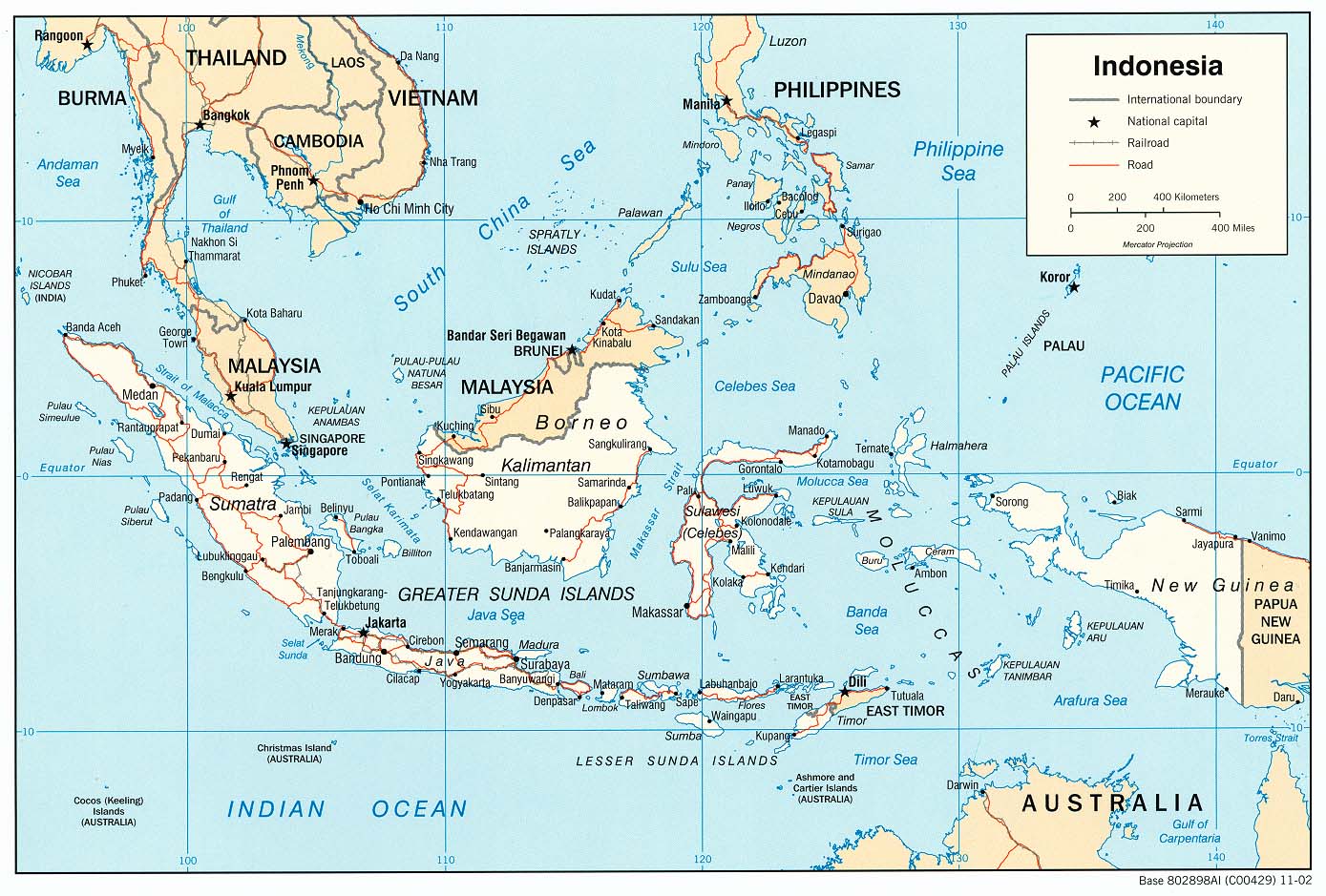
Map B. Indonesia. See much larger here (courtesy University of Texas). Shows how many islands and chokepoints there are to influence Nagapasa submarine missions. Monitoring non-state actors is likely a big part of the job because illegal non-state actors could politically further fragment Indonesia. Indonesia's more distant islands also share borders (and sometimes interests) with Malaysia's and the Philippines distant islands. All three countries meet in (and patrol) the Tri-Border Area which includes the Celebes and Sulu seas - a place where pirate/hijackers flourish.

Map C. Indonesian seafloor depth map. Showing much of the seafloor between western Indonesia islands is less than 200m deep - making it dangerous for shallow submarine travel in daylight. In such shallow water the magnetic signatures might be more easily detected by aircraft even at night. Meanwhile in eastern Indonesia there are many dangerous to navigate coral reefs (see red dots) between island chokepoints.

Indonesia has a complex sea and island geography that will prove a challenge for its new Nagapasa submarines.

SOME USEFUL SOURCES

Pete