April 13, 2018

How Could Taiwan Build A Submarine? Teardrop Solution.

After years of diplomatic inactivity the US has decided to license to Taiwan several major aspects of  conventional (diesel-electric) submarine. The very low amount (maybe only around US$100 million) Taiwan has budgeted to design its future submarines is just one indicator that Taiwan is not aiming to build a major new design. Taiwan's determination to build an existing teardrop design is highlighted in the display of Taiwan's teardrop model (see photo below) very similar to Taiwan's existing Hai Lung class submarines.

To minimize existing Chinese pressure against Taiwan designing and building submarines (considered by China potent strategic weapons) Taiwan may build an existing teardrop design. Designs for which Taiwan, the US, Japan and the Netherlands already have plans. Taiwan already has two teardrop design Dutch built Hai Lung class submarines commissioned in 1987-88. The Hai Lungs are based on the Dutch Zwaardvis class which in turn are based on the US Barbel class.

Japanese contractors might also assist Taiwan. This is noting Japan (inspired by the US Barbel class) developed and used the Uzushio class teardrop style submarines. See photo below of an Uzushio class on the surface.

The US's licensing decision (including new weapons, computers and sensors) can make an existing teardrop design a more formidable "modern" submarine.  Apparently "the [US] approvals cover a marketing license for a submarine combat management system, or CMS, along with a separate technical assistance agreement." 

A CMS typically covers the many hardware and software aspects of the submarine's weapons systems, sonar systems and photonics masts. It also covers the computerised command coordination between these systems to direct the weapons onto targets. The US has already licensed modern and potent submarine launched Harpoon missiles and Mark 48 torpedos to Taiwan. Anechoich tiles could also be applied to a teardrop hull.

The US could assist with its corporate records, including designs which went in building the Barbel class. Records would exist at the Pentagon, the US Navy run Portsmouth Naval Shipyard, in Kittery, Maine and at what was Ingalls Shipbuilding, Pascagoula, Mississippi (now Huntington Ingalls Industries).

Contractors, once in the Netherland's RH Marine, might also assist. As in 2017 they were involved in overhauling Taiwan's Hai Lung class submarine electronics and integration of the submarine  platform and electromechanical systems. 


Model of Taiwan's future submarine (safely still the 60 year old derivative teardrop design of the US Barbel class) at 2017's KIMD arms Expo. (Photo courtesy Taiwan News).
---

Reported May 4, 2018, TAIPEI (Taiwan News) – Taiwan’s plans to build a domestic submarine is likely to attract attention at the second edition of the Kaohsiung International Maritime and Defense Expo scheduled for September 27-30, 2018.


Taiwan's CSBC model of a teardrop hull style future submarine (above) displayed at the September 2016, Kaohsiung International Maritime and Defence Exhibition, arms exhibition, Taiwan. Notice this model's striking similarity with Taiwan's current teardrop hull style Hai Lung class, submarines (below).
---


Note how similar the photo of the model is to this cut away of  Taiwan's Hai Lung class submarines, commissioned in 1987-88 (Diagram courtesy Dutch Submarines . com)
---

BACKGROUND-COMMENTS

Even as fare back as 2016 Taiwan had advanced plans to develop its eight future submarines. Taiwan appears to be avoiding designing a totally new submarine on cost and Chinese pressure grounds. Instead Taiwan wants to utilize as many of the designs and components of its two existing Dutch built Hai Lung class submarines as possible.

From 15 to 18 September 2016, at Taiwan’s Kaohsiung International Maritime and Defence Exhibition, Taiwan was indicating it is getting more realistic about building 4 to 8 teardrop style submarines. Taiwan's Indigenous Defence Submarine Project is known as the "Qianlong Project".

Based on the Exhibition Media Release via MarketWired Taiwan’s China Shipbuilding Corporation (CSBC) created the Submarine Development [Design] Center of CSBC (SDCC)) in August 2016. The design contract, which is understood to be worth around US$95 million, is expected to be issued by the Taiwanese government before the end of 2016 and may run until 2019. 

Taiwan’s Ming Rong Yuan Business Co., LTD. ("one of the world's largest manufacturers of pressure vessels") has joined forces with various domestic research institutes to develop submarine pressure hulls. Ming Rong Yuan Business Co., LTD, at the Kaohsiung arms exhibition, exhibited a miniature model made of high strength low alloy (HSLA) pressure hull steel. HSLA-80 alloy steel has properties making it "easy to handle". HSLA-80 is actually produced by Taiwan's China Steel Corporation.


Japan's no longer used teardrop style Uzushio class submarine. While Uzushios no longer exist the original builders (Japan's MHI, KHI and Ministry of Defense) still have the design plans and could assist Taiwan to design and even construct a future teardrop submarine. (Photo courtesy seaforces(dot)org).
---

Pete
April 12, 2018

Dangerous Times 1. Mediterranean - US/UK-Russia - Probing Short of Confrontation

Business Insider Australia, April 12, 2018 reports regarding US preparations to fire Tomahawk missiles at Syria and Russia's show of force:

“...Russia’s navy appears to have responded to President Donald Trump’s warning that US missiles are headed to Syria, as well as the US Navy’s deployment of an aircraft carrier to the region.

The Russian military has said it is tracking the movements of the US Navy. In the past, the US has used Navy ships to attack Syria.

Eleven Russian navy ships were seen leaving [Tartus] a port in Syria, but an expert said it could be a bluff...”

Russia's Sputnik News adds April 11, 2018:

"...According to the UK's Daily Telegraph newspaper, British submarines have been ordered to move within [Tomahawk] missile range of Syria, as strikes against the Assad regime are expected as early as Thursday night..."

Dangerous Times 2. South China Sea - US-China - Probing Short of Confrontation

The Chinese Hong Kong based South China Morning Post, April 12, 2018 reports in part.

Chinese navy stages double show of strength as US strike group drills in disputed South China Sea - 
PLA puts aircraft carrier and submarines through their paces as USS Theodore Roosevelt passes through contested waterway.

The Chinese navy began a three-day drill yesterday near its main submarine base [at Yulin, Hainan Island/Province] as another exercise finished nearby in what analysts described as a message to the United States that it was capable of defending its core interests...”

Russian submarines exhibited at Defexpo Chennai India April 11-14, 2018


MOSCOW, April 11. 2018 /TASS/ http://tass.com/defense/999002:

"Russia’s United Shipbuilding Corporation (USC) will demonstrate five projects of conventional submarines of various classes and water displacement, including a submarine equipped with the air-independent propulsion system, at the Defexpo India 2018 arms show, the USC press office told TASS on Wednesday.

The land, naval and internal homeland security systems exhibition Defexpo India runs in Chennai, India, on April 11-14.

"The Project 636 submarine with the Club-S missile system, the conventional submarine Amur-1650 with the air-independent propulsion power plant, the P-650 small coastal submarine, the Piranya-T small coastal submarine, the Project 877 EKM diesel-electric submarine," the USC said, responding to the corresponding question.

The Project 877 and Project 636 diesel-electric submarines, and also Amur-1650 underwater cruisers were developed by the Rubin Central Design Bureau 

while small sabotage submarines (P-650 and Piranya-T) were created by the Malakhit Design Bureau..."

Also see a TASS 2016 articl'Black holes' of the Russian Navy focusing on the Kilo 636.3.

April 11, 2018

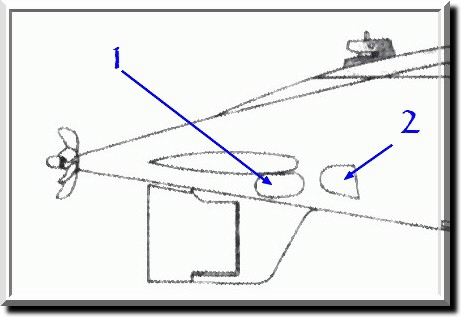
A Kilo Submarine's Impeller Tunnels (Internal Thrusters) Diagram Revealed *

Diagram 1. (Courtesy sourmasov(dot)eu) indicates the openings of the the starboard impeller tunnel in a Kilo 877's or 636's light hull.
--- 

Diagram 2. A Kilo 877 or 636 turned vertically to display its main and "economical" motors and propeller. Of greater interest is the two impeller tunnels (labelled "Auxiliary Propeller) port and starboard. This may be the first appearance of this diagram on the English Internet *. (Foreign source). * but every piece of information or diagrams that seem especially "new" need more evidence to verify their accuracy...
---

From two Anonymous sources, early April 2018, propulsion information for Kilo submarines have been put together. Kilos are equipped with a main propulsion propeller served by one main propulsion motor of around 5.5 MW up to 500 rpm. 

At high speeds, the main propulsion motor is connected to the shaft. The shaft speed (propeller speed) is reduced by the main propulsion motor’s reduction gear (eg. max speed of 500 rpm is significantly higher than propeller speed, eg. max speed 250 rpm). 

At very low speeds (perhaps less than 3 knots) <3 knots="" nbsp="" span="">the main propulsion motor is not connected to the shaft and the main propeller is driven only by a small ("Economical Prop Motor in Diagram 2.) propulsion motor to achieve "economical" (less battery use) and silent operation.

Kilos (both the 877s and 636s) also use two small pump impellers (can also be called internal thrusters but for submarine) in two tunnels (see the two diagrams below especially Diagram 2.). These can be for:

i)             for very low speed manoeuvring,
ii)           or staying still in a current (eg. while releasing or retrieving special forces divers).

The pump impellers are set inside tunnels in the Kilo submarines light, external, hull. Kilo submarines have a double hull structure consisting of the external light hull and the inner pressure hull. * but this impeller information and Diagrams that seem especially "new" needs more evidence to verify accuracy...

It is not known how common pump impellers are in Western and Northeast Asian (Japanese, South Korean and Chinesesubmarines. Perhaps the impellers are advanced features of the Kilos?

As reduction gear vibrates at high speed, the Improved Kilo 636.3 (built only for the Russian Navy) seems to have a louder acoustic fingerprint than more modern submarines (designed by TKMS, Naval Group, KHI-MHI or Saab) driven by PSMS or DC motor without reduction gear. 

The Kilo appears to be too old in many respects. A new Russian conventional submarine design with modern technologies such as PSMS, AIP, LIBs and higher power diesels is needed. However with most of Russia’s submarine design budget going to Russia’s nuclear propelled submarines there is insufficient money to bring Russian conventional submarines up to Western or Northeast Asian  standards.

Anonymouses and Pete

April 10, 2018

China's alleged (Late Coloniser) basing intentions in Vanuatu

 
Map courtesy Sydney Morning Herald
---
Latest News: Australia's DEFENCE CONNECT, April 11, 2018 reports in part: "Reports of China’s plans to establish a military base in Vanuatu have been met with stern criticism from Australia politicians, with Prime Minister Malcolm Turnbull labelling it a "great concern”... Malcolm Turnbull issued a warning to China not to establish a military base in Vanuatu this week, arguing it would disrupt the "peace and stability" of the region..."

COMMENT 

There appears to be an emerging pattern of Chinese loans to small island nations - loans too large for those nations to repay. Instead to money some nations might quietly cede port territory to Chinese companies. 

The light was shone on the Maldives in February 2018 and now Vanuatu. Fears that China will build military bases in island countries and larger countries (Pakistan and Myanmar) appear exaggerated - for now. 

Instead China assists with dual-use civilian-military port facities, large enough for a small Chinese flotilla (say two frigates and a supply ship) to visit, but no permanent basing - yet. Hence headlines or scares run ahead of reality.

China is prepared to wait, in a non-confrontational way, until its economic power can be focussed sufficiently on Vanuatu, to steadily build dual-use facilities can support extended visits. Other vulnerable island nations include East Timor, Solomon Islands and Fiji.

VANUATU

In the last 24 hours reports (see below) have been published about Vanuatu being in (not completely verified preliminary) talks with its main creditor, China, on possible future Chinese bases on Vanuatu. At worst, the positioning of a Chinese naval base in Vanuatu could isolate/blockade Australian east coast, New Zealand and France's New Caledonian shipping. An airport conversion that could support long range Chinese military aircraft might also be a worry.

Vanuatu (also see CIA Factbook entry) is a tiny South Pacific nation of islands, with just over 270,000 people. Formerly called the New Hebrides, Vanuatu gained independence from Britain and France in 1980. Vanuatu is a poor country, reliant on aid and loans (including from China). Vanuatu's main industries are low levels of agriculture, tourism, offshore financial services, and raising cattle.

FURTHER COMMENT

Western governments are opposing alleged Chinese basing intentions with the argument "China is Militarising the Pacific"

This forgets the US's massive Pacific naval and air bases at Guam (Mariana Islands), Pearl Harbour (Hawaii) as well as bases at Japan / Okinawa and in South Korea. 

There are major Australian Pacific naval bases "Fleet Base East" Sydney Harbour and major New Zealand base at Devonport / Auckland.

On a more minor scale is France's stationing of two French Floreal class frigates in the South Pacific with one the Vendémiare at Noumea, New Caledonia (which is very near to Vanuatu), and the frigate Prairial based at Papeete, Tahiti.

China (only a possible coloniser since 1949 after occupation and civil war) is late to Pacific island base colonising. Other powers (eg. US and France) have secured Pacific island bases, originally by force, for over a century. China's lateness does not make its right/claims illegitimate.

It is difficult to determine what is true or false about China-Vanuatuan bilateral relations: Vanuatu's “Foreign Minister Ralph Regenvanu said reports in Fairfax Media that the two countries were in preliminary discussions were false [BUT] Vanuatu is one of few countries that has backed China's position on the disputed South China Sea."

The fiendish thing is that China generally wins power and influence over island nations by legitimate means. Vanuatu probably won't become a Chinese base for some time. A growing (dual-use) Chinese commercial presence, increased Chinese flotilla visits, increased Chinese emigration and increased Chinese tourism may be precursors. There is little evidence that China uses the force used by previous colonial powers in New Hebrides days.

ARTICLES

Main article by Fairfax news (Sydney Morning Herald) most cited: 


Background article by Fairfax news (Sydney Morning Herald)


Two shorter articles by Australia's government owned ABC News:


Pete