January 9, 2012

Joint US - Australian Base Envisaged for Cocos Islands in Indian Ocean

The Cocos (Keeling) Islands are ideally situated to base air and sea assets to cover alternate (to the Strait of Malacca) sea lines of communication (SLOCS) between the Indian and Pacific Oceans.
-
The Australian, November 21, 2011, reports:

"Smith forecasts Cocos Islands joint military base"

THE upgrading of defence ties with the US may include the development of joint military facilities on Cocos Islands.

Defence Minister Stephen Smith said yesterday the first priority would be upgrading the HMAS Stirling naval base [Australia's main submarine base - envisaged for greater use by US SSNs] , near Perth. "In the future, there may well be some possibility or prospect of greater utilisation of Cocos Islands," he said.

Mr Smith told the Ten Network there would have to be a major upgrade of the infrastructure on Cocos Islands, an Australian territory in the Indian Ocean, before they were fit for joint use by the Australian and US forces.

His comments confirm that the steps announced last week, starting with 250 additional US troops visiting Darwin, mark the start of what is likely to be a much wider collaboration. Mr Smith has played down suggestions of China's displeasure with the new military arrangement between Australia and the US, saying the official response has been measured and appropriate.

But a spokesman for China's Ministry of Foreign Affairs, Liu Weimin, said the move might not be in the interests of countries in the region and questioned the expansion of military ties while global economics were still shaky.

An editorial in China's state-run People's Daily newspaper went further, saying if Australia used its military bases to help the US hurt Chinese interests, "one thing is certain . . . Australia will be caught in the crossfire".

Mr Smith said the media commentary should be divorced from China's official response. "And the official response has quite frankly been a measured one. It hasn't been over the top." He said China was against military alliances, but understood Australia's ties with the US."
-
Pete

January 8, 2012

Prominent defence thinker Professor Babbage suggests 12 nuclear submarines and ballistic missiles for Australia

The concept of an arsenal ship proposed for use in the US Navy and also by Professor Babbage for the Australian Navy.

An extraordinary essay by prominent defence thinker, Professor Ross Babbage, on Australia's response to the China threat, will become public in 48 hours on January 7. The following is a preliminary analysis in The Australian January 5, 2011 by conservative journalist Greg Sheridan. My blog has long supported the notion of nuclear submarines for Australia - preferably armed with (hypersonic) ballistic missiles because cruise missiles are too slow for first or second strike. Long flight times lose the element of surprise and cruise missiles are more easily shot down.  Hence cruise missiles lack the deterrent value of ballistic missiles. Sheridan's preliminary analysis is:

'Boost military' to take on China: adviser AUSTRALIA will need nuclear-powered attack submarines among a range of highly potent weapons systems, and must revolutionise its strategic culture to answer the security dangers posed by China's massive military build-up, according to one of the federal government's chief military advisers.

Ross Babbage, who served on the government's advisory panel for the 2009 Defence white paper, believes Australia should acquire a fleet of 12 nuclear-powered attack submarines.


He also favours developing a conventionally armed cruise and ballistic missile capability to be carried on new "arsenal ships", as well as a massive increase in Australia's cyber-warfare investment. [Pete's comment: The concept of specialised arsenal ships comes from the US Navy which (unlike the Australian Navy) can afford a whole range of specialised ships.  A ship which carries cruise and/or ballistic missiles would be a warship, requiring a regular navy crew to maintain and fire the missiles. The crew and surrounding escort ships would likely also defend the "arsenal ship" from air, submarine and sea-surface threats. Making the ship submersible would improve survivability and would improve the element of surprise as well as deterrent value. In short a SSBN would be a better solution than an arsenal ship.]

In a report to be published on Monday, Australia's Strategic Edge 2030, Professor Babbage calls for Australia to host a range of American military bases. This would help disperse US military assets and make them harder to hit in the event of military conflict with China.

It would also emphasise the strength and intimacy of the US-Australia alliance and discourage any aggression against Australia, as any hostile power would fear that this would automatically involve the Americans.

Professor Babbage, the founder of the influential Kokoda Foundation security think tank, believes all this is necessary because China's extremely aggressive military build-up has transformed Australia's strategic environment, making it much more dangerous.

"Australia cannot overlook the way that the scale, pattern and speed of (Chinese) People's Liberation Army's development is altering security in the Western Pacific," Professor Babbage argues in the new paper, which has been obtained by The Weekend Australian.

Professor Babbage believes that China's massive military expansion is focused on "striking United States and allied forces in the Western Pacific" and that this has been accompanied by much more aggressive military and diplomatic behaviour by Beijing.

"Australia has to develop an effective response," he argues.

"The challenge posed by the rising PLA is arguably one of the most serious that has confronted Australia's national security planners since World War II," he says.

"China is for the first time close to achieving a military capability to deny United States and allied forces access to much of the Western Pacific rim."

Professor Babbage argues that this is not a question of distant threats to Australia's region but of direct threat to Australia itself, as it is within range of many existing Chinese weapons systems.

He identifies a vast range of Chinese military capabilities that are on a massive growth path. These include cruise and ballistic missiles, which can attack US and Australian ships and fixed targets; a massive investment in cyber-warfare capabilities, with reports of tens of thousands of Chinese cyber intrusions daily; new classes of both nuclear and conventionally powered submarines, including more than 40 new Chinese subs since 1995; a massive increase in Chinese nuclear weapons that will double or triple in number by 2030; a huge investment in space warfare so that China could destroy the communications satellites which are central to the Western way of war; and a massive increase in fighter bomber and other airborne strike capabilities.

Professor Babbage does not believe Australia can match these Chinese capabilities.

Rather, his strategic response consists of two elements.

One is Australia taking action to strengthen the US military position in Asia, such as by hosting more US military facilities.

The other is for Australia to do to China what China is doing to the US, which is to develop an "asymmetric" ability to use a smaller force to impose massive costs on China in the event of any conflict.

This would help to deter Chinese military adventurism and avoid conflict."

[Elsewhere in the January 5, 2011 edition of The Australian Sheridan describes http://www.theaustralian.com.au/news/opinion/time-to-beat-china-at-its-own-game/story-e6frg6zo-1226000381520 the Babbage Essay (to be published on January 7 as:

 "one of the most important, deeply considered and logically compelling strategic documents ever seen in Australia".
-
PETE'S COMMENTS
-
Babbages views on Australia defence carry special weight due to his long career in the Australia DoD, in academia and because he has been asked several times to contribute to pivotal strategic (White) Papers on Australia's Defence.


As founder and most prominent member of the Kokoda Foundation Babbage regularly produces highly creative ideas on Australia's defence. Here is an earlier blog article where I comment on Professor Babbage's ripping the arms off Asian giants Kokoda article of March 2008.
-
Unfortunately the US is likely to maintain its position that its allies, such as Australia and Canada, cannot have nuclear submarines. In comments below my blog article Australia New Submarine Program - On Drawing Board I wrote on March 22, 2009 :


"The US has policies, laws and has signed treaties against nuclear proliferation. Proliferation includes the spread of nuclear weapons, fissile material, and weapons-applicable nuclear technology and information, to nations which are not recognized as "nuclear weapon States" by the Nuclear Nonproliferation Treaty.


As submarine reactors often contain weapons grade uranium (97% for US sub reactors when only 85% would be enough for a bomb)) exporting such a reactor would amount to weapon proliferation. Teaching Australian technicians the skills to maintain and operate such reactors would amount proliferation of dual use information.


So the US in its self appointed role as world policeman and moral high grounder would be unlikely to help Australia in the nuclear propulsion and weapon areas.


But probably more likely nuclear exporters are France for naval reactors and Israel for actual weapons.


France has a history of building handy little SSNs that would be a better size for Australian requirements. For example the 6 French SSNs of the Rubis Class only displace 2,400 tons surfaced, 2,600 submerged. http://en.wikipedia.org/wiki/Rubis_class_submarine


The Rubis Class are less than a third of the weight of US Los Angeles or Virginia class SSN/SSGNs. The Rubis' crew of 62 (the smaller the better for Australia) is only half that of US SSNs. Rubis are fairly recent with the first launched 1979 - obtaining them second hand or new build followon French SSN's ( http://en.wikipedia.org/wiki/Barracuda_class_submarines  ) may be the best way to go if Australia considered nuclear propulsion.


Australia also fields Harpoon anti shipping and land attack missiles in its Collins Class subs. Given probable Israeli sub cruise missile warhead developments and Israel's past willingness to supply nuclear weapons technology to South Africa - Israel could well help Australia some day. Israel would certainly value Australian uranium aand diplomatic support in return:


"In June 2002, former State Department and Pentagon officials confirmed that the U.S. Navy observed Israeli missile tests in the Indian Ocean in 2000, and that the [Israeli HDW 214 derivative] Dolphin-class vessels have been fitted with nuclear-capable cruise missiles of a new design. Israel issued new denials, albeit in an indirect manner. In October 2003, unidentified senior U.S. and Israeli officials were quoted as saying that Israel had successfully modified nuclear warheads to fit its Harpoon missiles." http://www.nti.org/db/submarines/israel/index.html "
-
In line with US strictures Australia dismissed the option of Australian nuclear subs in the 2009 Defence White Paper - see http://gentleseas.blogspot.com/2009/05/australia-defence-white-paper-submarine.html However Professor Babbage is reviving that option due to the increasing China threat and perhaps a resultant decline in US power to limit US allies' weapon preferences. In http://gentleseas.blogspot.com/2009/05/australia-defence-white-paper-submarine.html I also noted:


"subsonic Tomahawk missiles are stealthy and part of an EW attack, however, a much faster mach 2+ weapon (retaining 2,000+ km range) would eventually be preferable for surprise land attack, quick response and to evade anti missile defences, such as the Russian or Chinese sourced S-400 (or equivalent) SAMs." [Ballistic missiles and their warheads are the only practical and mature hypersonic vehicles over their whole flight - not just a hypersonic endrun as seen in the BrahMos. Ballistic missile and warheads mainly operate in space where they do not overheat. Although there is much impractical, overheated, complete flight, hypersonic research in the atmosphere going on].
-
Pete

January 7, 2012

Thorium Reactors - Indian and Australian Prospects

This post is about the highly complex scientific and economic topic of thorium reactors. Much is claimed but little appears to have been achieved in any country over the last four decades of thorium breeder reactor research and development. India has put in a considerable amount of its nuclear effort into developing such reactors. My views are:
- thorium reactor research is as difficult a set of tasks (see "Disadvantages" below) as the intense multinational effort that produced the world's first nuclear weapons.
- Compared to building a miniturised submarine reactor (which, in the end, required Russian assistance) India faces a tougher technical hurdle in independently making thorium a mature process.
- there are currently perceptions in most other countries of uranium abundance including all the major nuclear countries, except India.

- Most countries that have embarked on thorium in reactor research programs have closed down programs due to technical difficulties and high relative cost of using thorium. See List of Thorium Fueled Reactors for reference to Indian and foreign reactors partly using thorium.
- if ample uranium were available to India in future its nuclear research effort might also move away from thorium (a complex issue which needs to be considered)

- At least two reactors (CIRUS and DHRUVA) that partly use thorium also have produced significant amounts of weapons grade plutonium. This association of inputs and outputs suggest that part of India's interest in thorium might be weapons driven. This runs conter to the standard belief that reactors using thorium produce less plutonium and thus are more "peaceful". The peacefulness or otherwise of thorium is thus an open question.
- with the post 1998 test sanctions being lifted by most countries (Australia has maintained sanctions) it may well be that India already has sufficient uranium to make continued thorium research (other than for plutonium production) a lower priority.
- without considerable US, European, Japanese and Russian involvement, thorium fuel cycles will not be complete, cost-effective or efficient in other respects for decades. -
Australia's position (or lack of...)
-
- while Australia has good scientists and some useful theoretical knowledge it has nowhere near the government, academic or commercial resources to assist India with practical thorium applications or standand uranium nuclear reactors.

- India like most major countries is way ahead of Australia in applied nuclear matters.
- in Australia all nuclear research has been intentionally run down by the government for Labor Party unity, environmental green and nuclear free regional utopian reasons.

- the very abundance of Australian uranium and coal likely means that Australia would not seriously consider undeveloped thorium technology for domestic use for decades - and that is after we build our own standard uranium reactors
- any Australian standard power reactors (none are planned) might not go on line before 2035 - probably much later, then add 20 years for thorium/fast breeders.
Comments arising from my post Indian-Australian Differences but Hope November 19, 2009 covered India's nuclear, specifically thorium technology prospects:

jbmoore said... ...If Australia played its cards better, it could come out ahead on any deal. Help the Indians develop thorium reactors (you guys have a lot of thorium deposits). Setup joint research programs between India and Australia...Friday, November 20, 2009 11:07:00 AM"
---------------------------------------

Parminder Grewal said...
"I have been going through your blog for the last few days. It has a lot of interesting stuff. ...3. Regarding Australia and the uranium politics: India and Australia are both rich in another ore called as thorium. Thorium is a much more cleaner source of nuclear energy than uranium(less dangerous by products), it cannot be used to make nuclear weapons, it is much more abundant (conservative estimates say that Indian reserves can satisfy Indian needs for 350 years, optimistic estimates talk in terms of millenia).
The technology to use thorium exists with the United States since the 1970's but has not been used (my speculation is that this was ensured by the oil companies and uranium industry). India has been planning to do the same and is at stage 2 of her 3 stage plan to develop thorium based reactors (there is speculation that the civilian nuclear deal was partly aimed at blocking this thorium based energy cycle). Thorium could be the ultimate solution to the climate/energy problem for centuries to come but the vested interests of a few companies is stopping that from happening. Its very sad I'd say. Saturday, November 21, 2009 6:43:00 AM"
Background
Wiki contains this fairly clear description of the Thorium fuel cycle:
The thorium fuel cycle is a nuclear fuel cycle that uses the naturally abundant isotope of thorium, 232Th, as fertile material, and the artificial uranium isotope, 233U, as fissile fuel for a nuclear reactor.
However, unlike natural uranium, natural thorium contains only trace amounts of fissile material (such as 231Th) that are insufficient to initiate a nuclear chain reaction. Thus, some fissile material must be mixed with natural thorium in order to initiate the fuel cycle. In a thorium-fueled reactor, 232Th will absorb slow neutrons to produce 233U, which is similar to the process in uranium-fueled reactors whereby fertile 238U absorbs neutrons to form fissile 239Pu.
Depending on the design of the reactor and fuel cycle, the 233U generated is either utilized in situ or chemically separated from the used nuclear fuel and used in new nuclear fuel.

A thorium fuel cycle offers several potential advantages over a uranium fuel cycle, including greater resource abundance, superior physical and nuclear properties of fuel, enhanced proliferation resistance, and reduced plutonium and actinide production.

Concerns about the limits of worldwide uranium resources motivated initial interest in the thorium fuel cycle. It was envisioned that as uranium reserves were depleted, thorium would supplement uranium as a fertile material. However, for most countries uranium was relatively abundant, and research in thorium fuel cycles waned. A notable exception is the Republic of India which is developing a three stage thorium fuel cycle. Recently there has been renewed interest in thorium-based fuels for improving proliferation resistance and waste characteristics of used nuclear fuel.

Thorium fuels have been used in several power and research reactors. One of the earliest efforts to use a thorium fuel cycle took place at Oak Ridge National Laboratory in the 1960s. An experimental Molten Salt Reactor (MSR) technology to study the feasibility of such an approach, using thorium(IV) fluoride salt kept hot enough to be liquid, thus eliminating the need for fabricating fuel elements. This effort culminated in the Molten-Salt Reactor Experiment that used 232Th as the fertile material and 233U as the fissile fuel. Due to a lack of funding, the MSR program was discontinued in 1976.
- Advantages of thorium as a nuclear fuel
-
There are several potential advantages to thorium-based fuels.
Thorium is estimated to be about three to four times more abundant than uranium in the earth's crust
, although present knowledge of reserves is limited. Current demand for thorium has been satisfied as a by-product of rare-earth extraction from monazite sands. Also, unlike uranium, naturally occurring thorium consists of only a single isotope (232Th) in significant quantities. Consequently, all mined thorium is useful in thermal reactors.
Thorium-based fuels also display favorable physical and chemical properties which improve reactor and repository performance. Because the 233U produced in thorium fuels is inevitably contaminated with 232U, thorium-based used nuclear fuel possesses inherent proliferation resistance. Uranium-232 can not be chemically separated from 233U and has several decay products which emit high energy gamma radiation. These high energy photons are a radiological hazard that necessitate the use of remote handling of separated uranium and aid in the passive detection of such materials. [can also be seen as a toxic disadvantage].
-
[however plutonium may be worse in toxicity] The long term (on the order of roughly 103 to 106 years) radiological hazard of conventional uranium-based used nuclear fuel is dominated by plutonium and other
minor actinides, after which long-lived fission products become significant contributors again.
-
Disadvantages of thorium as nuclear fuel
-
Unlike uranium, natural thorium contains no fissile isotopes; fissile material, generally 233U, 235U, or plutonium, must be supplemented to achieve
criticality. This, along with the high sintering temperature necessary to make thorium-dioxide fuel, complicates the fuel fabrication process. Oak Ridge National Laboratory experimented with thorium-tetrafluoride as fuel in a molten salt reactor from 1964-1969, which was far easier to both process and separate from fuel poisons (contaminants that slow or stop the chain reaction.)

If thorium is used in an
open fuel cycle (i.e. utilizing 233U in-situ), higher burnup is necessary to achieve a favorable neutron economy. Although thorium dioxide has performed well at burnups of 170,000 MWd/t and 150,000 MWd/t at Fort St. Vrain Generating Station and the German AVR reactor [closed 1980], there are challenges associated with achieving this burnup in light water reactors (LWR), which compose the vast majority of existing power reactors.

Another challenge associated with a once-through thorium fuel cycle is the comparatively long time scale over which 232Th breeds to 233U. The
half-life of 233Pa is about 27 days, which is an order of magnitude longer than the half-life of 239Np [Neptunium]. As a result, substantial 233Pa builds into thorium-based fuels. Protactinium-233 is a significant neutron absorber, and although it eventually breeds into fissile 235U, this requires two more neutron absorptions, which degrades neutron economy and increases the likelihood of transuranic production.
Alternately, if thorium is used in a closed fuel cycle in which 233U is recycled, remote handling is necessary for fuel fabrication because of the high radiation dose resulting from the decay products of 232U. This is also true of recycled thorium because of the presence of 228Th, which is part of the 232U decay sequence.
Further, although there is substantial worldwide experience recycling uranium fuels (e.g. PUREX), similar technology for thorium (e.g. THOREX) is still under development.

Although the presence of 232U makes it a challenge, 233U can be used in
fission weapons, but this has been done only occasionally. The United States first tested 233U as part of a bomb core in Operation Teapot in 1955. However, unlike plutonium, 233U can be easily denatured [rendered not suitable for weapons ] by mixing it with natural or depleted uranium.

Despite the fact that thorium-based fuels produce far less long-lived
transuranics than uranium-based fuels, there are some long-lived actinides produced that constitute a long term radiological impact, especially 231Pa.
-
Pete

January 6, 2012

Lyons Australian Nuclear Paper - References to India


India's long range nuclear deliverers - the Agnis and K-15


An excellent assessment by Rod Lyon, a Program Director at the the Australian Strategic Policy Institute in Canberra has written a ground breaking paper A delicate issue: Asia's nuclear future Monday, 14 December 2009 ("Download PDF" version is free) . Some of it deals with India and much with Pakistan.The summary includes: "The world stands on the cusp of a new era in nuclear relations—one in which Asia is likely to become the dominant influence on global nuclear arrangements...The report concludes that Australian strategic policy should retain the flexibility to accommodate a range of possible Asian nuclear futures, striking a balance between its ordering and hedging strategies during a possible turbulent era in regional security."

I will address issues for Australia in a subsequent blog or journal article. Some interesting references to India include:

- page.10 - "But there’s the rub: just as some banks and financial institutions were deemed ‘too big to fail’ in the recent global financial crisis, aren’t some possible proliferators going to be ‘too big to sanction’ if we hit a nuclear tipping point in East Asia? For example, is Australia going to apply strong sanctions against a proliferating Japan, one of our strongest trade partners? After all, current evidence suggests that a great-power proliferator is already treated differently from others. India is the case in point."- p.12 "If we were to look at the case study of the India–Pakistan nuclear relationship—which is grounded in an enduring strategic rivalry, and therefore not ‘typical’ of the broader nuclear relationships in Asia—it’s a moot point whether Pakistani behaviour has been much altered by the ‘deterrence’ policies of India. Indeed, the case seems to show that Pakistan doesn’t even accept a long‑term condition of strategic asymmetry with India, and that it intends to use its nuclear weapons as an ‘equaliser’ against India’s larger conventional forces by building a nuclear arsenal larger than the Indian arsenal arrayed against it."- p.14 - Excellent "Table 1: Current, planned and proposed civil nuclear energy programs in Asia" including numbers and total Mw of Indian reactors.

- p.15 - "China has an arsenal much closer to the 250–400 warhead range, for a ratio of about 1:20 with both the US and Russia. India has perhaps 70–100 warheads (for a ratio of 1:3 or 1:4 with China). Japan has none. Pakistan’s arsenal is generally thought to be somewhere in the 70–100 warhead range (a 1:1 ratio with India), although reports suggest that it has been moving vigorously recently to enhance the quantity and quality of its weapons."

- p.19 "India sees a strategic future in which it ‘escapes’ the localised strategic rivalry it has with Pakistan and plays a larger role upon the bigger stage of the Asian theatre. It knows that its nuclear arsenal isn’t really about Pakistan, but about the bigger issue of its place at the ‘Asian table’. How much asymmetry can New Delhi tolerate, and with whom?"

[more]"...It isn’t entirely clear that Russia and India are indifferent to the growth of Chinese power. As one Indian strategic analyst has observed:

"for India to limit itself well short of the nuclear weapons strength of the second‑tier nuclear power, China, with some 500 warheads/weapons, is to accept a status on par with that of Pakistan by default … The logic of nuclear technology dictates that a big country, like India … will not only acquire an arsenal it thinks is militarily adequate, but one that it feels will do justice to its size, resources and potential, and will help realize its ambitions. "(Karnad 2005:552)

"... As a recent assessment concluded: India and Pakistan each claim minimum nuclear deterrence policies; but in South Asia minimum deterrence does not call for a finite ceiling on the development of nuclear weapons and delivery systems … [It] is a dynamic concept that changes with the evolving threat environment. The ‘minimum’ label has more to do with Indian and Pakistani desires not to provoke nuclear-armed adversaries (China and India, respectively) or the United States and other nonproliferation stalwarts. (Khan and Lavoy 2008:229)"

- p.31 - "It is possible, of course, that non‑state actors might yet turn out to be much more serious nuclear players. At one level, they might be ongoing strategic irritants that provoke strategic confrontations between nuclear-armed states. The terrorist attacks on the Indian parliament in December 2001 and on Mumbai in November 2008 illustrate the strategic challenges that non‑state groups can bring to an Indian–Pakistani relationship already fraught with a legacy of tensions."

- p.32 - "It’s reasonable to assume that there are provisions for ‘mating’ and deploying some number of nuclear warheads in particular crisis scenarios. Logically, those scenarios probably involve a crisis between India and Pakistan, for the simple reason that ‘the nuclear dimension of regional security in South Asia is essentially a deterrence construct between India and Pakistan’ (Khan 2009). Media reports suggest that some US officials worried most about the Mumbai terrorist incident precisely because it might generate a set of escalatory tensions that could result in such circumstances, fully mated and deployed Pakistani warheads being more vulnerable to ambush and theft than their separated components might be under normal, peacetime conditions."


These are just some of the sections focusing on India. There is so much more in Lyon's paper about the international nuclear weapons framework and recent concepts and conditions in other Asian regions. The full paper is here.
-


Pete

February 15, 2010

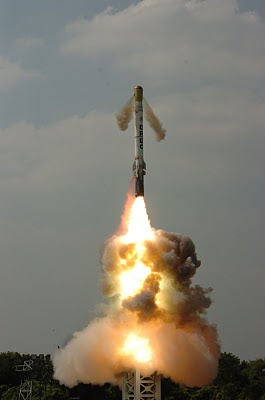
The K-15 (aka Sagarika or Shaurya) mini SLBM - Hypersonic Cruise Missile is gradually developing


Interesting about the stabilising (retro-rocket?) instrument at top of the K-15 during initial launch phase. I assume it keeps the K-15 upright and gets out of the flight path once detached?
-
The Business Standard, February 17, 2010 reports:

Shaurya surfaces as India's underwater nuclear missile - The country’s top defence scientist has, for the first time, revealed that India’s new Shaurya missile, which can carry a one-tonne nuclear warhead over 750 kilometers, is specially designed to be fired from Indian submarines and could form the crucial third leg of India’s nuclear deterrent.

[India's first indigenously designed nuclear submarine, the Arihant, will be armed with 12 K-15s.]

If launched from a submarine off the China coast, it could hit several Chinese cities like Beijing, Nanjing and Shanghai.

Air and land-based nuclear weapons are delivered to their targets by fighter aircraft and ballistic missiles, respectively. Since these can be knocked out by an enemy first strike, the most reliable nuclear deterrent has traditionally been underwater, missiles hidden in a submarine.

V K Saraswat, the DRDO chief and Scientific Advisor to the Defence Minister, revealed to Business Standard at the ongoing Defexpo 2010, “We have designed the Shaurya so that it can be launched from under water as easily as from land. The gas-filled canister that houses the missile fits easily into a submarine. The underwater leg of the nuclear triad needs to be totally reliable and needs a state-of-the-art missile.”

India’s undersea deterrent had so far revolved around the K-15 ballistic missile, built with significant help from Russia [?]. The K-15 was to equip the INS Arihant, India’s lone nuclear-powered submarine, which is being constructed in Visakhapatnam. But now, after rigorous underwater testing, the Shaurya could be the mainstay of Arihant’s arsenal.

“The Shaurya was developed from ground up as a submarine-capable missile,” confirms Dr Prahlada, the top DRDO scientist responsible for liaising with the military. “Every piece of technology for fitting it in a submarine is already in place.”

Shortly before the Defexpo 2010, Dr Saraswat had publicly stated that India’s missile technology was ahead of China’s and Pakistan’s.

Now top DRDO scientists have revealed that the Shaurya is not a ballistic missile, as it has been thought to be; it is actually a hypersonic cruise missile, which never leaves the atmosphere.

A ballistic missile is like a stone being lobbed towards a target. Rockets toss it upwards and towards the target; after the rocket burns out, gravity pulls the missile warhead down towards the target. Buffeted by wind and re-entry forces, accuracy is a problem; and, since the ballistic missile’s path is predictable, shooting it down is relatively easy.

The Shaurya has none of these issues. Its solid-fuel, two-stage rocket accelerates the missile to six times the speed of sound before it reaches an altitude of 40 kilometers (125,000 feet), after which it levels out and cruises towards the target, powered by its onboard fuel.

While ballistic missiles cannot correct their course midway, the Shaurya is an intelligent missile. Onboard navigation computers kick in near the target, guiding the missile to the target and eliminating errors that inevitably creep in during its turbulent journey.

The Shaurya, say DRDO sources, will strike within 20-30 metres of its target after travelling 750 kilometres.

Conventional cruise missiles, like the American Tomahawk and the Indo-Russian Brahmos, offer similar accuracy. But their air-breathing engines carry them along slowly, rendering them vulnerable to enemy aircraft and missiles. The Shaurya’s solid-fuel, air-independent engine propels it along at hypersonic speeds, leaving enemy fighters and missiles far behind.

“I would say the Shaurya is a hybrid propulsion missile”, says Dr Saraswat. “Like a ballistic missile, it is powered by solid fuel. And, like a cruise missile, it can guide itself right up to the target.”

Making the Shaurya even more capable is its ability to manoeuvre, following a twisting path to the target that makes it very difficult to shoot it down. In contrast, a ballistic missile is predictable; its trajectory gives away its target and its path to it.

Background

The K-15 Shaurya/Sagarika could be described as a quasi ballistic missile as it has a low (atmospheric) trajectory and can perform maneuvers in flight or make unexpected changes in direction and range

Wiki explains - "The Shaurya missile is speculated to be the land version of the under-water Sagarika K-15 missile[6], although DRDO officials have reportedly denied its connection with the K-15 program[2] Similar to the BrahMos [in land, sea and air? launched mode], Shaurya is stored in a composite canister, which makes it much easier to store for long periods without maintenance as well as to handle and transport. It also houses the gas generator to eject the missile from the canister before its solid propellant motors take over to hurl it at the intended target.

Shaurya missiles can remain hidden or camouflaged in underground silos from enemy surveillance or satellites till they are fired from the special storage-cum-launch canisters. DRDO scientists admit that given Shaurya's limited range at present, either the silos will have to be constructed closer to India's borders or an extended range version will have to be developed. The Shaurya system will require some more tests before it becomes fully operational in two-three years. Moreover, defence scientists say the high-speed, two-stage Shaurya has high maneuverability which also makes it less vulnerable to existing anti-missile defence systems.[7] Shaurya can reach a velocity of Mach 6 even at low altitudes. On November 12, even before the missile crossed a distance of 300 km, it reached a velocity of Mach 5, heating up its surface to 700{+0} Celsius. The missile performed rolls to spread the heat uniformly on its surface. Its flight time is 500 seconds to 700 seconds. with its high-performance navigation and guidance systems, efficient propulsion systems, state-of-the-art control technologies and canisterised launch. It can be easily transported by road. The missile, encased in a canister, is mounted on a single vehicle, which has only a driver’s cabin, and the vehicle itself is the launch platform. This “single vehicle solution” reduces its signature – it cannot be easily detected by satellites – and makes its deployment easy.The gas generator, located at the bottom of the canister, fires for about a second and a half. It produces high pressure gas, which expands and ejects the missile from the tube. The missile has six motors; the first one is the motor in the gas generator.The centerpiece of a host of new technologies incorporated in Shourya is its ring laser gyroscope and accelerometer. The ring laser gyroscope was tested & integrated by the Research Center Imarat (RCI) based in Hyderabad.[8]

Shaurya missile was reviled to be designed specifically to be fired from Submarines. Top DRDO scientist has confirmed this and said that this missile is actually a Hypersonic cruse missile and not a ballistic missile, as it was earlier thought to be.
-
Comment
-

It seems odd that the DRDO and the Navy are re-announcing the K-15's nature and functions. It could be in place of continual testing milestones that would heighten public support. Still the new information is comprehensive and puts the K-15's capabilities in perspective.

-

Pete

January 14, 2010

Russian-Indian PAK-FA (T-50) First Test Flight - PR Success

The PAK-FA or T-50 is the talk of the aviation world due to its (allegedly) "first" test flight yesterday. 

Unfortunately for modern Tsar/neo-Red Putin, compared to the US and even China, Russia has been unable to maintain financial or technical momentum on 5 Gen Jets.

India has been rightly wary of financing Russia's high risk PAK-FA:


But Airpower Australia (APA) has been reporting on the PAK-FA and has had this artist's rendering since March 2009 due to APA's close personal Russian contacts:


See rendering in Russia's PAK-FA versus the F-22 and F-35 (APA

NOTAM 30th March, 2009) which contains much comparative discussion
Reuters January 29, 2010 reports :


Click to blow-up greatly. From November 2009 issue of Russan-language Popular Mechanics.

New Russian stealth fighter makes first flight MOSCOW (Reuters) - Russia test-flew a long-awaited new fighter aircraft on Friday (Jan 29, 2010), determined to challenge the United States for technical superiority in the skies and impress weapons buyers.

The "fifth-generation" stealth fighter -- Russia's first all-new warplane since the collapse of the Soviet Union plunged the defense industry into poverty and disarray -- flew for 47 minutes, planemaker Sukhoi said.

"It's a remarkable event," Prime Minister Vladimir Putin told his cabinet, but he suggested the plane still needed work. "There is very much to be done, in part as regards the engine," Putin said. "But the fact that the plane is already in the air is a big step forward."

...flight [was] at a Sukhoi factory in Komsomolsk-on-Amur, in Russia's Far East.

"The plane performed very well. All our expectations for this first flight were met," Sukhoi spokeswoman Olga Kayukova said on Rossiya 24 television. "The premiere was a success."

Foreign journalists were not invited.

Fifth-generation aircraft are invisible to radar, have advanced flight and weapons control systems and can cruise at supersonic speeds [F-35 only subsonic cruise!]. The new plane is Moscow's answer to the U.S.-built F-22 Raptor stealth fighter -- the world's only fifth-generation fighter yet in service -- which first flew in 1997.

Putin said the plane would first be delivered to the Defense Ministry in 2013 and serial production would start in 2015. Analysts have said it would probably be five to seven years before Russia's military gets to fly the new fighter.

Successful development of the fighter, which Rossiya 24 said has been tentatively dubbed the T-50, is crucial to showing Russia can challenge U.S. technology.

The 1991 Soviet collapse ushered in a cash-strapped time of troubles for Russia's military. Its aircraft makers have been building warplanes based on updated Soviet-era designs.

...The Interfax news agency quoted an unidentified source as saying the new Russian plane had lowered and raised its landing gear twice during the flight and added that "the American F-35 fifth-generation jet couldn't do that (on its test flight)."

Lieutenant Colonel Marcel de Haas, Russian security researcher at the Netherlands Institute of International Relations Clingendael, was not convinced of the plane's bright future.

"My impression is that this new fighter plane is also more propaganda than a real expectancy," he told Reuters by e-mail.

Russian Deputy Prime Minister Sergei Ivanov told the cabinet more work had to be done on the engine and the armaments system. Neither he nor Putin went into details.

In a statement on the company website sukhoi.org, Sukhoi director Mikhail Pogosyan said the company planned to develop its fifth-generation fighter program further with India, its biggest client for existing planes.

...Besides India and China, existing clients for Russia's weapons include U.S. foes such as Iran, Syria and Venezuela, and their purchase of an advanced new fighter could cause concern in the United States and its allies.

The U.S. Congress has banned export sales of the F-22. Full Article."

Comment

Unless Russia has engaged in productive espionage to steal F-22 and F-35 secrets it may be a decade before a very expensive PAK-FA, T-50 is rolling off the production lines. The cost of production and purchase, deadline slippage and complexity of the F-22 were vastly greater than expected.

Is it simplistic to say that Russia is doing the designing while India is paying most of the development cost (like the Nerpa)?

Pete