November 30, 2023

Canadian Patrol Submarine Project: KSS-3?

At Canadian Patrol Submarine Project: Update 1. of November 24, 2023 https://gentleseas.blogspot.com/2023/11/canadian-patrol-submarine-project.html I asked what were the three decent contenders for the Canadian Patrol Submarine Project (CPSP). This was with reference to likely requirements also set out at https://gentleseas.blogspot.com/2023/11/canadian-patrol-submarine-project.html:

It is early days with the CPSP team having few staff. This means firm contenders or a shortlist may not exist well into the 2020s. In the meantime here is my top  contender:

South Korea’s (SK’s) Hanwha Ocean (was DSME) KSS-3 https://en.wikipedia.org/wiki/KSS-III_submarine. Hanwha may already know/hope it is top contender having already signed 4 MoUs with Canadian companies and a Technical Cooperation Agreement with Babcock Canada. 

The KSS-3 is the largest (highest surface displacement) sub being considered.

The KSS-3 Batch-1 already has 3 operational subs. Batch 1s are 83.5m long, 3,358 tonnes surfaced, 10,000nm range, with 50 crew. It has Lead-acid batteries (LABs) and a SK developed fuel cell AIP. 

The first (even larger) Batch-2 is under construction, scheduled to be commissioned in 2026. It is 89m long, 3,600 tonnes surfaced, with Lithium-ion batteries (LIBs) and AIP. If the RCN (like the RAN) is nervous about the short track record and runaway heat buildup = fire concerns about LIBs compared to the 120 year record of LABs, then LIBs might be considered a minus. However if Canada sees LIBs as a plus then the Batch-2's AIP and LIBs might be the winning combination.

Some in Canada might be attracted to the still currently named "DSME"-3000 export concept sub. But it may run the risk of being a Canada only orphan design, also displacing only 3,000 tonnes surfaced and the current draft concept doesn’t have VLS. 

VLS is seen by the SK and maybe Israeli navies and PLA as attractive in SSKs and essential in Los Angeles (Flights II and III), Virginias, Russian Yasens and emerging SSN designs. 

SK, unlike Japan (which might be offering Taigei-class subs to Canada) has a long history of supplying major weapons systems to foreign customers. SK’s Hanwha Ocean (then DSME) built and supplied 2 x Type 209 variant/highly improved Nagapasa-class subs in 2017 and 2018 to Indonesia. Hanwha also supplied the parts of a third Nagapasa-class for assembly by PT PAL, Surabaya Indonesia, commissioned 2021.

Consideration of other submarines for Canada and Poland might occur after I shift my attention to a new blog - on WordPress.

Regards Pete

November 24, 2023

Canadian Patrol Submarine Project: Update 1.

At the moment South Korea, in the shape of Hanwha Ocean (was DSME) appears to be the most determined contender for the long term (15-20 years) Canadian Patrol Submarine Project (CPSP).

In late 2023 Hanwha signed MoUs with four Canadian companies (CAE, J-Squared Technologies, Modest Tree and Des Nedhe) https://www.navalnews.com/naval-news/2023/11/hanwha-ocean-signed-mou-with-four-canadian-firms-for-patrol-submarine-project/

Earlier, in June 2023, Hanwha Ocean signed a Technical Cooperation Agreement with (project advisory and designer?) Babcock Canada aimed at the CPSP. https://www.navalnews.com/event-news/madex-2023/2023/06/babcock-and-hanwha-ocean-sign-a-technical-cooperation-agreement-for-the-canadian-patrol-submarine-project/

Canada, over the next 15-25 years is seeking, likely with reference to the following requirements:

- between 6 and 12 submarines (probably the RCN submarine service would prefer 12). Four subs is far too few for Canada's 3 Ocean (Atlantic, Pacific and Arctic) Navy.

- buying new, not secondhand

- that are foreign built (to contain costs and reduce project risk and reduce cost and to meet deadlines (eg. avoiding the build locally Australian habit).

- of existing design, preferably already at sea or under imminent completion. Some minimal alterations might be acceptable as no sub is chosen off-the-shelf. Existing design minimizes technical risk and avoids all of the spares shortages, upgrade problems and other downsides of operating an orphan submarine chosen at a concept submarine stage. Canada is very mindful of Australian downsides eg. that produced the orphan Collins-class and almost led to the orphan Attack-class.

- large (probably 3,000 tonnes (surfaced) at a minimum).

- for oceanic long range, long endurance, probably with 50+ crew

- also large to desirably be able to rise through 1 to 2m of ice to permit (battery recharging and 2-way communications) operations as far north as possible. See genuine importance of rising through ice at Timothy Choi's and Chris Spedding's long joint papers at https://basicint.org/wp-content/uploads/2022/11/22_66_BASIC_Canadian-Submarine-Recapitalization-within-the-context-of-Climate-Change-report_03.pdf  and https://www.navalassoc.ca/wp-content/uploads/2023/04/Starshell-March-2023-LR.pdf

- diesel-electric (the US clearly did not apply AUKUS Pillar 1 (SSN) reasoning to Canada or Canada didn't want to pay a whole-of-life $Half Trillion for an 8 x SSN Project), 

- proven already at sea AIP (no promised immature new technology AIP). This may exclude France's and Spain's new technology not-yet-at-sea AIP systems.  

- if no AIP then Lithium-ion batteries (LIBs) might be considered. But any significant LIBs caused fires on subs in the 2020s may rapidly exclude LIBs from  consideration.   

- SSNs are not an option. The US and UK significantly did not invite Canada to the AUKUS Pillar 1 (SSN) Arrangement and the US has a long history of opposing SSNs for Canada 

I think there may be three decent contenders for the CPSP that I'll write about next week. Can you guess which 3 subs?

November 20, 2023

US industry, with a 66 Virginia Order, Doesn't Need Australia

In response to Anonymous interesting points of November 19, 2023, all the considerations in Australia's future SSN(s) build are very complex.:

Yes "one class is far safer over the thirty years we will operate these SSNs."

But a major concern is timing.

Given the combination of the UK's and Australia's very inefficient Ship/Submarine building industries it is possible UK built SSN-AUKUSs may be delayed until the mid 2040s.

It is likely Virginias cannot be delivered to Australia in the 2030s (basically because the efficient, but distracted, US's main effort is building Columbia SSBNs in that decade) with too few new Virginias even for the USN. Equally the UK will be building its own latest generation SSBNs, the Dreadnoughts, throughout the 2030s, with launchings every 3 or 4 years. See these over-optimistic SSN-AUKUS enter into service with UK RN timings.

So that may well leave Australia with no SSNs in the 2030s. Australia will suffer considerable technical and political risks in the 2040s in choosing between the Virginia Block VIs or SSN-AUKUSs. Relying on the US to deliver the world’s most advanced SSN technology is already politically risky as it relies on highly variable presidential personalities, unstable congressional politics and perhaps a reluctant USN.

The SSN-AUKUS will be advanced, though not so much as a Virginia VI, but less politically risky. The UK RN might only be able to afford 8 x SSN AUKUS. The UK needs our money and economies of scale that a Australian SSN-AUKUS order can bring. Meanwhile the US needs neither as the USN requires 66 x Virginias (see right sidebar) so the US can take us or leave us, even if we are paying an "industrial base" deposit in advance.

I don't think GDEB will be available to supervise an SSN-AUKUS build in Adelaide. This is in part because GDEB's (and US Government's) highest naval priority in the 2030s will be the Columbia SSBN build. Note GDEB might be very busy until 2042. See:

"In March 2016, the U.S. Navy chose General Dynamics Electric Boat as the prime contractor and lead design yard [for the Columbia SSBN].[21] Electric Boat...will do most of the work on all 12 Columbias, including final assembly...All 12 submarines are expected to be completed by 2042" see https://en.wikipedia.org/wiki/Columbia-class_submarine#Overview

It is actually the other Virginia SSN builder, HII, that will be helping Western Australia maintain Virginias and Astutes and helping South Australia to build SSN-AUKUS. See:

- a major boost to Western Australia’s maritime defence industry has been achieved with the signing of a MoU the State Government and HII https://asiapacificdefencereporter.com/wa-government-signs-mou-with-huntington-ingalls-industries-australia/

and

- HII is assisting the South Australian shipbilding sector including on "SSN-AUKUS" https://asiapacificdefencereporter.com/us-partnership-to-shore-up-south-australias-shipbuilding-capabilities/

HII working with BAE to build the front halves (and not reactor rear halves) of 6 or all 8  SSN-AUKUS in Adelaide makes sense.

Also Lockheed Martin Australia (assisted by GD Mission Systems) will be integrating the Combat System (database, weapons and sensors) which will be the bulk of the front end build for the SSN-AUKUS.

November 17, 2023

Pak-PLA-N Joint Patrols in Indian Ocean: Australia

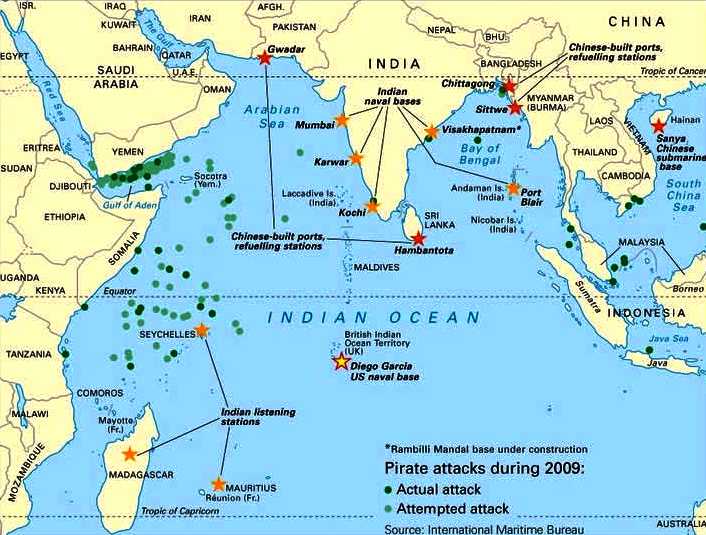
The main area of the joint Pakistani and Chinese exercise and joint patrols is in the northern Arabian Sea. Meanwhile Russia and Myanmar held naval drills, beginning November 7, 2023 in the Andaman Sea. India controls the Andamans particularly from the Port Blair (Map courtesy International Maritime Bureau)
---

Pete Comment

If joint Pakistani and Chinese (PLA-N) navy patrols become regular and frequent in the Indian Ocean this may be detrimental to India’s and Australia’s security.

SMRUTI DESHPANDE for India’s The Print reports https://theprint.in/defence/pakistan-and-china-to-conduct-maiden-joint-patrolling-with-submarines-and-destroyers/1844330/ November 14, 2023:

“Pakistan and China to conduct maiden joint patrolling with submarines and destroyers” (Edited by Tony Rai)

Two navies are currently jointly conducting the third edition of Sea Guardian-3. This comes soon after India, US held the fifth edition of annual 2+2 ministerial dialogues on 10 November.

New Delhi: Chinese and Pakistani navies will be conducting their first joint patrol in the high seas, indicating the flourishing military relationship that both share.

[China’s Global Times, November 16, also reported https://www.globaltimes.cn/page/202311/1301985.shtml the joint patrol exercise, known as China-Pakistan Sea Guardian-3, was in waters around major maritime routes and port channels in the northern Arabian Sea,  And “This marks the first time that the PLA Navy and the Pakistan Navy have held a joint maritime patrol” serving to “safeguard the China-Pakistan Economic Corridor (CPEC).”

“During the joint patrol [and presumably exercise], the two sides conducted training that included joint search and rescue operations, formation maneuvering and VBSS (visit, board, search and seizure), effectively enhancing their capabilities in jointly dealing with maritime security threats.” Song Zhongping, a Chinese military expert and TV commentator, told the Global Times “a joint patrol is a military presence that allows fast response to emergencies and safeguards security in a region, while a joint exercise is training with preset goals and targets.” And Song said “This type of joint naval patrol will likely become routine.”]

While the US has been traditionally the big arms supplier to Pakistan for several decades, China has now emerged as the key player with sales from artillery to fighter aircraft and submarines.

The joint patrolling in the Arabian Sea was announced by the People’s Liberation Army Navy (PLAN) as part of the ongoing bilateral naval exercise.

This comes soon after India and the US held the fifth edition of the annual 2+2 ministerial dialogues to cooperate on security issues, on 10 November in New Delhi. The exercise also comes after Russia, Myanmar held naval drills, beginning 7 November [2023], in the Andaman Sea [of the Indian Ocean].

The opening ceremony of the Sea Guardian-2023 was held at the Pakistan Navy Dockyard in Karachi...

As per the PLA, six vessels, including the [Type 052D destroyer] Zibo, [Type 054A] frigates Jingzhou and Linyi, and the [Type 903 replenishment ship Qiandaohu] along with two shipborne helicopters and dozens of marines. China’s PLA Navy has also deployed a Type-039 Song-class  diesel-electric submarine for the exercise.

[The Global Times also reported the Pakistani frigate Type 054A/P frigate Shah Jahan and F-22P frigate Saif also participated].

China’s defence cooperation with Pakistan

Military cooperation between the two countries is elaborate, and Pakistan remains heavily dependent on China for its defence needs.

In a special report published in March 2023, United States Institute of Peace stated: “Pakistan received significant injections of US arms during the Afghan jihad in the 1980s and during the war on terror (particularly from 2005 to 2015), but the volume of US arms never caught up with that of Chinese arms transfers, which began a steep ascent around 2009.

“The dramatic growth in arms transfers is clear while looking at trend-indicator value (TIV), a measure of the volume of international arms transfers that represents relative military resources rather than the financial value.

[The Stockholm International Peace Research Institute (SIPRI) TIV is described on the Arms Transfers Database https://www.sipri.org/databases/armstransfers].

The estimated value of Chinese arms transferred to Pakistan in the past 15 years (US$8,469 million TIV) is nearly equal to the estimated value of arms transferred to Pakistan by China in the previous 50 years (US$8,794 million TIV). Since 2015, China has provided nearly 75 percent of all of Pakistan’s imported arms (by TIV).”

Chinese platforms such as the JF-17 multirole combat aircraft form the largest share of Pakistan’s modern fighter fleet. Pakistan has also inducted limited numbers of the J-10 fighters.

In 2021, Pakistan acquired the Chinese-made Air Defence (AD) system HQ-9/P, [a derivative of the Russian S-300] also called the High-to-Medium Air Defence System Surface to Air Missile (HMADSAM) system.

Similarly, the Pakistan Army uses a number of Chinese-origin equipment such as artillery and rocket launchers.

For its Navy, Pakistan is said to have inducted Chinese Type 054A/P frigates, and potentially even a destroyer, alongside its already deployed F-22 frigate for sea control. Pakistan has also ordered [8 x Type 039B variant AIP Hangor-class diesel-electric] submarines that are being built simultaneously in the two countries.
November 16, 2023

US AUKUS Obligations: too many SSN "compromised" Virginia Block V SSGNs in USN Fleet mix

Shawn Chung’s November 14, 2023 comment  and noting https://en.wikipedia.org/wiki/Virginia-class_submarine#Boats_in_class has prompted me to add the following thoughts: 

The USN has announced the US intends to sell/deliver two used Block IV Virginias to Australia in 2032 and 2035  see https://www.defensenews.com/naval/2023/11/13/heres-when-the-us-navy-plans-to-sell-subs-to-australia-under-aukus/

A downstream problem, which I don't think is being adequately addressed or at least publicized by the US, is that Australia will be receiving the last or near last two "pure SSN" Block IV submarines. This is at a time the US will be building "SSN compromised" Block V SSGNs. All meaning a higher proportion of Block Vs will be in the fleet than the USN may deem desirable. 

10 Block Vs have been planned with the first to be commissioned by 2028 and one or two per year thereafter into the mid 2030s. So, as well as the US's AUKUS obligations impinging on actual numbers of Virginias available to the USN, there may be capability downsides in the mix of specific Virginia Blocks available to the USN. 

I say "comprised" because the Block V's Virginia Payload Module (VPM) (see right sidebar of https://en.wikipedia.org/wiki/Virginia-class_submarine) is likely to involve negative trade-offs:

-  a Block V will be 25m longer than a Block I-IV, and

-  a Block V will be 2,300 tonnes heavier (higher displacement) than a Block I-IV). 

This may negatively impact a Block V’s: 

- speed (which may be 1 or 2 knots slower than a Block I-IV) and 

- maneuverability (eg. a Block V can't accelerate or decelerate as quickly or turn as sharply as a Block I-IV) 

In short  the USN, until it begins to commission a return to "pure SSN" Virginia Block VIs and VIIs, towards the late 2030s, may have too many "SSN compromised" Block V SSGNs in its Virginia mix in the late 2020s to mid 2030s. 

Peter Coates

November 14, 2023

SSN-AUKUS's better bet than Australian Virginias

On November 13, 2023 Shawn Chung made some excellent points. 

To which I respond:

I agree "Australia needs to reconsider its submarine policy." 

Yes "Virginias are delayed" in terms of only an average of 1.16 being commissioned per year up till 2023. And that was before fully sharing production with higher priority Columbia SSBNs. The last Columbia is "expected to be completed by 2042" https://en.wikipedia.org/wiki/Columbia-class_submarine#Overview   

Thanks for https://www.defensenews.com/naval/2023/11/09/us-navy-eyes-two-submarine-delivery-rate-in-2024-after-schedule-upset/ in which USN Admirals make claims on future progress with Virginia deliveries with no significant mentions of much more complex and higher work commitments for Columbia SSBN production. Its as if a Virginia fixated USN refuses to take full account of Columbia work impacts. 

Given Columbia impacts it is likely there may be a drop in average Virginia commissionings (to less than 1 per year) and probably no rise to the 2.33 per year (see page 20) required by the US Government to permit Virginia exports to Australia. 

Also even if the RAN receives a Virginia in 2032-33 the RAN simply will not enough highly trained nuclear submariners until 3-4 years later, in 2036. See "it’s likely to be 15 years before qualified Australians are able to run the boats in a self-reliant manner." at https://www.aspistrategist.org.au/astute-versus-virginia-which-nuclear-powered-sub-is-the-best-fit-for-australia/  

Biden appears to have made an unrealisable Virgina offer for political reasons to keep his AUKUS policy afloat and to reduce the Australian Government's embarrassment. This includes embarrassment that Australia will have no new submarines until about 2045 (when the first Australian built SSN-AUKUS might be launched in Adelaide). 

So, eventually, Collins LOTE and Ghost Shark AUV deployments, from about 2030, will need to fill a gap until 2045, in strategic and public relations terms.

I agree that it is more realistic for Australia to stop following the receding Virginia myth and buy/assemble 8 SSN-AUKUS in Adelaide in the 2040s. A production run any lower than 8 would be uneconomic for Australia.

This timing will put all our "ducks in a row" in terms of:

- training 1,000s of Australian nuclear engineers, shipbuilders and submariners

- would be welcomed by the UK (which could enjoy Economies of Scale for the SSN-AUKUS + PWR3 SSN-AUKUS Core development burden and parts production)

- rather than being a major irritant for the USN and wider US government (long after Biden is voted out, retires or simply dies of old age).

- would permit time to build an Australian East Coast SSN Base, and

- would fully utilize LOTEd Collins and AUV capabilities.