September 29, 2023

Australian Army Shrinking Due to AUKUS Subs Cost

"‘This will make us weaker’: Army restructure faces backlash" see following Sept 28, 2023 article https://www.smh.com.au/politics/federal/this-will-make-us-weaker-army-restructure-faces-backlash-20230928-p5e8br.html

Pete Comment

My estimate of a A$Half Trillion (over 30 years) required for Australia’s future AUKUS submarine purchases is at the expense of less money for Australia’s Army (causing it to shrink).

However, Trump (on the advice of the US Navy) may well cancel the Virginias for Australia. Trump is increasinly likely win the 2024 elections (the betting odds today are Trump 2.60 to Biden's 3.00). Biden's chances are in free fall. Instead Australia may need to wait for a joint build of Australian SSN-AUKUS subs in the 2040s-2050s.

Whatever the AUKUS partners are claiming now, the cost of Australian SSN-AUKUS's only make sense if they are seen as Australian SSGNs equipped with nuclear weapons.  Australia, after all, only has a very small defence budget compared to the other nuclear submarine owning countries (see SIPRI Table 1.). Those countries (see this very useful wiki site) are all great powers (UK, France, India, Russia) or super powers (US, China).

Significantly the great and super power have nuclear powered submarines as their highest priority and most numerous strategic nuclear weapon platforms. Australia may well follow the same nuclear weapon policy.

September 28, 2023

Pete Renames Taiwan's Submarine Classes TSS-1s, 2s & 3s

I've noticed the potential for great confusion caused by Taiwan's submarine class naming conventions, with successive classes being called Hai Shihs, Hai Lungs and now Hai Kuns (formerly Indigenous Defense Submarines (IDS)) 

As Biden (in his one of his last compos mentis acts) and then the Pope and now the Sec-Gen of the UN have deputized yours truly world Namer-in-Chief of submarine classes (I claim I first, in 2016 used the term "Dolphin 3s" for Israel's Dakar-class) I hereby name Taiwan's Submarines (TSS). So, following this logic: 

Hai Shihs are now TSS-1s

Hai Lungs are now TSS-2s and

Hai Kuns are now TSS-3s.

What's good for South Korea's KSS-Is, KSS-IIs & KSS-IIIs, is even better for Taiwan.

I hope and trust President Tsai Ing-wen will send me but a pittance, just 1% of the TSS-3s' program budget, for this kindly act of renaming? :)

Cheers Pete

South Korean Boomer (Bomber in UK RN slang) Ambitions

By Shawn Chung


This article started off as a long email chain between Peter and me, that was a spin off of Peter’s article on a potential South Korean submarine-based nuclear deterrent.


As Pete’s article highlights, the increasing nuclear sabre-rattling by Kim Jong Un and North Korea has not been ignored by South Korea, and while South Korea has secured a nuclear defense deal with the US, developing an indigenous South Korean nuclear deterrent is no longer a taboo subject. 


But what are potential SK nuclear delivery systems? 


South Korea actually has a series of ballistic and cruise missiles under the Hyunmoo program, which is detailed in this excellent article from Navalnews.com. Hyunmoo systems were recently seen at the South Korean Armed Forces Day parade, which included drones, cruise missiles, the L-SAM BMD missile system and the Hyunmoo V, a new 3,000km MRBM. South Korea is also researching Hypersonic Cruise Missiles


https://youtu.be/CkLf2rAeKnQ?si=_bdQcN_bYQdyNRBg


Now, while South Korea could potentially equip the Hyunmoo V with a nuclear warhead, it is a land based system and in the information age of spysats and synthetic aperture radar, vulnerable to a pre-emptive strike. Submarine launched nuclear weapons, however, have the advantage of ‘hiding out of sight’ for second-strike and strategic nuclear deterrence, and South Korea already has ballistic missile submarines, so to speak.


Both HHI and Hanwha Ocean are currently building the Dosan Ahn Chanho-class (KSS-III) submarines for the ROKN for nine submarines in three batches.


Three KSS-III Batch-I boats have been completed (one was built by HHI, two by Hanwha/DSME). Batch-I boats are equipped with 6 K-VLS for SLBMs and cruise missiles, and can carry the 500km Hyunmoo 4-4, which has a conventional payload. Batch-I submarines are crewed by 50 submariners, and are reported to displace 3,400 tons (surfaced), are 83.5m in length and use AIP fuel cells, with a maximum range of 19,000KM.


Hanwha started construction of the first KSS-III Batch-II boat, with the keel laid in March 2023. While the three batch-III boats are larger, and while crew size is unchanged, displacement is now 3,600 ton (surface) displacement, 89m in length, they will have updated sensor and combat systems, including lithium ion batteries and 10 VLS.


While the current K-VLS launcher, with a 9.8m length, just fits within the hull of the KSS-III submarines, and they carry the Hyunmoo 4-4, which has a 500km range, so it’s just able to reach Pyongyang if it’s fired off the East coast of SK, near Pohang. This means that the KSS-III have relatively short ballistic missile range, and need to stay within an area around the Korean Peninsula to strike North Korean targets. The KSS-III likely can use Hyunmoo-3C cruise missiles with a 1,500km range, but as the Ukraine-Russian conflict has shown, cruise missiles can be countered by a significantly alert and equipped air defense system.


While first two batches of KSS-III can be considered ‘tactical ballistic missile submarines’, the following three Batch-III boats, the first of which is expected to be delivered as early as 2027, could be a real boomer - an SSB armed with 3,000km (Nuclear) SLBMs.


Batch III boats have always been expected to be the largest of the three batches, and they could incorporate, from the construction yard, large VLSs that can launch 3,000km SLBMs derived from the Hyunmoo V. An South Korean SSB could hide in the Philippine Sea, where its AIP/Lithium Ion would enable the sub to lurk for extended periods of time submerged.


The South Korean Agency for Defense Development, has just issued an RFP for the development of a large VLS that could launch a ‘proper size’ SLBM, with a prototype to be tested underwater by 2026.  Navalnews has also implied that South Korea may adopt a missile module, similar to the Virginia Payload Module to add more firepower to the earlier KSS-III batches.

September 27, 2023

Too Few Taiwanese Subs, TSS-3s Probably Too Late.

This article pre-announces the launch of Taiwan's first domestically built submarine, now known as the Hai Kun-class [TSS-3s] or ("Narwhal" a whale with a sharp tusk, in English) was launched at CSBC Corporation's Kaohsiung shipyard on Sept 28, 2023. First of class, Hai Kun, will undergo harbor acceptance trails from Oct 1, 2023. It might be delivered to the Taiwanese Navy before the end of 2024. A second IDS is expected to be delivered by 2027.

Meanwhile Taiwan’s 2 Dutch built Hai Lung-class [TSS-2subs, launched in the1986, are 37 years old. Too old, with much obsolete equipment and probably noisy, to be considered fully operational. Taiwan’s 2 World War Two US built Hai Shih-class [TSS-1sub’s are 79-80 years old, making them accidents waiting to happen, hence very scrap worthy. 

The PRC’s government instructed Global Times reportedSept 25, along the lines – Taiwan is dreaming if it thinks its 2 modern [TSS-3] submarine force, by 2027, will make much difference. In addition to many more PRC subs the PRC has many other ASW platforms, including aircraft and surface ships. 

Pete Comment

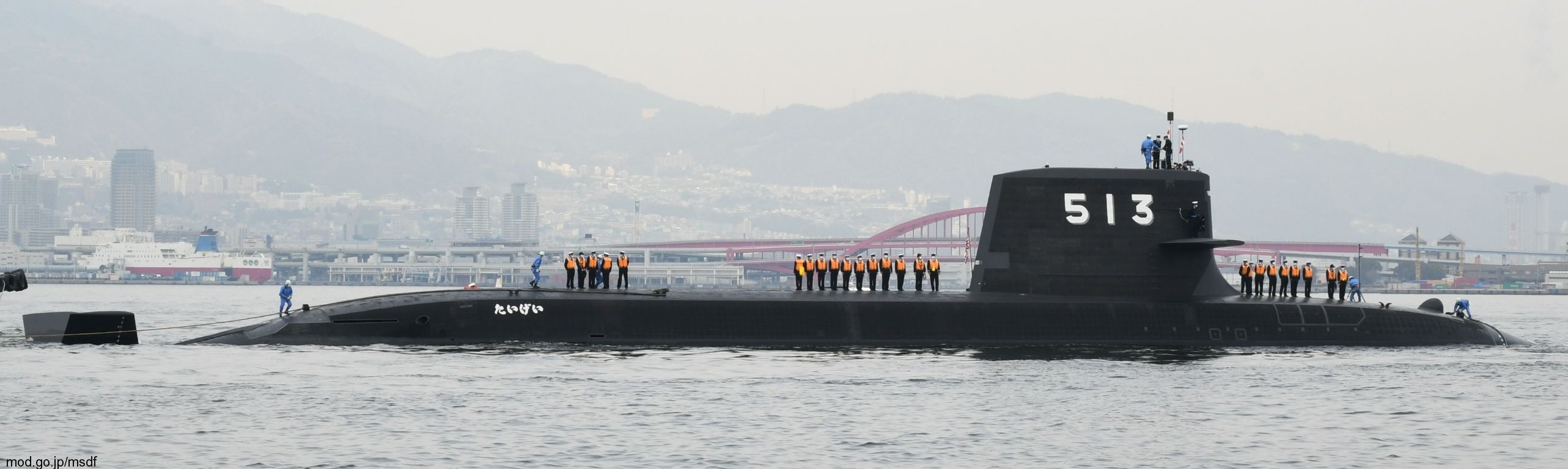
Taiwan’s two TSS-3s by 2027 are probably Japanese designed (with a resemblance to Japan's Soryu or Taigei classes and Taiwan's TSS-2s) and joint Taiwan-Japanese built. As I commented on Sept 29, 2023, all subs are a blend of derived shapes and contents, so the TSS-3s combine ancestor designs, including:

-  Japan 1967 Uzushio-class design which adopted the US 1956 Barbel-class teardrop shape, for more rapid and efficient/longer range fully submerged travel. After the Uzushios Japan gradually made their submarine classes more a bit cigar shaped.

-  Also the Barbel teardrop design came via the Dutch built TSS-2 design. 

As both Japan and Taiwan have efficient shipbuilding industries the 2 TSS-3s will have been built very quickly. But if the PRC invades by the oft described target year of 2027 Taiwan's two modern TSS-3s subs and (by then) two 40 year old TSS-2s will be quickly destroyed. A larger force of US SSNs (Trump permitting) and Japanese SSKs will be very much needed to aid Taiwan. 

I assume the PRC has added to its numerous mobile ASW resources with an intense network of fixed undersea sensors and smart mines programmed to detect and destroy Western (including Taiwanese) subs and ships.


In support of my TSS-3s are Japanese designed theoryCompare model (photo above from many outlets) of a TSS-3 with the similar rather long fin/sail in a similar position also with X-cross rudders of Japan's Soryu and Taigei classes. JS Taigei is below (Photo courtesy Seaforces online).


September 23, 2023

Ukrainian Missile Hits Russia's Crimea Fleet HQ

On 22 Sept, new Ukrainian missile strike makes Russia's cost of aggression, that much more expensive.

https://www.businessinsider.com/russias-black-sea-fleet-headquarters-hit-another-blow-forces-crimea-2023-9

Russia’s Black Sea Fleet (Crimea) HQ building with new large "entrance" 22 Sept.
(Photo courtesy Jimmy Rushton on “X”)
--- 

September 21, 2023

A Nuclear Armed South Korea? Confidential Reactions

I’ve been casting a net to confidential contacts on the issue of South Korea (SK) converting its conventionally missile armed KSS-IIIs to subs providing a nuclear deterrent. The following are their responses, speaking under protection of anonymity:

South Korea: We SK politicians and public are increasingly positive about building our own nuclear deterrent. This is because any nuclear free Korean peninsula policy is now an out of date fantasy. A Trump or even an isolationist Democrat win in the 2024 US Elections is too much of a (remove the US nuclear umbrella) risk to our homeland.  

We more than realize that our KSS-IIIs are the only SSBs (which stands for conventionally propelled submarines (SS) armed with Ballistic missiles) in history that are not nuclear armed. Also all SLBMs (except ours, so far) have been nuclear armed. Historically Soviet SSBs were nuclear armed and it is strongly suspected Israel's INS Drakon and then Dakar-class will have SLBMs that are nuclear armed.

We may have a joint program with Israel for developing an SLBM. 

UK and France: We great-middle powers see submarines as the most reliable nuclear weapons delivery platforms. This is because the other 2 launch modes: air bases (for nuclear armed aircraft) and land based missile silos (on countries like ours with small land areas) can be “taken out” within a few minutes by enemy first strikes.

South Korea: Our country, SK, suffers from having a small land area and sharing a border with our main threat, North Korean (NK). This means NK could launch a disarming nuclear first strike (taking out our air bases and any missile silos) in less than 10 minutes. So viable second strike deterrents must be SSBs that are difficult for NK and any other country to find. 

Developing boosted fission weapons is a much higher priority than developing nuclear propulsion for subs. 

China: We are concerned that once SK publicizes its nuclear deterrent (or the SK "Bomb" is revealed by espionage) this will have unwelcome impacts on NK and Japan. 

We may not be able to restrain NK from taking violent and unpredictable nuclear and/or conventional military actions against SK. A Korean nuclear war on our doorstep could mean radiation blowing into highly populated northeast China and a large Korean refugee problem streaming over the border. 

Japan: We are a rival to SK. A nuclear armed SK would remove the "nuclear taboo" limiting our nuclear weapons proliferation. We will likely and eventually react, on hearing about a nuclear SK, by publicizing our own nuclear weapons, capabilities or plans. We realize that China may be somewhat concerned about a militarily resurgent nuclear armed Japan, but we will always be weaker than China.

Russia: Rolling nuclear weapons proliferation that includes SK and Japan will raise tensions in China and NK to our south. We border China and North Korea. Chinese nuclear weapons growth might accelerate. While we are currently friends with China we are also regional and world political rivals. We don't want that rivalry to become a nuclear and conventional arms race with China. We also don't want nuclear or even conventional war in the Korean Peninsula. 

We don't want to be drawn into northeast Asian conflicts while we are fighting in what we insist are dissident, NATO proxy, Russian territories like Ukraine, Finland and other naturally Russian Baltic states. Also northeast Asian conflicts would be bad for our oil and gas exporting businesses.  

Australia: If SK and Japan publicize their nuclear weapons capability we will eventually publicize ours. Our future SSNs, when armed with better missiles than Tomahawks, will be our logical nuclear weapons platforms.

US: Who knows?! Our views depend on whether we get Trump back. Biden's lead over Trump has "evaporated". God help us! I'm also not sure our aging Biden, a steady hand on SK, will contest the November 2024 presidential election.